Cited by 108Cervical Cancer and HPV ResearchWomen's cancer prevention and managementReproductive tract infections research

The DOI matches its Crossref record; 66 of the 67 references it cites were found in a registry or an index.

Benefits, harms and cost-effectiveness of cervical screening, triage and treatment strategies for women in the general population

Open access

Published version of a preprint

Abstract

In 2020, the World Health Organization (WHO) launched a strategy to eliminate cervical cancer as a public health problem. To support the strategy, the WHO published updated cervical screening guidelines in 2021. To inform this update, we used an established modeling platform, Policy1-Cervix , to evaluate the impact of seven primary screening scenarios across 78 low- and lower-middle-income countries (LMICs) for the general population of women. Assuming 70% coverage, we found that primary human papillomavirus (HPV) screening approaches were the most effective and cost-effective, reducing cervical cancer age-standardized mortality rates by 63–67% when offered every 5 years. Strategies involving triaging women before treatment (with 16/18 genotyping, cytology, visual inspection with acetic acid (VIA) or colposcopy) had close-to-similar effectiveness to HPV screening without triage and fewer pre-cancer treatments. Screening with VIA or cytology every 3 years was less effective and less cost-effective than HPV screening every 5 years. Furthermore, VIA generated more than double the number of pre-cancer treatments compared to HPV. In conclusion, primary HPV screening is the most effective, cost-effective and efficient cervical screening option in LMICs. These findings have directly informed WHO’s updated cervical screening guidelines for the general population of women, which recommend primary HPV screening in a screen-and-treat or screen-triage-and-treat approach, starting from age 30 years with screening every 5 years or 10 years.

Overview

The claims and statistics of this paper haven’t been checked yet.

Run the check — free, no account needed. It reads the open-access text and checks the sources it cites.

A few free checks a day · papers already verified open instantly · results are public

Integrity signals

Registry

Crossref · 10.1038/s41591-023-02600-4

Cites

66 of 66 references verified0 citation errors · 0 not checkable

Statistics

Figures

Fig. 1 Predicted number of cervical cancer cases, cervical cancer deaths, pre-cancer treatments, additional pre-term delivery events, NNTs and NNSs, discounted costs and HALYs over the lifetime of a cohort of 100,000 women. a, Tabular summary of the lifetime number of cervical cancer cases, cervical cancer deaths, pre-cancer treatments, additional pre-term delivery events, number of pre-cancer treatments needed to prevent a cervical cancer death (NNT), costs and HALYs over the lifetime of a cohort of 100,000 women across 78 LMICs. The cells are colored to provide an overall impression of strategies that are performing well—best-performing strategies in a column are colored green (best = largest cancer incidence/mortality reduction or the lowest number of pre-cancer treatments, NNTs or costs)—followed by teal, yellow and then red for the worst-performing strategies. b, The range for the color-coding for each column. ASCUS, atypical squamous cells of undetermined significance; NNS, needed to screen; yrly, yearly; yrs, years. Outcomes represent total events over the lifetime of a cohort of 100,000 women. Percentage discounted costs represent costs incurred over the lifetime of an average woman discounting by 3% from age 30, as described in Methods. ‘]’ indicates that the percentage in the range is inclusive of the endpoints; ‘)’ indicates that it is not. *All positive women treated after assessment of eligibility for ablative treatment. **Triage positive referred to colposcopy. ^^VIA triage positive women treated after assessment of eligibility for ablative treatment. ^HPV 16/18 positive women treated after assessment of eligibility for ablative treatment. Women positive for HPV types other than HPV 16/18 (‘OHR’) are triaged with VIA. +There could be multiple treatments in the same woman over her lifetime. @0% discount rate for effect, 3% discount rate for cost.
Fig. 1 Predicted number of cervical cancer cases, cervical cancer deaths, pre-cancer treatments, additional pre-term delivery events, NNTs and NNSs, discounted costs and HALYs over the lifetime of a cohort of 100,000 women. a, Tabular summary of the lifetime number of cervical cancer cases, cervical cancer deaths, pre-cancer treatments, additional pre-term delivery events, number of pre-cancer treatments needed to prevent a cervical cancer death (NNT), costs and HALYs over the lifetime of a cohort of 100,000 women across 78 LMICs. The cells are colored to provide an overall impression of strategies that are performing well—best-performing strategies in a column are colored green (best = largest cancer incidence/mortality reduction or the lowest number of pre-cancer treatments, NNTs or costs)—followed by teal, yellow and then red for the worst-performing strategies. b, The range for the color-coding for each column. ASCUS, atypical squamous cells of undetermined significance; NNS, needed to screen; yrly, yearly; yrs, years. Outcomes represent total events over the lifetime of a cohort of 100,000 women. Percentage discounted costs represent costs incurred over the lifetime of an average woman discounting by 3% from age 30, as described in Methods. ‘]’ indicates that the percentage in the range is inclusive of the endpoints; ‘)’ indicates that it is not. *All positive women treated after assessment of eligibility for ablative treatment. **Triage positive referred to colposcopy. ^^VIA triage positive women treated after assessment of eligibility for ablative treatment. ^HPV 16/18 positive women treated after assessment of eligibility for ablative treatment. Women positive for HPV types other than HPV 16/18 (‘OHR’) are triaged with VIA. +There could be multiple treatments in the same woman over her lifetime. @0% discount rate for effect, 3% discount rate for cost.CC BY · PubMed Central
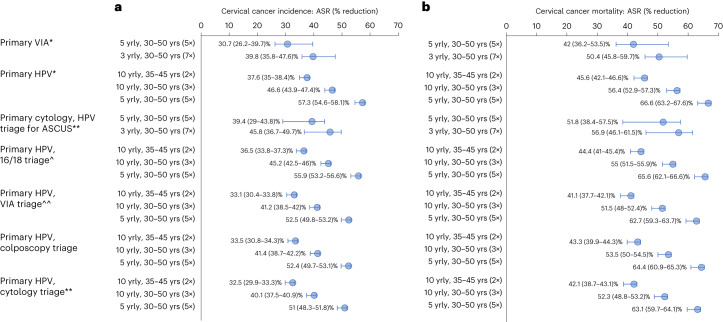
Fig. 2 Impact of screening scenarios on cervical cancer incidence and mortality rates. Reductions in age-standardized cervical cancer incidence (a) and age-standardized cervical cancer mortality (b) compared to no screening, shown as the dots for base case assumptions. The error bars represent the reductions when assuming the best (upper range) and worst (lower range) primary test performance assumptions, as described in Supplementary Table 3. Age-standardization was performed using the 2015 World Female Population for ages 0–99 years. ASCUS, atypical squamous cells of undetermined significance; yrly, yearly; yrs, years. *All positive women treated after assessment of eligibility for ablative treatment. **Triage positive referred to colposcopy. ^^VIA triage positive women treated after assessment of eligibility for ablative treatment. ^HPV 16/18 positive women treated after assessment of eligibility for ablative treatment. Women positive for HPV types other than HPV 16/18 (‘OHR’) are triaged with VIA. oThe range in sensitivity to CIN2+ is varied as shown in Supplementary Table 3c: for primary HPV, we consider a range of CIN2+ sensitivity of 88% (worst case) to 96% (best case) for primary cytology, we consider a range of CIN2+ sensitivity at the LSIL threshold of 46.8% (worst case) to 80% (best case) and for primary VIA, we consider a range of CIN2+ sensitivity of 30% (worst case) to 60% (best case).
Fig. 2 Impact of screening scenarios on cervical cancer incidence and mortality rates. Reductions in age-standardized cervical cancer incidence (a) and age-standardized cervical cancer mortality (b) compared to no screening, shown as the dots for base case assumptions. The error bars represent the reductions when assuming the best (upper range) and worst (lower range) primary test performance assumptions, as described in Supplementary Table 3. Age-standardization was performed using the 2015 World Female Population for ages 0–99 years. ASCUS, atypical squamous cells of undetermined significance; yrly, yearly; yrs, years. *All positive women treated after assessment of eligibility for ablative treatment. **Triage positive referred to colposcopy. ^^VIA triage positive women treated after assessment of eligibility for ablative treatment. ^HPV 16/18 positive women treated after assessment of eligibility for ablative treatment. Women positive for HPV types other than HPV 16/18 (‘OHR’) are triaged with VIA. oThe range in sensitivity to CIN2+ is varied as shown in Supplementary Table 3c: for primary HPV, we consider a range of CIN2+ sensitivity of 88% (worst case) to 96% (best case) for primary cytology, we consider a range of CIN2+ sensitivity at the LSIL threshold of 46.8% (worst case) to 80% (best case) and for primary VIA, we consider a range of CIN2+ sensitivity of 30% (worst case) to 60% (best case).CC BY · PubMed Central
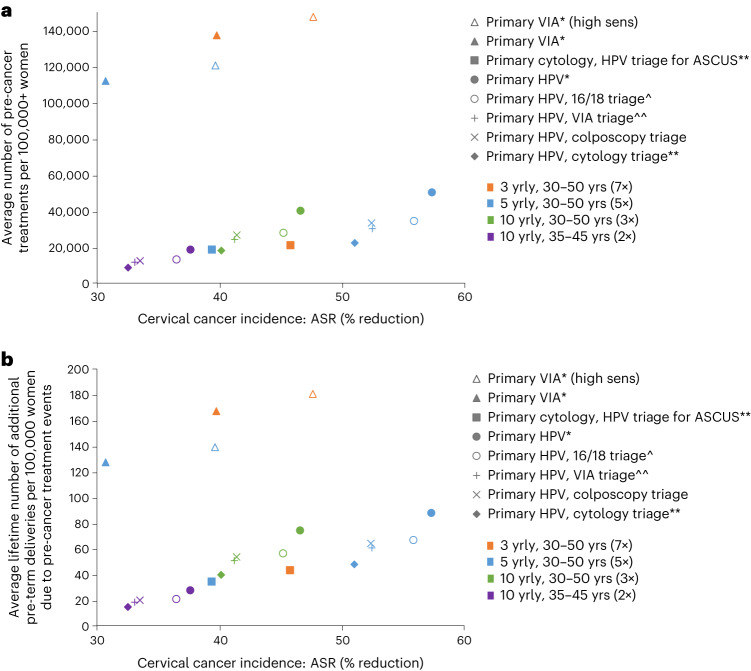
Fig. 3 Comparison of age-standardized cervical cancer incidence reduction as a measure of the benefits-to-harms profile of each strategy. a, Lifetime number of pre-cancer treatments. b, Lifetime number of additional pre-term deliveries due to pre-cancer treatment. ASCUS, atypical squamous cells of undetermined significance; yrly, yearly; yrs, years. +There could be multiple treatments in the same woman over her lifetime. *All positive women treated after assessment of eligibility for ablative treatment. **Triage positive referred to colposcopy. ^^VIA triage positive women treated after assessment of eligibility for ablative treatment. ^HPV 16/18 positive women treated after assessment of eligibility for ablative treatment. Women positive for HPV types other than HPV 16/18 (‘OHR’) are triaged with VIA.
Fig. 3 Comparison of age-standardized cervical cancer incidence reduction as a measure of the benefits-to-harms profile of each strategy. a, Lifetime number of pre-cancer treatments. b, Lifetime number of additional pre-term deliveries due to pre-cancer treatment. ASCUS, atypical squamous cells of undetermined significance; yrly, yearly; yrs, years. +There could be multiple treatments in the same woman over her lifetime. *All positive women treated after assessment of eligibility for ablative treatment. **Triage positive referred to colposcopy. ^^VIA triage positive women treated after assessment of eligibility for ablative treatment. ^HPV 16/18 positive women treated after assessment of eligibility for ablative treatment. Women positive for HPV types other than HPV 16/18 (‘OHR’) are triaged with VIA.CC BY · PubMed Central
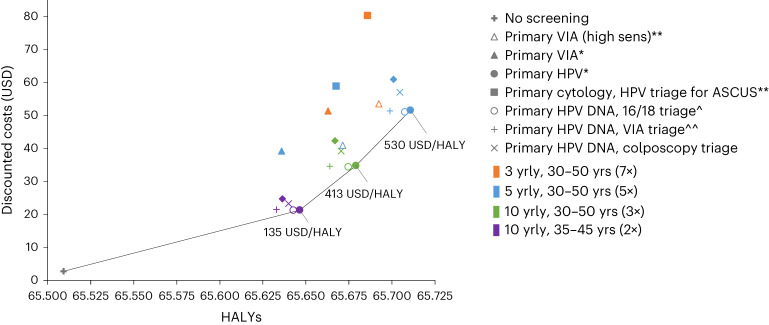
Fig. 4 Cost-effectiveness plane depicting relationship between cost and HALYs for each screening strategy. The results are shown for alternative primary screening and triaging options and for different relevant screening intervals and age ranges. For those strategies appearing on the cost-effectiveness frontier, the incremental cost-effectiveness ratio is noted (cost per HALY). ASCUS, atypical squamous cells of undetermined significance; USD, US dollar ($); yrly, yearly; yrs, years. *All positive women treated after assessment of eligibility for ablative treatment. **Triage positive referred to colposcopy. ^^VIA triage positive women treated after assessment of eligibility for ablative treatment. ^HPV 16/18 positive women treated after assessment of eligibility for ablative treatment. Women positive for HPV types other than HPV 16/18 (‘OHR’) are triaged with VIA. +0% discount rate for effect, 3% discount rate for cost. As a reference point for a potential WTP threshold across 78 LMICs, the population-weighted average GDP per capita (pc) for 2019 across the 78 LMIC is US$2,093, and 69 of 78 (89%) of LMICs had a GDP pc equal to or above US$530 and 77/78 (99%) of LMICs had a GDP pc equal to or above US$136.
Fig. 4 Cost-effectiveness plane depicting relationship between cost and HALYs for each screening strategy. The results are shown for alternative primary screening and triaging options and for different relevant screening intervals and age ranges. For those strategies appearing on the cost-effectiveness frontier, the incremental cost-effectiveness ratio is noted (cost per HALY). ASCUS, atypical squamous cells of undetermined significance; USD, US dollar ($); yrly, yearly; yrs, years. *All positive women treated after assessment of eligibility for ablative treatment. **Triage positive referred to colposcopy. ^^VIA triage positive women treated after assessment of eligibility for ablative treatment. ^HPV 16/18 positive women treated after assessment of eligibility for ablative treatment. Women positive for HPV types other than HPV 16/18 (‘OHR’) are triaged with VIA. +0% discount rate for effect, 3% discount rate for cost. As a reference point for a potential WTP threshold across 78 LMICs, the population-weighted average GDP per capita (pc) for 2019 across the 78 LMIC is US$2,093, and 69 of 78 (89%) of LMICs had a GDP pc equal to or above US$530 and 77/78 (99%) of LMICs had a GDP pc equal to or above US$136.CC BY · PubMed Central
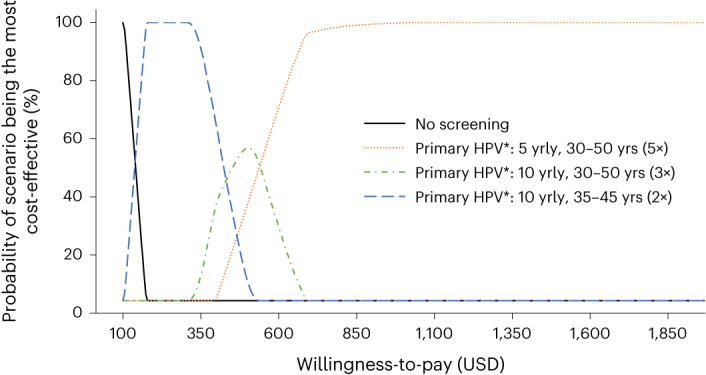
Fig. 5 Cost-effectiveness acceptability curves. These curves show the probability of a strategy being the most cost-effective for a range of WTP values of US$100–$2,000 per HALY. USD, US dollar ($); yrly, yearly; yrs, years. *All positive women treated after assessment of eligibility for ablative treatment. Some strategies had a small probability of being cost-effective but are not visible on the graph and are as follows: primary VIA screening (high sensitivity) every 5 years for ages 30–50 had <4% probability of being the most cost-effective approach for WTP US$290–$570/HALY saved. Primary VIA screening (high sensitivity) every 3 years for ages 30–50 had <5% chance of being the most cost-effective approach for WTP US$480–$1,095/HALY saved. Primary HPV with HPV16/18 triage every 5 years for ages 30–50 had <0.1% chance of being the most cost-effective approach for WTP US$410–$440/HALY saved.
Fig. 5 Cost-effectiveness acceptability curves. These curves show the probability of a strategy being the most cost-effective for a range of WTP values of US$100–$2,000 per HALY. USD, US dollar ($); yrly, yearly; yrs, years. *All positive women treated after assessment of eligibility for ablative treatment. Some strategies had a small probability of being cost-effective but are not visible on the graph and are as follows: primary VIA screening (high sensitivity) every 5 years for ages 30–50 had <4% probability of being the most cost-effective approach for WTP US$290–$570/HALY saved. Primary VIA screening (high sensitivity) every 3 years for ages 30–50 had <5% chance of being the most cost-effective approach for WTP US$480–$1,095/HALY saved. Primary HPV with HPV16/18 triage every 5 years for ages 30–50 had <0.1% chance of being the most cost-effective approach for WTP US$410–$440/HALY saved.CC BY · PubMed Central
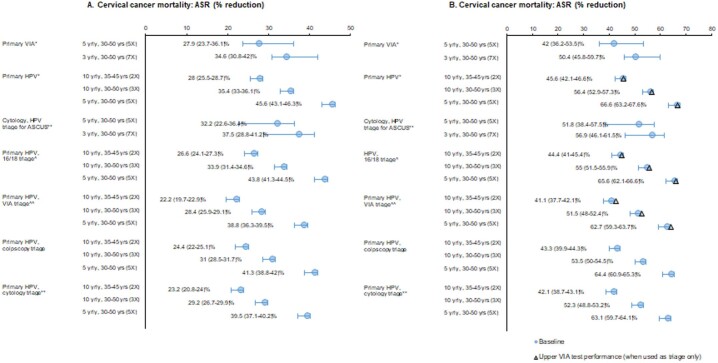
Extended Data Fig. 1 Cervical cancer mortality ASR % reductions (A) assuming lower screening adherenceo and (B) assuming favorable VIA triage test performance (black triangles). The dots represent reductions assuming base case assumptions for test performance and the error bars represent the reductions when assuming the best (upper range) and worst (lower range) primary test performance assumptions as described in Supplementary Table 3. oAssuming 50% attendance for routine screening (with 30% of women never attending) and 75% for adherence with treatment or follow-up visits (100% for same-day eligibility). *All positive women treated after assessment of eligibility for ablative treatment. **Triage positive referred to colposcopy. ^^VIA triage positive women treated after assessment of eligibility for ablative treatment. ^HPV 16/18 positive women treated after assessment of eligibility for ablative treatment. Women positive for HPV types other than HPV 16/18 (‘OHR’) are triaged with VIA.
Extended Data Fig. 1 Cervical cancer mortality ASR % reductions (A) assuming lower screening adherenceo and (B) assuming favorable VIA triage test performance (black triangles). The dots represent reductions assuming base case assumptions for test performance and the error bars represent the reductions when assuming the best (upper range) and worst (lower range) primary test performance assumptions as described in Supplementary Table 3. oAssuming 50% attendance for routine screening (with 30% of women never attending) and 75% for adherence with treatment or follow-up visits (100% for same-day eligibility). *All positive women treated after assessment of eligibility for ablative treatment. **Triage positive referred to colposcopy. ^^VIA triage positive women treated after assessment of eligibility for ablative treatment. ^HPV 16/18 positive women treated after assessment of eligibility for ablative treatment. Women positive for HPV types other than HPV 16/18 (‘OHR’) are triaged with VIA.CC BY · PubMed Central
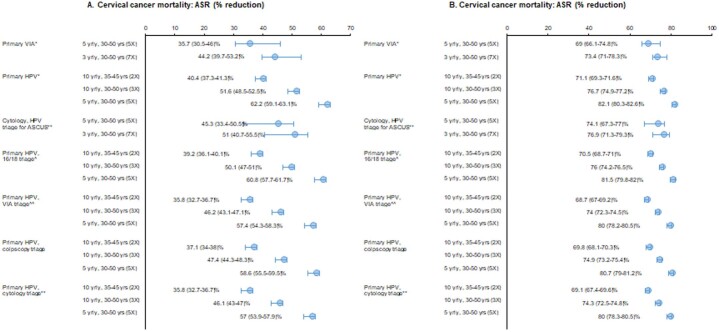
Extended Data Fig. 2 Cervical cancer mortality ASR % reductions (A) assuming both women symptomatically-detected and screen-detected for cancer receive status-quo rates for cancer treatment access and (B) assuming both women symptomatically-detected and screen-detected for cancer receive 90% cancer treatment access. The dots represent reductions assuming base case assumptions for test performance and the error bars represent the reductions when assuming the best (upper range) and worst (lower range) primary test performance assumptions as described in Supplementary Table 3. *All positive women treated after assessment of eligibility for ablative treatment. **Triage positive referred to colposcopy. ^^VIA triage positive women treated after assessment of eligibility for ablative treatment. ^HPV16/18 positive women treated after assessment of eligibility for ablative treatment; women positive for HPV types other than HPV 16/18 (‘OHR’) are triaged with VIA.
Extended Data Fig. 2 Cervical cancer mortality ASR % reductions (A) assuming both women symptomatically-detected and screen-detected for cancer receive status-quo rates for cancer treatment access and (B) assuming both women symptomatically-detected and screen-detected for cancer receive 90% cancer treatment access. The dots represent reductions assuming base case assumptions for test performance and the error bars represent the reductions when assuming the best (upper range) and worst (lower range) primary test performance assumptions as described in Supplementary Table 3. *All positive women treated after assessment of eligibility for ablative treatment. **Triage positive referred to colposcopy. ^^VIA triage positive women treated after assessment of eligibility for ablative treatment. ^HPV16/18 positive women treated after assessment of eligibility for ablative treatment; women positive for HPV types other than HPV 16/18 (‘OHR’) are triaged with VIA.CC BY · PubMed Central
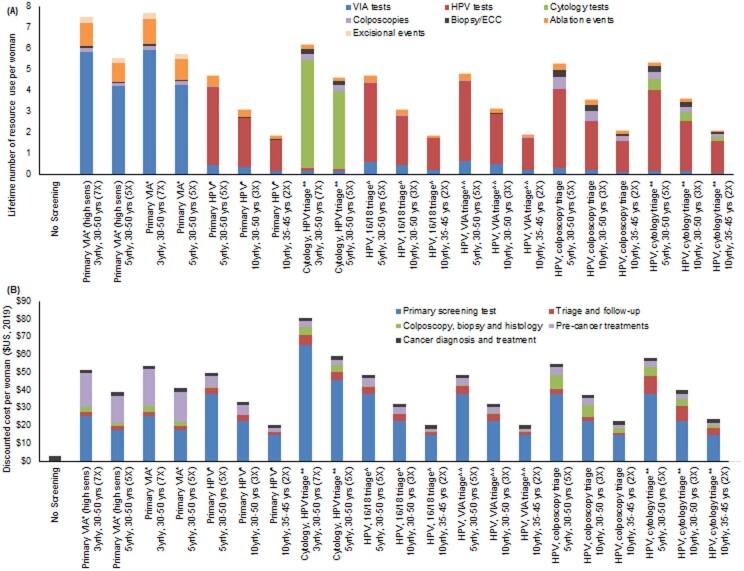
Extended Data Fig. 3 (A) Resource utilization breakdown for each strategy and (B) average discounted cost per woman in the population, over the lifetime of the cohort, broken down by component for each strategy. @3% discount rate for cost. *All positive women treated after assessment of eligibility for ablative treatment. **Triage positive referred to colposcopy. ^^VIA triage positive women treated after assessment of eligibility for ablative treatment. ^HPV16/18 positive women treated after assessment of eligibility for ablative treatment; women positive for HPV types other than HPV 16/18 (‘OHR’) are triaged with VIA.
Extended Data Fig. 3 (A) Resource utilization breakdown for each strategy and (B) average discounted cost per woman in the population, over the lifetime of the cohort, broken down by component for each strategy. @3% discount rate for cost. *All positive women treated after assessment of eligibility for ablative treatment. **Triage positive referred to colposcopy. ^^VIA triage positive women treated after assessment of eligibility for ablative treatment. ^HPV16/18 positive women treated after assessment of eligibility for ablative treatment; women positive for HPV types other than HPV 16/18 (‘OHR’) are triaged with VIA.CC BY · PubMed Central
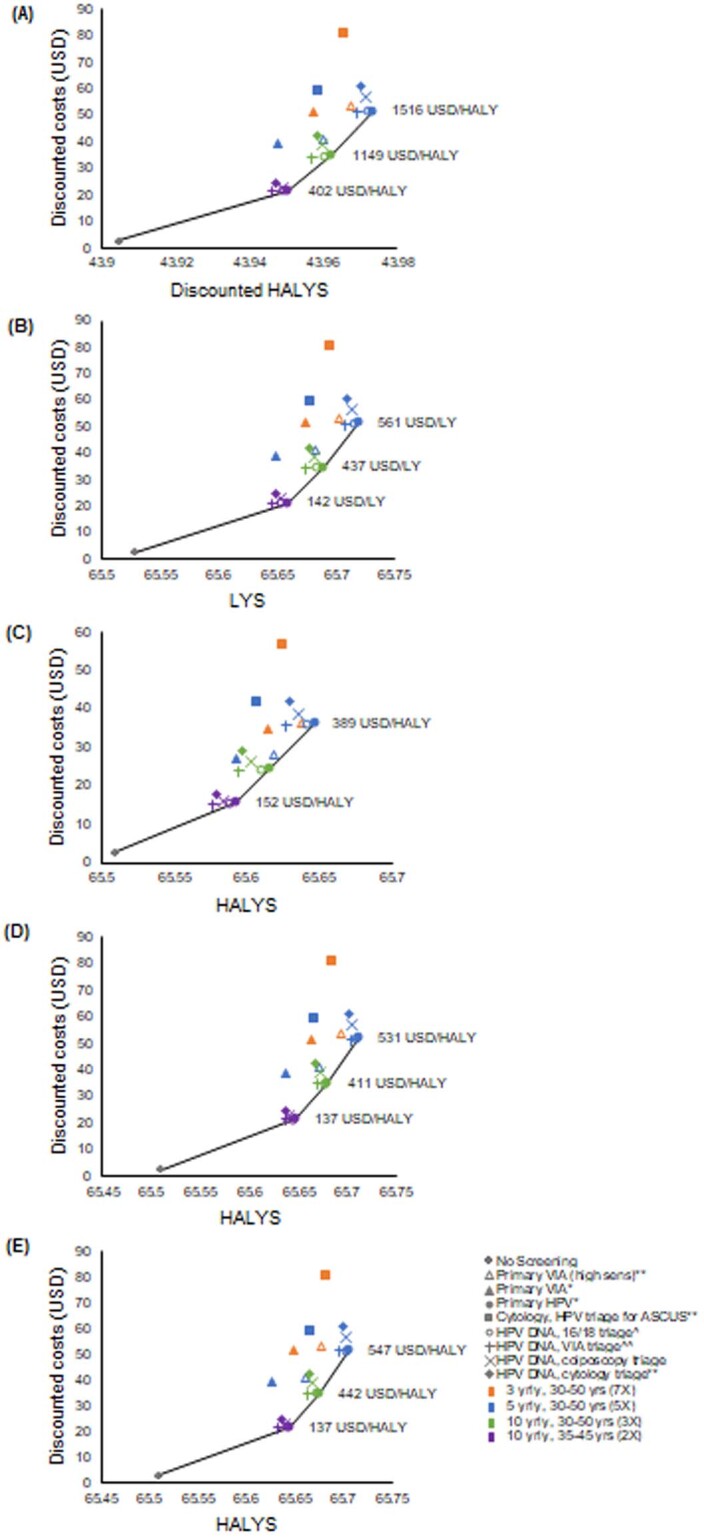
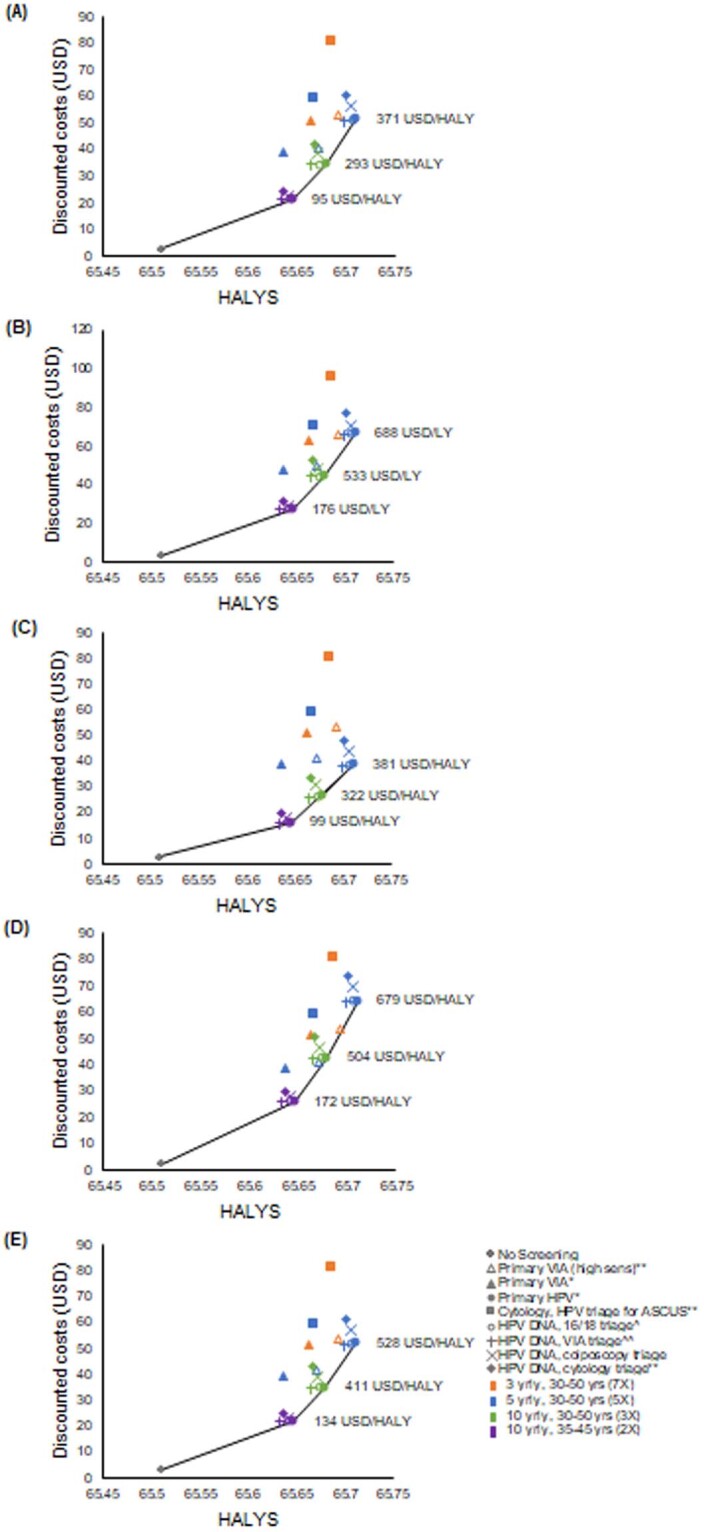
Extended Data Fig. 4 Cost-effectiveness outcomes assuming (A) 3% discount for both costs and effects; (B) using life-years without disability weights; (C) assuming low screening adherence; and (D) assuming favorable VIA performance; (E) including pre-cancer treatment disutilities for HALYs calculation. *All positive women treated after assessment of eligibility for ablative treatment. **Triage positive referred to colposcopy. ^^VIA triage positive women treated after assessment of eligibility for ablative treatment. ^HPV16/18 positive women treated after assessment of eligibility for ablative treatment; women positive for HPV types other than HPV 16/18 (‘OHR’) are triaged with VIA.
Extended Data Fig. 4 Cost-effectiveness outcomes assuming (A) 3% discount for both costs and effects; (B) using life-years without disability weights; (C) assuming low screening adherence; and (D) assuming favorable VIA performance; (E) including pre-cancer treatment disutilities for HALYs calculation. *All positive women treated after assessment of eligibility for ablative treatment. **Triage positive referred to colposcopy. ^^VIA triage positive women treated after assessment of eligibility for ablative treatment. ^HPV16/18 positive women treated after assessment of eligibility for ablative treatment; women positive for HPV types other than HPV 16/18 (‘OHR’) are triaged with VIA.CC BY · PubMed Central
Extended Data Fig. 5 Cost-effectiveness across 78-LMICs assuming (A) Lower bound assumptions for all costs (B) Upper bound assumptions for all costs (C) Lower bound assumptions for HPV test costs (all other costs at base case) (D) Upper bound assumptions for HPV test costs (all other costs at base case) (E) Upper bound assumptions for Cancer treatment costs (all other costs at base case). *All positive women treated after assessment of eligibility for ablative treatment. **Triage positive referred to colposcopy. ^^VIA triage positive women treated after assessment of eligibility for ablative treatment. ^HPV16/18 positive women treated after assessment of eligibility for ablative treatment; women positive for HPV types other than HPV 16/18 (‘OHR’) are triaged with VIA.0% discount rate for effect, 3% discount rate for cost HALY: health-adjusted life-years.
Extended Data Fig. 5 Cost-effectiveness across 78-LMICs assuming (A) Lower bound assumptions for all costs (B) Upper bound assumptions for all costs (C) Lower bound assumptions for HPV test costs (all other costs at base case) (D) Upper bound assumptions for HPV test costs (all other costs at base case) (E) Upper bound assumptions for Cancer treatment costs (all other costs at base case). *All positive women treated after assessment of eligibility for ablative treatment. **Triage positive referred to colposcopy. ^^VIA triage positive women treated after assessment of eligibility for ablative treatment. ^HPV16/18 positive women treated after assessment of eligibility for ablative treatment; women positive for HPV types other than HPV 16/18 (‘OHR’) are triaged with VIA.0% discount rate for effect, 3% discount rate for cost HALY: health-adjusted life-years.CC BY · PubMed Central
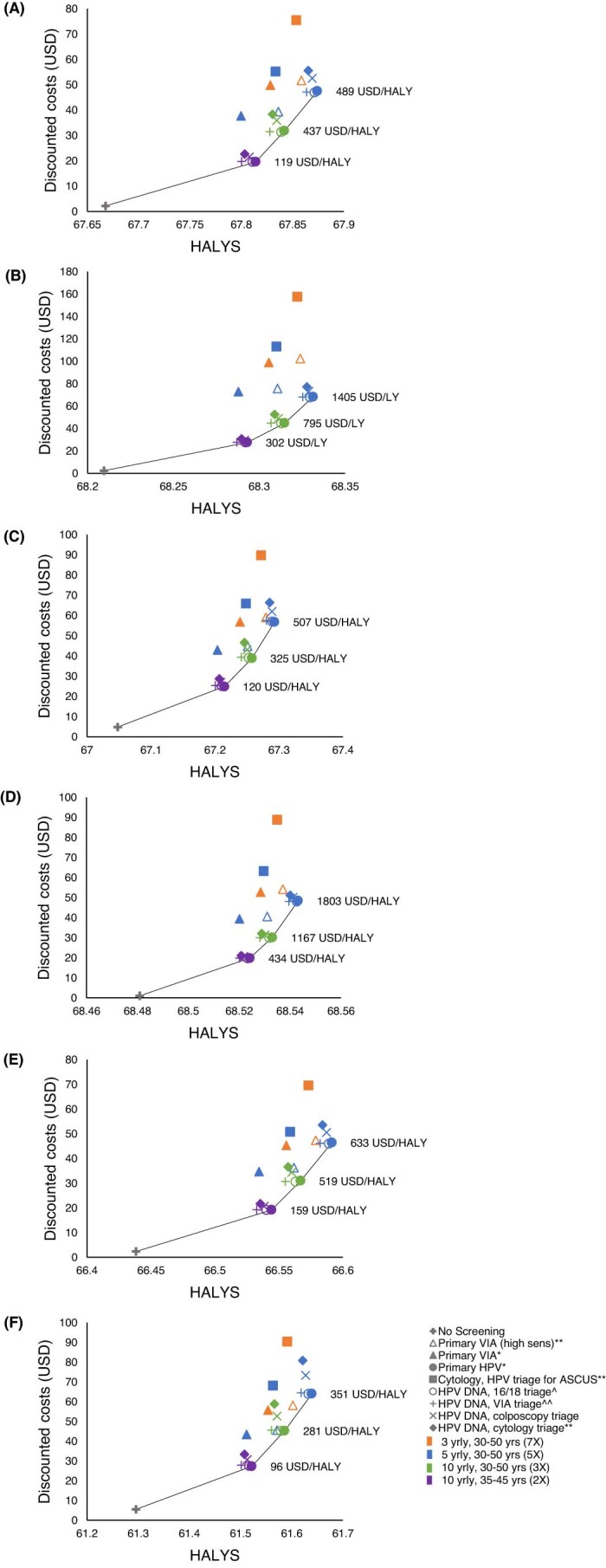
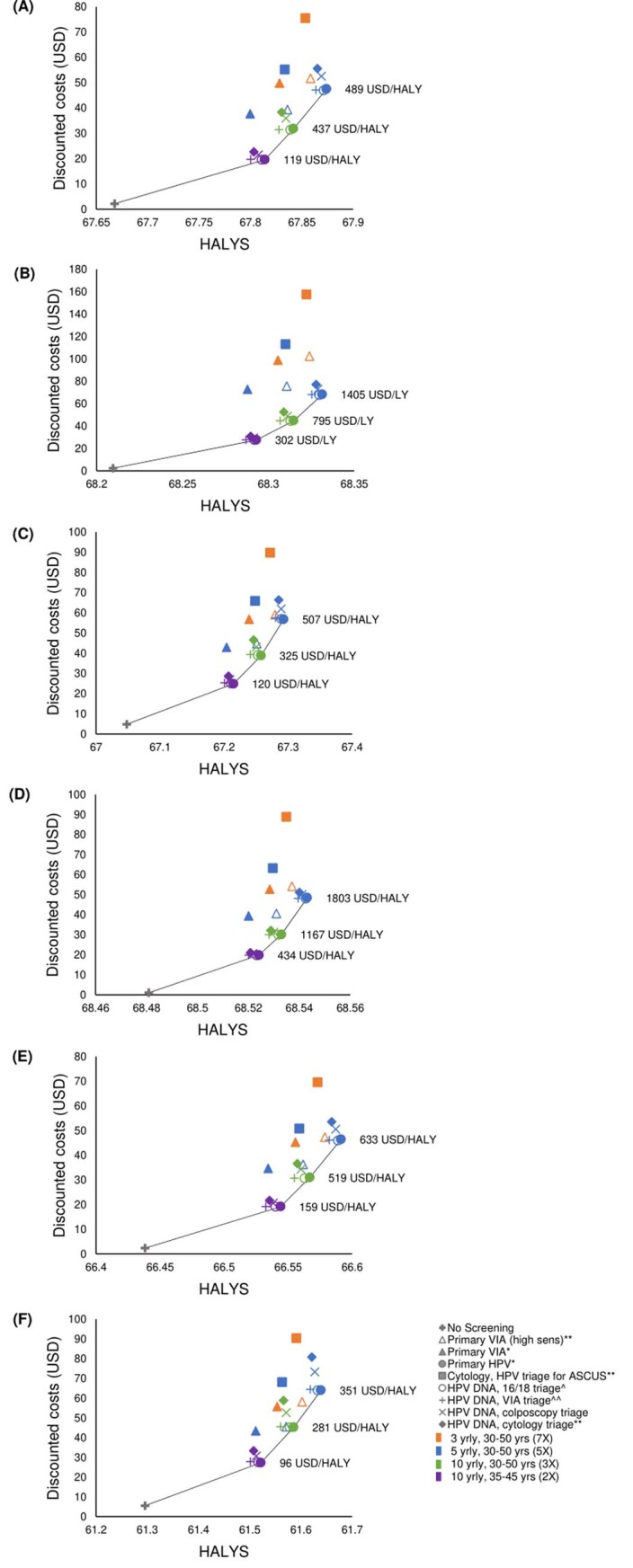
Extended Data Fig. 6 Cost-effectiveness for different regions (A) East Asia & Pacific; (B) Europe & East Asia; (C) Latin America & Caribbean; (D) Middle East & North Africa; (E) South Asia; (F) Sub-Saharan Africa. *All positive women treated after assessment of eligibility for ablative treatment. **Triage positive referred to colposcopy. ^^VIA triage positive women treated after assessment of eligibility for ablative treatment. ^HPV16/18 positive women treated after assessment of eligibility for ablative treatment; Women positive for HPV types other than HPV 16/18 (‘OHR’) are triaged with VIA.0% discount rate for effect, 3% discount rate for cost. HALY: health-adjusted life-years.
Extended Data Fig. 6 Cost-effectiveness for different regions (A) East Asia & Pacific; (B) Europe & East Asia; (C) Latin America & Caribbean; (D) Middle East & North Africa; (E) South Asia; (F) Sub-Saharan Africa. *All positive women treated after assessment of eligibility for ablative treatment. **Triage positive referred to colposcopy. ^^VIA triage positive women treated after assessment of eligibility for ablative treatment. ^HPV16/18 positive women treated after assessment of eligibility for ablative treatment; Women positive for HPV types other than HPV 16/18 (‘OHR’) are triaged with VIA.0% discount rate for effect, 3% discount rate for cost. HALY: health-adjusted life-years.CC BY · PubMed Central
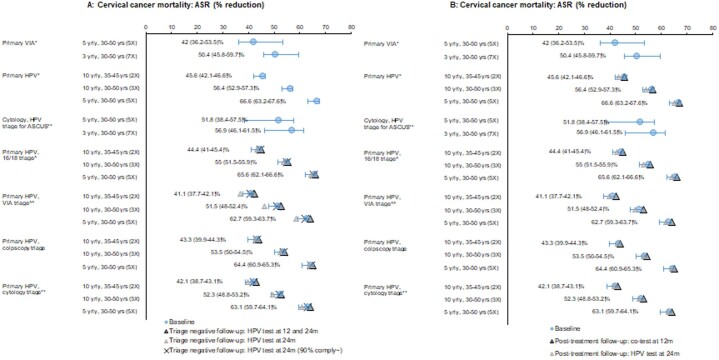
Extended Data Fig. 7 Cervical cancer mortality ASR % reductions assuming (A) HPV positive and triage negative women are followed-up after 2 years with 10% loss-to-follow-up (black triangle), followed-up after 2 years with 30% loss-to-follow-up (grey triangle), followed-up at both 1- and 2- years with 10% loss-to-follow-up for each visit (black crosses)) and (B) assuming women treated for pre-cancer treatment (not known to have CIN3 + ) are followed-up after 2 years assuming with 30% loss-to-follow-up (gray triangle), followed-up after 1 year with cotesting assuming 10% loss-to-follow-up (black triangle). The dots represent reductions assuming base case assumptions for test performance and the error bars represent the reductions when assuming the best (upper range) and worst (lower range) primary test performance assumptions as described in Supplementary Table 3. *All positive women treated after assessment of eligibility for ablative treatment. **Triage positive referred to colposcopy. ^^VIA triage positive women treated after assessment of eligibility for ablative treatment. ^HPV16/18 positive women treated after assessment of eligibility for ablative treatment; women positive for HPV types other than HPV 16/18 (‘OHR’) are triaged with VIA.
Extended Data Fig. 7 Cervical cancer mortality ASR % reductions assuming (A) HPV positive and triage negative women are followed-up after 2 years with 10% loss-to-follow-up (black triangle), followed-up after 2 years with 30% loss-to-follow-up (grey triangle), followed-up at both 1- and 2- years with 10% loss-to-follow-up for each visit (black crosses)) and (B) assuming women treated for pre-cancer treatment (not known to have CIN3 + ) are followed-up after 2 years assuming with 30% loss-to-follow-up (gray triangle), followed-up after 1 year with cotesting assuming 10% loss-to-follow-up (black triangle). The dots represent reductions assuming base case assumptions for test performance and the error bars represent the reductions when assuming the best (upper range) and worst (lower range) primary test performance assumptions as described in Supplementary Table 3. *All positive women treated after assessment of eligibility for ablative treatment. **Triage positive referred to colposcopy. ^^VIA triage positive women treated after assessment of eligibility for ablative treatment. ^HPV16/18 positive women treated after assessment of eligibility for ablative treatment; women positive for HPV types other than HPV 16/18 (‘OHR’) are triaged with VIA.CC BY · PubMed Central
Extended Data Fig. 8 Lifetime number of precancer treatment events for each strategy, including different management of HPV positive women who have a negative triage, versus (A) Cervical cancer incidence ASR % reduction and (B) Cervical cancer mortality ASR % reduction. *All positive women treated after assessment of eligibility for ablative treatment. **Triage positive referred to colposcopy. ^^VIA triage positive women treated after assessment of eligibility for ablative treatment. ^HPV16/18 positive women treated after assessment of eligibility for ablative treatment; women positive for HPV types other than HPV 16/18 (‘OHR’) are triaged with VIA. +Note there could be multiple treatments in women who require follow-up.
Extended Data Fig. 8 Lifetime number of precancer treatment events for each strategy, including different management of HPV positive women who have a negative triage, versus (A) Cervical cancer incidence ASR % reduction and (B) Cervical cancer mortality ASR % reduction. *All positive women treated after assessment of eligibility for ablative treatment. **Triage positive referred to colposcopy. ^^VIA triage positive women treated after assessment of eligibility for ablative treatment. ^HPV16/18 positive women treated after assessment of eligibility for ablative treatment; women positive for HPV types other than HPV 16/18 (‘OHR’) are triaged with VIA. +Note there could be multiple treatments in women who require follow-up.CC BY · PubMed Central

Verification

Claims the paper makes

The claims and statistics of this paper haven’t been checked yet.

Run the check — free, no account needed. It reads the open-access text and checks the sources it cites.

A few free checks a day · papers already verified open instantly · results are public

Claims other papers make about this one

Each is checked against this paper’s own text: does it say what the citing paper says it does?

Self-check

Percentages, sums and reported differences re-computed from the paper’s own numbers.

The self-check needs the paper’s full text.

Citations

Cites

Show all 67 references

Research works printed but not linked: 2

  1. Feachem, R. G. A. Commission on Macroeconomics and Health. Bull. World Health Organ. 80, 87 (2002).
  2. Simms, K. T. et al. Cost-effectiveness of the next generation nonavalent human papillomavirus vaccine in the context of primary human papillomavirus screening in Australia: a comparative modelling analysis. Lancet Public Health 1, e66–e75 (2017). · DOI

Cited by

Sorted by citations

See all 108

Metadata

Authors
Simms, K. T., Keane, A., Nguyen, D. T. N., Caruana, M., Hall, M. T., Lui, G., Gauvreau, C., Demke, O., Arbyn, M., Basu, P., Wentzensen, N., Lauby-Secretan, B., Ilbawi, A., Hutubessy, R., Almonte, M., De Sanjosé, S., Kelly, H., Dalal, S., Eckert, L. O., Santesso, N., Broutet, N., & Canfell, K.
Affiliations
  • The University of Sydney (AU)
  • Hospital for Sick Children (CA)
  • Clinton Health Access Initiative (US)
  • Ghent University (BE)
  • Centre international de recherche sur le cancer (FR)
  • National Institutes of Health (US)
  • World Health Organization (CH)
  • London School of Hygiene & Tropical Medicine (GB)
  • University of Washington (US)
  • McMaster University (CA)
Corresponding author
Simms, Kate T.
Venue
Nature Medicine
Published
2023-12
Volume
29
Issue
12
Pages
3050-3058
ISSN
  • 1078-8956 (ISSN-L)
  • 1546-170X
OpenAlex
W4389617045
Cited by
105
References
67
Citations by year
2026: 29 · 2025: 43 · 2024: 32 · 2023: 1
FWCI
20.97
Type
journal article
Language
en
Open access
Locations
  • Nature Medicine (publishedVersion, cc-by)
  • Research Square (acceptedVersion, cc-by-nc-sa)
  • PubMed Central (publishedVersion, cc-by)
  • PubMed (publishedVersion)
  • LSHTM Research Online (London School of Hygiene and Tropical Medicine) (acceptedVersion)
Funders
World Health Organization
Topics
  • Health Sciences › Medicine › Epidemiology › Cervical Cancer and HPV Research
  • Health Sciences › Medicine › Public Health, Environmental and Occupational Health › Women's cancer prevention and management
  • Life Sciences › Immunology and Microbiology › Microbiology › Reproductive tract infections research
Keywords
cervical cancer screening, HPV testing, cervical cancer elimination, cost-effectiveness, triage, visual inspection with acetic acid, colposcopy, cytology, low- and lower-middle-income countries, cervical cancer mortality
MeSH terms
Adult, Uterine Cervical Neoplasms, Cervix Uteri, Child, Preschool, Cost-Benefit Analysis, Female, Humans, Triage, Papillomavirus Infections, Early Detection of Cancer

About these checks

Registry, retraction, Cites and statistics results are computed, not judged, with one exception: a printed reference that no index lists is read once by a model before it counts as a citation error. Claims are extracted by a model and kept only when their quote appears verbatim in the text; each cited source is then checked, with a model’s help, for whether it says what the claim relies on. Those verdicts can be wrong — read the claim’s quote and the cited source before relying on one.

Statistics and arithmetic are recomputed, not judged.

Confidence bands are shown only for fields calibrated on our annotated test set. None is calibrated yet, so no band is shown.

What counts as a claim ›How we measure confidence ›How we check this ›

Are you an author, or do you see a problem with this page? Request a review