

Association between pathologic response and survival after neoadjuvant therapy in lung cancer
Open accessThe DOI matches its Crossref record; 40 of the 41 references it cites were found in a registry or an index.
Abstract
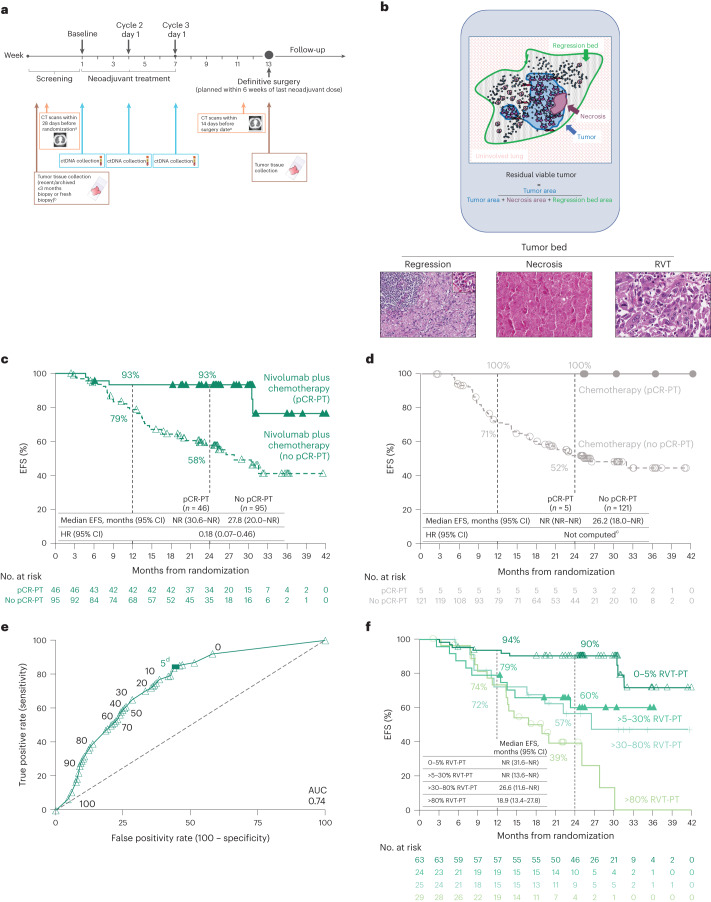
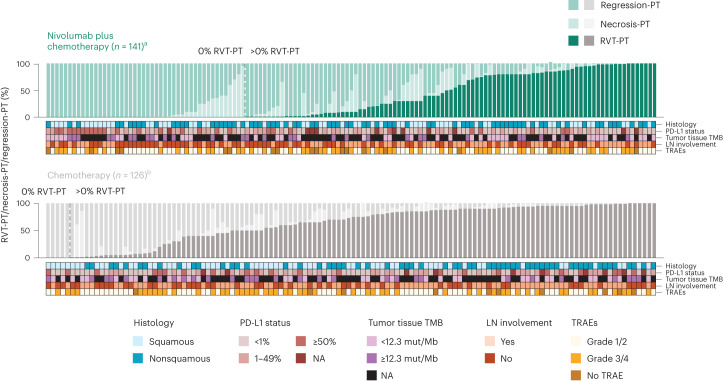
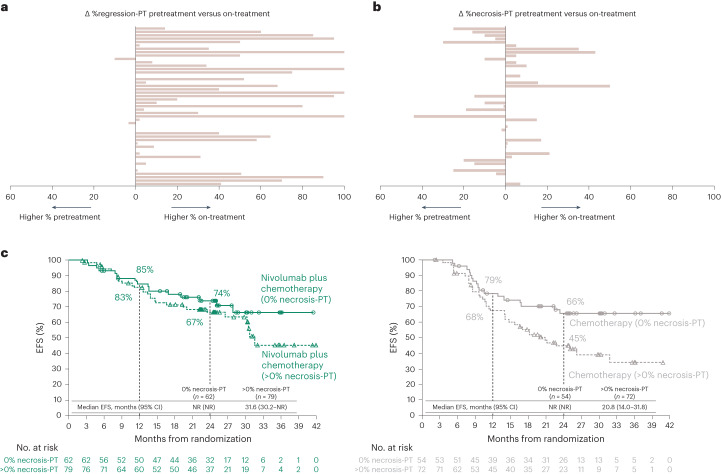
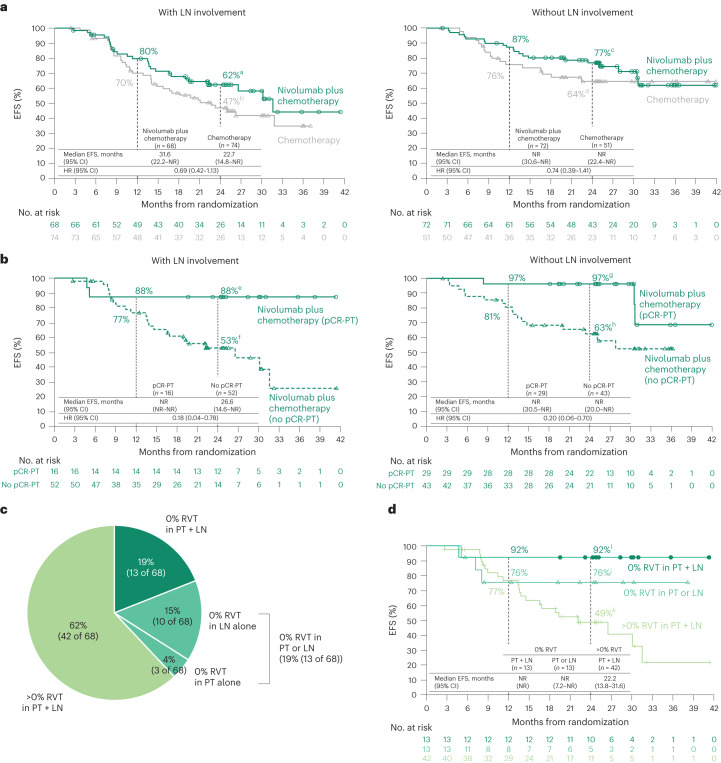
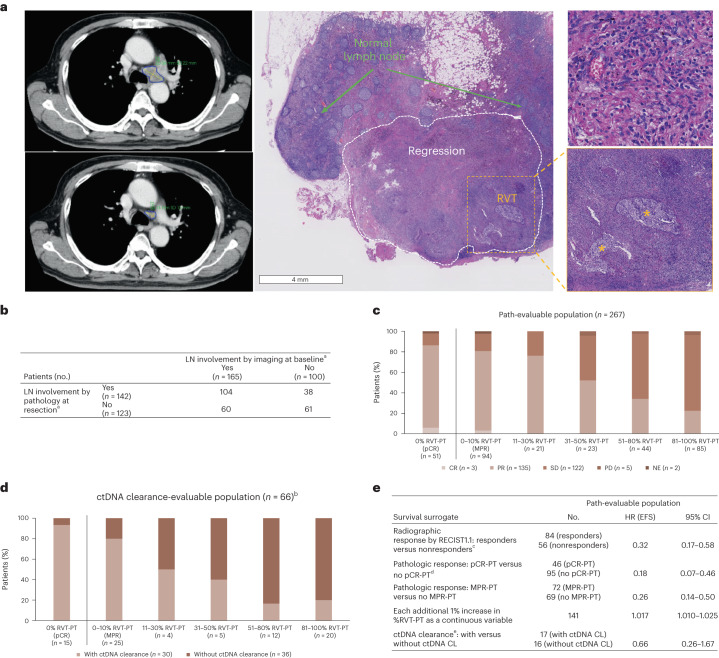
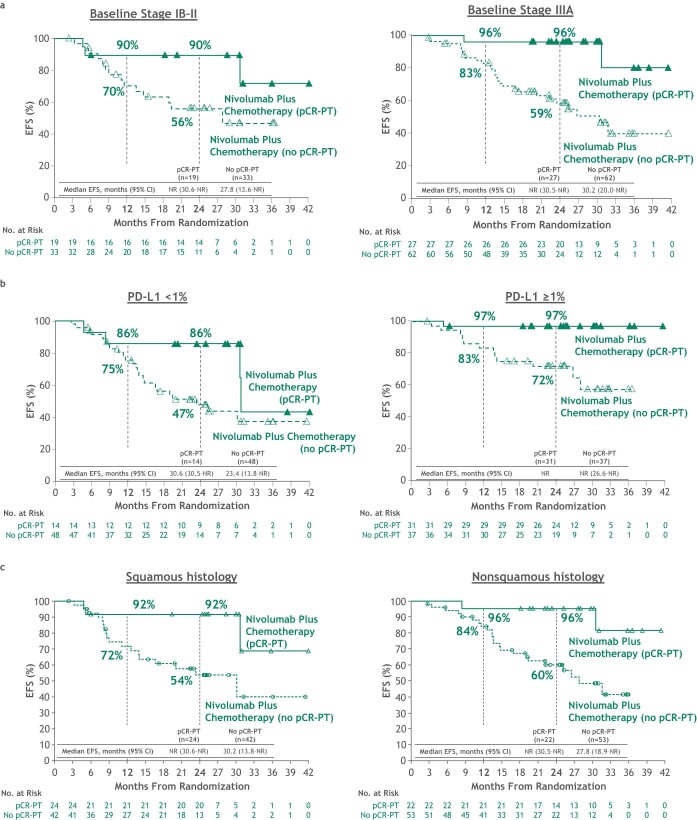
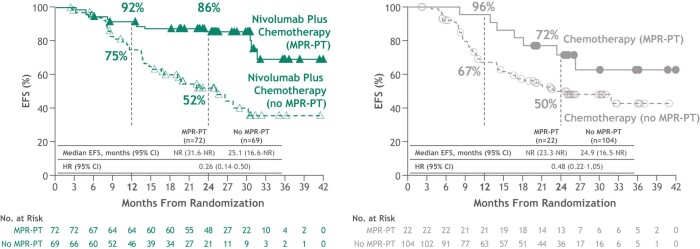
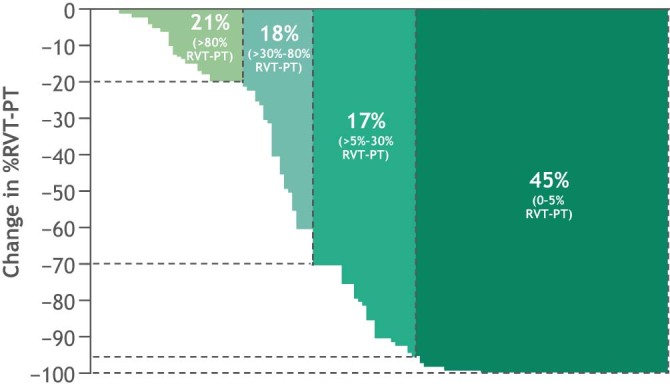
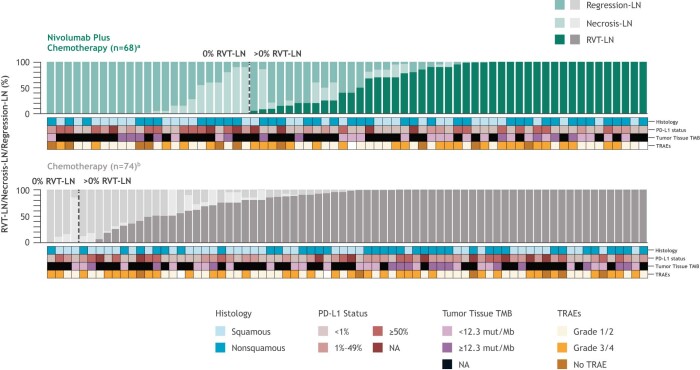
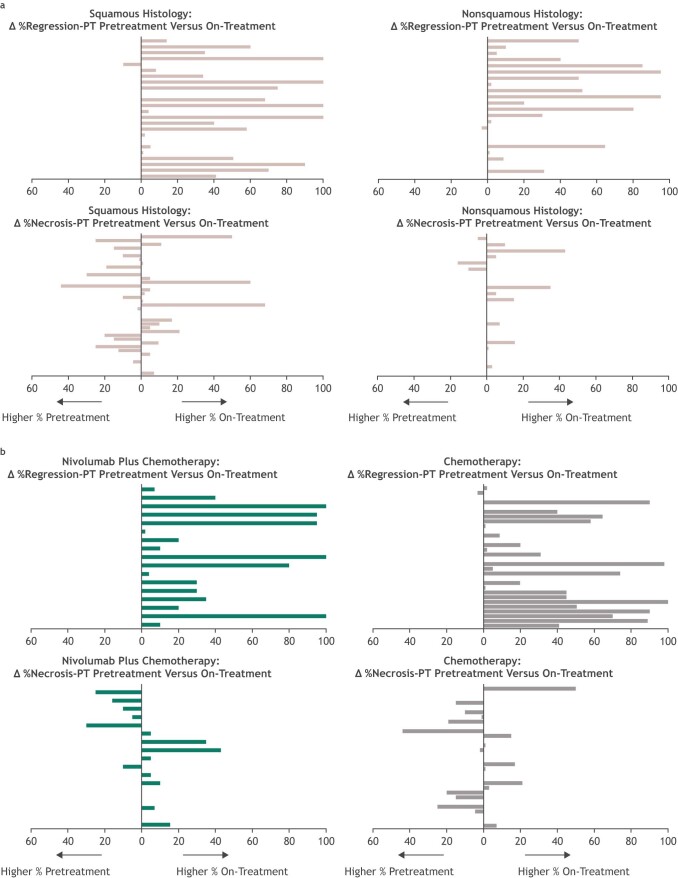
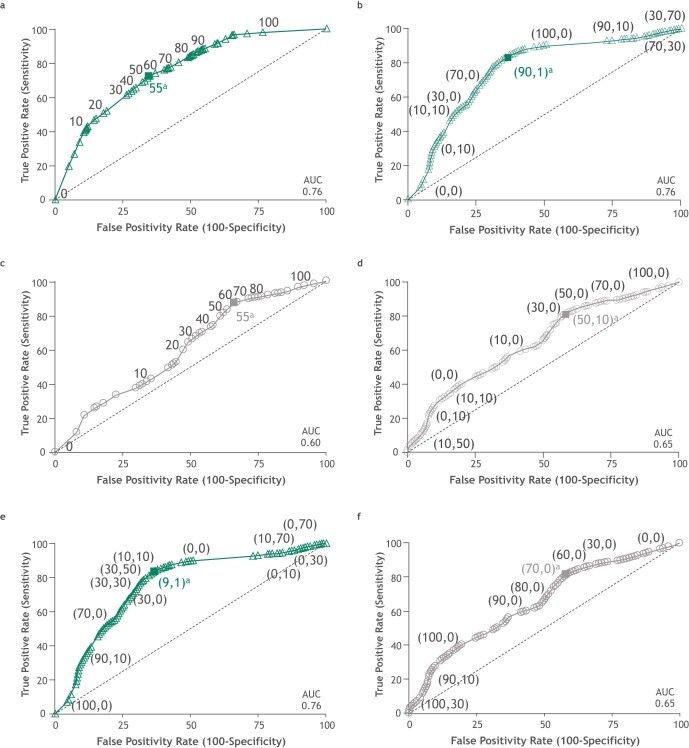
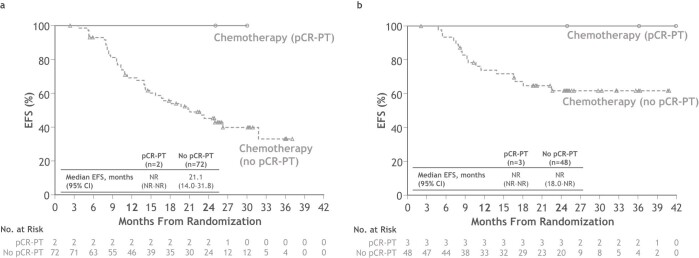
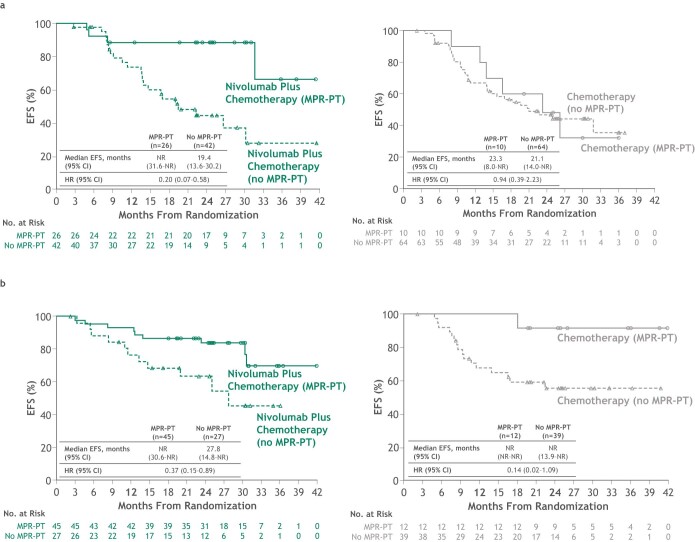
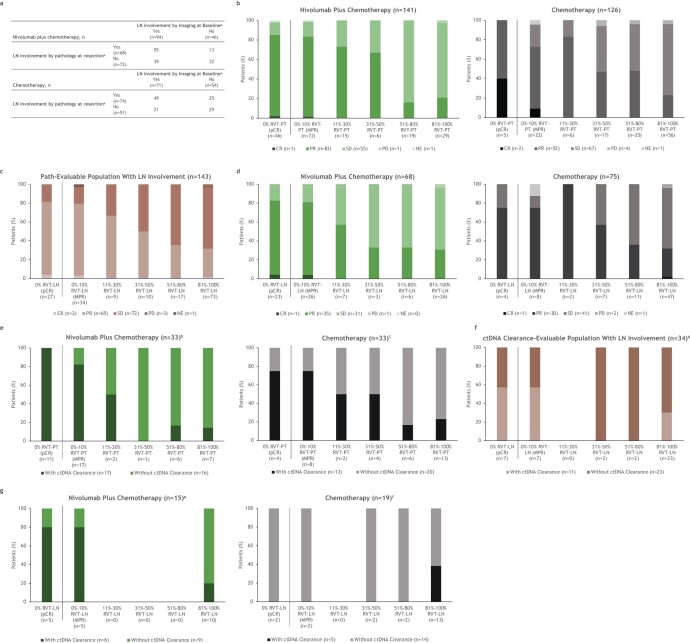
Neoadjuvant immunotherapy plus chemotherapy improves event-free survival (EFS) and pathologic complete response (0% residual viable tumor (RVT) in primary tumor (PT) and lymph nodes (LNs)), and is approved for treatment of resectable lung cancer. Pathologic response assessment after neoadjuvant therapy is the potential analog to radiographic response for advanced disease. However, %RVT thresholds beyond pathologic complete response and major pathologic response (≤10% RVT) have not been explored. Pathologic response was prospectively assessed in the randomized, phase 3 CheckMate 816 trial (NCT02998528), which evaluated neoadjuvant nivolumab (anti-programmed death protein 1) plus chemotherapy in patients with resectable lung cancer. RVT, regression and necrosis were quantified (0–100%) in PT and LNs using a pan-tumor scoring system and tested for association with EFS in a prespecified exploratory analysis. Regardless of LN involvement, EFS improved with 0% versus >0% RVT-PT (hazard ratio = 0.18). RVT-PT predicted EFS for nivolumab plus chemotherapy (area under the curve = 0.74); 2-year EFS rates were 90%, 60%, 57% and 39% for patients with 0–5%, >5–30%, >30–80% and >80% RVT, respectively. Each 1% RVT associated with a 0.017 hazard ratio increase for EFS. Combining pathologic response from PT and LNs helped differentiate outcomes. When compared with radiographic response and circulating tumor DNA clearance, %RVT best approximated EFS. These findings support pathologic response as an emerging survival surrogate. Further assessment of the full spectrum of %RVT in lung cancer and other tumor types is warranted. ClinicalTrials.gov registration: NCT02998528 .
Overview
The claims and statistics of this paper haven’t been checked yet.
Free: it reads the open-access text and checks the first 5 claims that cite a source we can check. Create a free account to check every claim.
Integrity signals
Registry
Cites
Statistics
Figures
Verification
Claims the paper makes
The claims and statistics of this paper haven’t been checked yet.
Free: it reads the open-access text and checks the first 5 claims that cite a source we can check. Create a free account to check every claim.
Claims other papers make about this one
Each is checked against this paper’s own text: does it say what the citing paper says it does?
The source backs part of the claim, not all of it — or backs it for a different population, condition or comparison.
In the citing paper
“Evolving experience from the use of systemic anticancer therapy in solid tumours suggests that a pathologically demonstrated response in resected specimens predicts improved chances of complete remission in patients with various oncological diagnoses, including breast cancer, non-small-cell lung cancer, and bladder cancer.15–17”
From Pathological response following neoadjuvant immune checkpoint inhibitors in patients with hepatocellular carcinoma: a cross-trial, patient-level analysis (2024) · cites this paper as [16]
Experimental — accuracy not yet measuredThe source backs part of the claim, not all of it — or backs it for a different population, condition or comparison.
In the citing paper
“These findings are in line with what has been previously shown in patients with non-small-cell lung cancer, whereby a population of patients with early-stage disease undergoing neoadjuvant chemotherapy combined with ICI showed a similar polarisation of pathological responses.16”
From Pathological response following neoadjuvant immune checkpoint inhibitors in patients with hepatocellular carcinoma: a cross-trial, patient-level analysis (2024) · cites this paper as [16]
Experimental — accuracy not yet measured
Self-check
Percentages, sums and reported differences re-computed from the paper’s own numbers.
The self-check needs the paper’s full text.
Citations
Cites
New response evaluation criteria in solid tumours: revised RECIST guideline (version 1.1)
Eisenhauer, E. A., Therasse, P., Bogaerts, J., Schwartz, L. H., Sargent, D., Ford, R., Dancey, J., Arbuck, S., Gwyther, S., Mooney, M., et al. (2009) · European Journal of Cancer · doi:10.1016/j.ejca.2008.10.026 · Cited by 29,534 · cited 1×
“It also serves as a guide for the treating oncologist 27 .”
BackgroundGoldstraw, P., Chansky, K., Crowley, J., Rami-Porta, R., Asamura, H., Eberhardt, W. E. E., Nicholson, A. G., Groome, P., Mitchell, A., Bolejack, V., et al. (2016) · Journal of Thoracic Oncology · doi:10.1016/j.jtho.2015.09.009 · Cited by 4,607 · cited 1×
“Previous scoring systems for pathologic response to chemotherapy as well as American Joint Committee on Cancer pathologic downstaging require pathologic confirmation of pretreatment nodal disease 36 , which is subject to sampling error.”
MethodTime‐Dependent ROC Curves for Censored Survival Data and a Diagnostic Marker
Heagerty, P. J., Lumley, T., & Pepe, M. S. (2000) · Biometrics · doi:10.1111/j.0006-341x.2000.00337.x · Cited by 2,854
Neoadjuvant Nivolumab plus Chemotherapy in Resectable Lung Cancer
Forde, P. M., Spicer, J., Lu, S., Provencio, M., Mitsudomi, T., Awad, M. M., Felip, E., Broderick, S. R., Brahmer, J. R., Swanson, S. J., et al. (2022) · New England Journal of Medicine · doi:10.1056/nejmoa2202170 · Cited by 2,825 · cited 6×
“A list of investigators and study sites was previously published 19 .”
BackgroundMethodResultInfluentialSelf-citationNeoadjuvant PD-1 Blockade in Resectable Lung Cancer
Forde, P. M., Chaft, J. E., Smith, K. N., Anagnostou, V., Cottrell, T. R., Hellmann, M. D., Zahurak, M., Yang, S. C., Jones, D. R., Broderick, S., et al. (2018) · New England Journal of Medicine · doi:10.1056/nejmoa1716078 · Cited by 2,099
Self-citationSurrogate End Points in Clinical Trials: Are We Being Misled?
Fleming, T. R., & DeMets, D. L. (1996) · Annals of Internal Medicine · doi:10.7326/0003-4819-125-7-199610010-00011 · Cited by 1,651 · cited 1×
“In contrast to correlates, surrogates not only associate with outcome, but also manifest overall treatment effect on the clinical outcome 24,25 .”
BackgroundChalabi, M., Fanchi, L. F., Dijkstra, K. K., Van den Berg, J. G., Aalbers, A. G., Sikorska, K., Lopez-Yurda, M., Grootscholten, C., Beets, G. L., Snaebjornsson, P., et al. (2020) · Nature Medicine · doi:10.1038/s41591-020-0805-8 · Cited by 1,417 · cited 1×
“…is independent of disease location, for example, primary tumor (PT), lymph node (LN) or distant metastasis 7,8 , and scores RVT from 0 to 100%. irPRC for the assessment of %RVT has been used in multiple phase 1 and 2 trials evaluating neoadjuvant immunotherapy across diverse tumor types 9–18 .”
MethodPerioperative Pembrolizumab for Early-Stage Non–Small-Cell Lung Cancer
Wakelee, H., Liberman, M., Kato, T., Tsuboi, M., Lee, S.-H., Gao, S., Chen, K.-N., Dooms, C., Majem, M., Eigendorff, E., et al. (2023) · New England Journal of Medicine · doi:10.1056/nejmoa2302983 · Cited by 1,180 · cited 1×
“Since the first report, periadjuvant chemotherapy plus immunotherapy regimens have shown efficacy in this patient population 20,21 .”
BackgroundSelf-citationNeoadjuvant checkpoint blockade for cancer immunotherapy
Topalian, S. L., Taube, J. M., & Pardoll, D. M. (2020) · Science · doi:10.1126/science.aax0182 · Cited by 1,001 · cited 1×
“Neoadjuvant systemic immunotherapy offers the advantage of enhanced priming of the immune system while higher levels of tumor antigens are present, leading to improved immune surveillance of micrometastatic disease 4 .”
BackgroundSelf-citationIonic immune suppression within the tumour microenvironment limits T cell effector function
Eil, R., Vodnala, S. K., Clever, D., Klebanoff, C. A., Sukumar, M., Pan, J. H., Palmer, D. C., Gros, A., Yamamoto, T. N., Patel, S. J., et al. (2016) · Nature · doi:10.1038/nature19364 · Cited by 678 · cited 1×
“Preclinical studies have reported the adverse effect of necrosis on T cell effector function 34 , and a recent study in renal cell carcinoma showed that necrosis attenuated the survival benefit of TILs in patients receiving anti-PD-1 (ref.”
Background
Cited by
Items 101–198 of 198
Sievers, C. M., Chang, T., Robbins, Y. L., Friedman, J., Craveiro, M., Yang, X., Silvin, C. J., Redman, J. M., Soon‐Shiong, P., Lassoued, W., et al. (2026) · npj Precision Oncology · doi:10.1038/s41698-026-01437-7 · Cited by 4
Biomarkers of nivolumab benefit in resectable non-small cell lung cancer
Cascone, T., Awad, M. M., Spicer, J. D., He, J., Lu, S., Tanaka, F., Cornelissen, R., Petruzelka, L. B., Gao, Y., Pujol, J.-L., et al. (2026) · Nature · doi:10.1038/s41586-026-10925-6 · Cited by 3
Self-citationTesting new anticancer drugs before curative locoregional therapies: MDICT 2024 recommendations
(2024) · ESMO Open · doi:10.1016/j.esmoop.2024.103649 · Cited by 2
Survival Outcomes of Neoadjuvant Therapy Followed by Sleeve Lobectomy in Non-Small Cell Lung Cancer
Li, X., Li, Q., Yang, F., Gao, E., Lin, L., Li, Y., Hu, X., Song, X., & Duan, L. (2024) · The Annals of Thoracic Surgery · doi:10.1016/j.athoracsur.2024.09.043 · Cited by 6
Tian, J., Pan, S., Wang, Y., Yu, Y., Wang, S., Shen, Y., Yang, L., Liu, X., Qiu, Q., Luan, J., et al. (2024) · Biomedicines · doi:10.3390/biomedicines12122769 · Cited by 4
“Its clinical benefits have been demonstrated in various solid tumors, including triple-negative breast cancer, melanoma, non-small-cell lung cancer, and bladder cancer [27–30].”
VPS25 Promotes an Immunosuppressive Microenvironment in Head and Neck Squamous Cell Carcinoma
Chen, L., Fang, Y.-H., Wang, K.-M., Zhang, W., & Chen, G. (2025) · Biomolecules · doi:10.3390/biom15030323 · Cited by 2
“With the increasing use of combination therapies and neoadjuvant immunotherapy, more precise pathological assessments of treatment efficacy have become essential [48–52].”
Cottrell, T. R., Roskes, J. S., Fotheringham, M., Cohen, E., Zhang, B., Engle, L. L., Wang, D., Will, E., Sunshine, J. C., Jiménez‐Sánchez, D., et al. (2025) · bioRxiv (Cold Spring Harbor Laboratory) · doi:10.1101/2025.08.13.665980 · Cited by 4
Self-citationBaba, S., Kinoshita, F., Yamamoto, Y., Nakanishi, Y., Akamine, T., Kohno, M., Ozono, K., Takenaka, T., & Yoshizumi, T. (2025) · General Thoracic and Cardiovascular Surgery Cases · doi:10.1186/s44215-025-00187-5 · Cited by 1
“In several clinical trials, including the CheckMate-816 trial, which demonstrated the efficacy of neoadjuvant ICI combination chemotherapy, a pCR or major pathological response (MPR) was associated with a favorable postoperative prognosis [1–3 , 10].”
Han, T., Cheng, S., Wang, X., Qi, Q., Chen, J., Wang, W., Zhou, J. H., Li, Y., Chen, K., Li, H., et al. (2025) · Thoracic Cancer · doi:10.1111/1759-7714.70073 · Cited by 5
“Also, the data from the Checkmate 816 cohort suggested that combining pathologic responses from PT and LNs helped differentiate outcomes [25].”
Ning, Y., Song, Y., Li, H., He, Y., Liu, S., & Liu, Y. (2025) · World Journal of Surgical Oncology · doi:10.1186/s12957-025-03865-4 · Cited by 2
“In a randomized phase 3 clinical trial (NCT029985) [26], the pathological response was prospectively evaluated.”
Perioperative Management of Non-Small Cell Lung Cancer in the Era of Immunotherapy
Kumbasar, U., Dikmen, E., Dikmen, Z. G., Tenekeci, A. K., Mender, I., Gryaznov, S. M., Bilgin, B., & Kılıçkap, S. (2025) · Cells · doi:10.3390/cells14130971 · Cited by 2
“Deutsch et al. published the results of an exploratory analysis of the CheckMate 816 trial investigating the relationship between residual tumor volume and survival [31].”
Emerging Role of Pathologic Response in Head and Neck Squamous Cell Carcinoma Immunotherapy
Dahal, A., Uppaluri, R., & Wise-Draper, T. M. (2025) · JAMA Otolaryngology–Head & Neck Surgery · doi:10.1001/jamaoto.2025.2111 · Cited by 1
Sekmek, S., Ozan, S., Köş, F. T., Doğan, H. T., Parlar, M. A., & Dede, D. S. (2025) · Expert Review of Anticancer Therapy · doi:10.1080/14737140.2025.2555468 · Cited by 1
“Deutsch et al. showed that pCR was a very important factor in predicting survival in lung cancer [35].”
Wang, Z., Ye, M., Wang, C., Ma, D., Zhang, J., & Fang, F. (2025) · Journal of Materials Science Materials in Medicine · doi:10.1007/s10856-025-06936-w · Cited by 1
“Advancements in targeted therapy, particularly those that can accurately regulate the release and localization of medications such as doxorubicin and paclitaxel, offer a viable option [5].”
Neoadjuvant Chemoimmunotherapy
Yavuz, G., & Spicer, J. D. (2025) · Thoracic surgery clinics/Thorac. surg. clin. · doi:10.1016/j.thorsurg.2025.09.008 · Cited by 1
Self-citationNakamoto, T., Yoshida, T., Ohe, C., Yasukochi, Y., Atsumi, N., Sano, T., Higasa, K., Uchida, K., Tsuta, K., & Kinoshita, H. (2025) · Journal for ImmunoTherapy of Cancer · doi:10.1136/jitc-2025-012568 · Cited by 1
Ismaili, K.-E., Fenneteau, F., Bruneau, J., Schirru, M., Charef, H., Zugaj, D., Tremblay, P., & Nekka, F. (2025) · Frontiers in Oncology · doi:10.3389/fonc.2025.1659304 · Cited by 2
Chen, C., Chen, J., Huang, J., Li-ping, H., Shen, Y.-M., Tu, J.-H., Lian, L.-Y., Jin, Z., Wang, H., Wang, Z., et al. (2025) · European Journal of Surgical Oncology · doi:10.1016/j.ejso.2025.111339 · Cited by 1
Qu, L., Sun, W., Liu, X., Di, J., Wang, S., & Xiong, Y. (2025) · Frontiers in Oncology · doi:10.3389/fonc.2025.1682497 · Cited by 1
Eberhardt, W. E. E., Schulte, C. E., Pöttgen, C., Gauler, T. C., Friedel, G., Kopp, H., Fischer, B., Schmidtberger, H., Kimmich, M., Budach, W., et al. (2026) · European Journal of Cancer · doi:10.1016/j.ejca.2026.116256 · Cited by 1
Abodunrin, F., Cameron, R. B., Haque, W. Z., Bestvina, C. M., & Garassino, M. C. (2026) · Frontiers in Oncology · doi:10.3389/fonc.2026.1779081 · Cited by 3
“Pathologists measure the residual viable tumor (RVT) at the time of surgical resection to identify the proportion of the tumor that was killed by treatment (28).”
InfluentialBila, M., Poorten, V. V., Meulemans, J., Huvenne, W., Vos, W. D., Willaert, R., Ceulaer, J. D., & Clément, P. M. (2026) · Frontiers in Oncology · doi:10.3389/fonc.2026.1799437 · Cited by 2
“…with EFS across the full spectrum of %RVT. Data from the CheckMate 816 trial established that every 1% increase in RVT corresponds to a 0.017 increase in the hazard ratio for EFS, con fi rming that clinically meaningful risk gradients extend well beyond the traditional 0% and 10% thresholds (45).”
InfluentialMolina-Alejandre, M., Martínez-Toledo, C., Sierra‐Rodero, B., Calvo, V., Collazo-Lorduy, A., Taín, P. D., Sequero-Lopez, S., Estévez, S. V., Mielgo-Rubio, X., Martínez-Banaclocha, N., et al. (2026) · Biomarker Research · doi:10.1186/s40364-026-00929-9 · Cited by 1
Self-citationTetzlaff, M. T., Taube, J., Long, G. V., Dummer, R., Robert, C., Menzies, A. M., Hill, A., Gaudy‐Marqueste, C., Portnoy, D. C., Lebbé, C., et al. (2026) · ESMO Open · doi:10.1016/j.esmoop.2026.107699 · Cited by 1
Self-citationYavuz, G., Wang, M., Spicer, J. D., Cascone, T., & Corona-Cruz, J. F. (2026) · American Society of Clinical Oncology Educational Book · doi:10.1200/edbk-26-519336 · Cited by 3
Self-citationZhou, Y., Hong, T., Qi, H., Zhao, J., Wu, Z. Y., Du, J., Liu, L., & Zou, F. (2026) · Frontiers in Immunology · doi:10.3389/fimmu.2026.1898208 · Cited by 1
Early-stage non-small-cell lung cancer: emerging treatments and evolving challenges
Remón, J., Cascone, T., Saw, S. P. L., Frost, N., Li, M. S. C., Hendriks, L. E. L., Lévy, A., Federico, A. D., Chaft, J. E., Abdelhamid, K., et al. (2026) · The Lancet Respiratory Medicine · doi:10.1016/s2213-2600(26)00221-3 · Cited by 2
Ao, Y., Han, Z., Xia, M., Wen, J., Wang, C., Liang, F., Xu, B., Wang, H., Wang, S., Gao, J., et al. (2026) · Annals of Surgical Oncology · doi:10.1245/s10434-026-20600-9 · Cited by 1
(Neo)adjuvant approaches in lung cancer—paving the road to a cure
Wass, R. E., Hochmair, M. J., Lang, D., Horner, A., & Lamprecht, B. (2024) · memo - Magazine of European Medical Oncology · doi:10.1007/s12254-023-00949-3 · Cited by 1
Measures for response assessment in HCC treatment
Yazdanpanah, F., Al‐Daoud, O., Moradpour, M., & Hunt, S. J. (2024) · Hepatoma Research · doi:10.20517/2394-5079.2024.60 · Cited by 3
Iguchi, H., Akamatsu, H., Hirai, Y., Nakaya, T., Fusamoto, A., Yata, Y., Nagai, T., Kitahara, D., Takakura, T., Nishimura, Y., et al. (2024) · Respirology Case Reports · doi:10.1002/rcr2.70007 · Cited by 1
Hansen, T., Hill, J., Tincknell, G., Siu, D. H. W., Brungs, D., Clingan, P. R., Chantrill, L. A., & Nindra, U. (2024) · Exploration of Targeted Anti-tumor Therapy · doi:10.37349/etat.2024.00273 · Cited by 1
Characteristic of Immunotherapy Trials in Head and Neck Squamous Cell Carcinoma: 2013–2023
Xia, B., Wu, F., Wei, B., Li, Q., Lin, H., Lu, P., Xie, Z., Liu, N., Wu, J., Zhong, J., et al. (2025) · Oral Diseases · doi:10.1111/odi.15251 · Cited by 1
“On the contrary, studies have indicated that patients with a pathological response tend to experience longer PFS and event-free survival (EFS), making it a suitable clinical endpoint indicator (Deutsch et al. 2024; Provencio et al. 2020).”
Xu, X., & Ma, Z. (2025) · Frontiers in Immunology · doi:10.3389/fimmu.2025.1601125 · Cited by 1
“Existing research has con fi rmed (29) that the clearance of ctDNA is more accurate than imaging examinations in predicting pCR, and patients with persistent negative postoperative MRD often have a longer survival period.”
Werner, R. S., Lauk, O., Tscherry, G., Fontecedro, A. C., Höller, S., & Opitz, I. (2024) · Journal of Cardiothoracic Surgery · doi:10.1186/s13019-024-02759-y · Cited by 1
“Pathological response currently holds the highest predictive value for event-free survival when compared to the radiographic response or circulating tumor DNA clearance, and may ultimately guide subsequent adjuvant therapy in the perioperative setting [12].”
BackgroundCollazo-Lorduy, A., Clemente, M. B., Calvo, V., & Provencio, M. (2024) · Current Opinion in Pulmonary Medicine · doi:10.1097/mcp.0000000000001079
Self-citationZhang, P., Zhang, X., Wang, X.-F., Xie, J., Zhang, G., Zhou, Z., Yu, Z., Zhang, L., & Zhang, Z. (2024) · SSRN Electronic Journal · doi:10.2139/ssrn.4857099
Bott, M. J. (2024) · Journal of Thoracic and Cardiovascular Surgery · doi:10.1016/j.jtcvs.2024.06.006
Immuntherapien beim frühen NSCLC (Neo-)adjuvante und perioperative Ansätze erweitern das Feld
Rost, M., & Sebastian, M. (2024) · Im Focus Onkologie · doi:10.1007/s15015-024-3860-z
Damirov, F., Stoleriu, M. G., Manapov, F., Boedeker, E., Dreher, S., Gerz, S., Hehr, T., Sandner, E., Ott, G., Hatz, R. A., et al. (2024) · Cancers · doi:10.3390/cancers16162885
Assessment of the Pathologic Response to Neoadjuvant Therapy
Kashima, J., & Yatabe, Y. (2024) · Haigan · doi:10.2482/haigan.64.263
Squamous cell lung cancer coexisting with pulmonary MALT lymphoma: a rare case reportPreprint
Li, A., Jiang, L., Hu, Y., Liu, Z., & Jiang, B. (2024) · Research Square · doi:10.21203/rs.3.rs-5295067/v1
Liu, W., Yue, D., & Zhang, B. (2024) · Annals of Surgical Oncology · doi:10.1245/s10434-024-16150-7
Dynamics analysis and optimal control of a fractional-order lung cancer model
Wu, X., Huang, L., Zhang, S., & Qin, W. (2024) · AIMS Mathematics · doi:10.3934/math.20241697 · Cited by 1
Ye, F., Chen, M., Wang, C., He, M., Gui, Z., An, Z., Huang, P., Chen, J., Zhang, Y., Shi, Y., et al. (2025) · SSRN Electronic Journal · doi:10.2139/ssrn.5137609
Park, C., & Saw, S. P. L. (2025) · Journal of Thoracic Oncology · doi:10.1016/j.jtho.2025.02.007
Morikawa, K., Kojima, K., Marushima, H., Sugiura, Y., Koike, J., Saji, H., & Mineshita, M. (2025) · Thoracic Cancer · doi:10.1111/1759-7714.70096
Kwon, C., Purshouse, K. R., Phillips, I., & Dorward, D. A. (2025) · Diagnostic histopathology · doi:10.1016/j.mpdhp.2025.05.002
Li, P., Wang, X., Gu, M., Huang, K., Tian, L., Li, J., Wu, Q., Wang, T., He, J., Che, G., et al. (2025) · Chinese Medical Journal · doi:10.1097/cm9.0000000000003664
Ha, D. M., New, M. L., Randhawa, S. K., Chan, E. D., Dempsey, E. C., Fuster, M. M., Lippman, S. M., Murphy, J. D., & Rivera, M. P. (2025) · Journal of Thoracic Disease · doi:10.21037/jtd-2025-213
Liu, W., Tang, J., Xu, L., Gong, L., Yang, D., Yin, H. Y., Wang, W., & Zhang, B. (2025) · Oncology Letters · doi:10.3892/ol.2025.15247
“For example, meta‑analyses and clinical trials report that neoad‑ juvant immunotherapy combined with chemotherapy not only enhances pCR but also supports safer resections with higher event‑free survival rates, particularly when surgical scope is minimized to preserve pulmonary function (9).”
Which dominates recurrence: tumor or microenvironment?
Lyu, G., Deng, X., Yang, M., Guo, Y. P., Zhang, Y., Wang, L., Huang, Y., Sun, W., Liu, Y., Lv, W., et al. (2025) · Journal of Translational Medicine · doi:10.1186/s12967-025-07193-9
“For instance, the CheckMate 816 trial demonstrated that neoadjuvant nivolumab plus chemotherapy significantly improved event-free survival (EFS) and pCR in resectable lung cancer, with pCR and major pathological response (MPR, defined as ≤ 10% viable tumor) associated with better outcomes [3].”
Priming for Cure: How Perioperative Immunotherapy Is Redrawing Surgical Boundaries
Ryu, W. K., Lim, J. H., & Ryu, J. (2025) · Journal of Thoracic Oncology · doi:10.1016/j.jtho.2025.07.125
Biomarkers associated with response to neoadjuvant chemoimmunotherapy in non-small cell lung cancer
Wu, H., Yan, H., Yang, C. Z., Ji, Y., & Chen, H. (2025) · ONCOLOGIE · doi:10.1515/oncologie-2025-0346 · Cited by 1
“Consequently, pathological responses – speci fi cally pCR (0 % viable tumor) and major pathological response (MPR, ≤ 10 % viable tumor) – have been established as robust surrogate endpoints for rapid e ffi cacy assessment in clinical trials [3].”
Chen, C., & Chen, S. (2025) · Journal of Thoracic Oncology · doi:10.1016/j.jtho.2025.07.008
Granular and ethical radiomics for predicting HNSCC NACI response – letter to the editor
Sun, M., Zang, D., & Chen, J. (2025) · International Journal of Surgery · doi:10.1097/js9.0000000000004176
Unlocking the potential of immunotherapy for patients with resectable non–small cell lung cancer
Patel, S. P., Gainor, J. F., Kao, S. C.-H., Lee, S.-H., Mok, T. S. K., Shah, R., Zhou, C., & Peters, S. (2026) · Frontiers in Oncology · doi:10.3389/fonc.2025.1690367 · Cited by 1
Xu, J., Wang, K., Zhang, G., Liu, X., Zhang, Y., Ren, J., Huang, Y., Song, Z., Ren, F., Wei, T., et al. (2026) · The Annals of Thoracic Surgery · doi:10.1016/j.athoracsur.2026.01.030
Update zur Regressionsgraduierung nichtkleinzelliger Lungenkarzinome
Elsner, F., Löwer-Kiem, L.-M., Fuchs, F., Berezowska, S., & Steinestel, K. (2026) · Die Pathologie · doi:10.1007/s00292-026-01544-z
Priorities for local immunotherapy research and drug development
Isaacs, J. M., & Luke, J. J. (2026) · Journal for ImmunoTherapy of Cancer · doi:10.1136/jitc-2025-014222
“31 However, the correlation between pathologic response rate and long-term outcomes is context-specific and should be evaluated for each therapy class.”
Wang, Y., Zhang, W., Wang, X., Zhang, H., Mu, Q., Wang, J., Liu, Q., Wang, G., Li, X., & Sun, D. (2026) · Cancers · doi:10.3390/cancers18060955
“Several pivotal trials, including CheckMate-816 [1–5], NADIM II [6–8], and KEYNOTE-671 [9], have demonstrated the potential of neoadjuvant immunotherapy to increase pathological response (PR) rates and improve intermediate-term survival outcomes.”
Huang, Y., Lin, X., Li, Z., Fang, C., Chen, J., Xie, X., Wu, H., Wang, W., Yang, H., & Fu, J. (2026) · Lung Cancer · doi:10.1016/j.lungcan.2026.109380
Liu, H., Gu, Z., Yu, K., Zhao, Z.-R., Yan, W., Fang, Y., Yu, X., Jiang, L., & Wang, Y. (2026) · Clinical Lung Cancer · doi:10.1016/j.cllc.2026.03.015 · Cited by 1
Tamada, S., Obara, W., & Nishizuka, S. (2026) · Cancer Treatment and Research Communications · doi:10.1016/j.ctarc.2026.101378
Bader, J. M., Ermer, T., Santis, W. D., Ragoowansi, H., Kramer, R. J., Zolfaghari, E. J., Tremblay, E. E., Resio, B. J., Boffa, D. J., Blasberg, J. D., et al. (2026) · JTCVS Open · doi:10.1016/j.xjon.2026.101831 · Cited by 1
“The Journal policy requires editors and reviewers to disclose conflicts of interest and to decline handling or re-viewing manuscripts for which they may have a conflict of interest.”
Provencio, M., Aguiar, D., Antoñanzas, M., Areses, M. C., Azkárate, A., Barba, A., Bernabé, R., Blanco, R., Borregón, M., Campos, B., et al. (2026) · Expert Opinion on Biological Therapy · doi:10.1080/14712598.2026.2677905
Self-citationShao, H., Zou, L., Zhu, X., Ruan, Y., & Xue, H. (2026) · Frontiers in Oncology · doi:10.3389/fonc.2026.1842157
Kong, L., Wu, S., Cai, C., Tsui, F. W., Zhang, X., Zhan, W., Yao, L., Pei, X., Lv, X., Zhou, H., et al. (2026) · Medical Image Analysis · doi:10.1016/j.media.2026.104154
Garitaonaindía, Y., Witteveen, S. J., Dionisio, E., Weiss, A. M., Ellebæk, E., Rolfo, C. D., Provencio, M., Blank, C., & Donia, M. (2026) · JNCI Journal of the National Cancer Institute · doi:10.1093/jnci/djag197 · Cited by 1
Self-citationSteinestel, K., Löwer-Kiem, L.-M., Ambrosi, F., Becker, A., Bohnenberger, H., Bräutigam, K., Cazzato, G., Conde, E., Cozac-Szőke, A.-R., Curto, D., et al. (2026) · Lung Cancer · doi:10.1016/j.lungcan.2026.109510
Wang, J.-Y., Wang, Y.-H., Chen, H., Zhang, H., Zhao, X.-J., Mu, Q.-Q., Jiang, Y.-H., Wang, Y.-B., Song, Z.-C., Li, Y.-X., et al. (2026) · Diagnostics · doi:10.3390/diagnostics16132021 · Cited by 1
“In particular, assessment of post-treatment lymph node status and residual tumor burden remains a key issue affecting subsequent surgical planning, pathological evaluation, and prognostic stratification [4].”
Xue, Z., Liu, D., Sun, Z. X., Li, B., Liu, X., Zhao, J., Li, H., Wang, Z., & Wang, Z. (2026) · Cancer Reports · doi:10.1002/cnr2.70704
Repurposed ethoxzolamide reprograms antitumor immunity through β-TrCP-dependent PD-L1 ubiquitination
Lin, X., Wang, Q., Xu, M., Yu, D., Hu, H., Zhang, Q. H., Yao, J., Xie, M., Xu, H., Zang, X., et al. (2026) · Cell Reports Medicine · doi:10.1016/j.xcrm.2026.102920
Ge, J., Tong, X., Wang, X., & Wang, J. (2026) · BMC Cancer · doi:10.1186/s12885-026-16565-3
“Clinical trials have demonstrated that this combination significantly improves major pathological response (MPR) rates and prolongs recurrence-free survival (RFS) [3–5].”
Early-Stage NSCLC: Novel Surgical Techniques and Neoadjuvant, Adjuvant, and Perioperative Therapies
Kim, S. Y., & Woodard, G. A. (2026) · The Cancer Journal · doi:10.1097/ppo.0000000000000835
Curto, D., Hernández, S., Alonso, M., Peressini, M., García‐Luján, R., Gámez, P., de la Cruz, J. L. C.-C., Sun, W., Shuang, H., Lin, D., et al. (2026) · Lung Cancer · doi:10.1016/j.lungcan.2026.109609
Self-citationZhang, W., Zhao, W., Chen, X., Chen, X., Ye, L., Chen, Z., Huang, L., Xu, K., Liu, X., & He, Y. (2026) · Holistic Integrative Oncology · doi:10.1007/s44178-026-00278-5
“In NSCLC, there is sufficient evidence to support pathologic response as an emerging survival surrogate endpoint [38].”
Baskin, A. S., Canavan, M., Resio, B. J., Boffa, D. J., & Caturegli, G. (2026) · JTCVS Open · doi:10.1016/j.xjon.2026.101983
Jiang, J., Zhang, Z., Zeng, J., Zhang, L., Pu, X., An, J., Zhou, Y., Deng, P., Chang, R., Xie, M., et al. (2026) · Chinese Medical Journal · doi:10.1097/cm9.0000000000004185
Standardizing pCR/MPR Assessment in NSCLC After Neoadjuvant Therapy: Challenges and Perspectives
Ascione, A., Adotti, F., Vittori, L., Chiappetta, C., & Graziano, P. (2026) · Cancers · doi:10.3390/cancers18162676
“In addition, RVT percentage alone may not fully capture other biologically relevant dimensions of response, including immune contexture, intratumor heterogeneity, nodal regression patterns, and molecular residual disease (MRD) detectable through circulating tumor DNA (ctDNA) assays [15–17].”
InfluentialWu, H., Cheng, Y., Yan, H., Zhang, S., Chen, H., Xue, H., Chen, H., & Yuan, J. (2026) · Frontiers in Oncology · doi:10.3389/fonc.2026.1877829
Economic evaluations of neoadjuvant drug regimens in cancer: a systematic review
Nie, Y., Wang, X., Kang, S., & Pan, Z. (2026) · Frontiers in Public Health · doi:10.3389/fpubh.2026.1918274
Chen, L., Fu, G., Bao, T., Yu, J.-C., Ge, M., Li, Q.-S., & Zhou, D. (2026) · Research Square · doi:10.21203/rs.3.rs-10615776/v1
Wang, J., Chi, X., Yang, Y., Guo, Y., Qu, S., Zhang, L., Fan, D., Zhang, W., & Liu, Y. (2026) · Clinical Therapeutics · doi:10.1016/j.clinthera.2026.07.009
Pezzuto, F., Vedovelli, L., Maggioni, G., Fortarezza, F., Ascione, A., Pernazza, A., Marinelli, D., Brascia, D., Piscuoglio, S., Lombardi, M., et al. (2026) · Lung Cancer · doi:10.1016/j.lungcan.2026.109605
Wei, Y., Jin, R., Liu, X., Wang, W., Wang, S., Li, X., & Chen, K. (2026) · Lung Cancer · doi:10.1016/j.lungcan.2026.109607
ctDNA-based detection of residual disease: implications for management of non-metastatic NSCLC
Leclercq, C., Wespiser, M., Tachon, G., Buisson, A., Pérol, M., & Swalduz, A. (2026) · Frontiers in Oncology · doi:10.3389/fonc.2026.1951454
“In CheckMate 77T, among patients without pCR, ctDNA clearance was associated with substantially better EFS than ctDNA persistence (46).”
Ma, Y., Chen, W., Guo, F., & Han, S. (2026) · Frontiers in Oncology · doi:10.3389/fonc.2026.1917451
Croll, B. J., Yahya, H. A., Fredette, J. D., Keller, A., Chung, R., Wei, S., Flieder, D., Anari, F. M., Ghatalia, P., Plimack, E. R., et al. (2026) · European Urology Oncology · doi:10.1016/j.euo.2026.08.007
Wei, Z., Chen, H., Wang, D., Li, L., Pei, Y., yang, H., Wang, F., Jin, J., Luo, Y., Chen, F., et al. (2026) · Journal for ImmunoTherapy of Cancer · doi:10.1136/jitc-2025-014100
Self-citationLiu, Z., Song, X., Chen, W.-S., Dhingra, S., He, J., He, L., Chen, C., Balasi, J. A., Sayegh, Z., Segura, C. M. M., et al. (2026) · bioRxiv (Cold Spring Harbor Laboratory) · doi:10.64898/2026.09.12.751186
“As the FDA has recognized pathologic response as a surrogate endpoint for accelerated approval across multiple cancer types (17,18), there is an urgent need for precise, scalable computational tools that can extract spatially resolved biomarkers from multiplexed assays and universally available H&E…”
Li, S., Li, M., Zhu, F., Qin, Y., Tang, W., Yao, J., Chen, J., Liu, L., Liang, Z., Wei, H., et al. (2026) · Frontiers in Immunology · doi:10.3389/fimmu.2026.1911781 · Cited by 1
Lin, J., Xu, H., Tang, J., He, C., Peishen, L., Lin, X., Wu, J., Huang, Z., Huang, C., Xie, Z., et al. (2026) · Frontiers in Immunology · doi:10.3389/fimmu.2026.1925301
“In this context, pCR and MPR have been widely investigated as indicators of treatment ef fi cacy and potential surrogate endpoints for EFS and OS (11, 12).”
Zhang, L., Yijie, W., Wang, X., Li, C., Zhang, X., Zhuang, Y., Zhang, P., & Zhang, Z. (2026) · Annals of Surgical Oncology · doi:10.1245/s10434-026-20572-w
Liu, R., Liang, S., Tian, J., Yang, Y., Luo, X., & Ma, G. (2026) · Cancer Treatment and Research Communications · doi:10.1016/j.ctarc.2026.101462
Cui, Y., Bao, X., Yu, G., Fang, F., Li, Q., Mu, H., Liu, C., Wu, Q., Zhang, W., Li, H., et al. (2026) · MedComm · doi:10.1002/mco2.70861
“Pathological response has gained increasing recognition as a potential surrogate endpoint for survival in cancer immunotherapy, surpassing radiological assessment in prognostic value, particularly in cancers such as melanoma and lung cancer [ 23, 24 ].”
Hamidi, A. A., Moaven, O., Mahmoudian, R. A., & Abbaszadegan, M. R. (2026) · Experimental Hematology and Oncology · doi:10.1186/s40164-026-00849-2
“In perioperative studies, ctDNA response, pathologic response and spatial immune-stro-mal remodeling should be co-registered [179, 198].”
Berjaoui, N., Siu, Y. T. (., Billè, A., & Patel, A. J. (2026) · Frontiers in Pharmacology · doi:10.3389/fphar.2026.1929734
Metadata
- Authors
- Deutsch, J. S., Cimino-Mathews, A., Thompson, E., Provencio, M., Forde, P. M., Spicer, J., Girard, N., Wang, D., Anders, R. A., Gabrielson, E., Illei, P., Jedrych, J., Danilova, L., Sunshine, J., Kerr, K. M., Tran, M., Bushong, J., Cai, J., Devas, V., Neely, J., Balli, D., Cottrell, T. R., Baras, A. S., & Taube, J. M.
- Affiliations
- Johns Hopkins University (US)
- Hospital Universitario Puerta de Hierro Majadahonda (ES)
- McGill University Health Centre (CA)
- Institut Curie (FR)
- Aberdeen Royal Infirmary (GB)
- Bristol-Myers Squibb (United States) (US)
- Queen's University (CA)
- Corresponding author
- Taube, Janis M.
- ORCID
- Deutsch, Julie Stein
- Thompson, Elizabeth
- Provencio, Mariano
- Forde, Patrick M.
- Spicer, Jonathan
- Girard, Nicolas
- Wang, Daphne
- Anders, Robert A.
- Gabrielson, Edward
- Illei, Peter
- Jedrych, Jaroslaw
- Danilova, Ludmila
- Sunshine, Joel
- Bushong, Judith
- Neely, Jaclyn
- Balli, David
- Cottrell, Tricia R.
- Baras, Alex S.
- Taube, Janis M.
- Venue
- Nature Medicine
- Published
- 2023-10-30
- Volume
- 30
- Issue
- 1
- Pages
- 218-228
- ISSN
- 1078-8956 (ISSN-L)
- 1546-170X
- PMC
- PMC10803255
- OpenAlex
- W4388033556
- Semantic Scholar
- 182c659710b9cefadbc3b5d26bd3b319b9bae21c
- Cited by
- 198
- References
- 41
- Citations by year
- 2026: 63 · 2025: 80 · 2024: 54 · 2023: 1
- FWCI
- 36.48
- Type
- journal article
- Language
- en
- Open access
- hybrid
- doi.org
- Licence
- cc-by
- creativecommons.org/licenses/by/4.0 (tdm)
- creativecommons.org/licenses/by/4.0 (vor)
- Locations
- Nature Medicine (publishedVersion, cc-by)
- PubMed Central (publishedVersion, cc-by)
- PubMed (publishedVersion)
- Funders
- U.S. Department of Defense
- Mesothelioma Applied Research Foundation
- LUNGevity Foundation
- Amgen
- Bristol-Myers Squibb
- Eli Lilly and Company
- Pfizer
- AstraZeneca
- Sanofi
- Regeneron Pharmaceuticals
- Society for Immunotherapy of Cancer
- Mark Foundation For Cancer Research
- F-star Therapeutics
- G1 Therapeutics
- Canadian Association of Thoracic Surgeons
- Ono Pharmaceutical
- National Institutes of Health
- Genentech
- National Cancer Institute (R01CA142779)
- Congressionally Directed Medical Research Programs
- Topics
- Health Sciences › Medicine › Pulmonary and Respiratory Medicine › Lung Cancer Diagnosis and Treatment
- Health Sciences › Medicine › Oncology › Cancer Immunotherapy and Biomarkers
- Health Sciences › Medicine › Oncology › Lung Cancer Research Studies
- Keywords
- lung cancer, neoadjuvant therapy, pathological response, residual viable tumor, event-free survival, nivolumab, immune checkpoint inhibitors, chemotherapy, resectable lung cancer, lymph node involvement, circulating tumor DNA, surrogate endpoints, CheckMate 816
- MeSH terms
- Nivolumab, Progression-Free Survival, Pathologic Complete Response, Antineoplastic Combined Chemotherapy Protocols, Humans, Lung Neoplasms, Randomized Controlled Trials as Topic, Treatment Outcome, Clinical Trials, Phase III as Topic, Neoadjuvant Therapy
About these checks
Registry, retraction, Cites and statistics results are computed, not judged, with one exception: a printed reference that no index lists is read once by a model before it counts as a citation error. Claims are extracted by a model and kept only when their quote appears verbatim in the text; each cited source is then checked, with a model’s help, for whether it says what the claim relies on. Those verdicts can be wrong — read the claim’s quote and the cited source before relying on one.
Statistics and arithmetic are recomputed, not judged.
Confidence bands are shown only for fields calibrated on our annotated test set. None is calibrated yet, so no band is shown.
What counts as a claim ›How we measure confidence ›How we check this ›
Are you an author, or do you see a problem with this page? Request a review
Data sources
Bibliographic data: Semantic Scholar, OpenAlex, Crossref.
Contains information from the Semantic Scholar Academic Graph Datasets, made available under the ODC Attribution License (ODC-BY 1.0).
Semantic Scholar’s data is described in: Kinney, R., et al. (2023). The Semantic Scholar Open Data Platform. arXiv:2301.10140.
