

Sotorasib with panitumumab in chemotherapy-refractory KRASG12C-mutated colorectal cancer: a phase 1b trial
Open accessThe DOI matches its Crossref record; 35 of the 38 references it cites were found in a registry or an index; 22 of the 30 sources its claims cite were checked for support.
Abstract
The current third-line (and beyond) treatment options for RAS-mutant metastatic colorectal cancer have yielded limited efficacy. At the time of study start, the combination of sotorasib, a KRAS (Kirsten rat sarcoma viral oncogene homolog)-G12C inhibitor, and panitumumab, an epidermal growth factor receptor (EGFR) inhibitor, was hypothesized to overcome treatment-induced resistance. This phase 1b substudy of the CodeBreaK 101 master protocol evaluated sotorasib plus panitumumab in patients with chemotherapy-refractory KRASG12C-mutated metastatic colorectal cancer. Here, we report the results in a dose-exploration cohort and a dose-expansion cohort. Patients received sotorasib (960 mg, once daily) plus panitumumab (6 mg kg−1, once every 2 weeks). The primary endpoints were safety and tolerability. Secondary endpoints included efficacy and pharmacokinetics. Exploratory biomarkers at baseline were assessed. Forty-eight patients (dose-exploration cohort, n = 8; dose-expansion cohort, n = 40) were treated. Treatment-related adverse events of any grade and grade ≥3 occurred in 45 (94%) and 13 (27%) patients, respectively. In the dose-expansion cohort, the confirmed objective response rate was 30.0% (95% confidence interval (CI) 16.6%, 46.5%). Median progression-free survival was 5.7 months (95% CI 4.2, 7.7 months). Median overall survival was 15.2 months (95% CI 12.5 months, not estimable).
Overview
CoChat Summary
TL;DR
In this phase 1b CodeBreaK 101 substudy, sotorasib plus panitumumab was tolerable and showed promising efficacy in chemotherapy-refractory KRAS G12C-mutated metastatic colorectal cancer. Among 40 dose-expansion patients, confirmed ORR was 30.0%, median PFS 5.7 months, and median OS 15.2 months, with treatment-related grade ≥3 adverse events in 27% of all 48 patients.
Key findings
- Safety: among 48 treated patients, treatment-related adverse events of any grade occurred in 45 (94%) and grade ≥3 in 13 (27%); there were no grade 4 or 5 treatment-related events and no treatment-related discontinuations. No dose-limiting toxicities were observed in the 7 evaluable dose-exploration patients.
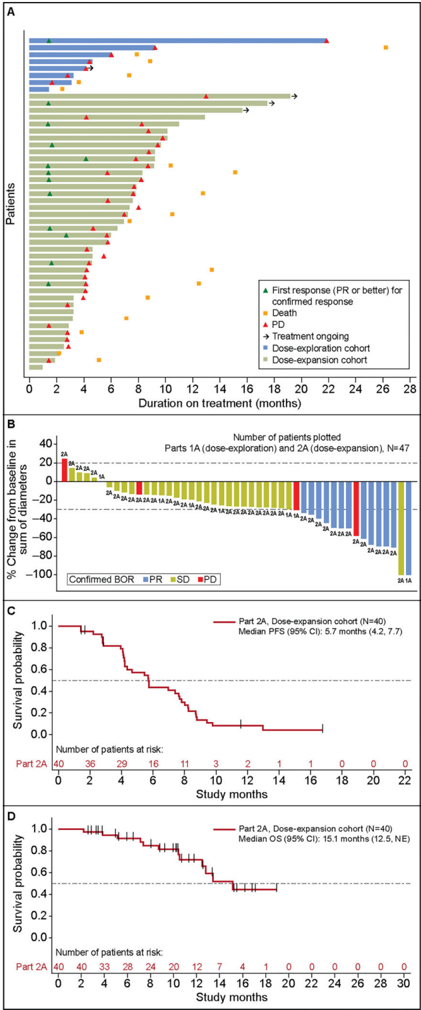
- Efficacy in the dose-expansion cohort (n=40): confirmed objective response rate 30.0% (95% CI 16.6–46.5), disease control rate 92.5% (95% CI 79.6–98.4), median duration of response 5.3 months (95% CI 2.8–7.4), median PFS 5.7 months (95% CI 4.2–7.7), and median OS 15.2 months (95% CI 12.5–not evaluable).
- Dose-exploration cohort (n=8): 1 confirmed partial response (12.5%; 95% CI 0.3–52.7) and disease control rate 75.0% (95% CI 34.9–96.8); among 5 patients with prior sotorasib treatment, 80.0% achieved stable disease.
- Baseline cfDNA alterations: most prevalent were APC (84%), TP53 (74%), SMAD4 (33%), PIK3CA (28%), and EGFR (26%). Median PFS was shorter with baseline BRAF alterations (2.9 vs 7.4 months) and ARID1A mutations (4.4 vs 7.4 months).
Methods
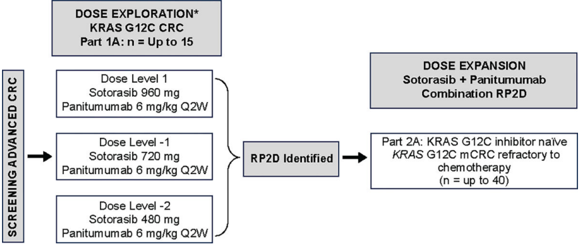
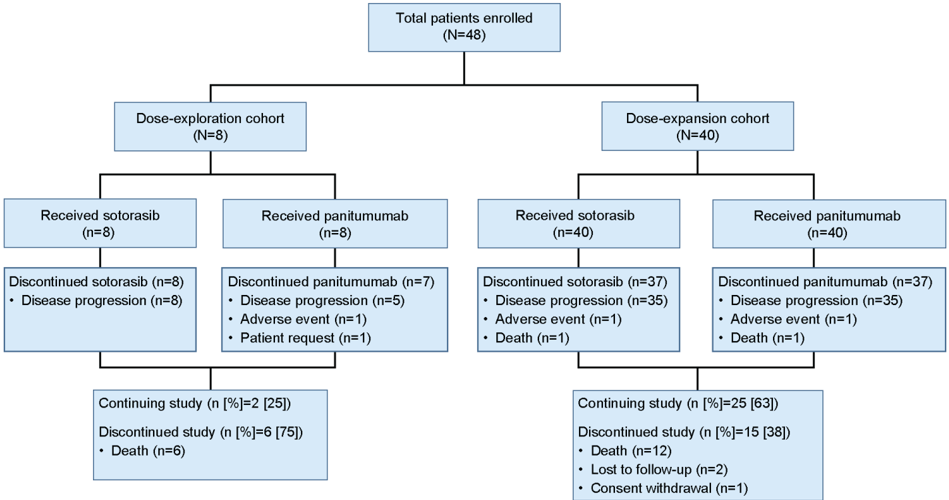
- Design: phase 1b, multicenter, open-label substudy of the CodeBreaK 101 master protocol (subprotocol H, Part 1 Cohort A and Part 2 Cohort A), with a dose-exploration cohort (n=8) and dose-expansion cohort (n=40); enrollment occurred June 24, 2020–December 21, 2021, with data cutoff January 4, 2023.
- Participants and treatment: adults with KRAS G12C-mutated metastatic colorectal cancer; dose-expansion patients had progression on or after fluoropyrimidine, oxaliplatin, irinotecan, and an antiangiogenic agent. Prior KRAS G12C inhibitor was permitted only in dose exploration. All patients received sotorasib 960 mg once daily plus panitumumab 6 mg/kg every 2 weeks.
- Endpoints and analysis: primary endpoints were safety and tolerability (dose-limiting toxicities within 28 days and adverse events per CTCAE v5.0); secondary endpoints included ORR, DCR, duration of response, time to response, PFS, OS per RECIST v1.1 by investigator assessment, and pharmacokinetics. Exploratory baseline cfDNA was assessed with the 74-gene Guardant360 test. Descriptive statistics, Clopper-Pearson exact CIs, and Kaplan-Meier methods were used.
Limitations
- Stated in the paper: this was a single-arm study; efficacy endpoints were based on investigator assessment rather than blinded independent central review; and the exploratory analysis of genomic co-alterations was not statistically powered.
- Evident from the text: the sample size was small, subgroup analyses (e.g., BRAF/ARID1A alterations, tumor sidedness, region) had overlapping CIs, and the dose-exploration cohort was confounded by prior KRAS G12C inhibitor treatment in 5 of 8 patients.
Model-written summary. Check it against the paper before relying on it.
Integrity signals
Registry
Cites
Statistics
Figures
Verification
Claims the paper makes
12 Valid · 3 Not valid · 6 Not checked · 72 Own results and interpretations
The cited sources that could be checked couldn’t confirm or dispute this claim.
In the paper
“Our observation that the combination of sotorasib plus panitumumab showed similar efficacy regardless of primary tumor location is consistent with data for BRAF and EGFR inhibitor combination in BRAFV600E metastatic colorectal cancer 22 , although owing to the small sample sizes and overlapping CIs in this subgroup analysis, these results must be interpreted with caution.”
What the sources say
- Could not verifycites [22] 22. Tabernero J, et al. Trifluridine/tipiracil plus bevacizumab for third-line treatment of refractory metastatic colorectal cancer: The phase 3 randomized SUNLIGHT study. 41, 4-4 (2023). sourceExperimental — accuracy not yet measured
The unpaginated abstract field in our copy reports results for trifluridine/tipiracil plus bevacizumab, not BRAF and EGFR inhibitor combination. Searches for BRAF V600E and efficacy by primary tumor location found no passage addressing the comparison attributed to this source. (LLM, conf=0.76)
plain- Asserted: passes — The authors put it forward as true.
- Checkable: passes — It can be checked against evidence.
- Load-bearing: unclear — It is unclear whether the paper’s conclusions depend on it.
- Based: passes — The paper gives a reason why it holds.
- Could not verify
The cited sources support only part of this claim — read each source’s verdict below.
In the paper
“These findings that a combination approach is more effective than either agent alone is generally consistent with that of the recent phase 2 nonrandomized KRYSTAL-1 trial that tested the combination of the KRAS G12C inhibitor adagrasib with cetuximab in KRAS G12C mutated colorectal cancer. 18”
What the sources say
- Partly supportedcites [18] 18. Yaeger R, et al. Adagrasib with or without Cetuximab in Colorectal Cancer with Mutated KRAS G12C. N Engl J Med 388, 44-54 (2023). [PubMed: 36546659] sourceExperimental — accuracy not yet measured
Split into 2 atoms — 1 confirmed, 1 partially supported, 0 disputed, 0 misattributed, 0 unverifiable. Expand the claim to see per-atom verdicts.
hedgedstates a cause- Asserted: passes — The authors put it forward as true.
- Checkable: passes — It can be checked against evidence.
- Load-bearing: unclear — It is unclear whether the paper’s conclusions depend on it.
- Based: passes — The paper gives a reason why it holds.
- Partly supported
Every source the paper cites for this claim was checked and supports it.
In the paper
“In this KRAS G12C-mutated population where patients were not expected to respond to panitumumab, these results provide a proof of principle that sotorasib and an anti-EGFR antibody work synergistically as observed in preclinical studies. 16,17”
What the sources say
- Supportedcites [16] 16. Ryan MB, et al. KRAS(G12C)-independent feedback activation of wild-type RAS constrains KRAS(G12C) inhibitor efficacy. Cell Rep 39, 110993 (2022). [PubMed: 35732135] source
The Results section (page unavailable) reports that AMG 510 (sotorasib) plus panitumumab improved responses over AMG 510 alone in several preclinical KRAS G12C-mutant colorectal cancer models. The paper notes that the benefit varied across models; it supports the cited preclinical rationale, not the citing authors’ conclusion about their patients. (LLM, conf=0.85)
- Supportedcites [17] 17. Amodio V, et al. EGFR Blockade Reverts Resistance to KRAS(G12C) Inhibition in Colorectal Cancer. Cancer Discov 10, 1129-1139 (2020). [PubMed: 32430388] source
The preclinical cell-line experiments (p. 6) report that cetuximab, an anti-EGFR antibody, synergized with AMG510 (sotorasib) in KRAS G12C colorectal cancer models. The Discussion (p. 9) notes that cetuximab and panitumumab are approved for RAS/RAF wild-type colorectal cancer, consistent with the expectation that panitumumab alone would not benefit this KRAS-mutated population. The citing authors’ characterization of their own results as proof of principle is not a finding attributed to this source. (LLM, conf=0.92)
boostedstates a cause- Asserted: passes — The authors put it forward as true.
- Checkable: passes — It can be checked against evidence.
- Load-bearing: passes — The paper’s conclusions depend on it.
- Based: passes — The paper gives a reason why it holds.
- Rests on an assumption not shown here.
- Supported
A result the paper reports from its own data — it cites no other source for it, so there is none to check. The quote shows it is in the paper.
In the paper
“No treatment-related adverse events led to discontinuation of either drug.”
- Also stated in: § Discussion · p. 8 · plain
“No treatment-related adverse events were grade 4 or 5 or led to treatment discontinuation of either agent.”
plainn = 48- Asserted: passes — The authors put it forward as true.
- Checkable: passes — It can be checked against evidence.
- Load-bearing: passes — The paper’s conclusions depend on it.
- Based: passes — The paper gives a reason why it holds.
- Also stated in: § Discussion · p. 8 · plain
A result the paper reports from its own data — it cites no other source for it, so there is none to check. The quote shows it is in the paper.
In the paper
“Treatment-related adverse events of any grade and grade ≥3 occurred in 45 (94%) and 13 (27%) patients, respectively.”
- Also stated in: § Safety · p. 6 · plain
“Among 48 patients, treatment-related adverse events of any grade and grade ≥3 were observed in 45 (94%) and 13 (27%) patients, respectively”
plainn = 48- Asserted: passes — The authors put it forward as true.
- Checkable: passes — It can be checked against evidence.
- Load-bearing: passes — The paper’s conclusions depend on it.
- Based: passes — The paper gives a reason why it holds.
- Also stated in: § Safety · p. 6 · plain
44 more claims
Create a free account to see all 93 claims and every source verdict.
- Probably not a substantial claim. 30
- It may state two separate claims as one. 19
- The quote only partly states this claim. 2
Claims other papers make about this one
Each is checked against this paper’s own text: does it say what the citing paper says it does?
The cited source says what the claim attributes to it.
In the citing paper
“Similarly, phase I/II data for other KRASG12C inhibitors in colorectal cancer demonstrated greater activity in combination with anti-EGFR antibodies versus monotherapy (17–21).”
From Efficacy and Safety of Adagrasib plus Cetuximab in Patients with KRAS G12C-Mutated Metastatic Colorectal Cancer (2024) · cites this paper as [17]
Self-check
Percentages, sums and reported differences re-computed from the paper’s own numbers.
Each contradiction between two passages listed here was confirmed by an independent check.
Rated minor: it would not touch a result — a value no result rests on, a p-value that stays on the same side of the significance level, or a conflict that is clerical, resolved elsewhere in the paper, or outside its own findings.
In the paper
“| Irinotecan | 7 (88) | 40 (100) | 46 (96) |”
Reported 46 · recomputed 47
Rated minor: it would not touch a result — a value no result rests on, a p-value that stays on the same side of the significance level, or a conflict that is clerical, resolved elsewhere in the paper, or outside its own findings.
In the paper
“| Bevacizumab | 8 (100) | 39 (98) | 45 (94) |”
Reported 45 · recomputed 47
Rated minor: it would not touch a result — a value no result rests on, a p-value that stays on the same side of the significance level, or a conflict that is clerical, resolved elsewhere in the paper, or outside its own findings.
In the paper
§ Efficacy · p. 7
“The median duration of treatment was 6.0 months (range: 0.5-18.9).”
§ Efficacy · p. 7
“Three patients remained on treatment at data cutoff and had received the combination for 15.6-19.2 months.”
Citations
Cites
Sung, H., Ferlay, J., Siegel, R. L., Laversanne, M., Soerjomataram, I., Jemal, A., & Bray, F. (2021) · CA: A Cancer Journal for Clinicians · doi:10.3322/caac.21660 · Cited by 108,699
Siegel, R. L., Miller, K. D., Wagle, N. S., & Jemal, A. (2023) · CA: A Cancer Journal for Clinicians · doi:10.3322/caac.21763 · Cited by 16,303
THE USE OF CONFIDENCE OR FIDUCIAL LIMITS ILLUSTRATED IN THE CASE OF THE BINOMIAL
CLOPPER, C. J., & PEARSON, E. S. (1934) · Biometrika · doi:10.1093/biomet/26.4.404 · Cited by 5,003
Grothey, A., Cutsem, E. V., Sobrero, A., Siena, S., Falcone, A., Ychou, M., Humblet, Y., Bouché, O., Mineur, L., Barone, C., et al. (2013) · The Lancet · doi:10.1016/s0140-6736(12)61900-x · Cited by 2,895 · cited 1×
“3c). and overall survival of 6.4 months for regorafenib and 7.1 months for trifluridine–tipiracil 4,5 .”
InfluentialThe Clinical KRAS(G12C) Inhibitor AMG 510 Drives Anti-Tumour Immunity
Canon, J., Rex, K., Saiki, A. Y., Mohr, C., Cooke, K., Bagal, D., Gaida, K., Holt, T., Knutson, C. G., Koppada, N., et al. (2019) · Nature · doi:10.1038/s41586-019-1694-1 · Cited by 2,277 · cited 10×
“Prior treatment with a KRAS-G12C inhibitor was permitted only in the dose-exploration cohort.”
InfluentialSelf-citationDe Roock, W., Claes, B., Bernasconi, D., De Schutter, J., Biesmans, B., Fountzilas, G., Kalogeras, K. T., Kotoula, V., Papamichael, D., Laurent-Puig, P., et al. (2010) · The Lancet Oncology · doi:10.1016/s1470-2045(10)70130-3 · Cited by 2,144
Colon Cancer, Version 2.2021, NCCN Clinical Practice Guidelines in Oncology
Benson, A. B., Venook, A. P., Al-Hawary, M. M., Arain, M. A., Chen, Y.-J., Ciombor, K. K., Cohen, S., Cooper, H. S., Deming, D., Farkas, L., et al. (2021) · Journal of the National Comprehensive Cancer Network · doi:10.6004/jnccn.2021.0012 · Cited by 1,696
Randomized Trial of TAS-102 for Refractory Metastatic Colorectal Cancer
Mayer, R. J., Van Cutsem, E., Falcone, A., Yoshino, T., Garcia-Carbonero, R., Mizunuma, N., Yamazaki, K., Shimada, Y., Tabernero, J., Komatsu, Y., et al. (2015) · New England Journal of Medicine · doi:10.1056/nejmoa1414325 · Cited by 1,431 · cited 1×
“3c). and overall survival of 6.4 months for regorafenib and 7.1 months for trifluridine–tipiracil 4,5 .”
InfluentialTabernero, J., Grothey, A., Van Cutsem, E., Yaeger, R., Wasan, H., Yoshino, T., Desai, J., Ciardiello, F., Loupakis, F., Hong, Y. S., et al. (2021) · Journal of Clinical Oncology · doi:10.1200/jco.20.02088 · Cited by 569 · cited 1×
“These findings are analogous to the outcomes observed when a BRAF inhibitor was combined with an anti-EGFR antibody to treat BRAF V600E -mutated metastatic colorectal cancer, implying that inhibition of an overactive RAS–BRAF–MAPK pathway requires concurrent EGFR inhibition 20 .”
Self-citationAdagrasib with or without Cetuximab in Colorectal Cancer with Mutated KRAS G12C
Yaeger, R., Weiss, J., Pelster, M. S., Spira, A. I., Barve, M., Ou, S.-H. I., Leal, T. A., Bekaii-Saab, T. S., Paweletz, C. P., Heavey, G. A., et al. (2023) · New England Journal of Medicine · doi:10.1056/nejmoa2212419 · Cited by 527 · cited 3×
“This finding that a combination approach is more effective than either agent alone is generally consistent with that of the recent phase 2 nonrandomized KRYSTAL-1 trial, which tested the combination of the KRAS-G12C inhibitor adagrasib with cetuximab in KRAS G12C -mutated colorectal cancer 18 .”
Self-citation
Cited by
Colon Cancer, Version 3.2024, NCCN Clinical Practice Guidelines in Oncology
Benson, A. B., Venook, A. P., Adam, M., Chang, G., Chen, Y.-J., Ciombor, K. K., Cohen, S. A., Cooper, H. S., Deming, D., Garrido-Laguna, I., et al. (2024) · Journal of the National Comprehensive Cancer Network · doi:10.6004/jnccn.2024.0029 · Cited by 371
KRAS inhibitors: resistance drivers and combinatorial strategies
Isermann, T., Sers, C., Der, C. J., & Papke, B. (2025) · Trends in Cancer · doi:10.1016/j.trecan.2024.11.009 · Cited by 196
Yaeger, R., Uboha, N. V., Pelster, M. S., Bekaii-Saab, T. S., Barve, M., Saltzman, J., Sabari, J. K., Peguero, J. A., Paulson, A. S., Jänne, P. A., et al. (2024) · Cancer Discovery · doi:10.1158/2159-8290.cd-24-0217 · Cited by 139
Self-citationCombinatorial strategies to target RAS-driven cancers
Perurena, N., Situ, L., & Cichowski, K. M. (2024) · Nature reviews. Cancer · doi:10.1038/s41568-024-00679-6 · Cited by 115
KRAS G12C inhibitor combination therapies: current evidence and challenge
Miyashita, H., Kato, S., & Hong, D. S. (2024) · Frontiers in Oncology · doi:10.3389/fonc.2024.1380584 · Cited by 85
Self-citationSignaling pathways in liver cancer: pathogenesis and targeted therapy
Xue, Y., Ruan, Y., Wang, Y., Xiao, P., & Xu, J. (2024) · Molecular Biomedicine · doi:10.1186/s43556-024-00184-0 · Cited by 98
Targeting KRAS: from metabolic regulation to cancer treatment
Shi, Y., Zheng, H., Wang, T., Zhou, S., Zhao, S., Li, M., & Cao, B. (2025) · Molecular Cancer · doi:10.1186/s12943-024-02216-3 · Cited by 89
Current landscape of innovative drug development and regulatory support in China
Tan, R., Hua, H., Zhou, S., Yang, Z., Yang, C., Huang, G., Zeng, J., & Zhao, J. (2025) · Signal Transduction and Targeted Therapy · doi:10.1038/s41392-025-02267-y · Cited by 51
The role of PIK3CA gene mutations in colorectal cancer and the selection of treatment strategies
Wang, H., Tang, R., Ling, J., & Jia, Y. (2024) · Frontiers in Pharmacology · doi:10.3389/fphar.2024.1494802 · Cited by 65
Targeting KRAS G12C Mutation in Colorectal Cancer, A Review: New Arrows in the Quiver
Ros, J., Vaghi, C., Baraibar, I., Gonzalez, N. S., Rodríguez-Castells, M., García, A., Alcaráz, A., Salvà, F., Tabernero, J. M., & Élez, E. (2024) · International Journal of Molecular Sciences · doi:10.3390/ijms25063304 · Cited by 62
“The phase Ib trial, CodeBreaK 101, included cohorts specifically focused on mCRC patients, comprising a dose exploration cohort of eight patients to determine the RP2D of sotorasib in combination with panitumumab and a dose expansion cohort that included 40 patients [36].”
BackgroundMethodCiracì, P., Studiale, V., Taravella, A., Antoniotti, C., & Cremolini, C. (2024) · Nature Reviews Clinical Oncology · doi:10.1038/s41571-024-00965-0 · Cited by 54
Hamid, M. A., Pammer, L. M., Lentner, T., Doleschal, B., Gruber, R., Kocher, F., Gasser, E., Jöbstl, A., Seeber, A., & Amann, A. (2024) · Current Oncology Reports · doi:10.1007/s11912-024-01583-w · Cited by 36
“While some novel therapies, such as drugs targeting KRAS [5] or BRAF [6] mutations, have shown outstanding clinical improvement, other strategies such as immune checkpoint inhibition (ICI) has only proven to be effective in patients with mCRC that are mismatch-repair-deficient (dMMR) or MSI-High…”
BackgroundEmerging landscape of KRAS inhibitors in cancer treatment
Riedl, J. M., Matsubara, H., McNeil, R., Patel, P. S., de la Cruz, F. F., Gulhan, D., & Corcoran, R. B. (2026) · Cancer Cell · doi:10.1016/j.ccell.2026.01.001 · Cited by 53
Evaluation of KRAS inhibitor-directed therapies for pancreatic cancer treatment
Long, S.-A., Amparo, A. M., Goodhart, G., Ahmad, S. A., & Waters, A. M. (2024) · Frontiers in Oncology · doi:10.3389/fonc.2024.1402128 · Cited by 31
Ma, J., Fu, S., Tan, J., Han, Y., Chen, Y., Deng, X., Shen, H., Zeng, S., Peng, Y., & Cai, C. (2025) · Advanced Science · doi:10.1002/advs.202502714 · Cited by 23
Dewan, A., Tattoli, I., & Mascellino, M. T. (2025) · International Journal of Molecular Sciences · doi:10.3390/ijms26146958 · Cited by 16
“Panitumumab and sotorasib (960 mg once daily) have been combined and evaluated in 40 patients with chemotherapy-refractory KRAS-G12C-mutant mCRC, leading to a 30% objective response rate (ORR) [98].”
RetractedTargeting the KRAS Oncogene for Patients with Metastatic Colorectal Cancer
Miao, R., Yu, J. B., & Kim, R. D. (2025) · Cancers · doi:10.3390/cancers17091512 · Cited by 21
“These and several other pan-RAS inhibitors are being investigated in KRAS-mutant mCRC (Table 2).”
Targeting the MAPK pathway for NRAS mutant melanoma: from mechanism to clinic
Wang, Y., Xu, G., & Xia, H. (2025) · British Journal of Dermatology · doi:10.1093/bjd/ljaf178 · Cited by 15
Uddin, M. B., Wang, Z., & Yang, C. (2024) · Advanced Science · doi:10.1002/advs.202403936 · Cited by 21
Combining EGFR and KRAS G12C Inhibitors for KRAS G12C Mutated Advanced Colorectal Cancer
Miyashita, H., & Hong, D. S. (2024) · Journal of Cancer Immunology · doi:10.33696/cancerimmunol.6.086 · Cited by 16
“Treatment-related adverse events with grade 3 or higher happened in 27% of patients with dermatologic events most common, which suggests an acceptable safety profile of the regimen [18].”
BackgroundSelf-citationReady, Set, Go: Setting Off on the Mission to Target KRAS in Colorectal Cancer
Pellatt, A. J., Bhamidipati, D., & Subbiah, V. (2024) · JCO Oncology Practice · doi:10.1200/op.24.00295 · Cited by 14
Advances in Novel Targeted Therapies for Pancreatic Adenocarcinoma
Hoang, T. A., & Tsang, E. S. (2025) · Journal of Gastrointestinal Cancer · doi:10.1007/s12029-024-01149-w · Cited by 18
Recent advances in therapeutic targeting of the KRAS pathway in cancer
Hitchen, N., Williams, S., & Desai, J. (2025) · Pharmacology & Therapeutics · doi:10.1016/j.pharmthera.2025.108889 · Cited by 15
Khelwatty, S. A., Puvanenthiran, S., Seddon, A. M., Bagwan, I., Essapen, S., & Modjtahedi, H. (2025) · Cancers · doi:10.3390/cancers17172810 · Cited by 15
“The CodeBreaK 101 phase 1b study demonstrated that this combination yielded an ORR of 30% and a disease control rate (DCR) of 93% in heavily pre-treated patients with manageable toxicity, suggesting an actionable strategy for a population historically considered undruggable [144].”
Precision immune regulation in KRAS-mutated cancers: the final piece of the puzzle?
Fu, S., Ma, J., Cai, C., Tan, J., Deng, X., Shen, H., Zeng, S., Chen, Y., & Han, Y. (2025) · Journal of Experimental & Clinical Cancer Research · doi:10.1186/s13046-025-03444-1 · Cited by 14
Sütcüoğlu, O., Yıldırım, H. Ç., Almuradova, E., Günenç, D., & Yalçın, Ş. (2025) · Medicina · doi:10.3390/medicina61071202 · Cited by 10
Švec, J., Onhajzer, J., & Kořínek, V. (2024) · Critical Reviews in Oncology/Hematology · doi:10.1016/j.critrevonc.2024.104544 · Cited by 10
Harrold, E. C., Keane, F., Walch, H. S., Chou, J. F., Sinopoli, J. C., Palladino, S., Al-Rawi, D. H., Chadalavada, K., Manca, P., Chalasani, S. B., et al. (2024) · Clinical Cancer Research · doi:10.1158/1078-0432.ccr-23-4005 · Cited by 13
“…indicate an association of baseline amplification in EGFR, MET , and / or ERBB2 in baseline circulating tumor DNA (ctDNA) with inferior progression-free survival (PFS) in BRAF V600E colorectal cancer (34) and of baseline BRAF amplification with shorter PFS in KRAS G12C colorectal cancer (35).”
Self-citationKale, R. R., Samant, C., Nandakumar, K., Pai, K. S. R., & Bhonde, M. (2025) · Biochemical and Biophysical Research Communications · doi:10.1016/j.bbrc.2025.151688 · Cited by 12
Wang, P., Sun, X., He, X., Kang, D., Liu, X., Liu, D., Li, A., Yang, G., Lin, Y., Li, S., et al. (2025) · Cancer Research Communications · doi:10.1158/2767-9764.crc-25-0001 · Cited by 9
“In vivo studies showed that once-daily dosing of glecirasib can strongly inhibit p-ERK for at least 24 hours and induce maximal tumor responses agent alone in patients with colorectal cancer (36, 37).”
Emerging Tumor-Agnostic Molecular Targets
Bhamidipati, D., & Schram, A. M. (2024) · Molecular Cancer Therapeutics · doi:10.1158/1535-7163.mct-23-0725 · Cited by 11
Adagrasib in the treatment of colorectal cancer
Haddad, S. F., Bouferraa, Y., & Nair, K. G. (2025) · Future Oncology · doi:10.1080/14796694.2025.2524311 · Cited by 10
“Therefore, CodeBreaK 101 evaluated sotorasib with panitumumab in 48 patients with chemother-apy-refractory KRAS G12C -mutated mCRC and demonstrated improved efficacy with ORR of 30%, PFS of 5.7 months, and median OS of 15.2 months and tolerable safety profile [32].”
InfluentialStahlhut, C. E., Maciag, A. E., Sullivan, K. A., Singh, K., Gitego, N., Zhang, Z., Chan, A. H., Sharma, A. K., Alexander, P., Shu, J., et al. (2026) · Cancer Discovery · doi:10.1158/2159-8290.cd-25-1280 · Cited by 12
“# BE0146) was formulated in PBS and dosed intraperitoneally on days 1, 4, 8, 11, 15, 18, 22, 25, and 28.”
KRAS-targeted therapies in cancer: novel approaches and overcoming resistance
Tang, D., Kroemer, G., & Kang, R. (2025) · BMJ Oncology · doi:10.1136/bmjonc-2025-000946 · Cited by 16
Clinical Actionability of Genes in Gastrointestinal Tumors
Gonzalez, N. S., Patelli, G., & Crisafulli, G. (2025) · Genes · doi:10.3390/genes16101130 · Cited by 7
“Innovative and dynamic clinical trial designs, such as platform trials, are increasingly being applied, as exemplified by the development of KRAS p.G12C inhibitors using master protocols [206].”
Baird, L., Zhang, L., Hidaka, T., Xi, L., Wang, K., Tateno, K., Iso, T., Suzuki, T., Kumada, K., Katsuoka, F., et al. (2025) · British Journal of Cancer · doi:10.1038/s41416-025-03162-7 · Cited by 10
“KRAS G12Ci induce the NRF2-dependent NISP to promote anti-cancer immunity While G12Ci drugs are potent KRAS inhibitors at a concentration of approximately 100 nM, the plasma concentration achieved in patients at doses optimized for clinical ef fi cacy is above 10 μ M [9, 46].”
Zhang, Q., Kuang, G., Wang, L., Fan, L., Zhou, Y., Shang, L., Zhao, Y., & Sun, W. (2024) · Journal of Nanobiotechnology · doi:10.1186/s12951-024-02778-w · Cited by 6
“Chemotherapy is among the main methods of tumor treatment, which kills cells directly through chemotherapeutic drugs [4, 5].”
BackgroundHan, H., Li, Y., Lin, Z., Ma, X., Huang, W., Lu, C., Ma, R., & Han, R. (2025) · Oncogene · doi:10.1038/s41388-025-03490-1 · Cited by 9
“The advent of Sotorasib, the fi rst drug approved for clinical use as a KRASG12C-speci fi c inhibitor in lung cancer, represents a breakthrough, yet it offers little respite for the more prevalent KRAS mutations in CRC, such as KRASG12D and KRASG12V, which remain largely undruggable [8].”
Akkuş, E., Öksüz, N. E., & Erul, E. (2025) · Critical Reviews in Oncology/Hematology · doi:10.1016/j.critrevonc.2025.104741 · Cited by 6
KRAS G12C Inhibitors in the Treatment of Metastatic Colorectal Cancer
Xiao, A., & Fakih, M. (2024) · Clinical Colorectal Cancer · doi:10.1016/j.clcc.2024.05.004 · Cited by 7
Self-citationEmerging and Established Targets in Colorectal Cancer: Translating Biology Into Therapeutics
Grochot, R. M., Bartolini, M., Algaze, S. D., Reimann, P., Winder, T., Lenz, H., & Fontana, E. (2026) · American Society of Clinical Oncology Educational Book · doi:10.1200/edbk-26-516576 · Cited by 5
Wei, X., Blaj, C., Al-Radhawi, M. A., Lai, L., Maldonato, B. J., Yang, Y. C., Seu, L., Gundlapalli, H., Jiang, L., Ayala, M. A. M., et al. (2026) · Cancer Discovery · doi:10.1158/2159-8290.cd-25-1616 · Cited by 9
“63–65 ).”
Xu, H., Lu, J., Wu, J., Zhang, K., Zhou, X., Gao, Z., Feng, J., Zhuang, Z., & Zhong, X. (2025) · Frontiers in Oncology · doi:10.3389/fonc.2025.1675745 · Cited by 6
Concurrent genetic and non-genetic resistance mechanisms to KRAS inhibition in CRCPreprint
Alonso, S., Chu, K., Parsons, M. J., Granowsky, E., Gunasinghe, H. I., Shia, J., Yaeger, R. D., & Dow, L. E. (2025) · bioRxiv (Cold Spring Harbor Laboratory) · doi:10.1101/2025.08.05.668666 · Cited by 4
“Patients received treatment in one of two clinical trials combining sotorasib plus panitumumab, or testing adagrasib with or without cetuximab 6,18 ; all patients had previously”
Self-citationDing, C., Yao, R., Wang, Y., Liu, H., Li, C., & Xie, H. (2025) · Frontiers in Pharmacology · doi:10.3389/fphar.2025.1656372 · Cited by 7
KRAS mutations in colorectal cancer: impacts on tumor microenvironment and therapeutic implications
Emami, A., Sharif, P. M., & Rezaei, N. (2025) · Expert Opinion on Therapeutic Targets · doi:10.1080/14728222.2025.2500426 · Cited by 4
“Another combination approach with EGFR inhibitors involves panitumumab, further supporting the notion that resistance to AMG 510 in CRC cells is linked to the overactivation of RTKs (particularly EGFR) [123,124].”
Rosas, D., Barad, P., Wright, J., & Raez, L. E. (2026) · International Journal of Molecular Sciences · doi:10.3390/ijms27146455 · Cited by 5
“EGFR/RTK co-inhibition is being explored to overcome adaptive MAPK reactivation in KRAS G12C-mutant NSCLC, with CodeBreaK 101 demonstrating activity for sotorasib plus afatinib, and parallel evaluation of sotorasib plus panitumumab in colorectal cancer supporting vertical pathway inhibition [2,40].”
Lv, Y., Zhao, Z., Di, W., Liu, L., Chen, Y., Wei, S., Ji, Y., & Zhong, J. (2026) · Critical Reviews in Oncology/Hematology · doi:10.1016/j.critrevonc.2026.105150 · Cited by 4
Therapeutic Advances in Rectal Cancer
Lago, A. D. M., Moga, M., Hogea, M. D., Khudor, A. J., & Mișarca, C. (2025) · American Journal of Therapeutics · doi:10.1097/mjt.0000000000002015 · Cited by 3
Current Status of Precision Medicine in Colorectal Cancer in Japan
Kojitani, Y., & Takeda, M. (2025) · International Journal of Molecular Sciences · doi:10.3390/ijms26115029 · Cited by 6
“These results have led to the FDA approval of adagrasib plus cetuximab and sotora-sib plus panitumumab for KRAS G12C-mutant CRC, markedly expanding the treatment options for these patients [36,37].”
Kasper, S., & Sebastian, M. (2025) · Deutsches Ärzteblatt international · doi:10.3238/arztebl.m2025.0002 · Cited by 4
Chen, P., Qian, K., Zhu, K., Lü, X., & Dajin, L. (2025) · Journal of Medical Biochemistry · doi:10.5937/jomb0-56862 · Cited by 4
“Mutations in oncogenes (e.g., KRAS) and tumor suppressor genes (e.g., APC, TP53), chronic inflammation, microbiota dysbiosis, and dietary carcinogens all play critical roles in the development of colon cancer (6, 7).”
Venegas-Rodríguez, J. L., Hernández-Sandoval, J. A., Angulo, M. G., Moreno-Ortíz, J. M., González‐Mercado, A., Peregrina-Sandoval, J., Ramírez-Plascencia, H. H. F., Flores-López, B. A., Alvizo-Rodríguez, C. R., Valenzuela-Pérez, J. A., et al. (2024) · Cancers · doi:10.3390/cancers16132323 · Cited by 4
“However, targeted therapies based on KRAS variants have also been achieved in early-phase trials in advanced or metastatic CRC patients, with adagrasib [48] and sotorasib [49] being the first FDA-approved inhibitors that selectively target cells harboring the KRAS p.Gly12Cys variant.”
BackgroundGhosh, S., Fan, F., Powell, R. T., Park, Y. S., STEPHAN, C. C., Kopetz, S., Ellis, L. M., & Bhattacharya, R. (2024) · Therapeutic Advances in Medical Oncology · doi:10.1177/17588359241303302 · Cited by 4
Self-citationLi, J., Wang, Z., Huang, J., Ba, Y., Cao, B., Luo, S., Li, W., Bai, C., Song, Z., Xiong, J., et al. (2026) · The Lancet Gastroenterology & Hepatology · doi:10.1016/s2468-1253(25)00267-5 · Cited by 3
Pastor, P. G., Gonzalez, N. S., Salvà, F., Ros, J., Baraibar, I., Rodríguez-Castells, M., de Torres, C. S., García, A., Alcaráz, A., Vaghi, C., et al. (2026) · Genes · doi:10.3390/genes17040460 · Cited by 4
Molecular Pathology of Pancreatic Ductal Adenocarcinoma
Shalaby, A. S., Sadri, N., & Xue, Y. (2025) · Cancers · doi:10.3390/cancers17213549 · Cited by 8
Wang, W., Alley, A., Sun, N., Tadesse, M., Wang, X., & Zhang, R. (2025) · Frontiers in Pharmacology · doi:10.3389/fphar.2025.1663766 · Cited by 7
Guo, Y., Jin, Y., Gao, J., Wang, D., Wang, Y., Shan, L., Yang, M., Li, X., & Ma, K. (2024) · Pharmaceuticals · doi:10.3390/ph17121696 · Cited by 2
Chemical perturbations impacting histone acetylation govern colorectal cancer differentiationPreprint
Likasitwatanakul, P., Li, Z., Doan, K. T., et al. (2024) · bioRxiv (Cold Spring Harbor Laboratory) · doi:10.1101/2024.12.06.626451 · Cited by 2
Mishra, S., Chauhan, A. J., & Ramajayam, R. (2024) · Results in Chemistry · doi:10.1016/j.rechem.2024.101799 · Cited by 2
PLK1 and its role in the evolving landscape of KRAS-mutated colorectal cancer
Harvey, H. M., & Chen, E. X. (2024) · Journal of Gastrointestinal Oncology · doi:10.21037/jgo-24-323 · Cited by 2
“The Codebreak101 trial combined sotorasib with panitumumab, ORR and DCR improved to 30% and 90% respectively in the CRC cohort (14).”
Colorectal Cancer Screening: Time to Spring Forward
Shaukat, A., & Crockett, S. D. (2024) · The American Journal of Gastroenterology · doi:10.14309/ajg.0000000000002713 · Cited by 2
Ai, X., Song, Z., Wu, L., Zhou, A., Cheng, D., Zong, H., Wu, H., Niu, Z., Sun, Y., Zhu, L., et al. (2026) · Nature Medicine · doi:10.1038/s41591-026-04559-4 · Cited by 3
“The synergetic effect between KRAS inhibition and EGFR inhibitor has been well established in CRC 44,45 .”
Guo, Y., Zhong, Y., Hu, P., Chen, Y., Guo, W., Chen, J., Guan, P., Zhou, Z., Zhu, F., Zeng, X., et al. (2026) · Nature Communications · doi:10.1038/s41467-026-73805-7 · Cited by 2
“These fi ndings translate into improved ef fi cacy and durable responses in clinical trials 25,26 , culminating in FDA approval of combination therapy for colorectal cancer.”
Harmych, S. J., Joshi, N., Tanaka, H., Bogatcheva, G. T., Ramirez, M. A., Graves‐Deal, R., Tydings, C. W., Elia, M. T., Mueller, H. R. L., Silvestri, I. M., et al. (2026) · Cancer Letters · doi:10.1016/j.canlet.2026.218607 · Cited by 1
Concurrent genetic and non-genetic resistance mechanisms to KRAS inhibition in colorectal cancer
Alonso, S., Chu, K., Granowsky, E., Saraiba-Rabanales, V., Parsons, M. J., Gunasinghe, H. I., Shia, J., Yaeger, R., & Dow, L. E. (2026) · Cancer Cell · doi:10.1016/j.ccell.2026.04.009 · Cited by 14
Self-citationBoby, J. M., Ilerhunmwuwa, N. P., Benny, J. M., Peniche, P. Z., Baytar, D. K., & Sahin, I. H. (2026) · Cancer Investigation · doi:10.1080/07357907.2026.2636581 · Cited by 1
Yang, Y., Cao, H., Xu, Z., Dai, Y., Dai, X., Shao, M., Yao, Y., & He, S. (2026) · Clinical Surgical Oncology · doi:10.1016/j.cson.2026.100119 · Cited by 1
Bartl, T., & Castillo‐Tong, D. C. (2026) · International Journal of Gynecological Cancer · doi:10.1016/j.ijgc.2026.104485 · Cited by 5
We, L., Kong, D., An, J., & Song, L. (2025) · World Journal of Gastrointestinal Surgery · doi:10.4240/wjgs.v17.i8.105391 · Cited by 1
Yang, P., & Li, Y. (2025) · Investigational New Drugs · doi:10.1007/s10637-025-01514-x · Cited by 1
“1) [36, 37].”
Targeting mutated KRAS in the first‐line therapy
Ijichi, H. (2024) · Clinical and Translational Discovery · doi:10.1002/ctd2.291 · Cited by 1
Peng, S., Zhang, Y., Lin, X., Si, C., Van Horn, R. D., Dempsey, J. A., Goetz, E., Evans, R. J., Farber, A., Vandekopple, M. J., et al. (2026) · Nature Communications · doi:10.1038/s41467-026-72650-y · Cited by 1
An overview of KRAS-targeting therapies for colorectal cancer in phase I and II development
Chamseddine, S., Azmi, A. S., & Saif, M. W. (2025) · Expert Opinion on Investigational Drugs · doi:10.1080/13543784.2025.2611395 · Cited by 2
Kwiatkowska, L., & Szczuko, M. (2026) · International Journal of Molecular Sciences · doi:10.3390/ijms27177559
“The clinical activity of sotorasib plus pan-itumumab in KRAS G12C-mutated mCRC provides strong evidence that panitumumab may retain therapeutic relevance even in selected RAS -mutant tumors when the oncogenic driver is directly inhibited [60,61].”
InfluentialMasuishi, T., Strickler, J. H., Kuboki, Y., Fakih, M., Greil, R., Galot, R., Price, T. J., Élez, E., Siena, S., Hippenmeyer, J., et al. (2026) · ESMO Open · doi:10.1016/j.esmoop.2026.108338 · Cited by 10
Self-citationKRAS G12C-mutated Metastatic Colorectal Cancer: Current Therapeutic Strategies and Future Directions
Sagawa, T., Nagashima, H., & Fujikawa, K. (2026) · Journal of Gastrointestinal Cancer · doi:10.1007/s12029-026-01547-2
“In CodeBreaK 101, sotorasib plus panitu - mumab produced a confirmed objective response rate of 30.0%, a median progression-free survival of 5.7 months, and a median overall survival of 15.2 months in chemother - apy-refractory KRAS G12C-mutated mCRC [ 6].”
InfluentialChen, J., Cao, J. R., Zhou, B., 赵连爽, & Zheng, C. J. (2026) · Frontiers in Immunology · doi:10.3389/fimmu.2026.1835351
Baytar, D. K., Peniche, P. Z., Wang, S., Jan, Y. J., McFarquhar, A., Singhi, A. D., Saeed, A., & Şahin, İ. H. (2026) · Cancers · doi:10.3390/cancers18132158
“With the approval of sotorasib and adagrasib for the G12C variant [15,16], and ongoing trials targeting other KRAS mutations [17], characterizing individual mutation subtypes is becoming essential for patient selection and risk stratification.”
Zhang, N., Wan, L., He, N., Chen, X., Yang, X., & Wang, J. J. (2026) · Gene · doi:10.1016/j.gene.2026.150305
Lu, D., Osgood, T., Ma, S., Zhang, H., Kanke, M., Tan, J. A., Paudel, S. N., Zhou, H., Estrada, J., Yamawaki, T., et al. (2026) · Cancer Immunology Research · doi:10.1158/2326-6066.cir-25-0794 · Cited by 1
Targeting KRAS for cancer therapy
Jia, J., Liu, R., Adamide, T. A., Fernandez, I. E., & Stathopoulos, G. T. (2026) · British Journal of Pharmacology · doi:10.1111/bph.70546 · Cited by 4
RAS signaling at the crossroads of radioresistance and tumor immunity
Quevrin, C., Mondini, M., Meziani, L., de Thoré, M. G., Liu, W., Lopes, E., Morel, D., Clémenson, C., Deutsch, É., & Lévy, A. (2026) · Journal for ImmunoTherapy of Cancer · doi:10.1136/jitc-2026-015274 · Cited by 1
Lü, S., Ai, X., Li, Z., Wu, L., Chen, P., Niu, Z., Sun, Y., Song, Z., Yao, W., He, J. S., et al. (2026) · Research Square · doi:10.21203/rs.3.rs-8540837/v2
Максимовна, П. Е. (2026) · P A Herzen Journal of Oncology · doi:10.17116/onkolog202615031112
Karahan, L., Arslan, S., & Dızdar, Ö. (2026) · Cureus · doi:10.7759/cureus.110414
“…modest activity in KRAS G12C-mutated CRC [5], but combining KRAS-G12C inhibition with EGFR blockade enhances efficacy, has yielded higher response rates in early studies and is now being evaluated in phase III trials [6,7] and recently (in early 2025) approved by the FDA for KRAS G12C-mutated CRC.”
Li, Y., Zhou, M., Pan, J., Su, H., Song, M., Guan, Z., Zhao, D., Zhao, X., Zhao, Y., Chen, P., et al. (2026) · Translational Oncology · doi:10.1016/j.tranon.2026.102821
“…cancer, whereas AMG510 combined with EGFR inhibitors exhibits significantly increased efficacy, indicating that the antitumor effects of AMG510 monotherapy on certain KRAS G12C-mutant solid tumors may be constrained by resistance mechanisms or the activation of alternative signaling pathways [19].”
InfluentialGrancher, A., Landi, M., Ballhausen, A., Tocino, R. V., Alig, A. H. S., Taravella, A., Malicot, K. L., Soularue, É., Gallois, C., Guarssifi, M., et al. (2026) · Digestive and Liver Disease · doi:10.1016/j.dld.2026.04.009
Salvatore, L., Fakih, M., Kuboki, Y., Hong, D. S., Modest, D. P., Taïeb, J., Price, T. J., Cremolini, C., Majer, I. M., Rehn, M., et al. (2026) · Clinical Colorectal Cancer · doi:10.1016/j.clcc.2026.04.003 · Cited by 1
Self-citationContext defines precision: rethinking KRAS inhibition in oncology
Marchiò, S. (2026) · npj Precision Oncology · doi:10.1038/s41698-026-01422-0 · Cited by 1
“Dual EGFR/KRAS(G12C) blockade has moved beyond proof of principle and now represents an established later-line approach, supported by phase 1b and phase 3 sotorasib plus panitumumab data and by pooled KRYSTAL-1 results with adagrasib plus cetuximab 41,42,49 .”
From undruggable to actionable: advances in KRAS targeting in colorectal cancer
Chan, M., Shelke, M., Townsend, A. R., Roy, A. C., Broadbridge, V. T., Karapetis, C. S., & Price, T. J. (2026) · Academia oncology. · doi:10.20935/acadonco8216
Lu, S., Ai, X., Li, Z., Wu, L., Chen, P., Niu, Z., Sun, Y., Song, Z., Yao, W., He, J., et al. (2026) · Research Square · doi:10.21203/rs.3.rs-8540837/v1
EGFR as a biomarker in colorectal Cancer: An electrochemical biosensing approach
Break, M. K. B., Syed, R. U., Hussein, W., Nawaz, M., Abdalla, R. A. H., Aboshouk, N. A. M., Khoo, T.-J., Elariny, H. A., Mohammed, A. E., & Alghamdi, S. S. (2026) · Clinica Chimica Acta · doi:10.1016/j.cca.2026.120917 · Cited by 1
Hollander, E. M., Buma, A. I. G., Leentjens, J., Janssen, P. K. C., van den Heuvel, M. M., Burger, D. M., Piet, B., & ter Heine, R. (2026) · International Journal of Cancer · doi:10.1002/ijc.70326
Actionable subgroups (I): RAS (KRAS G12C) and BRAF V600E
Alonso-Orduña, V., Tobeña, M., & Marqués, E. P. (2026) · Revisiones en cáncer · doi:10.20960/revcancer.00134
Ratain, M. J., & Fojo, A. T. (2025) · Journal of Clinical Oncology · doi:10.1200/jco-25-01607
Treatment Modalities, Targeted Therapies, and Immunotherapy in Metastatic Colorectal Cancer
Karakullukcu, M., & Şenocak, D. (2025) · IntechOpen eBooks · doi:10.5772/intechopen.1012530
Pavithra, M. K., Deepakumari, H. N., Shyla, B., & Sowmya, P. T. (2025) · Analytical Chemistry Letters · doi:10.1080/22297928.2025.2563830
Treatment options for KRAS G12C mutated metastatic colorectal cancer
Liberko, M. (2025) · Onkologie · doi:10.36290/xon.2025.008
Metadata
- Authors
- Kuboki, Y., Fakih, M., Strickler, J., Yaeger, R., Masuishi, T., Kim, E. J., Bestvina, C. M., Kopetz, S., Falchook, G. S., Langer, C., Krauss, J., Puri, S., Cardona, P., Chan, E., Varrieur, T., Mukundan, L., Anderson, A., Tran, Q., & Hong, D. S.
- Affiliations
- National Cancer Center Hospital East (JP)
- City Of Hope National Medical Center (US)
- Duke Medical Center (US)
- Memorial Sloan Kettering Cancer Center (US)
- Aichi Cancer Center Hospital (JP)
- UC Davis Comprehensive Cancer Center (US)
- University of Chicago (US)
- The University of Texas MD Anderson Cancer Center (US)
- Sarah Cannon (US)
- University of Pennsylvania (US)
- University of Michigan (US)
- Huntsman Cancer Institute (US)
- Amgen (United States) (US)
- Corresponding author
- Hong, David S.
- ORCID
- Venue
- Nature Medicine
- Published
- 2024-01
- Volume
- 30
- Issue
- 1
- Pages
- 265-270
- ISSN
- 1078-8956 (ISSN-L)
- 1546-170X
- PMC
- PMC11135132
- OpenAlex
- W4390582065
- Semantic Scholar
- d47de84d04238c5b05350acac3db1e45cb29b618
- Cited by
- 103
- References
- 38
- Citations by year
- 2026: 38 · 2025: 38 · 2024: 27
- FWCI
- 17.53
- Type
- journal article
- Language
- en
- Open access
- green
- www.ncbi.nlm.nih.gov
- Licence
- www.springernature.com/gp/researchers/text-and-data-mining (tdm)
- www.springernature.com/gp/researchers/text-and-data-mining (vor)
- Locations
- Nature Medicine (publishedVersion)
- PubMed (publishedVersion)
- PubMed Central (acceptedVersion)
- eScholarship (California Digital Library) (submittedVersion)
- Digital Commons-TMC (Texas Medical Center) (submittedVersion)
- Funders
- Amgen
- Topics
- Health Sciences › Medicine › Oncology › Colorectal Cancer Treatments and Studies
- Health Sciences › Medicine › Pulmonary and Respiratory Medicine › Lung Cancer Treatments and Mutations
- Health Sciences › Medicine › Oncology › Colorectal Cancer Surgical Treatments
- Keywords
- sotorasib, panitumumab, KRAS G12C mutation, metastatic colorectal cancer, chemotherapy-refractory disease, treatment resistance, objective response rate, progression-free survival, overall survival, safety and tolerability, pharmacokinetics, APC, TP53, SMAD4
- MeSH terms
- Panitumumab, Antibodies, Monoclonal, Antineoplastic Combined Chemotherapy Protocols, Humans, Mutation, Piperazines, Pyridines, Pyrimidines, Colorectal Neoplasms, Proto-Oncogene Proteins p21(ras), ErbB Receptors
About these checks
Registry, retraction, Cites and statistics results are computed, not judged, with one exception: a printed reference that no index lists is read once by a model before it counts as a citation error. Claims are extracted by a model and kept only when their quote appears verbatim in the text; each cited source is then checked, with a model’s help, for whether it says what the claim relies on. Those verdicts can be wrong — read the claim’s quote and the cited source before relying on one.
The claim verdicts this report counts are experimental: their accuracy is not yet measured.
A language model drew the claims from the paper on 2026-10-10, under version 3 of the claim definition (model deepseek-v4.1-flash, prompt extract-v3).
A second model labelled each claim on 2026-10-10 (model jev-1.13-20260917, definition revision gold-guideline-v0.2).
Cited sources are checked with a language model’s help (gpt-6-sol).
Statistics and arithmetic are recomputed, not judged.
Confidence bands are shown only for fields calibrated on our annotated test set. None is calibrated yet, so no band is shown.
What counts as a claim ›How we measure confidence ›How we check this ›
Are you an author, or do you see a problem with this page? Request a review
Data sources
Bibliographic data: Semantic Scholar, OpenAlex, Crossref.
Contains information from the Semantic Scholar Academic Graph Datasets, made available under the ODC Attribution License (ODC-BY 1.0).
Semantic Scholar’s data is described in: Kinney, R., et al. (2023). The Semantic Scholar Open Data Platform. arXiv:2301.10140.
