

The DOI matches its Crossref record; 71 of the 72 references it cites were found in a registry or an index.
Transparent medical image AI via an image–text foundation model grounded in medical literature
Open accessPublished version of a preprint
Abstract
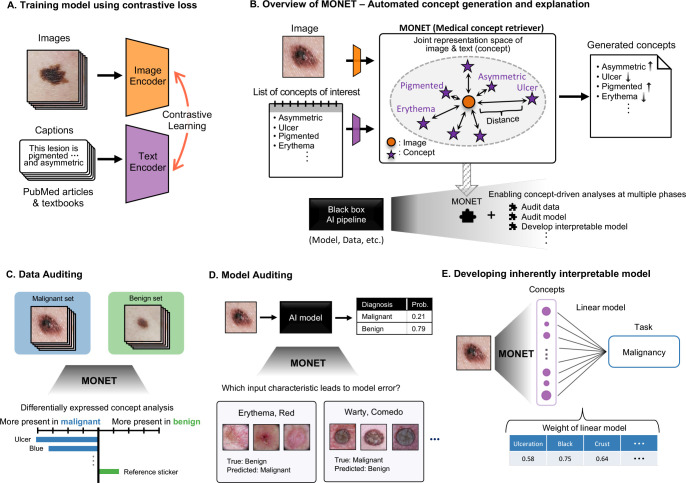
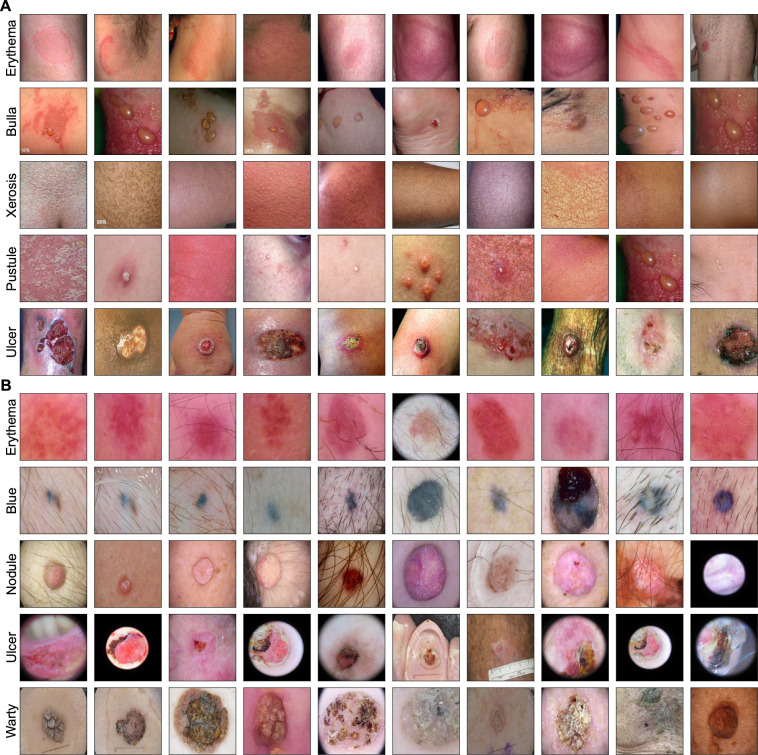
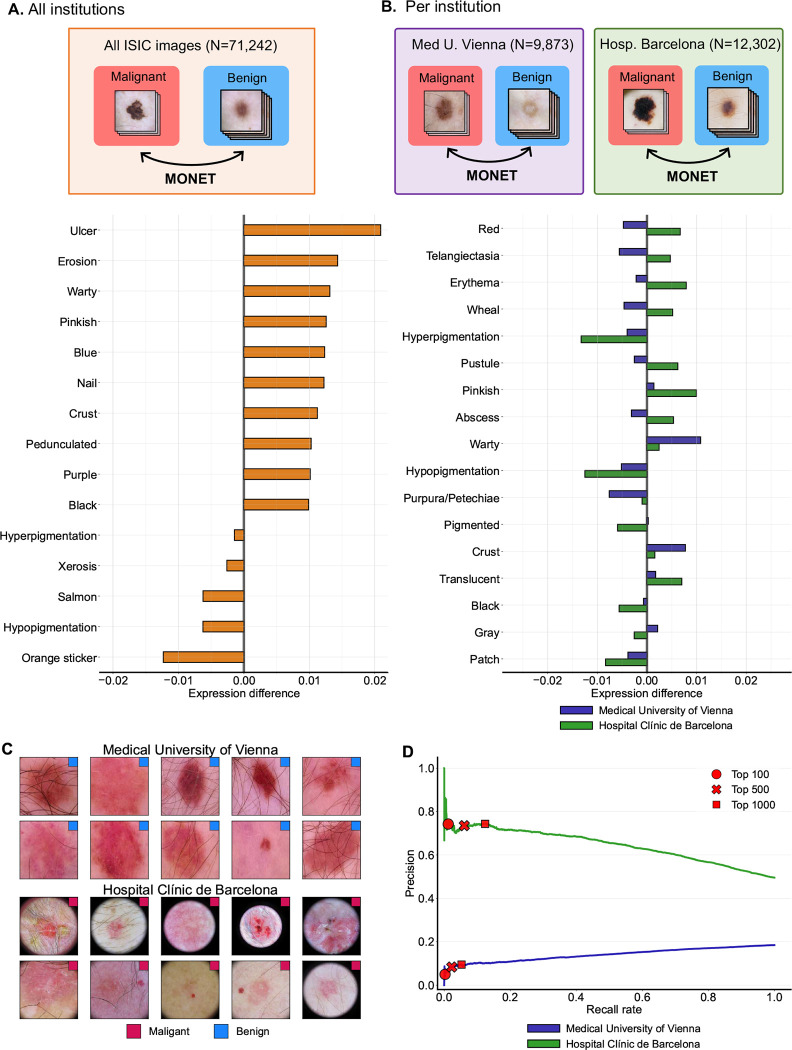
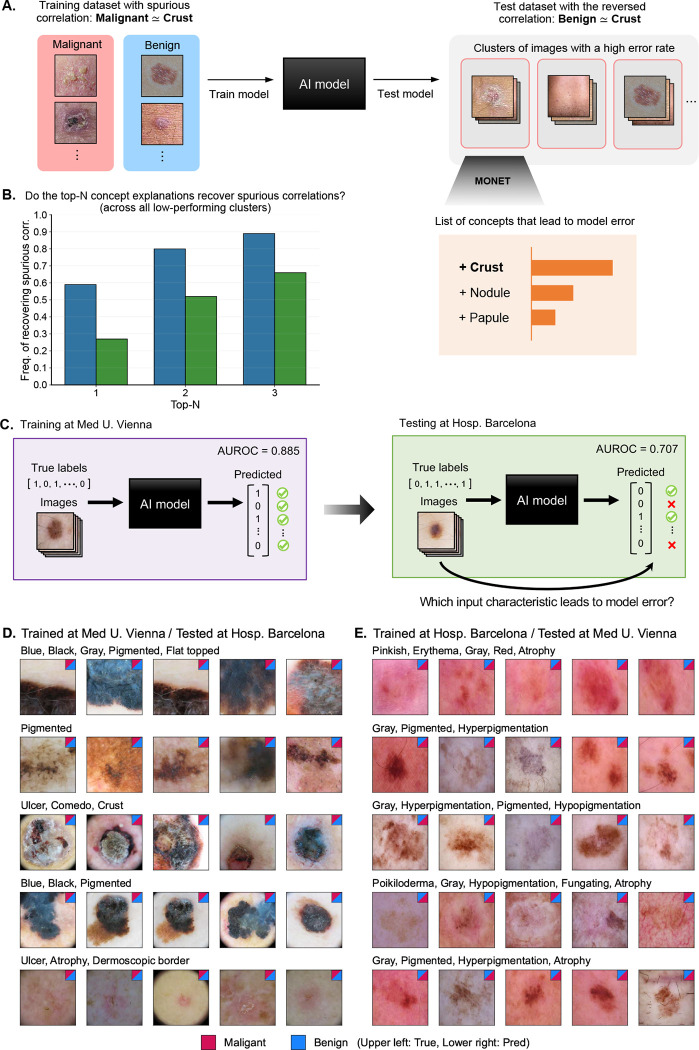
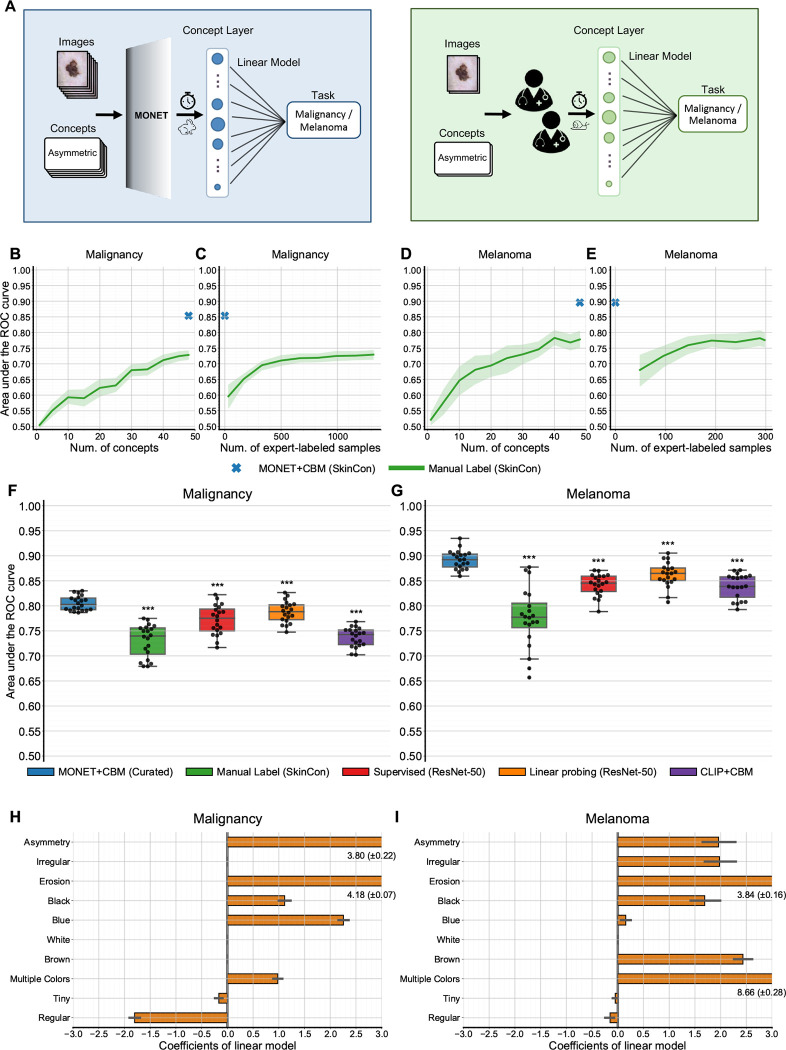
Abstract Building trustworthy and transparent image-based medical AI systems requires the ability to interrogate data and models at all stages of the development pipeline: from training models to post-deployment monitoring. Ideally, the data and associated AI systems could be described using terms already familiar to physicians, but this requires medical datasets densely annotated with semantically meaningful concepts. Here, we present a foundation model approach, named MONET ( M edical c ON cept r ET riever), which learns how to connect medical images with text and generates dense concept annotations to enable tasks in AI transparency from model auditing to model interpretation. Dermatology provides a demanding use case for the versatility of MONET, due to the heterogeneity in diseases, skin tones, and imaging modalities. We trained MONET on the basis of 105,550 dermatological images paired with natural language descriptions from a large collection of medical literature. MONET can accurately annotate concepts across dermatology images as verified by board-certified dermatologists, outperforming supervised models built on previously concept-annotated dermatology datasets. We demonstrate how MONET enables AI transparency across the entire AI development pipeline from dataset auditing to model auditing to building inherently interpretable models.
Overview
The claims and statistics of this paper haven’t been checked yet.
Run the check — free, no account needed. It reads the open-access text and checks the sources it cites.
Integrity signals
Registry
Cites
Statistics
Figures
Verification
Claims the paper makes
The claims and statistics of this paper haven’t been checked yet.
Run the check — free, no account needed. It reads the open-access text and checks the sources it cites.
Claims other papers make about this one
Each is checked against this paper’s own text: does it say what the citing paper says it does?
In the citing paper
“Furthermore, PanDerm also surpassed vision-language models such as CLIP36, MONET39 and biomedical-specific CLIP (BiomedCLIP)40 in benchmark evaluations (Supplementary Table 1)”
From A Multimodal Vision Foundation Model for Clinical Dermatology (2025) · cites this paper as [39]
In the citing paper
“CLIP-large outperformed biomedical-specific and dermatology-specific CLIP models”
From A Multimodal Vision Foundation Model for Clinical Dermatology (2025) · cites this paper as [39]
Self-check
Percentages, sums and reported differences re-computed from the paper’s own numbers.
The self-check needs the paper’s full text.
Citations
Cites
Deep Residual Learning for Image Recognition
He, K., Zhang, X., Ren, S., & Sun, J. (2016) · 2016 IEEE Conference on Computer Vision and Pattern Recognition (CVPR) · doi:10.1109/cvpr.2016.90 · Cited by 235,474
Scikit-learn: Machine Learning in Python
Pedregosa, F., Varoquaux, G., Gramfort, A., Michel, V., Thirion, B., Grisel, O., Blondel, M., Müller, A., Nothman, J., Louppe, G., et al. (2012) · arXiv · doi:10.48550/arxiv.1201.0490 · Cited by 71,016
ImageNet: A large-scale hierarchical image database
Deng, J., Dong, W., Socher, R., Li, L.-J., Li, K., & Fei-Fei, L. (2009) · 2009 IEEE Conference on Computer Vision and Pattern Recognition · doi:10.1109/cvpr.2009.5206848 · Cited by 65,333
Densely Connected Convolutional Networks
Huang, G., Liu, Z., Van Der Maaten, L., & Weinberger, K. Q. (2017) · 2017 IEEE Conference on Computer Vision and Pattern Recognition (CVPR) · doi:10.1109/cvpr.2017.243 · Cited by 48,566
Grad-CAM: Visual Explanations from Deep Networks via Gradient-Based Localization
Selvaraju, R. R., Cogswell, M., Das, A., Vedantam, R., Parikh, D., & Batra, D. (2017) · 2017 IEEE International Conference on Computer Vision (ICCV) · doi:10.1109/iccv.2017.74 · Cited by 24,513
Unpaired image-to-image translation using cycle-consistent adversarial networks
Zhu, J.-Y., Park, T., Isola, P., & Efros, A. A. (2017) · 2017 IEEE International Conference on Computer Vision (ICCV) · doi:10.1109/iccv.2017.244 · Cited by 23,602
Least squares quantization in PCM
Lloyd, S. (1982) · IEEE Transactions on Information Theory · doi:10.1109/tit.1982.1056489 · Cited by 15,836
Learning Transferable Visual Models From Natural Language Supervision
Radford, A., Kim, J. W., Hallacy, C., Ramesh, A., Goh, G., Agarwal, S., Sastry, G., Askell, A., Mishkin, P., Clark, J., et al. (2021) · arXiv · doi:10.48550/arxiv.2103.00020 · Cited by 15,293
Large Language Models Encode Clinical Knowledge
Singhal, K., Azizi, S., Tu, T., Mahdavi, S. S., Wei, J., Chung, H. W., Scales, N., Tanwani, A., Cole-Lewis, H., Pfohl, S., et al. (2022) · arXiv · doi:10.48550/arxiv.2212.13138 · Cited by 4,083
Large language models encode clinical knowledge
Singhal, K., Azizi, S., Tu, T., Mahdavi, S. S., Wei, J., Chung, H. W., Scales, N., Tanwani, A., Cole-Lewis, H., Pfohl, S., et al. (2023) · Nature · doi:10.1038/s41586-023-06291-2 · Cited by 4,083
Research works printed but not linked: 16
- Daneshjou, R., Yuksekgonul, M., Cai, Z. R., Novoa, R. & Zou, J. Y. SkinCon: a skin disease dataset densely annotated by domain experts for fine-grained debugging and analysis. In Advances in Neural Information Processing Systems (eds Koyejo, S. et al.) 18157–18167 (Curran Associates, Inc., 2022).
- Combalia, M. et al. BCN20000: dermoscopic lesions in the wild. Preprint at https://arxiv.org/abs/1908.02288 (2019). · arXiv
- Singh, C., Balakrishnan, G. & Perona, P. Matched sample selection with GANs for mitigating attribute confounding. Preprint at https://arxiv.org/abs/2103.13455 (2021). · arXiv
- Goel, K., Gu, A., Li, Y. & Ré, C. Model patching: closing the subgroup performance gap with data augmentation. In 9th International Conference on Learning Representations (ICLR, 2021); https://openreview.net/forum?id=9YlaeLfuhJF
- Sagawa, S., Koh, P. W., Hashimoto, T. B. & Liang, P. Distributionally robust neural networks. In International Conference on Learning Representations (ICLR, 2020); https://dblp.org/rec/conf/iclr/SagawaKHL20.html?view=bibtex
- Lundberg, S. M. & Lee, S.-I. A unified approach to interpreting model predictions. In Proc. 31st International Conference on Neural Information Processing Systems (eds Guyon, I. et al.) 4768–4777 (Curran Associates Inc., 2017).
- Sundararajan, M., Taly, A. & Yan, Q. Axiomatic attribution for deep networks. In Proc. 34th International Conference on Machine Learning (eds Precup, D. & Teh, Y. W.) 3319–3328 (PMLR, 2017).
- Crabbé, J. & van der Schaar, M. Concept activation regions: a generalized framework for concept-based explanations. In Advances in Neural Information Processing Systems (eds Koyejo, S. et al.) 2590–2607 (Curran Associates Inc., 2022).
- Abid, A., Yuksekgonul, M. & Zou, J. Meaningfully debugging model mistakes using conceptual counterfactual explanations. In Proc. 39th International Conference on Machine Learning (eds Chaudhuri, K. et al.) 66–68 (PMLR, 2022).
- Yuksekgonul, M., Wang, M. & Zou, J. Post-hoc concept bottleneck models. In The Eleventh International Conference on Learning Representations (ICLR, 2023); https://dblp.org/rec/conf/iclr/YuksekgonulW023.html?view=bibtex
- PMC Open Access Subset. National Library of Medicine www.ncbi.nlm.nih.gov/pmc/tools/openftlist (2022).
- Tan, M. & Le, Q. V. EfficientNetV2: smaller models and faster training. In Proc. 38th International Conference on Machine Learning, ICML 2021 (eds Meila, M. & Zhang, T.) 10096–10106 (PMLR, 2021).
- Dosovitskiy, A. et al. An image is worth 16 × 16 words: transformers for image recognition at scale. In 9th International Conference on Learning Representations, ICLR 2021 (ICLR, 2021); https://openreview.net/forum?id=YicbFdNTTy
- Sennrich, R., Haddow, B. & Birch, A. Neural machine translation of rare words with subword units. In Proc. 54th Annual Meeting of the Association for Computational Linguistics, Vol. 1: Long Papers 1715–1725 (Association for Computational Linguistics, 2016). · DOI · Paper page
- Kingma, D. P. & Ba, J. Adam: A method for stochastic optimization. In 3rd International Conference on Learning Representations, ICLR 2015 (eds Bengio, Y. & LeCun, Y.) (ICLR, 2015).
- Wu, C., Parbhoo, S., Havasi, M. & Doshi-Velez, F. Learning optimal summaries of clinical time-series with concept bottleneck models. In Proc. 7th Machine Learning for Healthcare Conference (eds Lipton, Z. C. et al.) 648–672 (PMLR, 2022).
Cited by
Sorted by citations
A Vision-Language Foundation Model for Precision Oncology
Xiang, J., Wang, X., Zhang, X., Xi, Y., Eweje, F., Chen, Y., Li, Y., Bergstrom, C., Gopaulchan, M., Kim, T., et al. (2025) · Nature · doi:10.1038/s41586-024-08378-w · Cited by 256
CLIP in medical imaging: A survey
Zhao, Z., Liu, Y., Wu, H., Wang, M., Li, Y., Wang, S., Teng, L., Liu, D., Cui, Z., Wang, Q., et al. (2025) · Medical Image Analysis · doi:10.1016/j.media.2025.103551 · Cited by 248
A Multimodal Vision Foundation Model for Clinical Dermatology
Yan, S., Yu, Z., Primiero, C., Vico-Alonso, C., Wang, Z., Yang, L., Tschandl, P., Hu, M., Ju, L., Tan, G., et al. (2025) · Nature Medicine · doi:10.1038/s41591-025-03747-y · Cited by 117
“Furthermore, PanDerm also surpassed vision-language models such as CLIP 36 , MONET 39 and biomedical-specific CLIP (BiomedCLIP) 40 in benchmark evaluations (Supplementary Table 1), while showing emergent capabilities in dermatology similar to those of DINOv2 in natural images, with linear probing performance comparabl…”
Digital twins as global learning health and disease models for preventive and personalized medicine
Li, X., Loscalzo, J., Mahmud, A. K. M. F., Aly, D. M., Rzhetsky, A., Žitnik, M., & Benson, M. (2025) · Genome Medicine · doi:10.1186/s13073-025-01435-7 · Cited by 135
Principles, applications, and future of artificial intelligence in dermatology
Omiye, J. A., Gui, H., Daneshjou, R., Cai, Z. R., & Muralidharan, V. (2023) · Frontiers in Medicine · doi:10.3389/fmed.2023.1278232 · Cited by 87
Self-citationKurtansky, N. R., D’Alessandro, B. M., Gillis, M. C., Betz‐Stablein, B., Cerminara, S. E., García, R. P., Girundi, M. A., Goessinger, E. V., Gottfrois, P., Guitera, P., et al. (2024) · Scientific Data · doi:10.1038/s41597-024-03743-w · Cited by 73
Transparency of medical artificial intelligence systems
Kim, C., Gadgil, S. U., & Lee, S. (2025) · Nature Reviews Bioengineering · doi:10.1038/s44222-025-00363-w · Cited by 60
Self-citationAdvancing medical imaging with language models: featuring a spotlight on ChatGPT
Hu, M., Qian, J. Y., Pan, S., Li, Y., Qiu, R. L. J., & Yang, X. (2024) · Physics in Medicine and Biology · doi:10.1088/1361-6560/ad387d · Cited by 97
Ghosh, S., Poynton, C. B., Visweswaran, S., & Batmanghelich, K. N. (2024) · Lecture notes in computer science · doi:10.1007/978-3-031-72390-2_59 · Cited by 46
Bian, Y., Li, J., Ye, C., Jia, X., & Yang, Q. (2025) · Chinese Medical Journal · doi:10.1097/cm9.0000000000003489 · Cited by 58
Developing a Transparent Anaemia Prediction Model Empowered With Explainable Artificial Intelligence
Farooq, M. S., Muhammad, M. H. G., Ali, O., Zeeshan, Z., Saleem, M. A., Ahmad, M., Abbas, S., Khan, M. A., & Ghazal, T. M. (2024) · IEEE Access · doi:10.1109/access.2024.3522080 · Cited by 39
Explainable Artificial Intelligence: Advancements and Limitations
Aysel, H. I., Cai, X., & Prügel‐Bennett, A. (2025) · Applied Sciences · doi:10.3390/app15137261 · Cited by 36
Wang, S., Zhou, X., Li, C., Wang, S., Li, Y., Tan, T., & Zheng, H. (2025) · Research · doi:10.34133/research.1029 · Cited by 29
Investigating the Quality of DermaMNIST and Fitzpatrick17k Dermatological Image Datasets
Abhishek, K., Jain, A., & Hamarneh, G. (2025) · Scientific Data · doi:10.1038/s41597-025-04382-5 · Cited by 37
Generative Artificial Intelligence in Medicine
Shanmugam, D., Agrawal, M., Movva, R., Chen, I. Y., Ghassemi, M., Jacobs, M. L., & Pierson, E. (2025) · Annual Review of Biomedical Data Science · doi:10.1146/annurev-biodatasci-103123-095332 · Cited by 40
Shen, Y., Li, H., Sun, C., Ji, H., Zhang, D., Hu, K., Tang, Y., Chen, Y., Wei, Z., & Lv, J. (2024) · npj Digital Medicine · doi:10.1038/s41746-024-01014-x · Cited by 21
Sun, Y., Wen, X., Zhang, Y., Jin, L., Yang, C., Zhang, Q., Jiang, M. C., Xu, Z., Guo, W., Su, J., et al. (2025) · Computer Methods and Programs in Biomedicine · doi:10.1016/j.cmpb.2025.108870 · Cited by 27
Visual–language foundation models in medicine
Liu, C., Jin, Y., Guan, Z., Li, T., Qin, Y., Qian, B., Jiang, Z., Wu, Y.-L., Wang, X., Zheng, Y. F., et al. (2024) · The Visual Computer · doi:10.1007/s00371-024-03579-w · Cited by 25
Guo, R., Zhang, R., Zhou, H., Xie, T., Peng, Y., Chen, X., Guo, Y. F., Wan, F., Li, L., Zhang, Y., et al. (2024) · Plants · doi:10.3390/plants13162274 · Cited by 18
Challenges and applications in generative AI for clinical tabular data in physiology
Umesh, C., Mahendra, M., Bej, S., Wolkenhauer, O., & Wolfien, M. (2024) · Pflügers Archiv - European Journal of Physiology · doi:10.1007/s00424-024-03024-w · Cited by 20
Artificial intelligence in clinical trials of lung cancer: Current and future prospects
Zhang, Y., You, P., Liu, R., Lu, Y., Li, J., Lei, Y., Wu, S., & Zhou, H. (2024) · Intelligent Oncology · doi:10.1016/j.intonc.2024.11.003 · Cited by 18
Leveraging large language models in dermatology
Matin, R., Linos, E., & Rajan, N. (2023) · British Journal of Dermatology · doi:10.1093/bjd/ljad230 · Cited by 18
Mechanistic understanding and validation of large AI models with SemanticLens
Dreyer, M., Berend, J., Labarta, T., Vielhaben, J., Wiegand, T., Lapuschkin, S., & Samek, W. (2025) · Nature Machine Intelligence · doi:10.1038/s42256-025-01084-w · Cited by 24
Towards Concept-Based Interpretability of Skin Lesion Diagnosis Using Vision-Language Models
Patrício, C., Teixeira, L. F., & Neves, J. C. (2024) · IEEE International Symposium on Biomedical Imaging (ISBI) · doi:10.1109/isbi56570.2024.10635623 · Cited by 16
Medical multimodal large language models: A systematic review
Hu, Y., Xu, C., Lin, B., Yang, W., & Tang, Y. Y. (2025) · Intelligent Oncology · doi:10.1016/j.intonc.2025.09.005 · Cited by 14
The clinical potential of counterfactual AI models
Lee, S., & Topol, E. J. (2024) · The Lancet · doi:10.1016/s0140-6736(24)00313-1 · Cited by 14
Self-citationTraffic Scene-Informed Attribution of Autonomous Driving Decisions
Shi, R., Li, T., Yamaguchi, Y., & Zhang, L. (2025) · IEEE Transactions on Intelligent Transportation Systems · doi:10.1109/tits.2025.3547879 · Cited by 15
Panayides, A. S., Chen, H., Filipović, N., Geroski, T., Hou, J., Lekadir, K., Kostas Marias, A., Matsopoulos, G. K., Papanastasiou, G., Sarder, P., et al. (2025) · IEEE Journal of Biomedical and Health Informatics · doi:10.1109/jbhi.2025.3649496 · Cited by 14
Artificial Intelligence in the Non-Invasive Detection of Melanoma
Mendi, B. İ., Köse, K., Fleshner, L., Adam, R., Safai, B., Farabi, B., & Atak, M. F. (2024) · Life · doi:10.3390/life14121602 · Cited by 14
Gao, Y., Gao, Z., Gao, X., Liu, Y., Wang, B., & Zhuang, X. (2024) · Lecture notes in computer science · doi:10.1007/978-3-031-72117-5_29 · Cited by 11
Wan, Z., Guo, Y., Bao, S., Wang, Q., & Malin, B. (2025) · Health Data Science · doi:10.34133/hds.0256 · Cited by 12
Tschandl, P., Akay, B. N., Rosendahl, C. O., Rotemberg, V. M., Todorovska, V., Jochen, W., Wolber, A. K., Müller, C., Kurtansky, N. R., Halpern, A., et al. (2025) · Journal of Investigative Dermatology · doi:10.1016/j.jid.2025.06.1594 · Cited by 13
AI dermatology: Reviewing the frontiers of skin cancer detection technologies
Yu, Z., Xin, C., Yu, Y., Xia, J., & Han, L. (2025) · Intelligent Oncology · doi:10.1016/j.intonc.2025.03.002 · Cited by 13
UniMRISegNet: Universal 3D Network for Various Organs and Cancers Segmentation on Multi-Sequence MRI
Zhang, Z., Han, L., Zhang, T., Lin, Z., Gao, Q., Tong, T., Sun, Y., & Tan, T. (2024) · IEEE Journal of Biomedical and Health Informatics · doi:10.1109/jbhi.2024.3504603 · Cited by 8
Augmented reality microscopy to bridge trust between AI and pathologists
Badve, S., Kumar, G. L., Lang, T., Peigin, E., Pratt, J., Anders, R. A., Chatterjee, D., González, R. S., Graham, R. P., Krasinskas, A. M., et al. (2025) · npj Precision Oncology · doi:10.1038/s41698-025-00899-5 · Cited by 9
Medical Knowledge Intervention Prompt Tuning for Medical Image Classification
Du, Y., Yu, N., & Wang, S. (2025) · IEEE Transactions on Medical Imaging · doi:10.1109/tmi.2025.3584841 · Cited by 9
Yan, S., Li, X., Hu, M., Jiang, Y., Yu, Z., & Ge, Z. (2025) · Lecture notes in computer science · doi:10.1007/978-3-032-04971-1_35 · Cited by 16
A two-step concept-based approach for enhanced interpretability and trust in skin lesion diagnosis
Patrício, C., Teixeira, L. F., & Neves, J. C. (2025) · Computational and Structural Biotechnology Journal · doi:10.1016/j.csbj.2025.02.013 · Cited by 12
Borra, S., Dey, N., Fong, S., Sherratt, R. S., & Shi, F. (2026) · Cancers · doi:10.3390/cancers18091361 · Cited by 8
Artificial intelligence–enabled precision medicine for inflammatory skin diseases
Tang, A. S., Wei, M. L., Haemel, A., La, C., Sirota, M., & Lee, E. Y. (2026) · Journal of Investigative Dermatology · doi:10.1016/j.jid.2025.10.596 · Cited by 10
Jiang, C., Jiang, Z., Zhang, Z., Huang, H., Zhou, H., Jiang, Q., Teng, Y., Li, H., Xu, B., Li, X., et al. (2025) · European Journal of Nuclear Medicine and Molecular Imaging · doi:10.1007/s00259-025-07090-9 · Cited by 6
Interpretable framework for predicting preoperative cardiorespiratory fitness using wearable data
Hussain, I., Zeepvat, J., Reid, M. C., Czaja, S. J., Pryor, K. O., & Boyer, R. B. (2025) · Computer Methods and Programs in Biomedicine · doi:10.1016/j.cmpb.2025.108980 · Cited by 8
Jiang, R., Chen, B., Dong, Z., Zeng, X., You, H., Li, Y., Deng, Y., Mu, G., Wang, J., Huang, L., et al. (2026) · npj Digital Medicine · doi:10.1038/s41746-026-02569-7 · Cited by 6
Fang, J., Zhang, D., Xie, K., Xu, L., & Bi, X.-A. (2024) · Interdisciplinary Sciences Computational Life Sciences · doi:10.1007/s12539-024-00651-w · Cited by 6
An explainable machine learning framework for predicting driving states using electroencephalogram
Hussain, I., Park, S.-J., Azad, A., & Alyami, S. A. (2025) · Medical Engineering & Physics · doi:10.1016/j.medengphy.2025.104355 · Cited by 8
A genotype-phenotype transformer to assess and explain polygenic riskPreprint
Lee, I., Wallace, Z. S., Wang, Y., Park, S., Nam, H., Majithia, A. R., & Ideker, T. (2024) · bioRxiv (Cold Spring Harbor Laboratory) · doi:10.1101/2024.10.23.619940 · Cited by 9
Exploring Decision Shifts in Autonomous Driving With Attribution-Guided Visualization
Shi, R., Li, T., Yamaguchi, Y., & Zhang, L. (2024) · IEEE Transactions on Intelligent Transportation Systems · doi:10.1109/tits.2024.3513400 · Cited by 5
Tu, P., Zheng, C., Xie, X., Lv, J., Xie, M., Guo, J., Yin, S., Qiu, K., Wei, Y., Wang, C., et al. (2026) · Nature Biomedical Engineering · doi:10.1038/s41551-026-01622-w · Cited by 4
Research progress of dosiomics in precision radiotherapy
Lei, Y., Bai, H., Yu, J., Zhang, Z., Wang, L., Li, B., Li, L., & Li, L. (2025) · Journal of Cancer Research and Therapeutics · doi:10.4103/jcrt.jcrt_132_25 · Cited by 4
Liang, Y., Wei, Z., Yi, D., Chen, X., Siyao, D. U., Wong, C., Xu, Z., Gao, W., Han, C., Chen, K., et al. (2026) · Nature Communications · doi:10.1038/s41467-026-69212-7 · Cited by 4
Understanding Decision-Making of Autonomous Driving via Semantic Attribution
Shi, R., Li, T., Yamaguchi, Y., & Zhang, L. (2024) · IEEE Transactions on Intelligent Transportation Systems · doi:10.1109/tits.2024.3483810 · Cited by 4
Foundation Models in Medical Image Analysis: Overview and Prospects
Rashed, E. A., & Bekhit, M. (2024) · IEEE International Conference on Future Machine Learning and Data Science (FMLDS) · doi:10.1109/fmlds63805.2024.00011 · Cited by 4
From task-specific to foundation models: A paradigm shift in medical vision-language analysis
Ali, M. U., Zafar, A., Kim, S., Kim, K. S., & Lee, S. W. (2025) · Computer Science Review · doi:10.1016/j.cosrev.2025.100831 · Cited by 6
Self-citationSpatial biomarker discovery via interpretable semantic learning in histopathology
Liang, J., Jiang, X., Reitsam, N. G., Lenz, T., Zhang, L., Gustav, M., Carrero, Z. I., Muti, H. S., Neidlinger, P., Clusmann, J., et al. (2026) · Cancer Cell · doi:10.1016/j.ccell.2026.05.014 · Cited by 3
Mask of Truth: Model Sensitivity to Unexpected Regions of Medical Images
Sourget, T., Hestbek-Møller, M., Jiménez-Sánchez, A., Xu, J. J., & Cheplygina, V. (2025) · Journal of Imaging Informatics in Medicine · doi:10.1007/s10278-025-01531-5 · Cited by 6
DREAM: A framework for discovering mechanisms underlying AI prediction of protected attributesPreprint
Gadgil, S. U., DeGrave, A. J., Janizek, J. D., Xu, S. H., Nwandu, L., Fonjungo, F., Lee, S., & Daneshjou, R. (2024) · medRxiv · doi:10.1101/2024.04.09.24305289 · Cited by 3
Self-citationEditorial for Special Issue on Foundation Models for Medical Image Analysis
Wang, X., Wang, D., Li, X., Rittscher, J., Metaxas, D., & Zhang, S. (2024) · Medical Image Analysis · doi:10.1016/j.media.2024.103389 · Cited by 3
Zhu, Y. Y., Wang, X., Huang, X., Xia, M., Mu, P., Hu, H., & Zhang, X. (2025) · IEEE Journal of Biomedical and Health Informatics · doi:10.1109/jbhi.2025.3606881 · Cited by 3
Cheema, M. N., Nazir, A., Harmanci, A. O., Harmanci, A. O., Cheema, Y., Masood, S., & Khokhar, F. A. (2026) · The Visual Computer · doi:10.1007/s00371-026-04385-2 · Cited by 2
A universal foundation model for grounded biomedical image interpretation
Wu, L., Nie, Y., He, S., Zhuang, J., Luo, L., Li, T., Xie, Z., Chen, D., Zhao, Y., Mahboobani, N. R., et al. (2026) · Nature Communications · doi:10.1038/s41467-026-73986-1 · Cited by 23
Jia, H., Qian, B., Qu, Y., Wang, J., Chen, J. H., Li, T., Zheng, C., Han, J., Zhang, G., Jin, Y., et al. (2026) · Nature Medicine · doi:10.1038/s41591-026-04545-w · Cited by 2
Self-citationDivergent impacts of explainable AI for dermatological diagnosis on clinicians versus lay people
Xu, X., Hu, H., Zhang, H., Wang, W. K., Wang, R., Soenksen, L. R., Badri, O., Jafry, S., Burger, E., Nwandu, L., et al. (2026) · Nature Medicine · doi:10.1038/s41591-026-04553-w · Cited by 8
Self-citationTowards Robust Zero-shot Chest X-ray Classification
Bhat, S., Panambur, A. B., Mansoor, A., Georgescu, B., Grbić, S., & Maier, A. (2025) · Informatik aktuell · doi:10.1007/978-3-658-47422-5_42 · Cited by 2
Hyperbolic vision language representation learning on chest radiology images
Zhang, Z., Qiao, Z., Han, L., Yang, H. B., Qian, Z., & Wu, J. (2025) · Health Information Science and Systems · doi:10.1007/s13755-025-00341-x · Cited by 2
Limitations of ChatGPT in Dermatologic Image Analysis: Toward Broader and Deeper Evaluation
Keplinger, L. E., & Hu, G. (2025) · Journal of Investigative Dermatology · doi:10.1016/j.jid.2025.05.015 · Cited by 2
Attribution explanations for decision-making in deep lane-change models
Shi, R., Li, T., Yamaguchi, Y., & Zhang, L. (2025) · Transportation Research Part C Emerging Technologies · doi:10.1016/j.trc.2025.105361 · Cited by 2
Foundation models in medical image analysis: A systematic review and quantitative analysis
Rajendran, P., Safari, M., He, W., Hu, M., Shah, K. D., Wang, S., Zhou, J., & Yang, X. (2026) · Medical Image Analysis · doi:10.1016/j.media.2026.104293 · Cited by 8
Widening the scope of artificial intelligence applications in dermatology
Matin, R. (2024) · Clinical and Experimental Dermatology · doi:10.1093/ced/llae174 · Cited by 2
Artificial intelligence-enabled precision medicine for inflammatory skin diseasesPreprint
Tang, A., Wei, M. L., Haemel, A. K., La, C., Sirota, M., & Lee, E. Y. (2025) · PubMed · doi:10.48550/arxiv.2505.09527 · Cited by 5
Haile, G., Zhu, Y., Maqsood, M. H., Yin, X., & Liew, A. W. (2025) · Computers in Biology and Medicine · doi:10.1016/j.compbiomed.2025.110734 · Cited by 1
Interpretable Gastric Cancer Survival Prediction via Concept Bottleneck Model
Zhao, F., Li, A., Tian, X., & Wang, M. (2025) · International Conference on Artificial Intelligence Technologies and Applications (ICAITA) · doi:10.1109/icaita67588.2025.11137851 · Cited by 1
Concept-Induced Graph Perception Model for Interpretable Diagnosis
Zhao, L., Chen, C., Pu, B., Qi, X., Peng, F., Wang, C., Li, K., & Tan, G. (2025) · Lecture notes in computer science · doi:10.1007/978-3-032-05162-2_21 · Cited by 1
Reducing bulky medical images via shape-texture decoupled deep neural networks
Yang, R., Xiao, T., Cheng, Y., & Suo, J. (2026) · Nature Communications · doi:10.1038/s41467-026-68292-9 · Cited by 1
Clinical Implementation of Artificial Intelligence Systems in Medical Imaging and Radiotherapy
Vienna International Centre, 100, P. B., Vienna, A.-1., Austria, 2600-0, T. +. (., & 2600-7, F. +. (. (2026) · IAEA human health series · doi:10.61092/iaea.9olq-aqa9 · Cited by 2
Marini, N., Liang, Z., Rajaraman, S., Xue, Z., & Antani, S. (2026) · Journal of Biomedical Informatics · doi:10.1016/j.jbi.2026.105055 · Cited by 1
Beyond Pattern Recognition: Call for Functionally Aware AI for Anatomical Illustration
Kawalec, A., & Simka, M. (2026) · JMIR Medical Education · doi:10.2196/92700 · Cited by 1
Generalizable CT vision-language modeling for population health and disease risk
Beeche, C., Kim, J., Tavolinejad, H., Zhao, B., Dong, J., Sharma, R., Duda, J. T., Gee, J., Dako, F., Verma, A., et al. (2026) · npj Digital Medicine · doi:10.1038/s41746-026-03257-2 · Cited by 1
A Framework for Evaluating the Efficacy of Foundation Embedding Models in HealthcarePreprint
Xu, S. H., Gui, H., Rotemberg, V. M., Wang, T., Chen, Y. T., & Daneshjou, R. (2024) · medRxiv · doi:10.1101/2024.04.17.24305983 · Cited by 1
Self-citationOpportunities in AI/ML to endotype asthma and other eosinophilic diseases
Ray, A., Das, J., & Khoury, P. (2025) · Journal of Allergy and Clinical Immunology · doi:10.1016/j.jaci.2025.01.044 · Cited by 1
Nguyen, T., Panwar, V., Jarmale, V. N., Perny, A., Dusek, C., Cai, Q., Kapur, P., Danuser, G. M., & Rajaram, S. (2025) · bioRxiv (Cold Spring Harbor Laboratory) · doi:10.1101/2025.03.18.643999 · Cited by 2
Yılmaz, A., Yuceyalcin, F., Varol, R., Gökyayla, E., Erdem, O., Choi, D., Demirçalı, A. A., Gençoğlan, G., Posma, J. M., & Temelkuran, B. (2025) · medRxiv · doi:10.1101/2025.05.17.25327785 · Cited by 4
Translating clinical gene sequencing into a foundational representation of tumor subtypePreprint
Kong, J., Lee, I., Boecher, D., Singhal, A., Kelly, M. R., Moon, J., Ahn, C. H., Ock, C., Kumar, T., Sears, T. J., et al. (2025) · bioRxiv (Cold Spring Harbor Laboratory) · doi:10.1101/2025.09.08.674723 · Cited by 1
Explainable AI as a Double-Edged Sword in Dermatology: The Impact on Clinicians versus The PublicPreprint
Xu, X., Hu, H., Zhang, H., Wang, W. K., Wang, R., Soenksen, L. R., Badri, O., Jafry, S., Burger, E., Nwandu, L., et al. (2025) · medRxiv · doi:10.64898/2025.12.19.25342205 · Cited by 1
Self-citationProspector Heads: Generalized Feature Attribution for Large Models & DataPreprint
Machiraju, G., Derry, A., Desai, A., Guha, N., Karimi, A.-H., Zou, J., Altman, R. B., Ré, C., & Mallick, P. (2024) · PubMed · doi:10.48550/arxiv.2402.11729
Artificial intelligence: empowering new insights into gamete and embryo development
Du, Z., & Gao, S. (2024) · Scientia Sinica Vitae · doi:10.1360/ssv-2024-0072 · Cited by 1
Injecting Visual Prototypes into CLIP-driven Long-Tailed Skin Lesion Classification
Pan, Y. (2025) · Applied and Computational Engineering · doi:10.54254/2755-2721/2025.tj22275
ToPoMesh: accurate 3D surface reconstruction from CT volumetric data via topology modification
Chen, J., Zhu, Q. X., Xie, B., & Li, T. (2025) · Medical & Biological Engineering & Computing · doi:10.1007/s11517-025-03381-3
Artificial Intelligence and Skin Disease Scoring: An Opportunity to Reset the Standards
Kittler, H. (2025) · Journal of Investigative Dermatology · doi:10.1016/j.jid.2025.07.002
Identifying Gender-Specific Visual Bias Signals in Skin Lesion Classification
Lee, H. J., Yang, S., Chu, Y., & Oh, B. H. (2025) · Lecture notes in computer science · doi:10.1007/978-3-032-05870-6_6
Automated Laryngoscope Using AI Image Detection
John, R. R., Eisha, M., Safla, P., Sreekutty, K. S., & Vidya, G. S. (2025) · Lecture notes in networks and systems · doi:10.1007/978-3-032-06674-9_45
Yu, J., Wang, Y., Li, Z., & Shen, Y. (2025) · Intelligent Medicine · doi:10.1016/j.imed.2025.04.005
Jin, C., Rezk, E., Moursi, W. M., & Wang, Z. (2025) · IEEE-EMBS International Conference on Biomedical and Health Informatics (BHI ...) · doi:10.1109/bhi67747.2025.11269526
Skin-R1: Clinical Knowledge-Guided Dermatological Diagnosis Using Vision-Language Models
Liu, Z., Ren, W., Zhang, J., Zhao, T., Zhu, J., Li, X., & Honavar, V. G. (2026) · Lecture notes in computer science · doi:10.1007/978-3-032-37314-4_1 · Cited by 4
Equitable AI in Healthcare: Navigating Sex, Gender, and Intersectional Biases in Diagnostics
Lee, H., Yang, S., & Chu, Y. (2026) · Springer eBooks · doi:10.1007/978-981-95-2070-1_10
Evaluating the Trustworthiness of Foundation Models for Skin Lesion Segmentation
Chu, Y., Oh, B., & Yang, S. (2025) · IEEE International Conference on Computer Vision Workshops · doi:10.1109/iccvw69036.2025.00065
Extending Aumann-Shapley for Reliable Neuron Attribution in Autonomous Driving Decisions
Shi, R., Li, T., Yamaguchi, Y., & Zhang, L. (2026) · IEEE Transactions on Multimedia · doi:10.1109/tmm.2026.3678500
Finetuning medical vision‑language models for interpretable and fine‑grained disease classification
Engelson, S., Ehrhardt, J., & Heinz Handels, A. (2026) · SPIE Medical Imaging: Computer-Aided Diagnosis · doi:10.1117/12.3086032
Scheuerman, M. K., Hutiri, W. T., Rahmattalabi, A., Matthews, V., Xiang, A., & Andrews, J. T. A. (2026) · CHI Conference on Human Factors in Computing Systems · doi:10.1145/3772318.3790364 · Cited by 1
Sun, T., Jiang, Y., Jin, Y., Guo, H., & Zhang, Z. (2026) · IEEE Winter Conference on Applications of Computer Vision · doi:10.1109/wacv61042.2026.00520
Bhat, S., Mansoor, A., Georgescu, B., Zinnen, M., Sahu, P., Panambur, A. B., Ghesu, F. C., Grbić, S., & Maier, A. (2026) · Scientific Reports · doi:10.1038/s41598-026-52235-x · Cited by 1
Metadata
- Authors
- Kim, C., Gadgil, S. U., DeGrave, A. J., Omiye, J. A., Cai, Z. R., Daneshjou, R., & Lee, S.-I.
- Affiliations
- University of Washington (US)
- Stanford Medicine (US)
- Stanford University (US)
- Corresponding author
- Daneshjou, Roxana
- Lee, Su-In
- ORCID
- Venue
- Nature Medicine
- Published
- 2024-04
- Volume
- 30
- Issue
- 4
- Pages
- 1154-1165
- ISSN
- 1078-8956 (ISSN-L)
- 1546-170X
- PMC
- PMC10312868
- OpenAlex
- W4394832225
- Cited by
- 125
- References
- 72
- Citations by year
- 2026: 48 · 2025: 50 · 2024: 25
- FWCI
- 11.52
- Type
- journal article
- Language
- en
- Open access
- hybrid
- doi.org
- Licence
- Locations
- Nature Medicine (publishedVersion, cc-by)
- medRxiv (acceptedVersion, cc-by-nc)
- PubMed (publishedVersion)
- PubMed Central (submittedVersion, cc-by-nc)
- Funders
- National Science Foundation (DBI-1552309, DBI-1759487)
- U.S. Department of Health & Human Services | National Institutes of Health (R01 AG061132, R35 GM 128638, 5T32 AR007422-38, AR007422-38)
- Topics
- Health Sciences › Medicine › Health Informatics › Artificial Intelligence in Healthcare and Education
- Physical Sciences › Computer Science › Artificial Intelligence › Explainable Artificial Intelligence (XAI)
- Physical Sciences › Computer Science › Computer Vision and Pattern Recognition › Multimodal Machine Learning Applications
- Keywords
- vision-language models, medical literature, dermatological images, model auditing, data auditing, model interpretability, AI transparency, self-supervised learning
About these checks
Registry, retraction, Cites and statistics results are computed, not judged, with one exception: a printed reference that no index lists is read once by a model before it counts as a citation error. Claims are extracted by a model and kept only when their quote appears verbatim in the text; each cited source is then checked, with a model’s help, for whether it says what the claim relies on. Those verdicts can be wrong — read the claim’s quote and the cited source before relying on one.
Statistics and arithmetic are recomputed, not judged.
Confidence bands are shown only for fields calibrated on our annotated test set. None is calibrated yet, so no band is shown.
What counts as a claim ›How we measure confidence ›How we check this ›
Are you an author, or do you see a problem with this page? Request a review
