

Allogeneic mesenchymal stem cell therapy with laromestrocel in mild Alzheimer’s disease: a randomized controlled phase 2a trial
Open accessThe DOI matches its Crossref record; 68 of the 68 references it cites were found in a registry or an index; none of the 59 sources its claims cite is checked for support yet.
Abstract
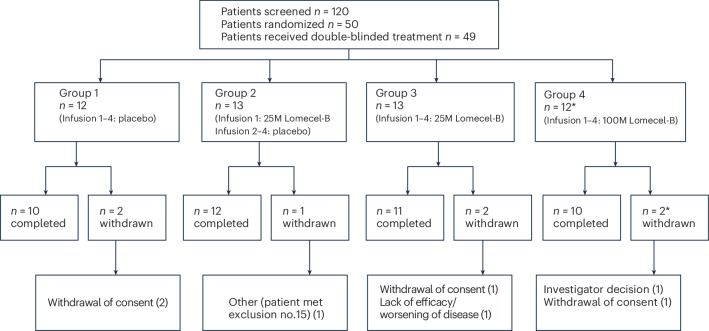
Alzheimer’s disease (AD) is characterized by progressive cognitive decline, severe brain atrophy and neuroinflammation. We conducted a randomized, double-blind, placebo-controlled, parallel-group phase 2a clinical trial that tested the safety and efficacy of laromestrocel, a bone-marrow-derived, allogeneic mesenchymal stem-cell therapy, in slowing AD clinical progression, atrophy and neuroinflammation. Participants across ten centers in the United States were randomly assigned 1:1:1:1 to four infusion groups: group 1 (placebo; four monthly infusions, n = 12); group 2 (25 million cells, one infusion followed by three monthly infusions of placebo, n = 13); group 3 (25 million cells; four monthly doses, n = 13); and group 4 (100 million cells; four monthly doses, n = 11). The study met its primary end point of safety; the rate of treatment-emergent serious adverse events within 4 weeks of any infusion was similar in all four groups: group 1, 0% (95% CI 0–26.5%); group 2, 7.7% (95% CI 0.2–36%); group 3, 7.7% (95% CI 0.2–36%) and group 4, 9.1% (95% CI 0.2–41.3%). Additionally, there were no reported infusion-related reactions, hypersensitivities or amyloid-related imaging abnormalities. Laromestrocel improved clinical assessments at 39 weeks compared to placebo, as measured by a composite AD score (secondary end point was met: group 2 versus placebo change: 0.38; 95% CI −0.06–0.82), Montreal cognitive assessment and the Alzheimer’s Disease Cooperative Study Activities of Daily Living. At 39 weeks, Laromestrocel slowed the decline of whole brain volume compared to placebo ( n = 10) by 48.4% for all treatment groups combined (groups 2–4: P = 0.005; n = 32) and left hippocampal volume by 61.9% (groups 2–4, P = 0.021; n = 32), and reduced neuroinflammation as measured by diffusion tensor imaging. The change in bilateral hippocampal atrophy correlated with the change in mini-mental state exam scores ( R = 0.41, P = 0.0075) in all study patients ( N = 42). Collectively these results support safety of single and multiple doses of laromestrocel treatment for mild AD and provide indications of efficacy in combating decline of brain volume and potentially cognitive function. Larger-scale clinical trials of laromestrocel in AD are warranted. ClinicalTrials.gov registration: NCT05233774 .
Overview
CoChat Summary
TL;DR
In a randomized, double-blind, placebo-controlled phase 2a trial in 49 patients with mild Alzheimer’s disease, intravenous laromestrocel met its primary safety endpoint and showed signals of slowed clinical and brain-volume decline versus placebo. The authors conclude that larger-scale trials of laromestrocel in Alzheimer’s disease are warranted.
Key findings
- The primary safety endpoint was met: treatment-emergent serious adverse events within 4 weeks of any infusion occurred in 0% of placebo (95% CI 0–26.5%), 7.7% of group 2 (95% CI 0.2–36%), 7.7% of group 3 (95% CI 0.2–36%) and 9.1% of group 4 (95% CI 0.2–41.3%). There were no infusion-related reactions, hypersensitivities, amyloid-related imaging abnormalities or deaths.
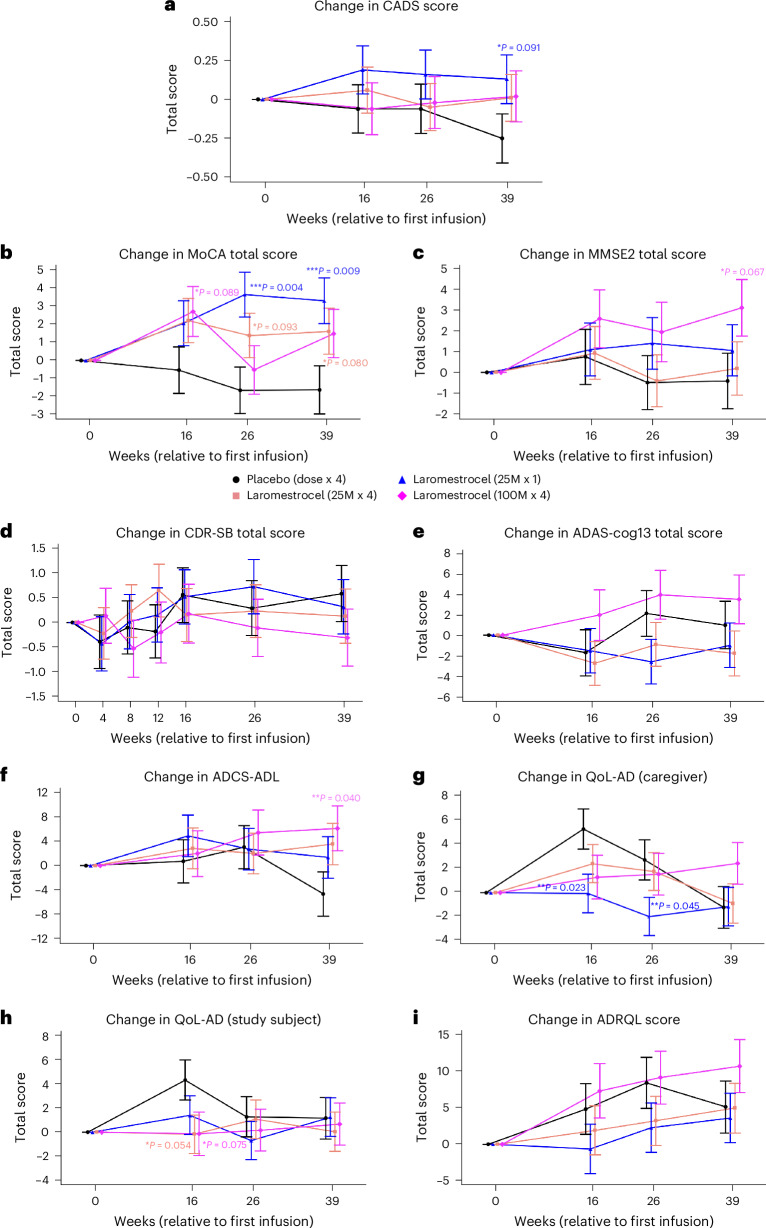
- The secondary composite Alzheimer’s disease score endpoint was met for group 2 versus placebo (change 0.38; 95% CI −0.06–0.82; P = 0.091; pre-specified P < 0.1). MoCA improved significantly for group 2 (P = 0.009; n = 11) and combined groups 2–4 (P = 0.015; n = 32); ADCS-ADL improved significantly for group 4 (P = 0.040; n = 10); MMSE-2 trended for group 4 (P = 0.067; n = 10); CDR-SB and ADAS-Cog13 were not statistically different from placebo.
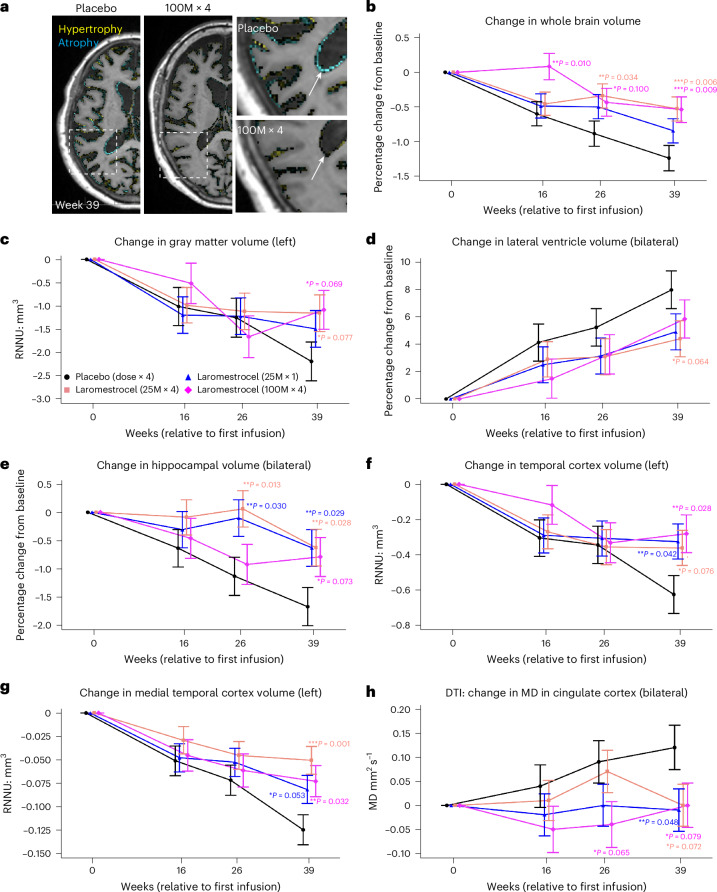
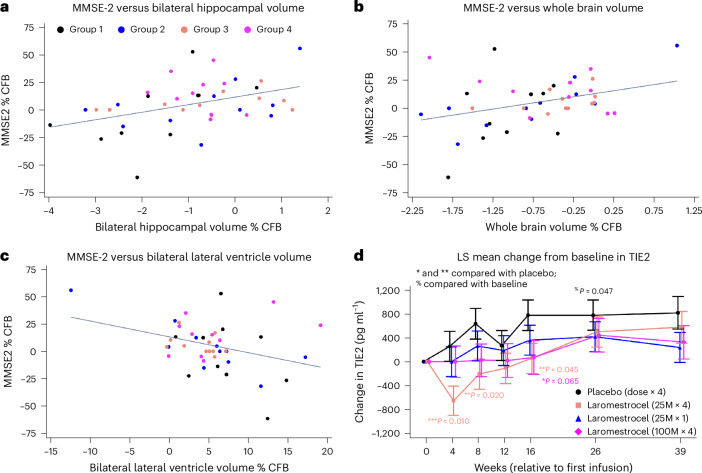
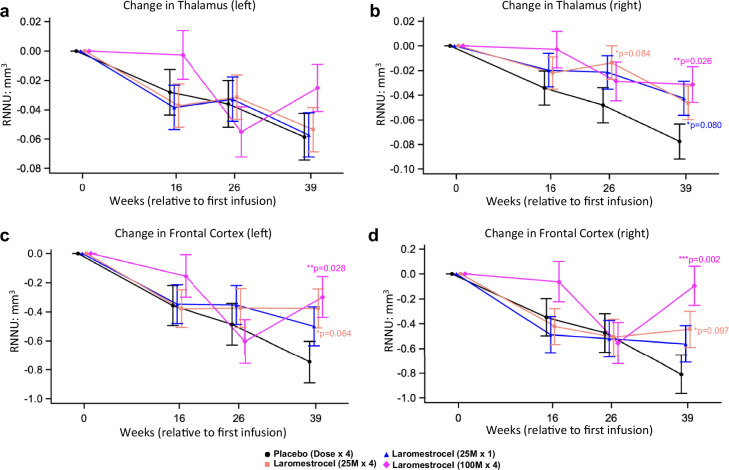
- Imaging showed slowed whole brain atrophy by 48.4% for combined treatment groups 2–4 versus placebo (P = 0.005; n = 32) and slowed left hippocampal volume decline by 61.9% (P = 0.021; n = 32). DTI mean diffusivity in cingulate cortex improved significantly for group 2 (P = 0.048; n = 11), and change in bilateral hippocampal atrophy correlated with change in MMSE-2 scores (R = 0.41; P = 0.0075; N = 42).
- Serum soluble TIE2 rose progressively in placebo (P = 0.047 at week 26; n = 11) and was significantly reduced by laromestrocel in group 3 at week 4 (P = 0.01), week 8 (P = 0.02) and week 16 (P = 0.045).
Methods
- Randomized, double-blind, placebo-controlled, parallel-group phase 2a trial at ten US centers. Participants were assigned 1:1:1:1 to placebo (n = 12), 25 million cells × 1 (n = 13), 25 million cells × 4 (n = 13) or 100 million cells × 4 (n = 11); 49 received treatment and were analyzed for safety (ITT), and 48 completed at least one post-baseline efficacy assessment (mITT). Infusions were given on day 0 and weeks 4, 8 and 12, with follow-up to week 39.
- Primary endpoint: proportion of patients with treatment-emergent serious adverse events within 4 weeks of any infusion. Secondary endpoint: change from baseline to week 39 in a novel Composite Alzheimer’s Disease Score. Exploratory endpoints included MoCA, MMSE-2, CDR-SB, ADAS-Cog13, ADCS-ADL, quality-of-life measures, volumetric MRI, diffusion tensor imaging and serum biomarkers including sTIE2.
- Safety used Clopper–Pearson exact confidence intervals. Efficacy endpoints used mixed models for repeated measures with fixed effects for visit, treatment group, visit-by-treatment interaction, sex and baseline value, plus patient as a random effect; analyses were conducted in SAS v9.4. No adjustment for multiple comparisons was made, and CADS statistical significance was pre-set at P < 0.10.
Limitations
- Stated: relatively small sample size with a high proportion of patients of Hispanic ethnicity, and some variables such as patient education level were not ascertained; the 39-week study duration was relatively short for trials of disease-modifying agents in early Alzheimer’s disease; and the CADS is not a validated composite endpoint.
- Stated/evident: the study was not powered to detect a statistically significant difference in CADS; assuming a two-sided α of 0.1, power to detect 50% slowing of disease progression comparing three active arms combined (n = 36) versus placebo (n = 12) was 36% at 6 months.
- Evident: no adjustment for multiple comparisons was performed across many clinical, imaging and biomarker endpoints, and small per-group sample sizes limit the precision and interpretability of the exploratory efficacy signals.
Model-written summary. Check it against the paper before relying on it.
Integrity signals
Registry
Cites
Statistics
Figures
Verification
Claims the paper makes
0 Valid · 0 Not valid · 27 Not checked · 138 Own results and interpretations
A result the paper reports from its own data — it cites no other source for it, so there is none to check. The quote shows it is in the paper.
In the paper
“secondary end point was met: group 2 versus placebo change: 0.38; 95% CI −0.06–0.82”
§ Allogeneic mesenchymal stem cell therapy with laromestrocel in mild Alzheimer’s disease: a randomized controlled phase 2a trial > Abstract
plainstates a causen = 13- Asserted: passes — The authors put it forward as true.
- Checkable: passes — It can be checked against evidence.
- Load-bearing: passes — The paper’s conclusions depend on it.
- Based: passes — The paper gives a reason why it holds.
A result the paper reports from its own data — it cites no other source for it, so there is none to check. The quote shows it is in the paper.
In the paper
“The study met its primary end point of safety; the rate of treatment-emergent serious adverse events within 4 weeks of any infusion was similar in all four groups: group 1, 0% (95% CI 0–26.5%); group 2, 7.7% (95% CI 0.2–36%); group 3, 7.7% (95% CI 0.2–36%) and group 4, 9.1% (95% CI 0.2–41.3%).”
§ Allogeneic mesenchymal stem cell therapy with laromestrocel in mild Alzheimer’s disease: a randomized controlled phase 2a trial > Abstract
plain- Asserted: passes — The authors put it forward as true.
- Checkable: passes — It can be checked against evidence.
- Load-bearing: passes — The paper’s conclusions depend on it.
- Based: passes — The paper gives a reason why it holds.
A result the paper reports from its own data — it cites no other source for it, so there is none to check. The quote shows it is in the paper.
In the paper
“At 39 weeks, Laromestrocel slowed the decline of whole brain volume compared to placebo (n = 10) by 48.4% for all treatment groups combined (groups 2–4: P = 0.005; n = 32)”
§ Allogeneic mesenchymal stem cell therapy with laromestrocel in mild Alzheimer’s disease: a randomized controlled phase 2a trial > Abstract
plainstates a causen = 32 ·- Asserted: passes — The authors put it forward as true.
- Checkable: passes — It can be checked against evidence.
- Load-bearing: passes — The paper’s conclusions depend on it.
- Based: passes — The paper gives a reason why it holds.
A result the paper reports from its own data — it cites no other source for it, so there is none to check. The quote shows it is in the paper.
In the paper
“and left hippocampal volume by 61.9% (groups 2–4, P = 0.021; n = 32)”
§ Allogeneic mesenchymal stem cell therapy with laromestrocel in mild Alzheimer’s disease: a randomized controlled phase 2a trial > Abstract
plainstates a causen = 32 ·- Asserted: passes — The authors put it forward as true.
- Checkable: passes — It can be checked against evidence.
- Load-bearing: passes — The paper’s conclusions depend on it.
- Based: passes — The paper gives a reason why it holds.
A result the paper reports from its own data — it cites no other source for it, so there is none to check. The quote shows it is in the paper.
In the paper
“and reduced neuroinflammation as measured by diffusion tensor imaging.”
§ Allogeneic mesenchymal stem cell therapy with laromestrocel in mild Alzheimer’s disease: a randomized controlled phase 2a trial > Abstract
plainstates a cause- Asserted: passes — The authors put it forward as true.
- Checkable: passes — It can be checked against evidence.
- Load-bearing: passes — The paper’s conclusions depend on it.
- Based: passes — The paper gives a reason why it holds.
56 more claims
Create a free account to see all 165 claims and to verify the 59 references still open.
- It may state two separate claims as one. 72
- Probably not a substantial claim. 51
Self-check
Percentages, sums and reported differences re-computed from the paper’s own numbers.
Each contradiction between two passages listed here was confirmed by an independent check.
Rated major: it would touch a result — a value a result rests on, reported and recomputed p-values on opposite sides of the significance level, two passages that conflict with no sign which is right, or a cited work retracted before this paper was published.
In the paper
§ Allogeneic mesenchymal stem cell therapy with laromestrocel in mild Alzheimer’s disease: a randomized controlled phase 2a trial > Methods > Patient population
“Further criteria included APOe4 positivity, MMSE-2 score of 18–24, age 60–85 years”
§ Allogeneic mesenchymal stem cell therapy with laromestrocel in mild Alzheimer’s disease: a randomized controlled phase 2a trial > Results > Patient disposition
“| Non-carrier, n (%) | 10 (83.3) | 8 (61.5) | 7 (53.8) | 10 (90.9) | 35 (71.4) | |”
Rated minor: it would not touch a result — a value no result rests on, a p-value that stays on the same side of the significance level, or a conflict that is clerical, resolved elsewhere in the paper, or outside its own findings.
In the paper
“| Heterozygous, n (%) | 2 (16.7) | 5 (41.7) | 5 (38.5) | 1 (8.3) | 13 (26.5) | |”
§ Allogeneic mesenchymal stem cell therapy with laromestrocel in mild Alzheimer’s disease: a randomized controlled phase 2a trial > Results > Patient disposition
Reported 41.7 · recomputed 38.461538
Rated minor: it would not touch a result — a value no result rests on, a p-value that stays on the same side of the significance level, or a conflict that is clerical, resolved elsewhere in the paper, or outside its own findings.
In the paper
“| Heterozygous, n (%) | 2 (16.7) | 5 (41.7) | 5 (38.5) | 1 (8.3) | 13 (26.5) | |”
§ Allogeneic mesenchymal stem cell therapy with laromestrocel in mild Alzheimer’s disease: a randomized controlled phase 2a trial > Results > Patient disposition
Reported 8.3 · recomputed 9.090909
Rated minor: it would not touch a result — a value no result rests on, a p-value that stays on the same side of the significance level, or a conflict that is clerical, resolved elsewhere in the paper, or outside its own findings.
In the paper
§ Allogeneic mesenchymal stem cell therapy with laromestrocel in mild Alzheimer’s disease: a randomized controlled phase 2a trial > Discussion
“repeated dosing (groups 3 and 4) produced better responses than single dosing (group 1) in 27 of 35 total clinical and vMRI measures”
§ Allogeneic mesenchymal stem cell therapy with laromestrocel in mild Alzheimer’s disease: a randomized controlled phase 2a trial > Results > Patient disposition
“group 1, placebo infusions once per month for 4 months (n = 12); group 2, 25 million cells at day 0 followed by three monthly infusions of placebo”
Rated minor: it would not touch a result — a value no result rests on, a p-value that stays on the same side of the significance level, or a conflict that is clerical, resolved elsewhere in the paper, or outside its own findings.
In the paper
§ Allogeneic mesenchymal stem cell therapy with laromestrocel in mild Alzheimer’s disease: a randomized controlled phase 2a trial > Methods > Study design and enrollment
“Three SAEs occurred during the study and were unrelated to the treatment.”
§ Allogeneic mesenchymal stem cell therapy with laromestrocel in mild Alzheimer’s disease: a randomized controlled phase 2a trial > Results > Primary outcome
“| Total number of TE-SAEs | n | 0 | 1 | 2 | 3 | 6 |”
1 more finding
Create a free account to see every finding of this check.
Citations
Cites
The Montreal Cognitive Assessment, MoCA: a brief screening tool for mild cognitive impairment
Nasreddine, Z. S., Phillips, N. A., Bédirian, V., Charbonneau, S., Whitehead, V., Collin, I., Cummings, J. L., & Chertkow, H. (2005) · Journal of the American Geriatrics Society · doi:10.1111/j.1532-5415.2005.53221.x · Cited by 25,553
Kok, J. S., Berg, I. J., & Scherder, E. J. A. (2013) · Dementia and Geriatric Cognitive Disorders Extra · doi:10.1159/000353441 · Cited by 20,589
The Neuropsychiatric Inventory: Comprehensive assessment of psychopathology in dementia
Cummings, J. L., Mega, M., Gray, K., Rosenberg-Thompson, S., Carusi, D. A., & Gornbein, J. (1994) · Neurology · doi:10.1212/wnl.44.12.2308 · Cited by 7,568
Lecanemab in early Alzheimer's disease
van Dyck, C. H., Swanson, C. J., Aisen, P., Bateman, R. J., Chen, C., Gee, M., Kanekiyo, M., Li, D., Reyderman, L., Cohen, S., et al. (2023) · New England Journal of Medicine · doi:10.1056/nejmoa2212948 · Cited by 5,678
Astrocyte-endothelial interactions at the blood-brain barrier
Abbott, N. J., Rönnbäck, L., & Hansson, E. (2006) · Nature Reviews Neuroscience · doi:10.1038/nrn1824 · Cited by 5,595
Scheltens, P., De Strooper, B., Kivipelto, M., Holstege, H., Chételat, G., Teunissen, C. E., Cummings, J., & van der Flier, W. M. (2021) · The Lancet · doi:10.1016/s0140-6736(20)32205-4 · Cited by 5,465
Gauthier, S., Reisberg, B., Zaudig, M., Petersen, R. C., Ritchie, K., Broich, K., Belleville, S., Brodaty, H., Bennett, D., Chertkow, H., et al. (2006) · The Lancet · doi:10.1016/s0140-6736(06)68542-5 · Cited by 3,850
Donanemab in Early Symptomatic Alzheimer Disease: The TRAILBLAZER-ALZ 2 Randomized Clinical Trial
Sims, J. R., Zimmer, J. A., Evans, C. D., Lu, M., Ardayfio, P., Sparks, J., Wessels, A. M., Shcherbinin, S., Wang, H., Monkul Nery, E. S., et al. (2023) · JAMA · doi:10.1001/jama.2023.13239 · Cited by 2,932
Self-citationInflammation as a central mechanism in Alzheimer's disease
Kinney, J. W., Bemiller, S. M., Murtishaw, A. S., Leisgang, A. M., Salazar, A. M., & Lamb, B. T. (2018) · Alzheimer's & Dementia: Translational Research & Clinical Interventions · doi:10.1016/j.trci.2018.06.014 · Cited by 2,253
Mesenchymal stem cell perspective: cell biology to clinical progress
Pittenger, M. F., Discher, D. E., Péault, B. M., Phinney, D. G., Hare, J. M., & Caplan, A. I. (2019) · npj Regenerative Medicine · doi:10.1038/s41536-019-0083-6 · Cited by 2,008
Self-citation
Cited by
CRISPR/Cas9 and iPSC-Based Therapeutic Approaches in Alzheimer’s Disease
Raffaele, I., Cipriano, G. L., Anchesi, I., Oddo, S., & Silvestro, S. (2025) · Antioxidants · doi:10.3390/antiox14070781 · Cited by 34
He, C., Chen, B., Yan, C., & Zhou, X. (2025) · Frontiers in Genome Editing · doi:10.3389/fgeed.2025.1612868 · Cited by 22
Randomized phase 2b dose-escalation trial of stem cell therapy with laromestrocel for aging frailty
Ruiz, J. G., Oliva, A. A., Ramdas, K. N., Javier, J., Rosen, J., Perry, R., Blanco, A., Ylisastigui, P. P., Walston, J. D., Arai, H., et al. (2026) · Cell stem cell · doi:10.1016/j.stem.2026.01.017 · Cited by 20
Self-citationClinical translational research on stem cell products: prospects and challenges
Chen, S., ZHANG, L., Ren, Y., Bai, X., Wei, X., Chai, M., 崔苏甦, Zhao, X., & Deng, H. (2026) · Signal Transduction and Targeted Therapy · doi:10.1038/s41392-026-02582-y · Cited by 18
Recent advances in CAR-MSCs: the new engine of cellular immunotherapy evolution
Chen, Y., Li, J., Ma, Y., Fang, J., Yang, Y., Yan, L., Zhang, X., & Zhang, C. (2025) · Journal of Hematology & Oncology · doi:10.1186/s13045-025-01746-7 · Cited by 15
Shi, M., Chu, F., & Zhu, J. (2025) · Pharmacological Research · doi:10.1016/j.phrs.2025.107960 · Cited by 15
Sheng, L., Zheng, X., Zhao, D., Liu, J., & Song, W. (2025) · Frontiers in Neurology · doi:10.3389/fneur.2025.1522485 · Cited by 14
The drug discovery and therapeutic nano-strategies targeting cellular senescence
Wang, Y., Liu, M., Chen, X., Wang, S., Li, J., Sun, Y., Zheng, X., Zhang, J.-X., & Li, H. (2025) · Materials Today Bio · doi:10.1016/j.mtbio.2025.102480 · Cited by 13
Mesenchymal stem cells and exosomes: A novel therapeutic approach for aging
Lan, D., Zhang, D., Dai, X., Ji, C., Zhou, H., Song, T., Wang, X., Kong, Q., Tang, Z., Tan, J., et al. (2025) · Experimental Gerontology · doi:10.1016/j.exger.2025.112781 · Cited by 12
Signs of Alzheimer’s Disease: Tied to Aging
Chen, J., Zhu, Z., & Xu, Y. (2025) · International Journal of Molecular Sciences · doi:10.3390/ijms26114974 · Cited by 12
Neuroimmune Dysregulation and AI-Driven Therapeutic Strategies in Alzheimer’s Disease
Ghosh, S., Bhaskar, R., Singh, K. K., Sharma, S., Yarlagadda, B., Sinha, J. K., & Han, S. S. (2025) · Cellular and Molecular Neurobiology · doi:10.1007/s10571-025-01651-0 · Cited by 11
Mesenchymal Stem Cell-Based Therapies Applied in Neurological Diseases: A Systematic Review
Trabulo, A., Sousa, P., Alvites, R., & Maurício, A. C. (2026) · Biomedicines · doi:10.3390/biomedicines14020475 · Cited by 11
Rationale and emerging evidence for microglial replacement in Alzheimer’s disease
Bang, J. Y., & Yoo, Y. (2025) · Molecules and Cells · doi:10.1016/j.mocell.2025.100265 · Cited by 9
Stem cell therapies advance in Parkinson’s disease and beyond
Healey, N. (2025) · Nature Medicine · doi:10.1038/d41591-025-00036-6 · Cited by 7
Kim, A.-L., Lee, W. K., Kwon, S., Han, I. B., & Choi, B. H. (2026) · Tissue Engineering and Regenerative Medicine · doi:10.1007/s13770-025-00782-1 · Cited by 6
Stem cell-based therapeutic strategies for down syndrome and Alzheimer’s disease
Hamadelseed, O., & Skutella, T. (2025) · Stem Cell Research & Therapy · doi:10.1186/s13287-025-04556-3 · Cited by 6
Nakazaki, M., Lankford, K. L., Ukai, R., Hirota, R., Oka, S., Sasaki, M., Kocsis, J. D., & Honmou, O. (2026) · Frontiers in Cellular Neuroscience · doi:10.3389/fncel.2026.1819046 · Cited by 6
Mesenchymal stem cells and secretome as modulators of neuroinflammation in neurological disorders
Yao, D., Nie, L., Liu, X., Wu, X., Tang, Y., Pan, C., Chen, S., Chen, D., Wu, D., Nie, H., et al. (2026) · Journal of Translational Medicine · doi:10.1186/s12967-026-08052-x · Cited by 6
Kerestély, M., Narozsny, I., Szarka, L., Veres, D. V., Csermely, P., & Keresztes, D. (2026) · Advanced Science · doi:10.1002/advs.202522532 · Cited by 6
Oncolytic Therapy: Delivery System and New Therapeutic Strategies for Cancer
Jin, S., Zhang, Y., Zhou, Z., Zhang, Y., Yu, T., Xu, R., Xu, L., Zhang, J., Zhang, L., Yang, S., et al. (2026) · MedComm · doi:10.1002/mco2.70725 · Cited by 5
Alzheimer’s disease: where do we stand now and what are the strategic interventions?
González, A., Geywitz, S., & Maccioni, R. B. (2025) · Frontiers in Cellular Neuroscience · doi:10.3389/fncel.2025.1655342 · Cited by 5
Chiral Spindle-like Nanorods Reprogram Neuroinflammation by Catalyzing α-Ketoglutarate Biosynthesis
Dong, J., Xu, L., Xu, X., Shi, B., Wang, Q., Xu, J., Xu, C., Kuang, H., & Qu, A. (2026) · Journal of the American Chemical Society · doi:10.1021/jacs.5c19753 · Cited by 4
Zecca, V., Palombelli, G., Vanacore, N., & Canese, R. (2026) · Journal of Magnetic Resonance Imaging · doi:10.1002/jmri.70296 · Cited by 4
Aligning Intrinsic Capacity and Geroscience: Linking Function with Biology
Zhu, S. N., Tao, L., Fan, C., Wei, Y., Chhetri, J. K., & Chan, P. (2025) · Aging and Disease · doi:10.14336/ad.2025.1419 · Cited by 4
Early-stage research and new pharmacological targets in Alzhei-mer's dementia
Grecu, M., Romila, A., Moldovanu, S., Condratovici-Plesa, A., Anghel, L., Oprea, V. D., & Bocancia, L. A. (2026) · Balneo and PRM Research Journal · doi:10.12680/balneo.2026.1024 · Cited by 3
Neuroprotective effects of ursodeoxycholic acid in Parkinson's disease and Alzheimer's disease
Chong, A. E. Y., Sasmita, A. O., Koh, R. Y., & Ling, A. P. K. (2026) · Neuroprotection/Neuroprotection (Chichester, England. Print) · doi:10.1002/nep3.70039 · Cited by 3
Huang, Y., Ikawa, M., Nogami, M., Mori, T., Makino, A., Kitazaki, Y., Mizuno, T., Kosaka, H., Kiyono, Y., Nishiyama, Y., et al. (2025) · Journal of Neural Transmission · doi:10.1007/s00702-025-03081-0 · Cited by 3
Gray matter structural and molecular signatures in Alzheimer's disease and late-life depression
Yang, S., Wang, X., Yan, Y., Zhang, J., Wei, Y., Zhang, D., & Yao, W. (2025) · Journal of Affective Disorders · doi:10.1016/j.jad.2025.120915 · Cited by 3
Viral and non-viral cellular therapies for neurodegeneration
Srivastav, J., & Sharma, S. (2026) · Frontiers in Medicine · doi:10.3389/fmed.2025.1718669 · Cited by 3
The puzzling duality of mesenchymal stem cells and adipocytes in bone marrow and ageing
Gonzalez-Garcia, B., Aparicio, C., Rocio, A., Muriana, F. J. G., & Jaramillo-Carmona, S. M. (2026) · npj Aging · doi:10.1038/s41514-026-00353-1 · Cited by 3
Kademani, A., Avraam, C., Montenegro, D., Paloh, A., Somannagari, N., Gupta, A., Lafi, A. W., Algaba, A. E., Islam, R., Fahima, C., et al. (2025) · Cureus · doi:10.7759/cureus.89629 · Cited by 3
Cellular Senescence and Aging: Mechanisms, Disease Convergence, and Therapeutic Frontiers
Cai, G., Ren, J., Wang, L., Wu, Y., Wang, H., Cao, X., Shang, H., Hou, X., Wang, Y., Xue, H., et al. (2026) · MedComm · doi:10.1002/mco2.70827 · Cited by 2
Nguyen, L. T., Nguyen, K. T., Dao, L. T. M., Hoang, V. H., Phan, T. T. K., Dinh, N. H., Nguyen, H. T., Nguyen, A. T. P., Nguyen, T. T. N., Ho, T. T. K., et al. (2026) · EBioMedicine · doi:10.1016/j.ebiom.2026.106268 · Cited by 2
Friend or foe? Glial–vascular interactions in health and neurodegenerative disease
McQuaid, C., Sewell, M. D. E., & Montagne, A. (2026) · Pharmacological Reviews · doi:10.1016/j.pharmr.2026.100143 · Cited by 2
Chen, N., Wang, S., Liu, J., Zheng, X., & Shang, H. (2026) · Journal of Nanobiotechnology · doi:10.1186/s12951-026-04154-2 · Cited by 2
Zhang, Z., Lv, M., Hu, W., Xu, J., Liu, S., Yang, B., Zhang, F., & Fan, Z. (2026) · Advanced Functional Materials · doi:10.1002/adfm.202529220 · Cited by 2
Tonelli, R., Pischiutta, F., Elice, F., Zanier, E. R., Grisendi, G., Astori, G., Samarelli, A. V., Bruzzi, G., Manicardi, L., Spano, C., et al. (2025) · Cytotherapy · doi:10.1016/j.jcyt.2025.04.059 · Cited by 2
Mesenchymal stem cell therapy for pulmonary hypertension: an update
Tian, R., Xu, S., Liu, C., Wang, Y., Wu, Y., Li, L., & Liu, J. (2025) · Frontiers in Bioengineering and Biotechnology · doi:10.3389/fbioe.2025.1692396 · Cited by 2
Wen, Y., Zhan, S., Duan, Y., Pang, M., Jh, Y., Deng, M., & Fan, H. (2026) · Stem Cells and Development · doi:10.1177/15473287261468404 · Cited by 1
An overview of gene and cell therapy approaches for Alzheimer’s disease
Heidari, Z., Zakaee, A., Vafadar, A., Alavimanesh, S., Charami, H., Jamali, Z., Jahromi, A. H., Rakhsha, A., & Savardashtaki, A. (2025) · Metabolic Brain Disease · doi:10.1007/s11011-025-01763-y · Cited by 1
Xiang, L., Xiao, Y., Cai, M., Qin, J., Wang, T., Xiang, X., Ke, J., & Peng, G. (2026) · Interactive Journal of Medical Research · doi:10.2196/83709 · Cited by 1
Clinical Trials of Cell Products for the Treatment of Alzheimer’s Disease (Review)
Voronova, A. D., Karsuntseva, E. K., Shishkina, V. S., Chadin, A. V., Fursa, G. A., Gurin, P. I., Kuznetsova, T. V., Reshetov, I. V., Шпорт, С. В., Stepanova, O. V., et al. (2025) · Bulletin of Experimental Biology and Medicine · doi:10.1007/s10517-026-06590-4 · Cited by 1
Chen, F., Ge, Y., Zhang, L., Huang, J., Feng, F., Kuang, N., Luo, Y., Huang, N., & Wu, J. (2026) · Ageing Research Reviews · doi:10.1016/j.arr.2026.103350 · Cited by 1
Lao, Z.-K., & Xu, N. (2026) · Translational Neurodegeneration · doi:10.1186/s40035-026-00546-4 · Cited by 1
He, Z., Zeng, J., Wang, G., Li, Y., & Zhang, F. (2026) · MedComm · doi:10.1002/mco2.71090 · Cited by 1
Global trends in R&D translation and industrial development of cell and gene therapy
Fan, Y.-L., Xue-Chen, W. U., Ji, Y., Sai, Z. H. O. U., Bi-Yun, S. H. U., & Kai-Yun, M. A. O. (2026) · Shengming kexue · doi:10.3724/cbls.2026031 · Cited by 1
Kim, S., Jung, Y., & Lee, H.-Y. (2026) · Advanced Science · doi:10.1002/advs.76207 · Cited by 1
Engineered mechanosensitive MSCs enable synthetic radiotheranostic targeting across tumor types
Yang, X., Yin, Q., Li, K., Wang, J., Song, R., Zhou, H., Han, S., Zhang, L., Zeng, Y., Xu, D., et al. (2026) · Cell stem cell · doi:10.1016/j.stem.2026.07.015 · Cited by 1
Stem Cell Therapy: Past, Present, and Future Aspects
Alim, E., Greenwell, A., Hess, R., Blanco, N., Torres, J. H., & Şahiner, N. (2026) · Biomedicines · doi:10.3390/biomedicines14071443 · Cited by 1
Senescence of T cells and organ aging
Ohyagi, M., Ito, M., & Yoshimura, A. (2026) · Inflammation and Regeneration · doi:10.1186/s41232-026-00419-3 · Cited by 1
Cendelín, J., Kučera, R., & Manto, M. U. (2026) · Contemporary clinical neuroscience · doi:10.1007/978-3-032-18296-8_25
Yang, S., Zhou, X., Zhang, J. N., Na.PAN, Liu, M., & Song, H. (2026) · Brain Research Bulletin · doi:10.1016/j.brainresbull.2026.112056
Su, R., & Yang, Q.-Y. (2026) · New cell · doi:10.61958/ncjg8269
Mesenchymal Stromal Cell Rejuvenation Strategies to Enhance Clinical Translation in Cell Therapy
Sodomaco, A., Bernardi, I., Rambaldi, A., Lombardi, P., Rossi, M., Paris, F., Manzoli, L., Ratti, S., & Alviano, F. (2026) · Aging Cell · doi:10.1111/acel.70672
Lei, L., Hu, X., Lu, R., Yang, J., & Meng, Q. (2026) · CNS Neuroscience & Therapeutics · doi:10.1002/cns.71151
Reshaping the immune landscape: next-generation microglia-targeted therapies for Alzheimer’s disease
Wu, J., Zhao, J. J., Chen, S. Y., & Xu, F. (2026) · Biological Research · doi:10.1186/s40659-026-00716-8
Applications of Mesenchymal Stromal Cells for Treatment of Diseases
薛冬梅, Li, Y., & Wu, L. (2026) · MedComm · doi:10.1002/mco2.70971
Bach, D., Hoang, V. H., & Nguyễn, T. L. (2026) · Molecular Neurobiology · doi:10.1007/s12035-026-06193-0
Shishkina, V. S., Pokidko, V. Y., Mukhina, A. I., Voronova, A. D., Karsuntseva, E. K., Fursa, G. A., Chadin, A. V., Masenko, V. P., Stepanova, O. V., & Chekhonin, V. P. (2026) · Molecular Biology · doi:10.1134/s0026893326700172
Tiwari, A., & Bissa, B. (2026) · Advances in pharmacology · doi:10.1016/bs.apha.2026.07.009
Gogu, M.-R., Costăchescu, I., Stanciu, G. D., Tamba, B.-I., Ciorpac, M., & Gorgan, L. (2026) · Pharmaceuticals · doi:10.3390/ph19101603
Multiple target strategies in Alzheimer's disease therapy
Ma, X., Sun, H., & Ye, J. (2026) · Acta Pharmaceutica Sinica B · doi:10.1016/j.apsb.2026.10.018
Lu, W., Yan, J., & Feng, H. (2026) · CNS Neuroscience & Therapeutics · doi:10.1002/cns.71211
Mullagulova, A. I., Sidorova, A. S., Luzina, E. A., Sufianov, A. A., Суфианова, Г. З., Zaynutdinov, A. M., Rizvanov, A. A., & Solovyeva, V. V. (2026) · Cells · doi:10.3390/cells15171540
Stem Cell Therapy in Alzheimer’s Disease: a Scoping Review of Safety, Efficacy and Clinical Insights
Maity, P., Nayak, A. S., Sharma, G., Sinha, S., Nanda, K. N., Das, C. C., Das, S., Kaur, R., & Bagade, T. (2026) · Current Stem Cell Reports · doi:10.1007/s40778-026-00263-8
Long, Z., Guo, H., & Sun, L. (2026) · Frontiers in Immunology · doi:10.3389/fimmu.2026.1965598
Lysozyme Aggregates Induce Apoptosis and Necroptosis in Adipose Mesenchymal Stem CellsPreprint
Avizheh, S., Emadi, S., & Akbari‐Birgani, S. (2026) · Research Square · doi:10.21203/rs.3.rs-8514014/v1
童军辉, Li, F., Cai, J., Xing, H., Guo, S., & Ren, L. (2026) · Journal of Neurorestoratology · doi:10.1016/j.jnrt.2026.100347
Stem Cells and Cellular Therapies
Minden, A. (2026) · Springer eBooks · doi:10.1007/978-3-032-20529-2_26
Stefański, M., Racki, E., Traczyk, N., Wiak, B., Jaguszewska, J., Wieliczko, K., Natalia Zych, M. J.-H., Izabela Truchel, J. S., Monika Łapot, W. G., Nataliia Yushchuk, A. I., et al. (2026) · African Journal of Biomedical Research · doi:10.69980/p3pezf52
Liu, J. T., Li, D. Y., Wu, S., & Liu, N. (2026) · Stem Cell Reviews and Reports · doi:10.1007/s12015-026-11157-x
Baran, J., Drabik, A., Bebrysz, E., Dunder, I., Koss, M., Biszewski, M., Dębek-Kalinowska, K., Bartnik, P., Palmi, J., & Ziomek, W. (2025) · International Journal of Innovative Technologies in Social Science · doi:10.31435/ijitss.3(47).2025.3693
Ding, L., Yu, W., Chen, Y., Wang, H., Li, S., Li, H., Shu, T., Huang, X., Yang, Y., Liu, R., et al. (2026) · CNS Neuroscience & Therapeutics · doi:10.1002/cns.71215
Anais do VI Congresso Internacional em Ciências da Saúde Única - Resumos Expandidos
Fernandes, A. P., Barbosa, F. P. D. S., & de Fontes-Junior, A. A. (2026) · doi:10.62642/tec-978-65-83199-39-3
The 2025 yearbook of neurorestoratology
Huang, H., Wang, J., He, J., Hu, Y., Sanberg, P. R., Sharma, H. S., Siniscalco, D., Chen, X., Bach, J. R., Andrews, R. J., et al. (2026) · Journal of Neurorestoratology · doi:10.1016/j.jnrt.2026.100348
Pan, L., Liu, B., Xu, J., Mu, X., & Fan, L. (2026) · International Journal of Nanomedicine · doi:10.2147/ijn.s628071
Rash, B. G., Levitina, S., Botbyl, J. D., Conklin, C. J., Ingalhalikar, M., & Hare, J. M. (2026) · medRxiv · doi:10.64898/2026.09.16.26363132
Self-citationTerapia con células madre en la enfermedad de Alzheimer
García, A. B., & Oliván García, S. /. M. P. (2026) · Zaguan (Universidad de Zaragoza)
Mesenchymal stromal cells and paracrine modulation of neuroplasticity in the central nervous system
Silva, S. K. E., Sanches, I. V. R., de Lima, J. S. L., & Sueur, L. D. P. L. (2026) · EXCLI journal · doi:10.17179/excli2026-9599
Influência do zinco sobre aspectos imunomodulatórios das células-tronco mesenquimais
Makiyama, E. N. (2025) · Digital Library of Theses and Dissertations (Universidade de São Paulo) · doi:10.11606/d.9.2025.tde-06022026-141056
Liu, Y. (2026) · Theoretical and Natural Science · doi:10.54254/2753-8818/2026.33915
Gupta, R. V., Lakhanpal, S., Gupta, S., Rawat, J. M., Ravi, K., Abomughaid, M. M., Jha, N. K., Singh, K. K., & Kumar, N. (2026) · Translational research · doi:10.1016/j.trsl.2026.11.006
Beyond Amyloid: Stem Cell Therapy Targets Neurodegeneration in Alzheimer’s Disease
Li, C., Hu, Q., Wang, Q., & Xie, C. (2025) · Neuroscience Bulletin · doi:10.1007/s12264-025-01561-7
Montacir, H., Biskup, K., Sittinger, M., Tauber, R., & Blanchard, V. (2026) · PROTEOMICS · doi:10.1002/pmic.70124
Ge, Y., Zhang, L., Huang, X., Huang, J., Wu, J., Huang, N., & Luo, Y. (2026) · Frontiers in Cell and Developmental Biology · doi:10.3389/fcell.2026.1990844
Metadata
- Authors
- Rash, B. G., Ramdas, K. N., Agafonova, N., Naioti, E., McClain-Moss, L., Zainul, Z., Varnado, B., Peterson, K., Brown, M., Leal, T., Kopcho, S., Carballosa, R., Patel, P., Brody, M., Herskowitz, B., Fuquay, A., Rodriguez, S., Jacobson, A. F., Leon, R., Pfeffer, M., Schwartzbard, J. B., Botbyl, J., Oliva, A. A., & Hare, J. M.
- Affiliations
- Brain Matters Research (US)
- University of Miami (US)
- Corresponding author
- Rash, Brian G.
- Hare, Joshua M.
- ORCID
- Venue
- Nature Medicine
- Published
- 2025-03-10
- Volume
- 31
- Issue
- 4
- Pages
- 1257-1266
- ISSN
- 1078-8956 (ISSN-L)
- 1546-170X
- PMC
- PMC12003194
- OpenAlex
- W4408275973
- Semantic Scholar
- c8e073df2d77fe10338bf2127ff058bf30099855
- Cited by
- 86
- References
- 68
- Citations by year
- 2026: 62 · 2025: 24
- FWCI
- 20.87
- Type
- journal article
- Language
- en
- Open access
- hybrid
- doi.org
- Licence
- cc-by
- creativecommons.org/licenses/by/4.0 (tdm)
- creativecommons.org/licenses/by/4.0 (vor)
- Locations
- Nature Medicine (publishedVersion, cc-by)
- PubMed Central (publishedVersion, cc-by)
- PubMed (publishedVersion)
- Funders
- National Institute on Aging (R44AG062015)
- Topics
- Life Sciences › Biochemistry, Genetics and Molecular Biology › Cell Biology › Mesenchymal stem cell research
- Life Sciences › Neuroscience › Cellular and Molecular Neuroscience › Alzheimer's disease research and treatments
- Health Sciences › Medicine › Psychiatry and Mental health › Dementia and Cognitive Impairment Research
- Keywords
- allogeneic mesenchymal stem cells, bone marrow-derived stem cells, Alzheimer's disease, mild Alzheimer's disease, stem cell therapy, brain atrophy, hippocampal volume, neuroinflammation, cognitive decline, treatment safety, diffusion tensor imaging, Montreal Cognitive Assessment, activities of daily living, amyloid imaging, treatment-emergent adverse events
- MeSH terms
- Aged, Aged, 80 and over, Alzheimer Disease, Brain, Double-Blind Method, Female, Humans, Magnetic Resonance Imaging, Male, Middle Aged, Transplantation, Homologous, Treatment Outcome, Mesenchymal Stem Cell Transplantation, Mesenchymal Stem Cells
About these checks
Registry, retraction, Cites and statistics results are computed, not judged, with one exception: a printed reference that no index lists is read once by a model before it counts as a citation error. Claims are extracted by a model and kept only when their quote appears verbatim in the text; each cited source is then checked, with a model’s help, for whether it says what the claim relies on. Those verdicts can be wrong — read the claim’s quote and the cited source before relying on one.
A language model drew the claims from the paper on 2026-11-27, under version 3 of the claim definition (model deepseek-v4.1-flash, prompt extract-v3).
A second model labelled each claim on 2026-11-27 (model jev-1.13-20260917, definition revision gold-guideline-v0.2).
Statistics and arithmetic are recomputed, not judged.
Confidence bands are shown only for fields calibrated on our annotated test set. None is calibrated yet, so no band is shown.
What counts as a claim ›How we measure confidence ›How we check this ›
Are you an author, or do you see a problem with this page? Request a review
Data sources
Bibliographic data: Semantic Scholar, OpenAlex, Crossref.
Contains information from the Semantic Scholar Academic Graph Datasets, made available under the ODC Attribution License (ODC-BY 1.0).
Semantic Scholar’s data is described in: Kinney, R., et al. (2023). The Semantic Scholar Open Data Platform. arXiv:2301.10140.
