

Sensitive protein alignments at tree-of-life scale using DIAMOND
Open accessThe DOI matches its Crossref record; 32 of the 32 references it cites were found in a registry or an index.
Abstract
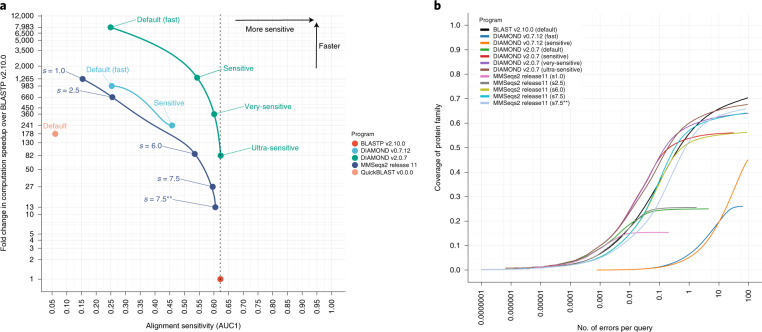
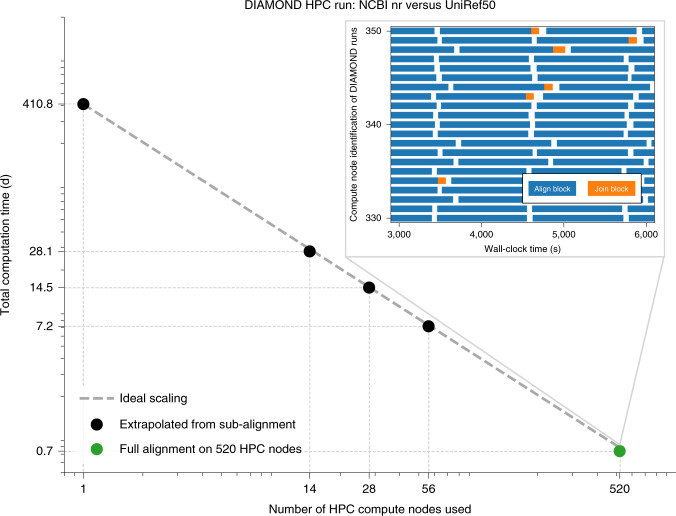
We are at the beginning of a genomic revolution in which all known species are planned to be sequenced. Accessing such data for comparative analyses is crucial in this new age of data-driven biology. Here, we introduce an improved version of DIAMOND that greatly exceeds previous search performances and harnesses supercomputing to perform tree-of-life scale protein alignments in hours, while matching the sensitivity of the gold standard BLASTP.
Overview
The claims and statistics of this paper haven’t been checked yet.
Free: it reads the open-access text and checks the first 5 claims that cite a source we can check. Create a free account to check every claim.
Integrity signals
Registry
Cites
Statistics
Figures
Verification
Claims the paper makes
The claims and statistics of this paper haven’t been checked yet.
Free: it reads the open-access text and checks the first 5 claims that cite a source we can check. Create a free account to check every claim.
Self-check
Percentages, sums and reported differences re-computed from the paper’s own numbers.
The self-check needs the paper’s full text.
Citations
Cites
Gapped BLAST and PSI-BLAST: a new generation of protein database search programs
Altschul, S. (1997) · Nucleic Acids Research · doi:10.1093/nar/25.17.3389 · Cited by 73,302 · cited 2×
“If required, the tantan masking can be replaced by the more conservative default BLASTP SEG masking and composition-based statistics using the option --comp-based-stats 3 (ref.”
MethodInfluentialSearch and clustering orders of magnitude faster than BLAST
Edgar, R. C. (2010) · Bioinformatics · doi:10.1093/bioinformatics/btq461 · Cited by 20,826
Minimap2: Pairwise alignment for nucleotide sequences
Li, H. (2018) · Bioinformatics · doi:10.1093/bioinformatics/bty191 · Cited by 14,807 · cited 1×
“23 ).”
Fast and sensitive protein alignment using DIAMOND
Buchfink, B., Xie, C., & Huson, D. H. (2015) · Nature Methods · doi:10.1038/nmeth.3176 · Cited by 14,201
Self-citationIdentification of common molecular subsequences
Smith, T. F., & Waterman, M. S. (1981) · Journal of Molecular Biology · doi:10.1016/0022-2836(81)90087-5 · Cited by 9,940
MMseqs2 enables sensitive protein sequence searching for the analysis of massive data sets
Steinegger, M., & Söding, J. (2017) · Nature Biotechnology · doi:10.1038/nbt.3988 · Cited by 4,840
Kraken: ultrafast metagenomic sequence classification using exact alignments
Wood, D. E., & Salzberg, S. L. (2014) · Genome Biology · doi:10.1186/gb-2014-15-3-r46 · Cited by 4,521
A Statistical Method for Evaluating Systematic Relationships
Sokal, R. R., & Michener, C. D. (1958) · Biodiversity Heritage Library (Smithsonian Institution) · doi:10.5281/zenodo.16435756 · Cited by 4,416
Structure and function of the global topsoil microbiome
Bahram, M., Hildebrand, F., Forslund, S. K., Anderson, J. L., Soudzilovskaia, N. A., Bodegom, P. M., Bengtsson-Palme, J., Anslan, S., Coelho, L. P., Harend, H., et al. (2018) · Nature · doi:10.1038/s41586-018-0386-6 · Cited by 2,538
UniRef: comprehensive and non-redundant UniProt reference clusters
Suzek, B. E., Huang, H., McGarvey, P., Mazumder, R., & Wu, C. H. (2007) · Bioinformatics · doi:10.1093/bioinformatics/btm098 · Cited by 1,613
The Oxford Nanopore MinION: delivery of nanopore sequencing to the genomics community
Jain, M., Olsen, H. E., Paten, B., & Akeson, M. (2016) · Genome Biology · doi:10.1186/s13059-016-1103-0 · Cited by 1,588
Adaptive seeds tame genomic sequence comparison
Kiełbasa, S. M., Wan, R., Sato, K., Horton, P., & Frith, M. C. (2011) · Genome Research · doi:10.1101/gr.113985.110 · Cited by 1,281
Protein database searches using compositionally adjusted substitution matrices
Altschul, S. F., Wootton, J. C., Gertz, E. M., Agarwala, R., Morgulis, A., Schäffer, A. A., & Yu, Y. (2005) · The FEBS Journal · doi:10.1111/j.1742-4658.2005.04945.x · Cited by 1,060
Earth BioGenome Project: Sequencing life for the future of life
Lewin, H. A., Robinson, G. E., Kress, W. J., Baker, W. J., Coddington, J., Crandall, K. A., Durbin, R., Edwards, S. V., Forest, F., Gilbert, M. T. P., et al. (2018) · Proceedings of the National Academy of Sciences · doi:10.1073/pnas.1720115115 · Cited by 962
PatternHunter: faster and more sensitive homology search
Ma, B., Tromp, J., & Li, M. (2002) · Bioinformatics · doi:10.1093/bioinformatics/18.3.440 · Cited by 829
Fox, N. K., Brenner, S. E., & Chandonia, J.-M. (2014) · Nucleic Acids Research · doi:10.1093/nar/gkt1240 · Cited by 762
Statistics of local complexity in amino acid sequences and sequence databases
Wootton, J. C., & Federhen, S. (1993) · Computers & Chemistry · doi:10.1016/0097-8485(93)85006-x · Cited by 729
Stewart, R. D., Auffret, M. D., Warr, A., Walker, A. W., Roehe, R., & Watson, M. (2019) · Nature Biotechnology · doi:10.1038/s41587-019-0202-3 · Cited by 604
Brenner, S. E., Chothia, C., & Hubbard, T. J. P. (1998) · Proceedings of the National Academy of Sciences · doi:10.1073/pnas.95.11.6073 · Cited by 530
Striped Smith–Waterman speeds database searches six times over other SIMD implementations
Farrar, M. (2007) · Bioinformatics · doi:10.1093/bioinformatics/btl582 · Cited by 415
The design, implementation, and evaluation of mpiBLAST
Darling, A. E., Carey, L. B., & Feng, W.-C. (2003) · OSTI OAI (U.S. Department of Energy Office of Scientific and Technical Information) · Cited by 378
Sort vs. Hash revisited: fast join implementation on modern multi-core CPUs
Kim, C., Kaldewey, T., Lee, V. W., Sedlar, E., Nguyen, A. D., Satish, N., Chhugani, J., Di Blas, A., & Dubey, P. (2009) · Proceedings of the VLDB Endowment · doi:10.14778/1687553.1687564 · Cited by 280
MMseqs software suite for fast and deep clustering and searching of large protein sequence sets
Hauser, M., Steinegger, M., & Söding, J. (2016) · Bioinformatics · doi:10.1093/bioinformatics/btw006 · Cited by 271
Faster Smith-Waterman database searches with inter-sequence SIMD parallelisation
Rognes, T. (2011) · BMC Bioinformatics · doi:10.1186/1471-2105-12-221 · Cited by 206
A new repeat-masking method enables specific detection of homologous sequences
Frith, M. C. (2011) · Nucleic Acids Research · doi:10.1093/nar/gkq1212 · Cited by 196
An Evolutionarily Structured Universe of Protein Architecture
Caetano-Anollés, G., & Caetano-Anollés, D. (2003) · Genome Research · doi:10.1101/gr.1161903 · Cited by 165
Advances and Applications in the Quest for Orthologs
Glover, N., Dessimoz, C., Ebersberger, I., Forslund, S. K., Gabaldón, T., Huerta-Cepas, J., Martin, M.-J., Muffato, M., Patricio, M., Pereira, C., et al. (2019) · Molecular Biology and Evolution · doi:10.1093/molbev/msz150 · Cited by 94 · cited 1×
“0.7) uses two seed shapes of weight 10 for its fast mode, 16 shapes of weight 8 and 14 shapes of weight 7 for its sensitive and very-sensitive modes, respectively, and 64 shapes of weight 7 for its ultra-sensitive mode.”
MethodInfluentialPhylogenetic Analysis of Gene Expression
Dunn, C. W., Luo, X., & Wu, Z. (2013) · Integrative and Comparative Biology · doi:10.1093/icb/ict068 · Cited by 85
Capra, J. A., Stolzer, M., Durand, D., & Pollard, K. S. (2013) · Trends in Genetics · doi:10.1016/j.tig.2013.07.001 · Cited by 63
SpEED: fast computation of sensitive spaced seeds
Ilie, L., Ilie, S., & Bigvand, A. M. (2011) · Bioinformatics · doi:10.1093/bioinformatics/btr368 · Cited by 56
The Earth BioGenome project: opportunities and challenges for plant genomics and conservation
Expósito‐Alonso, M., Drost, H., Burbano, H. A., & Weigel, D. (2019) · The Plant Journal · doi:10.1111/tpj.14631 · Cited by 50
Self-citationBuchfink, B. (2021) · Figshare · doi:10.6084/m9.figshare.c.5053112 · Cited by 2
Self-citation
Cited by
Szklarczyk, D., Kirsch, R., Koutrouli, M., Nastou, K., Mehryary, F., Hachilif, R., Gable, A. L., Fang, T., Doncheva, N. T., Pyysalo, S., et al. (2023) · Nucleic Acids Research · doi:10.1093/nar/gkac1000 · Cited by 9,726
“After the proteome is uploaded, STRING directly aligns the sequences to all sequences in its database using DIAMOND (58) (with the –iterate option).”
MethodFast and accurate protein structure search with Foldseek
van Kempen, M., Kim, S. S., Tumescheit, C., Mirdita, M., Lee, J., Gilchrist, C. L. M., Söding, J., & Steinegger, M. (2022) · doi:10.1101/2022.02.07.479398 · Cited by 2,598
Fast and accurate protein structure search with Foldseek
van Kempen, M., Kim, S. S., Tumescheit, C., Mirdita, M., Lee, J., Gilchrist, C. L. M., Söding, J., & Steinegger, M. (2024) · Nature Biotechnology · doi:10.1038/s41587-023-01773-0 · Cited by 2,596
“The most widely used approach to protein annotation and analysis is based on sequence similarity search 5–8 .”
MethodCunningham, F., Allen, J. E., Allen, J., Alvarez-Jarreta, J., Amode, M. R., Armean, I. M., Austine-Orimoloye, O., Azov, A. G., Barnes, I., Bennett, R., et al. (2022) · Nucleic Acids Research · doi:10.1093/nar/gkab1049 · Cited by 1,923
“The comparison, based on Diamond (8), identifies the reciprocal best hits or the best hit (when no reciprocal best hit is available) to each representative genome to infer the closest homologue.”
Identification of mobile genetic elements with geNomad
Camargo, A. P., Roux, S., Schulz, F., Babinski, M., Xu, Y., Hu, B., Chain, P. S. G., Nayfach, S., & Kyrpides, N. C. (2024) · Nature Biotechnology · doi:10.1038/s41587-023-01953-y · Cited by 980
Metadata
- Authors
- Buchfink, B., Reuter, K., & Drost, H.-G.
- Affiliations
- Max Planck Institute for Developmental Biology (DE)
- Max Planck Computing and Data Facility (DE)
- Corresponding author
- Drost, Hajk-Georg
- Venue
- Nature Methods
- Published
- 2021-04
- Volume
- 18
- Issue
- 4
- Pages
- 366-368
- ISSN
- 1548-7091 (ISSN-L)
- 1548-7105
- PMC
- PMC8026399
- OpenAlex
- W3143063265
- Semantic Scholar
- 249e1dee04a6b52aefbc6136c3ef38e464005332
- Cited by
- 5,097
- References
- 32
- Citations by year
- 2026: 1526 · 2025: 1494 · 2024: 1089 · 2023: 625 · 2022: 303 · 2021: 54
- FWCI
- 172.80
- Type
- journal article
- Language
- en
- Open access
- hybrid
- doi.org
- Licence
- cc-by
- creativecommons.org/licenses/by/4.0 (tdm)
- creativecommons.org/licenses/by/4.0 (vor, 6 d)
- Locations
- Nature Methods (publishedVersion, cc-by)
- PubMed Central (publishedVersion, cc-by)
- PubMed (publishedVersion)
- Discovery Research Portal (University of Dundee) (acceptedVersion)
- MPG.PuRe (Max Planck Society) (submittedVersion)
- Funders
- Max-Planck-Gesellschaft
- Topics
- Life Sciences › Biochemistry, Genetics and Molecular Biology › Molecular Biology › Genomics and Phylogenetic Studies
- Physical Sciences › Mathematics › Theoretical Computer Science › Algorithms and Data Compression
- Life Sciences › Biochemistry, Genetics and Molecular Biology › Molecular Biology › Fractal and DNA sequence analysis
- Keywords
- diamond, protein sequence alignment, high-performance computing, comparative genomics
- MeSH terms
- Algorithms, Proteins, Sequence Alignment, Computational Biology
About these checks
Registry, retraction, Cites and statistics results are computed, not judged, with one exception: a printed reference that no index lists is read once by a model before it counts as a citation error. Claims are extracted by a model and kept only when their quote appears verbatim in the text; each cited source is then checked, with a model’s help, for whether it says what the claim relies on. Those verdicts can be wrong — read the claim’s quote and the cited source before relying on one.
Statistics and arithmetic are recomputed, not judged.
Confidence bands are shown only for fields calibrated on our annotated test set. None is calibrated yet, so no band is shown.
What counts as a claim ›How we measure confidence ›How we check this ›
Are you an author, or do you see a problem with this page? Request a review
Data sources
Bibliographic data: Semantic Scholar, OpenAlex, Crossref.
Contains information from the Semantic Scholar Academic Graph Datasets, made available under the ODC Attribution License (ODC-BY 1.0).
Semantic Scholar’s data is described in: Kinney, R., et al. (2023). The Semantic Scholar Open Data Platform. arXiv:2301.10140.
