

The Upworthy Research Archive, a time series of 32,487 experiments in U.S. media
Open accessThe DOI matches its Crossref record; 17 of the 18 references it cites were found in a registry or an index.
Abstract
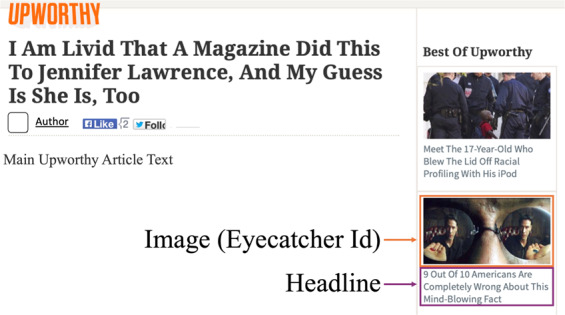
The pursuit of audience attention online has led organizations to conduct thousands of behavioral experiments each year in media, politics, activism, and digital technology. One pioneer of A/B tests was Upworthy.com, a U.S. media publisher that conducted a randomized trial for every article they published. Each experiment tested variations in a headline and image “package,” recording how many randomly-assigned viewers selected each variation. While none of these tests were designed to answer scientific questions, scientists can advance knowledge by meta-analyzing and data-mining the tens of thousands of experiments Upworthy conducted. This archive records the stimuli and outcome for every A/B test fielded by Upworthy between January 24, 2013 and April 30, 2015. In total, the archive includes 32,487 experiments, 150,817 experiment arms, and 538,272,878 participant assignments. The open access dataset is organized to support exploratory and confirmatory research, as well as meta-scientific research on ways that scientists make use of the archive.
Overview
The claims and statistics of this paper haven’t been checked yet.
Free: it reads the open-access text and checks the first 5 claims that cite a source we can check. Create a free account to check every claim.
Integrity signals
Registry
Cites
Statistics
Figures
Verification
Claims the paper makes
The claims and statistics of this paper haven’t been checked yet.
Free: it reads the open-access text and checks the first 5 claims that cite a source we can check. Create a free account to check every claim.
Claims other papers make about this one
Each is checked against this paper’s own text: does it say what the citing paper says it does?
The source backs part of the claim, not all of it — or backs it for a different population, condition or comparison.
In the citing paper
“The experiments were conducted separately (that is, only a single experiment was conducted at the same time for the entire website) so each test can be analysed as independent of all other tests53.”
From Negativity drives online news consumption (2023) · cites this paper as [53]
Experimental — accuracy not yet measuredThe check wasn’t confident either way, so it gives no verdict — never disputed.
In the citing paper
“Notably, we uncovered a negativity bias in the data even though Upworthy branded itself as a ‘positive news outlet’53.”
From Negativity drives online news consumption (2023) · cites this paper as [53]
Experimental — accuracy not yet measuredThe check wasn’t confident either way, so it gives no verdict — never disputed.
In the citing paper
“even though Upworthy branded itself as a ‘positive news outlet’53.”
From Negativity drives online news consumption (2023) · cites this paper as [53]
Experimental — accuracy not yet measuredIn the citing paper
“Upworthy has been regarded as one of the fastest-growing media companies worldwide53 and, at its peak, reached more users than established publishers such as the New York Times55.”
From Negativity drives online news consumption (2023) · cites this paper as [53]
In the citing paper
“Here we analyse data from the Upworthy Research Archive53, a repository of news consumption data that are both applied and causal.”
From Negativity drives online news consumption (2023) · cites this paper as [53]
2 more claims about this paper
Create a free account to see every claim other papers make about this one.
Self-check
Percentages, sums and reported differences re-computed from the paper’s own numbers.
The self-check needs the paper’s full text.
Citations
Cites
The Algorithmic Foundations of Differential Privacy
Dwork, C., & Roth, A. (2014) · Foundations and Trends® in Theoretical Computer Science · doi:10.1561/0400000042 · Cited by 5,557
The Algorithmic Foundations of Differential Privacy
Dwork, C., & Roth, A. (2013) · doi:10.1561/9781601988195 · Cited by 3,856
The State of Applied Econometrics: Causality and Policy Evaluation
Athey, S., & Imbens, G. W. (2017) · Journal of Economic Perspectives · doi:10.1257/jep.31.2.3 · Cited by 1,397
Field Experiments: Design, Analysis, and Interpretation
Green, D. (2024) · doi:10.61700/sgeirzx0v0mjh1252 · Cited by 1,320
Social Media and Democracy: The State of the Field, Prospects for Reform
(2020) · Cambridge University Press eBooks · doi:10.1017/9781108890960 · Cited by 295
Analytic Activism: Digital Listening and the New Political Strategy
Karpf, D. (2016) · Cited by 213
Interdependence and the cost of uncoordinated responses to COVID-19
Holtz, D., Zhao, M., Benzell, S. G., Cao, C. Y., Rahimian, M. A., Yang, J., Allen, J., Collis, A., Moehring, A., Sowrirajan, T., et al. (2020) · Proceedings of the National Academy of Sciences · doi:10.1073/pnas.2009522117 · Cited by 203
All the news That’s fit to click: the economics of clickbait media
Munger, K. (2020) · Political Communication · doi:10.1080/10584609.2019.1687626 · Cited by 175
Self-citationNo silver bullet: De-identification still doesn't work
Narayanan, A., & Felten, E. W. (2014) · Cited by 101
Analytic Activism: Digital Listening and the New Political Strategy
Karpf, D. (2017) · Oxford University Press eBooks · doi:10.1093/acprof:oso/9780190266127.001.0001 · Cited by 71
Cited by
Negativity drives online news consumption
Robertson, C. E., Pröllochs, N., Schwarzenegger, K., Pärnamets, P., Van Bavel, J. J., & Feuerriegel, S. (2023) · Nature Human Behaviour · doi:10.1038/s41562-023-01538-4 · Cited by 333
Statistical Challenges in Online Controlled Experiments: A Review of A/B Testing Methodology
Larsen, N., Stallrich, J. W., Sengupta, S., Deng, A., Kohavi, R., & Stevens, N. T. (2023) · The American Statistician · doi:10.1080/00031305.2023.2257237 · Cited by 139
“While some open access repositories exists (see, e.g., Liu et al. (2021a) and Matias et al. (2021)), the proprietary nature of these experiments makes open-access data-sharing uncommon.”
BackgroundValidated names for experimental studies on race and ethnicity
Crabtree, C. D., Kim, J. Y., Gaddis, S. M., Holbein, J. B., Guage, C., & Marx, W. W. (2023) · Scientific Data · doi:10.1038/s41597-023-01947-0 · Cited by 81
Reading dies in complexity: Online news consumers prefer simple writing
Shulman, H. C., Markowitz, D. M., & Rogers, T. (2024) · Science Advances · doi:10.1126/sciadv.adn2555 · Cited by 66
“The Upworthy Research Archive, and the methods therein, are discussed at length with the dataset ( 38 ) that introduced this resource.”
Did clickbait crack the code on virality?
Mukherjee, P., Dutta, S., & Bruyn, A. D. (2022) · Journal of the Academy of Marketing Science · doi:10.1007/s11747-021-00830-x · Cited by 64
The Language That Drives Engagement: A Systematic Large-scale Analysis of Headline Experiments
Banerjee, A., & Urminsky, O. (2021) · Marketing Science · doi:10.1287/mksc.2021.0018 · Cited by 44
Sparse Autoencoders for Hypothesis GenerationPreprint
Movva, R., Peng, K., Garg, N., Kleinberg, J. M., & Pierson, E. (2025) · arXiv (Cornell University) · doi:10.48550/arxiv.2502.04382 · Cited by 42
“We ultimately choose the following percentile bins for highly-activating texts: • W IKI -5, W IKI -15, H EADLINES : [80 , 100] .”
InfluentialLOLA: LLM-Assisted Online Learning Algorithm for Content ExperimentsPreprint
Ye, Z., Yoganarasimhan, H., & Zheng, Y. (2024) · SSRN Electronic Journal · doi:10.2139/ssrn.4851778 · Cited by 34
The evolution of online news headlines
Nickl, P. L., Moussaïd, M., & Lorenz-Spreen, P. (2025) · Humanities and Social Sciences Communications · doi:10.1057/s41599-025-04514-7 · Cited by 35
“At a time when the Facebook newsfeed algorithm preferentially recommended content that received a lot of clicks, the soft-news outlet Upworthy coined a particular kind of clickbait style (Munger 2020): long, conversational headlines that strategically induce a curiosity gap (Scott 2021) that readers can only bridge by…”
InfluentialThe Ethics of Online Controlled Experiments (A/B Testing)
Polonioli, A., Ghioni, R., Greco, C., Juneja, P., Tagliabue, J., Watson, D., & Floridi, L. (2023) · Minds and Machines · doi:10.1007/s11023-023-09644-y · Cited by 31
“In fact, to the best of the authors’ knowledge, there is only one dataset of experiments that has been released (Matias et al., 2021).”
The rise of and demand for identity‐oriented media coverage
Hopkins, D. J., Lelkes, Y., & Wolken, S. (2024) · American Journal of Political Science · doi:10.1111/ajps.12875 · Cited by 35
Gligorić, K., Lifchits, G., West, R., & Anderson, A. (2023) · PLoS ONE · doi:10.1371/journal.pone.0281682 · Cited by 26
Wu, J. J., Mazzuchi, T. A., & Sarkani, S. (2022) · Information and Software Technology · doi:10.1016/j.infsof.2022.107115 · Cited by 18
When curiosity gaps backfire: effects of headline concreteness on information selection decisions
Quéré, M. A. L., & Matias, J. N. (2025) · Scientific Reports · doi:10.1038/s41598-024-81575-9 · Cited by 16
Self-citationGligorić, K., Lifchits, G., West, R., & Anderson, A. (2021) · PLoS ONE · doi:10.1371/journal.pone.0257091 · Cited by 11
Datasets for Online Controlled ExperimentsPreprint
Liu, C. H. B., Cardoso, Â., Couturier, P., & McCoy, E. J. (2021) · arXiv (Cornell University) · doi:10.48550/arxiv.2111.10198 · Cited by 9
“While the Upworthy [57], ASSISTments [71], and MeuTutor [75] datasets meet the first two criteria, they all fail to meet the third.”
BackgroundInfluentialHe, K., & Chen, Z. (2025) · Transactions on machine learning research · doi:10.48550/arxiv.2505.21935 · Cited by 9
“Iteratively, after processing all questions in the benchmark, the LLM builds a rule library containing effective rules for solving the questions. et al., 2021), and Tweet Popularity (Tan et al., 2014).”
False discovery rate control with compound p-values
Barber, R. F., & Samworth, R. J. (2026) · Journal of the Royal Statistical Society Series B (Statistical Methodology) · doi:10.1093/jrsssb/qkag116 · Cited by 9
Alexander, R. (2023) · Chapman & Hall/CRC eBooks · doi:10.1201/9781003229407 · Cited by 8
On optimization: Cultural labor in platform capitalism
Berman, D. E. (2025) · New Media & Society · doi:10.1177/14614448251338514 · Cited by 7
“In one Upworthy A/B test, the headline “Don’t Ask Hillary Clinton About Abortion If You Can’t Her Answer” outperformed the headline “TIP: Don’t Ask Hillary Clinton About Reproductive Rights If You Can’t Handle Her Answer” 6.56% to 4.95% (Matias et al., 2021).”
InfluentialLeveraging semantic similarity for experimentation with AI-generated treatments
Shi, L., Arbour, D. T., Addanki, R., Sinha, R., & Feller, A. (2025) · neural information processing systems · doi:10.52202/085713-4494 · Cited by 5
“(i) The Upworthy Research Archive (Matias et al., 2021) 2 is an open-source A/B testing dataset from ASOS in the fashion industry.”
Empirical Bayes Selection for Value Maximization
Coey, D., & Hung, K. (2025) · ACM SIGKDD Conference on Knowledge Discovery and Data Mining (KDD) · doi:10.1145/3711896.3736928 · Cited by 5
Statistical Foundations of LLM-based A/B Testing: A Surrogacy Framework for Human Causal InferencePreprint
Persson, J., Schultzberg, M., & Ankargren, S. (2026) · arXiv (Cornell University) · doi:10.48550/arxiv.2606.17165 · Cited by 5
The case against efficiency: friction in social media
Garland, J., Bak-Coleman, J., Benesch, S., DeDeo, S., DiResta, R., Eissfeldt, J., Ha, S., Irons, J., Kempes, C. P., Lovato, J. L., et al. (2026) · npj Complexity · doi:10.1038/s44260-025-00061-z · Cited by 4
Correlates of and counterstrategies to news non-use: systematic review and prescriptive framework
Wertz, B., & Wojcieszak, M. (2026) · Annals of the International Communication Association · doi:10.1093/anncom/wlag023 · Cited by 3
Feezell, J. T., Searles, K., Wagner, J. K., Darr, J., Pingree, R., Sui, M., & Watson, B. K. (2024) · Journal of Information Technology & Politics · doi:10.1080/19331681.2024.2414001 · Cited by 3
A review of generative autoencoder frameworks and their latent modeling strategies
Behera, M., & Dey, P. (2026) · Applied Soft Computing · doi:10.1016/j.asoc.2026.115933 · Cited by 2
BOOST: Power-Optimal Strong-FWER Testing for Block-Structured MultiplicityPreprint
Dubey, P., & Huo, X. (2026) · arXiv (Cornell University) · doi:10.48550/arxiv.2605.27664 · Cited by 2
Hu, Z., Shi, L., Sinha, R., Grover, J., & Arbour, D. T. (2026) · ACM SIGKDD Conference on Knowledge Discovery and Data Mining (KDD) · doi:10.1145/3770855.3818404 · Cited by 1
Visual Polarization Measurement Using Counterfactual Image Generation
Mosaffa, M., Rafieian, O., & Yoganarasimhan, H. (2025) · ACM Conference on Economics and Computation (EC) · doi:10.1145/3736252.3742672 · Cited by 1
Wu, J., Mazzuchi, T. A., & Sarkani, S. (2022) · SSRN Electronic Journal · doi:10.2139/ssrn.4072566 · Cited by 1
Automating Content Generation: The Case of Email HeadlinesPreprint
Nguyen, N., & Johnson, J. (2022) · SSRN Electronic Journal · doi:10.2139/ssrn.4111592 · Cited by 1
Words That Matter: Analyzing the Causal Effect of WordsPreprint
Lemaire, A., Yin, M., & Netzer, O. (2025) · SSRN Electronic Journal · doi:10.2139/ssrn.5205681 · Cited by 1
Aligning Language Models with Observational Data: Opportunities and Risks from a Causal PerspectivePreprint
Loghmani, E. (2025) · RePEc: Research Papers in Economics · doi:10.48550/arxiv.2506.00152 · Cited by 1
“We therefore use the Upworthy dataset [14], which provides CTRs from controlled A/B tests.”
The Modern Informed Citizen: Understanding Trade-offs in Digital News Consumption
Quéré, M. A. L. (2023) · CHI Conference Extended Abstracts on Human Factors in Computing Systems (CHI EA) · doi:10.1145/3544549.3577051
“I curated, analyzed, and released a large-scale dataset of more than 30,000 A/B tested news headlines from the digital publisher Upworthy between 2013-2015 [26].”
MethodLiu, C. H. B. (2023) · arXiv (Cornell University) · doi:10.25560/110307
Science/Education Portraits X: Personal Archive of a Scientist
Ling, M. H. (2025) · ACTA SCIENTIFIC MICROBIOLOGY · doi:10.31080/asmi.2025.07.1469
Dabigatran Induced Oesophageal Keratosis Presenting as Bleeding Carcinoma Cuniculatum: A Case Report
Mayank, K., Kapil, K., Rajesh, K., & Vaibhav, S. (2025) · Acta Scientific Gastrointestinal Disorders · doi:10.31080/asgis.2025.07.0686
Exploring dynamics of online cultural evolution through agent-based simulations and online dataPreprint
Nickl, P. L., & Moussaïd, M. (2024) · SocArXiv (OSF Preprints) · doi:10.31235/osf.io/wfxsm_v1
Combining A/A Data and LLMs for Improved Content Evaluation
Shankar, S. S., Sinha, R., & Fiterau, M. (2025) · International World Wide Web Conference (WWW) · doi:10.1145/3701716.3717860
Readers prefer to click on a clear, simple headline − like this one
Markowitz, D. M., Rogers, T., & Shulman, H. C. (2024) · The Conversation · doi:10.64628/aai.7c3ragc4f
A Comment on "Negativity Drives Online News Consumption"Preprint
Reiss, M. V., & Roggenkamp, H. (2025) · RePEc: Research Papers in Economics
Bernardo, G. M. S. G. (2025) · Portuguese National Funding Agency for Science, Research and Technology (RCAAP Project by FCT)
Hu, Z., Shi, L., Sinha, R., Grover, J., & Arbour, D. T. (2026) · arXiv (Cornell University) · doi:10.48550/arxiv.2602.13852
TEA-Time: Transporting Effects Across TimePreprint
Parikh, H., Levin-Konigsberg, G., Perrault-Joncas, D., & Volfovsky, A. (2026) · arXiv (Cornell University) · doi:10.48550/arxiv.2603.07018
“We apply our framework to headline A/B tests from the Upworthy Research Archive [Matias et al., 2021], one of the largest publicly available collections of randomized digital experiments.”
InfluentialCommercial Determinants of Replication Infeasibility in Computational Social Science
Matias, J. N., Waldrip, C., & Lazer, D. M. J. (2026) · Journal of Quantitative Description Digital Media · doi:10.51685/jqd.2026.007
“Where technology platforms have released datasets of their routine experiments, scientists have been able to find evidence of robust, reproducible findings over time (Matias et al., 2021; Robertson et al., 2023; Shulman et al., 2024; Aubin Le Quéré and Matias, 2025).”
Self-citationEvaluating the Effectiveness of Cyber Cognitive Attacks: A Sentiment-Based Approach
Rushing, B., Hersch, W., Gwartney, K., & Xu, S. (2026) · doi:10.22492/issn.2760-7267.2026.5
Titles framed as questions reduce reader engagement
Fang, D. Q., & Wheeler, S. C. (2026) · Journal of Consumer Psychology · doi:10.1002/jcpy.70031
Pimentel, F. C. S., & Cortes, O. A. C. (2026) · Research on Biomedical Engineering · doi:10.1007/s42600-026-00490-2
Maiorano, A. C. (2026) · arXiv (Cornell University) · doi:10.48550/arxiv.2609.25010
“The Upworthy Research Archive [13] has supported large-scale analyses of what makes head-lines succeed; for example, negativity in headlines increases consumption at scale [15].”
InfluentialAlways-On ExperimentationPreprint
Sandoval, R. J., Arbour, D. T., Feller, A., & Jordan, M. I. (2026) · arXiv (Cornell University) · doi:10.48550/arxiv.2609.38695
“To test the efficacy of the proposed methods in realistic settings we constructed a set of semi-synthetic experiments using the Upworthy Research Archive [33], which is a corpus of randomized headline experiments that were run on an online platform between 2013 and 2015.”
When Can You Ship on Evals Alone? Trial-Level Surrogacy for Offline Evaluation of LLM SystemsPreprint
Schultzberg, M. (2026) · arXiv (Cornell University) · doi:10.48550/arxiv.2610.10142
Generative Policy Improvement from Observational DataPreprint
Schweisthal, J., Frauen, D., Feuerriegel, S., & Brunskill, E. (2026) · arXiv (Cornell University) · doi:10.48550/arxiv.2610.23436
“…modern systems, actions are complex and high-dimensional ; for example, an online platform can generate a personalized headline or advertisement (Matias et al., 2021; Meguellati et al., 2024) or a mental health support system may suggest an empathic reply in an online peer-support conversation…”
Metadata
- Authors
- Matias, J. N., Munger, K., Le Quere, M. A., & Ebersole, C.
- Affiliations
- Cornell University (US)
- Pennsylvania State University (US)
- University of Virginia (US)
- Corresponding author
- Matias, J. Nathan
- Venue
- Scientific Data
- Published
- 2021-08-02
- Volume
- 8
- Issue
- 1
- Pages
- 195-195
- ISSN
- 2052-4463 (ISSN-L)
- PMC
- PMC8329003
- OpenAlex
- W3189225531
- Cited by
- 29
- References
- 18
- Citations by year
- 2026: 6 · 2025: 6 · 2024: 5 · 2023: 6 · 2022: 4 · 2021: 2
- Type
- data paper
- Language
- en
- Update notices
- correction (2024-07-11)
- Open access
- gold
- doi.org
- Licence
- cc-by
- creativecommons.org/licenses/by/4.0 (tdm)
- creativecommons.org/licenses/by/4.0 (vor)
- Locations
- Scientific Data (publishedVersion, cc-by)
- PubMed Central (publishedVersion, cc-by)
- PubMed (publishedVersion)
- DOAJ (DOAJ: Directory of Open Access Journals) (submittedVersion, cc-by-sa)
- Topics
- Social Sciences › Library and Information Sciences › Academic Publishing and Open Access
- Social Sciences › General Social Sciences › Computational and Text Analysis Methods
- Social Sciences › Sociology and Political Science › Media Influence and Politics
- Keywords
- A/B testing, online media, audience attention, image variation, user engagement, randomized experiments, meta-analysis, data mining
About these checks
Registry, retraction, Cites and statistics results are computed, not judged, with one exception: a printed reference that no index lists is read once by a model before it counts as a citation error. Claims are extracted by a model and kept only when their quote appears verbatim in the text; each cited source is then checked, with a model’s help, for whether it says what the claim relies on. Those verdicts can be wrong — read the claim’s quote and the cited source before relying on one.
Statistics and arithmetic are recomputed, not judged.
Confidence bands are shown only for fields calibrated on our annotated test set. None is calibrated yet, so no band is shown.
What counts as a claim ›How we measure confidence ›How we check this ›
Are you an author, or do you see a problem with this page? Request a review
Data sources
Bibliographic data: Semantic Scholar, OpenAlex, Crossref.
Contains information from the Semantic Scholar Academic Graph Datasets, made available under the ODC Attribution License (ODC-BY 1.0).
Semantic Scholar’s data is described in: Kinney, R., et al. (2023). The Semantic Scholar Open Data Platform. arXiv:2301.10140.
