

FAIR principles for AI models with a practical application for accelerated high energy diffraction microscopy
Open accessThe DOI matches its Crossref record; 32 of the 32 references it cites were found in a registry or an index.
Abstract
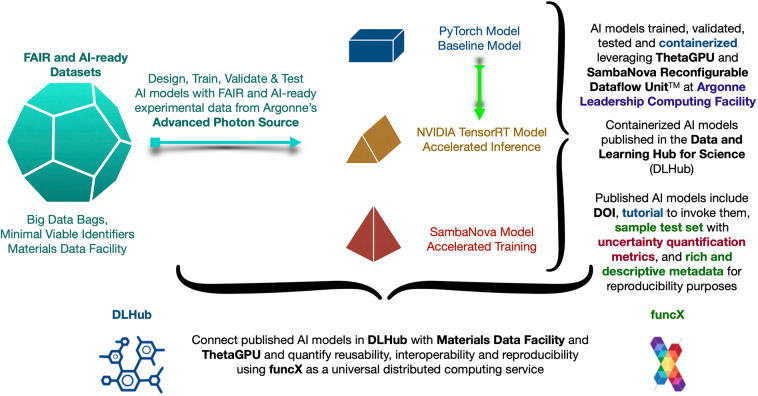
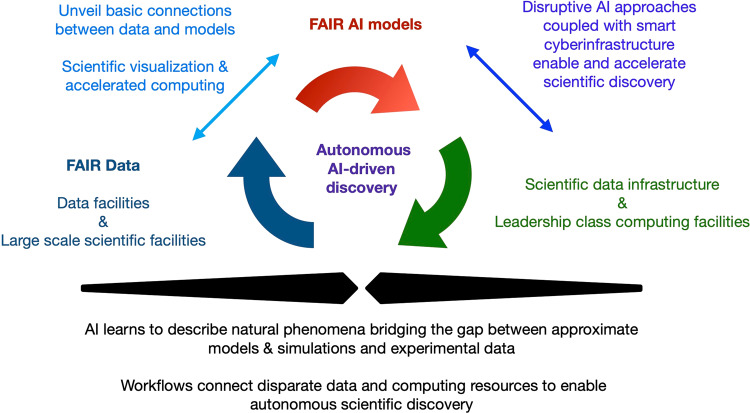
A concise and measurable set of FAIR (Findable, Accessible, Interoperable and Reusable) principles for scientific data is transforming the state-of-practice for data management and stewardship, supporting and enabling discovery and innovation. Learning from this initiative, and acknowledging the impact of artificial intelligence (AI) in the practice of science and engineering, we introduce a set of practical, concise, and measurable FAIR principles for AI models. We showcase how to create and share FAIR data and AI models within a unified computational framework combining the following elements: the Advanced Photon Source at Argonne National Laboratory, the Materials Data Facility, the Data and Learning Hub for Science, and funcX, and the Argonne Leadership Computing Facility (ALCF), in particular the ThetaGPU supercomputer and the SambaNova DataScale® system at the ALCF AI Testbed. We describe how this domain-agnostic computational framework may be harnessed to enable autonomous AI-driven discovery.
Overview
The claims and statistics of this paper haven’t been checked yet.
Free: it reads the open-access text and checks the first 5 claims that cite a source we can check. Create a free account to check every claim.
Integrity signals
Registry
Cites
Statistics
Figures
Verification
Claims the paper makes
The claims and statistics of this paper haven’t been checked yet.
Free: it reads the open-access text and checks the first 5 claims that cite a source we can check. Create a free account to check every claim.
Self-check
Percentages, sums and reported differences re-computed from the paper’s own numbers.
The self-check needs the paper’s full text.
Citations
Cites
LeCun, Y., Bengio, Y., & Hinton, G. (2015) · Nature · doi:10.1038/nature14539 · Cited by 84,126
The FAIR Guiding Principles for scientific data management and stewardship
Wilkinson, M. D., Dumontier, M., Aalbersberg, I. J., Appleton, G., Axton, M., Baak, A., Blomberg, N., Boiten, J.-W., da Silva Santos, L. B., Bourne, P. E., et al. (2016) · Scientific Data · doi:10.1038/sdata.2016.18 · Cited by 18,423
TensorFlow: A system for large-scale machine learning
Abadi, M., Barham, P., Chen, J., Chen, Z., Davis, A., Dean, J., Devin, M., Ghemawat, S., Irving, G., Isard, M., et al. (2016) · arXiv (Cornell University) · doi:10.48550/arxiv.1605.08695 · Cited by 11,822
(2017) · Cited by 11,625
Singularity: Scientific containers for mobility of compute
Kurtzer, G. M., Sochat, V., & Bauer, M. W. (2017) · PLOS ONE · doi:10.1371/journal.pone.0177459 · Cited by 2,740
Nanotechnology and artificial intelligence to enable sustainable and precision agriculture
Zhang, P., Guo, Z., Ullah, S., Melagraki, G., Afantitis, A., & Lynch, I. (2021) · Nature Plants · doi:10.1038/s41477-021-00946-6 · Cited by 478
Advancing mathematics by guiding human intuition with AI
Davies, A., Veličković, P., Buesing, L., Blackwell, S., Zheng, D., Tomašev, N., Tanburn, R., Battaglia, P., Blundell, C., Juhász, A., et al. (2021) · Nature · doi:10.1038/s41586-021-04086-x · Cited by 451
Deep learning and its application to LHC physics
Guest, D., Cranmer, K., & Whiteson, D. (2018) · Annual Review of Nuclear and Particle Science · doi:10.1146/annurev-nucl-101917-021019 · Cited by 417
The Materials Data Facility: Data Services to Advance Materials Science Research
Blaiszik, B., Chard, K., Pruyne, J., Ananthakrishnan, R., Tuecke, S., & Foster, I. (2016) · JOM · doi:10.1007/s11837-016-2001-3 · Cited by 326
Self-citationArtificial intelligence for precision medicine in neurodevelopmental disorders
Uddin, M., Wang, Y., & Woodbury-Smith, M. (2019) · npj Digital Medicine · doi:10.1038/s41746-019-0191-0 · Cited by 248
Research works printed but not linked: 6
- 1. Baevski, A. et al. data2vec: A general framework for self-supervised learning in speech, vision and language. In Chaudhuri, K. et al. (eds.) International Conference on Machine Learning, ICML 2022, 17-23 July 2022, Baltimore, Maryland, USA, vol. 162 of Proceedings of Machine Learning Research, 1298-1312 (PMLR, 2022).
- 15. Brun, R. & Rademakers, F. Root -an object oriented data analysis framework. AIHENP'96 Workshop, Lausane 389, 81-86 (1996).
- 36. Ravi, N. et al. PyTorch BraggNN Model https://doi.org/10.26311/s7hv-9r95 (2022). · doi:10.26311/s7hv-9r95
- 37. Ravi, N. et al. Accelerated TensorRT BraggNN Model https://doi.org/10.26311/11vb-7j24 (2022). · doi:10.26311/11vb-7j24
- 38. Liu, Z. et al. SambaNova BraggNN Model https://doi.org/10.26311/btnf-3a65 (2022). · doi:10.26311/btnf-3a65
- 40. Goodfellow, I., Bengio, Y. & Courville, A. Deep Learning (MIT press, 2016).
Cited by
Privacy, ethics, transparency, and accountability in AI systems for wearable devices
Radanliev, P. (2025) · Frontiers in Digital Health · doi:10.3389/fdgth.2025.1431246 · Cited by 173
FAIR for AI: An interdisciplinary and international community building perspective
Huerta, E. A., Blaiszik, B. J., Brinson, L. C., Bouchard, K. E., Díaz, D., Doglioni, C., Duarte, J. M., Emani, M. K., Foster, I. T., Fox, G., et al. (2023) · Scientific Data · doi:10.1038/s41597-023-02298-6 · Cited by 137
Self-citationApplications of physics informed neural operators
Rosofsky, S., Majed, H. A., & Huerta, E. A. (2023) · Machine Learning Science and Technology · doi:10.1088/2632-2153/acd168 · Cited by 114
Self-citationData Readiness for AI: A 360-Degree Survey
Hiniduma, K., Byna, S., & Bez, J. L. (2025) · ACM Computing Surveys · doi:10.1145/3722214 · Cited by 96
Linking scientific instruments and computation: Patterns, technologies, and experiences
Vescovi, R., Chard, R., Saint, N., Blaiszik, B. J., Pruyne, J., Biçer, T., Lavens, A., Liu, Z., Papka, M. E., Narayanan, S., et al. (2022) · Patterns · doi:10.1016/j.patter.2022.100606 · Cited by 71
Self-citationArtificial intelligence in the aquaculture industry: Current state, challenges and future directions
Fernandes, S., & DMello, A. (2024) · Aquaculture · doi:10.1016/j.aquaculture.2024.742048 · Cited by 68
Artificial Intelligence-Powered Raman Spectroscopy through Open Science and FAIR Principles
Coca-López, N., Alcolea-Rodriguez, V., Bañares, M. Á., Brockhauser, S., Gorenflot, J., Henderson, A., Hildebrandt, R., Jeliazkova, N., Kochev, N. T., Diz, E. L., et al. (2025) · ACS Nano · doi:10.1021/acsnano.5c09165 · Cited by 59
Carter, J. T., Feddema, J., Kothe, D. B., Neely, R., Pruet, J., Stevens, R. L., Balaprakash, P., Beckman, P., Foster, I. T., Iskra, K. A., et al. (2023) · OSTI OAI (U.S. Department of Energy Office of Scientific and Technical Information) · doi:10.2172/1986455 · Cited by 41
Self-citationData Quality in the Age of AI: A Review of Governance, Ethics, and the FAIR Principles
Guillen-Aguinaga, M., Aguinaga-Ontoso, E., Guillen-Aguinaga, L., Guillen-Grima, F., & Aguinaga-Ontoso, I. (2025) · Data · doi:10.3390/data10120201 · Cited by 37
“However, achieving AI readiness requires more than technical interoperability; it demands rigorous attention to data provenance, bias detection, and ethical sourcing—considerations that extend far beyond the original FAIR framework’s scope [236,241–245].”
Bettanti, A., Beccari, A. R., & Biccarino, M. (2024) · Discover Artificial Intelligence · doi:10.1007/s44163-024-00188-3 · Cited by 36
From FAIR to CURE: guidelines for computational models of biological systems
Sauro, H. M., Agmon, E., Blinov, M. L., Gennari, J. H., Hellerstein, J. L., Heydarabadipour, A., Jardine, B., May, E. E., Nickerson, D. P., Smith, L. P., et al. (2026) · npj Systems Biology and Applications · doi:10.1038/s41540-026-00651-0 · Cited by 33
Padoan, A., Cadamuro, J., Frans, G., Cabitza, F., Tolios, A., Bruyne, S. D., van Doorn, W. P. T. M., Elias, J., Debeljak, Ž., Pérez, S. M., et al. (2024) · Clinical Chemistry and Laboratory Medicine (CCLM) · doi:10.1515/cclm-2024-0971 · Cited by 31
The FAIR principles as a key enabler to operationalize safe and sustainable by design approaches
Karakoltzidis, A., Battistelli, C. L., Bossa, C., Bouman, E. A., Aguirre, I. G., Iavicoli, I., Jeddi, M. Z., Karakitsios, S., Leso, V., Løfstedt, M., et al. (2024) · RSC Sustainability · doi:10.1039/d4su00171k · Cited by 29
APPFLx: Providing Privacy-Preserving Cross-Silo Federated Learning as a Service
Li, Z., He, S., Chaturvedi, P., Hoàng, T.-H., Ryu, M., Huerta, E. A., Kindratenko, V., Fuhrman, J. D., Giger, M. L., Chard, R., et al. (2023) · IEEE International Conference on eScience · doi:10.1109/e-science58273.2023.10254842 · Cited by 26
Self-citationTabrizi, E., & Li, B. (2025) · Materials Today Bio · doi:10.1016/j.mtbio.2025.102609 · Cited by 24
AI for scientific discovery is a social problem
Channing, G., & Ghosh, A. (2026) · Patterns · doi:10.1016/j.patter.2026.101497 · Cited by 23
A Cloud-Based System for Automated AI Image Analysis and Reporting
Chatterjee, N. R., Duda, J., Gee, J. C., Elahi, A., Martin, K., Doan, V., Liu, H., MacLean, M. T., Rader, D. J., Borthakur, A., et al. (2024) · Journal of Imaging Informatics in Medicine · doi:10.1007/s10278-024-01200-z · Cited by 21
FAIR AI models in high energy physics
Duarte, J. M., Li, H., Roy, A., Zhu, R., Huerta, E. A., Díaz, D., Harris, P. C., Kansal, R., Katz, D. S., Kavoori, I. H., et al. (2023) · Machine Learning Science and Technology · doi:10.1088/2632-2153/ad12e3 · Cited by 19
Self-citationArtificial Intelligence and Leadership: A Bibliometric Analysis
Dissanayake, H., & Keppetipola, M. (2024) · Journal of Human Resource Management Perspectives · doi:10.4038/jhrmp.v9i1.5 · Cited by 19
Open and sustainable AI: challenges, opportunities and the road ahead in the life sciences
Farrell, G., Adamidi, E. S., Buono, R. A., Anton, M., Attafi, O. A., Capella-Gutiérrez, S., Capriotti, E., Castro, L. J., Cirillo, D., Crossman, L. C., et al. (2026) · Nature Methods · doi:10.1038/s41592-026-03037-6 · Cited by 16
Radha, S. K., Kuehlkamp, A., & Nabrzyski, J. (2025) · ACM Journal on Responsible Computing · doi:10.1145/3768151 · Cited by 16
From FAIR to CURE : guidelines for computational models of biological systems
Sauro, H. M., Agmon, E., Blinov, M. L., Gennari, J. H., Hellerstein, J. L., Heydarabadipour, A., Jardine, B., May, E. E., Nickerson, D. P., Smith, L. P., et al. (2025) · PubMed Central · doi:10.18452/37650 · Cited by 16
Autonomous artificial intelligence, scientific research, and human values
Resnik, D. B., Hosseini, M., & Hauswald, R. (2026) · AI and Ethics · doi:10.1007/s43681-025-00908-0 · Cited by 15
End-to-end AI framework for interpretable prediction of molecular and crystal properties
Park, H., Zhu, R., Huerta, E. A., Chaudhuri, S., Tajkhorshid, E., & Cooper, D. (2023) · Machine Learning Science and Technology · doi:10.1088/2632-2153/acd434 · Cited by 14
Self-citationda Silva, R. F., Abolhasani, M., Antonopoulos, D., Biven, L., Coffee, R., Foster, I. T., Hamilton, L., Jha, S., Mayer, T., Mintz, B., et al. (2025) · ICPP Workshops · doi:10.1145/3750720.3757292 · Cited by 11
Self-citationReviewing the Role of Artificial Intelligence in Personalized Learning and Education
Apelehin, A. A. (2026) · WORLD JOURNAL OF INNOVATION AND MODERN TECHNOLOGY · doi:10.56201/wjimt.v9.no2.2025.pg86.94 · Cited by 14
Advances in Privacy Preserving Federated Learning to Realize a Truly Learning Healthcare System
Madduri, R., Li, Z., Nandi, T., Kim, K., Ryu, M., & Rodriguez, A. (2024) · IEEE International Conference on Trust, Privacy and Security in Intelligent Systems and Applications (TPS-ISA) · doi:10.1109/tps-isa62245.2024.00039 · Cited by 13
Artificial intelligence: An explainer
Gajjar, D. (2023) · doi:10.58248/pb57 · Cited by 11
Shiferaw, K. B., Balaur, I., Welter, D., Waltemath, D., & Zeleke, A. A. (2024) · JAMIA Open · doi:10.1093/jamiaopen/ooae105 · Cited by 11
CORTEX: Composite Overlay for Risk Tiering and Exposure in Operational AI SystemsPreprint
Muhammad, A. E., Yow, K., Baili, J., Cho, Y., & Nam, Y. (2025) · Research Square · doi:10.21203/rs.3.rs-7377133/v1 · Cited by 11
Delivering real-time multi-modal materials analysis with enterprise beamlines
Maffettone, P. M., Campbell, S. I., Hanwell, M. D., Wilkins, S. B., & Olds, D. (2022) · Cell Reports Physical Science · doi:10.1016/j.xcrp.2022.101112 · Cited by 10
Blatch-Jones, A., Church, H., & Crane, K. (2025) · F1000Research · doi:10.12688/f1000research.160142.1 · Cited by 9
Radanliev, P. (2025) · Frontiers in Virtual Reality · doi:10.3389/frvir.2025.1589744 · Cited by 8
Diaspora: Resilience-Enabling Services for Real-Time Distributed Workflows
Nicolae, B., Wozniak, J. M., Biçer, T., Nguyen, H., Patel, P., Pan, H., Gueroudji, A., Gonthier, M., Hayot‐Sasson, V., Huerta, E. A., et al. (2024) · IEEE International Conference on eScience · doi:10.1109/e-science62913.2024.10678669 · Cited by 7
Self-citationBuilding Trustworthy AI for Materials Discovery: From Autonomous Laboratories to Z-scoresPreprint
Amirian, B., Dale, A. S., Kalinin, S. V., & Hattrick-Simpers, J. R. (2025) · arXiv (Cornell University) · doi:10.48550/arxiv.2512.01080 · Cited by 6
How I read an article that uses machine learning methods
Nazha, A., Elemento, O., McWeeney, S. K., Miles, M. E., & Haferlach, T. (2023) · Blood Advances · doi:10.1182/bloodadvances.2023010140 · Cited by 6
FAIR and Beyond: Evolving Principles for Modern Data Ecosystems
Bashir, M. A. (2025) · Lecture notes in networks and systems · doi:10.1007/978-3-031-89274-5_12 · Cited by 5
Healthcare Security Challenges Leveraging Generative AI to Transform Cybersecurity
Nadeem, G., Khaliq, A., Ahmed, J., & Aziz, A. (2025) · IGI Global eBooks · doi:10.4018/979-8-3693-6250-1.ch010 · Cited by 5
FAIRness Along the Machine Learning Lifecycle Using Dataverse in Combination with MLflow
Sherpa, L., Khaydarov, V., & Müller-Pfefferkorn, R. (2024) · Data Science Journal · doi:10.5334/dsj-2024-055 · Cited by 5
FAIR Principles for data and AI models in high energy physics research and education
Roy, A. (2022) · International Conference on High Energy Physics (ICHEP) · doi:10.22323/1.414.0240 · Cited by 3
Codebase release 2.0 for UFOManager
Neubauer, M. S., Roy, A., & Wang, Z. (2023) · SciPost Physics Codebases · doi:10.21468/scipostphyscodeb.13 · Cited by 3
Resilient execution of distributed X-ray image analysis workflows
Nguyen, H. D., Biçer, T., Nicolae, B., Kettimuthu, R., Huerta, E. A., & Foster, I. T. (2025) · Frontiers in High Performance Computing · doi:10.3389/fhpcp.2025.1550855 · Cited by 3
Self-citationAn ELIXIR scoping review on domain-specific evaluation metrics for synthetic data in life sciences
Fragkouli, S.-C., Iqbal, S., Crossman, L. C., Gravel, B., Masued, N., Onders, M., Haseja, D., Stikkelman, A., Valencia, A., Lenaerts, T., et al. (2026) · NAR Genomics and Bioinformatics · doi:10.1093/nargab/lqag012 · Cited by 3
End-to-end AI Framework for Interpretable Prediction of Molecular and Crystal PropertiesPreprint
Park, H., Zhu, R., Huerta, E. A., Chaudhuri, S., Tajkhorshid, E., & Cooper, D. (2022) · arXiv (Cornell University) · doi:10.48550/arxiv.2212.11317 · Cited by 3
Self-citationRisk Mitigation for Biological Design Tools
Rivera, S., & Mackelprang, R. (2025) · doi:10.25498/e4r10s · Cited by 2
Advancing biological imaging: computational techniques, AI, and bioinformatics in microscopy
Hassan, Y. M., Mohamed, A. S., Hassan, Y. M., Shalaby, A., & EL-SAYED, W. M. A. (2026) · Multimedia Tools and Applications · doi:10.1007/s11042-026-21396-2 · Cited by 2
Calibrating CONSORT-AI with FAIR Principles to enhance reproducibility in AI-driven clinical trialsPreprint
Shiferaw, K. B., Balaur, I., Collins, G. S., Sharma, C., Castro, L. J., Psomopoulos, F. E., Garijo, D., Henkel, R., Waltemath, D., & Zeleke, A. A. (2025) · medRxiv · doi:10.1101/2025.07.07.25330987 · Cited by 1
A Conceptual Framework for Trustworthy AI Decisions Across the Materials Design Lifecycle
Chen, W., & Zhang, L. (2024) · Journal of Artificial Intelligence for Materials Science · doi:10.68159/p426656712 · Cited by 1
Carneiro, F., Nóvoa, H., Carvalho, A., Duque, C., Silva, N., Fernandes, E., & Macedo, L. (2026) · Journal of Enterprise Information Management · doi:10.1108/jeim-03-2026-0437 · Cited by 1
A literature review on fairness in process mining.
Okeke, C. B. (2024) · Document Server@UHasselt (UHasselt) · Cited by 1
Enhancing Transparency and Traceability in Healthcare AI: The AI Product PassportPreprint
Sınacı, A. A., Postacı, Ş., Çavdaroğlu, D., Boonstra, M., Mercan, O., Yilmaz, K., Ertürkmen, G. B. L., Asselbergs, F. W., & Lekadir, K. (2025) · arXiv (Cornell University) · doi:10.48550/arxiv.2512.13702 · Cited by 1
Implications and Future Outcomes
Lubguban, A. A.-O., Alguno, A. C., Malaluan, R. M., & Dumancas, G. G. (2025) · SpringerBriefs in applied sciences and technology · doi:10.1007/978-981-96-2077-7_4 · Cited by 1
Thaker, N. G., Shetty, N., Kazmi, S., L’Official-German, I., & Flora, D. B. (2025) · AI in Precision Oncology · doi:10.1177/2993091x251396146
Artificial intelligence-assisted imaging technologies for disease diagnosis
Coelho, L. P. (2026) · Elsevier eBooks · doi:10.1016/b978-0-443-43934-6.00007-9
Neubauer, M. S., Roy, A., & Wang, Z. (2023) · SciPost Physics Codebases · doi:10.21468/scipost.report.6903
Neubauer, M. S., Roy, A., & Wang, Z. (2022) · SciPost Physics Codebases · doi:10.21468/scipost.report.6185
FAIR AI Models in High Energy Physics
Li, H., Duarte, J. M., Roy, A., Zhu, R., Huerta, E. A., Díaz, D., Harris, P. C., Kansal, R., Katz, D. S., Kavoori, I. H., et al. (2024) · EPJ Web of Conferences · doi:10.1051/epjconf/202429509017
Self-citationShevel, A. (2024) · Physics of Particles and Nuclei · doi:10.1134/s1063779624030742
DCAT-based metadata schema for a National Health Data Catalogue (Preprint)
Vieira, B. D. S., Henriques, I., Santos, L. O. B. D. S., Bernabé, C. H., Burger, K., Neikes, H. K., Konrad, A., Niehues, A., de Jong, M., Aguiló‐Castillo, S., et al. (2026) · JMIR Medical Informatics · doi:10.2196/preprints.94304
Sustaining the growth of the materials informatics ecosystem
Rajan, K. (2026) · Elsevier eBooks · doi:10.1016/b978-0-443-22256-6.00009-9
AI Model Reporting Standards in Health Care: Systematic Review and Consolidation
Akhmad, E. S., Slob, D., Gomes, A. L., Mingels, S. M. B., Dekker, A. L. A. J., & van Soest, J. (2026) · JMIR AI · doi:10.2196/92329
Pina, D., Kunstmann, L., Mattoso, M., Lage, M., & de Oliveira, D. (2025) · doi:10.5753/bresci.2025.248217
Proceedings of the Workshop on Deep Learning and Linked Data (DLnLD) @ LREC-COLING 2024
(2024) · Language Resources and Evaluation Conference (LREC) · doi:10.63317/543pjjgkbst9
Improving Reproducibility in Machine Learning: Overview, Barriers, and DriversPreprint
Mzyece, T. M. (2026) · doi:10.36227/techrxiv.177155769.94899097/v1
Li, L., Mathrani, A., & Sušnjak, T. (2026) · arXiv (Cornell University) · doi:10.48550/arxiv.2608.01711
Dhayade, S., Chodvadiya, D. A., Fan, Y., Gao, F., & Shen, Y. (2026) · Journal of Hazardous Materials Advances · doi:10.1016/j.hazadv.2026.101611
Evaluating bias within an epistemological framework for AI-based research in the humanities
OBERBICHLER, S., & Petz, C. (2026) · Open Repository and Bibliography (University of Luxembourg)
DairySocialTwin: Auditing the video-to-graph evidence chain in cattle social networksPreprint
Huang, Y., & Neethirajan, S. R. (2026) · arXiv (Cornell University) · doi:10.48550/arxiv.2610.32989
Fransisca, L., & Hapsari, Y. D. (2023) · Journal of Social and Economics Research · doi:10.54783/jser.v5i1.88
Human Values at Sea: Ethical Frameworks for AI-Driven Maritime Learning and Evaluation Systems
Djajasasana, E. E., Rusman, R., Aprianto, A., & Tuningrat, N. A. R. (2026) · IGI Global eBooks · doi:10.4018/979-8-3373-6670-8.ch010
Metadata
- Authors
- Ravi, N., Chaturvedi, P., Huerta, E. A., Liu, Z., Chard, R., Scourtas, A., Schmidt, K. J., Chard, K., Blaiszik, B., & Foster, I.
- Affiliations
- Argonne National Laboratory (US)
- Corresponding author
- Huerta, E. A.
- ORCID
- Venue
- Scientific Data
- Published
- 2022-11-10
- Volume
- 9
- Issue
- 1
- Pages
- 657-657
- ISSN
- 2052-4463 (ISSN-L)
- PMC
- PMC9649764
- OpenAlex
- W4308887398
- Cited by
- 51
- References
- 32
- Citations by year
- 2026: 12 · 2025: 16 · 2024: 10 · 2023: 10 · 2022: 3
- Type
- data paper
- Language
- en
- Open access
- gold
- doi.org
- Licence
- cc-by
- creativecommons.org/licenses/by/4.0 (tdm)
- creativecommons.org/licenses/by/4.0 (vor)
- Locations
- Scientific Data (publishedVersion, cc-by)
- PubMed Central (publishedVersion, cc-by)
- PubMed (publishedVersion)
- Knowledge@UChicago (University of Chicago) (submittedVersion, cc-by-nc-nd)
- DOAJ (DOAJ: Directory of Open Access Journals) (submittedVersion, cc-by-sa)
- OSTI OAI (U.S. Department of Energy Office of Scientific and Technical Information) (submittedVersion)
- Funders
- U.S. Department of Energy (DE-AC02-06CH11357, DE-AC02-06CH1135)
- National Science Foundation (1931306)
- United States Department of Commerce | National Institute of Standards and Technology (70NANB14H012)
- Topics
- Physical Sciences › Computer Science › Information Systems › Research Data Management Practices
- Social Sciences › Decision Sciences › Information Systems and Management › Scientific Computing and Data Management
- Physical Sciences › Materials Science › Materials Chemistry › Machine Learning in Materials Science
- Keywords
- FAIR principles, high-energy diffraction microscopy, data management
About these checks
Registry, retraction, Cites and statistics results are computed, not judged, with one exception: a printed reference that no index lists is read once by a model before it counts as a citation error. Claims are extracted by a model and kept only when their quote appears verbatim in the text; each cited source is then checked, with a model’s help, for whether it says what the claim relies on. Those verdicts can be wrong — read the claim’s quote and the cited source before relying on one.
Statistics and arithmetic are recomputed, not judged.
Confidence bands are shown only for fields calibrated on our annotated test set. None is calibrated yet, so no band is shown.
What counts as a claim ›How we measure confidence ›How we check this ›
Are you an author, or do you see a problem with this page? Request a review
Data sources
Bibliographic data: Semantic Scholar, OpenAlex, Crossref.
Contains information from the Semantic Scholar Academic Graph Datasets, made available under the ODC Attribution License (ODC-BY 1.0).
Semantic Scholar’s data is described in: Kinney, R., et al. (2023). The Semantic Scholar Open Data Platform. arXiv:2301.10140.
