

FAIR principles for AI models with a practical application for accelerated high energy diffraction microscopy
Open accessThe DOI matches its Crossref record; 32 of the 32 references it cites were found in a registry or an index.
Abstract
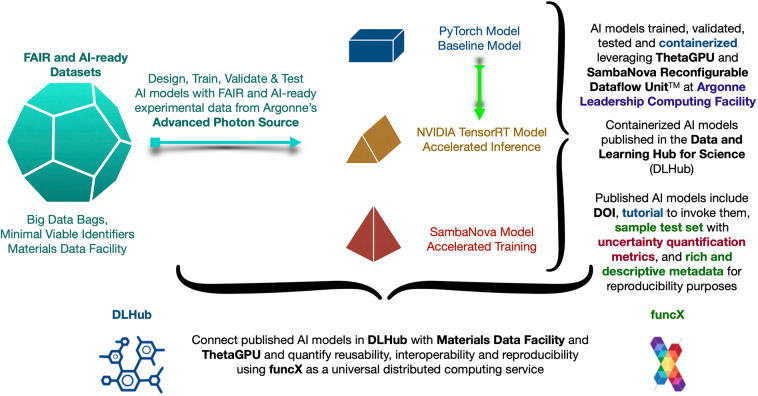
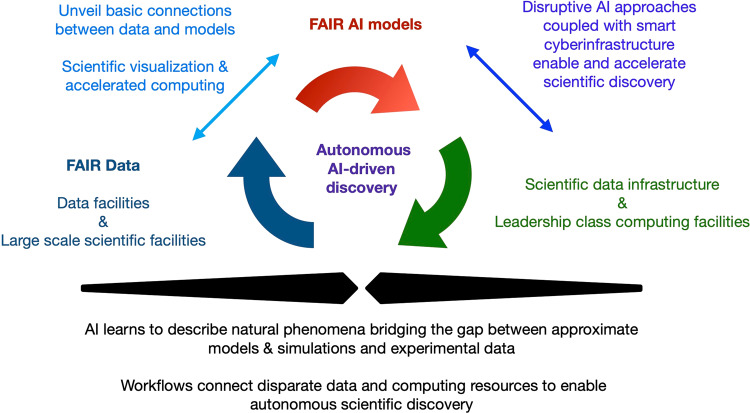
A concise and measurable set of FAIR (Findable, Accessible, Interoperable and Reusable) principles for scientific data is transforming the state-of-practice for data management and stewardship, supporting and enabling discovery and innovation. Learning from this initiative, and acknowledging the impact of artificial intelligence (AI) in the practice of science and engineering, we introduce a set of practical, concise, and measurable FAIR principles for AI models. We showcase how to create and share FAIR data and AI models within a unified computational framework combining the following elements: the Advanced Photon Source at Argonne National Laboratory, the Materials Data Facility, the Data and Learning Hub for Science, and funcX, and the Argonne Leadership Computing Facility (ALCF), in particular the ThetaGPU supercomputer and the SambaNova DataScale® system at the ALCF AI Testbed. We describe how this domain-agnostic computational framework may be harnessed to enable autonomous AI-driven discovery.
Overview
The claims and statistics of this paper haven’t been checked yet.
Free: it reads the open-access text and checks the first 5 claims that cite a source we can check. Create a free account to check every claim.
Integrity signals
Registry
Cites
Statistics
Figures
Verification
Claims the paper makes
The claims and statistics of this paper haven’t been checked yet.
Free: it reads the open-access text and checks the first 5 claims that cite a source we can check. Create a free account to check every claim.
Self-check
Percentages, sums and reported differences re-computed from the paper’s own numbers.
The self-check needs the paper’s full text.
Citations
Cites
LeCun, Y., Bengio, Y., & Hinton, G. (2015) · Nature · doi:10.1038/nature14539 · Cited by 84,126
The FAIR Guiding Principles for scientific data management and stewardship
Wilkinson, M. D., Dumontier, M., Aalbersberg, I. J., Appleton, G., Axton, M., Baak, A., Blomberg, N., Boiten, J.-W., da Silva Santos, L. B., Bourne, P. E., et al. (2016) · Scientific Data · doi:10.1038/sdata.2016.18 · Cited by 18,423
TensorFlow: A system for large-scale machine learning
Abadi, M., Barham, P., Chen, J., Chen, Z., Davis, A., Dean, J., Devin, M., Ghemawat, S., Irving, G., Isard, M., et al. (2016) · arXiv (Cornell University) · doi:10.48550/arxiv.1605.08695 · Cited by 11,822
(2017) · Cited by 11,625
Singularity: Scientific containers for mobility of compute
Kurtzer, G. M., Sochat, V., & Bauer, M. W. (2017) · PLOS ONE · doi:10.1371/journal.pone.0177459 · Cited by 2,740
Nanotechnology and artificial intelligence to enable sustainable and precision agriculture
Zhang, P., Guo, Z., Ullah, S., Melagraki, G., Afantitis, A., & Lynch, I. (2021) · Nature Plants · doi:10.1038/s41477-021-00946-6 · Cited by 478
Advancing mathematics by guiding human intuition with AI
Davies, A., Veličković, P., Buesing, L., Blackwell, S., Zheng, D., Tomašev, N., Tanburn, R., Battaglia, P., Blundell, C., Juhász, A., et al. (2021) · Nature · doi:10.1038/s41586-021-04086-x · Cited by 451
Deep learning and its application to LHC physics
Guest, D., Cranmer, K., & Whiteson, D. (2018) · Annual Review of Nuclear and Particle Science · doi:10.1146/annurev-nucl-101917-021019 · Cited by 417
The Materials Data Facility: Data Services to Advance Materials Science Research
Blaiszik, B., Chard, K., Pruyne, J., Ananthakrishnan, R., Tuecke, S., & Foster, I. (2016) · JOM · doi:10.1007/s11837-016-2001-3 · Cited by 326
Self-citationArtificial intelligence for precision medicine in neurodevelopmental disorders
Uddin, M., Wang, Y., & Woodbury-Smith, M. (2019) · npj Digital Medicine · doi:10.1038/s41746-019-0191-0 · Cited by 248
Methods of Information in Medicine
(1988) · Methods of Information in Medicine · doi:10.1055/s-0038-1636640 · Cited by 238
A design framework and exemplar metrics for FAIRness
Wilkinson, M. D., Sansone, S.-A., Schultes, E., Doorn, P., Bonino da Silva Santos, L. O., & Dumontier, M. (2018) · Scientific Data · doi:10.1038/sdata.2018.118 · Cited by 211
funcX: A Federated Function Serving Fabric for Science
Chard, R., Babuji, Y., Li, Z., Skluzacek, T., Woodard, A., Blaiszik, B., Foster, I., & Chard, K. (2020) · Proceedings of the 29th International Symposium on High-Performance Parallel and Distributed Computing · doi:10.1145/3369583.3392683 · Cited by 188
Self-citationA data ecosystem to support machine learning in materials science
Blaiszik, B., Ward, L., Schwarting, M., Gaff, J., Chard, R., Pike, D., Chard, K., & Foster, I. (2019) · MRS Communications · doi:10.1557/mrc.2019.118 · Cited by 179
Self-citationFrom Raw Data to FAIR Data: The FAIRification Workflow for Health Research
Sınacı, A. A., Núñez-Benjumea, F. J., Gençtürk, M., Jauer, M.-L., Deserno, T. M., Chronaki, C. E., Cangioli, G., Cavero, C., Rodríguez-Pérez, J. M., Pérez‐Pérez, M. M., et al. (2020) · Methods of Information in Medicine · doi:10.1055/s-0040-1713684 · Cited by 141
Sharma, H., Huizenga, R. M., & Offerman, S. E. (2012) · Journal of Applied Crystallography · doi:10.1107/s0021889812025563 · Cited by 101
Enabling real-time multi-messenger astrophysics discoveries with deep learning
Huerta, E. A., Allen, G., Andreoni, I., Antelis, J. M., Bachelet, E., Berriman, G. B., Bianco, F. B., Biswas, R., Kind, M. C., Chard, K., et al. (2019) · Nature Reviews Physics · doi:10.1038/s42254-019-0097-4 · Cited by 98
Self-citationAccelerated, scalable and reproducible AI-driven gravitational wave detection
Huerta, E. A., Khan, A. A. R., Huang, X., Tian, M., Levental, M., Chard, R., Wei, W., Heflin, M., Katz, D. S., Kindratenko, V., et al. (2021) · Nature Astronomy · doi:10.1038/s41550-021-01405-0 · Cited by 96
Self-citationTen simple rules for making a vocabulary FAIR
Cox, S., Gonzalez-Beltran, A. N., Magagna, B., & Marinescu, M.-C. (2021) · PLoS Computational Biology · doi:10.1371/journal.pcbi.1009041 · Cited by 90
BraggNN : fast X-ray Bragg peak analysis using deep learning
Liu, Z., Sharma, H., Park, J.-S., Kenesei, P., Miceli, A., Almer, J., Kettimuthu, R., & Foster, I. T. (2021) · IUCrJ · doi:10.1107/s2052252521011258 · Cited by 82
Self-citationDLHub: Model and Data Serving for Science
Chard, R., Li, Z., Chard, K., Ward, L., Babuji, Y., Woodard, A., Tuecke, S., Blaiszik, B., Franklin, M. J., & Foster, I. (2019) · 2019 IEEE International Parallel and Distributed Processing Symposium (IPDPS) · doi:10.1109/ipdps.2019.00038 · Cited by 68
Self-citationI'll take that to go: Big data bags and minimal identifiers for exchange of large, complex datasets
Chard, K., D’Arcy, M., Heavner, B., Foster, I. T., Kesselman, C., Madduri, R., Rodriguez, A., Soiland‐Reyes, S., Goble, C., Clark, K. A., et al. (2016) · IEEE International Conference on Big Data (BigData) · doi:10.1109/bigdata.2016.7840618 · Cited by 54
Self-citationA FAIR and AI-ready Higgs boson decay dataset
Chen, Y., Huerta, E. A., Duarte, J. M., Harris, P. C., Katz, D. S., Neubauer, M. S., Díaz, D., Mokhtar, F., Kansal, R., Park, S. E., et al. (2022) · Scientific Data · doi:10.1038/s41597-021-01109-0 · Cited by 46
Self-citationGlobus Nexus: A Platform-as-a-Service provider of research identity, profile, and group management
Chard, K., Lidman, M., McCollam, B., Bryan, J., Ananthakrishnan, R., Tuecke, S. J., & Foster, I. T. (2015) · Future Generation Computer Systems · doi:10.1016/j.future.2015.09.006 · Cited by 41
Self-citationBridging Data Center AI Systems with Edge Computing for Actionable Information Retrieval
Liu, Z., Ali, A. Z. E., Kenesei, P., Miceli, A., Sharma, H., Schwarz, N., Trujillo, D., Yoo, H., Coffee, R., Layad, N., et al. (2021) · Annual Workshop on Extreme-scale Experiment-in-the-Loop Computing · doi:10.1109/xloop54565.2021.00008 · Cited by 40
Self-citationShade, P. A., Menasche, D. B., Bernier, J. V., Kenesei, P., Park, J., Suter, R. M., Schuren, J. C., & Turner, T. J. (2016) · Journal of Applied Crystallography · doi:10.1107/s1600576716001989 · Cited by 31
Artificial intelligence powered statistical genetics in biobanks
Narita, A., Ueki, M., & Tamiya, G. (2020) · Journal of Human Genetics · doi:10.1038/s10038-020-0822-y · Cited by 30
Huerta, E. A., & Zhao, Z. (2021) · Springer eBooks · doi:10.1007/978-981-15-4702-7_47-1 · Cited by 26
Self-citationFAIR and Interactive Data Graphics from a Scientific Knowledge Graph
Deagen, M. E., McCusker, J. P., Fateye, T., Stouffer, S., Brinson, L. C., McGuinness, D. L., & Schadler, L. S. (2022) · Scientific Data · doi:10.1038/s41597-022-01352-z · Cited by 26
HPCFAIR: Enabling FAIR AI for HPC Applications
Verma, G., Emani, M. K., Liao, C., Lin, P., Vanderbruggen, T., Shen, X., & Chapman, B. (2021) · Workshop on Machine Learning in HPC Environments · doi:10.1109/mlhpc54614.2021.00011 · Cited by 16
Ravi, N., Liu, Z., Sharma, H., Chaturvedi, P., Huerta, E. A., Scourtas, A., KJ, S., Chard, R., & Blaiszik, B. J. (2022) · Globus Services · doi:10.18126/iftp-twz1 · Cited by 1
Self-citationRavi, N., Liu, Z., Sharma, H., Chaturvedi, P., Huerta, E. A., Scourtas, A., KJ, S., Chard, R., & Blaiszik, B. J. (2022) · Globus Services · doi:10.18126/hvny-s7ax · Cited by 1
Self-citation
Research works printed but not linked: 6
- 1. Baevski, A. et al. data2vec: A general framework for self-supervised learning in speech, vision and language. In Chaudhuri, K. et al. (eds.) International Conference on Machine Learning, ICML 2022, 17-23 July 2022, Baltimore, Maryland, USA, vol. 162 of Proceedings of Machine Learning Research, 1298-1312 (PMLR, 2022).
- 15. Brun, R. & Rademakers, F. Root -an object oriented data analysis framework. AIHENP'96 Workshop, Lausane 389, 81-86 (1996).
- 36. Ravi, N. et al. PyTorch BraggNN Model https://doi.org/10.26311/s7hv-9r95 (2022). · doi:10.26311/s7hv-9r95
- 37. Ravi, N. et al. Accelerated TensorRT BraggNN Model https://doi.org/10.26311/11vb-7j24 (2022). · doi:10.26311/11vb-7j24
- 38. Liu, Z. et al. SambaNova BraggNN Model https://doi.org/10.26311/btnf-3a65 (2022). · doi:10.26311/btnf-3a65
- 40. Goodfellow, I., Bengio, Y. & Courville, A. Deep Learning (MIT press, 2016).
Cited by
Privacy, ethics, transparency, and accountability in AI systems for wearable devices
Radanliev, P. (2025) · Frontiers in Digital Health · doi:10.3389/fdgth.2025.1431246 · Cited by 173
FAIR for AI: An interdisciplinary and international community building perspective
Huerta, E. A., Blaiszik, B. J., Brinson, L. C., Bouchard, K. E., Díaz, D., Doglioni, C., Duarte, J. M., Emani, M. K., Foster, I. T., Fox, G., et al. (2023) · Scientific Data · doi:10.1038/s41597-023-02298-6 · Cited by 135
Self-citationApplications of physics informed neural operators
Rosofsky, S., Majed, H. A., & Huerta, E. A. (2023) · Machine Learning Science and Technology · doi:10.1088/2632-2153/acd168 · Cited by 114
Self-citationData Readiness for AI: A 360-Degree Survey
Hiniduma, K., Byna, S., & Bez, J. L. (2025) · ACM Computing Surveys · doi:10.1145/3722214 · Cited by 96
Linking scientific instruments and computation: Patterns, technologies, and experiences
Vescovi, R., Chard, R., Saint, N., Blaiszik, B. J., Pruyne, J., Biçer, T., Lavens, A., Liu, Z., Papka, M. E., Narayanan, S., et al. (2022) · Patterns · doi:10.1016/j.patter.2022.100606 · Cited by 71
Self-citation
Metadata
- Authors
- Ravi, N., Chaturvedi, P., Huerta, E. A., Liu, Z., Chard, R., Scourtas, A., Schmidt, K. J., Chard, K., Blaiszik, B., & Foster, I.
- Affiliations
- Argonne National Laboratory (US)
- Corresponding author
- Huerta, E. A.
- ORCID
- Venue
- Scientific Data
- Published
- 2022-11-10
- Volume
- 9
- Issue
- 1
- Pages
- 657-657
- ISSN
- 2052-4463 (ISSN-L)
- PMC
- PMC9649764
- OpenAlex
- W4308887398
- Cited by
- 51
- References
- 32
- Citations by year
- 2026: 12 · 2025: 16 · 2024: 10 · 2023: 10 · 2022: 3
- Type
- data paper
- Language
- en
- Open access
- gold
- doi.org
- Licence
- cc-by
- creativecommons.org/licenses/by/4.0 (tdm)
- creativecommons.org/licenses/by/4.0 (vor)
- Locations
- Scientific Data (publishedVersion, cc-by)
- PubMed Central (publishedVersion, cc-by)
- PubMed (publishedVersion)
- Knowledge@UChicago (University of Chicago) (submittedVersion, cc-by-nc-nd)
- DOAJ (DOAJ: Directory of Open Access Journals) (submittedVersion, cc-by-sa)
- OSTI OAI (U.S. Department of Energy Office of Scientific and Technical Information) (submittedVersion)
- Funders
- U.S. Department of Energy (DE-AC02-06CH11357, DE-AC02-06CH1135)
- National Science Foundation (1931306)
- United States Department of Commerce | National Institute of Standards and Technology (70NANB14H012)
- Topics
- Physical Sciences › Computer Science › Information Systems › Research Data Management Practices
- Social Sciences › Decision Sciences › Information Systems and Management › Scientific Computing and Data Management
- Physical Sciences › Materials Science › Materials Chemistry › Machine Learning in Materials Science
- Keywords
- FAIR principles, high-energy diffraction microscopy, data management
About these checks
Registry, retraction, Cites and statistics results are computed, not judged, with one exception: a printed reference that no index lists is read once by a model before it counts as a citation error. Claims are extracted by a model and kept only when their quote appears verbatim in the text; each cited source is then checked, with a model’s help, for whether it says what the claim relies on. Those verdicts can be wrong — read the claim’s quote and the cited source before relying on one.
Statistics and arithmetic are recomputed, not judged.
Confidence bands are shown only for fields calibrated on our annotated test set. None is calibrated yet, so no band is shown.
What counts as a claim ›How we measure confidence ›How we check this ›
Are you an author, or do you see a problem with this page? Request a review
Data sources
Bibliographic data: Semantic Scholar, OpenAlex, Crossref.
Contains information from the Semantic Scholar Academic Graph Datasets, made available under the ODC Attribution License (ODC-BY 1.0).
Semantic Scholar’s data is described in: Kinney, R., et al. (2023). The Semantic Scholar Open Data Platform. arXiv:2301.10140.
