

The DOI matches its Crossref record; 6 of the 6 references it cites were found in a registry or an index.
Exploring nonlinear topological states of matter with exciton-polaritons: Edge solitons in kagome lattice
Abstract
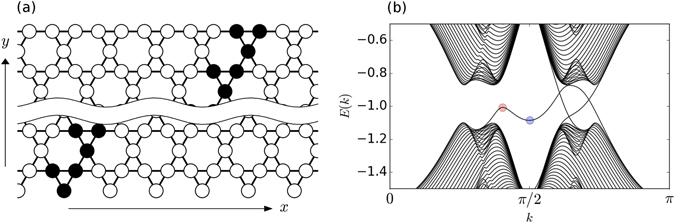
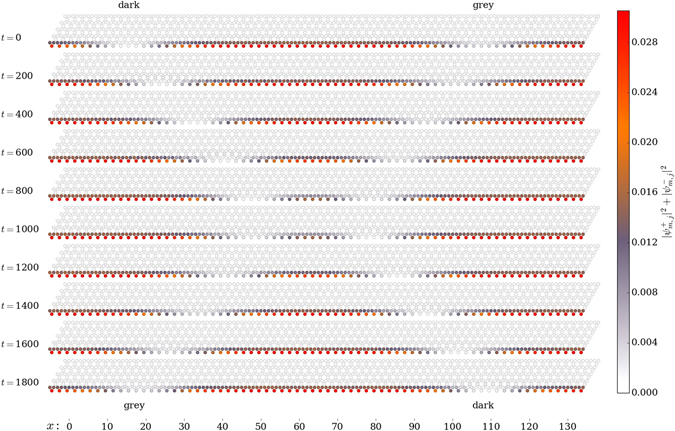
Matter in nontrivial topological phase possesses unique properties, such as support of unidirectional edge modes on its interface. It is the existence of such modes which is responsible for the wonderful properties of a topological insulator – material which is insulating in the bulk but conducting on its surface, along with many of its recently proposed photonic and polaritonic analogues. We show that exciton-polariton fluid in a nontrivial topological phase in kagome lattice, supports nonlinear excitations in the form of solitons built up from wavepackets of topological edge modes – topological edge solitons. Our theoretical and numerical results indicate the appearance of bright, dark and grey solitons dwelling in the vicinity of the boundary of a lattice strip. In a parabolic region of the dispersion the solitons can be described by envelope functions satisfying the nonlinear Schrödinger equation. Upon collision, multiple topological edge solitons emerge undistorted, which proves them to be true solitons as opposed to solitary waves for which such requirement is waived. Importantly, kagome lattice supports topological edge mode with zero group velocity unlike other types of truncated lattices. This gives a finer control over soliton velocity which can take both positive and negative values depending on the choice of forming it topological edge modes.
Overview
The claims and statistics of this paper haven’t been checked yet.
Run the check — free, no account needed. It reads the open-access text and checks the sources it cites.
Integrity signals
Registry
Cites
Statistics
Figures
Verification
Claims the paper makes
The claims and statistics of this paper haven’t been checked yet.
Run the check — free, no account needed. It reads the open-access text and checks the sources it cites.
Claims other papers make about this one
Each is checked against this paper’s own text: does it say what the citing paper says it does?
The cited source says what the claim attributes to it.
In the citing paper
“for kagome-shaped polariton lattices, topological edge solitons were studied by Gulevich et al. (2017).This latter work also highlighted the wide tunability of the edge soliton group velocity from positive to negative values as well as the robustness of topological edge solitons upon intersoliton collisions.”
From Topological photonics (2019) · cites this paper as Gulevich et al., 2017
Self-check
Percentages, sums and reported differences re-computed from the paper’s own numbers.
The self-check needs the paper’s full text.
Citations
Cites
Quantum Spin Hall Insulator State in HgTe Quantum Wells
König, M., Wiedmann, S., Brüne, C., Roth, A., Buhmann, H., Molenkamp, L. W., Qi, X.-L., & Zhang, S.-C. (2007) · Science · doi:10.1126/science.1148047 · Cited by 6,151
Photonic Floquet topological insulators
Rechtsman, M. C., Zeuner, J. M., Plotnik, Y., Lumer, Y., Podolsky, D., Dreisow, F., Nolte, S., Segev, M., & Szameit, A. (2013) · Nature · doi:10.1038/nature12066 · Cited by 3,332
Observation of unidirectional backscattering-immune topological electromagnetic states
Wang, Z., Chong, Y., Joannopoulos, J. D., & Soljačić, M. (2009) · Nature · doi:10.1038/nature08293 · Cited by 3,123
Georgescu, I. M., Ashhab, S., & Nori, F. (2014) · Reviews of Modern Physics · doi:10.1103/revmodphys.86.153 · Cited by 2,932
Reflection-Free One-Way Edge Modes in a Gyromagnetic Photonic Crystal
Wang, Z., Chong, Y. D., Joannopoulos, J. D., & Soljačić, M. (2008) · Physical Review Letters · doi:10.1103/physrevlett.100.013905 · Cited by 1,444 · cited 2×
“σ σ σ u u u u k k k , , 0 (7) k n k n k n k n , , , 2 2 , e e e e”
MethodDirect Observation of Dirac Cones and a Flatband in a Honeycomb Lattice for Polaritons
Jacqmin, T., Carusotto, I., Sagnes, I., Abbarchi, M., Solnyshkov, D. D., Malpuech, G., Galopin, E., Lemaître, A., Bloch, J., & Amo, A. (2014) · Physical Review Letters · doi:10.1103/physrevlett.112.116402 · Cited by 509
Research works printed but not linked: 50
- Kane, C. L. & Mele, E. J. Quantum spin hall effect in graphene. Phys. Rev. Lett. 95, 226801, doi:10.1103/PhysRevLett.95.226801 (2005). · DOI · Paper page
- Bernevig, B. A., Hughes, T. L. & Zhang, S. C. Quantum spin hall effect and topological phase transition in hgte quantum wells. Science 314, 1757–61, doi:10.1126/science.1133734 (2006). · DOI · Paper page
- Raghu, S. & Haldane, F. D. M. Analogs of quantum-hall-effect edge states in photonic crystals. Phys. Rev. A 78, 033834, doi:10.1103/PhysRevA.78.033834 (2008). · DOI · Paper page
- Haldane, F. & Raghu, S. Possible realization of directional optical waveguides in photonic crystals with broken time-reversal symmetry. Phys. Rev. Lett. 100, 013904, doi:10.1103/PhysRevLett.100.013904 (2008). · DOI · Paper page
- Hafezi, M., Demler, E. A., Lukin, M. D. & Taylor, J. M. Robust optical delay lines with topological protection. Nature Physics 7, 907–912, doi:10.1038/nphys2063 (2011). · DOI · Paper page
- Fang, K., Yu, Z. & Fan, S. Realizing effective magnetic field for photons by controlling the phase of dynamic modulation. Nature Photonics 6, 782–787, doi:10.1038/nphoton.2012.236 (2012). · DOI · Paper page
- Khanikaev, A. B. et al. Photonic topological insulators. Nature Materials 12, 233–239, doi:10.1038/nmat3520 (2013). · DOI · Paper page
- Lu, L., Joannopoulos, J. D. & Soljačic′, M. Topological photonics. Nature Photonics 8, 821–829, doi:10.1038/nphoton.2014.248 (2014). · DOI · Paper page
- Carusotto, I. & Ciuti, C. Quantum fluids of light. Reviews of Modern Physics 85, 299–366, doi:10.1103/RevModPhys.85.299 (2013). · DOI · Paper page
- Cerda-Méndez, E. A. et al. Polariton condensation in dynamic acoustic lattices. Phys. Rev. Lett. 105, 116402, doi:10.1103/PhysRevLett.105.116402 (2010). · DOI
- Kim, N. Y. et al. Exciton–polariton condensates near the dirac point in a triangular lattice. New Journal of Physics 15, 035032, doi:10.1088/1367-2630/15/3/035032 (2013). · DOI
- Baboux, F. et al. Bosonic condensation and disorder-induced localization in a flat band. Phys. Rev. Lett. 116, 066402, doi:10.1103/PhysRevLett.116.066402 (2016). · DOI
- Liew, T., Shelykh, I. & Malpuech, G. Polaritonic devices. Physica E 43, 1543–1568, doi:10.1016/j.physe.2011.04.003 (2011). · DOI
- D. Sanvitto, D. & Kéna-Cohen, S. The road towards polaritonic devices. Nature Materials 15, 1061–1073, doi:10.1038/nmat4668 (2016). · DOI
- Karzig, T., Bardyn, C.-E., Lindner, N. H. & Refael, G. Topological polaritons. Phys. Rev. X 5, 031001, doi:10.1103/PhysRevX.5.031001 (2015). · DOI
- Bardyn, C.-E., Karzig, T., Refael, G. & Liew, T. C. H. Topological polaritons and excitons in garden-variety systems. Phys. Rev. B 91, 161413, doi:10.1103/PhysRevB.91.161413 (2015). · DOI
- Nalitov, A. V., Solnyshkov, D. D. & Malpuech, G. Polariton ℤ topological insulator. Phys. Rev. Lett. 114, 116401, doi:10.1103/PhysRevLett.114.116401 (2015). · DOI
- Yi, K. & Karzig, T. Topological polaritons from photonic dirac cones coupled to excitons in a magnetic field. Phys. Rev. B 93, 104303, doi:10.1103/PhysRevB.93.104303 (2016). · DOI
- Bardyn, C.-E., Karzig, T., Refael, G. & Liew, T. C. H. Chiral bogoliubov excitations in nonlinear bosonic systems. Phys. Rev. B 93, 020502, doi:10.1103/PhysRevB.93.020502 (2016). · DOI · Paper page
- Janot, A., Rosenow, B. & Refael, G. Topological polaritons in a quantum spin hall cavity. Phys. Rev. B 93, 161111, doi:10.1103/PhysRevLett.111.230403 (2016). · DOI
- Gulevich, D. R., Yudin, D., Iorsh, I. V. & Shelykh, I. A. Kagome lattice from an exciton-polariton perspective. Phys. Rev. B 94, 115437, doi:10.1103/PhysRevB.94.115437 (2016). · DOI
- Lumer, Y., Plotnik, Y., Rechtsman, M. C. & Segev, M. Self-localized states in photonic topological insulators. Phys. Rev. Lett. 111, 243905, doi:10.1103/PhysRevLett.111.243905 (2013). · DOI
- Ostrovskaya, E. A., Abdullaev, J., Fraser, M. D., Desyatnikov, A. S. & Kivshar, Y. S. Self-localization of polariton condensates in periodic potentials. Phys. Rev. Lett. 110, 170407, doi:10.1103/PhysRevLett.110.170407 (2013). · DOI
- Hadad, Y., Khanikaev, A. B. & Alù, A. Self-induced topological transitions and edge states supported by nonlinear staggered potentials. Phys. Rev. B 93, 155112, doi:10.1103/PhysRevB.93.155112 (2016). · DOI
- Bleu, O., Solnyshkov, D. D. & Malpuech, G. Interacting quantum fluid in a polariton chern insulator. Phys. Rev. B 93, 085438, doi:10.1103/PhysRevLett.118.023901 (2016). · DOI · Paper page
- Kartashov, Y. V. & Skryabin, D. V. Two-dimensional lattice solitons in polariton condensates with spin-orbit coupling. Opt. Lett. 41, 5043–5046, doi:10.1364/OL.41.005043 (2016). · DOI
- Gulevich, D. R., Skryabin, D. V., Alodjants, A. P. & Shelykh, I. A. Topological spin meissner effect in spinor exciton-polariton condensate: Constant amplitude solutions, half-vortices, and symmetry breaking. Phys. Rev. B 94, 115407, doi:10.1103/PhysRevB.94.115407 (2016). · DOI
- Ablowitz, M. J., Curtis, C. W. & Ma, Y.-P. Linear and nonlinear traveling edge waves in optical honeycomb lattices. Phys. Rev. A 90, 023813, doi:10.1103/PhysRevA.90.023813 (2014). · DOI
- Leykam, D. & Chong, Y. D. Edge solitons in nonlinear-photonic topological insulators. Phys. Rev. Lett. 117, 143901, doi:10.1103/PhysRevLett.117.143901 (2016). · DOI · Paper page
- Kartashov, Y. V. & Skryabin, D. V. Modulational instability and solitary waves in polariton topological insulators. Optica 3, 1228, doi:10.1364/OPTICA.3.001228 (2016). · DOI
- Cerda-Méndez, E. A. et al. Exciton-polariton gap solitons in two-dimensional lattices. Phys. Rev. Lett. 111, 146401, doi:10.1103/PhysRevLett.111.146401 (2013). · DOI
- Solnyshkov, D. D., Bleu, O., Teklu, B. & Malpuech, G. Chirality of topological gap solitons in bosonic dimer chains. Phys. Rev. Lett. 118, 023901, doi:10.1103/PhysRevLett.118.023901 (2017). · DOI
- Rajaraman, R. Solitons and Instantons: An Introduction to Solitons and Instantons in Quantum Field Theory (Elsevier Science, 1987).
- de Vasconcellos, S. M. et al. Spatial, spectral, and polarization properties of coupled micropillar cavities. Appl. Phys. Lett. 99, 101103, doi:10.1063/1.3632111 (2011). · DOI
- Nalitov, A. V., Malpuech, G., Terças, H. & Solnyshkov, D. D. Spin-orbit coupling and the optical spin hall effect in photonic graphene. Phys. Rev. Lett. 114, 026803, doi:10.1103/PhysRevLett.114.026803 (2015). · DOI
- Sala, V. G. et al. Spin-orbit coupling for photons and polaritons in microstructures. Phys. Rev. X 5, 011034 (2015).
- Hasan, M. Z. & Kane, C. L. Colloquium: Topological insulators. Rev. Mod. Phys. 82, 3045–3067, doi:10.1103/RevModPhys.82.3045 (2010). · DOI · Paper page
- Fruchart, M. & Carpentier, D. An introduction to topological insulators. Comptes Rendus Physique 14, 779–815, doi:10.1016/j.crhy.2013.09.013 Topological insulators/Isolants topologiquesTopological insulators/Isolants topologiques (2013). · DOI
- Vladimirova, M. et al. Polarization controlled nonlinear transmission of light through semiconductor microcavities. Phys. Rev. B 79, 115325, doi:10.1103/PhysRevB.79.115325 (2009). · DOI
- Landau, L. D. & Lifshitz, L. M. Quantum Mechanics, Third Edition: Non-Relativistic Theory (Volume 3) (Pregamon Press, 1977).
- Ablowitz, M. J. Nonlinear Dispersive Waves: Asymptotic Analysis and Solitons (Cambridge University Press, 2011). · DOI
- Milićević, M. et al. Edge states in polariton honeycomb lattices. 2D Materials 2, 034012, doi:10.1088/2053-1583/2/3/034012 (2015). · DOI · Paper page
- Galbiati, M. et al. Polariton condensation in photonic molecules. Phys. Rev. Lett. 108, 126403, doi:10.1103/PhysRevLett.108.126403 (2012). · DOI
- Abbarchi, M. et al. Macroscopic quantum self-trapping and josephson oscillations of exciton polaritons. Nature Physics 9, 275–279, doi:10.1038/nphys2609 (2013). · DOI
- Dufferwiel, S. et al. Tunable polaritonic molecules in an open microcavity system. Applied Physics Letters 107, 201106, doi:10.1063/1.4936092 (2015). · DOI
- Kuwata-Gonokami, M. et al. Parametric scattering of cavity polaritons. Phys. Rev. Lett. 79, 1341–1344, doi:10.1103/PhysRevLett.79.1341 (1997). · DOI
- Savvidis, P. G. et al. Angle-resonant stimulated polariton amplifier. Phys. Rev. Lett. 84, 1547–1550, doi:10.1103/PhysRevLett.84.1547 (2000). · DOI
- Ciuti, C., Schwendimann, P. & Quattropani, A. Parametric luminescence of microcavity polaritons. Phys. Rev. B 63, 041303–5, doi:10.1103/PhysRevLett.84.1752 (2001). · DOI
- Dasbach, G., Schwab, M., Bayer, M. & Forchel, A. Parametric polariton scattering in microresonators with three-dimensional optical confinement. Phys. Rev. B 64, 201309, doi:10.1103/PhysRevB.64.201309 (2001). · DOI
- Tartakovskii, A. I. et al. Polariton parametric scattering processes in semiconductor microcavities observed in continuous wave experiments. Phys. Rev. B 65, 081308, doi:10.1103/PhysRevB.65.081308 (2002). · DOI
Cited by
Sorted by citations
Ozawa, T., Price, H. M., Amo, A., Goldman, N., Hafezi, M., Lu, L., Rechtsman, M. C., Schuster, D., Simon, J., Zilberberg, O., et al. (2019) · Reviews of Modern Physics · doi:10.1103/revmodphys.91.015006 · Cited by 3,722
Metadata
- Authors
- Gulevich, D. R., Yudin, D., Skryabin, D. V., Iorsh, I. V., & Shelykh, I. A.
- Venue
- Scientific Reports
- Published
- 2017-05-11
- Volume
- 7
- Issue
- 1
- ISSN
- 2045-2322
- PMC
- PMC5431788
- Cited by
- 87
- References
- 6
- Language
- en
About these checks
Registry, retraction, Cites and statistics results are computed, not judged, with one exception: a printed reference that no index lists is read once by a model before it counts as a citation error. Claims are extracted by a model and kept only when their quote appears verbatim in the text; each cited source is then checked, with a model’s help, for whether it says what the claim relies on. Those verdicts can be wrong — read the claim’s quote and the cited source before relying on one.
Statistics and arithmetic are recomputed, not judged.
Confidence bands are shown only for fields calibrated on our annotated test set. None is calibrated yet, so no band is shown.
What counts as a claim ›How we measure confidence ›How we check this ›
Are you an author, or do you see a problem with this page? Request a review
