

The DOI matches its Crossref record; the references it cites are not checked yet.
Portable and Error-Free DNA-Based Data Storage
Open accessPublished version of a preprint
Abstract
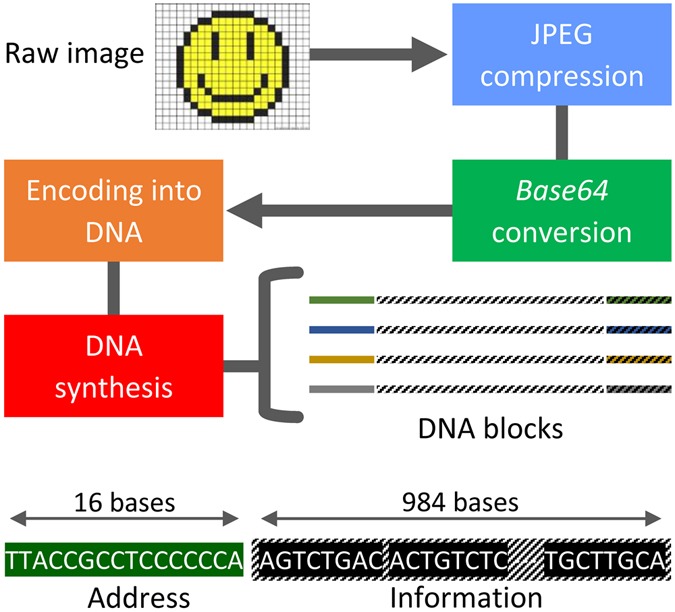
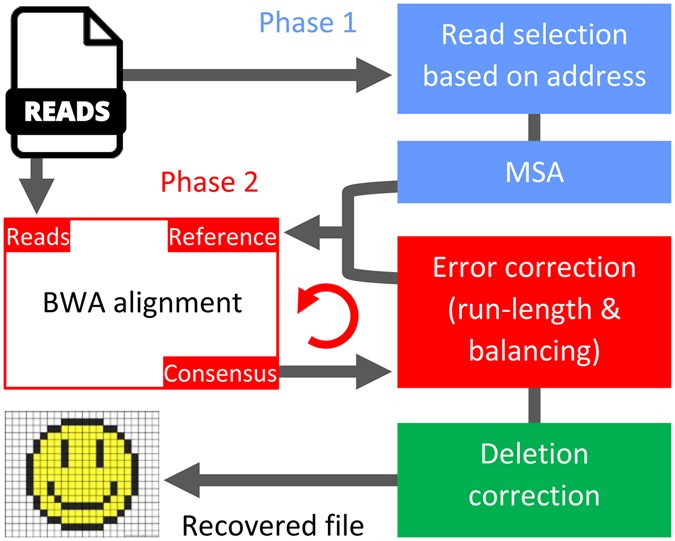
DNA-based data storage is an emerging nonvolatile memory technology of potentially unprecedented density, durability, and replication efficiency. The basic system implementation steps include synthesizing DNA strings that contain user information and subsequently retrieving them via high-throughput sequencing technologies. Existing architectures enable reading and writing but do not offer random-access and error-free data recovery from low-cost, portable devices, which is crucial for making the storage technology competitive with classical recorders. Here we show for the first time that a portable, random-access platform may be implemented in practice using nanopore sequencers. The novelty of our approach is to design an integrated processing pipeline that encodes data to avoid costly synthesis and sequencing errors, enables random access through addressing, and leverages efficient portable sequencing via new iterative alignment and deletion error-correcting codes. Our work represents the only known random access DNA-based data storage system that uses error-prone nanopore sequencers, while still producing error-free readouts with the highest reported information rate. As such, it represents a crucial step towards practical employment of DNA molecules as storage media.
Overview
The claims and statistics of this paper haven’t been checked yet.
Free: it reads the open-access text and checks the first 5 claims that cite a source we can check. Create a free account to check every claim.
Integrity signals
Registry
Cites
Statistics
Figures

Verification
Claims the paper makes
The claims and statistics of this paper haven’t been checked yet.
Free: it reads the open-access text and checks the first 5 claims that cite a source we can check. Create a free account to check every claim.
Claims other papers make about this one
Each is checked against this paper’s own text: does it say what the citing paper says it does?
The source backs part of the claim, not all of it — or backs it for a different population, condition or comparison.
In the citing paper
“However, the sequencing coverage (number of read counts of a unique sequence) of an oligonucleotide (henceforth referred to simply as “oligo”) was found to be very uneven, requiring modern error correction codes capable of handling sequence dropout7–12.”
From Quantifying Molecular Bias in DNA Data Storage (2019) · cites this paper as [12]
Experimental — accuracy not yet measuredThe source backs part of the claim, not all of it — or backs it for a different population, condition or comparison.
In the citing paper
“Moreover, its logical density (1.75 bits/nt) is double that of Antkowiak et al.’s method (0.8 bits/nt) [20] with only about 2.5% reduction in error correction capability.”
From Study of the error correction capability of multiple sequence alignment algorithm (MAFFT) in DNA storage (2023) · cites this paper as [21]
Experimental — accuracy not yet measuredThe source backs part of the claim, not all of it — or backs it for a different population, condition or comparison.
In the citing paper
“Compared with other methods in this regime, Yazdi et al. [21] has the most cost-efficient solution.”
From Study of the error correction capability of multiple sequence alignment algorithm (MAFFT) in DNA storage (2023) · cites this paper as [21]
Experimental — accuracy not yet measuredThe source backs part of the claim, not all of it — or backs it for a different population, condition or comparison.
In the citing paper
“Demonstrations of its viability as a general information storage medium include the storage and retrieval of books, images, computer programs, audio clips, works of art, and Shakespeare’s sonnets using a variety of encoding schemes6–12, with data size limited primarily by the cost of DNA synthesis.”
From Random access DNA memory using Boolean search in an archival file storage system (2021) · cites this paper as [10]
Experimental — accuracy not yet measuredThe source backs part of the claim, not all of it — or backs it for a different population, condition or comparison.
In the citing paper
“To date, molecular random access has largely relied on conventional polymerase chain reaction (PCR)8,10,12,13, which uses up to ~20–30 heating and cooling cycles with DNA polymerase to selectively amplify specific DNA sequences from a DNA data pool using primers.”
From Random access DNA memory using Boolean search in an archival file storage system (2021) · cites this paper as [10]
Experimental — accuracy not yet measured
3 more claims about this paper
Create a free account to see every claim other papers make about this one.
Self-check
Percentages, sums and reported differences re-computed from the paper’s own numbers.
The self-check needs the paper’s full text.
Citations
The citation lists are queued
They are fetched later and appear here then.
References 23 · Cited by 361
Metadata
- Authors
- Yazdi, S. M. H. T., Gabrys, R., & Milenkovic, O.
- Affiliations
- University of Illinois Urbana-Champaign (US)
- Venue
- Scientific Reports
- Published
- 2017-07-10
- Volume
- 7
- Issue
- 1
- Pages
- 5011-5011
- ISSN
- 2045-2322 (ISSN-L)
- PMC
- PMC5503945
- OpenAlex
- W2951269465
- Cited by
- 361
- References
- 23
- Citations by year
- 2026: 27 · 2025: 40 · 2024: 49 · 2023: 52 · 2022: 46 · 2021: 49 · 2020: 48 · 2019: 35 · 2018: 10 · 2017: 5
- FWCI
- 10.89
- Type
- journal article
- Language
- en
- Update notices
- correction (2020-04-22)
- Open access
- gold
- doi.org
- Licence
- cc-by
- creativecommons.org/licenses/by/4.0 (tdm)
- creativecommons.org/licenses/by/4.0 (vor)
- Locations
- Scientific Reports (publishedVersion, cc-by)
- bioRxiv (Cold Spring Harbor Laboratory) (acceptedVersion, cc-by-nd)
- PubMed Central (publishedVersion, cc-by)
- PubMed (publishedVersion)
- DOAJ (DOAJ: Directory of Open Access Journals) (submittedVersion, cc-by-sa)
- Funders
- National Science Foundation (1618366)
- University of Illinois at Urbana-Champaign
- Topics
- Physical Sciences › Mathematics › Theoretical Computer Science › DNA and Biological Computing
- Physical Sciences › Mathematics › Theoretical Computer Science › Algorithms and Data Compression
- Physical Sciences › Computer Science › Computer Networks and Communications › Advanced Data Storage Technologies
- Keywords
- DNA data storage, nanopore sequencing, random access, error correction, iterative alignment, data encoding, portable sequencing, non-volatile memory, data recovery
- MeSH terms
- Algorithms, DNA, Information Storage and Retrieval, Sequence Analysis, DNA, Databases, Nucleic Acid, Nanopores, High-Throughput Nucleotide Sequencing
About these checks
Registry, retraction, Cites and statistics results are computed, not judged, with one exception: a printed reference that no index lists is read once by a model before it counts as a citation error. Claims are extracted by a model and kept only when their quote appears verbatim in the text; each cited source is then checked, with a model’s help, for whether it says what the claim relies on. Those verdicts can be wrong — read the claim’s quote and the cited source before relying on one.
Statistics and arithmetic are recomputed, not judged.
Confidence bands are shown only for fields calibrated on our annotated test set. None is calibrated yet, so no band is shown.
What counts as a claim ›How we measure confidence ›How we check this ›
Are you an author, or do you see a problem with this page? Request a review
How to cite
Cite CoChat for the checks on this page, and the paper for its own findings.
- This page
- CoChat. (2026). Citation check: Portable and Error-Free DNA-Based Data Storage. https://app.cochat.ai/papers/10.1038/s41598-017-05188-1
- The paper
- Yazdi, S. M. H. T., Gabrys, R., & Milenkovic, O. (2017). Portable and Error-Free DNA-Based Data Storage. Scientific Reports. https://doi.org/10.1038/s41598-017-05188-1
Data sources
Bibliographic data: Semantic Scholar, OpenAlex, Crossref.
Contains information from the Semantic Scholar Academic Graph Datasets, made available under the ODC Attribution License (ODC-BY 1.0).
Semantic Scholar’s data is described in: Kinney, R., et al. (2023). The Semantic Scholar Open Data Platform. arXiv:2301.10140.
