

Vibronic Boson Sampling: Generalized Gaussian Boson Sampling for Molecular Vibronic Spectra at Finite Temperature
Open accessThe DOI matches its Crossref record; 36 of the 36 references it cites were found in a registry or an index.
Abstract
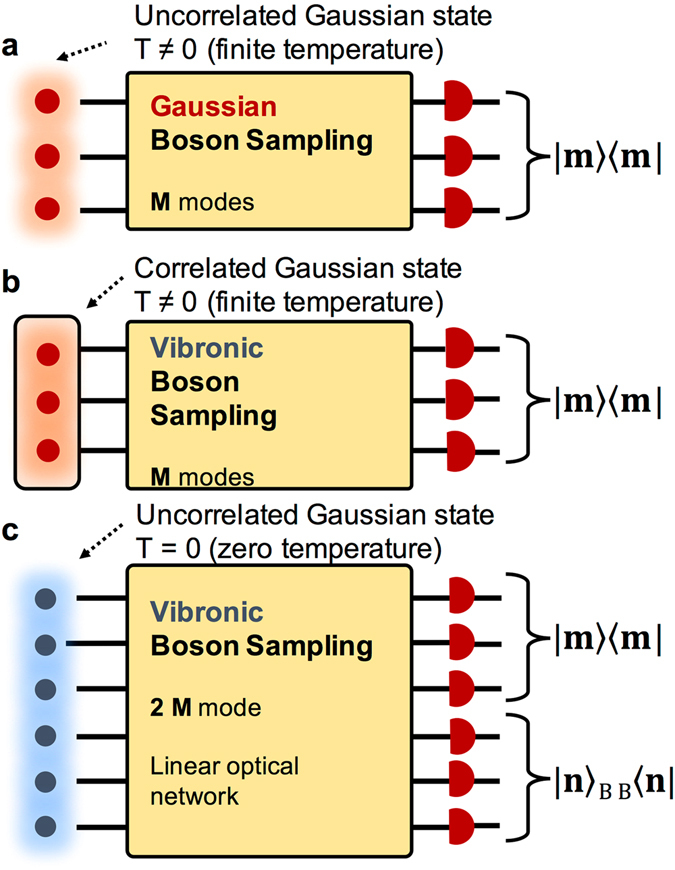
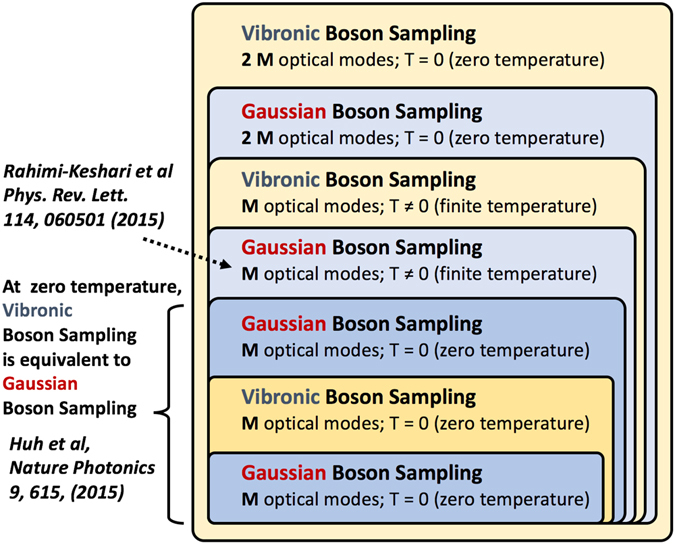
Molecular vibroic spectroscopy, where the transitions involve non-trivial Bosonic correlation due to the Duschinsky Rotation, is strongly believed to be in a similar complexity class as Boson Sampling. At finite temperature, the problem is represented as a Boson Sampling experiment with correlated Gaussian input states. This molecular problem with temperature effect is intimately related to the various versions of Boson Sampling sharing the similar computational complexity. Here we provide a full description to this relation in the context of Gaussian Boson Sampling. We find a hierarchical structure, which illustrates the relationship among various Boson Sampling schemes. Specifically, we show that every instance of Gaussian Boson Sampling with an initial correlation can be simulated by an instance of Gaussian Boson Sampling without initial correlation, with only a polynomial overhead. Since every Gaussian state is associated with a thermal state, our result implies that every sampling problem in molecular vibronic transitions, at any temperature, can be simulated by Gaussian Boson Sampling associated with a product of vacuum modes. We refer such a generalized Gaussian Boson Sampling motivated by the molecular sampling problem as Vibronic Boson Sampling.
Overview
The claims and statistics of this paper haven’t been checked yet.
Free: it reads the open-access text and checks the first 5 claims that cite a source we can check. Create a free account to check every claim.
Integrity signals
Registry
Cites
Statistics
Figures

Verification
Claims the paper makes
The claims and statistics of this paper haven’t been checked yet.
Free: it reads the open-access text and checks the first 5 claims that cite a source we can check. Create a free account to check every claim.
Claims other papers make about this one
Each is checked against this paper’s own text: does it say what the citing paper says it does?
In the citing paper
“We emphasize that Lloyd's result applies to a particular approach to quantum simulation, known as gate-based or digital quantum simulation . This approach is distinct from an analog quantum simulation , for which there have been several recent ground-breaking experiments 245-249 .”
From Quantum Chemistry in the Age of Quantum Computing (2019) · cites this paper as [245]
Self-check
Percentages, sums and reported differences re-computed from the paper’s own numbers.
The self-check needs the paper’s full text.
Citations
Cites
Coherent and Incoherent States of the Radiation Field
Glauber, R. J. (1963) · Physical Review · doi:10.1103/physrev.131.2766 · Cited by 6,797
Weedbrook, C., Pirandola, S., García-Patrón, R., Cerf, N. J., Ralph, T. C., Shapiro, J. H., & Lloyd, S. (2012) · Reviews of Modern Physics · doi:10.1103/revmodphys.84.621 · Cited by 3,664 · cited 1×
“diag( , , ), diag( , , ) , (22) N N 1 1”
Equivalence of Semiclassical and Quantum Mechanical Descriptions of Statistical Light Beams
Sudarshan, E. C. G. (1963) · Physical Review Letters · doi:10.1103/physrevlett.10.277 · Cited by 2,665 · cited 1×
“( ) U 0 9979 0 0646 0 0646 0 9979 , ( 1 8830,0 4551) (35) t”
Experimental realization of any discrete unitary operator
Reck, M., Zeilinger, A., Bernstein, H. J., & Bertani, P. (1994) · Physical Review Letters · doi:10.1103/physrevlett.73.58 · Cited by 2,155 · cited 1×
“X = ( 1 2 ( J− (Jt)−1 ) F (1)2 ( J+(Jt)−1 ) G G 0 ) , (19)”
The computational complexity of linear optics
Aaronson, S., & Arkhipov, A. (2011) · Proceedings of the forty-third annual ACM symposium on Theory of computing · doi:10.1145/1993636.1993682 · Cited by 874
Boson Sampling on a Photonic Chip
Spring, J. B., Metcalf, B. J., Humphreys, P. C., Kolthammer, W. S., Jin, X.-M., Barbieri, M., Datta, A., Thomas-Peter, N., Langford, N. K., Kundys, D., et al. (2013) · Science · doi:10.1126/science.1231692 · Cited by 837 · cited 1×
“ˆ ˆ ˆ † P R R n n n ( ) Tr[ ] (2) U U in”
Continuous Variable Quantum Information: Gaussian States and Beyond
Adesso, G., Ragy, S., & Lee, A. R. (2014) · Open Systems & Information Dynamics · doi:10.1142/s1230161214400010 · Cited by 787
Tillmann, M., Dakić, B., Heilmann, R., Nolte, S., Szameit, A., & Walther, P. (2013) · Nature Photonics · doi:10.1038/nphoton.2013.102 · Cited by 709 · cited 1×
“∑ ′ = = + + ˆ ˆ ˆ ˆ ˆ ˆ † † a U a U X a Y a z ( ) , (5) j j j jk k jk k j D D”
Integrated multimode interferometers with arbitrary designs for photonic boson sampling
Crespi, A., Osellame, R., Ramponi, R., Brod, D. J., Galvão, E. F., Spagnolo, N., Vitelli, C., Maiorino, E., Mataloni, P., & Sciarrino, F. (2013) · Nature Photonics · doi:10.1038/nphoton.2013.112 · Cited by 662
Photonic Boson Sampling in a Tunable Circuit
Broome, M. A., Fedrizzi, A., Rahimi-Keshari, S., Dove, J., Aaronson, S., Ralph, T. C., & White, A. G. (2013) · Science · doi:10.1126/science.1231440 · Cited by 634 · cited 1×
“X Y a a a z, (3) ˆ ˆ ˆ † † ′ = + + where the M × M matrices X and Y satisfy the following two conditions, − = † † XX YY I and = XY YX t .”
Research works printed but not linked: 2
- Duschinsky F Zur Deutung der Elektronenspektren mehratomiger Moleküle Acta Physicochim. URSS 1937 7 551 566
- Huh, J. Unified description of vibronic transitions with coherent states. Ph.D. thesis (2011).
Cited by
Quantum computational advantage using photons
Zhong, H.-S., Wang, H., Deng, Y.-H., Chen, M.-C., Peng, L.-C., Luo, Y.-H., Qin, J., Wu, D., Ding, X., Hu, Y., et al. (2020) · Science · doi:10.1126/science.abe8770 · Cited by 2,405
“ks to several potentially practical applications including certifiable random numbers, graph optimization (32-34), graph similarity (35), point process (36), molecular docking (37), quantum chemistry (38,39), and quantum machine learning (64). A natural next step would be to use the GBS quantum computer developed in o…”
MethodQuantum computational chemistry
McArdle, S., Endo, S., Aspuru-Guzik, A., Benjamin, S. C., & Yuan, X. (2020) · Reviews of Modern Physics · doi:10.1103/revmodphys.92.015003 · Cited by 1,621
Quantum Chemistry in the Age of Quantum Computing
Cao, Y., Romero, J., Olson, J. P., Degroote, M., Johnson, P. D., Kieferová, M., Kivlichan, I. D., Menke, T., Peropadre, B., Sawaya, N. P. D., et al. (2019) · Chemical Reviews · doi:10.1021/acs.chemrev.8b00803 · Cited by 1,560
Phase-Programmable Gaussian Boson Sampling Using Stimulated Squeezed Light
Zhong, H.-S., Deng, Y.-H., Qin, J., Wang, H., Chen, M.-C., Peng, L.-C., Luo, Y.-H., Wu, D., Gong, S.-Q., Su, H., et al. (2021) · Physical Review Letters · doi:10.1103/physrevlett.127.180502 · Cited by 434
Recent progress in quantum photonic chips for quantum communication and internet
Luo, W., Cao, L., Shi, Y., Wan, L., Zhang, H., Li, S., Chen, G., Li, Y., Li, S., Wang, Y., et al. (2023) · Light: Science & Applications · doi:10.1038/s41377-023-01173-8 · Cited by 284
“…delivered by photonic Gaussian boson sampling processors 220,221 , paving the path for further development of integrated speci fi c quantum computers with potential applications including graph optimization 222 , complex molecular spectra 223 , molecular docking 224 , quantum chemistry 225 , etc.”
Metadata
- Authors
- Huh, J., & Yung, M.-H.
- Affiliations
- Sungkyunkwan University (KR)
- Southern University of Science and Technology (CN)
- Corresponding author
- Huh, Joonsuk
- Yung, Man-Hong
- Venue
- Scientific Reports
- Published
- 2017-08-07
- Volume
- 7
- Issue
- 1
- Pages
- 7462-7462
- ISSN
- 2045-2322 (ISSN-L)
- PMC
- PMC5547170
- OpenAlex
- W2729145061
- Cited by
- 63
- References
- 35
- Citations by year
- 2025: 5 · 2024: 6 · 2023: 9 · 2022: 8 · 2021: 6 · 2020: 9 · 2019: 8 · 2018: 11 · 2017: 1
- FWCI
- 4.73
- Type
- journal article
- Language
- en
- Open access
- gold
- doi.org
- Licence
- cc-by
- creativecommons.org/licenses/by/4.0 (tdm)
- creativecommons.org/licenses/by/4.0 (vor)
- Locations
- Scientific Reports (publishedVersion, cc-by)
- PubMed Central (publishedVersion, cc-by)
- PubMed (publishedVersion)
- arXiv (Cornell University) (submittedVersion)
- DOAJ (DOAJ: Directory of Open Access Journals) (submittedVersion, cc-by-sa)
- arXiv (Cornell University)
- Funders
- National Research Foundation
- National Natural Science Foundation of China (11405093)
- Ministry of Science, ICT and Future Planning (1711028311)
- National Research Foundation of Korea (2015R1A6A3A04059773, NRF-2015R1A6A3A04059773)
- Ministry of Education, Science and Technology (NRF-2015R1A6A3A04059773)
- Institute for Information and Communications Technology Promotion
- Topics
- Physical Sciences › Computer Science › Artificial Intelligence › Quantum Computing Algorithms and Architecture
- Physical Sciences › Physics and Astronomy › Atomic and Molecular Physics, and Optics › Quantum Information and Cryptography
- Physical Sciences › Physics and Astronomy › Atomic and Molecular Physics, and Optics › Quantum Mechanics and Applications
- Keywords
- Gaussian boson sampling, finite temperature, Duschinsky rotation, thermal states, computational complexity, quantum sampling
About these checks
Registry, retraction, Cites and statistics results are computed, not judged, with one exception: a printed reference that no index lists is read once by a model before it counts as a citation error. Claims are extracted by a model and kept only when their quote appears verbatim in the text; each cited source is then checked, with a model’s help, for whether it says what the claim relies on. Those verdicts can be wrong — read the claim’s quote and the cited source before relying on one.
Statistics and arithmetic are recomputed, not judged.
Confidence bands are shown only for fields calibrated on our annotated test set. None is calibrated yet, so no band is shown.
What counts as a claim ›How we measure confidence ›How we check this ›
Are you an author, or do you see a problem with this page? Request a review
How to cite
Cite CoChat for the checks on this page, and the paper for its own findings.
- This page
- CoChat. (2026). Citation check: Vibronic Boson Sampling: Generalized Gaussian Boson Sampling for Molecular Vibronic Spectra at Finite Temperature. https://app.cochat.ai/papers/10.1038/s41598-017-07770-z
- The paper
- Huh, J., & Yung, M.-H. (2017). Vibronic Boson Sampling: Generalized Gaussian Boson Sampling for Molecular Vibronic Spectra at Finite Temperature. Scientific Reports. https://doi.org/10.1038/s41598-017-07770-z
Data sources
Bibliographic data: Semantic Scholar, OpenAlex, Crossref.
Contains information from the Semantic Scholar Academic Graph Datasets, made available under the ODC Attribution License (ODC-BY 1.0).
Semantic Scholar’s data is described in: Kinney, R., et al. (2023). The Semantic Scholar Open Data Platform. arXiv:2301.10140.
