

Diversity of Amyloid-beta Proteoforms in the Alzheimer’s Disease Brain
Open accessThe DOI matches its Crossref record; 46 of the 46 references it cites were found in a registry or an index.
Abstract
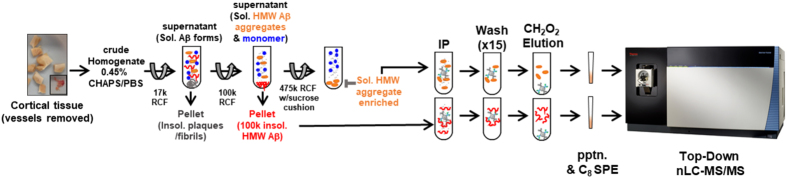
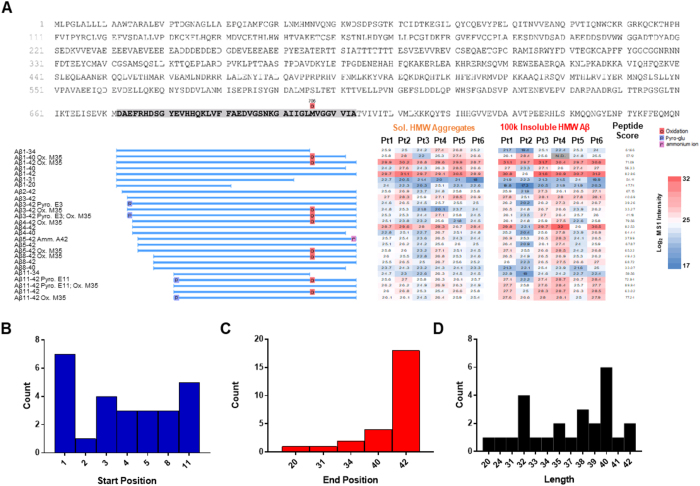
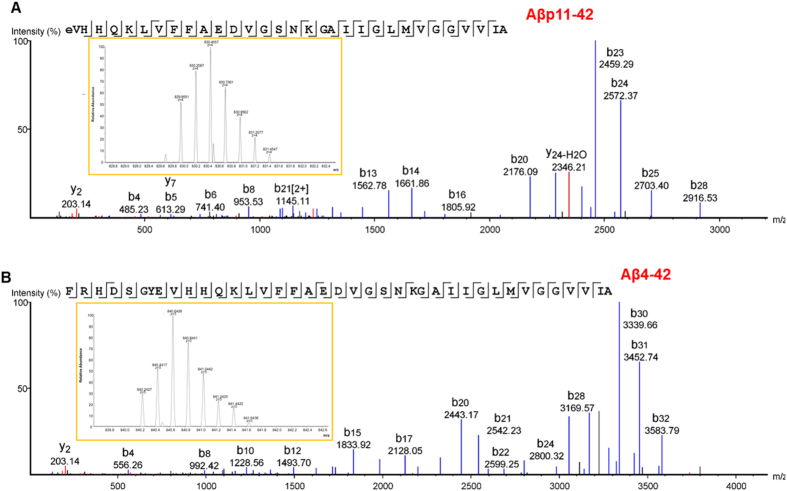
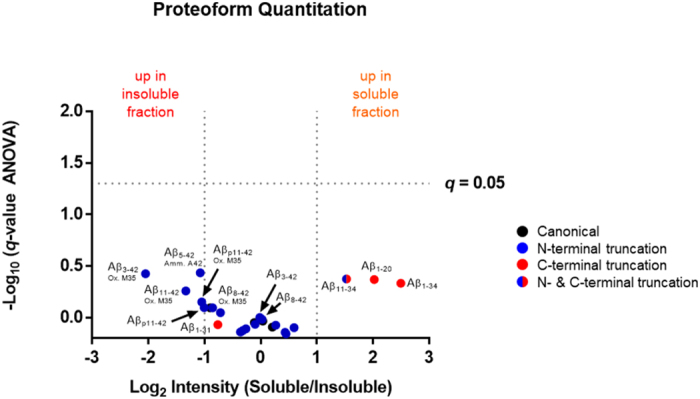
Amyloid-beta (Aβ) plays a key role in the pathogenesis of Alzheimer’s disease (AD), but little is known about the proteoforms present in AD brain. We used high-resolution mass spectrometry to analyze intact Aβ from soluble aggregates and insoluble material in brains of six cases with severe dementia and pathologically confirmed AD. The soluble aggregates are especially relevant because they are believed to be the most toxic form of Aβ. We found a diversity of Aβ peptides, with 26 unique proteoforms including various N- and C-terminal truncations. N- and C-terminal truncations comprised 73% and 30%, respectively, of the total Aβ proteoforms detected. The Aβ proteoforms segregated between the soluble and more insoluble aggregates with N-terminal truncations predominating in the insoluble material and C- terminal truncations segregating into the soluble aggregates. In contrast, canonical Aβ comprised the minority of the identified proteoforms (15.3%) and did not distinguish between the soluble and more insoluble aggregates. The relative abundance of many truncated Aβ proteoforms did not correlate with post-mortem interval, suggesting they are not artefacts. This heterogeneity of Aβ proteoforms deepens our understanding of AD and offers many new avenues for investigation into pathological mechanisms of the disease, with implications for therapeutic development.
Overview
The claims and statistics of this paper haven’t been checked yet.
Free: it reads the open-access text and checks the first 5 claims that cite a source we can check. Create a free account to check every claim.
Integrity signals
Registry
Cites
Statistics
Figures
Verification
Claims the paper makes
The claims and statistics of this paper haven’t been checked yet.
Free: it reads the open-access text and checks the first 5 claims that cite a source we can check. Create a free account to check every claim.
Claims other papers make about this one
Each is checked against this paper’s own text: does it say what the citing paper says it does?
The cited source says what the claim attributes to it.
In the citing paper
“In neurological disease and aging, modified proteins are the histopathological hallmarks of a number of diseases, such as SOD1 in amyotrophic lateral sclerosis (ALS) 56,57 , and a class of diseases long referred to as the proteinopathies 57 , including tauopathies in Alzheimer's disease 58 and inclusions of amyloidβ 59 , α -synuclein in Parkinson's 60,61 and multiple secondary ubiquitinopathies”
From How many human proteoforms are there? (2018) · cites this paper as [59]
In the citing paper
“In addition to the widely known amyloid-beta 40 and amyloid-beta 42 peptides, over 20 additional amyloid-beta proteoforms have been detected in samples of Alzheimer’s brain samples arising from endogenous cleavage and post-translational modifications.(12,13)”
From Putting humpty dumpty back together again: what does protein quantification mean in bottom-up proteomics? (2022) · cites this paper as [13]
Self-check
Percentages, sums and reported differences re-computed from the paper’s own numbers.
The self-check needs the paper’s full text.
Citations
Cites
Controlling the False Discovery Rate: A Practical and Powerful Approach to Multiple Testing
Benjamini, Y., & Hochberg, Y. (1995) · Journal of the Royal Statistical Society Series B: Statistical Methodology · doi:10.1111/j.2517-6161.1995.tb02031.x · Cited by 109,482
Alzheimer's disease: the amyloid cascade hypothesis
Hardy, J. A., & Higgins, G. A. (1992) · Science · doi:10.1126/science.1566067 · Cited by 7,484
The amyloid hypothesis of Alzheimer's disease at 25 years
Selkoe, D. J., & Hardy, J. (2016) · EMBO Molecular Medicine · doi:10.15252/emmm.201606210 · Cited by 6,164
Terry, R. D., Masliah, E., Salmon, D. P., Butters, N., DeTeresa, R., Hill, R., Hansen, L. A., & Katzman, R. (1991) · Annals of Neurology · doi:10.1002/ana.410300410 · Cited by 4,397
Vassar, R., Bennett, B. D., Babu-Khan, S., Kahn, S., Mendiaz, E. A., Denis, P., Teplow, D. B., Ross, S., Amarante, P., Loeloff, R., et al. (1999) · Science · doi:10.1126/science.286.5440.735 · Cited by 3,876
Shankar, G. M., Li, S., Mehta, T. H., Garcia-Munoz, A., Shepardson, N. E., Smith, I., Brett, F. M., Farrell, M. A., Rowan, M. J., Lemere, C. A., et al. (2008) · Nature Medicine · doi:10.1038/nm1782 · Cited by 3,685
Aβ Oligomers – a decade of discovery
Walsh, D. M., & Selkoe, D. J. (2007) · Journal of Neurochemistry · doi:10.1111/j.1471-4159.2006.04426.x · Cited by 1,938
The Proteomics Identifications (PRIDE) database and associated tools: status in 2013
Vizcaíno, J. A., Côté, R. G., Csordas, A., Dianes, J. A., Fabregat, A., Foster, J. M., Griss, J., Alpi, E., Birim, M., Contell, J., et al. (2012) · Nucleic Acids Research · doi:10.1093/nar/gks1262 · Cited by 1,918
Soluble Amyloid β Peptide Concentration as a Predictor of Synaptic Change in Alzheimer's Disease
Lue, L.-F., Kuo, Y.-M., Roher, A. E., Brachova, L., Shen, Y., Sue, L., Beach, T., Kurth, J. H., Rydel, R. E., & Rogers, J. (1999) · The American Journal of Pathology · doi:10.1016/s0002-9440(10)65184-x · Cited by 1,530
Proteoform: a single term describing protein complexity
The Consortium for Top Down Proteomics, Smith, L. M., & Kelleher, N. L. (2013) · Nature Methods · doi:10.1038/nmeth.2369 · Cited by 1,528
Self-citation
Cited by
Items 101–173 of 173
Manly, L. S., Roberts, A. M., Beckman, J. S., & Roberts, B. R. (2025) · Journal of the American Society for Mass Spectrometry · doi:10.1021/jasms.5c00116 · Cited by 8
DeHart, C. J., Fornelli, L., Anderson, L. C., Fellers, R. T., Lu, D., Hendrickson, C. L., Lahav, G., Gunawardena, J., & Kelleher, N. L. (2018) · bioRxiv (Cold Spring Harbor Laboratory) · doi:10.1101/455527 · Cited by 8
Self-citationKurakin, S., Badreeva, D. R., Dushanov, E., Shutikov, A., Vladimirovich, E. S., Timerova, A. F., Mukhametzyanov, T. A., Murugova, T. N., Ivankov, O. I., Маматкулов, К. З., et al. (2023) · Biochimica et Biophysica Acta (BBA) - Biomembranes · doi:10.1016/j.bbamem.2023.184237 · Cited by 8
Alvarez, A. B., Rodríguez, P. E. A., & Fidelio, G. D. (2023) · Biochimica et Biophysica Acta (BBA) - Biomembranes · doi:10.1016/j.bbamem.2023.184234 · Cited by 8
Asymmetry in Biological Homochirality
Hochberg, D. (2021) · MDPI eBooks · doi:10.3390/books978-3-0365-0442-1 · Cited by 7
Twitto‐Greenberg, R., Zaltsman, S. L., Michaelson, D. M., Liraz, O., Lubitz, I., Atrakchi, D., Shemesh, C., Ashery, U., Cooper, I., Harari, A., et al. (2023) · Neurobiology of Aging · doi:10.1016/j.neurobiolaging.2023.09.005 · Cited by 7
Solid-phase synthesis and pathological evaluation of pyroglutamate amyloid-β3-42 peptide
Cho, I., Lee, H., Lee, D.-H., Park, I. W., Yoon, S., Kim, H. Y., & Kim, Y. S. (2023) · Scientific Reports · doi:10.1038/s41598-022-26616-x · Cited by 7
Han, Y., Desai, A. A., Zupancic, J. M., Smith, M. D., Tessier, P. M., & Ruotolo, B. T. (2024) · Protein Science · doi:10.1002/pro.5008 · Cited by 7
Palani, R. S., Williams, C. G., Thacker, D., Silvers, R., Qian, F., Weinreb, P. H., Mueller, L. J., Linse, S. S., & Griffin, R. G. (2025) · Proceedings of the National Academy of Sciences · doi:10.1073/pnas.2515673122 · Cited by 7
Quantum dots-based “chemical tongue” for the discrimination of short-length Aβ peptides
Głowacz, K., Drozd, M., Tokarska, W., Wezynfeld, N. E., & Ciosek, P. (2024) · Microchimica Acta · doi:10.1007/s00604-023-06115-0 · Cited by 7
Suprun, E. V., Daboss, E. V., Pleshakov, V. M., Vokhmyanina, D. V., Radko, S. P., Karyakin, A. A., Kozin, S. A., Makarov, A. А., & Mitkevich, V. A. (2022) · Electrochimica Acta · doi:10.1016/j.electacta.2022.139829 · Cited by 7
Acetylcholine hydrolytic activity of fibrillated β-amyloid (1–40) peptide
Sanchís, I., Spinelli, R., & Siano, Á. (2023) · Amino Acids · doi:10.1007/s00726-023-03349-3 · Cited by 6
Kandi, S., Cline, E. N., Rivera, B. M., Viola, K. L., Zhu, J., Condello, C., LeDuc, R. D., Klein, W. L., Kelleher, N. L., & Patrie, S. M. (2023) · Journal of Proteome Research · doi:10.1021/acs.jproteome.3c00353 · Cited by 6
Self-citationOveisgharan, S., Yu, L., Yang, J., Agrawal, S., Vialle, R. A., Lopes, K. D. P., Tasaki, S., Wang, Y., Petyuk, V., Young‐Pearse, T. L., et al. (2025) · Neurology · doi:10.1212/wnl.0000000000214024 · Cited by 6
Lim, J., Kim, S., Lee, C., Park, J., Yang, G., & Yook, T. H. (2022) · Molecules · doi:10.3390/molecules27248678 · Cited by 6
Cascade autohydrolysis of Alzheimer's Aβ peptides
Wolfram, M., Tiwari, M. K., Hassenkam, T., Li, M., Bjerrum, M. J., & Meldal, M. (2023) · Chemical Science · doi:10.1039/d2sc06668h · Cited by 6
Selective transmembrane transport of Aβ protein regulated by tryptophan enantiomers
Zhu, F., Wang, W., Zhang, F., Dhinakaran, M. K., Wang, Y., Wang, R., Cheng, J., Toimil‐Molares, M. E., Trautmann, C., & Li, H. (2021) · Chemical Communications · doi:10.1039/d0cc06104b · Cited by 6
Direct evidence for binding of aluminum to NAP anti-amyloid peptide and its analogs
Lupăescu, A.-V., Humelnicu, I., Petre, B. A., Ciobanu, C. I., & Drochioiu, G. (2019) · European Journal of Mass Spectrometry · doi:10.1177/1469066719877714 · Cited by 6
Anionic lipids modulate little the reorganization effect of amyloid-beta peptides on membranes
Ivankov, O. I., Badreeva, D. R., Ermakova, E. V., Kondela, T., Murugova, T. N., & Kučerka, N. (2023) · General Physiology and Biophysics · doi:10.4149/gpb_2022052 · Cited by 6
In Vivo Seeding of Amyloid-β Protein and Implications in Modeling Alzheimer’s Disease Pathology
Liu, Q., Song, S., Liu, L., & Hong, W. (2025) · Biomolecules · doi:10.3390/biom15040571 · Cited by 5
Asp, E., Proschitsky, M., Lulu, M., Rockwell‐Postel, C., Tsubery, H., & Krishnan, R. (2019) · Journal of Molecular Biology · doi:10.1016/j.jmb.2019.03.022 · Cited by 5
Functionalized Mesoporous Silicas Direct Structural Polymorphism of Amyloid-β Fibrils
Lucas, M. J., Pan, H. S., Verbeke, E. J., Webb, L. J., Taylor, D. W., & Keitz, B. K. (2020) · Langmuir · doi:10.1021/acs.langmuir.0c00827 · Cited by 5
Molecular etiopathogenesis of neurodegenerative diseases
Divya, D., Thekkekkara, D., Sai, T. E., Ramakrishna, D., Manjula, S. N., & Goswami, S. K. (2024) · Elsevier eBooks · doi:10.1016/b978-0-443-28822-7.00002-7 · Cited by 3
Modulation of Aβ 1–40 and Aβ 4–40 co-assembly by zinc: getting closer to the biological reality
de Cremoux, L., Falcone, E., Schmitt, D. A., Stefaniak, E., Wiśniewska, M., Vitale, N., Bal, W., & Hureau, C. (2025) · Inorganic Chemistry Frontiers · doi:10.1039/d5qi00850f · Cited by 3
Delfino, D., Rossetti, D. V., Martelli, C., Inserra, I., Vincenzoni, F., Castagnola, M., Urbani, A., Scarpa, S., Fuso, A., Cavallaro, R. A., et al. (2019) · Journal of Chromatography B · doi:10.1016/j.jchromb.2019.06.005 · Cited by 3
Meprin β elevates hippocampal soluble Aβ in the APP/V717I mouse model
Keller, M., Gallagher, C., Marengo, L., Bickenbach, K., Schmitt, U., Abukhalaf, M., Tholey, A., Kreiselmaier, S., Becker-Pauly, C., Mittmann, T., et al. (2025) · Experimental Neurology · doi:10.1016/j.expneurol.2025.115600 · Cited by 2
The Features of Beta-Amyloid Phosphorylation in Alzheimer’s Disease
Strelnikova, P. A., Бугрова, А. Е., Zakharova, N. V., Danichkina, K. V., Indeykina, M. I., Gavrish, M. S., Krut’, V. G., Babaev, A. A., Morozova, A. Y., Kononikhin, A. S., et al. (2024) · Acta Naturae · doi:10.32607/actanaturae.27456 · Cited by 2
de Souza, I. D., Queiroz, M. E. C., Pichon, V., & Combès, A. (2026) · Analytica Chimica Acta · doi:10.1016/j.aca.2026.345809 · Cited by 2
Amyloid beta binding partners in the brain tissue of older adults
Oveisgharan, S., Yu, L., Wang, Y., Yang, J., Vialle, R. A., Lopes, K. D. P., Tasaki, S., Young‐Pearse, T. L., Jager, P. L. D., Petyuk, V., et al. (2025) · Alzheimer s & Dementia · doi:10.1002/alz.70882 · Cited by 2
Alzheimer’s Disease Silent Killer of Memory: A Review on Pathological Mechanisms
Singh, S. (2019) · Alzheimer’s & Neurodegenerative Diseases · doi:10.24966/and-9608/100017 · Cited by 2
Recent updates on immunotherapy in neurodegenerative diseases
Salunkhe, J., & Ugale, R. R. (2024) · Brain Research · doi:10.1016/j.brainres.2024.149205 · Cited by 2
Neglected N-Truncated Amyloid-β Peptide and Its Mixed Cu–Zn Complexes
Frączyk, T., & Cieplak, P. (2022) · The Protein Journal · doi:10.1007/s10930-022-10056-7 · Cited by 2
A new proposal for the causative agent of the sporadic form of Alzheimer‘s disease
Reinscheid, F. (2020) · Medical Hypotheses · doi:10.1016/j.mehy.2020.110453 · Cited by 2
Papageorgiou, L., Papakonstantinou, E., Salis, C., Polychronidou, E., Hagidimitriou, M., Maroulis, D., Eliopoulos, E., & Vlachakis, D. P. (2020) · Advances in experimental medicine and biology · doi:10.1007/978-3-030-32622-7_18 · Cited by 2
(2019) · Elsevier eBooks · doi:10.1016/b978-0-12-812518-2.00047-0 · Cited by 2
The role of N-truncated Aβ peptides in Alzheimer’s Disease
López‐Noguerola, J. S. (2018) · eDiss (Georg-August-Universität Göttingen) · doi:10.53846/goediss-6949 · Cited by 1
Quantitative Mass Spectrometric Assay of Whole and CNBr-Cleaved Amyloid-β Peptides in Human Brain
Furman, R., Ng, S. C. W., Komatsu, H., & Axelsen, P. H. (2020) · Journal of Alzheimer s Disease · doi:10.3233/jad-190647 · Cited by 1
The influence of neprilysin on the pathogenesis of sporadic Alzheimer’s disease
Hornung, K. A. (2024) · eDiss (Georg-August-Universität Göttingen) · doi:10.53846/goediss-10498 · Cited by 1
Spontaneous Breakdown of Long‐Lived Proteins in Aging and Their Implications in Disease
Friedrich, M. G. (2021) · Wiley eBooks · doi:10.1002/9783527826759.ch4 · Cited by 1
Khayat, E., Delfing, B. M., Laracuente, X. E., Olson, A., Lockhart, C., & Klimov, D. K. (2023) · ACS Chemical Neuroscience · doi:10.1021/acschemneuro.2c00722 · Cited by 1
Busch, L., & Bufe, B. (2023) · Neural Regeneration Research · doi:10.4103/1673-5374.374013 · Cited by 1
Molecular Simulations and Alzheimer׳s Disease
Söldner, C. A., Sticht, H., & Horn, A. H. C. (2020) · Elsevier eBooks · doi:10.1016/b978-0-12-801238-3.11541-7 · Cited by 1
Luo, R., Zhang, Y., Tan, X., & 邵龙泉 (2026) · Acta Biomaterialia · doi:10.1016/j.actbio.2026.05.021
Strain-specific profiling of Amyloid-β in Alzheimer´s disease: functional and clinical signature
Noor, A. (2020) · eDiss (Georg-August-Universität Göttingen) · doi:10.53846/goediss-7997
Zhang, X., Zhuang, D., Lai, C., Zheng, C., Soh, Z. D., Wagner, S. K., Cai, V. Y., Yang, Z., Wang, S., Geng, X., et al. (2026) · Progress in Retinal and Eye Research · doi:10.1016/j.preteyeres.2026.101504
Bai, B., Vanderwall, D., Li, Y., Wang, X., Poudel, S., Wang, H., Dey, K. K., Chen, P., Yang, K., & Peng, J. (2021) · Figshare · doi:10.6084/m9.figshare.15162179
Elmkvist, S. B., Thygesen, C., Jensen, P., Pihl, M., Freude, K., Finsen, B. R., & Larsen, M. R. (2026) · Journal of Proteome Research · doi:10.1021/acs.jproteome.5c01160
Mukherjee, S., Barthélemy, N. R., Atri, T. E., Wang, Q., Yen, D. P., He, Y., Coyle, R. A., Ovod, V., Franklin, E. E., Xiong, C., et al. (2026) · medRxiv · doi:10.64898/2026.09.22.26363432
Self-citationZampar, S. (2021) · eDiss (Georg-August-Universität Göttingen) · doi:10.53846/goediss-9004
del Valle, M. L., & Arienzo, D. (2026) · Ibrain · doi:10.1002/ibra.70016
Zampar, S., Fricke, M., Kremser, F., Talucci, I., Maric, H. M., Klafki, H., Rostagno, A. A., Jahn, O., Weggen, S., Ghiso, J. A., et al. (2026) · Molecular Neurobiology · doi:10.1007/s12035-026-05912-x
Valverde, A. (2020) · theses.fr (ABES) · doi:10.70675/f1b70734zf4e3z4870z8fbdz950d831642a7
Henniges, P. (2023) · eDiss (Georg-August-Universität Göttingen) · doi:10.53846/goediss-9694
Lee, E. J., Choi, H., Min, K. H., Park, H. W., & Pack, S. P. (2026) · International Journal of Molecular Sciences · doi:10.3390/ijms27083610
Galik-Olah, Z. (2018) · SZTE Repository of Dissertations (University of Szeged) · doi:10.14232/phd.9739
Tansey, M. G., Bozeat, S., Ackerman, P., Atri, A., Barnum, C. J., Brundin, P., de Carvalho, C. M. A., Fleisher, A., Graf, A., Head, E., et al. (2026) · Alzheimer s & Dementia Translational Research & Clinical Interventions · doi:10.1002/trc2.70287
Customer Loyalty in E-Business.
Raggad, B. G., & Lawler, J. E. (2003) · International Conference on Enterprise Information Systems
Development of copper ligands for therepeutic applications
Balderrama-Martínez-Sotomayor, R. (2020) · theses.fr (ABES) · doi:10.70675/449f1d52z9b40z487cza9cczb4edaf3b75f1
Montecinos-Oliva, C. (2018) · theses.fr (ABES) · doi:10.70675/1cb0a505zb904z4045z83b4z7ec8f3bc62b9
Mácsai, L. (2020) · SZTE Repository of Dissertations (University of Szeged) · doi:10.14232/phd.10388
Insights into Missense SNPs on Amyloidogenic Proteins
Galanis, F. P., Apostolakou, A. E., Nasi, G. I., Litou, Z. I., & Iconomidou, V. A. (2025) · Proteomes · doi:10.3390/proteomes13040064
Broader functional role of Meprin β in the murine brain and in the APP/V717I mouse model
Keller, M. (2025) · Gutenberg Open Science · doi:10.25358/openscience-13850
Makey, D. M. (2025) · Deep Blue (University of Michigan) · doi:10.7302/25754
Griffin, J. W. D. (2018) · Digital Commons - East Tennessee State University (East Tennessee State University)
Insertion of β-barrel amyloid (25-35) oligomers in lipid bilayers: a molecular dynamics study
Ni, T., Bi, K., & Wang, Y. (2025) · Journal of Biomolecular Structure and Dynamics · doi:10.1080/07391102.2025.2592592
Sayed, T. E., Patel, A., Xu, K., Salaiza, J. A., Valappil, H. A., Majumdar, S., Sutton, B. P., & Mirica, L. M. (2026) · Inorganic Chemistry Frontiers · doi:10.1039/d6qi01745b
Luo, X., Khayat, E., Bowers, S. R., Delfing, B. M., Lockhart, C., & Klimov, D. K. (2025) · Journal of Chemical Information and Modeling · doi:10.1021/acs.jcim.5c02148
Lanchec, E. (2020) · Knowledge UdeS (Institutional Deposit of the University of Sherbrooke)
Wagen, A. Z. (2017) · Minerva Access (University of Melbourne)
Sacco, R., Guidoboni, G., & Mauri, A. G. (2019) · Elsevier eBooks · doi:10.1016/b978-0-12-812518-2.00039-1
Remnestål, J. (2020) · KTH Publication Database DiVA (KTH Royal Institute of Technology)
PROTEOLYTIC MATURATION AND PROTEIN DEGRADATION IN ARABIDOPSIS THALIANA CHLOROPLASTS
Rowland, E. E. (2017) · eCommons (Cornell University) · doi:10.7298/x4th8jw6
Metadata
- Authors
- Wildburger, N. C., Esparza, T. J., LeDuc, R. D., Fellers, R. T., Thomas, P. M., Cairns, N. J., Kelleher, N. L., Bateman, R. J., & Brody, D. L.
- Affiliations
- Washington University in St. Louis (US)
- Northwestern University (US)
- Corresponding author
- Wildburger, Norelle C.
- Brody, David L.
- ORCID
- Venue
- Scientific Reports
- Published
- 2017-08-25
- Volume
- 7
- Issue
- 1
- Pages
- 9520-9520
- ISSN
- 2045-2322 (ISSN-L)
- PMC
- PMC5572664
- OpenAlex
- W2745586739
- Cited by
- 164
- References
- 46
- Citations by year
- 2026: 9 · 2025: 14 · 2024: 11 · 2023: 18 · 2022: 17 · 2021: 28 · 2020: 30 · 2019: 16 · 2018: 18 · 2017: 2
- FWCI
- 13.34
- Type
- journal article
- Language
- en
- Open access
- gold
- doi.org
- Licence
- cc-by
- creativecommons.org/licenses/by/4.0 (tdm)
- creativecommons.org/licenses/by/4.0 (vor)
- Locations
- Scientific Reports (publishedVersion, cc-by)
- PubMed Central (publishedVersion, cc-by)
- PubMed (publishedVersion)
- Digital Commons@Becker (Washington University School of Medicine) (submittedVersion, cc-by)
- DOAJ (DOAJ: Directory of Open Access Journals) (submittedVersion)
- Funders
- BrightFocus Foundation
- Cure Alzheimer's Fund
- Hope Center for Neurological Disorders
- National Institutes of Health (NIH-R01, AG05681, GM108569)
- Charles F. and Joanne Knight Alzheimer Disease Research Center, Washington University in St. Louis
- National Institute on Aging (P50AG005681, P01AG003991)
- National Institute of General Medical Sciences (P41GM108569, GM108569)
- National Institute of Neurological Disorders and Stroke (R01NS065069, R01NS065667)
- Topics
- Life Sciences › Neuroscience › Cellular and Molecular Neuroscience › Alzheimer's disease research and treatments
- Physical Sciences › Chemistry › Spectroscopy › Advanced Proteomics Techniques and Applications
- Health Sciences › Medicine › Psychiatry and Mental health › Dementia and Cognitive Impairment Research
- Keywords
- amyloid-beta, proteoforms, Alzheimer's disease, N-terminal truncation, C-terminal truncation, postmortem interval, neuropathology
- MeSH terms
- Alzheimer Disease, Amino Acid Sequence, Brain, Chromatography, Liquid, Humans, Solubility, Amyloid beta-Peptides, Proteomics, Tandem Mass Spectrometry, Plaque, Amyloid, Protein Aggregation, Pathological, Protein Aggregates
About these checks
Registry, retraction, Cites and statistics results are computed, not judged, with one exception: a printed reference that no index lists is read once by a model before it counts as a citation error. Claims are extracted by a model and kept only when their quote appears verbatim in the text; each cited source is then checked, with a model’s help, for whether it says what the claim relies on. Those verdicts can be wrong — read the claim’s quote and the cited source before relying on one.
Statistics and arithmetic are recomputed, not judged.
Confidence bands are shown only for fields calibrated on our annotated test set. None is calibrated yet, so no band is shown.
What counts as a claim ›How we measure confidence ›How we check this ›
Are you an author, or do you see a problem with this page? Request a review
Data sources
Bibliographic data: Semantic Scholar, OpenAlex, Crossref.
Contains information from the Semantic Scholar Academic Graph Datasets, made available under the ODC Attribution License (ODC-BY 1.0).
Semantic Scholar’s data is described in: Kinney, R., et al. (2023). The Semantic Scholar Open Data Platform. arXiv:2301.10140.
