

Diversity of Amyloid-beta Proteoforms in the Alzheimer’s Disease Brain
Open accessThe DOI matches its Crossref record; 46 of the 46 references it cites were found in a registry or an index.
Abstract
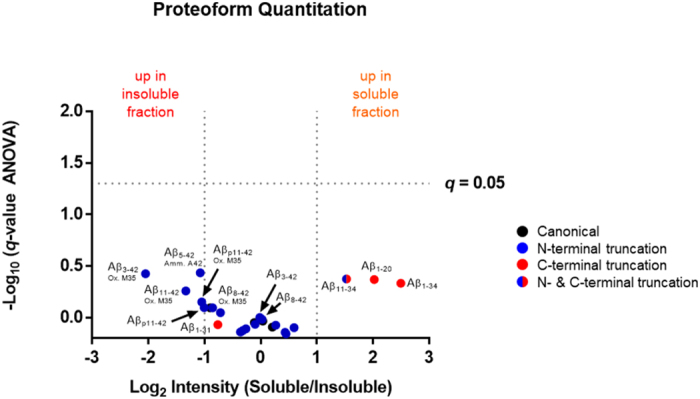
Amyloid-beta (Aβ) plays a key role in the pathogenesis of Alzheimer’s disease (AD), but little is known about the proteoforms present in AD brain. We used high-resolution mass spectrometry to analyze intact Aβ from soluble aggregates and insoluble material in brains of six cases with severe dementia and pathologically confirmed AD. The soluble aggregates are especially relevant because they are believed to be the most toxic form of Aβ. We found a diversity of Aβ peptides, with 26 unique proteoforms including various N- and C-terminal truncations. N- and C-terminal truncations comprised 73% and 30%, respectively, of the total Aβ proteoforms detected. The Aβ proteoforms segregated between the soluble and more insoluble aggregates with N-terminal truncations predominating in the insoluble material and C- terminal truncations segregating into the soluble aggregates. In contrast, canonical Aβ comprised the minority of the identified proteoforms (15.3%) and did not distinguish between the soluble and more insoluble aggregates. The relative abundance of many truncated Aβ proteoforms did not correlate with post-mortem interval, suggesting they are not artefacts. This heterogeneity of Aβ proteoforms deepens our understanding of AD and offers many new avenues for investigation into pathological mechanisms of the disease, with implications for therapeutic development.
Overview
The claims and statistics of this paper haven’t been checked yet.
Free: it reads the open-access text and checks the first 5 claims that cite a source we can check. Create a free account to check every claim.
Integrity signals
Registry
Cites
Statistics
Figures
Verification
Claims the paper makes
The claims and statistics of this paper haven’t been checked yet.
Free: it reads the open-access text and checks the first 5 claims that cite a source we can check. Create a free account to check every claim.
Claims other papers make about this one
Each is checked against this paper’s own text: does it say what the citing paper says it does?
The cited source says what the claim attributes to it.
In the citing paper
“In neurological disease and aging, modified proteins are the histopathological hallmarks of a number of diseases, such as SOD1 in amyotrophic lateral sclerosis (ALS) 56,57 , and a class of diseases long referred to as the proteinopathies 57 , including tauopathies in Alzheimer's disease 58 and inclusions of amyloidβ 59 , α -synuclein in Parkinson's 60,61 and multiple secondary ubiquitinopathies”
From How many human proteoforms are there? (2018) · cites this paper as [59]
In the citing paper
“In addition to the widely known amyloid-beta 40 and amyloid-beta 42 peptides, over 20 additional amyloid-beta proteoforms have been detected in samples of Alzheimer’s brain samples arising from endogenous cleavage and post-translational modifications.(12,13)”
From Putting humpty dumpty back together again: what does protein quantification mean in bottom-up proteomics? (2022) · cites this paper as [13]
Self-check
Percentages, sums and reported differences re-computed from the paper’s own numbers.
The self-check needs the paper’s full text.
Citations
Cites
Controlling the False Discovery Rate: A Practical and Powerful Approach to Multiple Testing
Benjamini, Y., & Hochberg, Y. (1995) · Journal of the Royal Statistical Society Series B: Statistical Methodology · doi:10.1111/j.2517-6161.1995.tb02031.x · Cited by 109,482
Alzheimer's disease: the amyloid cascade hypothesis
Hardy, J. A., & Higgins, G. A. (1992) · Science · doi:10.1126/science.1566067 · Cited by 7,484
The amyloid hypothesis of Alzheimer's disease at 25 years
Selkoe, D. J., & Hardy, J. (2016) · EMBO Molecular Medicine · doi:10.15252/emmm.201606210 · Cited by 6,164
Terry, R. D., Masliah, E., Salmon, D. P., Butters, N., DeTeresa, R., Hill, R., Hansen, L. A., & Katzman, R. (1991) · Annals of Neurology · doi:10.1002/ana.410300410 · Cited by 4,397
Vassar, R., Bennett, B. D., Babu-Khan, S., Kahn, S., Mendiaz, E. A., Denis, P., Teplow, D. B., Ross, S., Amarante, P., Loeloff, R., et al. (1999) · Science · doi:10.1126/science.286.5440.735 · Cited by 3,876
Shankar, G. M., Li, S., Mehta, T. H., Garcia-Munoz, A., Shepardson, N. E., Smith, I., Brett, F. M., Farrell, M. A., Rowan, M. J., Lemere, C. A., et al. (2008) · Nature Medicine · doi:10.1038/nm1782 · Cited by 3,685
Aβ Oligomers – a decade of discovery
Walsh, D. M., & Selkoe, D. J. (2007) · Journal of Neurochemistry · doi:10.1111/j.1471-4159.2006.04426.x · Cited by 1,938
The Proteomics Identifications (PRIDE) database and associated tools: status in 2013
Vizcaíno, J. A., Côté, R. G., Csordas, A., Dianes, J. A., Fabregat, A., Foster, J. M., Griss, J., Alpi, E., Birim, M., Contell, J., et al. (2012) · Nucleic Acids Research · doi:10.1093/nar/gks1262 · Cited by 1,918
Soluble Amyloid β Peptide Concentration as a Predictor of Synaptic Change in Alzheimer's Disease
Lue, L.-F., Kuo, Y.-M., Roher, A. E., Brachova, L., Shen, Y., Sue, L., Beach, T., Kurth, J. H., Rydel, R. E., & Rogers, J. (1999) · The American Journal of Pathology · doi:10.1016/s0002-9440(10)65184-x · Cited by 1,530
Proteoform: a single term describing protein complexity
The Consortium for Top Down Proteomics, Smith, L. M., & Kelleher, N. L. (2013) · Nature Methods · doi:10.1038/nmeth.2369 · Cited by 1,528
Self-citation
Cited by
The Amyloid-β Pathway in Alzheimer’s Disease
Hampel, H., Hardy, J., Blennow, K., Chen, C., Perry, G., Kim, S. H., Villemagne, V. L., Aisen, P., Vendruscolo, M., Iwatsubo, T., et al. (2021) · Molecular Psychiatry · doi:10.1038/s41380-021-01249-0 · Cited by 1,952
How many human proteoforms are there?
Aebersold, R., Agar, J. N., Amster, I. J., Baker, M. S., Bertozzi, C. R., Boja, E. S., Costello, C. E., Cravatt, B. F., Fenselau, C., Garcia, B. A., et al. (2018) · Nature Chemical Biology · doi:10.1038/nchembio.2576 · Cited by 907
Self-citationThe Amyloid-β Oligomer Hypothesis: Beginning of the Third Decade
Cline, E. N., Bicca, M. A., Viola, K. L., & Klein, W. L. (2018) · Journal of Alzheimer's Disease · doi:10.3233/jad-179941 · Cited by 870
“Canonical A 42 was a minority of the proteoforms identified and was equally distributed between the insoluble and soluble fractions [132].”
BackgroundProteomic landscape of Alzheimer’s Disease: novel insights into pathogenesis and biomarker discovery
Bai, B., Vanderwall, D., Li, Y., Wang, X., Poudel, S., Wang, H., Dey, K. K., Chen, P.-C., Yang, K., & Peng, J. (2021) · Molecular Neurodegeneration · doi:10.1186/s13024-021-00474-z · Cited by 257
Walker, L. C. (2020) · Free Neuropathology · doi:10.17879/freeneuropathology-2020-3025 · Cited by 174
β-Amyloid and the Pathomechanisms of Alzheimer’s Disease: A Comprehensive View
Penke, B., Bogár, F., & Fülöp, L. (2017) · Molecules · doi:10.3390/molecules22101692 · Cited by 132
Penke, B., Szűcs, M., & Bogár, F. (2020) · Molecules · doi:10.3390/molecules25071659 · Cited by 114
Hussain, G., Zhang, L., Rasul, A., Anwar, H., Sohail, M., Razzaq, A., Aziz, N., Shabbir, A., Ali, M., & Sun, T. (2018) · Molecules · doi:10.3390/molecules23040814 · Cited by 106
Pyroglutamate Aβ cascade as drug target in Alzheimer’s disease
Bayer, T. A. (2022) · Molecular Psychiatry · doi:10.1038/s41380-021-01409-2 · Cited by 94
Brody, D. L., Jiang, H., Wildburger, N., & Esparza, T. J. (2017) · Alzheimer's Research & Therapy · doi:10.1186/s13195-017-0293-3 · Cited by 87
Self-citationThijssen, E. H., Verberk, I. M. W., Vanbrabant, J., Koelewijn, A., Heijst, H., Scheltens, P., van der Flier, W., Vanderstichele, H., Stoops, E., & Teunissen, C. E. (2021) · Scientific Reports · doi:10.1038/s41598-021-89004-x · Cited by 86
Plubell, D. L., Käll, L., Webb-Robertson, B.-J., Bramer, L. M., Ives, A., Kelleher, N. L., Smith, L. M., Montine, T. J., Wu, C. C., & MacCoss, M. J. (2022) · Journal of Proteome Research · doi:10.1021/acs.jproteome.1c00894 · Cited by 85
Self-citationCandelise, N., Scaricamazza, S., Salvatori, I., Ferri, A., Valle, C., Manganelli, V., Garofalo, T., Sorice, M., & Misasi, R. (2021) · International Journal of Molecular Sciences · doi:10.3390/ijms22116016 · Cited by 78
Pantiya, P., Thonusin, C., Chattipakorn, N., & Chattipakorn, S. C. (2020) · Mitochondrion · doi:10.1016/j.mito.2020.08.003 · Cited by 70
Parodi‐Rullán, R., Ghiso, J., Cabrera, E., Rostagno, A., & Fossati, S. (2020) · Aging Cell · doi:10.1111/acel.13258 · Cited by 69
Enhancing Top-Down Proteomics of Brain Tissue with FAIMS
Fulcher, J. M., Makaju, A., Moore, R. J., Zhou, M., Bennett, D. A., De Jager, P. L., Qian, W.-J., Paša-Tolić, L., & Petyuk, V. A. (2021) · Journal of Proteome Research · doi:10.1021/acs.jproteome.1c00049 · Cited by 68
Enhancing top-down proteomics of brain tissue with FAIMS
(2021) · doi:10.1101/2021.01.18.427216 · Cited by 68
CuII Binding Properties of N-Truncated Aβ Peptides: In Search of Biological Function
Stefaniak, E., & Bal, W. (2019) · Inorganic Chemistry · doi:10.1021/acs.inorgchem.9b01399 · Cited by 62
Emerging Proof of Protein Misfolding and Interactions in Multifactorial Alzheimer's Disease
Uddin, M. S., Al Mamun, A., Rahman, M. A., Behl, T., Perveen, A., Hafeez, A., Bin-Jumah, M. N., Abdel-Daim, M. M., & Ashraf, G. M. (2020) · Current Topics in Medicinal Chemistry · doi:10.2174/1568026620666200601161703 · Cited by 59
Zhang, Y., Zhao, Y., Zhang, L., Yu, W., Wang, Y., & Chang, W. (2019) · Frontiers in Cellular Neuroscience · doi:10.3389/fncel.2019.00339 · Cited by 58
The Promises and Challenges of Erythropoietin for Treatment of Alzheimer’s Disease
Sun, J., Martin, J. M., Vanderpoel, V., & Sumbria, R. K. (2019) · NeuroMolecular Medicine · doi:10.1007/s12017-019-08524-y · Cited by 57
Iron stored in ferritin is chemically reduced in the presence of aggregating Aβ(1-42)
Everett, J., Brooks, J., Lermyte, F., O’Connor, P. B., Sadler, P. J., Dobson, J., Collingwood, J. F., & Telling, N. D. (2020) · Scientific Reports · doi:10.1038/s41598-020-67117-z · Cited by 55
N-Terminal Proteoforms in Human Disease
Bogaert, A., Fernández, E., & Gevaert, K. (2020) · Trends in Biochemical Sciences · doi:10.1016/j.tibs.2019.12.009 · Cited by 54
McAllister, B. B., Lacoursiere, S. G., Sutherland, R. J., & Mohajerani, M. H. (2020) · Neuroscience & Biobehavioral Reviews · doi:10.1016/j.neubiorev.2020.01.026 · Cited by 54
Mukherjee, S., Perez, K. A., Lago, L., Klatt, S., McLean, C., Birchall, I. E., Barnham, K. J., Masters, C. L., & Roberts, B. R. (2021) · Brain Communications · doi:10.1093/braincomms/fcab028 · Cited by 54
Bioactive human Alzheimer brain soluble Aβ: pathophysiology and therapeutic opportunities
Li, S., & Stern, A. M. (2022) · Molecular Psychiatry · doi:10.1038/s41380-022-01589-5 · Cited by 51
Key Peptides and Proteins in Alzheimer’s Disease
Penke, B., Bogár, F., Paragi, G., Gera, J., & Fülöp, L. (2019) · Current Protein & Peptide Science · doi:10.2174/1389203720666190103123434 · Cited by 49
de la Torre, A. V., Gay, M., Vilaprinyó-Pascual, S., Mazzucato, R., Serra-Batiste, M., Vilaseca, M., & Carulla, N. (2018) · Analytical Chemistry · doi:10.1021/acs.analchem.7b04936 · Cited by 48
Mass Spectrometry for Neurobiomarker Discovery: The Relevance of Post-Translational Modifications
Azevedo, R., Jacquemin, C., Villain, N., Fenaille, F., Lamari, F., & Bécher, F. (2022) · Cells · doi:10.3390/cells11081279 · Cited by 47
Kirabali, T., Rigotti, S., Siccoli, A., Liebsch, F., Shobo, A., Höck, C., Nitsch, R. M., Multhaup, G., & Kulic, L. (2019) · Acta Neuropathologica Communications · doi:10.1186/s40478-019-0846-8 · Cited by 45
Emerging roles of N- and C-terminally truncated Aβ species in Alzheimer’s disease
Wirths, O., & Zampar, S. (2019) · Expert Opinion on Therapeutic Targets · doi:10.1080/14728222.2019.1702972 · Cited by 44
Seckler, H. D. S., Fornelli, L., Mutharasan, R. K., Thaxton, C. S., Fellers, R., Daviglus, M., Sniderman, A., Rader, D., Kelleher, N. L., Lloyd-Jones, D. M., et al. (2018) · Journal of Proteome Research · doi:10.1021/acs.jproteome.8b00100 · Cited by 40
Self-citationOberstein, T. J., Utz, J., Spitzer, P., Klafki, H. W., Wiltfang, J., Lewczuk, P., Kornhuber, J., & Maler, J. M. (2021) · Frontiers in Molecular Neuroscience · doi:10.3389/fnmol.2020.615740 · Cited by 38
N‐terminal heterogeneity of parenchymal and vascular amyloid‐β deposits in Alzheimer’s disease
Zampar, S., Klafki, H., Sritharen, K., Bayer, T. A., Wiltfang, J., Rostagno, A. A., Ghiso, J. A., Miles, L. A., & Wirths, O. (2020) · Neuropathology and Applied Neurobiology · doi:10.1111/nan.12637 · Cited by 37
ApoE-fragment/Aβ heteromers in the brain of patients with Alzheimer’s disease
Mouchard, A., Boutonnet, M.-C., Mazzocco, C., Biendon, N., Macrez, N., & Neuro-CEB Neuropathology Network (2019) · Scientific Reports · doi:10.1038/s41598-019-40438-4 · Cited by 36
Stefaniak, E., Atrián‐Blasco, E., Goch, W., Sabater, L., Hureau, C., & Bal, W. (2021) · Chemistry - A European Journal · doi:10.1002/chem.202004484 · Cited by 35
Ali, M. H. M., Rakib, F., Abdelalim, E. M., Limbeck, A., Mall, R., Ullah, E., Mesaeli, N., McNaughton, D., Ahmed, T., & Al‐Saad, K. A. (2018) · Frontiers in Neuroscience · doi:10.3389/fnins.2018.00647 · Cited by 34
Alzheimer’s Aβ42 and Aβ40 form mixed oligomers with direct molecular interactions
Gu, L., & Guo, Z. (2020) · Biochemical and Biophysical Research Communications · doi:10.1016/j.bbrc.2020.11.092 · Cited by 34
Brain Region-Specific Differences in Amyloid-β Plaque Composition in 5XFAD Mice
Bader, A. S., Gnädig, M.-U., Fricke, M., Büschgens, L., Berger, L. J., Klafki, H., Meyer, T., Jahn, O., Weggen, S., & Wirths, O. (2023) · Life · doi:10.3390/life13041053 · Cited by 33
Citrullination of Amyloid-β Peptides in Alzheimer’s Disease
Mukherjee, S., Perez, K. A., Dubois, C., Nisbet, R. M., Li, Q., Varghese, S., Jin, L., Birchall, I. E., Streltsov, V. A., Vella, L. J., et al. (2021) · ACS Chemical Neuroscience · doi:10.1021/acschemneuro.1c00474 · Cited by 32
Current Evidence for a Bidirectional Loop Between the Lysosome and Alpha-Synuclein Proteoforms
Wildburger, N. C., Hartke, A.-S., Schidlitzki, A., & Richter, F. (2020) · Frontiers in Cell and Developmental Biology · doi:10.3389/fcell.2020.598446 · Cited by 30
Self-citationMolecular Profiles of Amyloid-β Proteoforms in Typical and Rapidly Progressive Alzheimer’s Disease
Noor, A., Zafar, S., Shafiq, M., Younas, N., Siegert, A., Mann, F. A., Kruss, S., Schmitz, M., Dihazi, H., Ferrer, I., et al. (2021) · Molecular Neurobiology · doi:10.1007/s12035-021-02566-9 · Cited by 28
Native Mass Spectrometry at the Convergence of Structural Biology and Compositional Proteomics
Jooß, K., McGee, J. P., & Kelleher, N. L. (2022) · Accounts of Chemical Research · doi:10.1021/acs.accounts.2c00216 · Cited by 28
Self-citationNeurodegenerative Proteinopathies in the Proteoform Spectrum—Tools and Challenges
Noor, A., Zafar, S., & Zerr, I. (2021) · International Journal of Molecular Sciences · doi:10.3390/ijms22031085 · Cited by 27
Fulcher, J. M., Ives, A. N., Tasaki, S., Kelly, S. S., Williams, S., Fillmore, T., Zhou, M., Moore, R., Qian, W., Paša‐Tolić, L., et al. (2025) · Molecular & Cellular Proteomics · doi:10.1016/j.mcpro.2025.100983 · Cited by 27
Domingo, G., Benussi, L., Saraceno, C., Bertuzzi, M., Nicsanu, R., Longobardi, A., Bellini, S., Cagnotto, A., Salmona, M., Binetti, G. G., et al. (2021) · Frontiers in Neuroscience · doi:10.3389/fnins.2021.708119 · Cited by 26
Marengo, L., Armbrust, F., Schoenherr, C., Storck, S. E., Schmitt, U., Zampar, S., Wirths, O., Altmeppen, H. C., Glatzel, M., Kaether, C., et al. (2022) · Cellular and Molecular Life Sciences · doi:10.1007/s00018-022-04205-5 · Cited by 26
The cellular modifier MOAG‐4/SERF drives amyloid formation through charge complementation
Pras, A., Houben, B., Aprile, F. A., Seinstra, R. I., Gallardo, R. U., Janssen, L., Hogewerf, W., Gallrein, C., Vleeschouwer, M. D., Mata‐Cabana, A., et al. (2021) · The EMBO Journal · doi:10.15252/embj.2020107568 · Cited by 26
Klafki, H., Rieper, P., Matzen, A., Zampar, S., Wirths, O., Vogelgsang, J. S., Osterloh, D., Rohdenburg, L., Oberstein, T. J., Jahn, O., et al. (2020) · International Journal of Molecular Sciences · doi:10.3390/ijms21186564 · Cited by 25
A Review of the Pathogenesis and Chinese Medicine Intervention of Alzheimer's Disease
Zhao, J., Yang, J., Li, D., Wang, F., & Li, L. (2022) · Journal of Integrative Neuroscience · doi:10.31083/j.jin2201002 · Cited by 24
N-terminally truncated Aβ4-x proteoforms and their relevance for Alzheimer’s pathophysiology
Rostagno, A., Cabrera, E., Lashley, T., & Ghiso, J. (2022) · Translational Neurodegeneration · doi:10.1186/s40035-022-00303-3 · Cited by 23
The Hidden Role of Non-Canonical Amyloid β Isoforms in Alzheimer’s Disease
Busch, L., Eggert, S., Endres, K., & Bufe, B. (2022) · Cells · doi:10.3390/cells11213421 · Cited by 23
Song, X., Zhou, H.-Y., Sun, Y.-Y., & Huang, H. (2021) · Journal of Alzheimer s Disease · doi:10.3233/jad-210337 · Cited by 23
Distinguishing the Effect on the Rate and Yield of Aβ42 Aggregation by Green Tea Polyphenol EGCG
Park, G., Xue, C., Wang, H., & Guo, Z. (2020) · ACS Omega · doi:10.1021/acsomega.0c02063 · Cited by 23
Varshavskaya, K. B., Mitkevich, V. A., Makarov, A. А., & Barykin, E. P. (2022) · International Journal of Molecular Sciences · doi:10.3390/ijms232315036 · Cited by 23
Emerging contributions of formyl peptide receptors to neurodegenerative diseases
Busch, L., Vieten, S., Brödel, S., Endres, K., & Bufe, B. (2021) · Biological Chemistry · doi:10.1515/hsz-2021-0258 · Cited by 23
Weiffert, T., Meisl, G., Flagmeier, P., De, S., Dunning, C. J. R., Frohm, B., Zetterberg, H., Blennow, K., Portelius, E., Klenerman, D., et al. (2019) · ACS Chemical Neuroscience · doi:10.1021/acschemneuro.8b00676 · Cited by 22
Ivankov, O. I., Murugova, T. N., Ermakova, E. V., Kondela, T., Badreeva, D. R., Hrubovčák, P., Soloviov, D., Tsarenko, A., Rogachev, A. V., Kuklin, A. I., et al. (2021) · Scientific Reports · doi:10.1038/s41598-021-01347-7 · Cited by 22
An inorganic overview of natural Aβ fragments: Copper(II) and zinc(II)-mediated pathways
Lanza, V., Bellia, F., & Rizzarelli, E. (2018) · Coordination Chemistry Reviews · doi:10.1016/j.ccr.2018.04.004 · Cited by 21
Makey, D. M., Gadkari, V. V., Kennedy, R. T., & Ruotolo, B. T. (2024) · Analytical Chemistry · doi:10.1021/acs.analchem.4c00477 · Cited by 21
Bitencourt, A. L. B., de Campos, R. M., Cline, E. N., Klein, W. L., & Sebollela, A. S. (2020) · International Journal of Molecular Sciences · doi:10.3390/ijms21238920 · Cited by 21
Effect of ferric citrate on amyloid‐beta peptides behavior
Galante, D., Cavallo, E., Perico, A., & D’Arrigo, C. (2018) · Biopolymers · doi:10.1002/bip.23224 · Cited by 21
Structural polymorphism and cytotoxicity of brain‐derived β‐amyloid extracts
Adem, K. A., & Lee, S. (2023) · Protein Science · doi:10.1002/pro.4639 · Cited by 20
Mass spectrometric studies of the variety of beta‐amyloid proteoforms in Alzheimer's disease
Zakharova, N. V., Kononikhin, A. S., Indeykina, M. I., Bugrova, A. E., Strelnikova, P. A., Игоревич, П. С., Kozin, S. A., Popov, I. A., Mitkevich, V. A., Makarov, A. А., et al. (2022) · Mass Spectrometry Reviews · doi:10.1002/mas.21775 · Cited by 20
Bayer, T. A. (2021) · Frontiers in Aging Neuroscience · doi:10.3389/fnagi.2021.710579 · Cited by 20
Esparza, T. J., Gangolli, M., Cairns, N. J., & Brody, D. L. (2018) · PLoS ONE · doi:10.1371/journal.pone.0200251 · Cited by 20
Self-citationMichno, W., Blennow, K., Zetterberg, H., & Brinkmalm, G. (2021) · Journal of Neurochemistry · doi:10.1111/jnc.15466 · Cited by 19
Guzman, N. A., & Guzman, D. E. (2021) · Biomolecules · doi:10.3390/biom11101443 · Cited by 19
N-Terminally Truncated Aß Peptide Variants in Alzheimer’s Disease
Wirths, O., Zampar, S., & Weggen, S. (2019) · Codon Publications eBooks · doi:10.15586/alzheimersdisease.2019.ch7 · Cited by 19
Stern, A. M., Liu, L., Jin, S., Liu, W., Meunier, A. L., Ericsson, M., Miller, M. B., Batson, M., Sun, T., Kathuria, S. V., et al. (2022) · Brain · doi:10.1093/brain/awac023 · Cited by 19
Sun, K. T., & Mok, S. (2025) · Neurotherapeutics · doi:10.1016/j.neurot.2024.e00512 · Cited by 18
Alasmari, F. F., Ashby, C. R., Hall, F. S., Sari, Y., & Tiwari, A. K. (2018) · Frontiers in Pharmacology · doi:10.3389/fphar.2018.00658 · Cited by 18
Multiple Competition-Based FDR Control and Its Application to Peptide Detection
Emery, K., Hasam, S., Noble, W. S., & Keich, U. (2020) · Lecture notes in computer science · doi:10.1007/978-3-030-45257-5_4 · Cited by 18
A vaccine to prevent initial loss of cognition and eventual Alzheimer's disease in elderly persons
Fessel, J. (2021) · Alzheimer s & Dementia Translational Research & Clinical Interventions · doi:10.1002/trc2.12126 · Cited by 18
Zakharova, N. V., Bugrova, A. E., Kononikhin, A. S., Indeykina, M. I., Popov, I. A., & Николаев, Е. Н. (2018) · Expert Review of Proteomics · doi:10.1080/14789450.2018.1525296 · Cited by 17
Schachner, L. F., Tran, D. P., Lee, A. S., McGee, J. P., Jooß, K., Durbin, K. R., Seckler, H. S., Adams, L. M., Cline, E. N., Melani, R. D., et al. (2021) · International Journal of Mass Spectrometry · doi:10.1016/j.ijms.2021.116591 · Cited by 16
Self-citationVanderstichele, H., Teunissen, C. E., & Vanmechelen, E. (2019) · Neurology and Therapy · doi:10.1007/s40120-019-00166-3 · Cited by 15
Wirths, O., Lehnen, C., Fricke, M., Talucci, I., Klafki, H., Morgado, B., Lehmann, S., Münch, C., Liepold, T., Wiltfang, J., et al. (2024) · Neuropathology and Applied Neurobiology · doi:10.1111/nan.12991 · Cited by 15
Amyloid-β deposits in human astrocytes contain truncated and highly resistant proteoforms
Beretta, C., Svensson, E., Dakhel, A., Zyśk, M., Hanrieder, J., Sehlin, D., Michno, W., & Erlandsson, A. (2024) · Molecular and Cellular Neuroscience · doi:10.1016/j.mcn.2024.103916 · Cited by 15
Exceptional in vivo catabolism of neurodegeneration-related aggregates
Datki, Z., Galik-Olah, Z., Hortobágyi, T., Mácsai, L., Zsuga, K., Fülöp, L., Bozsó, Z., Gálik, B., Ács, É., Földi, A., et al. (2018) · Acta Neuropathologica Communications · doi:10.1186/s40478-018-0507-3 · Cited by 15
Condition-Dependent Coordination and Peroxidase Activity of Hemin-Aβ Complexes
Bacchella, C., Brewster, J. T., Bähring, S., Dell’Acqua, S., Root, H. D., Thiabaud, G., Reuther, J. F., Monzani, E., Sessler, J. L., & Casella, L. (2020) · Molecules · doi:10.3390/molecules25215044 · Cited by 15
Karkisaval, A. G., Rostagno, A. A., Azimov, R., Ban, D. K., Ghiso, J. A., Kagan, B. L., & Lal, R. (2020) · Nanomedicine Nanotechnology Biology and Medicine · doi:10.1016/j.nano.2020.102235 · Cited by 15
Hu, Z., Cruceta, L., Zhang, S., Sun, Y. P., & Qiang, W. (2021) · ACS Chemical Neuroscience · doi:10.1021/acschemneuro.1c00341 · Cited by 15
Chiral Interface of Amyloid Beta (Aβ): Relevance to Protein Aging, Aggregation and Neurodegeneration
Dyakin, V. V., Wısnıewskı, T., & Lajtha, Á. (2020) · Symmetry · doi:10.3390/sym12040585 · Cited by 15
Arber, C., Alatza, A., Leckey, C. A., Paterson, R. W., Zetterberg, H., & Wray, S. (2021) · Journal of Neurochemistry · doi:10.1111/jnc.15315 · Cited by 14
Monsalvo-Maraver, L. Á., Maya-López, M., Rangel‐López, E., Túnez, I., Tinkov, A. A., Skalny, A. V., Ferrer, B., Aschner, M., & Santamaría, A. (2022) · CNS & Neurological Disorders - Drug Targets · doi:10.2174/1871527321666220616094036 · Cited by 14
Methods for the isolation and analysis of Aβ from postmortem brain
Hong, W., Liu, W., DeSousa, A., Young‐Pearse, T. L., & Walsh, D. M. (2023) · Frontiers in Neuroscience · doi:10.3389/fnins.2023.1108715 · Cited by 14
Aβ42 promotes the aggregation of α‐synuclein splice isoforms via heterogeneous nucleation
Röntgen, A., Toprakcioglu, Z., & Vendruscolo, M. (2025) · FEBS Letters · doi:10.1002/1873-3468.70118 · Cited by 13
Ivankov, O. I., Kondela, T., Dushanov, E., Ermakova, E. V., Murugova, T. N., Soloviov, D., Kuklin, A. I., & Kučerka, N. (2023) · Biophysical Chemistry · doi:10.1016/j.bpc.2023.107023 · Cited by 13
Distinct Aggregation Behavior of N-Terminally Truncated Aβ4–42 Over Aβ1–42 in the Presence of Zn(II)
Na, C., Kim, M., Kim, G., Lin, Y., Lee, Y., Bal, W., Nam, E., & Lim, M. H. (2025) · ACS Chemical Neuroscience · doi:10.1021/acschemneuro.4c00831 · Cited by 12
Heterotypic Seeding Generates Mixed Amyloid Polymorphs
Banerjee, S., Baghel, D., Edmonds, H. O., & Ghosh, A. (2024) · Small Science · doi:10.1002/smsc.202400109 · Cited by 11
Suprun, E. V., Radko, S. P., Kozin, S. A., Mitkevich, V. A., & Makarov, A. А. (2018) · Journal of Electroanalytical Chemistry · doi:10.1016/j.jelechem.2018.10.016 · Cited by 11
Phosphorylation Promotes Aβ25–35 Peptide Aggregation within the DMPC Bilayer
Khayat, E., Klimov, D. K., & Smith, A. K. (2020) · ACS Chemical Neuroscience · doi:10.1021/acschemneuro.0c00541 · Cited by 11
Multiple competition-based FDR control for peptide detectionPreprint
Emery, K., Hasam, S., Noble, W. S., & Keich, U. (2019) · arXiv (Cornell University) · doi:10.48550/arxiv.1907.01458 · Cited by 11
Tobolska, A., Głowacz, K., Ciosek, P., Bal, W., Wróblewski, W., & Wezynfeld, N. E. (2022) · Dalton Transactions · doi:10.1039/d2dt03078k · Cited by 10
Shobo, A., Röntgen, A., Hancock, M. A., & Multhaup, G. (2022) · FEBS Letters · doi:10.1002/1873-3468.14358 · Cited by 10
Mukherjee, S., Coyle, R. A., Dubois, C., Perez, K. A., McLean, C., Masters, C. L., & Roberts, B. R. (2025) · Acta Neuropathologica · doi:10.1007/s00401-025-02914-2 · Cited by 9
Khayat, E., Lockhart, C., Delfing, B. M., Smith, A. K., & Klimov, D. K. (2021) · ACS Chemical Neuroscience · doi:10.1021/acschemneuro.1c00407 · Cited by 9
Putative Pore Structures of Amyloid β 25–35 in Lipid Bilayers
Dutta, A., Sepehri, A., & Lazaridis, T. (2023) · Biochemistry · doi:10.1021/acs.biochem.3c00323 · Cited by 9
Bohannon, D. G., Wellman, L. L., Kaul, M., Galkina, E., Guo, M., Datta, P. K., & Kim, W. (2024) · Journal of Cerebral Blood Flow & Metabolism · doi:10.1177/0271678x241296270 · Cited by 8
Metadata
- Authors
- Wildburger, N. C., Esparza, T. J., LeDuc, R. D., Fellers, R. T., Thomas, P. M., Cairns, N. J., Kelleher, N. L., Bateman, R. J., & Brody, D. L.
- Affiliations
- Washington University in St. Louis (US)
- Northwestern University (US)
- Corresponding author
- Wildburger, Norelle C.
- Brody, David L.
- ORCID
- Venue
- Scientific Reports
- Published
- 2017-08-25
- Volume
- 7
- Issue
- 1
- Pages
- 9520-9520
- ISSN
- 2045-2322 (ISSN-L)
- PMC
- PMC5572664
- OpenAlex
- W2745586739
- Cited by
- 164
- References
- 46
- Citations by year
- 2026: 9 · 2025: 14 · 2024: 11 · 2023: 18 · 2022: 17 · 2021: 28 · 2020: 30 · 2019: 16 · 2018: 18 · 2017: 2
- FWCI
- 13.34
- Type
- journal article
- Language
- en
- Open access
- gold
- doi.org
- Licence
- cc-by
- creativecommons.org/licenses/by/4.0 (tdm)
- creativecommons.org/licenses/by/4.0 (vor)
- Locations
- Scientific Reports (publishedVersion, cc-by)
- PubMed Central (publishedVersion, cc-by)
- PubMed (publishedVersion)
- Digital Commons@Becker (Washington University School of Medicine) (submittedVersion, cc-by)
- DOAJ (DOAJ: Directory of Open Access Journals) (submittedVersion)
- Funders
- BrightFocus Foundation
- Cure Alzheimer's Fund
- Hope Center for Neurological Disorders
- National Institutes of Health (NIH-R01, AG05681, GM108569)
- Charles F. and Joanne Knight Alzheimer Disease Research Center, Washington University in St. Louis
- National Institute on Aging (P50AG005681, P01AG003991)
- National Institute of General Medical Sciences (P41GM108569, GM108569)
- National Institute of Neurological Disorders and Stroke (R01NS065069, R01NS065667)
- Topics
- Life Sciences › Neuroscience › Cellular and Molecular Neuroscience › Alzheimer's disease research and treatments
- Physical Sciences › Chemistry › Spectroscopy › Advanced Proteomics Techniques and Applications
- Health Sciences › Medicine › Psychiatry and Mental health › Dementia and Cognitive Impairment Research
- Keywords
- amyloid-beta, proteoforms, Alzheimer's disease, N-terminal truncation, C-terminal truncation, postmortem interval, neuropathology
- MeSH terms
- Alzheimer Disease, Amino Acid Sequence, Brain, Chromatography, Liquid, Humans, Solubility, Amyloid beta-Peptides, Proteomics, Tandem Mass Spectrometry, Plaque, Amyloid, Protein Aggregation, Pathological, Protein Aggregates
About these checks
Registry, retraction, Cites and statistics results are computed, not judged, with one exception: a printed reference that no index lists is read once by a model before it counts as a citation error. Claims are extracted by a model and kept only when their quote appears verbatim in the text; each cited source is then checked, with a model’s help, for whether it says what the claim relies on. Those verdicts can be wrong — read the claim’s quote and the cited source before relying on one.
Statistics and arithmetic are recomputed, not judged.
Confidence bands are shown only for fields calibrated on our annotated test set. None is calibrated yet, so no band is shown.
What counts as a claim ›How we measure confidence ›How we check this ›
Are you an author, or do you see a problem with this page? Request a review
Data sources
Bibliographic data: Semantic Scholar, OpenAlex, Crossref.
Contains information from the Semantic Scholar Academic Graph Datasets, made available under the ODC Attribution License (ODC-BY 1.0).
Semantic Scholar’s data is described in: Kinney, R., et al. (2023). The Semantic Scholar Open Data Platform. arXiv:2301.10140.
