

Effect of aerobic exercise and diet on liver fat in pre-diabetic patients with non-alcoholic-fatty-liver-disease: A randomized controlled trial
Open accessThe DOI matches its Crossref record; 44 of the 44 references it cites were found in a registry or an index.
Abstract
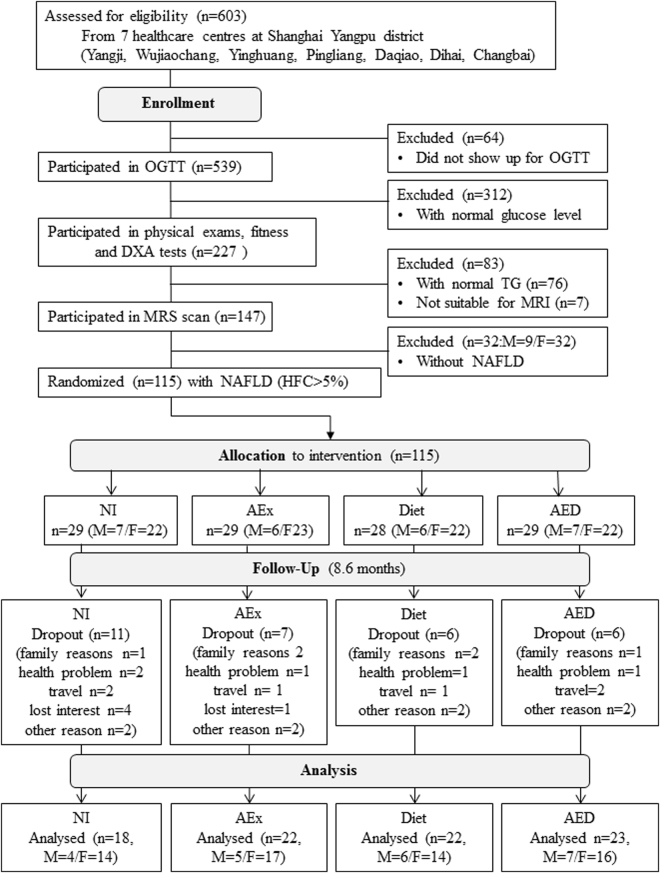
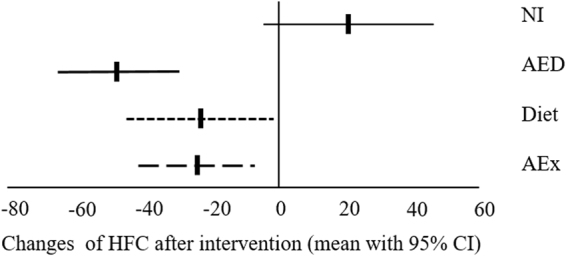
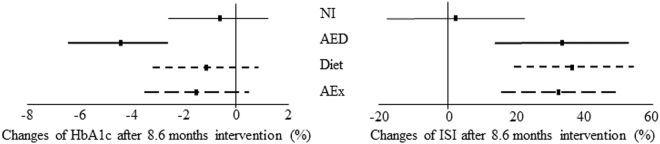
The study aimed to assess whether aerobic exercise (AEx) training and a fibre-enriched diet can reduce hepatic fat content (HFC) and increase glycaemic control in pre-diabetic patients with non-alcoholic fatty liver disease (NAFLD). Six-hundred-and-three patients from seven clinics in Yangpu district, Shanghai, China were recruited. Of them 115 individuals aged 50–65-year fulfilled the inclusion criteria (NAFLD with impaired fasting glucose or impaired glucose tolerance) and were randomly assigned into exercise (AEx n = 29), diet (Diet n = 28), exercise plus diet (AED n = 29), or no-intervention (NI n = 29) groups. Progressive supervised AEx training (60–75% VO2max intensity) was given 2-3 times/week in 30–60 min/sessions, and the diet intervention was provided as lunch with 38% carbohydrate and diet fibre of 12 g/day for 8.6-month. HFC was assessed by 1 H MRS. We found that HFC was significantly reduced in the AEx (−24.4%), diet (−23.2%), and AED (−47.9%) groups by contrast to the 20.9% increase in the NI group (p = 0.001 for all) after intervention. However, only AED group significantly decreased HbA 1c (−4.4%, p = 0.01) compared with the NI group (−0.6%). Aerobic exercise training combined with fibre-enriched diet can reduce HFC more effectively than either exercise or increased fibre-intake alone in pre-diabetic patients with NAFLD.
Overview
The claims and statistics of this paper haven’t been checked yet.
Free: it reads the open-access text and checks the first 5 claims that cite a source we can check. Create a free account to check every claim.
Integrity signals
Registry
Cites
Statistics
Figures
Verification
Claims the paper makes
The claims and statistics of this paper haven’t been checked yet.
Free: it reads the open-access text and checks the first 5 claims that cite a source we can check. Create a free account to check every claim.
Claims other papers make about this one
Each is checked against this paper’s own text: does it say what the citing paper says it does?
The cited source doesn’t support the claim as written.
In the citing paper
“Interventions on aerobic and aerobic-resistance combination showed weight reduction in comparison to control (WMD = − 1.56 kg, 95%CI − 2.31 to − 0.82, P < 0.001 and WMD = − 1.90 kg, 95%CI − 3.59 to − 0.22, P = 0.03, respectively).”
From Effects of Mediterranean diet, exercise, and their combination on body composition and liver outcomes in metabolic dysfunction-associated steatotic liver disease: a systematic review and meta-analysis of randomized controlled trials (2025) · cites this paper as [67]
Checked by a reasoning model — may be wrong.
Experimental — accuracy not yet measuredThe cited source says what the claim attributes to it.
In the citing paper
“Six RCTs on aerobic exercise showed a significant reduction in liver fat compared to controls [67, 69, 71, 75, 76, 79]”
The cited source says what the claim attributes to it.
In the citing paper
“Five studies on aerobic [67, 74, 77–79] and four on combined aerobic-resistance intervention included in the meta-analysis showed no changes in GGT in comparison to control”
Self-check
Percentages, sums and reported differences re-computed from the paper’s own numbers.
The self-check needs the paper’s full text.
Citations
Cites
Statistical power analysis for the behavioral sciences
(1990) · Computers, Environment and Urban Systems · doi:10.1016/0198-9715(90)90050-4 · Cited by 65,269
The metabolic phenotype in obesity: Fat mass, body fat distribution, and adipose tissue function
Goossens, G. H. (2017) · Obesity Facts · doi:10.1159/000471488 · Cited by 8,481
Matsuda, M., & DeFronzo, R. A. (1999) · Diabetes Care · doi:10.2337/diacare.22.9.1462 · Cited by 5,621
Pan, X.-R., Li, G.-W., Hu, Y.-H., Wang, J.-X., Yang, W.-Y., An, Z.-X., Hu, Z.-X., Juan-Lin, Xiao, J.-Z., Cao, H.-B., et al. (1997) · Diabetes Care · doi:10.2337/diacare.20.4.537 · Cited by 4,320
Chalasani, N., Younossi, Z., Lavine, J. E., Diehl, A. M., Brunt, E. M., Cusi, K., Charlton, M., & Sanyal, A. J. (2012) · Hepatology · doi:10.1002/hep.25762 · Cited by 3,803
Prevalence of Hepatic Steatosis in An Urban Population in the United States: Impact of Ethnicity
Browning, J. D., Szczepaniak, L. S., Dobbins, R., Nuremberg, P., Horton, J. D., Cohen, J. C., Grundy, S. M., & Hobbs, H. H. (2004) · Hepatology · doi:10.1002/hep.20466 · Cited by 3,664
Prevalence and Control of Diabetes in Chinese Adults
Xu, Y. (2013) · JAMA · doi:10.1001/jama.2013.168118 · Cited by 2,703
Vilar-Gomez, E., Martinez-Perez, Y., Calzadilla-Bertot, L., Torres-Gonzalez, A., Gra-Oramas, B., Gonzalez-Fabian, L., Friedman, S. L., Diago, M., & Romero-Gomez, M. (2015) · Gastroenterology · doi:10.1053/j.gastro.2015.04.005 · Cited by 2,492
Automatic quantitation of localized in vivo1H spectra with LCModel
Provencher, S. W. (2001) · NMR in Biomedicine · doi:10.1002/nbm.698 · Cited by 1,634
Nonalcoholic fatty liver disease
Adams, L. A. (2005) · Canadian Medical Association Journal · doi:10.1503/cmaj.045232 · Cited by 1,610
Research works printed but not linked: 1
- Yuexin, Y., Guangya, W. & Xingchang, P. China food composition (Peking University Medical Press, National Institute of Nutrition and Food Safety, China CDC, 2011).
Cited by
Koutoukidis, D. A., Astbury, N. M., Tudor, K. E., Morris, E., Henry, J. A., Noreik, M., Jebb, S. A., & Aveyard, P. (2019) · JAMA Internal Medicine · doi:10.1001/jamainternmed.2019.2248 · Cited by 270
Haigh, L., Kirk, C., El Gendy, K., Gallacher, J., Errington, L., Mathers, J. C., & Anstee, Q. M. (2022) · Clinical Nutrition · doi:10.1016/j.clnu.2022.06.037 · Cited by 209
Ezpeleta, M., Gabel, K., Cienfuegos, S., Kalam, F., Lin, S., Pavlou, V., Song, Z., Haus, J. M., Koppe, S., Alexandria, S. J., et al. (2023) · Cell Metabolism · doi:10.1016/j.cmet.2022.12.001 · Cited by 181
Diet and exercise in NAFLD/NASH: Beyond the obvious
Semmler, G., Datz, C., Reiberger, T., & Trauner, M. (2021) · Liver International · doi:10.1111/liv.15024 · Cited by 179
Fougerat, A., Montagner, A., Loiseau, N., Guillou, H., & Wahli, W. (2020) · Cells · doi:10.3390/cells9071638 · Cited by 156
Metadata
- Authors
- Cheng, S., Ge, J., Zhao, C., Le, S., Yang, Y., Ke, D., Wu, N., Tan, X., Zhang, X., Du, X., Sun, J., Wang, R., Shi, Y., Borra, R. J. H., Parkkola, R., Wiklund, P., & Lu, D.
- Affiliations
- Shanghai Jiao Tong University (CN)
- Shanghai University of Sport (CN)
- Fudan University (CN)
- University Medical Center Groningen (NL)
- University of Turku (FI)
- Imperial College London (GB)
- Corresponding author
- Cheng, Sulin
- Lu, Dajiang
- ORCID
- Venue
- Scientific Reports
- Published
- 2017-11-21
- Volume
- 7
- Issue
- 1
- Pages
- 15952-15952
- ISSN
- 2045-2322 (ISSN-L)
- PMC
- PMC5698376
- OpenAlex
- W2769013162
- Cited by
- 127
- References
- 44
- Citations by year
- 2026: 11 · 2025: 18 · 2024: 18 · 2023: 21 · 2022: 23 · 2021: 18 · 2020: 10 · 2019: 5 · 2018: 3
- FWCI
- 3.86
- Type
- journal article
- Language
- en
- Open access
- gold
- doi.org
- Licence
- cc-by
- creativecommons.org/licenses/by/4.0 (tdm)
- creativecommons.org/licenses/by/4.0 (vor)
- Locations
- Scientific Reports (publishedVersion, cc-by)
- PubMed Central (publishedVersion, cc-by)
- PubMed (publishedVersion)
- University of Groningen research database (University of Groningen / Centre for Information Technology) (publishedVersion, cc-by)
- Jyväskylä University Digital Archive (University of Jyväskylä) (submittedVersion, cc-by)
- University of Groningen research database (University of Groningen / Centre for Information Technology) (submittedVersion, cc-by)
- Funders
- Suomen Lääketieteen Säätiö
- National Natural Science Foundation of China (2015B039, 31571219)
- Academy of Finland
- Shanghai Jiao Tong University (CP2014013)
- Topics
- Health Sciences › Medicine › Hepatology › Liver Disease Diagnosis and Treatment
- Health Sciences › Medicine › Endocrinology, Diabetes and Metabolism › Diabetes, Cardiovascular Risks, and Lipoproteins
- Health Sciences › Medicine › Endocrinology, Diabetes and Metabolism › Diet, Metabolism, and Disease
- Keywords
- aerobic exercise, dietary fiber, non-alcoholic fatty liver disease, hepatic fat content, prediabetes, impaired glucose tolerance, impaired fasting glucose, glycemic control, HbA1c, 1H magnetic resonance spectroscopy
- MeSH terms
- Diet, Female, Glycated Hemoglobin, Humans, Insulin Resistance, Liver, Male, Middle Aged, Prediabetic State, Biomarkers, Exercise, Treatment Outcome, Disease Progression, Adiposity, Intention to Treat Analysis, Non-alcoholic Fatty Liver Disease
About these checks
Registry, retraction, Cites and statistics results are computed, not judged, with one exception: a printed reference that no index lists is read once by a model before it counts as a citation error. Claims are extracted by a model and kept only when their quote appears verbatim in the text; each cited source is then checked, with a model’s help, for whether it says what the claim relies on. Those verdicts can be wrong — read the claim’s quote and the cited source before relying on one.
Statistics and arithmetic are recomputed, not judged.
Confidence bands are shown only for fields calibrated on our annotated test set. None is calibrated yet, so no band is shown.
What counts as a claim ›How we measure confidence ›How we check this ›
Are you an author, or do you see a problem with this page? Request a review
How to cite
Cite CoChat for the checks on this page, and the paper for its own findings.
- This page
- CoChat. (2026). Citation check: Effect of aerobic exercise and diet on liver fat in pre-diabetic patients with non-alcoholic-fatty-liver-disease: A randomized controlled trial. https://app.cochat.ai/papers/10.1038/s41598-017-16159-x
- The paper
- Cheng, S., Ge, J., Zhao, C., Le, S., Yang, Y., Ke, D., Wu, N., Tan, X., Zhang, X., Du, X., Sun, J., Wang, R., Shi, Y., Borra, R. J. H., Parkkola, R., Wiklund, P., & Lu, D. (2017). Effect of aerobic exercise and diet on liver fat in pre-diabetic patients with non-alcoholic-fatty-liver-disease: A randomized controlled trial. Scientific Reports. https://doi.org/10.1038/s41598-017-16159-x
Data sources
Bibliographic data: Semantic Scholar, OpenAlex, Crossref.
Contains information from the Semantic Scholar Academic Graph Datasets, made available under the ODC Attribution License (ODC-BY 1.0).
Semantic Scholar’s data is described in: Kinney, R., et al. (2023). The Semantic Scholar Open Data Platform. arXiv:2301.10140.
