

The DOI matches its Crossref record; 63 of the 63 references it cites were found in a registry or an index.
A smartphone app to reduce excessive alcohol consumption: Identifying the effectiveness of intervention components in a factorial randomised control trial
Open accessAbstract
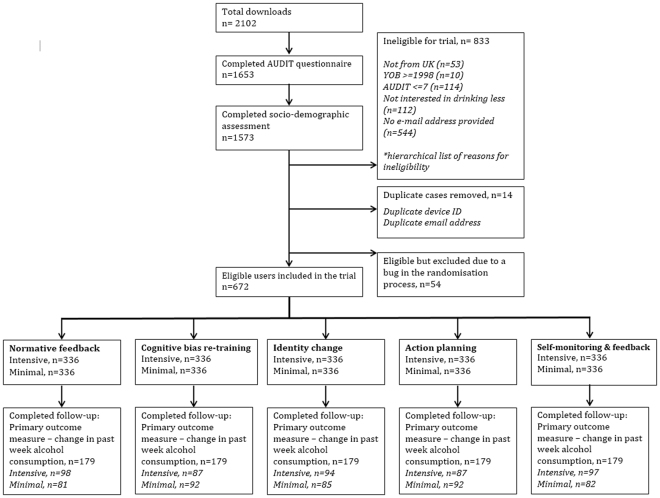
Our aim was to evaluate intervention components of an alcohol reduction app: Drink Less. Excessive drinkers (AUDIT>=8) were recruited to test enhanced versus minimal (reduced functionality) versions of five app modules in a 25 factorial trial. Modules were: Self-monitoring and Feedback, Action Planning, Identity Change, Normative Feedback, and Cognitive Bias Re-training. Outcome measures were: change in weekly alcohol consumption (primary); full AUDIT score, app usage, app usability (secondary). Main effects and two-way interactions were assessed by ANOVA using intention-to-treat. A total of 672 study participants were included. There were no significant main effects of the intervention modules on change in weekly alcohol consumption or AUDIT score. There were two-way interactions between enhanced Normative Feedback and Cognitive Bias Re-training on weekly alcohol consumption (F = 4.68, p = 0.03) and between enhanced Self-monitoring and Feedback and Action Planning on AUDIT score (F = 5.82, p = 0.02). Enhanced Self-monitoring and Feedback was used significantly more often and rated significantly more positively for helpfulness, satisfaction and recommendation to others than the minimal version. To conclude, in an evaluation of the Drink Less smartphone application, the combination of enhanced Normative Feedback and Cognitive Bias Re-training and enhanced Self-monitoring and Feedback and Action Planning yielded improvements in alcohol-related outcomes after 4-weeks.
Overview
The claims and statistics of this paper haven’t been checked yet.
Run the check — free, no account needed. It reads the open-access text and checks the sources it cites.
Integrity signals
Registry
Cites
Statistics
Figures
Verification
Claims the paper makes
The claims and statistics of this paper haven’t been checked yet.
Run the check — free, no account needed. It reads the open-access text and checks the sources it cites.
Claims other papers make about this one
Each is checked against this paper’s own text: does it say what the citing paper says it does?
The cited source doesn’t support the claim as written.
In the citing paper
“For example, a study using smartphone apps for treating eating disorder symptoms found a standard self-monitoring app led to significant improvements in outcomes (87).”
From Digital Therapeutic Alliance With Fully Automated Mental Health Smartphone Apps: A Narrative Review (2022) · cites this paper as [87]
Checked by a reasoning model — may be wrong.
Experimental — accuracy not yet measuredThe source backs part of the claim, not all of it — or backs it for a different population, condition or comparison.
In the citing paper
“For example, one study of an app for reducing alcohol consumption found that the feedback function was highly rated by clients (87).”
From Digital Therapeutic Alliance With Fully Automated Mental Health Smartphone Apps: A Narrative Review (2022) · cites this paper as [87]
Experimental — accuracy not yet measuredIn the citing paper
“For substance-related and addictive disorders, we found one RCT; the study found improvements in alcohol outcomes for the participants [106].”
From Smartphone Apps for the Treatment of Mental Disorders: Systematic Review (2020) · cites this paper as [106]
Self-check
Percentages, sums and reported differences re-computed from the paper’s own numbers.
The self-check needs the paper’s full text.
Citations
Cites
Jeffreys, H., Moran, P. A. P., & Chatfield, C. (1922) · Nature · doi:10.1038/109132a0 · Cited by 7,877
Michie, S., Richardson, M., Johnston, M., Abraham, C., Francis, J., Hardeman, W., Eccles, M. P., Cane, J., & Wood, C. E. (2013) · Annals of Behavioral Medicine · doi:10.1007/s12160-013-9486-6 · Cited by 7,629
Self-citationImplementation intentions: Strong effects of simple plans.
Gollwitzer, P. M. (1999) · American Psychologist · doi:10.1037/0003-066x.54.7.493 · Cited by 5,478
Sobell, L. C., & Sobell, M. B. (1992) · Measuring Alcohol Consumption · doi:10.1007/978-1-4612-0357-5_3 · Cited by 4,110
Carver, C. S., & Scheier, M. F. (1982) · Psychological Bulletin · doi:10.1037//0033-2909.92.1.111 · Cited by 2,650
Decision making, impulse control and loss of willpower to resist drugs: a neurocognitive perspective
Bechara, A. (2005) · Nature Neuroscience · doi:10.1038/nn1584 · Cited by 2,149 · cited 1×
“…one alone 29,30 ; dual-process models of behaviour and the PRIME Theory of Motivation propose that behaviour is determined by motivation and its two systems 31,32 ; the Normative Feedback module targeted reflective motivation and the Cognitive Bias Re-training module targeted automatic motivation.”
BackgroundUsing Bayes to get the most out of non-significant results
Dienes, Z. (2014) · Frontiers in Psychology · doi:10.3389/fpsyg.2014.00781 · Cited by 1,998
Regression to the mean: what it is and how to deal with it
Barnett, A. G. (2004) · International Journal of Epidemiology · doi:10.1093/ije/dyh299 · Cited by 1,988
Effectiveness of brief alcohol interventions in primary care populations
Kaner, E. F., Beyer, F. R., Muirhead, C., Campbell, F., Pienaar, E. D., Bertholet, N., Daeppen, J. B., Saunders, J. B., & Burnand, B. (2018) · Cochrane Database of Systematic Reviews · doi:10.1002/14651858.cd004148.pub4 · Cited by 1,665
The alcohol use disorders identification test: an update of research findings
Reinert, D. F., & Allen, J. P. (2007) · Alcoholism: Clinical and Experimental Research · doi:10.1111/j.1530-0277.2006.00295.x · Cited by 1,397
Research works printed but not linked: 1
- Garnett, C. Development and evaluation of a theory- and evidence-based smartphone app to help reduce excessive alcohol consumption (unpublished doctoral thesis). (University College London, 2016).
Cited by
Sorted by citations
Milne-Ives, M., Lam, C., De Cock, C., Van Velthoven, M. H., & Meinert, E. (2020) · JMIR mhealth and uhealth · doi:10.2196/17046 · Cited by 393
Mobile Apps for Mental Health Issues: Meta-Review of Meta-Analyses
Lecomte, T., Potvin, S., Corbière, M., Guay, S., Samson, C., Cloutier, B., Francoeur, A., Pennou, A., & Khazaal, Y. (2020) · JMIR mHealth and uHealth · doi:10.2196/17458 · Cited by 336
Smartphone Apps for the Treatment of Mental Disorders: Systematic Review
Miralles, I., Granell, C., Díaz-Sanahuja, L., Van Woensel, W., Bretón-López, J., Mira, A., Castilla, D., & Casteleyn, S. (2020) · JMIR mHealth and uHealth · doi:10.2196/14897 · Cited by 188
Perski, O., Crane, D., Beard, E., & Brown, J. (2019) · DIGITAL HEALTH · doi:10.1177/2055207619880676 · Cited by 135
Self-citationDigital Therapeutic Alliance With Fully Automated Mental Health Smartphone Apps: A Narrative Review
Tong, F., Lederman, R., D'Alfonso, S., Berry, K., & Bucci, S. (2022) · Frontiers in Psychiatry · doi:10.3389/fpsyt.2022.819623 · Cited by 106
“For example, one study of an app for reducing alcohol consumption found that the feedback function was highly rated by clients (87).”
Background
Metadata
- Authors
- Crane, D., Garnett, C., Michie, S., West, R., & Brown, J.
- Affiliations
- University College London (GB)
- Corresponding author
- Crane, David
- Venue
- Scientific Reports
- Published
- 2018-03-12
- Volume
- 8
- Issue
- 1
- Pages
- 4384-4384
- ISSN
- 2045-2322 (ISSN-L)
- PMC
- PMC5847600
- OpenAlex
- W2789617414
- Cited by
- 118
- References
- 63
- Citations by year
- 2026: 4 · 2025: 12 · 2024: 12 · 2023: 10 · 2022: 25 · 2021: 20 · 2020: 16 · 2019: 14 · 2018: 5
- FWCI
- 10.74
- Type
- journal article
- Language
- en
- Update notices
- correction (2018-04-27)
- Open access
- gold
- doi.org
- Locations
- Scientific Reports (publishedVersion, cc-by)
- Europe PMC (PubMed Central) (publishedVersion, cc-by)
- PubMed Central (publishedVersion, cc-by)
- PubMed (publishedVersion)
- DOAJ (DOAJ: Directory of Open Access Journals) (submittedVersion)
- UCL Discovery (University College London) (submittedVersion)
- Funders
- United Kingdom Clinical Research Collaboration
- Cancer Research UK ((C1417/A22962), C1417, 22962, A22962)
- National Institute for Health and Care Research (C1417/A22962)
- British Heart Foundation
- Medical Research Council (MR/K023195/1, C1417/A22962)
- Economic and Social Research Council
- School for Public Health Research (C1417/A22962)
- Topics
- Health Sciences › Medicine › Epidemiology › Substance Abuse Treatment and Outcomes
- Social Sciences › Psychology › Applied Psychology › Digital Mental Health Interventions
- Health Sciences › Health Professions › General Health Professions › Mobile Health and mHealth Applications
- Keywords
- excessive alcohol consumption, mobile application, alcohol reduction interventions, action planning, personal transformation, normative feedback, auditing, app usability, app usage
- MeSH terms
- Smartphone, Self-Management, Adult, Alcohol Drinking, Feedback, Female, Humans, Male, Teaching, Bias, Mobile Applications
About these checks
Registry, retraction, Cites and statistics results are computed, not judged, with one exception: a printed reference that no index lists is read once by a model before it counts as a citation error. Claims are extracted by a model and kept only when their quote appears verbatim in the text; each cited source is then checked, with a model’s help, for whether it says what the claim relies on. Those verdicts can be wrong — read the claim’s quote and the cited source before relying on one.
Statistics and arithmetic are recomputed, not judged.
Confidence bands are shown only for fields calibrated on our annotated test set. None is calibrated yet, so no band is shown.
What counts as a claim ›How we measure confidence ›How we check this ›
Are you an author, or do you see a problem with this page? Request a review
