

Mechanical Vibration Influences the Perception of Electrovibration
Open accessThe DOI matches its Crossref record; 57 of the 57 references it cites were found in a registry or an index.
Abstract
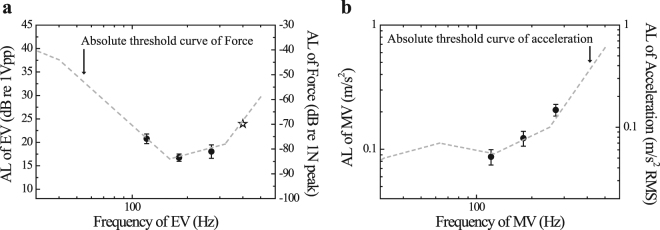
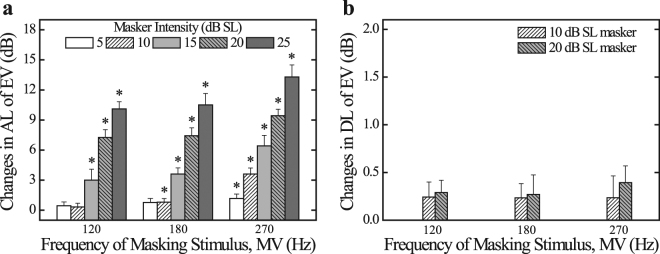
Recently, various methods using, simultaneously, two types of tactile feedback have been proposed to emulate a real object. However, the possible masking effect when providing two types of tactile feedback has been scarcely reported. In this study, we investigated the masking effect caused by mechanical vibration on the perception of electrovibration. The absolute and difference thresholds of the electrovibration were measured according to the presence/absence, frequency, and intensity of the mechanical vibration. The absolute threshold of electrovibration tended to increase in the form of a ramp function, as the intensity of the masking stimulus (mechanical vibration) increased. Particularly, the masking effect was more remarkable when the frequency of both the target and the masking stimulus was the same (up to 13 dB increase with 25 dB SL masker). Furthermore, the difference in the threshold (average of 1.21 dB) did not significantly change due to the masking stimulus, when the sensation level intensity of the target stimulus was within the section following the Weber’s law. The results further indicated that electrovibration contributes to the activation of slowly adapting afferents as well. This investigation will provide important guidelines for the design of haptic interface that employs multiple types of tactile feedback.
Overview
The claims and statistics of this paper haven’t been checked yet.
Free: it reads the open-access text and checks the first 5 claims that cite a source we can check. Create a free account to check every claim.
Integrity signals
Registry
Cites
Statistics
Figures
Verification
Claims the paper makes
The claims and statistics of this paper haven’t been checked yet.
Free: it reads the open-access text and checks the first 5 claims that cite a source we can check. Create a free account to check every claim.
Claims other papers make about this one
Each is checked against this paper’s own text: does it say what the citing paper says it does?
In the citing paper
“By applying localized mechanical force or vibration on skin, mechano-tactile devices can achieve safe and highly controllable stimulations for VR/AR sensation (5–7).”
From Self-powered electro-tactile system for virtual tactile experiences (2021) · cites this paper as [5]
Self-check
Percentages, sums and reported differences re-computed from the paper’s own numbers.
The self-check needs the paper’s full text.
Citations
Cites
Transformed Up-Down Methods in Psychoacoustics
Levitt, H. (1971) · The Journal of the Acoustical Society of America · doi:10.1121/1.1912375 · Cited by 5,477
Contrast masking in human vision
Legge, G. E., & Foley, J. M. (1980) · Journal of the Optical Society of America · doi:10.1364/josa.70.001458 · Cited by 1,182
Adaptive procedures in psychophysical research
Leek, M. R. (2001) · Perception & Psychophysics · doi:10.3758/bf03194543 · Cited by 808
TeslaTouch: electrovibration for touch surfaces
Bau, O., Poupyrev, I., Israr, A., & Harrison, C. (2010) · Proceedings of the 23nd annual ACM symposium on User interface software and technology · doi:10.1145/1866029.1866074 · Cited by 664
Tactile Displays: Guidance for Their Design and Application
Jones, L. A., & Sarter, N. B. (2008) · Human Factors: The Journal of the Human Factors and Ergonomics Society · doi:10.1518/001872008x250638 · Cited by 561
Spatial and temporal codes mediate the tactile perception of natural textures
Weber, A. I., Saal, H. P., Lieber, J. D., Cheng, J.-W., Manfredi, L. R., Dammann, J. F., & Bensmaia, S. J. (2013) · Proceedings of the National Academy of Sciences · doi:10.1073/pnas.1305509110 · Cited by 421
Tactile Functions of Mechanoreceptive Afferents Innervating the Hand
Johnson, K. O., Yoshioka, T., & Vega–Bermudez, F. (2000) · Journal of Clinical Neurophysiology · doi:10.1097/00004691-200011000-00002 · Cited by 351
T-PaD: Tactile Pattern Display through Variable Friction Reduction
Winfield, L., Glassmire, J., Colgate, J. E., & Peshkin, M. (2007) · Second Joint EuroHaptics Conference and Symposium on Haptic Interfaces for Virtual Environment and Teleoperator Systems (WHC'07) · doi:10.1109/whc.2007.105 · Cited by 348
Ambient touch: designing tactile interfaces for handheld devices
Poupyrev, I., Maruyama, S., & Rekimoto, J. (2002) · Proceedings of the 15th annual ACM symposium on User interface software and technology · doi:10.1145/571985.571993 · Cited by 329
BensmaÏa, S. J., & Hollins, M. (2003) · Somatosensory & Motor Research · doi:10.1080/0899022031000083825 · Cited by 280
Cited by
Mimicking Human and Biological Skins for Multifunctional Skin Electronics
Lee, Y., Park, J., Choe, A., Cho, S., Kim, J., & Ko, H. (2020) · Advanced Functional Materials · doi:10.1002/adfm.201904523 · Cited by 465
Non-invasive transcranial ultrasound stimulation for neuromodulation
Darmani, G., Bergmann, T. O., Butts Pauly, K., Caskey, C. F., de Lecea, L., Fomenko, A., Fouragnan, E., Legon, W., Murphy, K. R., Nandi, T., et al. (2022) · Clinical Neurophysiology · doi:10.1016/j.clinph.2021.12.010 · Cited by 332
A Review of Surface Haptics: Enabling Tactile Effects on Touch Surfaces
Basdogan, C., Giraud, F., Levesque, V., & Choi, S. (2020) · IEEE Transactions on Haptics · doi:10.1109/toh.2020.2990712 · Cited by 229
“[111] attached piezoactuators to a capacitive touch screen and investigated the effect of in-site vibrotactile masking on tactile perception of electrovibration.”
BackgroundSelf-powered electro-tactile system for virtual tactile experiences
Shi, Y., Wang, F., Tian, J., Li, S., Fu, E., Nie, J., Lei, R., Ding, Y., Chen, X., & Wang, Z. L. (2021) · Science Advances · doi:10.1126/sciadv.abe2943 · Cited by 251
Skin‐Integrated Vibrohaptic Interfaces for Virtual and Augmented Reality
Jung, Y. H., Kim, J., & Rogers, J. A. (2020) · Advanced Functional Materials · doi:10.1002/adfm.202008805 · Cited by 147
Ito, K., Okamoto, S., Yamada, Y., & Kajimoto, H. (2019) · ACM Transactions on Applied Perception · doi:10.1145/3340961 · Cited by 30
Tri-Modal Tactile Display and Its Application Into Tactile Perception of Visualized Surfaces
Liu, G., Zhang, C., & Sun, X. (2020) · IEEE Transactions on Haptics · doi:10.1109/toh.2020.2979182 · Cited by 25
“Specifically, The HUE [9] and the UltraShiver [33] displays are believed to lack the normal feedback dimension induced by mechanical vibration [12], whereas the coupled tactile displays in [10], [12], [34] only occupy the lateral force above the nominal friction level of the surface.”
BackgroundPerception Accuracy of a Multi-Channel Tactile Feedback System for Assistive Technology
Wersényi, G. (2022) · Sensors · doi:10.3390/s22228962 · Cited by 24
Otake, K., Okamoto, S., Akiyama, Y., & Yamada, Y. (2022) · ACM Transactions on Applied Perception · doi:10.1145/3539733 · Cited by 18
“Evaluation methods based on psychophysical behavioral responses consist of methods for estimating psychophysical thresholds [1, 3, 4, 12, 38, 46, 56, 61] and those to classify or identify virtual stimuli [14, 35, 50, 61, 63].”
BackgroundMethodKomurasaki, S., Kajimoto, H., & Ishizuka, H. (2019) · Micromachines · doi:10.3390/mi10050301 · Cited by 12
“integrated an electrovibration tactile display and vibrators [21].”
BackgroundEffect of Remote Masking on Tactile Perception of Electrovibration
Jamalzadeh, M., Başdoğan, Ç., & Güçlü, B. (2020) · IEEE Transactions on Haptics · doi:10.1109/toh.2020.3025772 · Cited by 11
“[24], who indeed used simultaneous vibrotactile masking of electrovibration at the same site.”
BackgroundResultInfluentialFelicetti, L., Chatelet, E., Bou‐Saïd, B., Latour, A., & Massi, F. (2023) · Tribology International · doi:10.1016/j.triboint.2023.109018 · Cited by 11
The effects of sensory quantization and control torque saturation on human balance control
Gyebrószki, G., Csernák, G., MILTON, J. G., & Insperger, T. (2021) · Chaos An Interdisciplinary Journal of Nonlinear Science · doi:10.1063/5.0028197 · Cited by 11
Boonpuek, P., Ma, Y., Li, X., Choi, C., Hipwell, M. C., & Felts, J. R. (2021) · Langmuir · doi:10.1021/acs.langmuir.0c03170 · Cited by 11
Effect of Remote Masking on Detection of Electrovibration
Jamalzadeh, M., Güçlü, B., Vardar, Y., & Başdoğan, Ç. (2019) · IEEE World Haptics Conference (WHC) · doi:10.1109/whc.2019.8816175 · Cited by 11
“In relation to our study, electrovibration stimulus was used for creating tangential masking stimulus in [4], while mechanical vibration in the direction normal to touchscreen was utilized as the masker in [21].”
BackgroundMethodResultInfluentialSun, X., Zhang, C., & Liu, G. (2020) · The Computer Journal · doi:10.1093/comjnl/bxaa091 · Cited by 8
Self-powered electro-tactile system for virtual tactile experiences
Shi, Y., Chen, X., & Wang, Z. L. (2022) · IEEE International Flexible Electronics Technology Conference (IFETC) · doi:10.1109/ifetc53656.2022.9948520 · Cited by 6
Otake, K., HASEGAWA, H., Okamoto, S., & Yamada, Y. (2020) · Conference on Human System Interactions · doi:10.1109/hsi49210.2020.9142626 · Cited by 6
“Many tactile displays that were previously studied were based on one of these two types of tactile stimulus, whereas a few perceptual studies about the conjunct vibrotactile and electrostatic friction stimuli were reported [10].”
BackgroundImpact of Whole-Body Vibrations on Electrovibration Perception Varies with Target Stimulus Duration
Vuik, J. D. A., Pool, D. M., Kenanoglu, C. U., & Vardar, Y. (2025) · Human Factors The Journal of the Human Factors and Ergonomics Society · doi:10.1177/00187208251326662 · Cited by 6
Christova, M., Sylwester, V., Gallasch, E., & Fresnoza, S. M. (2022) · The Cerebellum · doi:10.1007/s12311-022-01502-4 · Cited by 4
“The ascending inputs probably originated from the activation of the rapidly adapting type I receptors (RA-I) in the Meissner corpuscles, the most abundant myelinated mechanoreceptors in the human hand (43%), which are sensitive to mid-range (20–50 Hz) frequencies [53, 58–60].”
BackgroundStimulus Optimization for Softness Perception on a Friction-Variable Tactile Texture Display
Chihara, A., Okamoto, S., & Kurita, A. (2025) · Sci · doi:10.3390/sci7030096 · Cited by 6
“The interaction between vibration and frictional cues has also been explored [5,11,19,20].”
Flexible and Transparent Electrovibration-Based Haptic Display with Low Driving Voltage
Park, B., Choi, E., Byun, G., Choe, G., Hong, S. W., Yang, H., Lim, J., Lee, S., & Jung, Y. H. (2024) · ACS Applied Materials & Interfaces · doi:10.1021/acsami.4c11871 · Cited by 2
Song, R., Sun, X., Wang, D., Liu, G., & Nie, D. (2025) · Virtual Reality & Intelligent Hardware · doi:10.1016/j.vrih.2023.10.006 · Cited by 2
Chu, S., & Tu, H. (2022) · IEEE Access · doi:10.1109/access.2022.3167526 · Cited by 2
“Clearly the MV and UV increase touchscreen interaction channels [15, 16], but they are different and each has advantages and disadvantages, which are important design elements that deserve more formal and rigorous studies in academia and industry.”
BackgroundEdge Vibration Improves Ability to Discriminate Roughness Difference of Adjoining Areas
Ban, Y., Ujitoko, Y., & Minamizawa, K. (2020) · IEEE Transactions on Haptics · doi:10.1109/toh.2020.2970057 · Cited by 1
“Moreover, in the case of simultaneous masking in which the masking effect is generated by presenting two kinds of stimuli simultaneously, it has been confirmed that the masking effect becomes remarkable when the target and the masking stimulus frequencies are the same [23].”
BackgroundRendering Strategy to Counter Mutual Masking Effect in Multiple Tactile Feedback
Ryu, S., Pyo, D., Lim, S., & Kwon, D. (2020) · Applied Sciences · doi:10.3390/app10144990 · Cited by 1
Self-citationVardar, Y. (2020) · Springer series on touch and haptic systems · doi:10.1007/978-3-030-52252-0_2
Softness Perception Interfered by Friction in Gliding Virtual Surfaces
Wang, H., & Okamoto, S. (2025) · IEEE Access · doi:10.1109/access.2025.3594240
“A similar phenomenon was observed with the use of a tactile display [44], where the normal and tangential vibrations of the touch panel heightened the absolute perceptual thresholds for each other.”
Rodrigues, T. B. (2020) · Research@THEA
Analysis and rendering of contact vibrational stimuli for tactile perception
Felicetti, L. (2024) · theses.fr (ABES) · doi:10.70675/dab44cf6ze236z49e3za66cz7c27b59965ec · Cited by 1
Ehelagasthenna, M., Shahidi, A. M., Lugoda, P., Ebrahimi, P., Oliveira, C., Eberl-Craske, D., Hurley, W., Dias, T., & Hughes‐Riley, T. (2026) · npj Flexible Electronics · doi:10.1038/s41528-026-00613-w
Tan, Y., Mou, X., Liu, S., Zang, L., & Cui, H. (2026) · Frontiers in Psychology · doi:10.3389/fpsyg.2026.1914946
Dölker, E., Farouk, R., Altaeh, F., Sander, J., & Haueisen, J. (2026) · bioRxiv (Cold Spring Harbor Laboratory) · doi:10.64898/2026.09.17.749350
“Masking acts primarily on the detection threshold, whereas suprathreshold intensity discrimination is affected mainly close to the masked threshold and becomes largely independent of the masker at higher sensation levels [45,46].”
Metadata
- Authors
- Ryu, S., Pyo, D., Lim, S.-C., & Kwon, D.-S.
- Affiliations
- Hallym University (KR)
- Electronics and Telecommunications Research Institute (KR)
- Dongguk University (KR)
- Korea Advanced Institute of Science and Technology (KR)
- Corresponding author
- Kwon, Dong-Soo
- Venue
- Scientific Reports
- Published
- 2018-03-14
- Volume
- 8
- Issue
- 1
- Pages
- 4555-4555
- ISSN
- 2045-2322 (ISSN-L)
- PMC
- PMC5852143
- OpenAlex
- W2793060613
- Cited by
- 31
- References
- 57
- Citations by year
- 2026: 2 · 2025: 4 · 2024: 2 · 2023: 1 · 2022: 5 · 2021: 4 · 2020: 9 · 2019: 4
- FWCI
- 2.53
- Type
- journal article
- Language
- en
- Open access
- gold
- doi.org
- Licence
- cc-by
- creativecommons.org/licenses/by/4.0 (tdm)
- creativecommons.org/licenses/by/4.0 (vor)
- Locations
- Scientific Reports (publishedVersion, cc-by)
- PubMed Central (publishedVersion, cc-by)
- PubMed (publishedVersion)
- DOAJ (DOAJ: Directory of Open Access Journals) (submittedVersion)
- Funders
- National Research Foundation
- National Research Foundation of Korea
- Topics
- Life Sciences › Neuroscience › Cognitive Neuroscience › Tactile and Sensory Interactions
- Physical Sciences › Engineering › Mechanical Engineering › Teleoperation and Haptic Systems
- Life Sciences › Neuroscience › Cognitive Neuroscience › Motor Control and Adaptation
- Keywords
- electrovibration, mechanical vibration, masking, tactile perception, absolute threshold, just noticeable difference, haptic feedback, slowly adapting afferents, Weber's law, haptic device design
About these checks
Registry, retraction, Cites and statistics results are computed, not judged, with one exception: a printed reference that no index lists is read once by a model before it counts as a citation error. Claims are extracted by a model and kept only when their quote appears verbatim in the text; each cited source is then checked, with a model’s help, for whether it says what the claim relies on. Those verdicts can be wrong — read the claim’s quote and the cited source before relying on one.
Statistics and arithmetic are recomputed, not judged.
Confidence bands are shown only for fields calibrated on our annotated test set. None is calibrated yet, so no band is shown.
What counts as a claim ›How we measure confidence ›How we check this ›
Are you an author, or do you see a problem with this page? Request a review
Data sources
Bibliographic data: Semantic Scholar, OpenAlex, Crossref.
Contains information from the Semantic Scholar Academic Graph Datasets, made available under the ODC Attribution License (ODC-BY 1.0).
Semantic Scholar’s data is described in: Kinney, R., et al. (2023). The Semantic Scholar Open Data Platform. arXiv:2301.10140.
