

Mechanical Vibration Influences the Perception of Electrovibration
Open accessThe DOI matches its Crossref record; 57 of the 57 references it cites were found in a registry or an index.
Abstract
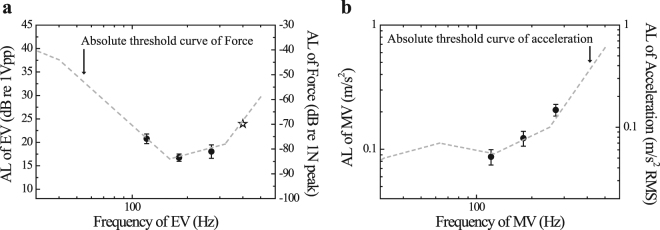
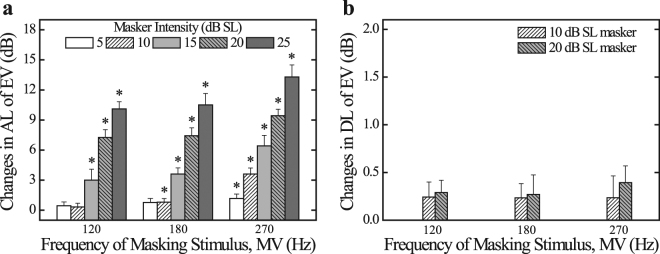
Recently, various methods using, simultaneously, two types of tactile feedback have been proposed to emulate a real object. However, the possible masking effect when providing two types of tactile feedback has been scarcely reported. In this study, we investigated the masking effect caused by mechanical vibration on the perception of electrovibration. The absolute and difference thresholds of the electrovibration were measured according to the presence/absence, frequency, and intensity of the mechanical vibration. The absolute threshold of electrovibration tended to increase in the form of a ramp function, as the intensity of the masking stimulus (mechanical vibration) increased. Particularly, the masking effect was more remarkable when the frequency of both the target and the masking stimulus was the same (up to 13 dB increase with 25 dB SL masker). Furthermore, the difference in the threshold (average of 1.21 dB) did not significantly change due to the masking stimulus, when the sensation level intensity of the target stimulus was within the section following the Weber’s law. The results further indicated that electrovibration contributes to the activation of slowly adapting afferents as well. This investigation will provide important guidelines for the design of haptic interface that employs multiple types of tactile feedback.
Overview
The claims and statistics of this paper haven’t been checked yet.
Free: it reads the open-access text and checks the first 5 claims that cite a source we can check. Create a free account to check every claim.
Integrity signals
Registry
Cites
Statistics
Figures
Verification
Claims the paper makes
The claims and statistics of this paper haven’t been checked yet.
Free: it reads the open-access text and checks the first 5 claims that cite a source we can check. Create a free account to check every claim.
Claims other papers make about this one
Each is checked against this paper’s own text: does it say what the citing paper says it does?
In the citing paper
“By applying localized mechanical force or vibration on skin, mechano-tactile devices can achieve safe and highly controllable stimulations for VR/AR sensation (5–7).”
From Self-powered electro-tactile system for virtual tactile experiences (2021) · cites this paper as [5]
Self-check
Percentages, sums and reported differences re-computed from the paper’s own numbers.
The self-check needs the paper’s full text.
Citations
Cites
Transformed Up-Down Methods in Psychoacoustics
Levitt, H. (1971) · The Journal of the Acoustical Society of America · doi:10.1121/1.1912375 · Cited by 5,477
Contrast masking in human vision
Legge, G. E., & Foley, J. M. (1980) · Journal of the Optical Society of America · doi:10.1364/josa.70.001458 · Cited by 1,182
Adaptive procedures in psychophysical research
Leek, M. R. (2001) · Perception & Psychophysics · doi:10.3758/bf03194543 · Cited by 808
TeslaTouch: electrovibration for touch surfaces
Bau, O., Poupyrev, I., Israr, A., & Harrison, C. (2010) · Proceedings of the 23nd annual ACM symposium on User interface software and technology · doi:10.1145/1866029.1866074 · Cited by 664
Tactile Displays: Guidance for Their Design and Application
Jones, L. A., & Sarter, N. B. (2008) · Human Factors: The Journal of the Human Factors and Ergonomics Society · doi:10.1518/001872008x250638 · Cited by 561
Spatial and temporal codes mediate the tactile perception of natural textures
Weber, A. I., Saal, H. P., Lieber, J. D., Cheng, J.-W., Manfredi, L. R., Dammann, J. F., & Bensmaia, S. J. (2013) · Proceedings of the National Academy of Sciences · doi:10.1073/pnas.1305509110 · Cited by 421
Tactile Functions of Mechanoreceptive Afferents Innervating the Hand
Johnson, K. O., Yoshioka, T., & Vega–Bermudez, F. (2000) · Journal of Clinical Neurophysiology · doi:10.1097/00004691-200011000-00002 · Cited by 351
T-PaD: Tactile Pattern Display through Variable Friction Reduction
Winfield, L., Glassmire, J., Colgate, J. E., & Peshkin, M. (2007) · Second Joint EuroHaptics Conference and Symposium on Haptic Interfaces for Virtual Environment and Teleoperator Systems (WHC'07) · doi:10.1109/whc.2007.105 · Cited by 348
Ambient touch: designing tactile interfaces for handheld devices
Poupyrev, I., Maruyama, S., & Rekimoto, J. (2002) · Proceedings of the 15th annual ACM symposium on User interface software and technology · doi:10.1145/571985.571993 · Cited by 329
BensmaÏa, S. J., & Hollins, M. (2003) · Somatosensory & Motor Research · doi:10.1080/0899022031000083825 · Cited by 280
LaMotte, R. H., & Mountcastle, V. B. (1975) · Journal of Neurophysiology · doi:10.1152/jn.1975.38.3.539 · Cited by 278
Quantitative analysis of static strain sensitivity in human mechanoreceptors from hairy skin
Edin, B. B. (1992) · Journal of Neurophysiology · doi:10.1152/jn.1992.67.5.1105 · Cited by 249
Creating Realistic Virtual Textures from Contact Acceleration Data
Romano, J. M., & Kuchenbecker, K. J. (2012) · IEEE Transactions on Haptics · doi:10.1109/toh.2011.38 · Cited by 244
Perceptual Masking in Multiple Sound Backgrounds
Carhart, R., Tillman, T. W., & Greetis, E. S. (1969) · The Journal of the Acoustical Society of America · doi:10.1121/1.1911445 · Cited by 222
Squeeze film effect for the design of an ultrasonic tactile plate
Biet, M., Giraud, F., & Lemaire-Semail, B. (2007) · IEEE Transactions on Ultrasonics, Ferroelectrics and Frequency Control · doi:10.1109/tuffc.2007.596 · Cited by 207
Psychophysics of vibrotactile stimulation
Verrillo, R. T. (1985) · The Journal of the Acoustical Society of America · doi:10.1121/1.392263 · Cited by 169
Loudness Function of a 1000-cps Tone in the Presence of a Masking Noise
Hellman, R. P., & Zwislocki, J. (1964) · The Journal of the Acoustical Society of America · doi:10.1121/1.1919255 · Cited by 169
Tactile rendering of 3D features on touch surfaces
Kim, S.-C., Israr, A., & Poupyrev, I. (2013) · Proceedings of the 26th annual ACM symposium on User interface software and technology · doi:10.1145/2501988.2502020 · Cited by 163
Fingertip friction modulation due to electrostatic attraction
Meyer, D. J., Peshkin, M. A., & Colgate, J. E. (2013) · 2013 World Haptics Conference (WHC) · doi:10.1109/whc.2013.6548382 · Cited by 138
Perception by the Skin of Electrically Induced Vibrations
Mallinckrodt, E., Hughes, A. L., & Sleator, W. W. (1953) · Science · doi:10.1126/science.118.3062.277 · Cited by 135
Quantitative Analyses of Dynamic Strain Sensitivity in Human Skin Mechanoreceptors
Edin, B. B. (2004) · Journal of Neurophysiology · doi:10.1152/jn.00628.2004 · Cited by 129
Tactile directional sensibility: peripheral neural mechanisms in man
Olausson, H., Wessberg, J., & Kakuda, N. (2000) · Brain Research · doi:10.1016/s0006-8993(00)02278-2 · Cited by 124
Vibrotacile masking of Pacinian and non-Pacinian channels
Hamer, R. D., Verrillo, R. T., & Zwislocki, J. J. (1983) · The Journal of the Acoustical Society of America · doi:10.1121/1.389278 · Cited by 113
Difference threshold for intensity of tactile stimuli
Craig, J. C. (1972) · Perception & Psychophysics · doi:10.3758/bf03210362 · Cited by 105
Morioka, M., & Griffin, M. J. (2005) · Somatosensory & Motor Research · doi:10.1080/08990220500420400 · Cited by 104
“Hearing” with the Sense of Touch
Knudsen, V. O. (1928) · The Journal of General Psychology · doi:10.1080/00221309.1928.9920128 · Cited by 102
Vibrotactile intensity discrimination measured by three methods
Gescheider, G. A., Bolanowski, S. J., Verrillo, R. T., Arpajian, D. J., & Ryan, T. F. (1990) · The Journal of the Acoustical Society of America · doi:10.1121/1.399300 · Cited by 99
Vibrotactile masking: Effects of oneand two-site stimulation
Verrillo, R. T., Gescheider, G. A., Calman, B. G., & Doren, C. L. V. (1983) · Perception & Psychophysics · doi:10.3758/bf03205886 · Cited by 97
Meyer, D. J., Wiertlewski, M., Peshkin, M. A., & Colgate, J. E. (2014) · 2014 IEEE Haptics Symposium (HAPTICS) · doi:10.1109/haptics.2014.6775434 · Cited by 94
Vibrotactile difference thresholds for intensity and the effect of a masking stimulus
Craig, J. C. (1974) · Perception & Psychophysics · doi:10.3758/bf03205839 · Cited by 88
Psychophysical Model for Vibrotactile Rendering in Mobile Devices
Ryu, J. (2010) · Presence: Teleoperators and Virtual Environments · doi:10.1162/pres_a_00011 · Cited by 82
Gescheider, G. A., Sklar, B. F., Van Doren, C. L., & Verrillo, R. T. (1985) · The Journal of the Acoustical Society of America · doi:10.1121/1.392475 · Cited by 73
Detection Threshold and Mechanical Impedance of the Hand in a Pen-Hold Posture
Israr, A., Choi, S., & Tan, H. (2006) · 2006 IEEE/RSJ International Conference on Intelligent Robots and Systems · doi:10.1109/iros.2006.282353 · Cited by 65
Improving 3D Shape Recognition withElectrostatic Friction Display
Osgouei, R. H., Kim, J. R., & Choi, S. (2017) · IEEE Transactions on Haptics · doi:10.1109/toh.2017.2710314 · Cited by 64
Israr, A., Tan, H. Z., & Reed, C. M. (2006) · The Journal of the Acoustical Society of America · doi:10.1121/1.2354022 · Cited by 59
Kruger, L. (1996) · Academic Press eBooks · Cited by 54
Vezzoli, E., Messaoud, W. B., Amberg, M., Giraud, F., Lemaire-Semail, B., & Bueno, M.-A. (2015) · IEEE Transactions on Haptics · doi:10.1109/toh.2015.2430353 · Cited by 53
Vibrotactile masking: Effects of stimulus onset asynchrony and stimulus frequency
Gescheider, G. A., Bolanowski, S. J., & Verrillo, R. T. (1989) · The Journal of the Acoustical Society of America · doi:10.1121/1.397858 · Cited by 49
Novel linear impact-resonant actuator for mobile applications
Pyo, D., Yang, T., Ryu, S., & Kwon, D. (2015) · Sensors and Actuators A Physical · doi:10.1016/j.sna.2015.07.037 · Cited by 49
Self-citationTactile modeling and rendering image-textures based on electrovibration
Wu, S., Sun, X., Wang, Q., & Chen, J. (2016) · The Visual Computer · doi:10.1007/s00371-016-1214-3 · Cited by 44
Park, W. H., Bae, J. W., Shin, E., & Kim, S. (2016) · Smart Materials and Structures · doi:10.1088/0964-1726/25/11/115020 · Cited by 44
Effect of Waveform in Haptic Perception of Electrovibration on Touchscreens
Vardar, Y., Güçlü, B., & Başdoğan, Ç. (2016) · Lecture notes in computer science · doi:10.1007/978-3-319-42321-0_18 · Cited by 42
Tactile stimulation can suppress visual perception
Ide, M., & Hidaka, S. (2013) · Scientific Reports · doi:10.1038/srep03453 · Cited by 42
Polymer-Based Flexible Visuo-Haptic Display
Yun, S., Park, S., Park, B., Park, S. K., Prahlad, H., von Guggenberg, P. A., & Kyung, K. (2014) · IEEE/ASME Transactions on Mechatronics · doi:10.1109/tmech.2013.2292956 · Cited by 40
Vibrotactile forward masking: Evidence for channel independence
Gescheider, G. A., O’Malley, M. J., & Verrillo, R. T. (1983) · The Journal of the Acoustical Society of America · doi:10.1121/1.389813 · Cited by 39
Method for Providing Electrovibration with Uniform Intensity
Kim, H., Kang, J., Kim, K.-D., Lim, K.-M., & Ryu, J. (2015) · IEEE Transactions on Haptics · doi:10.1109/toh.2015.2476810 · Cited by 37
Investigation on Low Voltage Operation of Electrovibration Display
Kang, J., Kim, H., Choi, S., Kim, K.-D., & Ryu, J. (2016) · IEEE Transactions on Haptics · doi:10.1109/toh.2016.2635145 · Cited by 36
Remarkable capacity for perception of the direction of skin pull in man
Olausson, H., Hamadeh, I., Pakdel, P., & Norrsell, U. (1998) · Brain Research · doi:10.1016/s0006-8993(98)00838-5 · Cited by 35
Vibrotactile forward masking: Effects of the amplitude and duration of the masking stimulus
Gescheider, G. A., Santoro, K. E., Makous, J. C., & Bolanowski, S. J. (1995) · The Journal of the Acoustical Society of America · doi:10.1121/1.413808 · Cited by 31
A flexible tactile-feedback touch screen using transparent ferroelectric polymer film vibrators
Ju, W.-E., Moon, Y.-J., Park, C.-H., & Choi, S. T. (2014) · Smart Materials and Structures · doi:10.1088/0964-1726/23/7/074004 · Cited by 29
A New Surface Display for 3D Haptic Rendering
Pyo, D., Ryu, S., Kim, S. C., & Kwon, D. (2014) · Lecture notes in computer science · doi:10.1007/978-3-662-44193-0_61 · Cited by 27
Self-citationIto, K., Okamoto, S., Elfekey, H., Kajimto, H., & Yamada, Y. (2017) · Conference proceedings/Conference proceedings - IEEE International Conference on Systems, Man, and Cybernetics · doi:10.1109/smc.2017.8122972 · Cited by 19
Effect of contact location on vibrotactile thresholds at the fingertip
Whitehouse, D. J., Whitehouse, D. J., Morioka, M., & Griffin, M. J. (2006) · Somatosensory & Motor Research · doi:10.1080/08990220600741119 · Cited by 14
SlickFeel: sliding and clicking haptic feedback on a touchscreen
Dai, X., Gu, J., Cao, X., Colgate, J. E., & Tan, H. Z. (2012) · ACM Symposium on User Interface Software and Technology (UIST) · doi:10.1145/2380296.2380308 · Cited by 14
Hybrid display of realistic tactile sense using ultrasonic vibrator and force display
Shiokawa, Y., Tazo, A., Konyo, M., & Maéno, T. (2008) · IEEE/RSJ International Conference on Intelligent Robots and Systems (IROS) · doi:10.1109/iros.2008.4650776 · Cited by 12
Feel through window: simultaneous geometry and texture display based on lateral force
Saga, S., & Raskar, R. (2012) · SIGGRAPH Asia Emerging Technologies · doi:10.1145/2407707.2407715 · Cited by 9
Hwang, H.-J., Lim, S., Ok, K., Park, J., & Kim, H. (2016) · Nanotechnology · doi:10.1088/0957-4484/27/50/505209 · Cited by 6
Self-citation
Cited by
Mimicking Human and Biological Skins for Multifunctional Skin Electronics
Lee, Y., Park, J., Choe, A., Cho, S., Kim, J., & Ko, H. (2020) · Advanced Functional Materials · doi:10.1002/adfm.201904523 · Cited by 465
Non-invasive transcranial ultrasound stimulation for neuromodulation
Darmani, G., Bergmann, T. O., Butts Pauly, K., Caskey, C. F., de Lecea, L., Fomenko, A., Fouragnan, E., Legon, W., Murphy, K. R., Nandi, T., et al. (2022) · Clinical Neurophysiology · doi:10.1016/j.clinph.2021.12.010 · Cited by 332
A Review of Surface Haptics: Enabling Tactile Effects on Touch Surfaces
Basdogan, C., Giraud, F., Levesque, V., & Choi, S. (2020) · IEEE Transactions on Haptics · doi:10.1109/toh.2020.2990712 · Cited by 229
“[111] attached piezoactuators to a capacitive touch screen and investigated the effect of in-site vibrotactile masking on tactile perception of electrovibration.”
BackgroundSelf-powered electro-tactile system for virtual tactile experiences
Shi, Y., Wang, F., Tian, J., Li, S., Fu, E., Nie, J., Lei, R., Ding, Y., Chen, X., & Wang, Z. L. (2021) · Science Advances · doi:10.1126/sciadv.abe2943 · Cited by 251
Skin‐Integrated Vibrohaptic Interfaces for Virtual and Augmented Reality
Jung, Y. H., Kim, J., & Rogers, J. A. (2020) · Advanced Functional Materials · doi:10.1002/adfm.202008805 · Cited by 147
Metadata
- Authors
- Ryu, S., Pyo, D., Lim, S.-C., & Kwon, D.-S.
- Affiliations
- Hallym University (KR)
- Electronics and Telecommunications Research Institute (KR)
- Dongguk University (KR)
- Korea Advanced Institute of Science and Technology (KR)
- Corresponding author
- Kwon, Dong-Soo
- Venue
- Scientific Reports
- Published
- 2018-03-14
- Volume
- 8
- Issue
- 1
- Pages
- 4555-4555
- ISSN
- 2045-2322 (ISSN-L)
- PMC
- PMC5852143
- OpenAlex
- W2793060613
- Cited by
- 31
- References
- 57
- Citations by year
- 2026: 2 · 2025: 4 · 2024: 2 · 2023: 1 · 2022: 5 · 2021: 4 · 2020: 9 · 2019: 4
- FWCI
- 2.53
- Type
- journal article
- Language
- en
- Open access
- gold
- doi.org
- Licence
- cc-by
- creativecommons.org/licenses/by/4.0 (tdm)
- creativecommons.org/licenses/by/4.0 (vor)
- Locations
- Scientific Reports (publishedVersion, cc-by)
- PubMed Central (publishedVersion, cc-by)
- PubMed (publishedVersion)
- DOAJ (DOAJ: Directory of Open Access Journals) (submittedVersion)
- Funders
- National Research Foundation
- National Research Foundation of Korea
- Topics
- Life Sciences › Neuroscience › Cognitive Neuroscience › Tactile and Sensory Interactions
- Physical Sciences › Engineering › Mechanical Engineering › Teleoperation and Haptic Systems
- Life Sciences › Neuroscience › Cognitive Neuroscience › Motor Control and Adaptation
- Keywords
- electrovibration, mechanical vibration, masking, tactile perception, absolute threshold, just noticeable difference, haptic feedback, slowly adapting afferents, Weber's law, haptic device design
About these checks
Registry, retraction, Cites and statistics results are computed, not judged, with one exception: a printed reference that no index lists is read once by a model before it counts as a citation error. Claims are extracted by a model and kept only when their quote appears verbatim in the text; each cited source is then checked, with a model’s help, for whether it says what the claim relies on. Those verdicts can be wrong — read the claim’s quote and the cited source before relying on one.
Statistics and arithmetic are recomputed, not judged.
Confidence bands are shown only for fields calibrated on our annotated test set. None is calibrated yet, so no band is shown.
What counts as a claim ›How we measure confidence ›How we check this ›
Are you an author, or do you see a problem with this page? Request a review
Data sources
Bibliographic data: Semantic Scholar, OpenAlex, Crossref.
Contains information from the Semantic Scholar Academic Graph Datasets, made available under the ODC Attribution License (ODC-BY 1.0).
Semantic Scholar’s data is described in: Kinney, R., et al. (2023). The Semantic Scholar Open Data Platform. arXiv:2301.10140.
