

A behavioral approach to shared mapping of peripersonal space between oneself and others
Open accessThe DOI matches its Crossref record; 55 of the 56 references it cites were found in a registry or an index.
Abstract
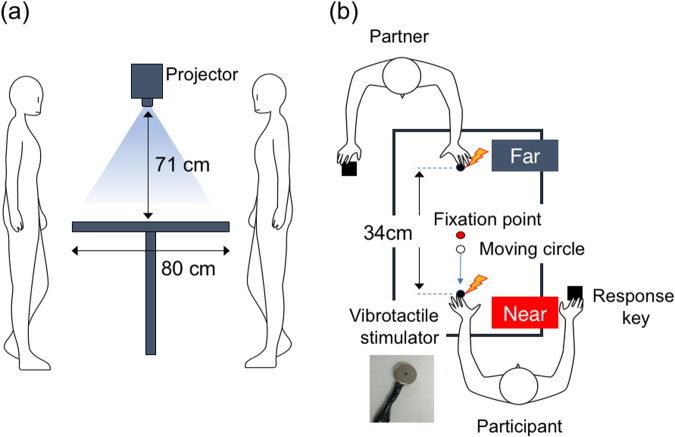
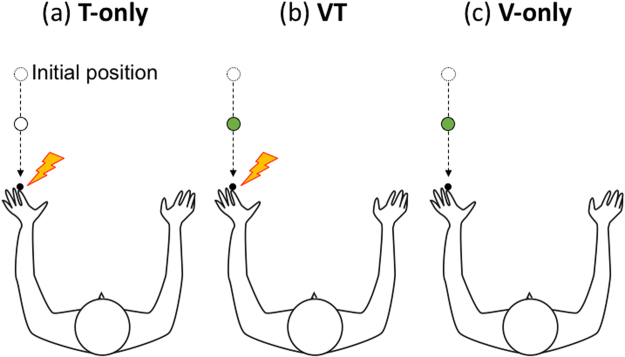
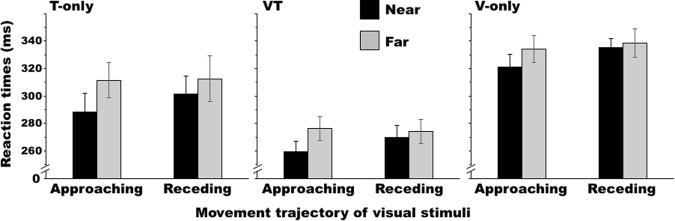
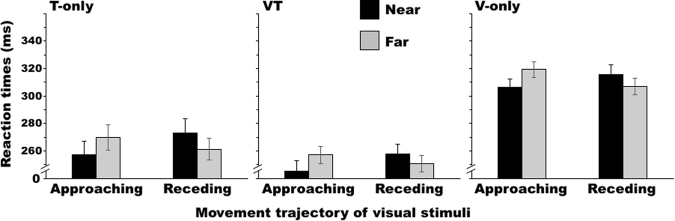
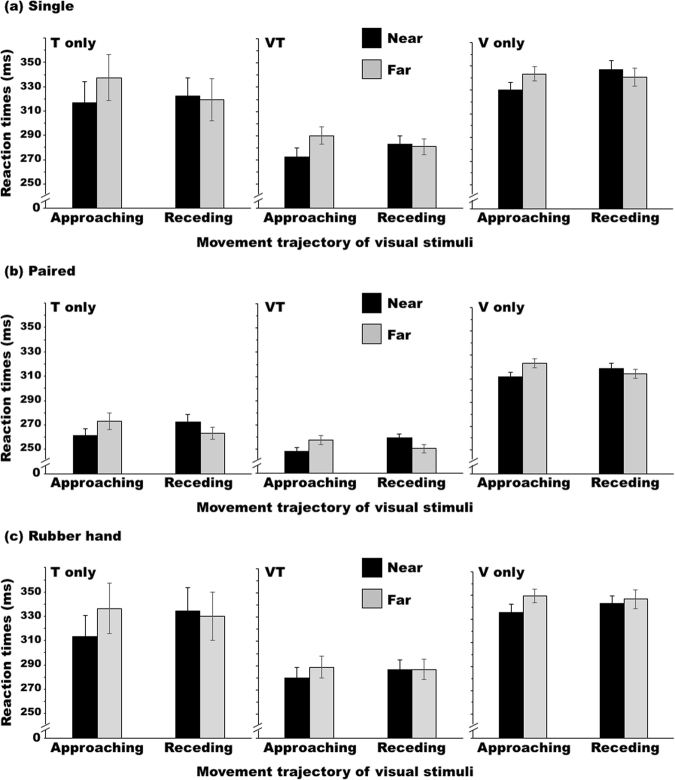
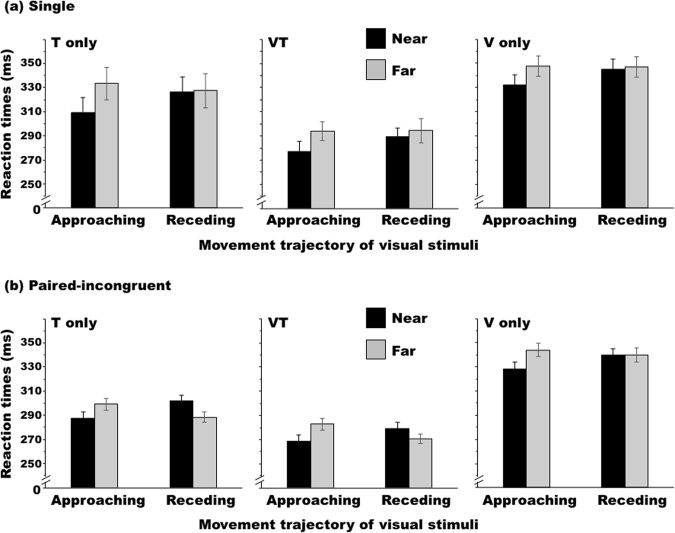
Recent physiological studies have showed that some visuotactile brain areas respond to other’s peripersonal spaces (PPS) as they would their own. This study investigates this PPS remapping phenomenon in terms of human behavior. Participants placed their left hands on a tabletop screen where visual stimuli were projected. A vibrotactile stimulator was attached to the tip of their index finger. While a white disk approached or receded from the hand in the participant’s near or far space, the participant was instructed to quickly detect a target (vibrotactile stimulation, change in the moving disk’s color or both). When performing this task alone, the participants exhibited shorter detection times when the disk approached the hand in their near space. In contrast, when performing the task with a partner across the table, the participants exhibited shorter detection times both when the disk approached their own hand in their near space and when it approached the partner’s hand in the partner’s near space but the participants’ far space. This phenomenon was also observed when the body parts from which the visual stimuli approached/receded differed between the participant and partner. These results suggest that humans can share PPS representations and/or body-derived attention/arousal mechanisms with others.
Overview
The claims and statistics of this paper haven’t been checked yet.
Free: it reads the open-access text and checks the first 5 claims that cite a source we can check. Create a free account to check every claim.
Integrity signals
Registry
Cites
Statistics
Figures
Verification
Claims the paper makes
The claims and statistics of this paper haven’t been checked yet.
Free: it reads the open-access text and checks the first 5 claims that cite a source we can check. Create a free account to check every claim.
Claims other papers make about this one
Each is checked against this paper’s own text: does it say what the citing paper says it does?
The cited source says what the claim attributes to it.
In the citing paper
“has been revealed in tasks involving either synchronous stimulation to the participants and the confederate (Maister et al., 2015) or when they both performed the same task concurrently (Teramoto, 2018)”
From The Peripersonal Space in a social world (2021) · cites this paper as Teramoto, 2018
The cited source says what the claim attributes to it.
In the citing paper
“These settings yielded faster detection time with stimuli approaching the confederate when the two persons experienced the same condition, mimicking 'a shift of PPS representation' between them, beyond physical spatial proximity.”
From The Peripersonal Space in a social world (2021) · cites this paper as Teramoto, 2018
Self-check
Percentages, sums and reported differences re-computed from the paper’s own numbers.
The self-check needs the paper’s full text.
Citations
Cites
Brainard, D. H. (1997) · Spatial Vision · doi:10.1163/156856897x00357 · Cited by 19,702
The VideoToolbox software for visual psychophysics: transforming numbers into movies
Pelli, D. G. (1997) · Spatial Vision · doi:10.1163/156856897x00366 · Cited by 11,098
Rizzolatti, G., & Craighero, L. (2004) · Annual Review of Neuroscience · doi:10.1146/annurev.neuro.27.070203.144230 · Cited by 7,433
Action recognition in the premotor cortex
Gallese, V., Fadiga, L., Fogassi, L., & Rizzolatti, G. (1996) · Brain · doi:10.1093/brain/119.2.593 · Cited by 4,968
Premotor cortex and the recognition of motor actions
Rizzolatti, G., Fadiga, L., Gallese, V., & Fogassi, L. (1996) · Cognitive Brain Research · doi:10.1016/0926-6410(95)00038-0 · Cited by 4,870
The chameleon effect: the perception–behavior link and social interaction
Chartrand, T. L., & Bargh, J. A. (1999) · Journal of Personality and Social Psychology · doi:10.1037/0022-3514.76.6.893 · Cited by 3,674
Understanding motor events: a neurophysiological study
di Pellegrino, G., Fadiga, L., Fogassi, L., Gallese, V., & Rizzolatti, G. (1992) · Experimental Brain Research · doi:10.1007/bf00230027 · Cited by 3,539
Neurophysiological mechanisms underlying the understanding and imitation of action
Rizzolatti, G., Fogassi, L., & Gallese, V. (2001) · Nature Reviews Neuroscience · doi:10.1038/35090060 · Cited by 3,302
Cattaneo, L., & Rizzolatti, G. (2009) · Archives of Neurology · doi:10.1001/archneurol.2009.41 · Cited by 3,137
Social Facilitation: A solution is suggested for an old unresolved social psychological problem.
Zajonc, R. B. (1965) · Science · doi:10.1126/science.149.3681.269 · Cited by 2,951
Cited by
The Peripersonal Space in a social world
Bogdanova, O. V., Bogdanov, V. B., Dureux, A., Farnè, A., & Hadj-Bouziane, F. (2021) · Cortex · doi:10.1016/j.cortex.2021.05.005 · Cited by 86
“Finally, another type of PPS plasticity, termed shared or merged PPS, has been revealed in tasks involving either synchronous stimulation to the participants and the confederate (Maister et al., 2015) or when they both performed the same task concurrently (Teramoto, 2018) (see Fig.”
BackgroundCoello, Y., & Cartaud, A. (2021) · Frontiers in Human Neuroscience · doi:10.3389/fnhum.2021.636124 · Cited by 74
“Overall, these results indicate that humans can access to different PPS representations and/or body-derived attention mechanisms, depending on the selected perspective taking (Teramoto, 2018).”
BackgroundThe Role of Sensorimotor Processes in Pain Empathy
Riečanský, I., & Lamm, C. (2019) · Brain Topography · doi:10.1007/s10548-019-00738-4 · Cited by 82
“2015a; Teramoto 2018; Serino 2019).”
Frontier of Self and Impact Prediction
Cléry, J., & Hamed, S. B. (2018) · Frontiers in Psychology · doi:10.3389/fpsyg.2018.01073 · Cited by 54
“…place near to the other person’s face acquired improved the salience of stimuli occurring in one’s own PPS. Nicely complementing these observations, Teramoto (2018) shows that, detection of tactile stimulation onto one’s own hand is faster when a visual stimulus is approaching the hand of…”
BackgroundVisual-Tactile Spatial Multisensory Interaction in Adults With Autism and Schizophrenia
Noel, J.-P., Failla, M. D., Quinde-Zlibut, J. M., Williams, Z. J., Gerdes, M., Tracy, J. M., Zoltowski, A. R., Foss-Feig, J. H., Nichols, H., Armstrong, K., et al. (2020) · Frontiers in Psychiatry · doi:10.3389/fpsyt.2020.578401 · Cited by 39
“In an attempt to determine whether putative differences in PPS between ASD and SZ are specific, or may reflect more general effects of visual-tactile integration, we also administered the cross modal congruency task [CCE; (44)], where visual cues may facilitate or impaired tactile processing, but cues are always prese…”
MethodPatané, I., Brozzoli, C., Koun, É., Frassinetti, F., & Farnè, A. (2021) · Journal of Experimental Psychology General · doi:10.1037/xge0001001 · Cited by 30
“Interestingly, multisensory enhancement occurs also while observing objects close to other individuals: Touches delivered on one’s own hand are boosted by visual stimuli near one’s own hand, as well as near someone else’s hand (Teramoto, 2018).”
BackgroundTestosterone administration in women increases the size of their peripersonal space
Masson, C. J., van der Westhuizen, D., Noel, J., Prévost, A., van Honk, J., Fotopoulou, A., Solms, M., & Serino, A. (2021) · Experimental Brain Research · doi:10.1007/s00221-021-06080-1 · Cited by 25
“2015; Serino 2019a, b; Teramoto 2018).”
BackgroundMethodThe macaque ventral intraparietal area has expanded into three homologue human parietal areas
Foster, C., Sheng, W.-A., Heed, T., & Ben Hamed, S. (2022) · Progress in Neurobiology · doi:10.1016/j.pneurobio.2021.102185 · Cited by 20
Fossataro, C., Galigani, M., Sebastiano, A. R., Bruno, V., Ronga, I., & Garbarini, F. (2022) · iScience · doi:10.1016/j.isci.2022.105879 · Cited by 18
Expansion of space for visuotactile interaction during visually induced self-motion
Kuroda, N., & Teramoto, W. (2020) · Experimental Brain Research · doi:10.1007/s00221-020-05966-w · Cited by 10
Self-citationFunctional networks for peripersonal space coding and prediction of impact to the body
Cléry, J. C., & Hamed, S. B. (2021) · Oxford University Press eBooks · doi:10.1093/oso/9780198851738.003.0004 · Cited by 12
Kuroda, N., & Teramoto, W. (2021) · Experimental Brain Research · doi:10.1007/s00221-021-06269-4 · Cited by 9
“We used a visuotactile interaction task (Teramoto 2018) to quantify the range of PPS immediately around the body.”
BackgroundMethodSelf-citationObject coding in peripersonal space depends on object ownership
Lenglart, L., Cartaud, A., Quesque, F., Sampaio, A., & Coello, Y. (2022) · Quarterly Journal of Experimental Psychology · doi:10.1177/17470218221128306 · Cited by 11
“salient when they are relevant for oneself but not for others (social association, Humphreys & Sui, 2015), leading to more accurate control of object-directed motor actions (Belk, 1988; Teramoto, 2018).”
BackgroundComparison of peripersonal space in front and rear spaces
Teraoka, R., Kuroda, N., Kojima, R., & Teramoto, W. (2024) · Experimental Brain Research · doi:10.1007/s00221-024-06782-2 · Cited by 9
“The experimental procedure employed in this study was based on our previous research (Kuroda and Teramoto 2021, 2022; Teramoto 2018), although these studies focused on measuring visuo-tactile PPS.”
Self-citationEvolutionary perspective on peripersonal space and perception
Froesel, M., Hamed, S. B., & Cléry, J. C. (2023) · Elsevier eBooks · doi:10.1016/b978-0-323-99193-3.00009-x · Cited by 7
Noel, J., Bertoni, T., & Serino, A. (2021) · Oxford University Press eBooks · doi:10.1093/oso/9780198851738.003.0002 · Cited by 12
Empathy as a predictor of peripersonal space: Evidence from the crossmodal congruency task
Gherri, E., Theocharopoulos, M., Browne, N., Duran, N., & Austin, E. J. (2022) · Consciousness and Cognition · doi:10.1016/j.concog.2021.103267 · Cited by 6
Whole-body immobilization modulates visuotactile interaction
Kuroda, N., Teraoka, R., Harada, S., & Teramoto, W. (2025) · Experimental Brain Research · doi:10.1007/s00221-025-07129-1 · Cited by 2
“Thus, our paradigm had equal time expectancy effects across distance conditions (Kuroda and Teramoto 2021, 2022; Teramoto 2018; Teraoka et al. 2024): a nearer probe never has a higher time expectancy than a farther probe.”
InfluentialSelf-citationHayashi, K. (2024) · International Journal of Social Robotics · doi:10.1007/s12369-024-01168-4 · Cited by 5
“Teramoto also proposed that when an individual engages in a task alongside a partner, participants share action space and attention with the partner [40].”
Kuroda, N., & Teramoto, W. (2024) · Experimental Brain Research · doi:10.1007/s00221-024-06975-9 · Cited by 3
“; Hence, the equal time expectancy effects were expected in any distance con - dition (Kuroda and Teramoto 2021, 2022; Teramoto 2018; Teraoka et al. 2024).”
Self-citationSimulated Persuasion in Extended Realities: Virtual Influencers in Immersive Virtual Environments
Ahn, S. J., & Hatfield, H. R. (2025) · Journal of Interactive Advertising · doi:10.1080/15252019.2025.2589445 · Cited by 1
PAR: Personal Activity Radius Camera View for Contextual SensingPreprint
Echterhoff, J. M., & Wang, E. J. (2020) · arXiv (Cornell University) · doi:10.48550/arxiv.2008.07204 · Cited by 4
“The PAR field-of-view is a subset of the Peripersonal Space concept used in neuroscience [42] and constrains the visual scene to a view on the wearer from above, specifically on everything below the user‘s nose and down to the ground with a radius of about an arm‘s length.”
MethodDimension sociale de l’espace péri-personnel des primates
Dureux, A. (2021) · theses.fr (ABES) · doi:10.70675/624f12eaz695fz4433zbd0aza56128110325
TOMINE, T., & Hayashi, K. (2026) · OSF Preprints (OSF Preprints)
Herwig, A. (2026) · Neuroscience & Biobehavioral Reviews · doi:10.1016/j.neubiorev.2026.106941
Geers, L., & Coello, Y. (2026) · Psychonomic Bulletin & Review · doi:10.3758/s13423-026-03023-1
“Similarly, Teramoto et al. (2018) reported facilitation effects not only when a visual stimulus approached the participant’s hand but also when it approached the hand of a confederate sitting across the table.”
Metadata
- Authors
- Teramoto, W.
- Affiliations
- Kumamoto University (JP)
- Corresponding author
- Teramoto, Wataru
- ORCID
- Teramoto, Wataru
- Venue
- Scientific Reports
- Published
- 2018-04-03
- Volume
- 8
- Issue
- 1
- Pages
- 5432-5432
- ISSN
- 2045-2322 (ISSN-L)
- PMC
- PMC5882808
- OpenAlex
- W2806725593
- Semantic Scholar
- 177762193ea8d8e80e1ff33df56951cd32bde651
- Cited by
- 26
- References
- 56
- Citations by year
- 2026: 3 · 2025: 2 · 2024: 3 · 2023: 1 · 2022: 3 · 2021: 8 · 2020: 4 · 2019: 1 · 2018: 1
- FWCI
- 4.58
- Type
- journal article
- Language
- en
- Open access
- gold
- doi.org
- Licence
- cc-by
- creativecommons.org/licenses/by/4.0 (tdm)
- creativecommons.org/licenses/by/4.0 (vor)
- Locations
- Scientific Reports (publishedVersion, cc-by)
- Europe PMC (PubMed Central) (publishedVersion, cc-by)
- PubMed Central (publishedVersion, cc-by)
- PubMed (publishedVersion)
- DOAJ (DOAJ: Directory of Open Access Journals) (submittedVersion)
- Funders
- Japan Society for the Promotion of Science (26285160, 17K18708, 15KK0092, 16H06325)
- Topics
- Social Sciences › Psychology › Experimental and Cognitive Psychology › Multisensory perception and integration
- Life Sciences › Neuroscience › Cognitive Neuroscience › Tactile and Sensory Interactions
- Social Sciences › Psychology › Social Psychology › Action Observation and Synchronization
- Keywords
- peripersonal space, visual-tactile integration, multisensory integration
- MeSH terms
- Female, Humans, Male, Personal Space, Spatial Behavior, Touch Perception, Young Adult
About these checks
Registry, retraction, Cites and statistics results are computed, not judged, with one exception: a printed reference that no index lists is read once by a model before it counts as a citation error. Claims are extracted by a model and kept only when their quote appears verbatim in the text; each cited source is then checked, with a model’s help, for whether it says what the claim relies on. Those verdicts can be wrong — read the claim’s quote and the cited source before relying on one.
Statistics and arithmetic are recomputed, not judged.
Confidence bands are shown only for fields calibrated on our annotated test set. None is calibrated yet, so no band is shown.
What counts as a claim ›How we measure confidence ›How we check this ›
Are you an author, or do you see a problem with this page? Request a review
Data sources
Bibliographic data: Semantic Scholar, OpenAlex, Crossref.
Contains information from the Semantic Scholar Academic Graph Datasets, made available under the ODC Attribution License (ODC-BY 1.0).
Semantic Scholar’s data is described in: Kinney, R., et al. (2023). The Semantic Scholar Open Data Platform. arXiv:2301.10140.
