

A behavioral approach to shared mapping of peripersonal space between oneself and others
Open accessThe DOI matches its Crossref record; 55 of the 56 references it cites were found in a registry or an index.
Abstract
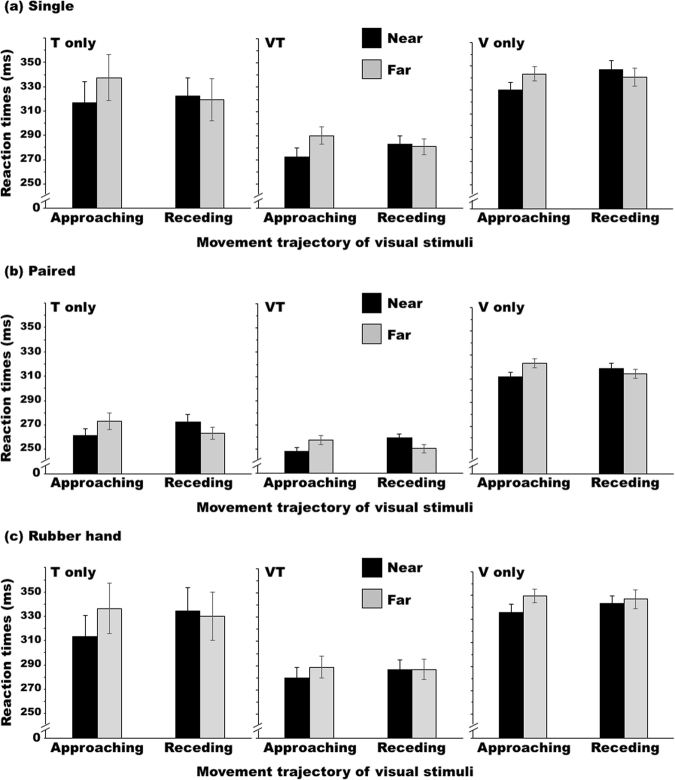
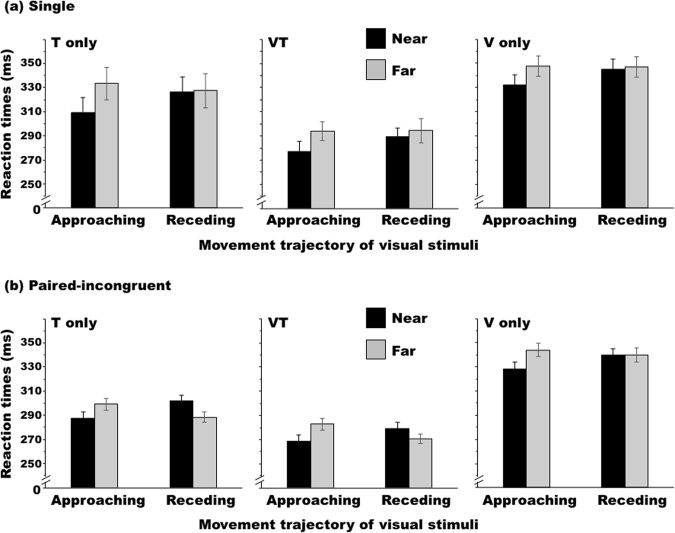
Recent physiological studies have showed that some visuotactile brain areas respond to other’s peripersonal spaces (PPS) as they would their own. This study investigates this PPS remapping phenomenon in terms of human behavior. Participants placed their left hands on a tabletop screen where visual stimuli were projected. A vibrotactile stimulator was attached to the tip of their index finger. While a white disk approached or receded from the hand in the participant’s near or far space, the participant was instructed to quickly detect a target (vibrotactile stimulation, change in the moving disk’s color or both). When performing this task alone, the participants exhibited shorter detection times when the disk approached the hand in their near space. In contrast, when performing the task with a partner across the table, the participants exhibited shorter detection times both when the disk approached their own hand in their near space and when it approached the partner’s hand in the partner’s near space but the participants’ far space. This phenomenon was also observed when the body parts from which the visual stimuli approached/receded differed between the participant and partner. These results suggest that humans can share PPS representations and/or body-derived attention/arousal mechanisms with others.
Overview
The claims and statistics of this paper haven’t been checked yet.
Free: it reads the open-access text and checks the first 5 claims that cite a source we can check. Create a free account to check every claim.
Integrity signals
Registry
Cites
Statistics
Figures
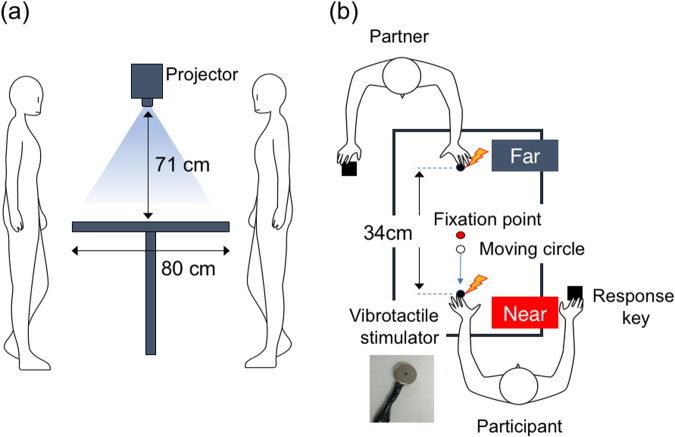
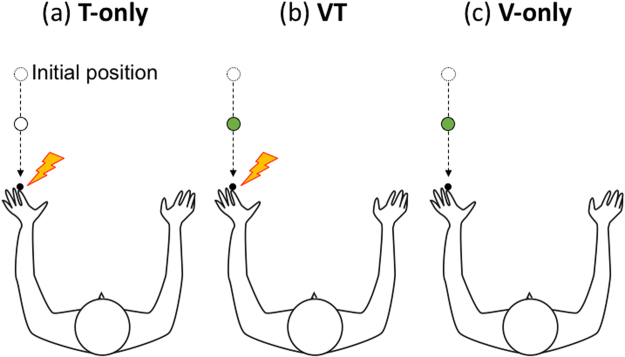
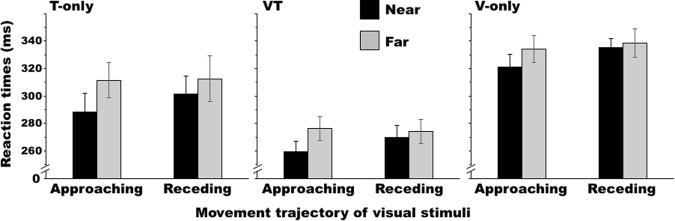
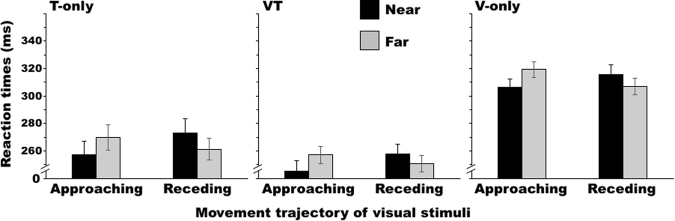
Verification
Claims the paper makes
The claims and statistics of this paper haven’t been checked yet.
Free: it reads the open-access text and checks the first 5 claims that cite a source we can check. Create a free account to check every claim.
Claims other papers make about this one
Each is checked against this paper’s own text: does it say what the citing paper says it does?
The cited source says what the claim attributes to it.
In the citing paper
“has been revealed in tasks involving either synchronous stimulation to the participants and the confederate (Maister et al., 2015) or when they both performed the same task concurrently (Teramoto, 2018)”
From The Peripersonal Space in a social world (2021) · cites this paper as Teramoto, 2018
The cited source says what the claim attributes to it.
In the citing paper
“These settings yielded faster detection time with stimuli approaching the confederate when the two persons experienced the same condition, mimicking 'a shift of PPS representation' between them, beyond physical spatial proximity.”
From The Peripersonal Space in a social world (2021) · cites this paper as Teramoto, 2018
Self-check
Percentages, sums and reported differences re-computed from the paper’s own numbers.
The self-check needs the paper’s full text.
Citations
Cites
Brainard, D. H. (1997) · Spatial Vision · doi:10.1163/156856897x00357 · Cited by 19,702
The VideoToolbox software for visual psychophysics: transforming numbers into movies
Pelli, D. G. (1997) · Spatial Vision · doi:10.1163/156856897x00366 · Cited by 11,098
Rizzolatti, G., & Craighero, L. (2004) · Annual Review of Neuroscience · doi:10.1146/annurev.neuro.27.070203.144230 · Cited by 7,433
Action recognition in the premotor cortex
Gallese, V., Fadiga, L., Fogassi, L., & Rizzolatti, G. (1996) · Brain · doi:10.1093/brain/119.2.593 · Cited by 4,968
Premotor cortex and the recognition of motor actions
Rizzolatti, G., Fadiga, L., Gallese, V., & Fogassi, L. (1996) · Cognitive Brain Research · doi:10.1016/0926-6410(95)00038-0 · Cited by 4,870
The chameleon effect: the perception–behavior link and social interaction
Chartrand, T. L., & Bargh, J. A. (1999) · Journal of Personality and Social Psychology · doi:10.1037/0022-3514.76.6.893 · Cited by 3,674
Understanding motor events: a neurophysiological study
di Pellegrino, G., Fadiga, L., Fogassi, L., Gallese, V., & Rizzolatti, G. (1992) · Experimental Brain Research · doi:10.1007/bf00230027 · Cited by 3,539
Neurophysiological mechanisms underlying the understanding and imitation of action
Rizzolatti, G., Fogassi, L., & Gallese, V. (2001) · Nature Reviews Neuroscience · doi:10.1038/35090060 · Cited by 3,302
Cattaneo, L., & Rizzolatti, G. (2009) · Archives of Neurology · doi:10.1001/archneurol.2009.41 · Cited by 3,137
Social Facilitation: A solution is suggested for an old unresolved social psychological problem.
Zajonc, R. B. (1965) · Science · doi:10.1126/science.149.3681.269 · Cited by 2,951
Both of Us Disgusted in My Insula
Wicker, B., Keysers, C., Plailly, J., Royet, J.-P., Gallese, V., & Rizzolatti, G. (2003) · Neuron · doi:10.1016/s0896-6273(03)00679-2 · Cited by 2,185
Keysers, C. (2004) · doi:10.1016/s0896-6273(04)00156-4 · Cited by 806
Ventral intraparietal area of the macaque: congruent visual and somatic response properties
Duhamel, J.-R., Colby, C. L., & Goldberg, M. E. (1998) · Journal of Neurophysiology · doi:10.1152/jn.1998.79.1.126 · Cited by 789
Afferent properties of periarcuate neurons in macaque monkeys. II. Visual responses
Rizzolatti, G., Scandolara, C., Matelli, M., & Gentilucci, M. (1981) · Behavioural Brain Research · doi:10.1016/0166-4328(81)90053-x · Cited by 766
Rizzolatti, G., Fadiga, L., Fogassi, L., & Gallese, V. (1997) · Science · doi:10.1126/science.277.5323.190 · Cited by 712
Coding of peripersonal space in inferior premotor cortex (area F4).
Fogassi, L., Gallese, V., Fadiga, L., Luppino, G., Matelli, M., & Rizzolatti, G. (1996) · Journal of Neurophysiology · doi:10.1152/jn.1996.76.1.141 · Cited by 688
Parieto-frontal interactions, personal space, and defensive behavior
Graziano, M. S. A., & Cooke, D. F. (2006) · Neuropsychologia · doi:10.1016/j.neuropsychologia.2005.09.011 · Cited by 653
Somatosensory activations during the observation of touch and a case of vision–touch synaesthesia
Blakemore, S.-J., Bristow, D., Bird, G., Frith, C., & Ward, J. (2005) · Brain · doi:10.1093/brain/awh500 · Cited by 614
The neuropsychology of 3-D space.
Previc, F. H. (1998) · Psychological Bulletin · doi:10.1037/0033-2909.124.2.123 · Cited by 604
Gentilucci, M., Fogassi, L., Luppino, G., Matelli, M., Camarda, R., & Rizzolatti, G. (1988) · Experimental Brain Research · doi:10.1007/bf00248741 · Cited by 541
Afferent properties of periarcuate neurons in macaque monkeys. I. Somatosensory responses
Rizzolatti, G., Scandolara, C., Matelli, M., & Gentilucci, M. (1981) · Behavioural Brain Research · doi:10.1016/0166-4328(81)90052-8 · Cited by 501
Reference frames for representing visual and tactile locations in parietal cortex
Avillac, M., Denève, S., Olivier, E., Pouget, A., & Duhamel, J.-R. (2005) · Nature Neuroscience · doi:10.1038/nn1480 · Cited by 464
The impact of social context on mimicry
Bourgeois, P., & Hess, U. (2008) · Biological Psychology · doi:10.1016/j.biopsycho.2007.11.008 · Cited by 458
Infant Responses to Impending Collision: Optical and Real
Ball, W., & Tronick, E. (1971) · Science · doi:10.1126/science.171.3973.818 · Cited by 383
Makin, T. R., Holmes, N. P., & Zohary, E. (2007) · The Journal of Neuroscience · doi:10.1523/jneurosci.3653-06.2007 · Cited by 381
The Human Premotor Cortex Is 'Mirror' Only for Biological Actions
Tai, Y. F., Scherfler, C., Brooks, D. J., Sawamoto, N., & Castiello, U. (2004) · Current Biology · doi:10.1016/j.cub.2004.01.005 · Cited by 342
Hands up: Attentional prioritization of space near the hand.
Reed, C. L., Grubb, J. D., & Steele, C. (2006) · Journal of Experimental Psychology: Human Perception and Performance · doi:10.1037/0096-1523.32.1.166 · Cited by 328
A neuronal representation of the location of nearby sounds
Graziano, M. S. A., Reiss, L. A. J., & Gross, C. G. (1999) · Nature · doi:10.1038/17115 · Cited by 318
di Pellegrino, G., Làdavas, E., & Farné, A. (1997) · Nature · doi:10.1038/41921 · Cited by 304
Ebisch, S. J. H., Perrucci, M. G., Ferretti, A., Del Gratta, C., Romani, G. L., & Gallese, V. (2008) · Journal of Cognitive Neuroscience · doi:10.1162/jocn.2008.20111 · Cited by 254
Dynamic sounds capture the boundaries of peripersonal space representation in humans
Canzoneri, E., Magosso, E., & Serino, A. (2012) · PLoS ONE · doi:10.1371/journal.pone.0044306 · Cited by 248
My face in yours: visuo-tactile facial stimulation influences sense of identity
Sforza, A., Bufalari, I., Haggard, P., & Aglioti, S. M. (2010) · Social Neuroscience · doi:10.1080/17470910903205503 · Cited by 247
Holmes, N. P., Snijders, H. J., & Spence, C. (2006) · Perception & Psychophysics · doi:10.3758/bf03208768 · Cited by 227
Gentilucci, M., Scandolara, C., Pigarev, I. N., & Rizzolatti, G. (1983) · Experimental Brain Research · doi:10.1007/bf00239214 · Cited by 224
Shared mapping of own and others' bodies in visuotactile bimodal area of monkey parietal cortex
Ishida, H., Nakajima, K., Inase, M., & Murata, A. (2010) · Journal of Cognitive Neuroscience · doi:10.1162/jocn.2009.21185 · Cited by 212
Mirror-touch synesthesia is linked with empathy
Banissy, M. J., & Ward, J. (2007) · Nature Neuroscience · doi:10.1038/nn1926 · Cited by 208
Spence, C., Pavani, F., Maravita, A., & Holmes, N. (2004) · Journal of Physiology-Paris · doi:10.1016/j.jphysparis.2004.03.008 · Cited by 205
FMRI adaptation reveals a cortical mechanism for the coding of space near the hand
Brozzoli, C., Gentile, G., Petkova, V. I., & Ehrsson, H. H. (2011) · Journal of Neuroscience · doi:10.1523/jneurosci.1172-11.2011 · Cited by 182
The joint flanker effect: sharing tasks with real and imagined co-actors
Atmaca, S., Sebanz, N., & Knoblich, G. (2011) · Experimental Brain Research · doi:10.1007/s00221-011-2709-9 · Cited by 180
Action-specific remapping of peripersonal space
Brozzoli, C., Cardinali, L., Pavani, F., & Farnè, A. (2009) · Neuropsychologia · doi:10.1016/j.neuropsychologia.2009.10.009 · Cited by 161
Serino, A., Canzoneri, E., & Avenanti, A. (2011) · Journal of Cognitive Neuroscience · doi:10.1162/jocn_a_00006 · Cited by 140
Makin, T. R., Holmes, N. P., Brozzoli, C., Rossetti, Y., & Farnè, A. (2009) · The Journal of Neuroscience · doi:10.1523/jneurosci.2955-09.2009 · Cited by 128
Visual peripersonal space centred on the face in humans
Ladavas, E. (1998) · Brain · doi:10.1093/brain/121.12.2317 · Cited by 117
Viewing a Face (Especially One's Own Face) Being Touched Enhances Tactile Perception on the Face
Serino, A., Pizzoferrato, F., & Làdavas, E. (2008) · Psychological Science · doi:10.1111/j.1467-9280.2008.02105.x · Cited by 117
Attention Affects Visual Perceptual Processing Near the Hand
Cosman, J. D., & Vecera, S. P. (2010) · Psychological Science · doi:10.1177/0956797610380697 · Cited by 115
A shared representation of the space near oneself and others in the human premotor cortex
Brozzoli, C., Gentile, G., Bergouignan, L., & Ehrsson, H. H. (2013) · Current Biology · doi:10.1016/j.cub.2013.07.004 · Cited by 110
Welsh, T. N., Higgins, L., Ray, M., & Weeks, D. J. (2007) · Human Movement Science · doi:10.1016/j.humov.2007.06.003 · Cited by 98
Visuo-tactile representation of near-the-body space
Làdavas, E., & Farnè, A. (2004) · Journal of Physiology-Paris · doi:10.1016/j.jphysparis.2004.03.007 · Cited by 97
Your place or mine: Shared sensory experiences elicit a remapping of peripersonal space
Maister, L., Cardini, F., Zamariola, G., Serino, A., & Tsakiris, M. (2015) · Neuropsychologia · doi:10.1016/j.neuropsychologia.2014.10.027 · Cited by 93
Viewing one’s own face being touched modulates tactile perception: An fMRI study
Cardini, F., Costantini, M., Galati, G., Romani, G. L., Làdavas, E., & Serino, A. (2011) · Journal of Cognitive Neuroscience · doi:10.1162/jocn.2010.21484 · Cited by 92
Impact Prediction by Looming Visual Stimuli Enhances Tactile Detection
Cléry, J., Guipponi, O., Odouard, S., Wardak, C., & Ben Hamed, S. (2015) · The Journal of Neuroscience · doi:10.1523/jneurosci.3031-14.2015 · Cited by 89
Sambo, C. F., & Forster, B. (2009) · Journal of Cognitive Neuroscience · doi:10.1162/jocn.2009.21109 · Cited by 75
Effects of a Priori Liking on the Elicitation of Mimicry
Stel, M., van Baaren, R. B., Blascovich, J., van Dijk, E., McCall, C., Pollmann, M. M. H., van Leeuwen, M. L., Mastop, J., & Vonk, R. (2010) · Experimental Psychology · doi:10.1027/1618-3169/a000050 · Cited by 71
Sharing Social Touch in the Primary Somatosensory Cortex
Bolognini, N., Rossetti, A., Fusaro, M., Vallar, G., & Miniussi, C. (2014) · Current Biology · doi:10.1016/j.cub.2014.05.025 · Cited by 69
What’s Coming Near? The Influence of Dynamical Visual Stimuli on Nociceptive Processing
De Paepe, A. L., Crombez, G., & Legrain, V. (2016) · PLOS ONE · doi:10.1371/journal.pone.0155864 · Cited by 30
Cited by
The Peripersonal Space in a social world
Bogdanova, O. V., Bogdanov, V. B., Dureux, A., Farnè, A., & Hadj-Bouziane, F. (2021) · Cortex · doi:10.1016/j.cortex.2021.05.005 · Cited by 86
“Finally, another type of PPS plasticity, termed shared or merged PPS, has been revealed in tasks involving either synchronous stimulation to the participants and the confederate (Maister et al., 2015) or when they both performed the same task concurrently (Teramoto, 2018) (see Fig.”
BackgroundCoello, Y., & Cartaud, A. (2021) · Frontiers in Human Neuroscience · doi:10.3389/fnhum.2021.636124 · Cited by 74
“Overall, these results indicate that humans can access to different PPS representations and/or body-derived attention mechanisms, depending on the selected perspective taking (Teramoto, 2018).”
BackgroundThe Role of Sensorimotor Processes in Pain Empathy
Riečanský, I., & Lamm, C. (2019) · Brain Topography · doi:10.1007/s10548-019-00738-4 · Cited by 82
“2015a; Teramoto 2018; Serino 2019).”
Frontier of Self and Impact Prediction
Cléry, J., & Hamed, S. B. (2018) · Frontiers in Psychology · doi:10.3389/fpsyg.2018.01073 · Cited by 54
“…place near to the other person’s face acquired improved the salience of stimuli occurring in one’s own PPS. Nicely complementing these observations, Teramoto (2018) shows that, detection of tactile stimulation onto one’s own hand is faster when a visual stimulus is approaching the hand of…”
BackgroundVisual-Tactile Spatial Multisensory Interaction in Adults With Autism and Schizophrenia
Noel, J.-P., Failla, M. D., Quinde-Zlibut, J. M., Williams, Z. J., Gerdes, M., Tracy, J. M., Zoltowski, A. R., Foss-Feig, J. H., Nichols, H., Armstrong, K., et al. (2020) · Frontiers in Psychiatry · doi:10.3389/fpsyt.2020.578401 · Cited by 39
“In an attempt to determine whether putative differences in PPS between ASD and SZ are specific, or may reflect more general effects of visual-tactile integration, we also administered the cross modal congruency task [CCE; (44)], where visual cues may facilitate or impaired tactile processing, but cues are always prese…”
Method
Metadata
- Authors
- Teramoto, W.
- Affiliations
- Kumamoto University (JP)
- Corresponding author
- Teramoto, Wataru
- ORCID
- Teramoto, Wataru
- Venue
- Scientific Reports
- Published
- 2018-04-03
- Volume
- 8
- Issue
- 1
- Pages
- 5432-5432
- ISSN
- 2045-2322 (ISSN-L)
- PMC
- PMC5882808
- OpenAlex
- W2806725593
- Cited by
- 26
- References
- 56
- Citations by year
- 2026: 3 · 2025: 2 · 2024: 3 · 2023: 1 · 2022: 3 · 2021: 8 · 2020: 4 · 2019: 1 · 2018: 1
- FWCI
- 4.58
- Type
- journal article
- Language
- en
- Open access
- gold
- doi.org
- Licence
- cc-by
- creativecommons.org/licenses/by/4.0 (tdm)
- creativecommons.org/licenses/by/4.0 (vor)
- Locations
- Scientific Reports (publishedVersion, cc-by)
- Europe PMC (PubMed Central) (publishedVersion, cc-by)
- PubMed Central (publishedVersion, cc-by)
- PubMed (publishedVersion)
- DOAJ (DOAJ: Directory of Open Access Journals) (submittedVersion)
- Funders
- Japan Society for the Promotion of Science (26285160, 17K18708, 15KK0092, 16H06325)
- Topics
- Social Sciences › Psychology › Experimental and Cognitive Psychology › Multisensory perception and integration
- Life Sciences › Neuroscience › Cognitive Neuroscience › Tactile and Sensory Interactions
- Social Sciences › Psychology › Social Psychology › Action Observation and Synchronization
- Keywords
- peripersonal space, visual-tactile integration, multisensory integration
- MeSH terms
- Female, Humans, Male, Personal Space, Spatial Behavior, Touch Perception, Young Adult
About these checks
Registry, retraction, Cites and statistics results are computed, not judged, with one exception: a printed reference that no index lists is read once by a model before it counts as a citation error. Claims are extracted by a model and kept only when their quote appears verbatim in the text; each cited source is then checked, with a model’s help, for whether it says what the claim relies on. Those verdicts can be wrong — read the claim’s quote and the cited source before relying on one.
Statistics and arithmetic are recomputed, not judged.
Confidence bands are shown only for fields calibrated on our annotated test set. None is calibrated yet, so no band is shown.
What counts as a claim ›How we measure confidence ›How we check this ›
Are you an author, or do you see a problem with this page? Request a review
Data sources
Bibliographic data: Semantic Scholar, OpenAlex, Crossref.
Contains information from the Semantic Scholar Academic Graph Datasets, made available under the ODC Attribution License (ODC-BY 1.0).
Semantic Scholar’s data is described in: Kinney, R., et al. (2023). The Semantic Scholar Open Data Platform. arXiv:2301.10140.
