

Large networks of rational agents form persistent echo chambers
Open accessThe DOI matches its Crossref record; 39 of the 40 references it cites were found in a registry or an index.
Abstract
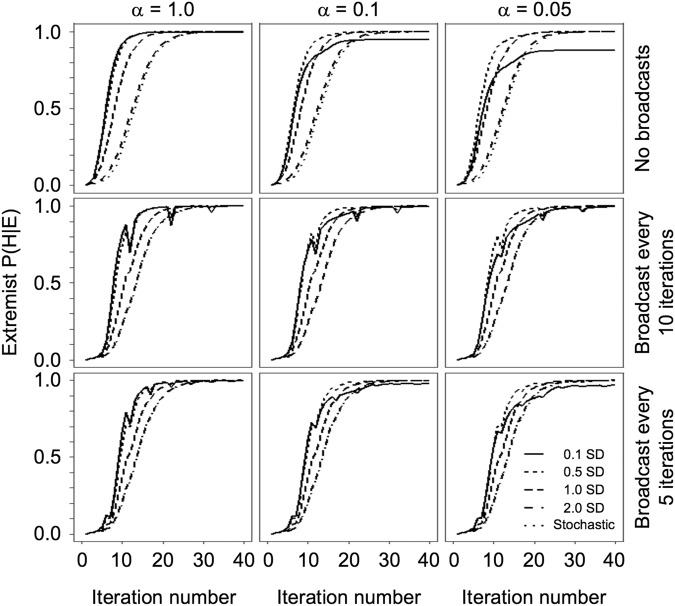
Echo chambers (ECs) are enclosed epistemic circles where like-minded people communicate and reinforce pre-existing beliefs. It remains unclear if cognitive errors are necessarily required for ECs to emerge, and then how ECs are able to persist in networks with available contrary information. We show that ECs can theoretically emerge amongst error-free Bayesian agents, and that larger networks encourage rather than ameliorate EC growth. This suggests that the network structure itself contributes to echo chamber formation. While cognitive and social biases might exacerbate EC emergence, they are not necessary conditions. In line with this, we test stylized interventions to reduce EC formation, finding that system-wide truthful ‘educational’ broadcasts ameliorate the effect, but do not remove it entirely. Such interventions are shown to be more effective on agents newer to the network. Critically, this work serves as a formal argument for the responsibility of system architects in mitigating EC formation and retention.
Overview
The claims and statistics of this paper haven’t been checked yet.
Free: it reads the open-access text and checks the first 5 claims that cite a source we can check. Create a free account to check every claim.
Integrity signals
Registry
Cites
Statistics
Figures
Verification
Claims the paper makes
The claims and statistics of this paper haven’t been checked yet.
Free: it reads the open-access text and checks the first 5 claims that cite a source we can check. Create a free account to check every claim.
Claims other papers make about this one
Each is checked against this paper’s own text: does it say what the citing paper says it does?
The cited source doesn’t support the claim as written.
In the citing paper
“In general, it is known in the literature that clusters are more easily formed in sparsely connected networks, but less so in densely connected networks where all agents communicate with each other [94].”
From Epistemic Communities under Active Inference (2022) · cites this paper as [94]
Checked by a reasoning model — may be wrong.
Experimental — accuracy not yet measuredThe source backs part of the claim, not all of it — or backs it for a different population, condition or comparison.
In the citing paper
“Communicating only with people who share similar ideology or opinion restricts beliefs and prevents learning the truth”
From Credibility of climate change denial in social media (2019) · cites this paper as Madsen et al., 2018
Experimental — accuracy not yet measured
Self-check
Percentages, sums and reported differences re-computed from the paper’s own numbers.
The self-check needs the paper’s full text.
Citations
Cites
Power-Law Distributions in Empirical Data
Clauset, A., Shalizi, C. R., & Newman, M. E. J. (2009) · SIAM Review · doi:10.1137/070710111 · Cited by 8,019
Power-law distributions in empirical data
Clauset, A. J., Shalizi, C. R., & Newman, M. E. J. (2018) · Figshare · doi:10.1184/r1/6586835.v1 · Cited by 6,504
Exposure to ideologically diverse news and opinion on Facebook
Bakshy, E., Messing, S., & Adamic, L. A. (2015) · Science · doi:10.1126/science.aaa1160 · Cited by 3,245 · cited 1×
“Recently, there has been much discussion of potential associations between ECs and political/democratic movements such as growth of populism and political polarisation 1,2 .”
BackgroundClasses of small-world networks
Amaral, L. A. N., Scala, A., Barthélémy, M., & Stanley, H. E. (2000) · Proceedings of the National Academy of Sciences · doi:10.1073/pnas.200327197 · Cited by 3,051 · cited 1×
“In model-SF, social connections are structured as a scale-free network 29 , meaning that number of contacts follow a power law distribution (social networks frequently have such structures).”
BackgroundA simple model of global cascades on random networks
Watts, D. J. (2002) · Proceedings of the National Academy of Sciences · doi:10.1073/pnas.082090499 · Cited by 2,673
Growing Artificial Societies: Social Science from the Bottom Up
Epstein, J. M., & Axtell, R. L. (1996) · doi:10.7551/mitpress/3374.001.0001 · Cited by 2,441
Confirmation, disconfirmation, and information in hypothesis testing
Klayman, J., & Ha, Y.-W. (1987) · Psychological Review · doi:10.1037/0033-295x.94.2.211 · Cited by 2,094 · cited 1×
“Inclusion of pruning in the model is motivated by strong evidence that humans tend to favour (to varying degrees) media and information outlets that are in line with their ideological position (e.g., frequently reported confirmation bias 32 and confirmatory information search strategies 33 ).”
Filter Bubbles, Echo Chambers, and Online News Consumption
Flaxman, S., Goel, S., & Rao, J. M. (2016) · Public Opinion Quarterly · doi:10.1093/poq/nfw006 · Cited by 1,992 · cited 1×
“Evidence suggests ECs have emerged and remained 3 , despite expectations that they should be increasingly untenable as social networks grow and additional, contrary information becomes available 4 .”
BackgroundInfluentials, Networks, and Public Opinion Formation
Watts, D. J., & Dodds, P. S. (2007) · Journal of Consumer Research · doi:10.1086/518527 · Cited by 1,875
Growing artificial societies: Social science from the bottom up
(1997) · Computers & Mathematics with Applications · doi:10.1016/s0898-1221(97)82923-9 · Cited by 1,646
Research works printed but not linked: 1
- Barkun, M. A Cultural of Conspiracy: Apocalyptic Visions in Contemporary America, University of California Press (2003).
Cited by
Out-group animosity drives engagement on social media
Rathje, S., Van Bavel, J. J., & van der Linden, S. (2021) · Proceedings of the National Academy of Sciences · doi:10.1073/pnas.2024292118 · Cited by 560
Interian, R., G. Marzo, R., Mendoza, I., & Ribeiro, C. C. (2023) · International Transactions in Operational Research · doi:10.1111/itor.13224 · Cited by 67
“A number of studies stand that social networks are in themselves causally sufficient to promote echo chambers due to their structure [96], size [86], lack of trust [80], or the embedded recommendation systems [63].”
BackgroundMethodEcho Chambers in Online Social Networks: A Systematic Literature Review
Mahmoudi, A., Jemielniak, D., & Ciechanowski, L. (2024) · IEEE Access · doi:10.1109/access.2024.3353054 · Cited by 79
“Madsen et al. in [36] suggest that echo chambers lead to conspiratorial thinking, although they do not provide specific characteristics for this effect.”
BackgroundEpistemic Communities under Active Inference
Albarracin, M., Demekas, D., Ramstead, M. J. D., & Heins, C. (2022) · Entropy · doi:10.3390/e24040476 · Cited by 60
“’ In general, it is 1147 known in the literature that clusters are more easily formed in sparsely connected networks, 1148 but less so in densely connected networks where all agents communicate with each other 1149 [95].”
BackgroundCredibility of climate change denial in social media
Samantray, A., & Pin, P. (2019) · Palgrave Communications · doi:10.1057/s41599-019-0344-4 · Cited by 60
Lewandowsky, S., Pilditch, T. D., Madsen, J. K., Орескес, Н., & Risbey, J. S. (2019) · Cognition · doi:10.1016/j.cognition.2019.01.011 · Cited by 67
Self-citationPilditch, T. D., Roozenbeek, J., Madsen, J. K., & van der Linden, S. (2022) · Royal Society Open Science · doi:10.1098/rsos.211953 · Cited by 54
Self-citationBrown, G. D. A., Lewandowsky, S., & Huang, Z. (2022) · Psychological Review · doi:10.1037/rev0000342 · Cited by 54
“Opinions, like behavior, spread differently in different network structures (e.g., Centola, 2010), and structure also in fl uences the formation of echo chambers (e.g., Madsen et al., 2018) and the transmission of extreme opinions (e.g., Amblard & Deffuant, 2004; Franks et al., 2008).”
BackgroundAnalytic Versus Computational Cognitive Models: Agent-Based Modeling as a Tool in Cognitive Sciences
Madsen, J. K., Bailey, R. M., Carrella, E., & Koralus, P. (2019) · Current Directions in Psychological Science · doi:10.1177/0963721419834547 · Cited by 37
Self-citationKnowledge through social networks: Accuracy, error, and polarisation
Hahn, U., Merdes, C. J., & von Sydow, M. (2024) · PLoS ONE · doi:10.1371/journal.pone.0294815 · Cited by 38
The impact of partial source dependence on belief and reliability revision.
Madsen, J. K., Hahn, U., & Pilditch, T. D. (2020) · Journal of Experimental Psychology Learning Memory and Cognition · doi:10.1037/xlm0000846 · Cited by 26
Self-citationCascades Across Networks Are Sufficient for the Formation of Echo Chambers: An Agent-Based Model
Fränken, J.-P., & Pilditch, T. D. (2021) · Journal of Artificial Societies and Social Simulation · doi:10.18564/jasss.4566 · Cited by 30
Self-citationAnalogies for modeling belief dynamics
Olsson, H., & Galešić, M. (2024) · Trends in Cognitive Sciences · doi:10.1016/j.tics.2024.07.001 · Cited by 30
“The model in [123] shows how echo chambers can occur even when individuals are Bayesian optimal.”
BackgroundUsing Agent-Based Modelling to Evaluate the Impact of Algorithmic Curation on Social Media
Gausen, A., Luk, W. W., & Guo, C. (2022) · Journal of Data and Information Quality · doi:10.1145/3546915 · Cited by 43
“The agents’ beliefs are inluenced by the information they see from their neighbours through Bayesian belief updating, meaning that there is information integration and their beliefs are updated without cognitive bias [29].”
BackgroundThe evolution of polarization in the legislative branch of government
Lu, X., Gao, J., & Szymanski, B. K. (2019) · Journal of The Royal Society Interface · doi:10.1098/rsif.2019.0010 · Cited by 24
Liu, J., Schwarz, A., Risius, M., Hirschheim, R., & Scotter, J. R. V. (2025) · The Journal of Strategic Information Systems · doi:10.1016/j.jsis.2025.101904 · Cited by 33
Incorporating Psychological Science Into Policy Making: The Case of Misinformation
Kozyreva, A., Smillie, L., & Lewandowsky, S. (2023) · European Psychologist · doi:10.1027/1016-9040/a000493 · Cited by 20
“For example, the structural properties of social networks may be enough in themselves to cause challenges such as echo chambers, regardless of how rational and unbiased its users are (e.g., Madsen et al, 2018 ).”
BackgroundAn approach to sociotechnical transparency of social media algorithms using agent-based modelling
Gausen, A., Guo, C., & Luk, W. W. (2024) · AI and Ethics · doi:10.1007/s43681-024-00527-1 · Cited by 21
“This means that agents integrate new information, from posts that they view, to their existing beliefs without cognitive biases [62].”
De-sounding echo chambers: Simulation-based analysis of polarization dynamics in social networks
Donkers, T., & Ziegler, J. (2023) · Online Social Networks and Media · doi:10.1016/j.osnem.2023.100275 · Cited by 18
Diez, I., & Bossio, J. F. (2023) · Information Technology for Development · doi:10.1080/02681102.2023.2279310 · Cited by 17
“…of feminist sophistication, as mentioned by our interviewees; (d) it has the construction of a cluster with some extreme beliefs – which are not always open to disagreement – as some members just want to share the space with other people who think as they do (Madsen et al., 2018; Törnberg, 2018).”
Individuals, Collectives, and Individuals in Collectives: The Ineliminable Role of Dependence
Hahn, U. (2023) · Perspectives on Psychological Science · doi:10.1177/17456916231198479 · Cited by 14
“…on occasion exhibit irrationality in groups, from research on information cascades (Acemoglu et al., 2011; Anderson & Holt, 1997; Bikhchandani et al., 1992) to a plethora of work on polarization in rational models (see, e.g., Madsen et al., 2018; O’Connor & Weatherall, 2018, 2019; Olsson, 2013).”
BackgroundNaïve information aggregation in human social learning.
Fränken, J.-P., Valentin, S., Lucas, C., & Bramley, N. (2023) · Cognition · doi:10.1016/j.cognition.2023.105633 · Cited by 9
Political reinforcement learners
Schulz, L., & Bhui, R. (2024) · Trends in Cognitive Sciences · doi:10.1016/j.tics.2023.12.001 · Cited by 11
Hu, Y., Zhu, J., & Tang, C. (2025) · Engineering Applications of Artificial Intelligence · doi:10.1016/j.engappai.2025.110044 · Cited by 8
Zheng, J., Li, C., Wu, P., & Pan, L. (2026) · Information Processing & Management · doi:10.1016/j.ipm.2026.104689 · Cited by 8
Informal networks and information environments
Lee, Y. G., & Choi, J. N. (2025) · Strategic Management Journal · doi:10.1002/smj.3686 · Cited by 9
Why do echo chambers form? The role of trust, population heterogeneity, and objective truth.
Perfors, A., & Navarro, D. (2019) · eScholarship (California Digital Library) · Cited by 16
Impiccichè, P., & Viviani, M. (2025) · ACM Transactions on the Web · doi:10.1145/3707701 · Cited by 9
“Madsen et al. [29], for example, discussed how the structure of a network alone can significantly influence the formation of persistent echo chambers.”
The Bias‐and‐Expertise Model: A Bayesian Network Model of Political Source Characteristics
Young, D. J., & de‐Wit, L. (2025) · Cognitive Science · doi:10.1111/cogs.70141 · Cited by 5
“Second, these models can be integrated into agent-based models, where they act as models of the agents’ cognition (e.g., Hahn, Merdes, & von Sydow, 2018; Madsen et al., 2018; Olsson, 2013; Pallavicini et al., 2021; Pilditch, Roozenbeek, Madsen, & van der Linden, 2022).”
Pilditch, T. D., Hahn, U., & Lagnado, D. A. (2025) · Synthese · doi:10.1007/s11229-025-04969-w · Cited by 8
“In an agent-based model of communication across social networks (such as Acemoglu et al., 2013; Madsen et al., 2018a; Olsson, 2011), the Bayesian machinery is used to calculate agents’ degrees of belief in the claim at issue, not whether or not they choose to communicate or what they communicate if…”
InfluentialSelf-citationFränken, J.-P., Θεοδωρόπουλος, Ν., Moore, A., & Bramley, N. R. (2020) · Edinburgh Research Explorer (University of Edinburgh) · Cited by 6
Zaccagnino, R., Lettieri, N., Malandrino, D., Lomasto, L., Camoia, A., & Guarino, A. (2025) · Neural Computing and Applications · doi:10.1007/s00521-025-11342-y · Cited by 5
Preferences for advisor agreement and accuracy
Jaquiery, M., & Yeung, N. (2024) · PLoS ONE · doi:10.1371/journal.pone.0311211 · Cited by 6
The role of bilinguals in the Bayesian naming game
Marchetti, G., Patriarca, M., & Heinsalu, E. (2021) · Physica D Nonlinear Phenomena · doi:10.1016/j.physd.2021.133062 · Cited by 4
“The BNG model provides new tools for investigating the effects of human cognitive biases on social consensus [26, 27, 28, 29, 30]: through the Bayes’ theorem [31], the BNG model takes into account the learner’s previous experiences and background knowledge.”
MethodSycophantic Chatbots Cause Delusional Spiraling, Even in Ideal Bayesians
Chandra, K., Kleiman-Weiner, M., Ragan-Kelley, J., & Tenenbaum, J. B. (2026) · arXiv · doi:10.48550/arxiv.2602.19141 · Cited by 3
“…Goodman, 2017), and, more generally, a long tradition in behavioral research of applying a rational lens to study phenomena like echo chambers and belief polarization (Banerjee, 1992; Cook & Lewandowsky, 2016; Dorst, 2023; Henderson & Gebharter, 2021; Jern et al., 2009, 2014; Madsen et al., 2018).”
How Identity and Uncertainty Affect Online Social Influence: An Agent-Based Approach
Mason, C., van der Putten, P., & van Duijn, M. J. (2020) · Lecture notes in computer science · doi:10.1007/978-3-030-61841-4_12 · Cited by 3
Construyendo seguridad para la manifestación de la sororidad desde #LasRespondonas
Diez, I. (2020) · Conexión · doi:10.18800/conexion.202002.008 · Cited by 3
“En otras palabras, las cámaras de eco son círculos de conocimiento cerrados en los que personas con pensamientos similares se comunican y refuerzan creencias previas (Madsen et al., 2018).”
BackgroundShepherd, P., Weaver, M., & Goldsmith, J. (2020) · IEEE/ACM International Conference on Advances in Social Networks Analysis and Mining (ASONAM) · doi:10.1109/asonam49781.2020.9381380 · Cited by 3
“[15] use an update scheme roughly the same as the bounded confidence model [4].”
MethodHow a minority can win: Unrepresentative outcomes in a simple model of voter turnout
Landgren, E., Juul, J. L., & Strogatz, S. H. (2021) · Physical review. E · doi:10.1103/physreve.104.054307 · Cited by 3
Rational factionalization for agents with probabilistically related beliefs
Freeborn, D. (2024) · Synthese · doi:10.1007/s11229-024-04491-5 · Cited by 3
“This is sometimes operationalized as an increase in the spread or dispersion of the belief across the population (for example, see Bramson et al., 2017; DiMaggio et al., 1996; Freeborn, 2023, 2024a, 2024b; Madsen et al., 2018; Pallavicini et al., 2021).”
Network-based computational communication
Huang, M. D., Wang, J.-L., & Zhang, Z.-K. (2025) · Europhysics Letters (EPL) · doi:10.1209/0295-5075/ade337 · Cited by 3
Psicología política y subjetividad política en jóvenes
Díaz Gómez, Á., Calderón Jaramillo, A. M., Cardozo Rusinque, A. A., Alemán Salcedo, E., Morales Cuadro, A. R., Vianchá Pinzón, M. A., Peña Sarmiento, M., Arroyave Hernández, S., Bravo, O. A., López López, W., et al. (2024) · doi:10.18046/eui/ee.1.2024 · Cited by 3
Capturing Argument in Agent-Based Models
Assaad, L., Fuchs, R., Phillips, K., Schöppl, K., & Hahn, U. (2025) · Topoi · doi:10.1007/s11245-025-10215-2 · Cited by 3
“One example of this in the ABM literature can be found in models of testimony (Olsson 2011; Madsen et al. 2018; Hahn et al. 2019).”
Symmetric Nash equilibrium of political polarization in a two-party system
Kim, J., Jeong, H.-C., & Baek, S. K. (2022) · Physica A Statistical Mechanics and its Applications · doi:10.1016/j.physa.2022.128207 · Cited by 3
“Thus, the question still remains: Why are they so polarized? It may be attributed to social homophily or echo chambers [12, 13], and temporary polarization may be consistent with Bayesian updating [14].”
BackgroundOnline Simulator-Based Experimental Design for Cognitive Model Selection
Aushev, A., Putkonen, A., Clarté, G., Chandramouli, S., Acerbi, L., Kaski, S., & Howes, A. (2023) · Computational Brain & Behavior · doi:10.1007/s42113-023-00180-7 · Cited by 5
“For these reasons, there is an interest in Bayesian approaches in computational cognitive science (Overstall & Woods, 2017; Tauber et al., 2017; Madsen et al., 2018; Kleinegesse & Gut-mann, 2021), which allow a close examination of Bayesian posteriors to identify potential problems or anomalies in…”
BackgroundA cognitive mechanism for the persistence of widespread false beliefsPreprint
Frigo, V., Chen, L., & Rogers, T. T. (2020) · PsyArXiv (OSF Preprints) · doi:10.31234/osf.io/4zfrp · Cited by 3
Generalized naming game and Bayesian naming game as dynamical systems
Marchetti, G. (2024) · Physical review. E · doi:10.1103/physreve.109.064202 · Cited by 2
The Power of Warning: Unpacking the Impact of Fact-Checking Flag on News Sharing and Verification
Han, J., & Chua, A. Y. K. (2024) · Lecture notes in computer science · doi:10.1007/978-981-96-0865-2_24 · Cited by 1
Дмитриевич, К. И., Podshibyakina, T. A., & Fedoseenkov, A. (2019) · SHS Web of Conferences · doi:10.1051/shsconf/20197204004 · Cited by 1
“The effect of echo chambers has also been compared to epistemic circles and networks (Madsen, 2018), where like-minded people actively communicate and become increasingly entrenched in their beliefs.”
BackgroundRaithel, S. (2020) · Springer eBooks · doi:10.1007/978-3-658-31563-4_15 · Cited by 1
Russo, V., Andrighetto, G., Maretti, M., di Sorrentino, E. P., & Cecconi, F. (2024) · Social Indicators Research · doi:10.1007/s11205-024-03461-1 · Cited by 2
“Currently, the reference literature tends to focus mainly on the agents involved in the process of information virality and on the structure of the echo chamber itself (Fränken & Pilditch, 2021; Ross et al., 2019; Madsen et al., 2018; Baumann et al., 2020).”
Stein, J., Romeijn, J., & Mäs, M. (2025) · Erkenntnis · doi:10.1007/s10670-024-00913-5 · Cited by 1
“Theoretical models on social influence (Flache et al., 2017; Hegselmann & Krause, 2002) and collective deliberation (Madsen et al., 2018; Olsson, 2013) usually assume similar behavior according to which individuals freely bring forth arguments supporting what they find best.”
InfluentialConfirmation bias and the plausible distribution of evidence
Hahn, U. (2025) · Mind & Society · doi:10.1007/s11299-025-00360-x · Cited by 1
“This, in itself, can lead otherwise unbiased agents to seemingly biased, polarised states, merely by contingent fate of experiential history (Olsson 2013; Madsen et al. 2018; Pallavicini et al. 2021; Hahn et al. 2024).”
Collective behaviour in digital societies
Samantray, A. (2020) · doi:10.13118/samantray-abhishek_phd2020 · Cited by 1
A Bayesian-Rational Framework for Conspiracy TheoriesPreprint
Doyle, G. (2021) · PsyArXiv (OSF Preprints) · doi:10.31234/osf.io/fupq3 · Cited by 2
Madsen, J. K. (2019) · Springer eBooks · doi:10.1007/978-3-030-22145-4_10
Self-citationFrom Analytic to Dynamic Micro-targeted Campaign Models
Madsen, J. K. (2019) · Springer eBooks · doi:10.1007/978-3-030-22145-4_11
Self-citationMadsen, J. K. (2019) · Springer eBooks · doi:10.1007/978-3-030-22145-4_12
Self-citationOpinion Diffusion Software with Strategic Opinion Revelation and UnfriendingPreprint
Shepherd, P., Weaver, M., & Goldsmith, J. (2020) · arXiv (Cornell University) · doi:10.48550/arxiv.2006.12572
“Madsen et al. [23] use a similar model, but with an update scheme roughly the same as the bounded confidence model [8].”
What interventions can decrease or increase belief polarisation in a population of rational agents?Preprint
Howe, P. D. L., Perfors, A., & Ransom, K. (2021) · PsyArXiv (OSF Preprints) · doi:10.31234/osf.io/ej2wm
Madsen, J. K. (2019) · Springer eBooks · doi:10.1007/978-3-030-22145-4_3
Self-citationMadsen, J. K. (2019) · Springer eBooks · doi:10.1007/978-3-030-22145-4_2
Self-citation(2019) · Conexión · doi:10.18800/conexion
The Problem of DependencyPreprint
Pilditch, T. D., Hahn, U., & Lagnado, D. A. (2023) · PsyArXiv (OSF Preprints) · doi:10.31234/osf.io/d2b6e
Self-citationLeclercq, S. (2023) · theses.fr (ABES) · doi:10.70675/cd59d3c2za8e5z4e97z9b95z8d6f0b38f79f
Stein, J., Romeijn, J., & Mäs, M. (2024) · OSF Preprints (OSF Preprints) · doi:10.31219/osf.io/n4asf
Learned Insignificance of Credibility Signs
Kainz, V., Sulik, J., Utz, S., & Enßlin, T. A. (2025) · Cognitive Science · doi:10.1111/cogs.70102
“Over time, social influence can lead agents to form echo chambers where different clusters of rational agents nonetheless hold incompatible beliefs (Madsen, Bailey, & Pilditch, 2018).”
A Bayesian Network Model of Political Belief Polarisation
Young, D. J. (2023) · Apollo (University of Cambridge) · doi:10.17863/cam.106767
Exploring Social Metacognition
Jaquiery, M. (2021) · doi:10.5281/zenodo.5554892
Modeling the Movement of Beliefs: Understanding Epistemic Bubbles and Echo Chambers
Bouwknegt, D. (2025) · Leiden Repository (Leiden University) · Cited by 2
Exploring social metacognition
Jaquiery, M. (2021) · Oxford University Research Archive (ORA) (University of Oxford) · doi:10.5287/ora-8rdbvjx0g
Belief revision as a socially situated rational process
Gelpí, R. (2025) · TSpace (University of Toronto)
Organizational Knowledge Drift: How AI Assistants Create Textual Echo Chambers
Mahmoudi, A., & Jemielniak, D. (2026) · Applied Artificial Intelligence · doi:10.1080/08839514.2026.2684100
Collective Cognition in Hybrid Groups: A Network Science SynthesisPreprint
Hemmatian, B., Baltaji, R., & Varshney, L. R. (2026) · arXiv (Cornell University) · doi:10.48550/arxiv.2607.05593
“When a few prominent nodes or strongly weighted in-group ties dominate, the same updating entrenches error and hardens into echo chambers (Golub and Jackson 2010; Madsen et al. 2018).”
Игоревич, С. А. (2026) · Journal of Political Research · doi:10.12737/2587-6295-2026-10-2-219-239
Algorithmic personalization and polarization in online social networks
Meydani, E. (2026) · Amtliche Mitteilungen (Universitätsbibliothek Paderborn) · doi:10.17619/unipb/1-2769
Metadata
- Authors
- Madsen, J. K., Bailey, R. M., & Pilditch, T. D.
- Affiliations
- University of Oxford (GB)
- University College London (GB)
- Corresponding author
- Madsen, Jens Koed
- Venue
- Scientific Reports
- Published
- 2018-08-17
- Volume
- 8
- Issue
- 1
- Pages
- 12391-12391
- ISSN
- 2045-2322 (ISSN-L)
- PMC
- PMC6098126
- OpenAlex
- W2887779549
- Cited by
- 66
- References
- 40
- Citations by year
- 2026: 3 · 2025: 10 · 2024: 12 · 2023: 8 · 2022: 6 · 2021: 7 · 2020: 8 · 2019: 12
- FWCI
- 3.45
- Type
- journal article
- Language
- en
- Open access
- gold
- doi.org
- Licence
- cc-by
- creativecommons.org/licenses/by/4.0 (tdm)
- creativecommons.org/licenses/by/4.0 (vor)
- Locations
- Scientific Reports (publishedVersion, cc-by)
- Europe PMC (PubMed Central) (publishedVersion, cc-by)
- PubMed Central (publishedVersion, cc-by)
- PubMed (publishedVersion)
- DOAJ (DOAJ: Directory of Open Access Journals) (submittedVersion, cc-by-sa)
- UCL Discovery (University College London) (submittedVersion)
- Topics
- Physical Sciences › Physics and Astronomy › Statistical and Nonlinear Physics › Opinion Dynamics and Social Influence
- Social Sciences › Sociology and Political Science › Misinformation and Its Impacts
- Social Sciences › Decision Sciences › Management Science and Operations Research › Game Theory and Applications
- Keywords
- echo chambers, Bayesian agents, rational agents, network structure, belief reinforcement, cognitive biases, social bias, misinformation, network architecture, information dissemination
About these checks
Registry, retraction, Cites and statistics results are computed, not judged, with one exception: a printed reference that no index lists is read once by a model before it counts as a citation error. Claims are extracted by a model and kept only when their quote appears verbatim in the text; each cited source is then checked, with a model’s help, for whether it says what the claim relies on. Those verdicts can be wrong — read the claim’s quote and the cited source before relying on one.
Statistics and arithmetic are recomputed, not judged.
Confidence bands are shown only for fields calibrated on our annotated test set. None is calibrated yet, so no band is shown.
What counts as a claim ›How we measure confidence ›How we check this ›
Are you an author, or do you see a problem with this page? Request a review
Data sources
Bibliographic data: Semantic Scholar, OpenAlex, Crossref.
Contains information from the Semantic Scholar Academic Graph Datasets, made available under the ODC Attribution License (ODC-BY 1.0).
Semantic Scholar’s data is described in: Kinney, R., et al. (2023). The Semantic Scholar Open Data Platform. arXiv:2301.10140.
