

Integrated Brain Atlas for Unbiased Mapping of Nervous System Effects Following Liraglutide Treatment
Open accessThe DOI matches its Crossref record; 33 of the 33 references it cites were found in a registry or an index.
Abstract
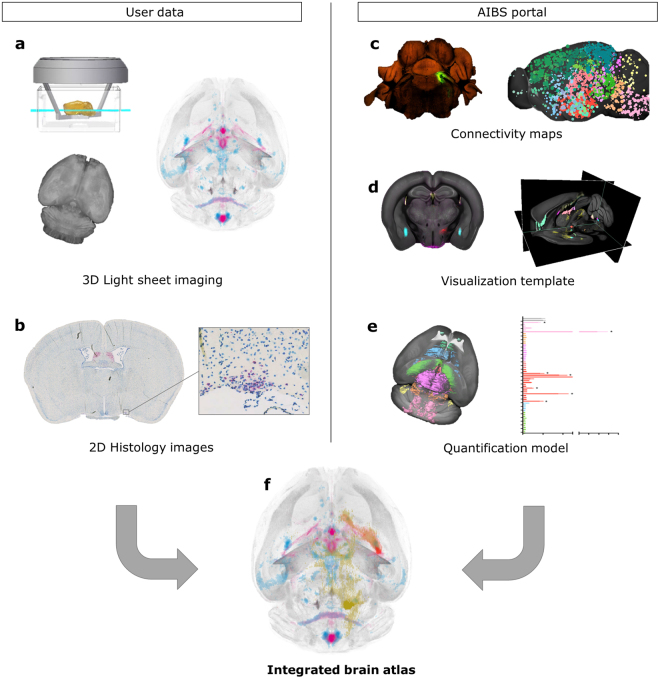
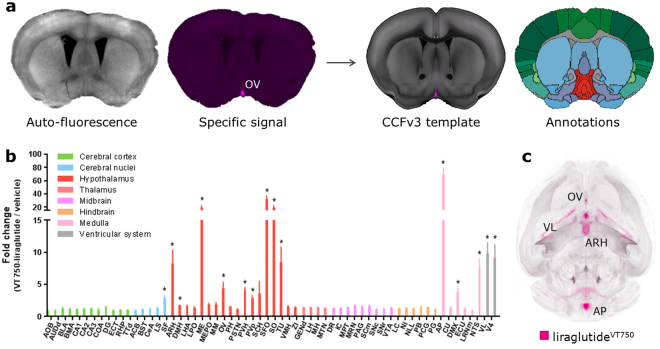
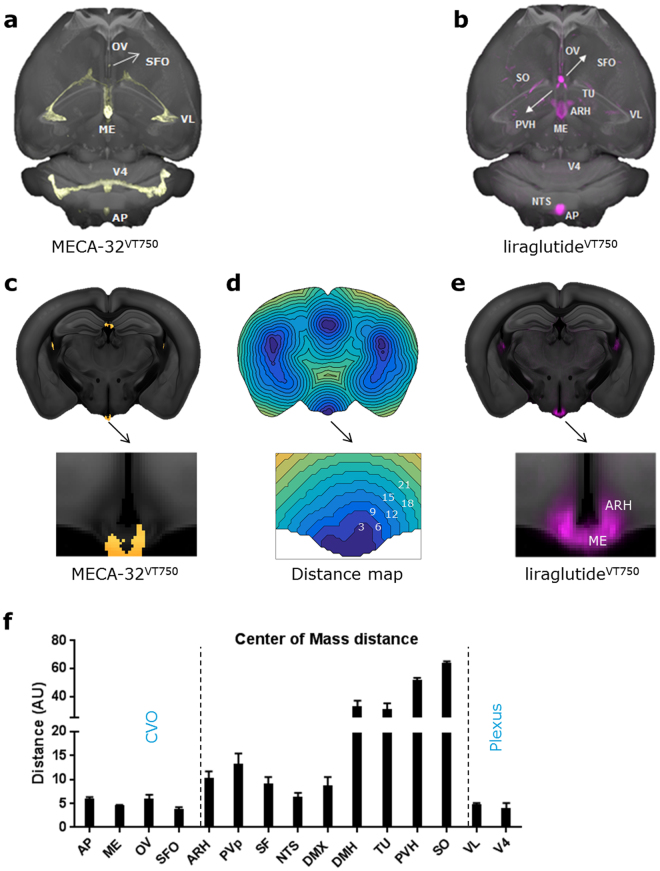
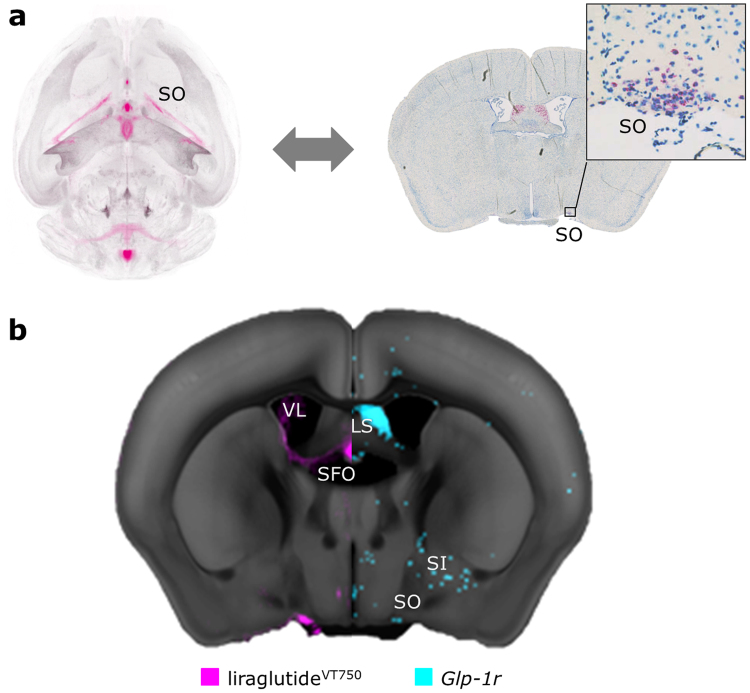
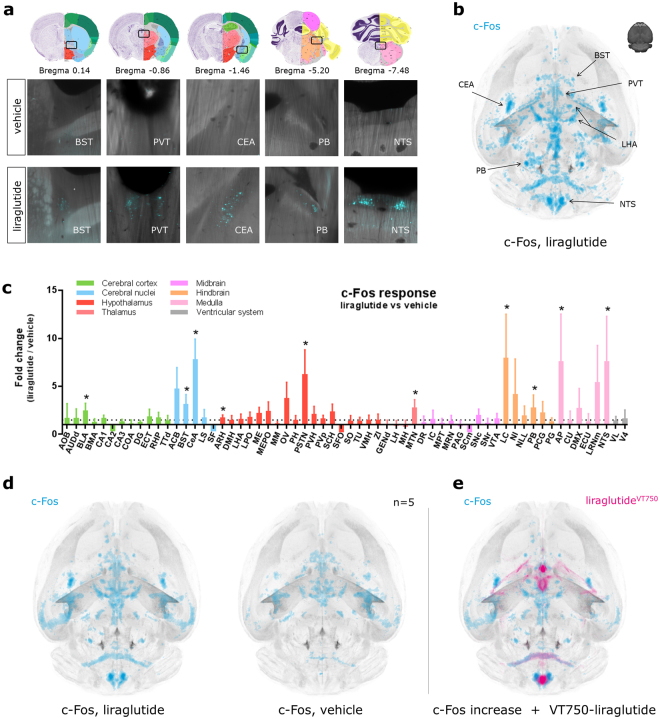
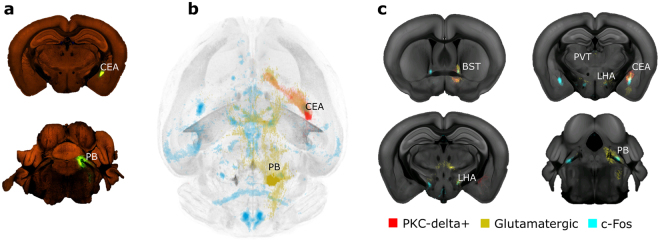
Light Sheet Fluorescence Microscopy (LSFM) of whole organs, in particular the brain, offers a plethora of biological data imaged in 3D. This technique is however often hindered by cumbersome non-automated analysis methods. Here we describe an approach to fully automate the analysis by integrating with data from the Allen Institute of Brain Science (AIBS), to provide precise assessment of the distribution and action of peptide-based pharmaceuticals in the brain. To illustrate this approach, we examined the acute central nervous system effects of the glucagon-like peptide-1 (GLP-1) receptor agonist liraglutide. Peripherally administered liraglutide accessed the hypothalamus and brainstem, and led to activation in several brain regions of which most were intersected by projections from neurons in the lateral parabrachial nucleus. Collectively, we provide a rapid and unbiased analytical framework for LSFM data which enables quantification and exploration based on data from AIBS to support basic and translational discovery.
Overview
The claims and statistics of this paper haven’t been checked yet.
Free: it reads the open-access text and checks the first 5 claims that cite a source we can check. Create a free account to check every claim.
Integrity signals
Registry
Cites
Statistics
Figures
Verification
Claims the paper makes
The claims and statistics of this paper haven’t been checked yet.
Free: it reads the open-access text and checks the first 5 claims that cite a source we can check. Create a free account to check every claim.
Claims other papers make about this one
Each is checked against this paper’s own text: does it say what the citing paper says it does?
The source backs part of the claim, not all of it — or backs it for a different population, condition or comparison.
In the citing paper
“These studies have demonstrated that the principal sites of action accessible to these drugs are GLP-1R neurons in circumventricular organs, particularly the AP and ME, and those in immediately adjacent regions—the NTS and arcuate nucleus of the hypothalamus (16, 51, 63‐66).”
From GLP-1 and the Neurobiology of Eating Control: Recent Advances (2025) · cites this paper as [66]
Experimental — accuracy not yet measured
Self-check
Percentages, sums and reported differences re-computed from the paper’s own numbers.
The self-check needs the paper’s full text.
Citations
Cites
Genome-wide atlas of gene expression in the adult mouse brain
Lein, E. S., Hawrylycz, M. J., Ao, N., Ayres, M., Bensinger, A., Bernard, A., Boe, A. F., Boguski, M. S., Brockway, K. S., Byrnes, E. J., et al. (2007) · Nature · doi:10.1038/nature05453 · Cited by 5,572
Elastix: a toolbox for intensity-based medical image registration
Klein, S., Staring, M., Murphy, K., Viergever, M. A., & Pluim, J. (2010) · IEEE Transactions on Medical Imaging · doi:10.1109/tmi.2009.2035616 · Cited by 4,311
A mesoscale connectome of the mouse brain
Oh, S. W., Harris, J. A., Ng, L., Winslow, B., Cain, N., Mihalas, S., Wang, Q., Lau, C., Kuan, L., Henry, A. M., et al. (2014) · Nature · doi:10.1038/nature13186 · Cited by 2,612
(2012) · doi:10.1016/j.jmoldx.2011.08.002 · Cited by 2,567
iDISCO: A Simple, Rapid Method to Immunolabel Large Tissue Samples for Volume Imaging
Renier, N., Wu, Z., Simon, D. J., Yang, J., Ariel, P., & Tessier-Lavigne, M. (2014) · Cell · doi:10.1016/j.cell.2014.10.010 · Cited by 1,818
Ultramicroscopy: three-dimensional visualization of neuronal networks in the whole mouse brain
Dodt, H.-U., Leischner, U., Schierloh, A., Jährling, N., Mauch, C. P., Deininger, K., Deussing, J. M., Eder, M., Zieglgänsberger, W., & Becker, K. (2007) · Nature Methods · doi:10.1038/nmeth1036 · Cited by 1,238
Three-dimensional imaging of solvent-cleared organs using 3DISCO
Ertürk, A., Becker, K., Jährling, N., Mauch, C. P., Hojer, C. D., Egen, J. G., Hellal, F., Bradke, F., Sheng, M., & Dodt, H.-U. (2012) · Nature Protocols · doi:10.1038/nprot.2012.119 · Cited by 992
The arcuate nucleus mediates GLP-1 receptor agonist liraglutide-dependent weight loss
Secher, A., Jelsing, J., Baquero, A. F., Hecksher-Sørensen, J., Cowley, M. A., Dalbøge, L. S., Hansen, G., Grove, K. L., Pyke, C., Raun, K., et al. (2014) · Journal of Clinical Investigation · doi:10.1172/jci75276 · Cited by 961
Self-citationMapping of Brain Activity by Automated Volume Analysis of Immediate Early Genes
Renier, N., Adams, E. L., Kirst, C., Wu, Z., Azevedo, R., Kohl, J., Autry, A. E., Kadiri, L., Umadevi Venkataraju, K., Zhou, Y., et al. (2016) · Cell · doi:10.1016/j.cell.2016.05.007 · Cited by 918
Parallel, Redundant Circuit Organization for Homeostatic Control of Feeding Behavior
Betley, J. N., Cao, Z. F. H., Ritola, K. D., & Sternson, S. M. (2013) · Cell · doi:10.1016/j.cell.2013.11.002 · Cited by 601
Cited by
Glucagon-like peptide 1 (GLP-1)
Müller, T. D., Finan, B., Bloom, S. R., D'Alessio, D., Drucker, D. J., Flatt, P. R., Fritsche, A., Gribble, F., Grill, H. J., Habener, J. F., et al. (2019) · Molecular Metabolism · doi:10.1016/j.molmet.2019.09.010 · Cited by 1,868
“While these studies suggest that GLP-1 influx into the brain might be a GLP-1R-independent process with passive diffusion of GLP-1 through the BBB [750e752], other studies suggest that uptake of liraglutide into the brain is GLP-1R-dependent [686,753].”
ResultThe Allen Mouse Brain Common Coordinate Framework: A 3D Reference Atlas
Wang, Q., Ding, S.-L., Li, Y., Royall, J., Feng, D., Lesnar, P., Graddis, N., Naeemi, M., Facer, B., Ho, A., et al. (2020) · Cell · doi:10.1016/j.cell.2020.04.007 · Cited by 1,386
The Discovery and Development of Liraglutide and Semaglutide
Knudsen, L. B., & Lau, J. (2019) · Frontiers in Endocrinology · doi:10.3389/fendo.2019.00155 · Cited by 970
Self-citationRevisiting the Complexity of GLP-1 Action from Sites of Synthesis to Receptor Activation
McLean, B. A., Wong, C. K., Campbell, J. E., Hodson, D. J., Trapp, S., & Drucker, D. J. (2021) · Endocrine Reviews · doi:10.1210/endrev/bnaa032 · Cited by 289
The role of glucagon‐like peptide 1 (GLP‐1) in addictive disorders
Klausen, M. K., Thomsen, M., Wortwein, G., & Fink‐Jensen, A. (2022) · British Journal of Pharmacology · doi:10.1111/bph.15677 · Cited by 259
Trapp, S., & Brierley, D. I. (2022) · British Journal of Pharmacology · doi:10.1111/bph.15638 · Cited by 154
“…of radiolabelled GLP-1, or fluorescently labelled GLP-1 receptor agonists or antagonists, into the periphery (i.p./i.v./s.c.) have demonstrated that circulating GLP-1 can access these structures (Ast et al., 2020; Gabery et al., 2020; Orskov et al., 1996; Salinas et al., 2018; Secher et al., 2014).”
BackgroundInfluentialDavoudian, P. A., Shao, L.-X., & Kwan, A. C. (2023) · ACS Chemical Neuroscience · doi:10.1021/acschemneuro.2c00637 · Cited by 129
Fortin, S. M., Lipsky, R. K., Lhamo, R., Chen, J., Kim, E., Borner, T., Schmidt, H. D., & Hayes, M. R. (2020) · Science Translational Medicine · doi:10.1126/scitranslmed.aay8071 · Cited by 127
“In addition, the AP is one of the most c-Fos–responsive areas of the brain following peripheral liraglutide (21, 36), and it is possible that part of the observed neural activity within the NTS (34, 36) is secondary to AP GLP-1R activation.”
BackgroundMethodInfluentialTanycytes control hypothalamic liraglutide uptake and its anti-obesity actions
Imbernon, M., Saponaro, C., Helms, H. C. C., Duquenne, M., Fernandois, D., Deligia, E., Denis, R. G. P., Chao, D. H. M., Rasika, S., Staels, B., et al. (2022) · Cell Metabolism · doi:10.1016/j.cmet.2022.06.002 · Cited by 124
Hölscher, C. (2024) · Neuropharmacology · doi:10.1016/j.neuropharm.2024.109952 · Cited by 108
“While exendin-4 has only a half-life of 2.4 h in the blood, semaglutide has a 165 h half-life (Dong et al., 2022), which means that less of the drug will enter the brain via the BBB (Gabery et al., 2020; Salameh et al., 2020; Salinas et al., 2018; Shi et al., 2017; Zhang et al., 2019, 2021).”
InfluentialA deep learning algorithm for 3D cell detection in whole mouse brain image datasets
Tyson, A. L., Rousseau, C. V., Niedworok, C. J., Keshavarzi, S., Tsitoura, C., Cossell, L., Strom, M., & Margrie, T. W. (2021) · PLoS Computational Biology · doi:10.1371/journal.pcbi.1009074 · Cited by 112
Gut-brain axis and addictive disorders: A review with focus on alcohol and drugs of abuse
Jerlhag, E. (2019) · Pharmacology & Therapeutics · doi:10.1016/j.pharmthera.2018.11.005 · Cited by 93
Krieger, J.-P. (2020) · Peptides · doi:10.1016/j.peptides.2020.170342 · Cited by 91
Dong, M., Wen, S., & Zhou, L. (2022) · Diabetes, Metabolic Syndrome and Obesity: Targets and Therapy · doi:10.2147/dmso.s375559 · Cited by 90
“GLP-1R–mediated transport occurs through circumventricular organs (CVOs) and maybe other parts of the hypothalamus via fenestrated capillaries and is partially dependent on tanycyte–mediated transport through certain localized compartments of the cerebrospinal fluid (CSF).(54,55) Central administration of GLP-1RAs sup…”
ResultPerens, J., Salinas, C. G., Skytte, J. L., Roostalu, U., Dahl, A. B., Dyrby, T. B., Wichern, F., Barkholt, P., Vrang, N., Jelsing, J., et al. (2020) · Neuroinformatics · doi:10.1007/s12021-020-09490-8 · Cited by 94
“For quantification of fluorescent signals, registration is followed by cell detection, e.g. ClearMap, to segment and count c-Fos positive cells (Nectow et al. 2017; Renier et al. 2016) or extract voxel intensities (Salinas et al. 2018).”
BackgroundMethodInfluentialSelf-citationJerlhag, E. (2023) · Frontiers in Pharmacology · doi:10.3389/fphar.2023.1063033 · Cited by 80
“The processes of passage through the blood–brain barrier and penetration into deeper brain regions differ between the GLP-1R agonists (Salinas et al., 2018).”
BackgroundVallöf, D., Kalafateli, A. L., & Jerlhag, E. (2020) · Translational Psychiatry · doi:10.1038/s41398-020-00923-1 · Cited by 72
Circulating Triglycerides Gate Dopamine-Associated Behaviors through DRD2-Expressing Neurons
Berland, C., Montalban, E., Perrin, E., Miceli, M. D., Nakamura, Y., Martinat, M., Sullivan, M., Davis, X. S., Shenasa, M. A., Martin, C., et al. (2020) · Cell Metabolism · doi:10.1016/j.cmet.2020.02.010 · Cited by 81
“The heat maps were generated as described in (Salinas et al., 2018).”
MethodSelf-citationRoostalu, U., Salinas, C. B. G., Thorbek, D. D., Skytte, J. L., Fabricius, K., Barkholt, P., John, L. M., Jurtz, V. I., Knudsen, L. B., Jelsing, J., et al. (2019) · Disease Models & Mechanisms · doi:10.1242/dmm.042200 · Cited by 65
Self-citationInventing Liraglutide, a Glucagon-Like Peptide-1 Analogue, for the Treatment of Diabetes and Obesity
Knudsen, L. B. (2019) · ACS Pharmacology & Translational Science · doi:10.1021/acsptsci.9b00048 · Cited by 56
Self-citationGLP-1 Receptor Agonists: Promising Therapeutic Targets for Alcohol Use Disorder
Jerlhag, E. (2025) · Endocrinology · doi:10.1210/endocr/bqaf028 · Cited by 66
Alcohol-mediated behaviours and the gut-brain axis; with focus on glucagon-like peptide-1
Jerlhag, E. (2020) · Brain Research · doi:10.1016/j.brainres.2019.146562 · Cited by 53
Gerstenberg, M. K., Salinas, C. B. G., Rehfeld, J. F., Secher, A., Raun, K., & Wulff, B. S. (2018) · Neuropeptides · doi:10.1016/j.npep.2018.11.004 · Cited by 56
“The enhanced c-fos reactivity could also be induced by several additional mechanisms such as 1) an increased access of PYY(3-36) and Ex4 into brain (Salinas et al., 2018; Kastin & Akerstrom, 2003; Kastin et al., 2002; Nonaka et al., 2003), 2) increased interaction of appetite-regulating neurons and cross talk between…”
BackgroundSelf-citationGLP-1-mediated delivery of tesaglitazar improves obesity and glucose metabolism in male mice
Quarta, C., Stemmer, K., Novikoff, A., Yang, B. S., Klingelhuber, F., Harger, A., Bakhti, M., Bastidas-Ponce, A., Baugé, E., Campbell, J. E., et al. (2022) · Nature Metabolism · doi:10.1038/s42255-022-00617-6 · Cited by 52
Le, T. D. V., Fathi, P. A., Watters, A. B., Ellis, B. J., Besing, G.-L. K., Bozadjieva-Kramer, N., Perez, M. B., Sullivan, A. I., Rose, J. P., Baggio, L. L., et al. (2023) · Molecular Metabolism · doi:10.1016/j.molmet.2023.101718 · Cited by 50
“Systemic liraglutide engages several brain regions such as the arcuate and paraventricular hypothalamic nuclei, subfornical organ, area postrema, and the nucleus tractus solitarius [65].”
BackgroundZhang, L., Li, C., Zhang, Z., Zhang, Z., Jin, Q., Li, L., & Hölscher, C. (2022) · Parkinson s Disease · doi:10.1155/2022/1428817 · Cited by 61
“A drawback of this strategy is that these drugs show only limited transfer across the BBB to enter the brain [48, 49, 60].”
Borner, T., Tinsley, I. C., Doyle, R. P., Hayes, M. R., & De Jonghe, B. C. (2022) · British Journal of Pharmacology · doi:10.1111/bph.15647 · Cited by 49
Gut peptide regulation of food intake – evidence for the modulation of hedonic feeding
Woodward, O. R. M., Gribble, F. M., Reimann, F., & Lewis, J. E. (2022) · The Journal of Physiology · doi:10.1113/jp280581 · Cited by 40
GLP-1 and the Neurobiology of Eating Control: Recent Advances
Jones, L. A., & Brierley, D. I. (2025) · Endocrinology · doi:10.1210/endocr/bqae167 · Cited by 43
Buller, S., & Blouet, C. (2024) · American Journal of Physiology-Endocrinology and Metabolism · doi:10.1152/ajpendo.00250.2023 · Cited by 40
Holt, M. K., Cook, D. R., Brierley, D. I., Richards, J. E., Reimann, F., Gourine, A. V., Marina, N., & Trapp, S. (2020) · Molecular Metabolism · doi:10.1016/j.molmet.2020.101024 · Cited by 35
“In fact, assuming that access to the CNS is similar for peripherally administered Ex-4 as it is for fluorescently labelled liraglutide [62,63], we would expect that Ex-4 acts in either PVN, AP/NTS or on spinal preganglionic sympathetic neurons to affect HR.”
BackgroundBakker, W., Imbernón, M., Salinas, C. G., Chao, D. H. M., Hassouna, R., Morel, C., Martin, C., Leger, C., Denis, R., Castel, J., et al. (2022) · Cell Reports · doi:10.1016/j.celrep.2022.111698 · Cited by 38
Self-citationAllingbjerg, M.-L., Hansen, S. N., Secher, A., & Thomsen, M. (2023) · Experimental and Clinical Psychopharmacology · doi:10.1037/pha0000620 · Cited by 37
Self-citationSalmon calcitonin distributes into the arcuate nucleus to a subset of NPY neurons in mice
Zakariassen, H. L., John, L. M., Lykkesfeldt, J., Raun, K., Glendorf, T., Schaffer, L., Lundh, S., Secher, A., Lutz, T. A., & Le Foll, C. (2020) · Neuropharmacology · doi:10.1016/j.neuropharm.2020.107987 · Cited by 33
Self-citationWagner, S., Brierley, D. I., Leeson-Payne, A., Jiang, W., Chianese, R., Lam, B. Y. H., Dowsett, G. K. C., Cristiano, C., Lyons, D., Reimann, F., et al. (2023) · Molecular Metabolism · doi:10.1016/j.molmet.2022.101665 · Cited by 32
“However, GLP-1R agonists show limited brain penetrance, at least acutely [2,10,11], and liraglutide-induced cFOS in neurons beyond the cir-cumventricular organs is found primarily in cells not expressing GLP-1Rs [12].”
Mano, T., Murata, K., Kon, K., Shimizu, C., Ono, H., Shi, S., Yamada, R. G., Miyamichi, K., Susaki, E. A., Touhara, K., et al. (2021) · Cell Reports Methods · doi:10.1016/j.crmeth.2021.100038 · Cited by 35
“Such automated analysis would allow comprehensive identification of cellular clusters that underlie an animal’s behavioral phenotype (Susaki et al., 2014; Renier et al., 2016; Tatsuki et al., 2016; Salinas et al., 2018).”
MethodSkovbjerg, G., Roostalu, U., Salinas, C. G., Skytte, J. L., Perens, J., Clemmensen, C., Elster, L., Frich, C. K., Hansen, H. H., & Hecksher‐Sørensen, J. (2023) · Neuropharmacology · doi:10.1016/j.neuropharm.2023.109637 · Cited by 33
Self-citationEffects of GLP‐1 Receptor Agonists in Alcohol Use Disorder
Klausen, M. K., Knudsen, G. M., Vilsbøll, T., & Fink‐Jensen, A. (2025) · Basic & Clinical Pharmacology & Toxicology · doi:10.1111/bcpt.70004 · Cited by 36
Histaminergic regulation of food intake
Khouma, A., Moeini, M. M., Plamondon, J., Richard, D., Caron, A., & Michael, N. J. (2023) · Frontiers in Endocrinology · doi:10.3389/fendo.2023.1202089 · Cited by 33
Zhang, Z., Li, H., Su, Y., Ma, J., Yuan, Y., Yu, Z., Shi, M., Shao, S., Zhang, Z., & Hölscher, C. (2022) · Frontiers in Neuroscience · doi:10.3389/fnins.2022.814430 · Cited by 31
“The electron-transport chain of mitochondria is the main site of intracellular ROS production (Sangwung et al., 2020).”
BackgroundThe antiemetic actions of GIP receptor agonism
Borner, T., Jonghe, B. C. D., & Hayes, M. R. (2024) · American Journal of Physiology-Endocrinology and Metabolism · doi:10.1152/ajpendo.00330.2023 · Cited by 28
Foll, C. L., & Lutz, T. A. (2020) · Comprehensive physiology · doi:10.1002/cphy.c190034 · Cited by 27
Oh, J., Lee, Y., Hwang, T., Cho, S., Jang, J., Ryu, Y., & Park, H. (2022) · Frontiers in Aging Neuroscience · doi:10.3389/fnagi.2022.885396 · Cited by 25
“Thus, c-Fos has been utilized as a key indicator of neuronal responses to various triggers, including specific behavioral and peripheral stimulation, and has been also used for brain-wide maps (Wheeler et al., 2013; Salinas et al., 2018; Chelini et al., 2019; Park et al., 2021; Bonapersona et al., 2022).”
BackgroundA brain reward circuit inhibited by next-generation weight-loss drugs in mice
Godschall, E., Güngül, T. B., Sajonia, I. R., Buyukaksakal, A., Li, O., Ogilvie, S., Keeler, A. B., Tian, G., Shi, Y., Koita, O., et al. (2026) · Nature · doi:10.1038/s41586-026-10444-4 · Cited by 23
“Building on previous work and our own finding that peptide GLP1RAs induce CeA FOS expression in WT mice 13,26,29,30 (Fig.”
InfluentialNampei, M., Horikawa, M., Ishizu, K., Yamazaki, F., Yamada, H., Kahyo, T., & Setou, M. (2019) · Scientific Reports · doi:10.1038/s41598-019-49819-1 · Cited by 21
Multimodal 3D Mouse Brain Atlas Framework with the Skull-Derived Coordinate System
Perens, J., Salinas, C. G., Roostalu, U., Skytte, J. L., Gundlach, C., Hecksher‐Sørensen, J., Dahl, A. B., & Dyrby, T. B. (2023) · Neuroinformatics · doi:10.1007/s12021-023-09623-9 · Cited by 21
“…volumes with a reference atlas to perform group analysis (Badea et al., 2019; Fried-mann et al., 2020; Goubran et al., 2019; Kirst et al., 2020; Massalimova et al., 2021; Perens et al., 2021; Renier et al., 2016; Salinas et al., 2018; Todorov et al., 2020; Tyson & Margrie, 2021; You et al., 2021 ).”
MethodSelf-citationGreenwood, M. P., Greenwood, M., Bárez‐López, S., Hawkins, J. W., Short, K., Tatović, D., & Murphy, D. (2023) · Molecular Metabolism · doi:10.1016/j.molmet.2023.101692 · Cited by 19
Zhang, Z., Shi, M., Li, Z., Ling, Y., Zhai, L., Yuan, Y., Ma, H., Li, H., Li, Z., Zhang, Z., et al. (2023) · Parkinson s Disease · doi:10.1155/2023/7427136 · Cited by 25
“Terefore, the ability to cross the blood-brain barrier (BBB) to get into the brain is limited [27, 56, 57].”
BackgroundGLP-1R–GIPR–PPARα/γ/δ quintuple agonism corrects obesity and diabetes in mice
Liśkiewicz, D., Novikoff, A., Khalil, A., Akindehin, S., Campbell, J. E., Candela, P., Castelino, R. L., Coupland, C., Culot, M., Dodson, W. S., et al. (2026) · Nature · doi:10.1038/s41586-026-10427-5 · Cited by 18
“Similar to liraglutide 42 , semaglutide 43 and acyl-GIP 5 , GLP-1–GIP–Lani and GLP-1–GIP showed no ability to cross the blood-brain barrier, as assessed in vitro using an established human blood-brain barrier model 44 (Fig.”
Roostalu, U., Thisted, L., Skytte, J. L., Salinas, C. G., Pedersen, P. J., Hecksher‐Sørensen, J., Rolin, B., Hansen, H. H., MacKrell, J. G., Christie, R. M., et al. (2021) · Scientific Reports · doi:10.1038/s41598-021-84812-7 · Cited by 17
Self-citationLe, T. D. V., Liu, D., Besing, G.-L. K., Raghavan, R., Ellis, B. J., Ceddia, R. P., Collins, S., & Ayala, J. E. (2023) · eLife · doi:10.7554/elife.80944 · Cited by 16
“This suggests that Raptor phosphorylation at Ser 791 by PKA contributes to the weight loss effect of GLP-1R agonists but not other G s-targeting pharmacological agents such as setmelanotide.”
BackgroundGlucagon‐Like Peptide‐1 Links Ingestion, Homeostasis, and the Heart
Krieger, J., Daniels, D., Lee, S. J., Mastitskaya, S., & Langhans, W. (2024) · Comprehensive physiology · doi:10.1002/cph4.7 · Cited by 15
“…analogs, such as Ex-4, liraglutide, or semaglutide, gain significant access to central GLP-1R, notably to those located in circum-ventricular areas (Gabery et al. 2020; Mietlicki-Baase et al. 2018; Salinas et al. 2018; Secher et al. 2014), that is, the AP, median eminence and subfornicular organs.”
Klausen, M. K., Kuzey, T., Pedersen, J. N., Justesen, S. K., Rasmussen, L. J. H., Knorr, U., Mason, G. F., Ekstrøm, C. T., Holst, J. J., Koob, G. F., et al. (2025) · BMJ Open · doi:10.1136/bmjopen-2024-086454 · Cited by 14
Pharmacological Advances in Incretin-Based Polyagonism: What We Know and What We Don’t
Novikoff, A., & Müller, T. D. (2024) · Physiology · doi:10.1152/physiol.00032.2023 · Cited by 15
Novel neural pathways targeted by GLP-1R agonists and bariatric surgery
Hankir, M. K., & Lutz, T. A. (2024) · Pflügers Archiv - European Journal of Physiology · doi:10.1007/s00424-024-03047-3 · Cited by 16
Whole‐Brain Image Analysis and Anatomical Atlas 3D Generation Using MagellanMapper
Young, D. M., Duhn, C., Gilson, M. C., Nojima, M., Yuruk, D., Kumar, A., Yu, W., & Sanders, S. (2020) · Current Protocols in Neuroscience · doi:10.1002/cpns.104 · Cited by 15
“Brainpatterns is a software suite that integrates atlas registration with regional quantification of fluorescent signal (Salinas et al., 2018).”
MethodGhrelin system and GLP-1 as potential treatment targets for alcohol use disorder
Jerlhag, E. (2024) · International review of neurobiology · doi:10.1016/bs.irn.2024.07.006 · Cited by 13
Integration of Glucagon-Like Peptide 1 Receptor Actions Through the Central Amygdala
Duran, M., Willis, J. R., Dalvi, N., Fokakis, Z. N., VIRKUS, S., & Hardaway, J. A. (2025) · Endocrinology · doi:10.1210/endocr/bqaf019 · Cited by 13
Feetham, C. H., Ai, M., Culotta, I., Costa, A., Hunter, J., Brown, R. A., Coşkun, T., Emmerson, P. J., D’Agostino, G., & Luckman, S. M. (2025) · Molecular Metabolism · doi:10.1016/j.molmet.2025.102214 · Cited by 13
“Currently, we have no evidence that systemically administered incretin can access the CeA - as shown above using fluorescently labelled TZP and GLP1RAs [20 — 22] - though we cannot discount the possibility entirely.”
InfluentialThe Duke Mouse Brain Atlas: MRI and light sheet microscopy stereotaxic atlas of the mouse brain
Mansour, H., Azrak, R., Cook, J. J., Hornburg, K. J., Qi, Y., Tian, Y., Williams, R. W., Yeh, F.-C., White, L. E., & Johnson, G. A. (2025) · Science Advances · doi:10.1126/sciadv.adq8089 · Cited by 11
Trapp, S., & Skoug, C. (2025) · Endocrinology · doi:10.1210/endocr/bqaf169 · Cited by 12
Deciphering Drug Targets and Actions with Single-Cell and Spatial Resolution
Pang, Z., Cravatt, B. F., & Li, Y. (2023) · The Annual Review of Pharmacology and Toxicology · doi:10.1146/annurev-pharmtox-033123-123610 · Cited by 13
Fortin, S. M., Chen, J., & Hayes, M. R. (2020) · Physiology & Behavior · doi:10.1016/j.physbeh.2020.112870 · Cited by 10
3D light-sheet fluorescence microscopy in preclinical and clinical drug discovery
Roostalu, U., Hansen, H. H., & Hecksher‐Sørensen, J. (2024) · Drug Discovery Today · doi:10.1016/j.drudis.2024.104196 · Cited by 11
Self-citationHansen, H. B., Roostalu, U., & Hecksher‐Sørensen, J. (2020) · Neural Regeneration Research · doi:10.4103/1673-5374.284983 · Cited by 12
“Another important aspect of LSFM is the ability to directly image and quantify biodistribution of therapeutic peptides and antibodies following systemic administration (Salinas et al., 2018).”
Self-citationShevchouk, O. T., Edvardsson, C. E., Ericson, M., Sköldheden, S. B., Zhang, Q., Nabinger, D. D., Snoeren, E. M. S., Westberg, L., & Jerlhag, E. (2026) · Behavioural Brain Research · doi:10.1016/j.bbr.2026.116085 · Cited by 9
A semi-automated brain atlas-based analysis pipeline for c-Fos immunohistochemical data
Bourgeois, J. R., Kalyanasundaram, G., Figueroa, C., Srinivasan, A., & Kopec, A. M. (2020) · Journal of Neuroscience Methods · doi:10.1016/j.jneumeth.2020.108982 · Cited by 9
“Intact brain analyses require tissue clearing and specialized imaging tools (Salinas et al., 2018; Renier et al., 2016; Kim et al., 2015), while manual analysis of multiple ROIs throughout the brain is prohibitively time consuming and dividing the task among multiple individuals introduces the…”
MethodGlucagon-like Peptide-1 Receptor Agonists (GLP-1 RAs): A Pan-Steatotic Liver Disease Treatment?
Chrysavgis, L., Mourelatou, N. G., & Cholongitas, Ε. (2025) · Biomedicines · doi:10.3390/biomedicines13071516 · Cited by 10
“Of importance, experimental studies have suggested that several GLP-1 RAs can cross the blood–brain barrier, at least at some extent, upon systemic administration [46,47].”
Liberini, C. G., Lhamo, R., Ghidewon, M. Y., Ling, T., Juntereal, N. A., Chen, J. C., Cao, A., Stein, L. M., & Hayes, M. R. (2018) · Diabetes Obesity and Metabolism · doi:10.1111/dom.13591 · Cited by 8
“While the CNS penetrance appears to slightly differ for GLP-1R analogues, previous research has shown that systemically injected liraglutide is able to cross the blood-brain barrier and act centrally by binding to GLP-1R in the hypothalamus and hindbrain.(46) In addition, systemic GLP-1R analogues may signal to appeti…”
BackgroundPerens, J., & Hecksher‐Sørensen, J. (2022) · Frontiers in Neuroscience · doi:10.3389/fnins.2022.866884 · Cited by 8
Self-citationWillekens, S. M. A., Morini, F., Mediavilla, T., Nilsson, E., Orädd, G., Hahn, M., Chotiwan, N., Visa, M., Berggren, P., Ilegems, E., et al. (2024) · Frontiers in Neuroscience · doi:10.3389/fnins.2024.1328815 · Cited by 7
Insights into the neurobiology of weight loss after bariatric surgery and GLP-1R agonists
Cook, T. M., Fuller, K. N. Z., & Sandoval, D. A. (2024) · Neuropharmacology · doi:10.1016/j.neuropharm.2024.110269 · Cited by 7
Wulff, B. S., Kuhre, R. E., Selvaraj, M., Rehfeld, J. F., Niss, K., Fels, J. J., Secher, A., Raun, K., & Gerstenberg, M. K. (2024) · Heliyon · doi:10.1016/j.heliyon.2024.e32009 · Cited by 6
Self-citationDuarte, F. T., Ramosaj, M., Hasanovic, E., Regio, S., Sipion, M., Rey, M. J., & Déglon, N. (2023) · Molecular Therapy — Methods & Clinical Development · doi:10.1016/j.omtm.2023.03.013 · Cited by 7
Monitoring longitudinal disease progression in a novel murine Kit tumor model using high-field MRI
Kraiger, M., Klein‐Rodewald, T., Rathkolb, B., Calzada‐Wack, J., Sanz‐Moreno, A., Fuchs, H., Wolf, E., Gailus‐Durner, V., & de Angelis, M. H. (2022) · Scientific Reports · doi:10.1038/s41598-022-17880-y · Cited by 5
Moeini, M. M., Lavoie, O., Caron, A., Williams, K. W., & Michael, N. J. (2025) · Obesity · doi:10.1002/oby.70051 · Cited by 3
Shevchouk, O. T., Edvardsson, C. E., Ericson, M., Westberg, L., & Jerlhag, E. (2026) · Psychoneuroendocrinology · doi:10.1016/j.psyneuen.2026.107893 · Cited by 2
The central amygdala gates exogenous glucagon-like peptide 1 signals
Duran, M., Zeng, N., Cutts, E. J., POLAMARASETTY, A., Rodríguez, M., Habegger, K. M., & Hardaway, J. A. (2026) · Molecular Metabolism · doi:10.1016/j.molmet.2026.102403 · Cited by 2
“This is consistent with the anatomical wiring of the CeA positioning it to gate and translate upstream GLP-1R signals into coordinated behavioral outputs and supported by our prior data [12,22,75].”
Liraglutide and semaglutide: comparative assessment of metabolic and side effects
Romantsova, T. I. (2024) · Endocrinology News Opinions Training · doi:10.33029/2304-9529-2024-13-4-72-83 · Cited by 2
The Connection Between the Appetite-Regulatory Peptides Ghrelin and GLP-1 and Alcohol Use Disorder
Jerlhag, E. (2025) · Advances in experimental medicine and biology · doi:10.1007/978-3-031-89525-8_8 · Cited by 2
Applebey, S. V., Xiao, A. G., Reiner, B. C., & Hayes, M. R. (2025) · Diabetes Obesity and Metabolism · doi:10.1111/dom.70177 · Cited by 2
Yang, H., Yu, W., Gao, Y., Wang, J., & Xu, S. (2026) · Frontiers in Endocrinology · doi:10.3389/fendo.2026.1740052 · Cited by 1
“Previous rigorous whole-brain imaging studies have demonstrated that fl uorophore-conjugated GLP-1R agonists preferentially accumulate in circumventricular organs, particularly the ARC and DVC (28, 29).”
Teravoxel Microscopy Image Analysis for Neurological Diseases
Wei, Z., & Wu, G. (2026) · Annual Review of Biomedical Engineering · doi:10.1146/annurev-bioeng-110824-012128 · Cited by 1
Hrickova, M., Demirci, S. F., Amchová, P., & Kučerová, J. (2026) · Frontiers in Pharmacology · doi:10.3389/fphar.2026.1791206 · Cited by 2
“For example, systemically injected LIR was detected in the hypothalamus, cerebellum, and brain stem (Secher et al., 2014; Salinas et al., 2018; Oh et al., 2023).”
Zhang, L., Peng, F., Wanting, Z., Qianqian, J., Zhang, Z., Bai, B., Xue, G., & Hölscher, C. (2026) · Frontiers in Endocrinology · doi:10.3389/fendo.2026.1825379 · Cited by 1
Martínez‐Corral, I., Monaco, N., Brierley, D. I., & Imbernón, M. (2026) · British Journal of Pharmacology · doi:10.1111/bph.70636 · Cited by 1
Berland, C., Gangarossa, G., Nakamura, Y., Sullivan, M., Davis, X., Shenasa, M., Caillé, S., Jensen, C. B., Castel, J., Morel, C., et al. (2019) · Social Science Research Network · doi:10.2139/ssrn.3382218 · Cited by 3
Self-citationA Weakly Supervised U-Net Model for Precise Whole Brain Immunolabeled Cell DetectionPreprint
Wang, L.-W., Wu, Y.-L., Lee, C.-L., Cheng, C.-C., Lu, K.-Y., Tsai, J.-H., Lin, Y., Hsu, C., Kuo, T.-H., & Chu, L. (2023) · bioRxiv (Cold Spring Harbor Laboratory) · doi:10.1101/2023.03.16.531434 · Cited by 1
“We tried numerous sets such as five for a (1, 2, 3, 4, 5) and three for b (300, 600, 900).”
MethodThe Gut-Brain Axis and Addictions: A New Narrative
Jerlhag, E. (2022) · Springer eBooks · doi:10.1007/978-3-030-67928-6_2-1
The Gut-Brain Axis and Addictions: A New Narrative
Jerlhag, E. (2022) · Springer eBooks · doi:10.1007/978-3-030-92392-1_2
Targeting Multiple Gut‐Brain Pathways in Obesity: Rationale for Combination Pharmacotherapy
Miras, A. D., & Hussain, M. (2026) · Obesity Science & Practice · doi:10.1002/osp4.70141 · Cited by 1
Oméga 3 et troubles de l'humeur : mécanismes d'actions neuroprotecteurs
Martinat, M. (2022) · theses.fr (ABES) · doi:10.70675/6f114f20z6c83z41a1zaa52zb4bae73f6832
Incretins: From Gene Expression to Secretion and Action of GLP-1 and GIP
Lobato, C. B., & Holst, J. J. (2026) · Elsevier eBooks · doi:10.1016/b978-0-443-11985-9.00004-4
Metadata
- Authors
- Salinas, C. B. G., Lu, T. T.-H., Gabery, S., Marstal, K., Alanentalo, T., Mercer, A. J., Cornea, A., Conradsen, K., Hecksher-Sørensen, J., Dahl, A. B., Knudsen, L. B., & Secher, A.
- Affiliations
- Novo Nordisk (Denmark) (DK)
- Erasmus MC (NL)
- Novo Nordisk (United States) (US)
- Technical University of Denmark (DK)
- Corresponding author
- Knudsen, Lotte Bjerre
- ORCID
- Venue
- Scientific Reports
- Published
- 2018-07-09
- Volume
- 8
- Issue
- 1
- Pages
- 10310-10310
- ISSN
- 2045-2322 (ISSN-L)
- PMC
- PMC6037685
- OpenAlex
- W2809697129
- Cited by
- 95
- References
- 33
- Citations by year
- 2026: 10 · 2025: 11 · 2024: 14 · 2023: 12 · 2022: 13 · 2021: 8 · 2020: 17 · 2019: 7 · 2018: 3
- FWCI
- 4.57
- Type
- journal article
- Language
- en
- Open access
- gold
- doi.org
- Licence
- cc-by
- creativecommons.org/licenses/by/4.0 (tdm)
- creativecommons.org/licenses/by/4.0 (vor)
- Locations
- Scientific Reports (publishedVersion, cc-by)
- Europe PMC (PubMed Central) (publishedVersion, other-oa)
- PubMed Central (publishedVersion, cc-by)
- PubMed (publishedVersion)
- EUR Research Repository (Erasmus University Rotterdam) (publishedVersion, other-oa)
- EUR Research Repository (Erasmus University Rotterdam) (submittedVersion, other-oa)
- RePub (Erasmus University Rotterdam) (submittedVersion, other-oa)
- DOAJ (DOAJ: Directory of Open Access Journals) (submittedVersion)
- Lund University Publications (Lund University) (submittedVersion)
- Technical University of Denmark, DTU Orbit (Technical University of Denmark, DTU) (submittedVersion, other-oa)
- RePub (Erasmus University Rotterdam) (submittedVersion)
- Funders
- Innovationsfonden
- Nederlandse Organisatie voor Wetenschappelijk Onderzoek (13351, 184.033.111)
- Novo Nordisk
- Stichting voor de Technische Wetenschappen (13351)
- Topics
- Life Sciences › Biochemistry, Genetics and Molecular Biology › Biophysics › Cell Image Analysis Techniques
- Life Sciences › Neuroscience › Cellular and Molecular Neuroscience › Neuroscience and Neuropharmacology Research
- Life Sciences › Biochemistry, Genetics and Molecular Biology › Biophysics › Advanced Fluorescence Microscopy Techniques
- Keywords
- liraglutide, GLP-1 receptor agonists, light-sheet microscopy, automated image analysis, hypothalamus, brainstem, lateral parabrachial nucleus, central nervous system effects
- MeSH terms
- Glucagon-Like Peptide-1 Receptor, Liraglutide, Glucagon-Like Peptide-1 Receptor Agonists, Animals, Brain Mapping, Brain Stem, Eating, Hypoglycemic Agents, Hypothalamus, Mice, Inbred C57BL, Microscopy, Fluorescence, Nervous System, Proto-Oncogene Proteins c-fos, Mice
About these checks
Registry, retraction, Cites and statistics results are computed, not judged, with one exception: a printed reference that no index lists is read once by a model before it counts as a citation error. Claims are extracted by a model and kept only when their quote appears verbatim in the text; each cited source is then checked, with a model’s help, for whether it says what the claim relies on. Those verdicts can be wrong — read the claim’s quote and the cited source before relying on one.
Statistics and arithmetic are recomputed, not judged.
Confidence bands are shown only for fields calibrated on our annotated test set. None is calibrated yet, so no band is shown.
What counts as a claim ›How we measure confidence ›How we check this ›
Are you an author, or do you see a problem with this page? Request a review
Data sources
Bibliographic data: Semantic Scholar, OpenAlex, Crossref.
Contains information from the Semantic Scholar Academic Graph Datasets, made available under the ODC Attribution License (ODC-BY 1.0).
Semantic Scholar’s data is described in: Kinney, R., et al. (2023). The Semantic Scholar Open Data Platform. arXiv:2301.10140.
