

Evaluation of Oxford Nanopore’s MinION Sequencing Device for Microbial Whole Genome Sequencing Applications
Open accessThe DOI matches its Crossref record; 32 of the 32 references it cites were found in a registry or an index.
Abstract
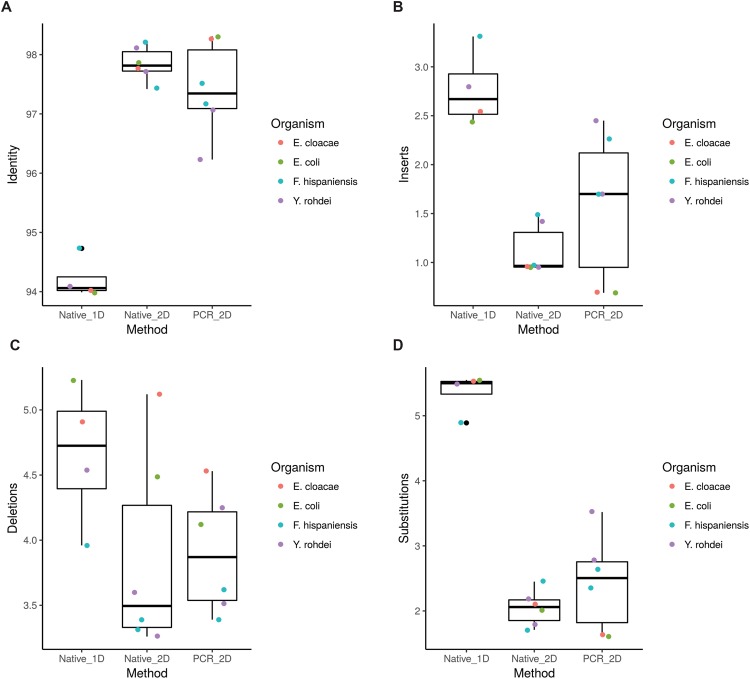
The MinION sequencer (Oxford Nanopore Technologies) is a paradigm shifting device allowing rapid, real time long read sequencing of nucleic acids. Yet external benchmarking of this technologies’ capabilities has not been extensively reported, nor has thorough evaluation of its utility for field-based analysis with sub-optimal sample types been described. The aim of this study was to evaluate the capability of the MinION sequencer for bacterial genomic and metagenomic applications, with specific emphasis placed on the quality, yield, and accuracy of generated sequence data. Two independent laboratories at the National Microbiology Laboratory (Public Health Agency of Canada), sequenced a set of microbes in replicate, using the currently available flowcells, sequencing chemistries, and software available at the time of the experiment. Overall sequencing yield and quality improved through the course of this set of experiments. Sequencing alignment accuracy was high reaching 97% for all 2D experiments, though was slightly lower for 1D sequencing (94%). 1D sequencing provided much longer sequences than 2D. Both sequencing chemistries performed equally well in constructing genomic assemblies. There was evidence of barcode cross-over using both the native and PCR barcoding methods. Despite the sub-optimal nature of samples sequenced in the field, sequences attributable to B. anthracis the target organism used in this scenario, could none-the-less be detected. Together, this report showcases the rapid advancement in this technology and its utility in the context of genomic sequencing of microbial isolates of importance to public health.
Overview
The claims and statistics of this paper haven’t been checked yet.
Free: it reads the open-access text and checks the first 5 claims that cite a source we can check. Create a free account to check every claim.
Integrity signals
Registry
Cites
Statistics
Figures
Verification
Claims the paper makes
The claims and statistics of this paper haven’t been checked yet.
Free: it reads the open-access text and checks the first 5 claims that cite a source we can check. Create a free account to check every claim.
Claims other papers make about this one
Each is checked against this paper’s own text: does it say what the citing paper says it does?
In the citing paper
“Research studies have also demonstrated the clinical potential of nanopore sequencing in targeted universal 16S ribosomal RNA (rRNA) bacterial detection127, microbiome analyses128, whole-genome sequencing of bacteria129 and outbreak viruses44,45,47, RNA sequencing (RNA-seq) using standardized controls130 and diagnosis of prosthetic joint131 and lower respiratory infections99.”
From Clinical metagenomics (2019) · cites this paper as [129]
Self-check
Percentages, sums and reported differences re-computed from the paper’s own numbers.
The self-check needs the paper’s full text.
Citations
Cites
Walker, B. J., Abeel, T., Shea, T., Priest, M., Abouelliel, A., Sakthikumar, S., Cuomo, C. A., Zeng, Q., Wortman, J., Young, S. K., et al. (2014) · PLoS ONE · doi:10.1371/journal.pone.0112963 · Cited by 9,197
Canu: scalable and accurate long-read assembly via adaptive k -mer weighting and repeat separation
Koren, S., Walenz, B. P., Berlin, K., Miller, J. R., Bergman, N. H., & Phillippy, A. M. (2017) · Genome Research · doi:10.1101/gr.215087.116 · Cited by 7,304
Assembly of long, error-prone reads using repeat graphs
Kolmogorov, M., Yuan, J., Lin, Y., & Pevzner, P. A. (2019) · Nature Biotechnology · doi:10.1038/s41587-019-0072-8 · Cited by 5,986
Versatile and open software for comparing large genomes
Kurtz, S., Phillippy, A., Delcher, A. L., Smoot, M., Shumway, M., Antonescu, C., & Salzberg, S. L. (2004) · Genome Biology · doi:10.1186/gb-2004-5-2-r12 · Cited by 5,254
Kraken: ultrafast metagenomic sequence classification using exact alignments
Wood, D. E., & Salzberg, S. L. (2014) · Genome Biology · doi:10.1186/gb-2014-15-3-r46 · Cited by 4,521
Mash: fast genome and metagenome distance estimation using MinHash
Ondov, B. D., Treangen, T. J., Melsted, P., Mallonee, A. B., Bergman, N. H., Koren, S., & Phillippy, A. M. (2016) · Genome biology · doi:10.1186/s13059-016-0997-x · Cited by 3,373
A complete bacterial genome assembled de novo using only nanopore sequencing data
Loman, N. J., Quick, J., & Simpson, J. T. (2015) · Nature Methods · doi:10.1038/nmeth.3444 · Cited by 1,294
Adaptive seeds tame genomic sequence comparison
Kiełbasa, S. M., Wan, R., Sato, K., Horton, P., & Frith, M. C. (2011) · Genome Research · doi:10.1101/gr.113985.110 · Cited by 1,281
Quick, J., Grubaugh, N. D., Pullan, S. T., Claro, I. M., Smith, A. D., Gangavarapu, K., Oliveira, G., Robles-Sikisaka, R., Rogers, T. F., Beutler, N. A., et al. (2017) · Nature Protocols · doi:10.1038/nprot.2017.066 · Cited by 1,190
Detecting DNA cytosine methylation using nanopore sequencing
Simpson, J. T., Workman, R. E., Zuzarte, P. C., David, M., Dursi, L. J., & Timp, W. (2017) · Nature Methods · doi:10.1038/nmeth.4184 · Cited by 1,136
Research works printed but not linked: 1
- Multiple contributors. Oxford Nanopore Community. Available at: community.nanoporetech.com. (Accessed: 12th March 2018) (2018).
Cited by
Items 301–322 of 322
Whole genome sequencing of SARS-CoV-2 for Canada's COVID-19 genomic surveillance
Seo, G. (2023) · Mspace (University of Manitoba)
Martínez-Campos, S., Ordeix, M., Soria, M., Balcázar, J. L., Fontana, F. Y., Rossi, N., Focaia, R., Rossato, M., Delledonne, M., Carere, M., et al. (2025) · bioRxiv (Cold Spring Harbor Laboratory) · doi:10.64898/2025.12.24.695448
“…in homopolymeric regions, which can inflate apparent richness and complicate species-level resolution (Delahaye & Nicolas, 2021; Rang et al., 2018; Tyler et al., 2018) , whereas Illumina shotgun sequencing yields lower per-base error rates but requires longer turnaround times and centralized…”
Shahraki, A. S., Magierowski, S., Abbasi, M., & Kamarposhti, M. A. (2026) · Scientific Reports · doi:10.1038/s41598-026-41649-2
MinION Sequencer Demonstrates Strong DNA Sequencing Accuracy and Identity
Gallagher, A., Illendula, P., & Pu, R. (2026) · PubMed Central · doi:10.17912/micropub.biology.002009
“Nanopore sequencing has seen substantial growth in basic and applied research (Hendrix et al., 2021; Leggett et al., 2020; Oehler et al., 2023; Tyler et al., 2018).”
Technologie µLAS pour l'analyse et la purification d'ADN de haut poids moléculaire
Milon, N. (2019) · theses.fr (ABES) · doi:10.70675/a5c24523zb66fz4178za69bz88cebf59b04c · Cited by 5
Brancaccio, R. N. (2020) · theses.fr (ABES) · doi:10.70675/b9d29e13z941fz4bdezbed3zcb7b5813f658
Gautreau, G. (2020) · theses.fr (ABES) · doi:10.70675/d5c3a7fezdc60z410fza79cz2ed2c937aa11 · Cited by 3
DNA data storage algorithms and synchronization
Hamoum, B. (2022) · theses.fr (ABES) · doi:10.70675/7722069cz1034z4e64z8238z6126d6f7f792
From sequences to knowledge, improving and learning from sequence alignments
Blassel, L. (2022) · theses.fr (ABES) · doi:10.70675/edb2db56z9b8ez4f44zb76az28681bf8bc51
Rôle de whiB6 et kdpDE dans le clone MDR hypertransmissible B0/W148 de Mycobacterium tuberculosi
Bonnet, I. (2023) · theses.fr (ABES) · doi:10.70675/d961c13ezf5c3z4891z8265z38ef4d598935
Development of Reproducible Metagenomic Approaches for Skin and Wound Microbiome Analysis
Freiheit, M. (2026) · Repository@Hull (Worktribe) (University of Hull) · doi:10.5281/zenodo.17083748
Sarin, P., Sehgal, P., Paveri, V., Rai, S., Chettri, A., Bhoyar, R. C., Mirza, D., Karyakarte, R., Gupta, S. S., Sivasubbu, S., et al. (2026) · Research Square · doi:10.21203/rs.3.rs-10698405/v1
Sharma, N., Chander, D., Hussain, N., & Chaubey, A. (2026) · Metabolomics · doi:10.1007/s11306-026-02468-8
“It was purified with SPRI magnetic bead technology and loaded onto a primed flow cell with loading beads and other reagents according to the described protocol (Tyler et al., 2018).”
Ghosh, P., Binsker, U., Kobialka, R. M., Ceruti, A., Asaduzzaman, M., Joardar, S. N., Asad, A., Savareh, B. A., Frimpong, M., Taneja, B., et al. (2026) · Frontiers in Microbiology · doi:10.3389/fmicb.2026.1854040
Akhtar, M. S., & Zaman, W. (2026) · Research in Veterinary Science · doi:10.1016/j.rvsc.2026.106352 · Cited by 1
Near-real-time whole-genome sequencing in hospital infection control: a narrative review
Singh, T., Taufiq, A., Jawed, A., Akhter, N., & Dar, S. A. (2026) · Infection · doi:10.1007/s15010-026-02937-1
Bozkurt, T. (2026) · Biologia · doi:10.1007/s11756-026-02341-y
“This technology enables real-time analysis of microbial communities, offering new possibilities for contamination management (Jain et al. 2016; Tyler et al. 2018).”
Methods for Investigating the Subgingival Microbiome in Periodontitis: A Literature Review
ABULADZE, N., Ketevan, G., Lursmanashvili, L., Khardziani, M., & Gogilashvili, L. (2026) · Translational and Clinical Medicine - Georgian Medical Journal
Chamonara, K., Masum, M. H. U., Faria, F. F., Chowdhury, S., Khan, M. S. R., & Kashem, M. A. (2026) · Genomics & Informatics · doi:10.1186/s44342-026-00078-3
“Taxonomic assignment was conducted using the wf-16s workflow in Epi2me software (Oxford Nanopore Technologies) [60], with SILVA [61] as the reference database and Kraken2 as the classifier.”
Sinthorn, K., Duangjinda, M., Benjapiyaporn, C., & Artnaseaw, A. (2026) · Waste Management Bulletin · doi:10.1016/j.wmb.2026.100395
Metadata
- Authors
- Tyler, A. D., Mataseje, L., Urfano, C. J., Schmidt, L., Antonation, K. S., Mulvey, M. R., & Corbett, C. R.
- Affiliations
- Public Health Agency of Canada (CA)
- Corresponding author
- Tyler, Andrea D.
- ORCID
- Venue
- Scientific Reports
- Published
- 2018-07-19
- Volume
- 8
- Issue
- 1
- Pages
- 10931-10931
- ISSN
- 2045-2322 (ISSN-L)
- PMC
- PMC6053456
- OpenAlex
- W2884978946
- Cited by
- 294
- References
- 29
- Citations by year
- 2026: 24 · 2025: 19 · 2024: 33 · 2023: 22 · 2022: 46 · 2021: 48 · 2020: 55 · 2019: 44 · 2018: 3
- FWCI
- 13.34
- Type
- journal article
- Language
- en
- Open access
- gold
- doi.org
- Licence
- cc-by
- creativecommons.org/licenses/by/4.0 (tdm)
- creativecommons.org/licenses/by/4.0 (vor)
- Locations
- Scientific Reports (publishedVersion, cc-by)
- Europe PMC (PubMed Central) (publishedVersion, cc-by)
- PubMed Central (publishedVersion, cc-by)
- PubMed (publishedVersion)
- DOAJ (DOAJ: Directory of Open Access Journals) (submittedVersion)
- Funders
- Canadian Safety and Security Program
- Genomics Research and Development Initiative
- Topics
- Life Sciences › Biochemistry, Genetics and Molecular Biology › Molecular Biology › Genomics and Phylogenetic Studies
- Health Sciences › Medicine › Microbiology (medical) › Bacterial Identification and Susceptibility Testing
- Physical Sciences › Engineering › Biomedical Engineering › Nanopore and Nanochannel Transport Studies
- Keywords
- Oxford Nanopore MinION, long-read sequencing, bacterial whole-genome sequencing, metagenomics, sequencing accuracy, genome assembly, Bacillus anthracis, public health microbiology
- MeSH terms
- Whole Genome Sequencing, Bacillus anthracis, Genome, Bacterial, Metagenomics, Nanopores, High-Throughput Nucleotide Sequencing
About these checks
Registry, retraction, Cites and statistics results are computed, not judged, with one exception: a printed reference that no index lists is read once by a model before it counts as a citation error. Claims are extracted by a model and kept only when their quote appears verbatim in the text; each cited source is then checked, with a model’s help, for whether it says what the claim relies on. Those verdicts can be wrong — read the claim’s quote and the cited source before relying on one.
Statistics and arithmetic are recomputed, not judged.
Confidence bands are shown only for fields calibrated on our annotated test set. None is calibrated yet, so no band is shown.
What counts as a claim ›How we measure confidence ›How we check this ›
Are you an author, or do you see a problem with this page? Request a review
Data sources
Bibliographic data: Semantic Scholar, OpenAlex, Crossref.
Contains information from the Semantic Scholar Academic Graph Datasets, made available under the ODC Attribution License (ODC-BY 1.0).
Semantic Scholar’s data is described in: Kinney, R., et al. (2023). The Semantic Scholar Open Data Platform. arXiv:2301.10140.
