

The DOI matches its Crossref record; 51 of the 52 references it cites were found in a registry or an index.
Home-based Rehabilitation With A Novel Digital Biofeedback System versus Conventional In-person Rehabilitation after Total Knee Replacement: a feasibility study
Open accessAbstract
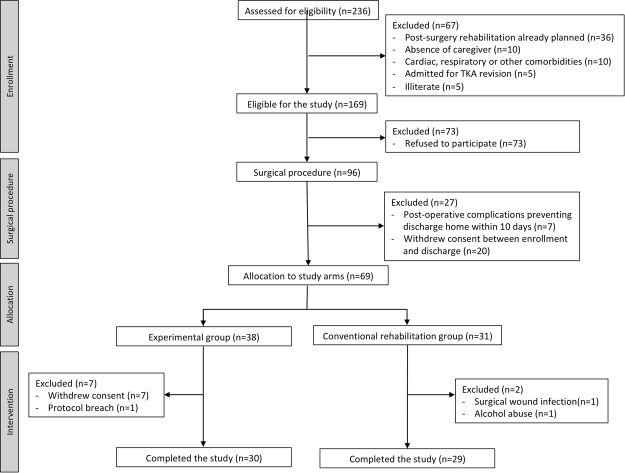
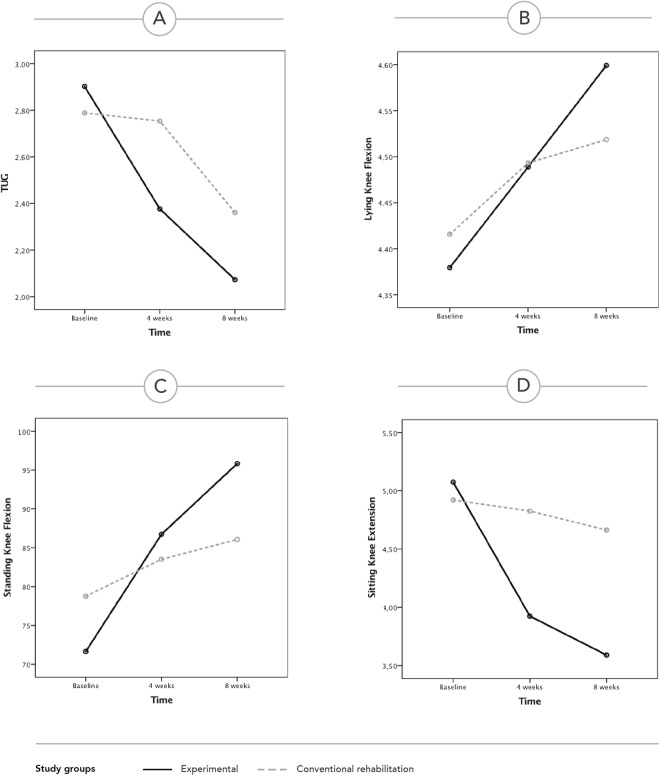
In-person home-based rehabilitation and telerehabilitation can be as effective as clinic-based rehabilitation after total knee arthroplasty (TKA), but require heavy logistics and are highly dependent on human supervision. New technologies that allow independent home-based rehabilitation without constant human supervision may help solve this problem. This was a single-center, feasibility study comparing a digital biofeedback system that meets these needs against conventional in-person home-based rehabilitation after TKA over an 8-week program. Primary outcome was the change in the Timed Up and Go score between the end of the program and baseline. Fifty-nine patients completed the study (30 experimental group; 29 conventional rehabilitation). The study demonstrated a superiority of the experimental group for all outcomes. Adverse events were similar in both groups. This is the first study to demonstrate that a digital rehabilitation solution can achieve better outcomes than conventional in-person rehabilitation, while less demanding in terms of human resources.
Overview
The claims and statistics of this paper haven’t been checked yet.
Run the check — free, no account needed. It reads the open-access text and checks the sources it cites.
Integrity signals
Registry
Cites
Statistics
Figures
Verification
Claims the paper makes
The claims and statistics of this paper haven’t been checked yet.
Run the check — free, no account needed. It reads the open-access text and checks the sources it cites.
Claims other papers make about this one
Each is checked against this paper’s own text: does it say what the citing paper says it does?
The source backs part of the claim, not all of it — or backs it for a different population, condition or comparison.
In the citing paper
“Previously, we have demonstrated the utility of a completely remote digital care program (DCP) integrating exercise, education, and cognitive behavioral therapy (CBT) in several MSK conditions [42,43,44,45], including for upper limb [46,47,48].”
From Digital Rehabilitation for Elbow Pain Musculoskeletal Conditions: A Prospective Longitudinal Cohort Study (2022) · cites this paper as [44]
Experimental — accuracy not yet measuredIn the citing paper
“Telerehabilitation has shown to provide comparable results to outpatient physical therapy [35–39] and to face-to-face home rehabilitation [40, 41], while reducing costs [42–44].”
From Telerehabilitation of acute musculoskeletal multi-disorders: prospective, single-arm, interventional study (2022) · cites this paper as [41]
In the citing paper
“This DCP was previously validated (feasibility and effectiveness) in post-surgery MSK rehabilitation [38, 41, 45, 46].”
From Telerehabilitation of acute musculoskeletal multi-disorders: prospective, single-arm, interventional study (2022) · cites this paper as [41]
Self-check
Percentages, sums and reported differences re-computed from the paper’s own numbers.
The self-check needs the paper’s full text.
Citations
Cites
The Timed “Up & Go”: A Test of Basic Functional Mobility for Frail Elderly Persons
Podsiadlo, D., & Richardson, S. (1991) · Journal of the American Geriatrics Society · doi:10.1111/j.1532-5415.1991.tb01616.x · Cited by 14,418
Projections of Primary and Revision Hip and Knee Arthroplasty in the United States from 2005 to 2030
Kurtz, S. M., Ong, K. L., Lau, E., Mowat, F. S., & Halpern, M. T. (2007) · Journal of Bone and Joint Surgery · doi:10.2106/jbjs.f.00222 · Cited by 8,714
Roos, E. M., Roos, H. P., Lohmander, S. L., Ekdahl, C. S., & Beynnon, B. D. (1998) · Journal of Orthopaedic and Sports Physical Therapy · doi:10.2519/jospt.1998.28.2.88 · Cited by 3,989
The Knee injury and Osteoarthritis Outcome Score (KOOS): from joint injury to osteoarthritis.
Roos, E. M., & Lohmander, S. L. (2003) · Health and Quality of Life Outcomes · doi:10.1186/1477-7525-1-64 · Cited by 2,361
Giggins, O. M., Persson, U., & Caulfield, B. (2013) · Journal of NeuroEngineering and Rehabilitation · doi:10.1186/1743-0003-10-60 · Cited by 760
Cottrell, M. A., Galea, O. A., O’Leary, S. P., Hill, A. J., & Russell, T. G. (2017) · Clinical Rehabilitation · doi:10.1177/0269215516645148 · Cited by 708
Quadriceps Strength and the Time Course of Functional Recovery After Total Knee Arthroplasty
Mizner, R. L., Petterson, S. C., & Snyder‐Mackler, L. (2005) · Journal of Orthopaedic and Sports Physical Therapy · doi:10.2519/jospt.2005.35.7.424 · Cited by 546
OECD (2015) · Health at a glance · doi:10.1787/health_glance-2015-en · Cited by 439
Russell, T. G., Buttrum, P., Wootton, R., & Jull, G. A. (2011) · The Journal of Bone and Joint Surgery-American Volume · doi:10.2106/jbjs.i.01375 · Cited by 382
Petterson, S. C., Mizner, R. L., Stevens, J. E., Raisis, L., Bodenstab, A. B., Newcomb, W., & Snyder‐Mackler, L. (2009) · Arthritis Care & Research · doi:10.1002/art.24167 · Cited by 326
Cited by
Sorted by citations
Items 101–110 of 110
Hernandez, V., & Gentiane, V. (2026) · Smart Health · doi:10.1016/j.smhl.2026.100635
Balance Training After Total Knee Arthroplasty: A Scoping Review
Kaur, M., & Kaur, V. P. (2026) · Current Physical Medicine and Rehabilitation Reports · doi:10.1007/s40141-026-00537-6
Karibzhanova, D., Niyetkaliyev, A. S., Khawaja, A. R., Zhaisanbek, A., Zeeshan, Utepbergen, A., Jamwal, P. K., Ozhikenov, К., Ozhikenova, A. K., Alimbayev, C. A., et al. (2026) · doi:10.2196/preprints.94916
State-of-the-Art Knee Exoskeleton for Gait Assistance and Rehabilitation: Systematic Review
Karibzhanova, D., Niyetkaliyev, A. S., Khawaja, A. R., Zhaisanbek, A., Zeeshan, Utepbergen, A., Jamwal, P. K., Ozhikenov, К., Ozhikenova, A. K., Alimbayev, C. A., et al. (2026) · JMIR Rehabilitation and Assistive Technologies · doi:10.2196/94916
Pagano, S., Dendorfer, S., & Renkawitz, T. F. (2026) · Journal of Personalized Medicine · doi:10.3390/jpm16070393
Paolucci, T., Rizzo, L. B., Cichelli, A., Bressi, F., Bernetti, A., Farì, G., Megna, M., Bonerba, M., Marotta, A., & Nicola, M. D. (2026) · Frontiers in Digital Health · doi:10.3389/fdgth.2026.1885446 · Cited by 1
Nakla, A. P., Aubin, P. M., Ademisoye, S., Burr, R. G., Rajaee, S. S., & Wu, M. (2026) · The Journal of Arthroplasty · doi:10.1016/j.arth.2026.08.011
Costa, F. M. T. A., Janela, D., Molinos, M., Moulder, R. G., Jr., Bento, V., Laíns, J., Scheer, J. K., Yanamadala, V., Cohen, S. P., & Correia, F. D. (2026) · Journal of Medical Internet Research · doi:10.2196/97493
Self-citationAreias, A. C., Janela, D., Molinos, M., Moulder, R. G., Jr., Bento, V., Yanamadala, V., Cohen, S. P., Correia, F. D., & Costa, F. M. T. A. (2026) · JMIR Rehabilitation and Assistive Technologies · doi:10.2196/97495
Self-citationFarrokhi, N., Sarzaeem, M. M., Feizi, D., Mohammadi, T., & Heydari, M. (2026) · BMJ Open · doi:10.1136/bmjopen-2025-112566
Metadata
- Authors
- Correia, F. D., Nogueira, A., Magalhães, I., Guimarães, J., Moreira, M., Barradas, I., Teixeira, L., Tulha, J., Seabra, R., Lains, J., & Bento, V.
- Affiliations
- Hospital de Santo António (PT)
- Sword Health, SA (Portugal) (PT)
- Universidade do Porto (PT)
- Hospital da Prelada (PT)
- Corresponding author
- Correia, Fernando Dias
- ORCID
- Venue
- Scientific Reports
- Published
- 2018-07-26
- Volume
- 8
- Issue
- 1
- Pages
- 11299-11299
- ISSN
- 2045-2322 (ISSN-L)
- PMC
- PMC6062628
- OpenAlex
- W2883522275
- Cited by
- 110
- References
- 52
- Citations by year
- 2026: 12 · 2025: 13 · 2024: 10 · 2023: 19 · 2022: 25 · 2021: 11 · 2020: 12 · 2019: 7
- FWCI
- 7.80
- Type
- journal article
- Language
- en
- Update notices
- correction (2026-06-23)
- Open access
- gold
- doi.org
- Locations
- Scientific Reports (publishedVersion, cc-by)
- Europe PMC (PubMed Central) (publishedVersion, other-oa)
- PubMed Central (publishedVersion, cc-by)
- PubMed (publishedVersion)
- DOAJ (DOAJ: Directory of Open Access Journals) (submittedVersion, cc-by-sa)
- Portuguese National Funding Agency for Science, Research and Technology (RCAAP Project by FCT) (submittedVersion, cc-by)
- Portuguese National Funding Agency for Science, Research and Technology (RCAAP Project by FCT) (submittedVersion, other-oa)
- Funders
- European Commission (H2020, 672814)
- Horizon 2020 Framework Programme
- Topics
- Health Sciences › Medicine › Surgery › Total Knee Arthroplasty Outcomes
- Physical Sciences › Engineering › Biomedical Engineering › Prosthetics and Rehabilitation Robotics
- Health Sciences › Medicine › Rehabilitation › Stroke Rehabilitation and Recovery
- Keywords
- total knee arthroplasty, home-based rehabilitation, telerehabilitation, Timed Up and Go test, walking speed, postoperative rehabilitation, feasibility
- MeSH terms
- Telerehabilitation, Aged, Feasibility Studies, Feedback, Female, Humans, Locomotion, Male, Middle Aged, Time, Treatment Outcome, Arthroplasty, Replacement, Knee, Drug-Related Side Effects and Adverse Reactions
About these checks
Registry, retraction, Cites and statistics results are computed, not judged, with one exception: a printed reference that no index lists is read once by a model before it counts as a citation error. Claims are extracted by a model and kept only when their quote appears verbatim in the text; each cited source is then checked, with a model’s help, for whether it says what the claim relies on. Those verdicts can be wrong — read the claim’s quote and the cited source before relying on one.
Statistics and arithmetic are recomputed, not judged.
Confidence bands are shown only for fields calibrated on our annotated test set. None is calibrated yet, so no band is shown.
What counts as a claim ›How we measure confidence ›How we check this ›
Are you an author, or do you see a problem with this page? Request a review
