

Expression of key genes affecting artemisinin content in five Artemisia species
Open accessThe DOI matches its Crossref record; 57 of the 57 references it cites were found in a registry or an index.
Abstract
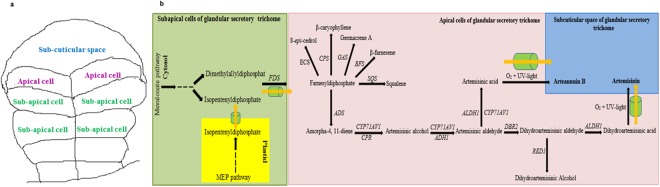
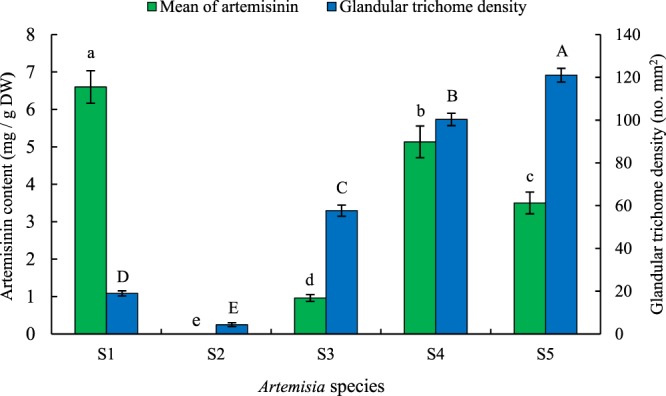
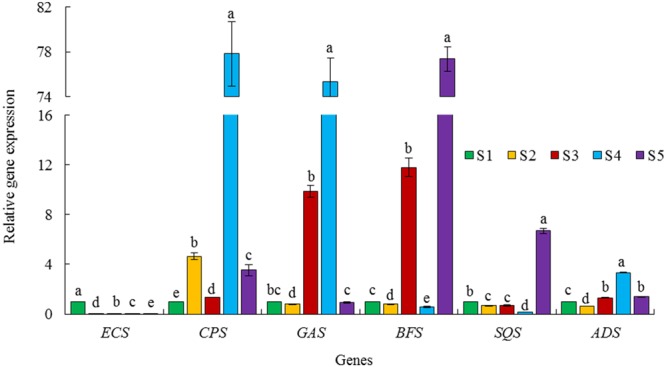
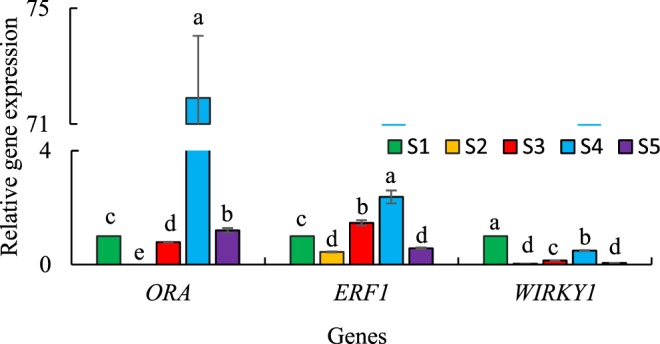
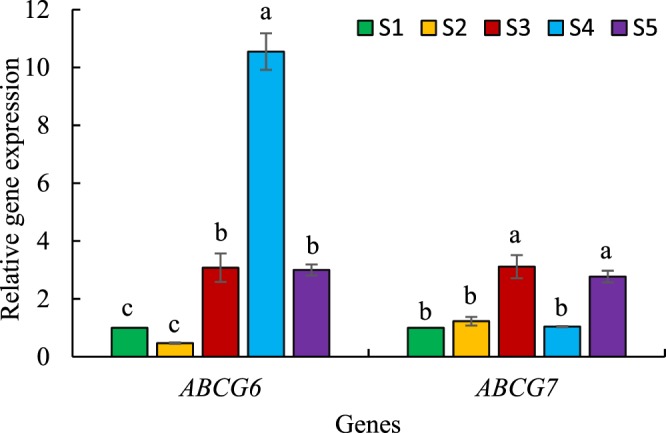
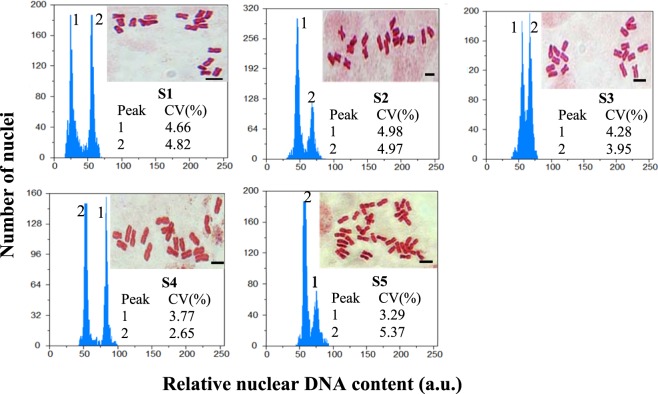
Artemisinin, an effective anti-malarial drug is synthesized in the specialized 10-celled biseriate glandular trichomes of some Artemisia species. In order to have an insight into artemisinin biosynthesis in species other than A. annua, five species with different artemisinin contents were investigated for the expression of key genes that influence artemisinin content. The least relative expression of the examined terpene synthase genes accompanied with very low glandular trichome density (4 No. mm−2) and absence of artemisinin content in A. khorassanica (S2) underscored the vast metabolic capacity of glandular trichomes. A. deserti (S4) with artemisinin content of 5.13 mg g−1 DW had a very high expression of Aa-ALDH1 and Aa-CYP71AV1 and low expression of Aa-DBR2. It is possible to develop plants with high artemisinin synthesis ability by downregulating Aa-ORA in S4, which may result in the reduction of Aa-ALDH1 and Aa-CYP71AV1 genes expression and effectively change the metabolic flux to favor more of artemisinin production than artemisinic acid. Based on the results, the Aa-ABCG6 transporter may be involved in trichome development. S4 had high transcript levels and larger glandular trichomes (3.46 fold) than A. annua found in Iran (S1), which may be due to the presence of more 2C-DNA (3.48 fold) in S4 than S1.
Overview
The claims and statistics of this paper haven’t been checked yet.
Free: it reads the open-access text and checks the first 5 claims that cite a source we can check. Create a free account to check every claim.
Integrity signals
Registry
Cites
Statistics
Figures
Verification
Claims the paper makes
The claims and statistics of this paper haven’t been checked yet.
Free: it reads the open-access text and checks the first 5 claims that cite a source we can check. Create a free account to check every claim.
Claims other papers make about this one
Each is checked against this paper’s own text: does it say what the citing paper says it does?
The cited source says what the claim attributes to it.
In the citing paper
“Artemisinin, a sesquiterpene lactone obtained from Artemisia annua L., is the most potent drug against malaria and used in the formulation of artemisinin combination therapies (ACTs).”
From Enhancing artemisinin content in and delivery from Artemisia annua: a review of alternative, classical, and transgenic approaches (2021) · cites this paper as Salehi et al. 2018
Self-check
Percentages, sums and reported differences re-computed from the paper’s own numbers.
The self-check needs the paper’s full text.
Citations
Cites
Analysis of Relative Gene Expression Data Using Real-Time Quantitative PCR and the 2−ΔΔCT Method
Livak, K. J., & Schmittgen, T. D. (2001) · Methods · doi:10.1006/meth.2001.1262 · Cited by 180,860
Mutation of the mouse klotho gene leads to a syndrome resembling ageing
Kuro-o, M., Matsumura, Y., Aizawa, H., Kawaguchi, H., Suga, T., Utsugi, T., Ohyama, Y., Kurabayashi, M., Kaname, T., Kume, E., et al. (1997) · Nature · doi:10.1038/36285 · Cited by 3,837
Chromosomal evolution in higher plants
Stebbins, G. L. (1971) · Medical Entomology and Zoology · Cited by 3,074
Estimation of nuclear DNA content in plants using flow cytometry
Doležel, J., Greilhuber, J., & Suda, J. (2007) · Nature Protocols · doi:10.1038/nprot.2007.310 · Cited by 1,639
Network Analysis of the MVA and MEP Pathways for Isoprenoid Synthesis
Vranová, E., Coman, D., & Gruissem, W. (2013) · Annual Review of Plant Biology · doi:10.1146/annurev-arplant-050312-120116 · Cited by 1,160
Doležel, J., Bartoš, J., Voglmayr, H., & Greilhuber, J. (2003) · Cytometry Part A · doi:10.1002/cyto.a.10013 · Cited by 1,071
Two New Nuclear Isolation Buffers for Plant DNA Flow Cytometry: A Test with 37 Species
Loureiro, J., Rodriguez, E., Dolezel, J., & Santos, C. (2007) · Annals of Botany · doi:10.1093/aob/mcm152 · Cited by 735
GREILHUBER, J. (2005) · Annals of Botany · doi:10.1093/aob/mci019 · Cited by 717
The Artemisia L. Genus: A Review of Bioactive Essential Oils
Abad, M. J., Bedoya, L. M., Apaza, L., & Bermejo, P. (2012) · Molecules · doi:10.3390/molecules17032542 · Cited by 615
The Genus Artemisia: A Comprehensive Review
Bora, K. S., & Sharma, A. (2011) · Pharmaceutical Biology · doi:10.3109/13880209.2010.497815 · Cited by 548
Cited by
Genetic Control of Glandular Trichome Development
Chalvin, C., Drevensek, S., Dron, M., Bendahmane, A., & Boualem, A. (2020) · Trends in Plant Science · doi:10.1016/j.tplants.2019.12.025 · Cited by 179
“In tomato, glandular trichomes are essential for plant defense against herbivores [2,18–22]; in Artemisia annua , they produce the anti-malarial drug artemisinin [8,23,24]; and in cucumber, their size and number are important fruit quality traits [25–27].”
BackgroundSalehi, M., Naghavi, M. R., & Bahmankar, M. (2019) · Industrial Crops and Products · doi:10.1016/j.indcrop.2019.111511 · Cited by 109
Self-citationSalehi, M., Cornish, K., Bahmankar, M., & Naghavi, M. R. (2021) · Industrial Crops and Products · doi:10.1016/j.indcrop.2021.113667 · Cited by 118
Self-citationSalehi, M., Farhadi, S., Moieni, A., Safaie, N., & Hesami, M. (2021) · Plant Methods · doi:10.1186/s13007-021-00714-9 · Cited by 96
Self-citationWani, K. I., Choudhary, S., Zehra, A., Naeem, M., Weathers, P., & Aftab, T. (2021) · Planta · doi:10.1007/s00425-021-03676-3 · Cited by 74
Salehi, M., Farhadi, S., Moieni, A., Safaie, N., & Ahmadi, H. (2020) · Frontiers in Plant Science · doi:10.3389/fpls.2020.01148 · Cited by 71
Self-citationA concise review on Artemisia annua L.: A major source of diverse medicinal compounds
Soni, R., Shankar, G., Mukhopadhyay, P., & Gupta, V. (2022) · Industrial Crops and Products · doi:10.1016/j.indcrop.2022.115072 · Cited by 76
Farhadi, S., Salehi, M., Moieni, A., Safaie, N., & Sabet, M. S. (2020) · PLoS ONE · doi:10.1371/journal.pone.0237478 · Cited by 63
Self-citationCRISPR-based metabolic editing: Next-generation metabolic engineering in plants
Sabzehzari, M., Zeinali, M., & Naghavi, M. R. (2020) · Gene · doi:10.1016/j.gene.2020.144993 · Cited by 59
Self-citationSalehi, M., Karimzadeh, G., & Naghavi, M. R. (2019) · Plant Cell Tissue and Organ Culture (PCTOC) · doi:10.1007/s11240-019-01593-8 · Cited by 57
Self-citationCheng, Y., Luo, J., Li, H., Feng, W., Zhang, Y., Jiang, H., & Peng, X. (2022) · International Journal of Molecular Sciences · doi:10.3390/ijms231810270 · Cited by 58
“Total RNA was extracted using the Trizol method [71,72].”
MethodWhole fungal elicitors boost paclitaxel biosynthesis induction in Corylus avellana cell culture
Salehi, M., Moieni, A., Safaie, N., & Farhadi, S. (2020) · PLoS ONE · doi:10.1371/journal.pone.0236191 · Cited by 50
Self-citationFarhadi, S., Moieni, A., Safaie, N., Sabet, M. S., & Salehi, M. (2020) · Scientific Reports · doi:10.1038/s41598-020-62196-4 · Cited by 45
Self-citationNaeini, M. S., Naghavi, M. R., Bihamta, M. R., Sabokdast, M., & Salehi, M. (2020) · In Vitro Cellular & Developmental Biology - Plant · doi:10.1007/s11627-020-10123-7 · Cited by 31
“With the advent of biotechnology, a number of alternative routes including callus culture, cell suspension culture, and hairy root culture have been proposed, and widely utilized (Tashackori et al. 2016; Salehi et al. 2018c, 2019a, b, c, d; Farhadi et al. 2020b).”
MethodSelf-citationBahmankar, M., Mortazavian, S. M. M., Tohidfar, M., Noori, S. A. S., Izadi‐Darbandi, A., & Al-Fekaiki, D. F. (2018) · Industrial Crops and Products · doi:10.1016/j.indcrop.2018.10.080 · Cited by 30
Golubkina, N., Logvinenko, L. A., Коновалов, Д. А., Garsiya, E. R., Федотов, М. А., Alpatov, A., Шевчук, О. М., Skrypnik, L. N., Sękara, A., & Caruso, G. (2022) · Horticulturae · doi:10.3390/horticulturae8070597 · Cited by 27
Bioprospecting of Artemisia genus: from artemisinin to other potentially bioactive compounds
Negri, S., Pietrolucci, F., Andreatta, S., Njoku, R. C., Ramos, C. A. S. N., Crimi, M., Commisso, M., Guzzo, F., & Avesani, L. (2024) · Scientific Reports · doi:10.1038/s41598-024-55128-z · Cited by 29
He, W., Liu, H., Li, Y., Wu, Z., Xie, Y., Yan, X., Wang, X., Miao, Q., Chen, T., Rahman, S.-U., et al. (2023) · Industrial Crops and Products · doi:10.1016/j.indcrop.2023.116736 · Cited by 32
Sayadi, V., Karimzadeh, G., Monfared, S. R., & Naghavi, M. R. (2020) · PLoS ONE · doi:10.1371/journal.pone.0228747 · Cited by 28
“Eliminating environmental effects via plant propagation under the same conditions have been noted by others studies [42,52,56].”
BackgroundResultSelf-citationFathi, E., Majdi, M., Dastan, D., & Maroufi, A. (2019) · Plant Physiology and Biochemistry · doi:10.1016/j.plaphy.2019.06.036 · Cited by 16
Rasouli, O., Ahmadi, N., & Monfared, S. R. (2020) · Scientia Horticulturae · doi:10.1016/j.scienta.2020.109399 · Cited by 13
Jamshidi, B., Etminan, A., Mehrabi, A., Shooshtari, L., & Pour‐Aboughadareh, A. (2024) · Heliyon · doi:10.1016/j.heliyon.2024.e26388 · Cited by 10
“Nomonov et al. [33] studied seven species of Artemisia in Tajikistan and found that the amount of artemisinin is between 0.07% and 0.45% of the dry mass. Salehi et al. [22] reported that A. deserti had 5.13 mg/g DW artemisinin.”
BackgroundInfluentialPark, Y. J., Truong, T. Q., Choi, Y. B., Huynh, P. K., Moon, J., Koo, S. Y., Kim, H. S., & Kim, S. M. (2024) · Applied Biological Chemistry · doi:10.1186/s13765-024-00883-w · Cited by 7
“Notably, the density and size of GTs had no significant correlation with the artemisinin content within these species [17].”
BackgroundA Short Review on Genes Regulating Biosynthesis of Major Secondary Metabolites
Kashyap, A. K., Dubey, S. K., Shah, S., & Kumar, A. (2022) · Springer eBooks · doi:10.1007/978-981-19-5779-6_20 · Cited by 11
Iakab, M., Domokos, E., Benedek, K., Molnár, K., Kentelky, E., Buta, E., & Dulf, F. V. (2022) · Horticulturae · doi:10.3390/horticulturae8121106 · Cited by 8
Hussain, A. (2023) · Current Pharmaceutical Biotechnology · doi:10.2174/1389201024666230327082051 · Cited by 8
Chen, S., Liao, B., Guo, S., Shen, X., Meng, Y., Liang, Y., Xu, J., & Chen, S. (2023) · Chinese Medicine · doi:10.1186/s13020-023-00708-w · Cited by 7
Current state, strategies, and perspectives in enhancing artemisinin production
Zakariya, A. M., Saiman, M. Z., Simonsen, H. T., & Ikram, N. K. K. (2023) · Phytochemistry Reviews · doi:10.1007/s11101-023-09897-6 · Cited by 5
“Its biosynthesis in A. annua occurs in the glandular secretory trichome located in the aerial parts of the plant (Salehi et al. 2018).”
Regulatory trends in engineering bioactive-phytocompounds
Saifi, M., Ashrafi, K., Qamar, F., & Abdin, M. Z. (2024) · Plant Science · doi:10.1016/j.plantsci.2024.112167 · Cited by 4
Strategies for enhancing paclitaxel bioavailability for cancer treatment
Salehi, M., & Farhadi, S. (2021) · Elsevier eBooks · doi:10.1016/b978-0-323-90951-8.00006-0 · Cited by 5
Self-citationSalehi, M., Bahmankar, M., & Naghavi, M. R. (2023) · Physiology · doi:10.5772/intechopen.109985 · Cited by 2
Self-citationZhang, M., Zhang, X., Wei, R., Li, Y.-N., Hu, Y., Zou, Y., Li, X., Wang, Y., Yang, W., & Guo, D. (2025) · Journal of Pharmaceutical Analysis · doi:10.1016/j.jpha.2025.101455 · Cited by 1
Zhang, S., Xu, H., Zhong, G., Huang, D.-W., Jiang, K., Wu, J., & Wang, B. (2023) · Industrial Crops and Products · doi:10.1016/j.indcrop.2023.117684 · Cited by 1
Glandular Trichomes: Bio-cell Factories of Plant Secondary Metabolites
Shukla, P., Prasad, A., Chawda, K., Saxena, G., Pandey, K. D., & Chakrabarty, D. (2024) · BENTHAM SCIENCE PUBLISHERS eBooks · doi:10.2174/9789815165227124010008 · Cited by 3
Chen, S., Liao, B., Guo, S., Shen, X., Meng, Y., Liang, Y., Xu, J., & Chen, S. (2024) · Figshare · doi:10.6084/m9.figshare.26560628
Chen, S., Liao, B., Guo, S., Shen, X., Meng, Y., Liang, Y., Xu, J., & Chen, S. (2024) · Figshare · doi:10.6084/m9.figshare.26560655
Chen, S., Liao, B., Guo, S., Shen, X., Meng, Y., Liang, Y., Xu, J., & Chen, S. (2024) · Figshare · doi:10.6084/m9.figshare.26560640
Chen, S., Liao, B., Guo, S., Shen, X., Meng, Y., Liang, Y., Xu, J., & Chen, S. (2024) · Figshare · doi:10.6084/m9.figshare.26560637
Chen, S., Liao, B., Guo, S., Shen, X., Meng, Y., Liang, Y., Xu, J., & Chen, S. (2024) · Figshare · doi:10.6084/m9.figshare.26560631
Chen, S., Liao, B., Guo, S., Shen, X., Meng, Y., Liang, Y., Xu, J., & Chen, S. (2024) · Figshare · doi:10.6084/m9.figshare.26560646
Chen, S., Liao, B., Guo, S., Shen, X., Meng, Y., Liang, Y., Xu, J., & Chen, S. (2024) · Figshare · doi:10.6084/m9.figshare.26560634
Chen, S., Liao, B., Guo, S., Shen, X., Meng, Y., Liang, Y., Xu, J., & Chen, S. (2024) · Figshare · doi:10.6084/m9.figshare.26560649
Chen, S., Liao, B., Guo, S., Shen, X., Meng, Y., Liang, Y., Xu, J., & Chen, S. (2024) · Figshare · doi:10.6084/m9.figshare.26560658
Chen, S., Liao, B., Guo, S., Shen, X., Meng, Y., Liang, Y., Xu, J., & Chen, S. (2024) · Figshare · doi:10.6084/m9.figshare.26560643
Chen, S., Liao, B., Guo, S., Shen, X., Meng, Y., Liang, Y., Xu, J., & Chen, S. (2024) · Figshare · doi:10.6084/m9.figshare.26560652
Kaleja, E., Radenkovs, V., Gāliņa, D., Juhnevica-Radenkova, K., Krasnova, I., & Valdovska, A. (2025) · Journal of Food Biochemistry · doi:10.1155/jfbc/6620031
Hallajian, M. T., Mohammadi, S. T., Ebrahimi, M. A., Naghavi, M. R., & Kordrostami, M. (2025) · Research Square · doi:10.21203/rs.3.rs-7265007/v1
Self-citationMahjouri, S., Rad, R. M., Jafarirad, S., Tarrahi, R., Sabaghfartash, F., Kiani, A., Gharehatlou, M. F., Faraj, S. E., Bakhshi, R., & Kosari‐Nasab, M. (2026) · Scientific Reports · doi:10.1038/s41598-026-38581-w
“Prior studies have identified that a high ALDH1 / DBR2 expression ratio indicates favorability to a metabolic switch toward artemisinic acid rather than artemisinin, particularly in A. deserti , where high expression of ALDH1 lead to accumulation of artemisinic acid in place of artemisinin 30 .”
Zhao, J., Xue, W., Shi, J., Zhao, X., Zhang, Y., & Zhang, Y. (2026) · Vegetable Research · doi:10.48130/vegres-0026-0019
Metadata
- Authors
- Salehi, M., Karimzadeh, G., Naghavi, M. R., Naghdi Badi, H., & Rashidi Monfared, S.
- Affiliations
- Tarbiat Modares University (IR)
- University of Tehran (IR)
- Corresponding author
- Karimzadeh, Ghasem
- Venue
- Scientific Reports
- Published
- 2018-08-23
- Volume
- 8
- Issue
- 1
- Pages
- 12659-12659
- ISSN
- 2045-2322 (ISSN-L)
- PMC
- PMC6107673
- OpenAlex
- W2886012941
- Cited by
- 44
- References
- 57
- Citations by year
- 2026: 2 · 2025: 3 · 2024: 11 · 2023: 6 · 2022: 5 · 2021: 4 · 2020: 9 · 2019: 3 · 2018: 1
- FWCI
- 1.51
- Type
- journal article
- Language
- en
- Update notices
- correction (2018-10-15)
- Open access
- gold
- doi.org
- Licence
- cc-by
- creativecommons.org/licenses/by/4.0 (tdm)
- creativecommons.org/licenses/by/4.0 (vor)
- Locations
- Scientific Reports (publishedVersion, cc-by)
- Europe PMC (PubMed Central) (publishedVersion, other-oa)
- PubMed Central (publishedVersion, cc-by)
- PubMed (publishedVersion)
- DOAJ (DOAJ: Directory of Open Access Journals) (submittedVersion)
- Funders
- National Science Foundation
- Iran National Science Foundation
- Tarbiat Modares University
- Topics
- Life Sciences › Biochemistry, Genetics and Molecular Biology › Molecular Biology › Plant biochemistry and biosynthesis
- Physical Sciences › Chemistry › Organic Chemistry › Sesquiterpenes and Asteraceae Studies
- Life Sciences › Agricultural and Biological Sciences › Plant Science › Plant tissue culture and regeneration
- Keywords
- artemisinin biosynthesis, Artemisia, glandular trichomes, terpene synthase genes, gene expression, Artemisia annua, ALDH1, CYP71AV1, Ora, artemisinic acid, metabolic flux, trichome development
- MeSH terms
- Antimalarials, Plant Proteins, Gene Expression Regulation, Plant, Plant Leaves, Artemisia, Alkyl and Aryl Transferases, Plants, Genetically Modified, Artemisia annua, Artemisinins, Trichomes
About these checks
Registry, retraction, Cites and statistics results are computed, not judged, with one exception: a printed reference that no index lists is read once by a model before it counts as a citation error. Claims are extracted by a model and kept only when their quote appears verbatim in the text; each cited source is then checked, with a model’s help, for whether it says what the claim relies on. Those verdicts can be wrong — read the claim’s quote and the cited source before relying on one.
Statistics and arithmetic are recomputed, not judged.
Confidence bands are shown only for fields calibrated on our annotated test set. None is calibrated yet, so no band is shown.
What counts as a claim ›How we measure confidence ›How we check this ›
Are you an author, or do you see a problem with this page? Request a review
Data sources
Bibliographic data: Semantic Scholar, OpenAlex, Crossref.
Contains information from the Semantic Scholar Academic Graph Datasets, made available under the ODC Attribution License (ODC-BY 1.0).
Semantic Scholar’s data is described in: Kinney, R., et al. (2023). The Semantic Scholar Open Data Platform. arXiv:2301.10140.
