

The DOI matches its Crossref record; 51 of the 52 references it cites were found in a registry or an index.
Distribution of insulin in trigeminal nerve and brain after intranasal administration
Open accessAbstract
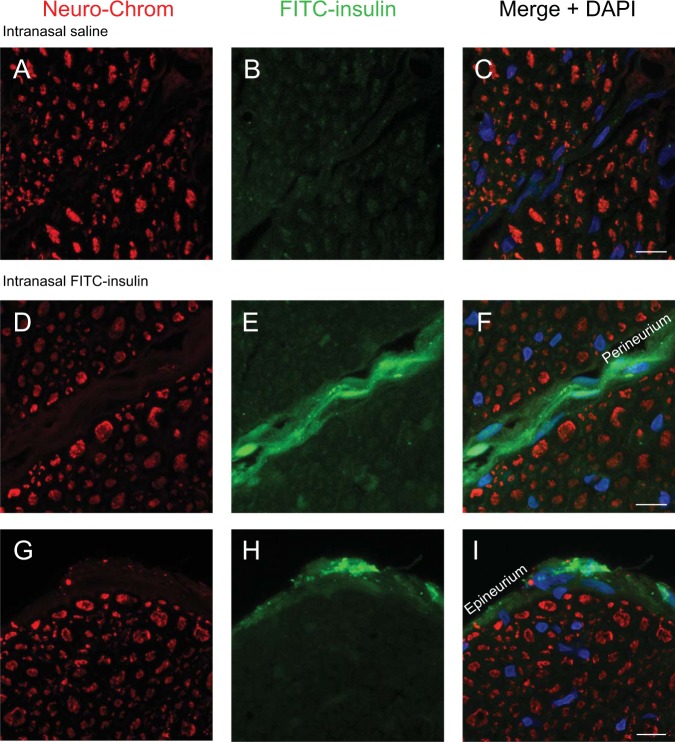
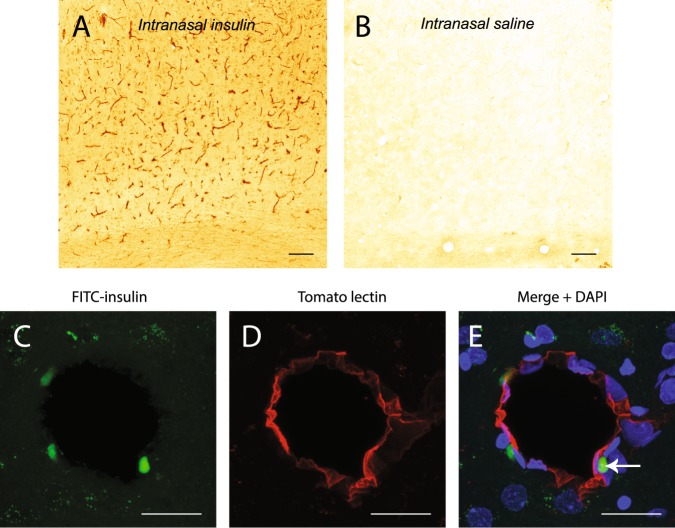
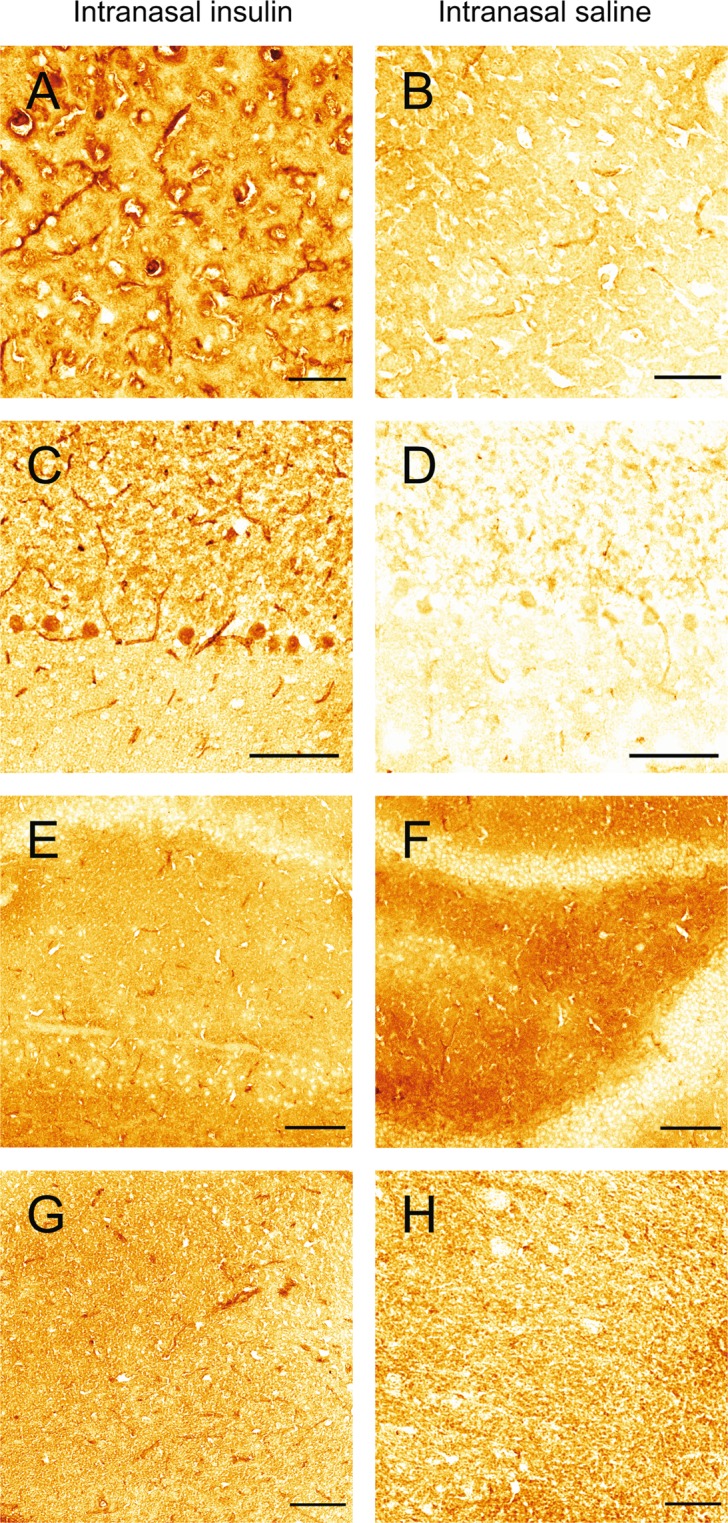
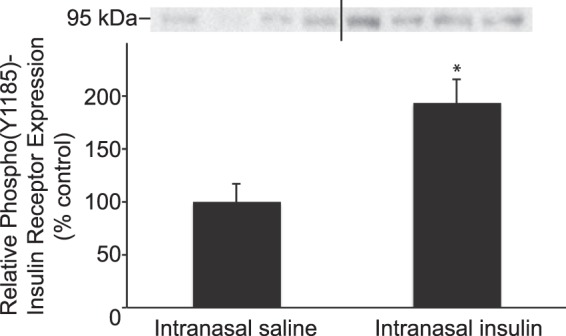
In the brain, insulin acts as a growth factor, regulates energy homeostasis, and is involved in learning and memory acquisition. Many central nervous system (CNS) diseases are characterized by deficits in insulin signaling. Pre-clinical studies have shown that intranasal insulin is neuroprotective in models of Alzheimer’s disease, Parkinson’s disease, and traumatic brain injury. Clinical trials have also shown that intranasal insulin elicits beneficial cognitive effects in patients with Alzheimer’s disease. It is known that insulin can be detected in the CNS within minutes following intranasal administration. Despite these advances, the anatomical pathways that insulin utilizes to reach the CNS and the cellular CNS targets after intranasal administration are not fully understood. Here, we intranasally administered fluorescently labeled insulin and imaged its localization within the brain and trigeminal nerves. Our data indicates that intranasal insulin can reach cellular CNS targets along extracellular components of the trigeminal nerve. Upon CNS entry, we found insulin significantly increased levels of an activated form of the insulin receptor. These findings suggest that the intranasal route of administration is able to effectively deliver insulin to CNS targets in a biologically active form.
Overview
The claims and statistics of this paper haven’t been checked yet.
Run the check — free, no account needed. It reads the open-access text and checks the sources it cites.
Integrity signals
Registry
Cites
Statistics
Figures
Verification
Claims the paper makes
The claims and statistics of this paper haven’t been checked yet.
Run the check — free, no account needed. It reads the open-access text and checks the sources it cites.
Claims other papers make about this one
Each is checked against this paper’s own text: does it say what the citing paper says it does?
In the citing paper
“In rats, transport along trigeminal nerve branches to brainstem regions has also been demonstrated.”
From Intranasal insulin (2021) · cites this paper as [34]
Self-check
Percentages, sums and reported differences re-computed from the paper’s own numbers.
The self-check needs the paper’s full text.
Citations
Cites
A Simple Practice Guide for Dose Conversion between Animals and Human
Nair, A., & Jacob, S. (2016) · Journal of Basic and Clinical Pharmacy · doi:10.4103/0976-0105.177703 · Cited by 6,174
Iliff, J. J., Wang, M., Liao, Y., Plogg, B. A., Peng, W., Gundersen, G. A., Benveniste, H., Vates, G. E., Deane, R., Goldman, S. A., et al. (2012) · Science Translational Medicine · doi:10.1126/scitranslmed.3003748 · Cited by 5,824
Brain insulin resistance in type 2 diabetes and Alzheimer disease: concepts and conundrums
Arnold, S. E., Arvanitakis, Z., Macauley-Rambach, S. L., Koenig, A. M., Wang, H.-Y., Ahima, R. S., Craft, S., Gandy, S., Buettner, C., Stoeckel, L. E., et al. (2018) · Nature Reviews Neurology · doi:10.1038/nrneurol.2017.185 · Cited by 1,597
Impairment of paravascular clearance pathways in the aging brain
Kress, B. T., Iliff, J. J., Xia, M., Wang, M., Wei, H. S., Zeppenfeld, D., Xie, L., Kang, H., Xu, Q., Liew, J. A., et al. (2014) · Annals of Neurology · doi:10.1002/ana.24271 · Cited by 1,521
Sniffing neuropeptides: A transnasal approach to the human brain
Born, J., Lange, T., Kern, W., McGregor, G. P., Bickel, U., & Fehm, H. L. (2002) · Nature Neuroscience · doi:10.1038/nn0602-849 · Cited by 1,356
Craft, S. (2012) · Archives of Neurology · doi:10.1001/archneurol.2011.233 · Cited by 1,253
Intranasal delivery of biologics to the central nervous system
Lochhead, J. J., & Thorne, R. G. (2012) · Advanced Drug Delivery Reviews · doi:10.1016/j.addr.2011.11.002 · Cited by 1,214
Self-citationImpairment of Glymphatic Pathway Function Promotes Tau Pathology after Traumatic Brain Injury
Iliff, J. J., Chen, M. J., Plog, B. A., Zeppenfeld, D. M., Soltero, M., Yang, L., Singh, I., Deane, R., & Nedergaard, M. (2014) · The Journal of Neuroscience · doi:10.1523/jneurosci.3020-14.2014 · Cited by 1,159
Thorne, R. G., Pronk, G. J., Padmanabhan, V., & Frey, W. H. (2004) · Neuroscience · doi:10.1016/j.neuroscience.2004.05.029 · Cited by 958
Intranasal insulin improves memory in humans
Benedict, C., Hallschmid, M., Hatke, A., Schultes, B., Fehm, H. L., Born, J., & Kern, W. (2004) · Psychoneuroendocrinology · doi:10.1016/j.psyneuen.2004.04.003 · Cited by 699
Cited by
Sorted by citations
Items 101–146 of 146
Diagnostic and theranostic intranasal nanointerventions for brain diseases
Upadhaya, P. G., Pulakkat, S., & Patravale, V. B. (2021) · Elsevier eBooks · doi:10.1016/b978-0-12-822522-6.00013-8 · Cited by 4
Becerra, L. A., Mendez, B., Khan, F. A., Lioutas, V., Novák, P., Mantzoros, C. S., Ngo, L. H., & Novak, V. (2022) · PubMed · Cited by 3
Modulation of antibody transport in the brain and spinal cord through the intranasal pathway
Spiegel, S., Joly, S., Meli, I., Chan, A., & Pernet, V. (2025) · Neurotherapeutics · doi:10.1016/j.neurot.2025.e00606 · Cited by 2
“Preclinical studies using small molecules and peptides, such as Desmopressin [20], Insulin [21,22] and Insulin-like growth factor-I [17], have proven intranasal administration suitable for targeting the CNS.”
Intranasal delivery of therapeutics to degenerating brain regions: From pathways to nanocarriers
Saha, P., Roy, S. J., Bhattacharya, S., & Datta, A. (2025) · Journal of Drug Delivery Science and Technology · doi:10.1016/j.jddst.2025.107818 · Cited by 4
Martini, L., Valori, C. F., Morrone, M., Brambilla, L., & Rossi, D. (2026) · Pharmaceutics · doi:10.3390/pharmaceutics18040484 · Cited by 2
Exploring the effects of an insulin challenge on neuroimaging outcomes: A scoping review
Stogios, N., Wu, S., Hahn, M., Emami, Z., Navagnanavel, J., Korann, V., Prasannakumar, A., Remington, G. J., Graff‐Guerrero, A., & Agarwal, S. M. (2025) · Frontiers in Neuroendocrinology · doi:10.1016/j.yfrne.2025.101187 · Cited by 2
Transport Mechanism in the Nose-to-Brain Drug Delivery and Role of Nanosystems
Suzuki, T., Suzuki, N., & Kanazawa, T. (2020) · Oleoscience · doi:10.5650/oleoscience.20.61 · Cited by 1
Zakharova, I. O., Zorina, I. I., Bayunova, L. V., Shpakov, A. O., & Avrova, N. F. (2023) · Journal of Evolutionary Biochemistry and Physiology · doi:10.1134/s0022093023010027 · Cited by 1
The role of membrane transporters in the absorption of atrazine following nasal exposure
Bakri, W. A., & Donovan, M. D. (2024) · Inhalation Toxicology · doi:10.1080/08958378.2024.2348165 · Cited by 1
“…insulin and insulin-like growth factor, into the brain have also shown that these proteins travel along the perineuronal and perivascular spaces adjacent to the olfactory and trigeminal nerves to reach the olfactory bulb (Thorne et al., 2004; Lochhead and Thorne, 2012; Lochhead et al., 2019).”
BackgroundHosoi, R., Tada, K., Hayakawa, T., & Haga, Y. (2025) · Molecular Imaging and Biology · doi:10.1007/s11307-025-02000-9 · Cited by 1
“Intranasally administrated fluorescein isothiocyanate-labeled insulin has also been shown to be delivered to the brain by bulk flow in the perivascular lumen within 30 min of nasal administration to rats [8, 9].”
Ng, K. T., Lim, W. E., Teoh, W. Y., & Abidin, M. F. Z. (2026) · Indian Journal of Anaesthesia · doi:10.4103/ija.ija_728_25 · Cited by 1
Nagashree, D., & Naveen, N. R. (2026) · Regenerative Engineering and Translational Medicine · doi:10.1007/s40883-025-00524-8 · Cited by 1
Next-generation intranasal delivery nano-platforms for targeted brain therapy of Alzheimer’s disease
Malaiya, A., Kenwat, R., Mamgain, A., Paliwal, S. R., Sulakhiya, K., Maiti, S., & Paliwal, R. (2026) · Nanomedicine · doi:10.1080/17435889.2026.2685131 · Cited by 2
Wang, Y., Li, H., Yang, X., Yang, M., Hu, W., Cheng, X., & Zhong, Y. (2026) · Biology · doi:10.3390/biology15130990 · Cited by 2
“It has shown neuroprotective effects in both preclinical research and clinical trials [139,140].”
Microneedle-mediated drug delivery systems for brain diseases
Li, J., Wang, Y., Ma, X., Bi, X., Wu, T., Zhang, N., Wang, F., Liu, T., & Geng, F. (2026) · Nanomedicine Nanotechnology Biology and Medicine · doi:10.1016/j.nano.2026.102996 · Cited by 1
Preliminary outcomes of the COVID-19 pandemic: a new chronic pain profile
Shen, N. P., Logvinenko, V., Tsiryateva, S. B., Osin, V. I., & Masserov, A. A. (2022) · Regional Anesthesia and Acute Pain Management · doi:10.17816/ra109668 · Cited by 1
Sandri, B. J., Ennis-Czerniak, K. M., Kanajam, P., Frey, W. H., Lock, E. F., & Rao, R. (2023) · American Journal of Physiology-Regulatory, Integrative and Comparative Physiology · doi:10.1152/ajpregu.00311.2022 · Cited by 1
Zorina, I. I., Avrova, N. F., Zakharova, I. O., & Shpakov, A. O. (2023) · Biochemistry (Moscow) · doi:10.31857/s0320972523030077 · Cited by 1
Development of lipid- and polymer-based nanocarriers for intranasal application
Akel, H. (2022) · SZTE Repository of Dissertations (University of Szeged) · doi:10.14232/phd.11343 · Cited by 1
Ong, S. S. Y., Konstantopoulos, J. K., Suarez, M. K., Rigdon, J., Ma, J., & Sappington, R. M. (2025) · bioRxiv (Cold Spring Harbor Laboratory) · doi:10.1101/2025.07.23.666398 · Cited by 1
Frazier, H. N. (2019) · UKnowledge (University of Kentucky) · doi:10.13023/etd.2019.298
Potential Pathomechanism of Neuro-COVID-19
Fguirouche, A., Louhab, N., Chraa, M., Kissani, N., & Admou, B. (2020) · OnLine Journal of Biological Sciences · doi:10.3844/ojbsci.2020.232.238
“The trigeminal nerve can also be affected by the viral adhesion to the mucosa (Lochhead et al., 2019; Lochhead and Thorne, 2012).”
BackgroundDiabetes mellitus tipo 2 no desencadeamento da Doença de Alzheimer
da Silveira, A. A., Nunes, A. D. S., Sevilha, I. N. C., Nunes, R. T. D. S., Souza, Á. P. S., Khouri, A. G., de Morais, M. C., Oliveira, L. N., & da Costa, A. C. (2021) · Revista Eletrônica Acervo Saúde · doi:10.25248/reas.e5174.2021
Kamei, N., & Takeda‐Morishita, M. (2022) · Wiley eBooks · doi:10.1002/9783527835997.ch19
Potential Targeting Sites to the Brain Through Nasal Passage
Govender, M., Indermun, S., Kumar, P., & Choonara, Y. E. (2023) · Springer eBooks · doi:10.1007/978-3-031-23112-4_6
Post-COVID neurocognitive disorders
Sapronenkova, О. A., & Shirokov, E. A. (2023) · Clinical Medicine (Russian Journal) · doi:10.30629/0023-2149-2023-101-6-265-274
Zakharova, I. O., Zorina, I. I., Bayunova, L. V., Shpakov, A. O., & Avrova, N. F. (2023) · Журнал эволюционной биохимии и физиологии · doi:10.31857/s0044452923010096
Direct prion neuroinvasion following inhalation into the nasal cavity
Kincaid, A. E., Clouse, M. D., Magrum, S. M., & Bartz, J. C. (2024) · mSphere · doi:10.1128/msphere.00863-24
Neurofunctional Impacts of COVID-19: Memory Loss and Cognitive Decline and Treatment
Deb, A., Pathak, K., Das, J., Bhattacharjee, R., Saikia, R., Gogoi, S., Sahariah, J. J., & Ahmad, M. Z. (2024) · Coronaviruses · doi:10.2174/0126667975336646241216051258
Abdulhameed, N., Babin, A., Hansen, K., Weaver, R. R., Banks, W. A., Talbot, K., & Rhea, E. M. (2024) · Figshare · doi:10.6084/m9.figshare.26420326
Abdulhameed, N., Babin, A., Hansen, K., Weaver, R. R., Banks, W. A., Talbot, K., & Rhea, E. M. (2024) · Figshare · doi:10.6084/m9.figshare.26756596
Abdulhameed, N., Babin, A., Hansen, K., Weaver, R. R., Banks, W. A., Talbot, K., & Rhea, E. M. (2024) · Figshare · doi:10.6084/m9.figshare.26420552
Cationic nanolipoplexes for high-performance mRNA transfection at the nasal mucosa
Dechbumroong, P., Lapmanee, S., Keaswejjareansuk, W., Yimsoo, T., Treesuppharat, W., Ariyachayut, A., Liang, X.-J., Namdee, K., & Zhu, M. (2026) · European Journal of Pharmaceutics and Biopharmaceutics · doi:10.1016/j.ejpb.2026.115089
Nose-to-Brain Delivery of Biologicals
Torres, J., Correia, A. C., & Silva, A. C. (2025) · Springer handbooks · doi:10.1007/978-3-032-01636-2_8
Tiebl, L., Solinski, H. J., Belejová, S., Soares, S. D. S., Pitzer, C., Palkovacs, R., Poschet, G., Schmelz, M., Oehler, B., & Carr, R. W. (2026) · Cephalalgia · doi:10.1177/03331024261453548
“More speci fi cally, studies using radiola-belled 28,29 ; and fl uorescent (FITC: 30 ; Evans blue: 28,29 ; IRdye800: 27 ) small molecules indicate that hydrophilic sub-stances traverse along the olfactory and trigeminal nerves.”
Lv, Y., Yang, Z., Li, L., Xu, Y., Qin, Y., Deng, B., & ZHAI, X. (2026) · European Journal of Pharmacology · doi:10.1016/j.ejphar.2026.179153
Liao, C., Sun, D., & Wang, X. (2026) · Discover Nano · doi:10.1186/s11671-026-04819-9
“1) [7, 10–12].”
Imaging of intranasal drug delivery to the brain: updated review 2.0
Beaven, H. E., Schinker, M. R., Oo, T. T., Smith, K. R., Alhamami, M., & Veronesi, M. C. (2026) · Drug Delivery and Translational Research · doi:10.1007/s13346-026-02204-8
“Trigeminal nerve endings are embedded within the respiratory mucosa and provide a direct route to the brainstem via intraneuronal transport (along axons) or perineural transport (through sub-epineu - rial structures) [ 8, 9 ].”
Kim, Y. B., Yun, C.-O., & Yoon, A. R. (2026) · Drug Delivery · doi:10.1080/10717544.2026.2738285
“The administered cargo undergoes multilineage distribution, splitting among local tissues, meningeal surfaces, and circulating fluid channels (Johnston et al. 2004; Nagra et al. 2006; Lochhead et al. 2015; Lochhead and Davis 2019; Lochhead et al. 2019; Proulx 2021; Spera et al. 2023).”
InfluentialOsawa, I., Nagawa, K., Shimizu, H., Shiratori, T., & Inoue, K. (2026) · Journal of Imaging · doi:10.3390/jimaging12100503
Qing, D. (2026) · Advances in Clinical Medicine · doi:10.12677/acm.2026.16103382
Metadata
- Authors
- Lochhead, J. J., Kellohen, K. L., Ronaldson, P. T., & Davis, T. P.
- Affiliations
- University of Arizona (US)
- Corresponding author
- Lochhead, Jeffrey J.
- Venue
- Scientific Reports
- Published
- 2019-02-22
- Volume
- 9
- Issue
- 1
- Pages
- 2621-2621
- ISSN
- 2045-2322 (ISSN-L)
- PMC
- PMC6385374
- OpenAlex
- W2917482585
- Cited by
- 146
- References
- 52
- Citations by year
- 2026: 17 · 2025: 24 · 2024: 19 · 2023: 18 · 2022: 21 · 2021: 20 · 2020: 21 · 2019: 6
- FWCI
- 7.26
- Type
- journal article
- Language
- en
- Open access
- gold
- doi.org
- Locations
- Scientific Reports (publishedVersion, cc-by)
- Europe PMC (PubMed Central) (publishedVersion, other-oa)
- PubMed Central (publishedVersion, cc-by)
- PubMed (publishedVersion)
- Funders
- American Heart Association (18CDA34110454)
- U.S. Department of Health & Human Services | NIH | National Institute of Neurological Disorders and Stroke (042652)
- Topics
- Life Sciences › Pharmacology, Toxicology and Pharmaceutics › Pharmaceutical Science › Advanced Drug Delivery Systems
- Life Sciences › Neuroscience › Neurology › Barrier Structure and Function Studies
- Life Sciences › Neuroscience › Cellular and Molecular Neuroscience › Alzheimer's disease research and treatments
- Keywords
- intranasal insulin, trigeminal nerve, insulin receptor activation, insulin receptor tyrosine kinase, neuroprotection, Alzheimer's disease, Parkinson's disease, traumatic brain injury, insulin signaling
- MeSH terms
- Administration, Intranasal, Animals, Brain, Female, Humans, Insulin, Receptor, Insulin, Tissue Distribution, Trigeminal Nerve, Fluorescein-5-isothiocyanate, Rats, Sprague-Dawley, Phosphotyrosine
About these checks
Registry, retraction, Cites and statistics results are computed, not judged, with one exception: a printed reference that no index lists is read once by a model before it counts as a citation error. Claims are extracted by a model and kept only when their quote appears verbatim in the text; each cited source is then checked, with a model’s help, for whether it says what the claim relies on. Those verdicts can be wrong — read the claim’s quote and the cited source before relying on one.
Statistics and arithmetic are recomputed, not judged.
Confidence bands are shown only for fields calibrated on our annotated test set. None is calibrated yet, so no band is shown.
What counts as a claim ›How we measure confidence ›How we check this ›
Are you an author, or do you see a problem with this page? Request a review
