

The DOI matches its Crossref record; 34 of the 34 references it cites were found in a registry or an index.
Circuit-Based Quantum Random Access Memory for Classical Data
Open accessAbstract
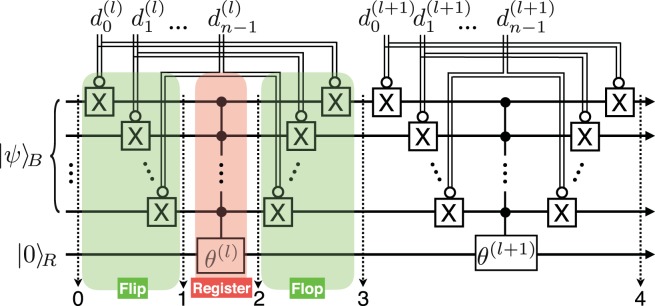
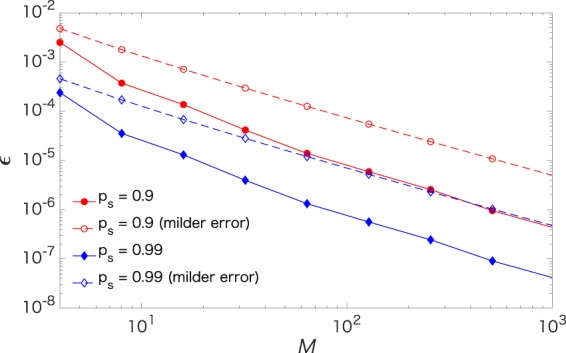
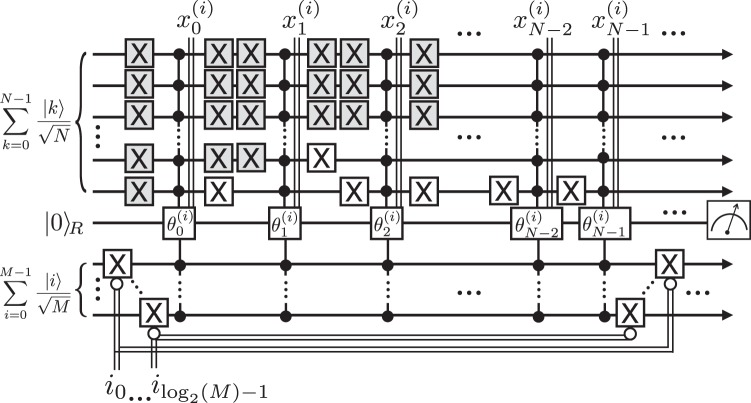
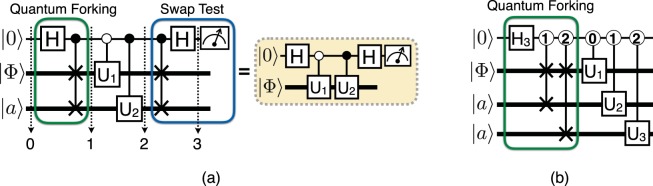
A prerequisite for many quantum information processing tasks to truly surpass classical approaches is an efficient procedure to encode classical data in quantum superposition states. In this work, we present a circuit-based flip-flop quantum random access memory to construct a quantum database of classical information in a systematic and flexible way. For registering or updating classical data consisting of M entries, each represented by n bits, the method requires O(n) qubits and O(Mn) steps. With post-selection at an additional cost, our method can also store continuous data as probability amplitudes. As an example, we present a procedure to convert classical training data for a quantum supervised learning algorithm to a quantum state. Further improvements can be achieved by reducing the number of state preparation queries with the introduction of quantum forking.
Overview
The claims and statistics of this paper haven’t been checked yet.
Run the check — free, no account needed. It reads the open-access text and checks the sources it cites.
Integrity signals
Registry
Cites
Statistics
Figures
Verification
Claims the paper makes
The claims and statistics of this paper haven’t been checked yet.
Run the check — free, no account needed. It reads the open-access text and checks the sources it cites.
Claims other papers make about this one
Each is checked against this paper’s own text: does it say what the citing paper says it does?
The source backs part of the claim, not all of it — or backs it for a different population, condition or comparison.
In the citing paper
“For example, a recent circuit-based proposal for QRAM [113] shows an unavoidable linear cost on the number of states that would outweigh any logarithmic-time algorithm.”
From The prospects of quantum computing in computational molecular biology (2021) · cites this paper as [113]
Experimental — accuracy not yet measured
Self-check
Percentages, sums and reported differences re-computed from the paper’s own numbers.
The self-check needs the paper’s full text.
Citations
Cites
Quantum Computation and Quantum Information
Nielsen, M. A., Chuang, I., & Grover, L. K. (2002) · American Journal of Physics · doi:10.1119/1.1463744 · Cited by 21,895
Quantum computation and quantum information
Law, J. (2001) · ACM SIGSOFT Software Engineering Notes · doi:10.1145/505482.505499 · Cited by 20,450
A fast quantum mechanical algorithm for database search
Grover, L. K. (1996) · Proceedings of the twenty-eighth annual ACM symposium on Theory of computing - STOC '96 · doi:10.1145/237814.237866 · Cited by 8,830
Biamonte, J., Wittek, P., Pancotti, N., Rebentrost, P., Wiebe, N., & Lloyd, S. (2017) · Nature · doi:10.1038/nature23474 · Cited by 4,779
Elementary gates for quantum computation
Barenco, A., Bennett, C. H., Cleve, R., DiVincenzo, D. P., Margolus, N., Shor, P., Sleator, T., Smolin, J. A., & Weinfurter, H. (1995) · Physical Review A · doi:10.1103/physreva.52.3457 · Cited by 4,311
Quantum Algorithm for Linear Systems of Equations
Harrow, A. W., Hassidim, A., & Lloyd, S. (2009) · Physical Review Letters · doi:10.1103/physrevlett.103.150502 · Cited by 3,325
Quantum Support Vector Machine for Big Data Classification
Rebentrost, P., Mohseni, M., & Lloyd, S. (2014) · Physical Review Letters · doi:10.1103/physrevlett.113.130503 · Cited by 1,951
Batens, D., & Bendegem, J. P. V. (1988) · Springer eBooks · doi:10.1007/978-94-009-2875-6 · Cited by 1,712
Quantum principal component analysis
Lloyd, S., Mohseni, M., & Rebentrost, P. (2014) · Nature Physics · doi:10.1038/nphys3029 · Cited by 1,385
Buhrman, H., Cleve, R., Watrous, J., & de Wolf, R. (2001) · Physical Review Letters · doi:10.1103/physrevlett.87.167902 · Cited by 1,190
Research works printed but not linked: 1
- Park, D. K., Sinayskiy, I., Fingerhuth, M., Petruccione, F. & Rhee, J. K. Quantum forking for fast weighted power summation. arXiv:1902.07959 [quant-ph] (2019). · arXiv
Cited by
Sorted by citations
Noisy intermediate-scale quantum algorithms
Bharti, K., Cervera-Lierta, A., Kyaw, T. H., Haug, T., Alperin-Lea, S., Anand, A., Degroote, M., Heimonen, H., Kottmann, J. S., Menke, T., et al. (2022) · Reviews of Modern Physics · doi:10.1103/revmodphys.94.015004 · Cited by 2,231
Quantum convolutional neural network for classical data classification
Hur, T., Kim, L., & Park, D. K. (2022) · Quantum Machine Intelligence · doi:10.1007/s42484-021-00061-x · Cited by 448
Self-citationThe bitter truth about gate-based quantum algorithms in the NISQ era
Leymann, F., & Barzen, J. (2020) · Quantum Science and Technology · doi:10.1088/2058-9565/abae7d · Cited by 251
A quantum deep convolutional neural network for image recognition
Li, Y., Zhou, R.-G., Xu, R., Luo, J., & Hu, W. (2020) · Quantum Science and Technology · doi:10.1088/2058-9565/ab9f93 · Cited by 225
The prospects of quantum computing in computational molecular biology
Outeiral, C., Strahm, M., Shi, J., Morris, G. M., Benjamin, S. C., & Deane, C. M. (2021) · WIREs Computational Molecular Science · doi:10.1002/wcms.1481 · Cited by 232
Metadata
- Authors
- Park, D. K., Petruccione, F., & Rhee, J.-K. K.
- Affiliations
- Korea Advanced Institute of Science and Technology (KR)
- Corresponding author
- Rhee, June-Koo Kevin
- Venue
- Scientific Reports
- Published
- 2019-03-08
- Volume
- 9
- Issue
- 1
- Pages
- 3949-3949
- ISSN
- 2045-2322 (ISSN-L)
- PMC
- PMC6408577
- OpenAlex
- W2909846583
- Cited by
- 151
- References
- 34
- Citations by year
- 2026: 11 · 2025: 28 · 2024: 22 · 2023: 22 · 2022: 26 · 2021: 24 · 2020: 15 · 2019: 3
- FWCI
- 7.76
- Type
- journal article
- Language
- en
- Open access
- gold
- doi.org
- Locations
- Scientific Reports (publishedVersion, cc-by)
- Europe PMC (PubMed Central) (publishedVersion, cc-by)
- PubMed Central (publishedVersion, cc-by)
- PubMed (publishedVersion)
- arXiv (Cornell University) (submittedVersion)
- DOAJ (DOAJ: Directory of Open Access Journals) (submittedVersion)
- arXiv (Cornell University)
- Funders
- National Research Foundation (2016R1A5A1008184)
- National Research Foundation of Korea (2016R1A5A1008184)
- Korea Advanced Institute of Science and Technology (2016R1A5A1008184)
- Iran Telecommunication Research Center
- Ministry of Science and ICT, South Korea (IITP-2018, 2016R1A5A1008184)
- Institute for Information and Communications Technology Promotion (IITP-2018-2015-0-00385, IITP-2018-2018-0-01402)
- Topics
- Physical Sciences › Computer Science › Artificial Intelligence › Quantum Computing Algorithms and Architecture
- Physical Sciences › Physics and Astronomy › Atomic and Molecular Physics, and Optics › Quantum Information and Cryptography
- Physical Sciences › Physics and Astronomy › Atomic and Molecular Physics, and Optics › Quantum Mechanics and Applications
- Keywords
- quantum random access memory, flip-flops, quantum superposition, post-selection
About these checks
Registry, retraction, Cites and statistics results are computed, not judged, with one exception: a printed reference that no index lists is read once by a model before it counts as a citation error. Claims are extracted by a model and kept only when their quote appears verbatim in the text; each cited source is then checked, with a model’s help, for whether it says what the claim relies on. Those verdicts can be wrong — read the claim’s quote and the cited source before relying on one.
Statistics and arithmetic are recomputed, not judged.
Confidence bands are shown only for fields calibrated on our annotated test set. None is calibrated yet, so no band is shown.
What counts as a claim ›How we measure confidence ›How we check this ›
Are you an author, or do you see a problem with this page? Request a review
