

The DOI matches its Crossref record; 39 of the 42 references it cites were found in a registry or an index.
QAOA for Max-Cut requires hundreds of qubits for quantum speed-up
Open accessAbstract
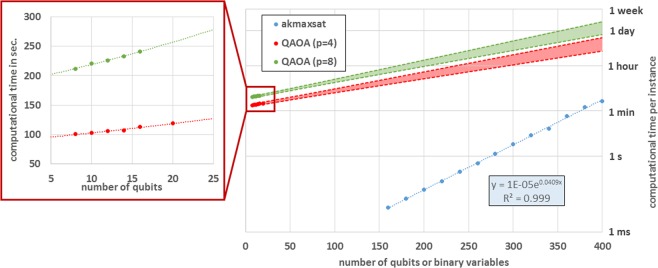
Computational quantum technologies are entering a new phase in which noisy intermediate-scale quantum computers are available, but are still too small to benefit from active error correction. Even with a finite coherence budget to invest in quantum information processing, noisy devices with about 50 qubits are expected to experimentally demonstrate quantum supremacy in the next few years. Defined in terms of artificial tasks, current proposals for quantum supremacy, even if successful, will not help to provide solutions to practical problems. Instead, we believe that future users of quantum computers are interested in actual applications and that noisy quantum devices may still provide value by approximately solving hard combinatorial problems via hybrid classical-quantum algorithms. To lower bound the size of quantum computers with practical utility, we perform realistic simulations of the Quantum Approximate Optimization Algorithm and conclude that quantum speedup will not be attainable, at least for a representative combinatorial problem, until several hundreds of qubits are available.
Overview
The claims and statistics of this paper haven’t been checked yet.
Run the check — free, no account needed. It reads the open-access text and checks the sources it cites.
Integrity signals
Registry
Cites
Statistics
Figures
Verification
Claims the paper makes
The claims and statistics of this paper haven’t been checked yet.
Run the check — free, no account needed. It reads the open-access text and checks the sources it cites.
Claims other papers make about this one
Each is checked against this paper’s own text: does it say what the citing paper says it does?
The cited source doesn’t support the claim as written.
In the citing paper
“Several QML algorithms based on PQC have been proposed [21–27], demonstrating superior performance and computational abilities compared to conventional algorithms [28–31].”
From Medical image diagnosis based on adaptive Hybrid Quantum CNN (2023) · cites this paper as [24]
Checked by a reasoning model — may be wrong.
Experimental — accuracy not yet measuredThe source backs part of the claim, not all of it — or backs it for a different population, condition or comparison.
In the citing paper
“With such peculiarities in mind, one should also view the results of Guerreschi and Matsuura, who found the point of quantum supremacy for QAOA to be in the order of several hundred to thousand of qubits [56] and further raised scaling issues [60].”
From Quantum Combinatorial Optimization in the NISQ Era: A Systematic Mapping Study (2024) · cites this paper as [56]
Experimental — accuracy not yet measuredThe cited source says what the claim attributes to it.
In the citing paper
“Noisy computation leads to scaling issues for QAOA [56, 60].”
From Quantum Combinatorial Optimization in the NISQ Era: A Systematic Mapping Study (2024) · cites this paper as [56]
Self-check
Percentages, sums and reported differences re-computed from the paper’s own numbers.
The self-check needs the paper’s full text.
Citations
Cites
Braun, W. J., & Murdoch, D. J. (2021) · Cambridge University Press eBooks · doi:10.1017/9781108993456.011 · Cited by 14,099
Nocedal, J., & Wright, S. J. (1999) · Springer eBooks · doi:10.1007/b98874 · Cited by 9,563
Quantum Computing in the NISQ era and beyond
Preskill, J. (2018) · Quantum · doi:10.22331/q-2018-08-06-79 · Cited by 8,830
Quantum Mechanics Helps in Searching for a Needle in a Haystack
Grover, L. K. (1997) · Physical Review Letters · doi:10.1103/physrevlett.79.325 · Cited by 4,306 · cited 1×
“Since quantum algorithms have a computational cost that is either polynomially [4] or exponentially lower [5] than their classical counterparts, for larger problem instances quantum algorithms provide an increasing advantage over classical approaches.”
BackgroundPolynomial-time algorithms for prime factorization and discrete logarithms on a quantum computer
Shor, P. W. (1999) · SIAM Review · doi:10.1137/s0036144598347011 · Cited by 3,904
Goemans, M. X., & Williamson, D. P. (1995) · Journal of the ACM · doi:10.1145/227683.227684 · Cited by 3,587
Hardware-efficient variational quantum eigensolver for small molecules and quantum magnets
Kandala, A., Mezzacapo, A., Temme, K., Takita, M., Brink, M., Chow, J. M., & Gambetta, J. M. (2017) · Nature · doi:10.1038/nature23879 · Cited by 2,982
Superconducting Circuits for Quantum Information: An Outlook
Devoret, M., & Schoelkopf, R. J. (2013) · Science · doi:10.1126/science.1231930 · Cited by 2,197
A Quantum Approximate Optimization Algorithm
Farhi, E., Goldstone, J., & Gutmann, S. (2014) · arXiv · doi:10.48550/arxiv.1411.4028 · Cited by 1,789
Superconducting quantum circuits at the surface code threshold for fault tolerance
Barends, R., Kelly, J., Megrant, A., Veitia, A., Sank, D., Jeffrey, E., White, T. C., Mutus, J., Fowler, A. G., Campbell, B., et al. (2014) · Nature · doi:10.1038/nature13171 · Cited by 1,733
Research works printed but not linked: 1
- Mack, C. A. Learning and Intelligent Optimization. Springer-Verlag Berlin Heidelberg (2011).
Cited by
Sorted by citations
Items 201–300 of 337
Miki, T., Tsukayama, D., Okita, R., Shimada, M., & Shirakashi, J. (2022) · IEEE International Conference on Manipulation, Manufacturing and Measurement on the Nanoscale (3M-NANO) · doi:10.1109/3m-nano56083.2022.9941666 · Cited by 3
Restricted global optimization for QAOA
Gleißner, P., Kruse, G., & Roßkopf, A. (2024) · APL Quantum · doi:10.1063/5.0189374 · Cited by 3
Hybrid Classical-Quantum Simulation of MaxCut using QAOA-in-QAOA
Esposito, A., & Danzig, T. (2024) · IEEE International Symposium on Parallel & Distributed Processing, Workshops and Phd Forum · doi:10.1109/ipdpsw63119.2024.00180 · Cited by 4
Computing Classical Partition Functions: From Onsager and Kaufman to Quantum Algorithms
Gargiulo, R., Rizzi, M., & Zeier, R. (2024) · doi:10.1145/3665870.3665878 · Cited by 3
Vandelli, M., Lignarolo, A., Cavazzoni, C., & Dragoni, D. (2024) · Quantum Information Processing · doi:10.1007/s11128-024-04560-1 · Cited by 5
Krüger, T., & Mauerer, W. (2025) · Quantum · doi:10.22331/q-2025-11-06-1903 · Cited by 7
Evolving a Multi-Population Evolutionary-QAOA on Distributed QPUs
Schiavello, F., Altamura, E., Tavernelli, I., Mensa, S., & Symons, B. C. B. (2025) · IEEE International Conference on Quantum Computing and Engineering (QCE) · doi:10.1109/qce65121.2025.00012 · Cited by 3
Recent advances of quantum neural networks on the near term quantum processor
Lü, Y., Gao, Q. Z., Lü, J., Pan, Y., & Dong, D. (2021) · Scientia Sinica Technologica · doi:10.1360/sst-2020-0459 · Cited by 3
A Tutorial on Quantum Approximate Optimization Algorithm for Maximum Independent Set Problem
Yang, M., Gao, F., Wu, G., Dai, W., & Shuang, F. (2021) · Chinese Control Conference (CCC) · doi:10.23919/ccc52363.2021.9550042 · Cited by 3
Some properties of maximal trace measure of quantum computer error rate
Fedichkin, L. E., & Kurkin, A. (2022) · International Conference on Micro- and Nano-Electronics (ICMNE) · doi:10.1117/12.2624606 · Cited by 3
Quantifying the uncertainty and global sensitivity of quantum computations on experimental hardware
Xu, G., Arachchilage, K. H., Hussaini, M. Y., & Oates, W. S. (2022) · Quantum Information Processing · doi:10.1007/s11128-022-03701-8 · Cited by 5
QAOA-based MRMR Algorithm for Feature Selection
Jiang, X., Chen, Z., Zhang, J., Yu, Z., Wang, L., & Mei, H. (2023) · International Conference on Advances in Artificial Intelligence and Applications (AAIA) · doi:10.1145/3603273.3631193 · Cited by 3
Missing Puzzle Pieces in the Performance Landscape of the Quantum Approximate Optimization Algorithm
Wybo, E., & Leib, M. (2025) · Quantum · doi:10.22331/q-2025-10-22-1892 · Cited by 15
A Variational Qubit-Efficient MaxCut Heuristic Algorithm
Tene-Cohen, Y., Kelman, T., Lev, O., & Makmal, A. (2026) · npj Quantum Information · doi:10.1038/s41534-026-01186-2 · Cited by 4
Zhang, Y., Mu, X.-D., Liu, X., Wang, X., Dong, C., Wu, T., & Li, K. (2021) · Acta Physica Sinica · doi:10.7498/aps.70.20211028 · Cited by 3
Depth Optimized Ansatz Circuit in QAOA for Max-CutPreprint
Majumdar, R., Bhoumik, D., Madan, D., Vinayagamurthy, D., Raghunathan, S., & Sur‐Kolay, S. (2021) · arXiv (Cornell University) · doi:10.48550/arxiv.2110.04637 · Cited by 3
An exponentially more efficient optimization algorithm for noisy quantum computersPreprint
Rančić, M. J. (2021) · arXiv (Cornell University) · doi:10.5281/zenodo.5592833 · Cited by 3
QUBO Formulations of Combinatorial Optimization Problems for Quantum Computing Devices
Quintero, R. A., & Zuluaga, L. F. (2022) · Encyclopedia of Optimization · doi:10.1007/978-3-030-54621-2_853-1 · Cited by 3
Kea, K., Chang, W.-D., Park, H. C., & Han, Y. (2024) · SSRN Electronic Journal · doi:10.2139/ssrn.4719914 · Cited by 3
The Emerging Strategic Environment
Geist, E. (2023) · Oxford University Press eBooks · doi:10.1093/oso/9780192886323.003.0002 · Cited by 2
Hybrid GRU-CNN bilinear parameters initialization for quantum approximate optimization algorithm
Xu, Z., Cai, P., Shen, K., Yang, T., Hu, Y., Gong, M., Zhu, Y., Wu, Z., Dai, Y., & Yang, F. (2024) · Physica Scripta · doi:10.1088/1402-4896/ad5a50 · Cited by 2
Graph Neural Networks for Parameterized Quantum Circuits Expressibility Estimation
Aktar, S., Bärtschi, A., Oyen, D., Eidenbenz, S., & Badawy, A. A. (2024) · IEEE International Conference on Quantum Computing and Engineering (QCE) · doi:10.1109/qce60285.2024.00181 · Cited by 9
Parallel Ising annealer via gradient-based Hamiltonian Monte Carlo
Wang, H., Liu, Z., Xie, Z., Li, L., Miao, Z., Cui, W., & Pan, Y. (2025) · Quantum Machine Intelligence · doi:10.1007/s42484-024-00231-7 · Cited by 2
Experimental Factoring Integers Using Fixed-Point-QAOA with a Trapped-Ion Quantum Processor
Zalivako, I. V., Chernyavskiy, A. Y., Nikolaeva, A. S., Borisenko, A. S., Semenin, N. V., Galstyan, K. P., Korolkov, A. E., Grebnev, S. V., Kiktenko, E. O., Khabarova, K. Y., et al. (2025) · Quantum Information and Computation · doi:10.2478/qic-2025-0021 · Cited by 4
From Barren Plateaus Through Fertile Valleys: Conic Extensions of Parameterised Quantum Circuits
Binkowski, L., Koßmann, G., Osborne, T. J., Schwonnek, R., & Ziegler, T. (2025) · IEEE International Conference on Quantum Computing and Engineering (QCE) · doi:10.1109/qce65121.2025.00022 · Cited by 2
Error Analysis of the Variational Quantum Eigensolver Algorithm
Brandhofer, S., Devitt, S. J., & Polian, I. (2021) · IEEE/ACM International Symposium on Nanoscale Architectures (NANOARCH) · doi:10.1109/nanoarch53687.2021.9642249 · Cited by 5
Application of the Variational Quantum Eigensolver to the Ultimate Pit Problem
Hindy, Y., Pointing, J., Tolunay, M., Venkatarao, S., Motta, M., & Latone, J. A. (2023) · IEEE International Conference on Quantum Computing and Engineering (QCE) · doi:10.1109/qce57702.2023.00083 · Cited by 2
Mesman, K. J., Battistel, F., Reehuis, E., de Jong, D., Tiggelman, M. J., Gloudemans, J., van Oven, J. C., & Bultink, C. C. (2024) · IEEE International Conference on Quantum Software (QSW) · doi:10.1109/qsw62656.2024.00026 · Cited by 2
Enhancing Quantum Algorithms for Quadratic Unconstrained Binary Optimization via Integer Programming
Wagner, F., Nüßlein, J., & Liers, F. (2025) · ACM Transactions on Quantum Computing · doi:10.1145/3711935 · Cited by 13
Lower Bounds on Circuit Depth of the Quantum Approximate Optimization AlgorithmPreprint
Ostrowski, J., Herrman, R., Humble, T. S., & Siopsis, G. (2020) · arXiv (Cornell University) · doi:10.48550/arxiv.2008.01820 · Cited by 2
Quantum ComputationPreprint
Bishnoi, B. (2020) · arXiv (Cornell University) · doi:10.48550/arxiv.2006.02799 · Cited by 7
An introduction to variational quantum algorithms for combinatorial optimization problemsPreprint
Grange, C., Poss, M., & Bourreau, E. (2022) · arXiv (Cornell University) · doi:10.48550/arxiv.2212.11734 · Cited by 2
Graph Neural Networks for Parameterized Quantum Circuits Expressibility Estimation (Rev.1)
Aktar, S., (NNSA), U. N. N. S. A., Bärtschi, A., Badawy, A. A., Oyen, D., & Eidenbenz, S. (2024) · OSTI OAI (U.S. Department of Energy Office of Scientific and Technical Information) · doi:10.2172/2350603 · Cited by 2
Lee, W. B., & Constantinides, A. G. (2026) · Encyclopedia · doi:10.3390/encyclopedia6050095 · Cited by 3
Globally Optimizing QAOA Circuit Depth for Constrained Optimization Problems
Herrman, R., Treffert, L., Ostrowski, J., Lotshaw, P. C., Humble, T. S., & Siopsis, G. (2021) · Algorithms · doi:10.3390/a14100294 · Cited by 1
Möller, M. (2023) · Computational methods in applied sciences · doi:10.1007/978-3-031-29082-4_21 · Cited by 1
Kumar, K. A., Vimal, V. R., & Karthick, V. (2024) · OPJU International Technology Conference on Smart Computing for Innovation and Advancement in Industry (OTCON) · doi:10.1109/otcon60325.2024.10687882 · Cited by 1
Neutral atom quantum computers for the applications in condensed matter physics
Shweta, Kaur, I., Singh, N., Kanjilal, S., & Santra, B. (2025) · Journal of Physics Condensed Matter · doi:10.1088/1361-648x/adbb9b · Cited by 2
Xie, J., 熊, J.-L. 俊. X., Cheng, B., Liang, S., & Miao, F. (2025) · Chinese Physics Letters · doi:10.1088/0256-307x/42/4/040202 · Cited by 1
Quantum Algorithms for Reconfigurable Intelligent Surface Optimization: Barren Plateaus Analysis
Colella, E., Bastianelli, L., Primiani, V. M., Moglie, F., & Gradoni, G. (2025) · European Conference on Antennas and Propagation · doi:10.23919/eucap63536.2025.10999170 · Cited by 1
The Symmetry‐Based Expressive QAOA for the MaxCut Problem
Xiumei, Z., Li, Y., Li, G., Shi, Y., Qin, S., & Gao, F. (2025) · Advanced Quantum Technologies · doi:10.1002/qute.202500199 · Cited by 2
Conditional diffusion-based parameter generation for quantum approximate optimization algorithm
Meng, F., Zhou, X., Zhu, P., & Luo, Y. (2025) · EPJ Quantum Technology · doi:10.1140/epjqt/s40507-025-00397-4 · Cited by 9
Hierarchical QAOA circuit design framework for distributed quantum computing
Luo, T.-Y., & Deng, Y. (2025) · Chinese Physics B · doi:10.1088/1674-1056/ae00ae · Cited by 1
Solving Large-Scale QUBO with Transferred Parameters from Multilevel QAOA of Low Depth
Bach, B. G., Maciejewski, F. B., & Safro, I. (2025) · IEEE International Conference on Quantum Computing and Engineering (QCE) · doi:10.1109/qce65121.2025.00232 · Cited by 1
QUEST: QUantum-Enhanced Shared Transportation
Onah, C., Misciasci, N., Othmer, C., & Michielsen, K. F. L. (2025) · IEEE International Conference on Quantum Computing and Engineering (QCE) · doi:10.1109/qce65121.2025.00235 · Cited by 1
Digital Zero-Noise Extrapolation with Quantum Circuit Unoptimization
Pelofske, E., & Russo, V. (2025) · IEEE International Conference on Quantum Computing and Engineering (QCE) · doi:10.1109/qce65121.2025.00020 · Cited by 7
Power-Aware Orchestration for Geo-Distributed LLM Inference via Quantum Optimization
Zheng, X., Min, J., Luo, L., Yu, H., & Li, Z. (2026) · IEEE Transactions on Network Science and Engineering · doi:10.1109/tnse.2026.3704855 · Cited by 1
Reproducible Josephson junctions are important for scalable quantum technologies
Bylander, J. (2020) · Superconductor Science and Technology · doi:10.1088/1361-6668/abb202 · Cited by 1
The Wasserstein Distance Using QAOA: A Quantum Augmented Approach to Topological Data Analysis
Saravanan, M., & Gopikrishnan, M. (2022) · International Conference on Innovative Trends in Information Technology (ICITIIT) · doi:10.1109/icitiit54346.2022.9744214 · Cited by 1
Accelerating VQE Algorithm via Parameters and Measurement Reuse
Li, X., Liu, J., Hansen, E. H., Xu, S., Hovland, P., & Chaudhary, V. (2023) · IEEE International Conference on Rebooting Computing (ICRC) · doi:10.1109/icrc60800.2023.10386370 · Cited by 1
Variational Quantum Based Simulation of Cylindrical Waveguides
Colella, E., Baldwin, B. A., Kelso, S., Bastianelli, L., Primiani, V. M., Moglie, F., & Gradoni, G. (2025) · IEEE journal on multiscale and multiphysics computational techniques · doi:10.1109/jmmct.2025.3531134 · Cited by 1
Wang, Z., He, Y., Luan, T., & Long, Y. (2025) · Entropy · doi:10.3390/e27030240 · Cited by 1
Benchmarking a heuristic Floquet adiabatic algorithm for the Max-Cut problem
Granet, E., & Dreyer, H. (2025) · Scientific Reports · doi:10.1038/s41598-025-13923-2 · Cited by 1
Anonymous, Kulikov, D. A., Bantysh, B. I., Bogdanov, Y. I., Fedorov, A. K., & Kiktenko, E. O. (2026) · Physical Review A · doi:10.1103/x32d-wx13 · Cited by 1
Combinatorial optimization with variational approaches on noisy quantum devices
Miki, T., Okita, R., Shimada, M., & Shirakashi, J. (2021) · IEEE International Conference on Manipulation, Manufacturing and Measurement on the Nanoscale (3M-NANO) · doi:10.1109/3m-nano49087.2021.9599740 · Cited by 1
Entropic property of randomized QAOA circuits
Chernyavskiy, A. Y., Bantysh, B. I., & Bogdanov, Y. I. (2023) · Laser Physics Letters · doi:10.1088/1612-202x/ad12ad · Cited by 3
Hybrid Quantum Algorithms and Quantum Software Development FrameworksPreprint
Ramouthar, R., & Şeker, H. (2023) · AfricArXiv (OSF Preprints) · doi:10.31730/osf.io/fsw24 · Cited by 1
From Quantum Computing to Quantum-inspired Computation for Neuromorphic Advancement – A SurveyPreprint
Jha, R. K. (2023) · doi:10.36227/techrxiv.24053250 · Cited by 1
Manenti, R., & Motta, M. (2023) · Oxford University Press eBooks · doi:10.1093/oso/9780198787488.005.0003 · Cited by 1
Study on quantum adiabatic approximate solution of max-cut with different vertices
Gao, X., Ni, M., Zhou, M. Q., & Wu, Y. (2020) · Applied Optics and Photonics China (AOPC): Optoelectronics and Nanophotonics · doi:10.1117/12.2579837
Introductory Tutorial for SPSA and the Quantum Approximation Optimization AlgorithmPreprint
Resch, S. (2021) · arXiv (Cornell University) · doi:10.48550/arxiv.2106.01578
Lima, G. L., de Melo, I. E. S., & LINS, S. L. S. (2021) · Anais ... Encontro Nacional de Engenharia de Produção/Anais do Encontro Nacional de Engenharia de Produção · doi:10.14488/enegep2021_tn_sto_356_1834_42226
Report on scipost_202106_00008v2
Borle, A., Elfving, V. E., & Lomonaco, S. J. (2021) · SciPost Physics Core · doi:10.21468/scipost.report.3619
Quantum Advantage on Machine Learning ModelsPreprint
Tomono, T., & Natsubori, S. (2022) · Research Square · doi:10.21203/rs.3.rs-1728380/v1
Quantum-Classical Variational Approaches with Single-Qubit Operation on Near-Term Quantum Processors
Miki, T., Tsukayama, D., Okita, R., Shimada, M., & Shirakashi, J. (2022) · IEEE International Conference on Nanotechnology (IEEE-NANO) · doi:10.1109/nano54668.2022.9928623
(2022) · SciPost Physics · doi:10.21468/scipost.report.6207
(2022) · SciPost Physics · doi:10.21468/scipost.report.6306
Exponential Qubit Reduction in Optimization for Financial Transaction SettlementPreprint
Huber, E. X., Tan, B. Y. L., Griffin, P., & Angelakis, D. G. (2023) · arXiv (Cornell University) · doi:10.48550/arxiv.2307.07193
Strategic Stability in a Deception-Dominant World
Geist, E. (2023) · Oxford University Press eBooks · doi:10.1093/oso/9780192886323.003.0007
Conclusion: A Case for (Tempered) Optimism
Geist, E. (2023) · Oxford University Press eBooks · doi:10.1093/oso/9780192886323.003.0008
A Rudimentary Model of Ontological Confrontation
Geist, E. (2023) · Oxford University Press eBooks · doi:10.1093/oso/9780192886323.005.0003
(2023) · Oxford University Press eBooks · doi:10.1093/oso/9780192886323.002.0008
A Bayesian Perspective on Camouflage, Concealment, and Deception
Geist, E. (2023) · Oxford University Press eBooks · doi:10.1093/oso/9780192886323.005.0002
Geist, E. (2023) · Oxford University Press eBooks · doi:10.1093/oso/9780192886323.003.0006
Geist, E. (2023) · Oxford University Press eBooks · doi:10.1093/oso/9780192886323.003.0005
(2023) · Oxford University Press eBooks · doi:10.1093/oso/9780192886323.002.0002
(2023) · Oxford University Press eBooks · doi:10.1093/oso/9780192886323.002.0004
(2023) · Oxford University Press eBooks · doi:10.1093/oso/9780192886323.002.0009
Geist, E. (2023) · Oxford University Press eBooks · doi:10.1093/oso/9780192886323.003.0004
Geist, E. (2023) · Oxford University Press eBooks · doi:10.1093/oso/9780192886323.005.0001
Introduction: Artificial Intelligence and the Nuclear Dilemma
Geist, E. (2023) · Oxford University Press eBooks · doi:10.1093/oso/9780192886323.003.0001
From Celluloid Nightmares to Silicon Realities
Geist, E. (2023) · Oxford University Press eBooks · doi:10.1093/oso/9780192886323.003.0003
(2023) · Oxford University Press eBooks · doi:10.1093/oso/9780192886323.002.0005
Manenti, R., & Motta, M. (2023) · Oxford University Press eBooks · doi:10.1093/oso/9780198787488.003.0006
Microwave resonators for superconducting devices
Manenti, R., & Motta, M. (2023) · Oxford University Press eBooks · doi:10.1093/oso/9780198787488.003.0013
(2023) · Oxford University Press eBooks · doi:10.1093/oso/9780198787488.002.0003
The rotating wave approximation
Manenti, R., & Motta, M. (2023) · Oxford University Press eBooks · doi:10.1093/oso/9780198787488.005.0001
Manenti, R., & Motta, M. (2023) · Oxford University Press eBooks · doi:10.1093/oso/9780198787488.003.0004
Manenti, R., & Motta, M. (2023) · Oxford University Press eBooks · doi:10.1093/oso/9780198787488.003.0007
Quantum simulation of Hamiltonian eigenstates
Manenti, R., & Motta, M. (2023) · Oxford University Press eBooks · doi:10.1093/oso/9780198787488.003.0012
Manenti, R., & Motta, M. (2023) · Oxford University Press eBooks · doi:10.1093/oso/9780198787488.003.0002
Quantum simulation of Hamiltonian dynamics
Manenti, R., & Motta, M. (2023) · Oxford University Press eBooks · doi:10.1093/oso/9780198787488.003.0011
Manenti, R., & Motta, M. (2023) · Oxford University Press eBooks · doi:10.1093/oso/9780198787488.003.0009
The molecular Hamiltonian in second quantization
Manenti, R., & Motta, M. (2023) · Oxford University Press eBooks · doi:10.1093/oso/9780198787488.005.0004
Manenti, R., & Motta, M. (2023) · Oxford University Press eBooks · doi:10.1093/oso/9780198787488.003.0005
Manenti, R., & Motta, M. (2023) · Oxford University Press eBooks · doi:10.1093/oso/9780198787488.003.0008
Oblivious amplitude amplification lemma
Manenti, R., & Motta, M. (2023) · Oxford University Press eBooks · doi:10.1093/oso/9780198787488.005.0005
Manenti, R., & Motta, M. (2023) · Oxford University Press eBooks · doi:10.1093/oso/9780198787488.005.0006
Manenti, R., & Motta, M. (2023) · Oxford University Press eBooks · doi:10.1093/oso/9780198787488.003.0003
Manenti, R., & Motta, M. (2023) · Oxford University Press eBooks · doi:10.1093/oso/9780198787488.003.0001
Metadata
- Authors
- Guerreschi, G. G., & Matsuura, A. Y.
- Affiliations
- Intel (United States) (US)
- Corresponding author
- Guerreschi, G. G.
- Venue
- Scientific Reports
- Published
- 2019-05-06
- Volume
- 9
- Issue
- 1
- Pages
- 6903-6903
- ISSN
- 2045-2322 (ISSN-L)
- PMC
- PMC6502860
- OpenAlex
- W2951211905
- Cited by
- 337
- References
- 42
- Citations by year
- 2026: 18 · 2025: 57 · 2024: 45 · 2023: 88 · 2022: 50 · 2021: 47 · 2020: 24 · 2019: 8
- FWCI
- 14.71
- Type
- journal article
- Language
- en
- Open access
- gold
- doi.org
- Locations
- Scientific Reports (publishedVersion, cc-by)
- PubMed Central (publishedVersion, cc-by)
- PubMed (publishedVersion)
- arXiv (Cornell University) (submittedVersion)
- OSTI OAI (U.S. Department of Energy Office of Scientific and Technical Information) (submittedVersion)
- arXiv (Cornell University)
- Funders
- U.S. Department of Energy (-AC02-05CH11231, Contract No. DE-AC02-05-CH11231, 05CH11231, No. DE-AC02-05-CH11231, DE AC02 05CH11231, DE-AC02-)
- University of Texas at Austin
- National Energy Research Scientific Computing Center (DE–AC02–05CH11231, 05CH11231, AC02-05CH11231, Contract No. DE-AC02-05CH11231)
- Office of Science (No. DE-AC02- 05-CH11231, DEAC02–05CH11231, AC02-05CH11231, DE-AC02, 05CH11231, Contract No. DE-AC02-05CH11231)
- Department of Mechanical Engineering, University of Texas at Austin
- Topics
- Physical Sciences › Computer Science › Artificial Intelligence › Quantum Computing Algorithms and Architecture
- Physical Sciences › Physics and Astronomy › Atomic and Molecular Physics, and Optics › Quantum many-body systems
- Physical Sciences › Physics and Astronomy › Atomic and Molecular Physics, and Optics › Quantum Information and Cryptography
- Keywords
- quantum approximate optimization algorithm, MaxCut, quantum advantage, qubit requirements, NISQ devices, hybrid quantum-classical algorithms, combinatorial optimization
About these checks
Registry, retraction, Cites and statistics results are computed, not judged, with one exception: a printed reference that no index lists is read once by a model before it counts as a citation error. Claims are extracted by a model and kept only when their quote appears verbatim in the text; each cited source is then checked, with a model’s help, for whether it says what the claim relies on. Those verdicts can be wrong — read the claim’s quote and the cited source before relying on one.
Statistics and arithmetic are recomputed, not judged.
Confidence bands are shown only for fields calibrated on our annotated test set. None is calibrated yet, so no band is shown.
What counts as a claim ›How we measure confidence ›How we check this ›
Are you an author, or do you see a problem with this page? Request a review
