

Enhanced weathering as a trigger for the rise of atmospheric O2 level from the late Ediacaran to the early Cambrian
Open accessThe DOI matches its Crossref record; 116 of the 117 references it cites were found in a registry or an index; 6 of the 26 sources its claims cite were checked for support.
Abstract
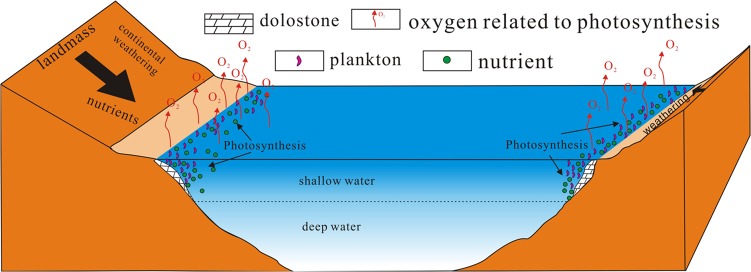
A shift toward a higher oxygen level in both ocean and atmosphere systems during the late Ediacaran to the early Cambrian has been suggested from multiple indirect proxies. However, the mechanism and magnitude of this oxidation remain unclear. To solve this issue, we measured carbon isotopes in both carbonate and organic matter as well as their trace element compositions for an Ediacaran-Cambrian sequence in the Lower Yangtze basin, South China. The δ 13 C org and δ 13 C carb excursions of this sequence are coupled and can be compared with contemporaneous global carbon isotope curves. A 2‰ rise in Δ 13 C carb-org occurred from the late Ediacaran to the early Cambrian, suggesting a substantial increase in atmospheric oxygen level from 16% to 30% of the present atmospheric level (PAL). Furthermore, the distribution pattern of rare earth elements and the concentrations of water-insoluble elements in the carbonates indicate a sudden enhancement in chemical weathering of the continental crust during the early Cambrian, which may be a trigger for the rise of atmospheric O 2 level. Both the supply of a large amount of nutrients due to the enhanced continental weathering and the contemporary increase of atmospheric oxygen concentrations may have promoted the appearance of large metazoans in the early Cambrian.
Overview
CoChat Summary
TL;DR
This paper uses carbon isotopes and trace-element geochemistry from an Ediacaran–Cambrian section in South China to argue that atmospheric oxygen rose sharply at the E-C transition. The authors interpret a ~2‰ increase in Δ13Ccarb-org as evidence for an early Cambrian pO2 of about 16% to 30% PAL, linked to enhanced continental weathering.
Key findings
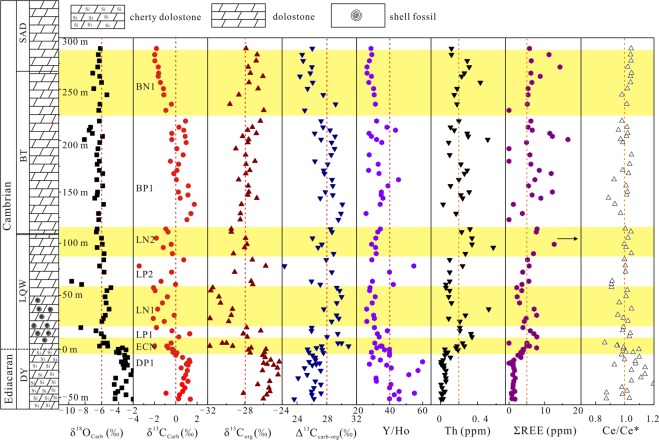
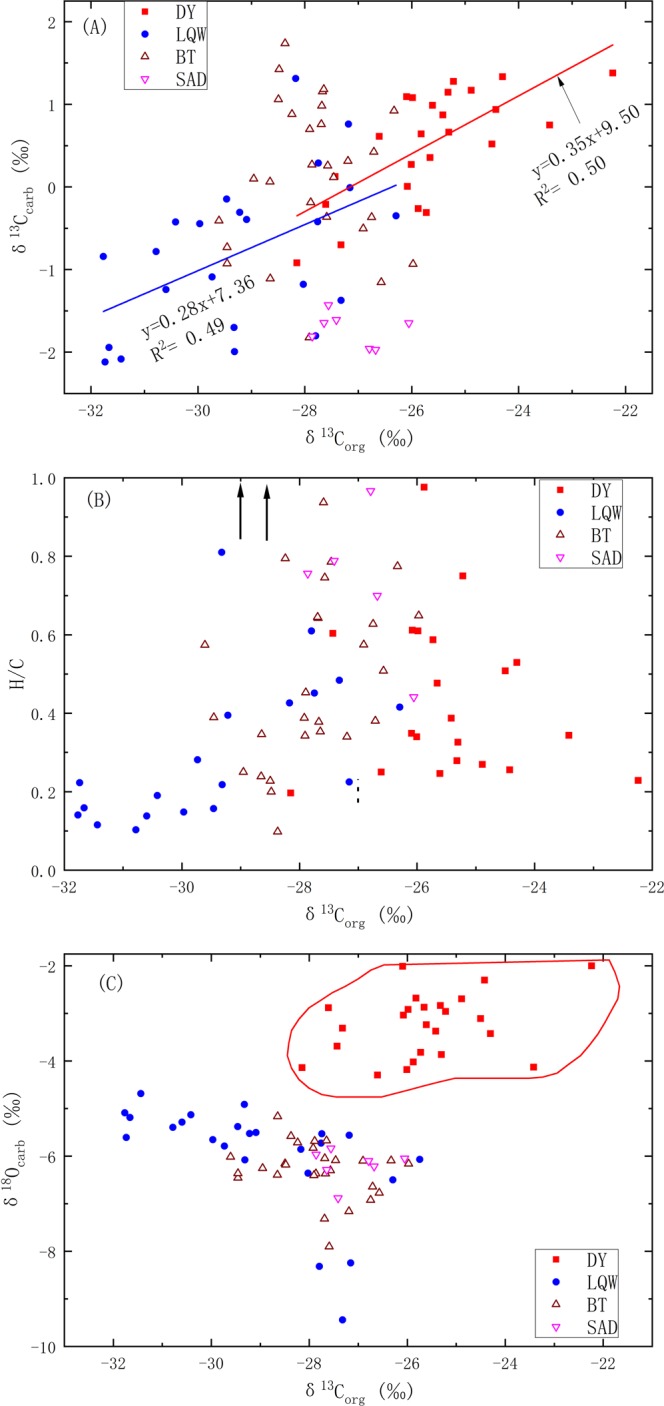
- In the Tangshan section, δ13Corg values range from −31.77 to −22.24‰ (n = 84) and show four positive and four negative excursions across the late Ediacaran to early Cambrian interval.
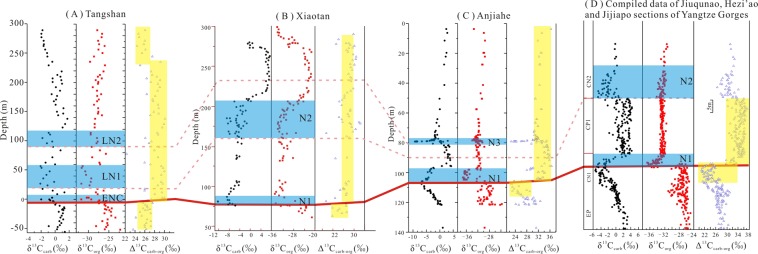
- The average Δ13Ccarb-org increases from 26.28‰ in the late Ediacaran DY Formation to 28.12‰ in the early Cambrian LQW Formation, an abrupt rise of about 2‰.
- Using the paper’s carbon-isotope framework, that ~2‰ increase is interpreted as a doubling of atmospheric oxygen mass, implying early Cambrian oxygen levels of 16% to 30% PAL.
- Geochemical proxies including REE+Y patterns, water-insoluble element concentrations, and Y/Ho ratios indicate a sudden enhancement in chemical weathering of the continental crust during the early Cambrian.
Methods
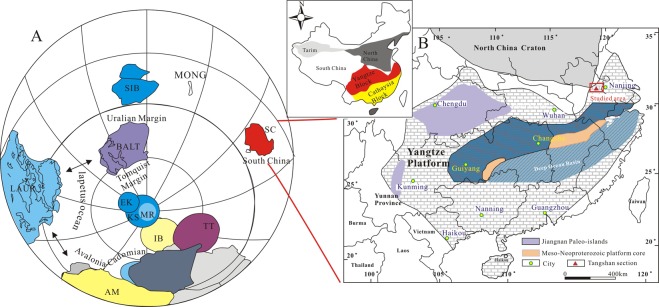
- The study analyzes an Ediacaran–Cambrian carbonate sequence from the Tangshan section in the Lower Yangtze basin, South China, spanning the Dengying, Lengquanwang, Bantang, and Shanaoding units.
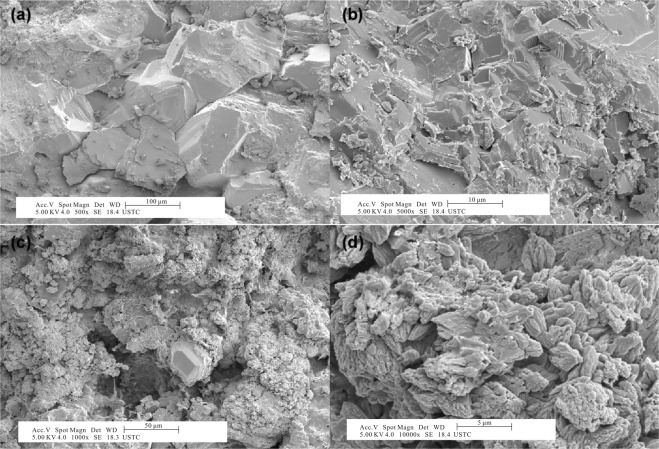
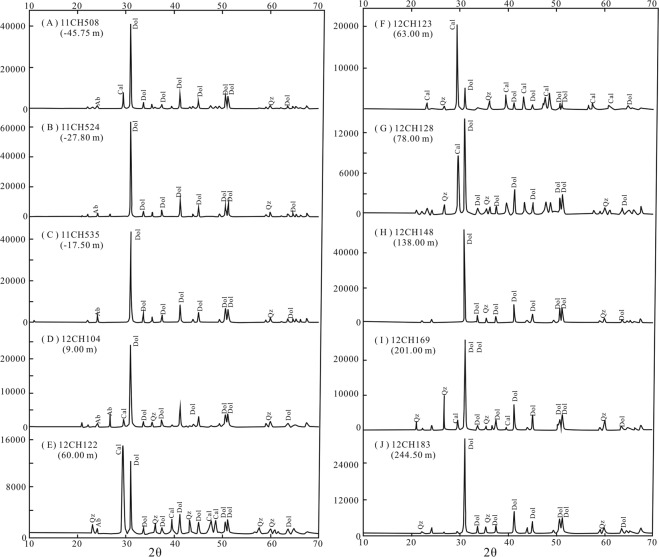
- Measurements include carbonate and organic carbon isotopes; δ13Corg was measured on 84 samples, and selected samples were also checked by XRD and SEM for mineralogy and preservation.
- The main analysis compares δ13Ccarb and δ13Corg excursions and uses trace-element/REE+Y proxies to infer weathering intensity and its relation to atmospheric oxygenation.
Limitations
- The paper states that the timing and magnitude of atmospheric O2 accumulation are difficult to accurately constrain.
- It also says the absolute Δ13Ccarb-org values vary with depositional settings, so the proxy is not uniform across sections.
- Evident from the text: the key oxygen estimate is indirect and model-dependent, relying on assumptions about baseline Δ13Ccarb-org and exclusion of other causes, rather than a direct measurement of atmospheric O2.
Model-written summary. Check it against the paper before relying on it.
Integrity signals
Registry
Cites
Statistics
Figures
Verification
Claims the paper makes
4 Valid · 2 Not valid · 7 Not checked · 29 Own results and interpretations
Some cited sources support this claim and some don’t — read each source’s verdict below.
In the paper
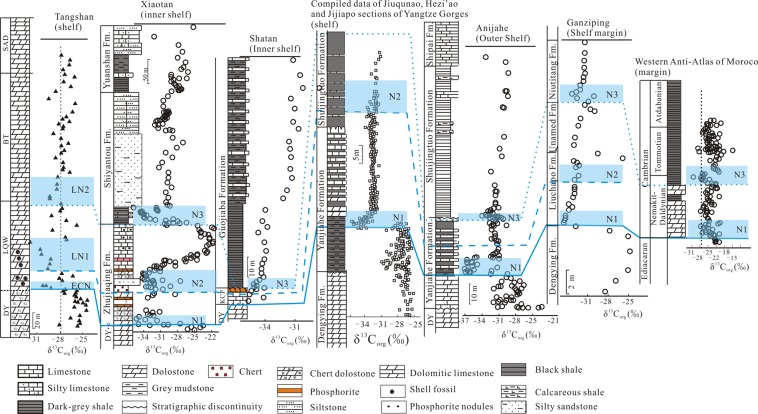
“The worldwide ECN or N1 negative δ13Ccarb excursion, named the BACE5,45, is consistent with the first appearance of small shelly fossils of Anabarites trisulcatus zone33, which was calibrated as the beginning of Cambrian61.”
§ Enhanced weathering as a trigger for the rise of atmospheric O2 level from the late Ediacaran to the early Cambrian > Discussion > Carbon isotope chemostratigraphy
What the sources say
- Disputedcites [5] Zhu M Zhuravlev AY Wood RA Zhao F Sukhov SS A deep root for the Cambrian explosion: Implications of new bio- and chemostratigraphy from the Siberian Platform Geology 2017 45 459 462 10.1130/G38865.1 sourceExperimental — accuracy not yet measured
Citation 61 is attached to the claim that the first appearance of the Anabarites trisulcatus zone was calibrated as the beginning of the Cambrian. The Introduction instead says the first appearance of Treptichnus pedum defines the Precambrian–Cambrian boundary. The Discussion also says an Anabarites-bearing assemblage can be interpreted as uppermost Ediacaran, rather than fixing the boundary. (LLM, conf=0.82)
Checked by a reasoning model — may be wrong.
- Not checked — no full text of the sourcecites [45] Zhu MY Strauss H Shields GA From snowball earth to the Cambrian bioradiation: Calibration of Ediacaran-Cambrian earth history in South China Palaeogeogr. Palaeoclimatol. Palaeoecol. 2007 254 1 6 10.1016/j.palaeo.2007.03.026 source
- Not checked — no full text of the sourcecites [33] Maloof A The earliest Cambrian record of animals and ocean geochemical change Bulletin of the Geological Society of America 2010 122 1731 1774 10.1130/B30346.1 source
- Partly supportedcites [61] Kaufman A Integrated chronostratigraphy of Proterozoic-Cambrian boundary beds in the western Anabar region, Northern Siberia Geol. Mag. 1996 133 509 533 10.1017/S0016756800007810 11541221 sourceExperimental — accuracy not yet measured
Our copy supports the biostratigraphic half: Section 3.c states that the initial Nemakit-Daldynian boundary at Kotuikan 'corresponds to the first appearance of SSFs of the Anabarites trisulcatus Zone', and Sections 4.c/5.a record strongly negative δ13C values (−3.6 to −4.4‰ in basal Manykai Bed II; the N' excursion near the base of the upper Staraya Rechka) around that level, with Section 5 arguing the Siberian, Moroccan and Indian curves reflect 'global biogeochemical events'. However, the paper never uses the terms ECN, N1 or BACE for any excursion (it labels peaks N', Z, Z', I, I' after Brasier, Khomentovsky & Corfield 1993), and it does not tie a named worldwide negative excursion to the A. trisulcatus FAD. The claim that this zone 'was calibrated as the beginning of the Cambrian' is also not stated: Section 3.c instead notes that the recently ratified base of the Cambrian (a trace-fossil GSSP, Fortune Head; Narbonne et al. 1987, Landing 1994, Brasier, Cowie & Taylor 1994) lies significantly below the Tommotian, so that Nemakit-Daldynian is merely being 'pressed into service' as a needed pre-Tommotian basal Cambrian stage. (LLM, conf=0.72)
plainstates an association- Asserted: passes — The authors put it forward as true.
- Checkable: passes — It can be checked against evidence.
- Load-bearing: unclear — It is unclear whether the paper’s conclusions depend on it.
- Based: passes — The paper gives a reason why it holds.
- Disputed
The cited sources support only part of this claim — read each source’s verdict below.
In the paper
“Then, the abrupt increase in the Δ13Ccarb-org values of approximately +2‰ (Fig. 7) indicates that the mass of oxygen in the atmosphere was doubled in the early Cambrian85,88.”
§ Enhanced weathering as a trigger for the rise of atmospheric O2 level from the late Ediacaran to the early Cambrian > Discussion > The Δ13Ccarb-org between carbonate and organic matter
What the sources say
- Not checked — no full text of the sourcecites [85] Beerling DJ Carbon isotope evidence implying high O2/CO2 ratios in the Permo-Carboniferous atmosphere Geochim. Cosmochim. Acta 2002 66 3757 3767 10.1016/S0016-7037(02)00901-8 source
- Partly supportedcites [88] Saltzman, M. R. et al. Pulse of atmospheric oxygen during the late Cambrian. Proceedings of the National Academy of Sciences (2011). PMC3053972 21368152 sourceExperimental — accuracy not yet measured
The Results and Discussion report an approximately +2‰ increase in carbon-isotope fractionation during the SPICE and calculate a rise in atmospheric oxygen from 14–18% to just over 30%, consistent with roughly doubling. But the paper places the SPICE in the late Cambrian, not the early Cambrian. Page numbers are not available in our copy. (LLM, conf=0.90)
hedgedstates a cause- Asserted: passes — The authors put it forward as true.
- Checkable: passes — It can be checked against evidence.
- Load-bearing: passes — The paper’s conclusions depend on it.
- Based: passes — The paper gives a reason why it holds.
The cited sources support only part of this claim — read each source’s verdict below.
In the paper
“The first negative δ13Corg excursion (ECN) is coupled with BACE43–46 at the E-C transition (Fig. 3).”
§ Enhanced weathering as a trigger for the rise of atmospheric O2 level from the late Ediacaran to the early Cambrian > Results
What the sources say
- Not checked — no full text of the sourcecites [43] Zhu M-Y Babcock LE Peng S-C Advances in Cambrian stratigraphy and paleontology: Integrating correlation techniques paleobiology, taphonomy and paleoenvironmental reconstruction. Palaeoworld 2006 15 217 222 source
- Partly supportedcites [44] Landing E Peng S Babcock L Geyer G Moczydlowska-Vidal M Global standard names for the lowermost Cambrian series and stage Episodes 2007 30 287 289 sourceExperimental — accuracy not yet measured
The Correlation section of Landing et al. (2007) supports only the BACE half of the claim: it states that the base of the Terreneuvian Series (the E-C transition) can be correlated geochemically 'near the onset of a large negative excursion in δ13C values ... referred to as the BACE Excursion (Basal Cambrian Carbon isotope Excursion; Zhu et al., 2006)', and the Geochronology section repeats that the base of the Cambrian System was approximated in Oman by the BACE excursion of Zhu et al., 2006. What our copy does not support is the organic-carbon and nomenclature part: it never mentions δ13Corg, never uses the label 'ECN', never speaks of a 'first' negative excursion, and does not couple any organic-carbon excursion to BACE — its excursion is cited generically as a δ13C (carbonate-type) signal credited to Amthor et al. (2003)/Zhu et al. (2006). The paper also reports BACE as someone else's result rather than as its own measurement, so it cannot ground the ECN–BACE coupling assertion. (LLM, conf=0.70)
- Not checked — no full text of the sourcecites [45] Zhu MY Strauss H Shields GA From snowball earth to the Cambrian bioradiation: Calibration of Ediacaran-Cambrian earth history in South China Palaeogeogr. Palaeoclimatol. Palaeoecol. 2007 254 1 6 10.1016/j.palaeo.2007.03.026 source
- Not checked — no full text of the sourcecites [46] Maloof AC Constraints on early Cambrian carbon cycling from the duration of the Nemakit-Daldynian-Tommotian boundary 13C shift, Morocco Geology 2010 38 623 626 10.1130/G30726.1 source
plainstates an association- Asserted: passes — The authors put it forward as true.
- Checkable: passes — It can be checked against evidence.
- Load-bearing: passes — The paper’s conclusions depend on it.
- Based: passes — The paper gives a reason why it holds.
The cited sources support only part of this claim — read each source’s verdict below.
In the paper
“A 2‰ rise in Δ13Ccarb-org occurred from the late Ediacaran to the early Cambrian, suggesting a substantial increase in atmospheric oxygen level from 16% to 30% of the present atmospheric level (PAL).”
- Also stated in: § The Δ13Ccarb-org between carbonate and organic matter · hedged
“Then, the abrupt increase in the Δ13Ccarb-org values of approximately +2‰ (Fig. 7) indicates that the mass of oxygen in the atmosphere was doubled in the early Cambrian85,88.”
- Also stated in: § The Δ13Ccarb-org between carbonate and organic matter · hedged
“In this regard, the pO2 of early Cambrian would be at least 16 to 30% PAL, which is consistent with 10% to 40% PAL estimated for the Cambrian87.”
§ Enhanced weathering as a trigger for the rise of atmospheric O2 level from the late Ediacaran to the early Cambrian > Abstract
What the sources say
- Not checked — no full text of the sourcecites [85] Beerling DJ Carbon isotope evidence implying high O2/CO2 ratios in the Permo-Carboniferous atmosphere Geochim. Cosmochim. Acta 2002 66 3757 3767 10.1016/S0016-7037(02)00901-8 source
- Partly supportedcites [88] Saltzman, M. R. et al. Pulse of atmospheric oxygen during the late Cambrian. Proceedings of the National Academy of Sciences (2011). PMC3053972 21368152 sourceExperimental — accuracy not yet measured
Results and Discussion (page not available) links an approximately 2‰ rise in carbonate–organic carbon isotope fractionation to an oxygen increase from 14–18% to just over 30%, but places it during the late Cambrian SPICE event, not from the late Ediacaran to the early Cambrian. The paper gives these figures as atmospheric O₂ percentages, not percentages of present atmospheric level (PAL); it states that the current atmosphere is 21% O₂. (LLM, conf=0.90)
hedgedstates a cause- Asserted: passes — The authors put it forward as true.
- Checkable: passes — It can be checked against evidence.
- Load-bearing: passes — The paper’s conclusions depend on it.
- Based: passes — The paper gives a reason why it holds.
- Also stated in: § The Δ13Ccarb-org between carbonate and organic matter · hedged
The cited sources support only part of this claim — read each source’s verdict below.
In the paper
“The BACE, on the other hand, was followed by the rapid appearance and diversification of bilaterian animals in the early Cambrian according to a combined study of lithology, fossils and geochemical data5,47.”
§ Enhanced weathering as a trigger for the rise of atmospheric O2 level from the late Ediacaran to the early Cambrian > Discussion > Carbon isotope chemostratigraphy
What the sources say
- Partly supportedcites [5] Zhu M Zhuravlev AY Wood RA Zhao F Sukhov SS A deep root for the Cambrian explosion: Implications of new bio- and chemostratigraphy from the Siberian Platform Geology 2017 45 459 462 10.1130/G38865.1 sourceExperimental — accuracy not yet measured
The Introduction says the BACE was followed by the rapid appearance and diversification of bilaterian animals, but presents this as prior understanding. The paper’s own data and Discussion instead report considerable diversification of Cambrian-type skeletal taxa before the BACE and no notable turnover across it. Thus the claim repeats the introductory account but overstates what the combined study found. (LLM, conf=0.86)
- Not checked — no full text of the sourcecites [47] Amthor JE Extinction of Cloudina and Namacalathus at the Precambrian-Cambrian boundary in Oman Geology 2003 31 431 434 10.1130/0091-7613(2003)031<0431:EOCANA>2.0.CO;2 doi:10.1130/0091-7613(2003)031
plainstates an association- Asserted: passes — The authors put it forward as true.
- Checkable: passes — It can be checked against evidence.
- Load-bearing: unclear — It is unclear whether the paper’s conclusions depend on it.
- Based: passes — The paper gives a reason why it holds.
- Partly supported
21 more claims
Create a free account to see all 42 claims and to verify the 1 reference still open.
- Borderline: one of the tests for a substantial claim is unclear. 1
- It may state two separate claims as one. 14
- Probably not a substantial claim. 3
Self-check
Percentages, sums and reported differences re-computed from the paper’s own numbers.
Rated major: it would touch a result — a value a result rests on, reported and recomputed p-values on opposite sides of the significance level, two passages that conflict with no sign which is right, or a cited work retracted before this paper was published.
In the paper
“The difference between the carbonate and organic carbon isotope compositions (Δ13Ccarb-org = δ13Ccarb − δ13Corg) varies between 22.31‰ and 30.93‰, averaging 22.27‰ (Fig. 2).”
§ Enhanced weathering as a trigger for the rise of atmospheric O2 level from the late Ediacaran to the early Cambrian > Results
Reported 22.27 · recomputed 26.62
Citations
Cites
Erwin, D. H., Laflamme, M., Tweedt, S. M., Sperling, E. A., Pisani, D., & Peterson, K. J. (2011) · Science · doi:10.1126/science.1206375 · Cited by 1,336
Archean Molecular Fossils and the Early Rise of Eukaryotes
Brocks, J. J., Logan, G. A., Buick, R., & Summons, R. E. (1999) · Science · doi:10.1126/science.285.5430.1033 · Cited by 1,275
History of Neoproterozoic rift basins in South China: implications for Rodinia break-up
Wang, J. (2003) · Precambrian Research · doi:10.1016/s0301-9268(02)00209-7 · Cited by 1,227
Proterozoic Ocean Chemistry and Evolution: A Bioinorganic Bridge?
Anbar, A. D., & Knoll, A. H. (2002) · Science · doi:10.1126/science.1069651 · Cited by 1,191
Interpreting carbon-isotope excursions: carbonates and organic matter
Kump, L. R., & Arthur, M. A. (1999) · Chemical Geology · doi:10.1016/s0009-2541(99)00086-8 · Cited by 1,171
Tracing the stepwise oxygenation of the Proterozoic ocean
Scott, C., Lyons, T. W., Bekker, A., Shen, Y., Poulton, S. W., Chu, X., & Anbar, A. D. (2008) · Nature · doi:10.1038/nature06811 · Cited by 1,098
THE EARLY HISTORY OF ATMOSPHERIC OXYGEN: Homage to Robert M. Garrels
Canfield, D. E. (2005) · Annual Review of Earth and Planetary Sciences · doi:10.1146/annurev.earth.33.092203.122711 · Cited by 1,032
Late-Neoproterozoic Deep-Ocean Oxygenation and the Rise of Animal Life
Canfield, D. E., Poulton, S. W., & Narbonne, G. M. (2007) · Science · doi:10.1126/science.1135013 · Cited by 1,000
Basalt weathering laws and the impact of basalt weathering on the global carbon cycle
Dessert, C., Dupré, B., Gaillardet, J., François, L. M., & Allègre, C. J. (2003) · Chemical Geology · doi:10.1016/j.chemgeo.2002.10.001 · Cited by 995
2-Methylhopanoids as biomarkers for cyanobacterial oxygenic photosynthesis
Summons, R. E., Jahnke, L. L., Hope, J. M., & Logan, G. A. (1999) · Nature · doi:10.1038/23005 · Cited by 975
Cited by
Wei, B., Tang, D., Shi, X., Lechte, M. A., Zhou, L., Zhou, X., & Song, H. (2021) · Geochemistry Geophysics Geosystems · doi:10.1029/2020gc009612 · Cited by 29
“2, and not correlated with δ(13)Corg (Figure 8h), implying an insignificant effect of diagenesis on the δ(13)Corg values (Li et al., 2019).”
BackgroundYang, Z., Wu, P., Fu, Y., Qiao, W., Qin, Y., Li, C., Xia, P., Guo, C., Long, X., & Wu, L. (2022) · Ore Geology Reviews · doi:10.1016/j.oregeorev.2022.104749 · Cited by 19
Liu, Z., Yan, D., & Niu, X. (2023) · Journal of Earth Science · doi:10.1007/s12583-023-1821-7 · Cited by 14
Deng, L., Yan, Q., Yang, J., Gao, S., Hou, Q., Tang, H., Song, B., & Deng, M. (2024) · Precambrian Research · doi:10.1016/j.precamres.2024.107666 · Cited by 9
Zhao, K., Zhu, G., Li, T., Chen, Z., & Li, S. (2023) · Geological Journal · doi:10.1002/gj.4778 · Cited by 10
Pehr, K., Baczynski, A. A., Bekker, A., Hoffmann, A., Freeman, K. H., Poulton, S. W., & Love, G. D. (2023) · Organic Geochemistry · doi:10.1016/j.orggeochem.2023.104641 · Cited by 9
Yang, J., Du, Y., Han, Z., Hu, L., Zhang, Z., Wan, L., & Zeng, Z. (2023) · Palaeogeography Palaeoclimatology Palaeoecology · doi:10.1016/j.palaeo.2023.111979 · Cited by 6
Huang, T., & Fernández‐Remolar, D. C. (2025) · Minerals · doi:10.3390/min15030203 · Cited by 3
Luemba, M., Chen, Z., Chai, Z., Chen, Y., Heritier, N.-R., & Matamba, R. (2025) · Sedimentary Geology · doi:10.1016/j.sedgeo.2025.106878 · Cited by 2
Xie, G., Zhou, G.-J., Sun, Y.-Y., Hu, Y.-R., & Hao, W. (2024) · Journal of Palaeogeography · doi:10.1016/j.jop.2024.07.002 · Cited by 4
Wu, K., Ueno, Y., Surma, J., & Nakajo, C. (2025) · Geostandards and Geoanalytical Research · doi:10.1111/ggr.70002 · Cited by 2
Luemba, M., Chen, Z., Liu, K., Chai, Z., Chen, Y. Q., Matamba, R., & Ntibahanana, M. (2024) · Palaeogeography Palaeoclimatology Palaeoecology · doi:10.1016/j.palaeo.2024.112632 · Cited by 2
A Multi-Analytical Approach to the Study of Phosphatic Materials from the Lower Cambrian of Spain
Xie, Y., Zhu, A., Huang, T., Jin, L., & Fernández‐Remolar, D. C. (2026) · Minerals · doi:10.3390/min16040405 · Cited by 1
An updated strontium isotope curve for early Cambrian seawater
Xu, A., He, T., Shields, G., von Strandmann, P. A. E. P., Zhuravlev, A. Y., Zhou, Y., THIRLWALL, M. F., Manning, C., Zhang, Y., Yang, C., et al. (2026) · Palaeogeography Palaeoclimatology Palaeoecology · doi:10.1016/j.palaeo.2026.114244
Earth’s magnetic field remained weak for 40 million years after the Cambrian radiation
Lloyd, S. J., Biggin, A. J., Hopkins, R., Tully, A. W., Cych, B., Paterson, G. A., & Trindade, R. I. F. (2026) · Science Advances · doi:10.1126/sciadv.aeg2325
Peng, G., Han, Y., Ran, B., Liu, S., Sun, T., & Li, Z. (2025) · Geological Journal · doi:10.1002/gj.70005 · Cited by 2
Addae, R. A., Chen, H., & Xiao, B. (2026) · Acta Geochimica · doi:10.1007/s11631-026-00872-4
“Globally, three interesting geological events have been distinguished for the Neoproterozoic; the breakup of Rodinia, the “Snowball Earth,” and preEdiacaran to Phanerozoic transitions dominated by rift sequences (e.g., Mattern and Sch-neider 2000; Li et al. 2019a, b).”
Liu, Z., Yan, D., Chen, S., Meng, F., & George, S. C. (2026) · Palaeogeography Palaeoclimatology Palaeoecology · doi:10.1016/j.palaeo.2026.113765
Metadata
- Authors
- Li, W.-P., Zhao, Y.-Y., Zhao, M.-Y., Zha, X.-P., & Zheng, Y.-F.
- Affiliations
- University of Science and Technology of China (CN)
- Corresponding author
- Zheng, Yong-Fei
- ORCID
- Zhao, Yan-Yan
- Venue
- Scientific Reports
- Published
- 2019-07-23
- Volume
- 9
- Issue
- 1
- Pages
- 10630-10630
- ISSN
- 2045-2322 (ISSN-L)
- PMC
- PMC6650434
- OpenAlex
- W2962756079
- Cited by
- 19
- References
- 117
- Citations by year
- 2026: 5 · 2025: 4 · 2024: 3 · 2023: 4 · 2022: 1 · 2021: 2
- FWCI
- 0.92
- Type
- journal article
- Language
- en
- Open access
- gold
- doi.org
- Licence
- cc-by
- creativecommons.org/licenses/by/4.0 (tdm)
- creativecommons.org/licenses/by/4.0 (vor)
- Locations
- Scientific Reports (publishedVersion, cc-by)
- PubMed (publishedVersion)
- PubMed Central (submittedVersion, cc-by)
- DOAJ (DOAJ: Directory of Open Access Journals) (submittedVersion)
- Topics
- Physical Sciences › Earth and Planetary Sciences › Paleontology › Paleontology and Stratigraphy of Fossils
- Physical Sciences › Earth and Planetary Sciences › Geochemistry and Petrology › Geochemistry and Elemental Analysis
- Physical Sciences › Earth and Planetary Sciences › Atmospheric Science › Geology and Paleoclimatology Research
- Keywords
- atmospheric oxygen rise, Ediacaran-Cambrian transition, chemical weathering, carbon isotope excursion, organic carbon isotopes, carbonate carbon isotopes, rare earth elements, continental weathering
About these checks
Registry, retraction, Cites and statistics results are computed, not judged, with one exception: a printed reference that no index lists is read once by a model before it counts as a citation error. Claims are extracted by a model and kept only when their quote appears verbatim in the text; each cited source is then checked, with a model’s help, for whether it says what the claim relies on. Those verdicts can be wrong — read the claim’s quote and the cited source before relying on one.
The claim verdicts this report counts are experimental: their accuracy is not yet measured.
A language model drew the claims from the paper on 2026-10-10, under version 3 of the claim definition (model deepseek-v4.1-flash, prompt extract-v3).
A second model labelled each claim on 2026-10-10 (model jev-1.13-20260917, definition revision gold-guideline-v0.2).
Cited sources are checked with a language model’s help (gpt-6-sol and qwen3.8-omni-flash).
Statistics and arithmetic are recomputed, not judged.
Confidence bands are shown only for fields calibrated on our annotated test set. None is calibrated yet, so no band is shown.
What counts as a claim ›How we measure confidence ›How we check this ›
Are you an author, or do you see a problem with this page? Request a review
Data sources
Bibliographic data: Semantic Scholar, OpenAlex, Crossref.
Contains information from the Semantic Scholar Academic Graph Datasets, made available under the ODC Attribution License (ODC-BY 1.0).
Semantic Scholar’s data is described in: Kinney, R., et al. (2023). The Semantic Scholar Open Data Platform. arXiv:2301.10140.
