

Comparative study of flocculation and adsorption behaviour of water treatment proteins from Moringa peregrina and Moringa oleifera seeds
Open accessThe DOI matches its Crossref record; 56 of the 56 references it cites were found in a registry or an index.
Abstract
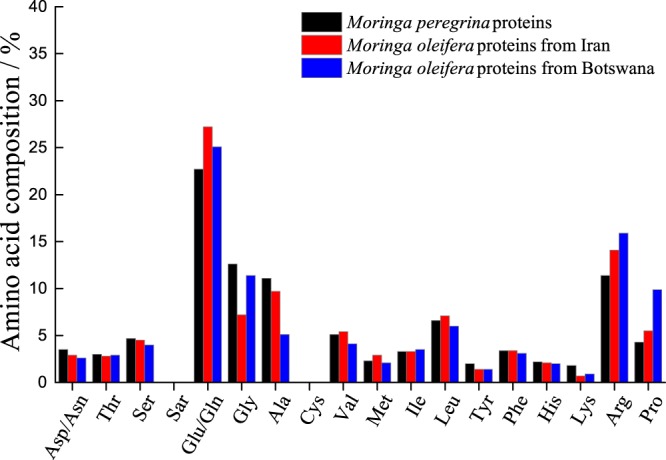
Trees of Moringa oleifera are the most widely exploited species of Moringa and proteins extracted from its seeds have been identified as the most efficient natural coagulant for water purification. Largely for climatic reasons, other Moringa species are more accessible in some regions and this paper presents a comparative study of the adsorption to different materials of the proteins extracted from seeds of Moringa peregrina and Moringa oleifera to explore their use as flocculating agents in regions where each is more readily accessible. Results showed that Moringa peregrina seed proteins had higher adsorption to alumina compared to silica, in contrast to opposite behavior for Moringa oleifera . Both species provide cationic proteins that can act as effective coagulants for the various impurities with different surface potential. Despite the considerable similarity of the amino acid composition, the seed proteins have significantly different adsorption and this presents the opportunity to improve processes by choosing the optimal species or combination of species depending on the type of impurity or possible development of separation processes.
Overview
The claims and statistics of this paper haven’t been checked yet.
Free: it reads the open-access text and checks the first 5 claims that cite a source we can check. Create a free account to check every claim.
Integrity signals
Registry
Cites
Statistics
Figures
Verification
Claims the paper makes
The claims and statistics of this paper haven’t been checked yet.
Free: it reads the open-access text and checks the first 5 claims that cite a source we can check. Create a free account to check every claim.
Claims other papers make about this one
Each is checked against this paper’s own text: does it say what the citing paper says it does?
The source backs part of the claim, not all of it — or backs it for a different population, condition or comparison.
In the citing paper
“By using MO seed extracts rather than the whole seed, one can reduce the amount of organic matter introduced to the water (Nouhi et al., 2019).”
From Use of biochar and Moringa oleifera in greywater treatment to remove heavy metals and contaminants of emerging concern (2023) · cites this paper as Nouhi et al., 2019
Experimental — accuracy not yet measuredThe source backs part of the claim, not all of it — or backs it for a different population, condition or comparison.
In the citing paper
“The active component of a powder prepared from dried, crushed MO seeds is a soluble protein which acts as a natural cationic polyelectrolyte that causes flocculation (Nouhi et al., 2019).”
From Use of biochar and Moringa oleifera in greywater treatment to remove heavy metals and contaminants of emerging concern (2023) · cites this paper as Nouhi et al., 2019
Experimental — accuracy not yet measured
Self-check
Percentages, sums and reported differences re-computed from the paper’s own numbers.
The self-check needs the paper’s full text.
Citations
Cites
Verma, A. K., Dash, R. R., & Bhunia, P. (2012) · Journal of Environmental Management · doi:10.1016/j.jenvman.2011.09.012 · Cited by 1,996
Coagulation by hydrolysing metal salts
Duan, J., & Gregory, J. (2003) · Advances in Colloid and Interface Science · doi:10.1016/s0001-8686(02)00067-2 · Cited by 1,716
Aluminium as a risk factor in Alzheimer’s disease, with emphasis on drinking water
Flaten, T. P. (2001) · Brain Research Bulletin · doi:10.1016/s0361-9230(01)00459-2 · Cited by 939
Emerging usage of plant-based coagulants for water and wastewater treatment
Yin, C.-Y. (2010) · Process Biochemistry · doi:10.1016/j.procbio.2010.05.030 · Cited by 581
Adsorption and flocculation by polymers and polymer mixtures
Gregory, J., & Barany, S. (2011) · Advances in Colloid and Interface Science · doi:10.1016/j.cis.2011.06.004 · Cited by 501
Compilation of PZC and IEP of sparingly soluble metal oxides and hydroxides from literature
Kosmulski, M. (2009) · Advances in Colloid and Interface Science · doi:10.1016/j.cis.2009.08.003 · Cited by 461
Isolation and characterization of a flocculating protein from Moringa oleifera Lam
Gassenschmidt, U., Jany, K. D., Bernhard, T., & Niebergall, H. (1995) · Biochimica et Biophysica Acta (BBA) - General Subjects · doi:10.1016/0304-4165(94)00176-x · Cited by 370
Aluminium in brain tissue in familial Alzheimer’s disease
Mirza, A., King, A., Troakes, C., & Exley, C. (2017) · Journal of Trace Elements in Medicine and Biology · doi:10.1016/j.jtemb.2016.12.001 · Cited by 261
Moringa oleifera seeds for softening hardwater
Muyibi, S. A., & Evison, L. M. (1995) · Water Research · doi:10.1016/0043-1354(94)00250-b · Cited by 214
International Journal of Water Resources and Environmental Engineering
(2026) · International Journal of Water Resources and Environmental Engineering · doi:10.5897/ijwree · Cited by 213
Choy, S. Y., Prasad, K. M. N., Wu, T. Y., & Ramanan, R. N. (2015) · International Journal of Environmental Science and Technology · doi:10.1007/s13762-013-0446-2 · Cited by 198
Moringa plants: Bioactive compounds and promising applications in food products
Saucedo-Pompa, S., Torres-Castillo, J. A., Castro-López, C., Rojas, R., Sánchez-Alejo, E. J., Ngangyo-Heya, M., & Martínez-Ávila, G. C. G. (2018) · Food Research International · doi:10.1016/j.foodres.2018.05.062 · Cited by 187
Removal of turbidity from drinking water using natural coagulants
Muthuraman, G., & Sasikala, S. (2014) · Journal of Industrial and Engineering Chemistry · doi:10.1016/j.jiec.2013.08.023 · Cited by 182
Oliveira, J. T. A., Silveira, S. B., Vasconcelos, I. M., Cavada, B. S., & Moreira, R. A. (1999) · Journal of the Science of Food and Agriculture · doi:10.1002/(sici)1097-0010(19990501)79:6<815::aid-jsfa290>3.0.co;2-p · Cited by 175
Combining Data from DNA Sequences and Morphology for a Phylogeny of Moringaceae (Brassicales)
Olson, M. E. (2002) · BioOne Complete (BioOne) · doi:10.1043/0363-6445-27.1.55 · Cited by 173
Potential ofM. oleiferafor the Treatment of Water and Wastewater
Kansal, S. K., & Kumari, A. (2014) · Chemical Reviews · doi:10.1021/cr400093w · Cited by 162
Araújo, C. S. T., Alves, V. N., Rezende, H. C., Almeida, I. L. S., de Assunção, R. M. N., Tarley, C. R. T., Segatelli, M. G., & Coelho, N. M. M. (2010) · Water Science and Technology · doi:10.2166/wst.2010.419 · Cited by 161
Madrona, G. S., Serpelloni, G. B., Vieira, A. M. S., Nishi, L., Valverde, K. C., & Bergamasco, R. (2010) · Water Air & Soil Pollution · doi:10.1007/s11270-009-0309-0 · Cited by 149
Flocculent activity of a recombinant protein from Moringa oleifera Lam. seeds
Broin, M., Santaella, C., Cuiné, S., Kokou, K., Peltier, G., & t, T. J. X. E. (2002) · Applied Microbiology and Biotechnology · doi:10.1007/s00253-002-1106-5 · Cited by 146
Ali, E. N., Muyibi, S. A., Salleh, H. M., Alam, M. Z., & Salleh, M. R. M. (2010) · Journal of Water Resource and Protection · doi:10.4236/jwarp.2010.23030 · Cited by 135
Dalvand, A., Gholibegloo, E., Ganjali, M. R., Golchinpoor, N., Khazaei, M., Kamani, H., Hosseini, S. S., & Mahvi, A. H. (2016) · Environmental Science and Pollution Research · doi:10.1007/s11356-016-6708-z · Cited by 125
Sánchez‐Martín, J., Ghebremichael, K. A., & Beltran-Heredia, J. (2010) · Bioresource Technology · doi:10.1016/j.biortech.2010.02.072 · Cited by 123
What is the risk of aluminium as a neurotoxin?
Exley, C. (2014) · Expert Review of Neurotherapeutics · doi:10.1586/14737175.2014.915745 · Cited by 102
Shebek, K. M., Schantz, A. B., Sines, I. T., Lauser, K. T., Velegol, S. B., & Kumar, M. (2015) · Langmuir · doi:10.1021/acs.langmuir.5b00015 · Cited by 98
Anti-cyanobacterial activity of Moringa oleifera seeds
Lürling, M., & Beekman, W. (2009) · Journal of Applied Phycology · doi:10.1007/s10811-009-9485-y · Cited by 95
de Paula, H. M., Ilha, M. S. D. O., & Andrade, L. S. (2014) · Journal of Cleaner Production · doi:10.1016/j.jclepro.2014.04.031 · Cited by 89
Recent upgrades of the neutron reflectometer D17 at ILL
Saerbeck, T., Cubitt, R., Wildes, A. R., Manzin, G., Andersen, K. H., & Gutfreund, P. (2018) · Journal of Applied Crystallography · doi:10.1107/s160057671800239x · Cited by 86
Self-citationFreire, J. E. D. C., Vasconcelos, I. M., Moreno, F. B. M. B., Batista, A. B., Lobo, M. D. P., Pereira, M. L., Lima, J. P. M. S., de Almeida, R. V. M., Sousa, A. J. S., Monteiro‐Moreira, A. C. D. O., et al. (2015) · PLoS ONE · doi:10.1371/journal.pone.0119871 · Cited by 85
Towards a molecular understanding of the water purification properties of Moringa seed proteins
Moulin, M., Mossou, E., Signor, L., Kieffer‐Jaquinod, S., Kwaambwa, H. M., Nermark, F. M., Gutfreund, P., Mitchell, E. P., Haertlein, M., Forsyth, V. T., et al. (2019) · Journal of Colloid and Interface Science · doi:10.1016/j.jcis.2019.06.071 · Cited by 84
Self-citationCoagulant proteins identified in Mustard: a potential water treatment agent
Bodlund, I., Pavankumar, A. R., Chelliah, R., kasi, S., Sankaran, K., & Rajarao, G. K. (2013) · International Journal of Environmental Science and Technology · doi:10.1007/s13762-013-0282-4 · Cited by 76
Teixeira, M. R., Camacho, F. P., Sousa, V. S., & Bergamasco, R. (2017) · Journal of Cleaner Production · doi:10.1016/j.jclepro.2017.06.004 · Cited by 69
Neutron and X-ray reflectometry of interfacial systems in colloid and polymer chemistry
Thomas, R. K., & Penfold, J. (1996) · Current Opinion in Colloid & Interface Science · doi:10.1016/s1359-0294(96)80040-9 · Cited by 67 · cited 1×
“The characteristic amount and the structure of Moringa seed proteins adsorbed to different surfaces in this article were studied using neutron reflectometry where the measured signal is highly sensitive to the adsorbed amount at the interface [1].”
BackgroundJuhaimi, F. A., Ghafoor, K., Babiker, E. E., Matthäus, B., & Özcan, M. M. (2016) · Journal of Food Biochemistry · doi:10.1111/jfbc.12322 · Cited by 62
Coagulant properties of Moringa oleifera protein preparations: application to humic acid removal
Santos, A. F. S., Paiva, P. M. G., Teixeira, J. A., de Brito, A. G., Coelho, L. C. B. B., & Nogueira, R. (2011) · Environmental Technology · doi:10.1080/09593330.2010.550323 · Cited by 55
Nordmark, B. A., Przybycien, T. M., & Tilton, R. D. (2016) · Journal of environmental chemical engineering · doi:10.1016/j.jece.2016.10.029 · Cited by 55
Sublethal toxicity of two wastewater treatment polymers to lake trout fry (Salvelinus namaycush)
Liber, K., Weber, L. P., & Lévesque, C. (2005) · Chemosphere · doi:10.1016/j.chemosphere.2005.03.004 · Cited by 53
Moreira, J. A. G., Zeng, X. H. T., & Amaral, L. A. N. (2015) · PLoS ONE · doi:10.1371/journal.pone.0143108 · Cited by 51
Kwaambwa, H. M., Hellsing, M. S., & Rennie, A. R. (2010) · Langmuir · doi:10.1021/la9031046 · Cited by 50
Self-citationImprovement of water treatment pilot plant withMoringa oleiferaextract as flocculant agent
Beltran-Heredia, J., & Sánchez‐Martín, J. (2009) · Environmental Technology · doi:10.1080/09593330902831176 · Cited by 49
Direct Flocculation Process for Wastewater Treatment
Chong, M. F. (2012) · Springer eBooks · doi:10.1007/978-94-007-4204-8_8 · Cited by 49
Rennie, A. R., Hellsing, M. S., Wood, K., Gilbert, E. P., Porcar, L., Schweins, R., Dewhurst, C. D., Lindner, P., Heenan, R. K., Rogers, S. E., et al. (2013) · Journal of Applied Crystallography · doi:10.1107/s0021889813019468 · Cited by 48
Self-citationStructure of flocs of latex particles formed by addition of protein from Moringa seeds
Hellsing, M. S., Kwaambwa, H. M., Nermark, F. M., Nkoane, B. B. M., Jackson, A., Wasbrough, M. J., Berts, I., Porcar, L., & Rennie, A. R. (2013) · Colloids and Surfaces A Physicochemical and Engineering Aspects · doi:10.1016/j.colsurfa.2013.11.038 · Cited by 44
Self-citationMicroalgae removal with Moringa oleifera
Barrado-Moreno, M. M., Beltran-Heredia, J., & Gallardo, J. M. (2015) · Toxicon · doi:10.1016/j.toxicon.2015.12.001 · Cited by 36
Vaknin, Y., & Mishal, A. (2017) · Scientia Horticulturae · doi:10.1016/j.scienta.2017.07.039 · Cited by 36
Mataka, L. M., Sajidu, S. M. I., Masamba, W. R. L., & Mwatseteza, J. F. (2010) · International Journal of Water Resources and Environmental Engineering · doi:10.5897/ijwree.9000008 · Cited by 35
Removal of Ni(II) from aqueous solution using leaf, bark and seed of Moringa stenopetala adsorbents
Aregawi, B. H., & Mengistie, A. A. (2012) · Bulletin of the Chemical Society of Ethiopia · doi:10.4314/bcse.v27i1.4 · Cited by 31
Coagulant Protein from plant materials: Potential Water Treatment Agent
Bodlund, I. (2013) · KTH Publication Database DiVA (KTH Royal Institute of Technology) · Cited by 28
Interaction of Moringa oleifera seed protein with a mineral surface and the influence of surfactants
Kwaambwa, H. M., Hellsing, M. S., Rennie, A. R., & Barker, R. D. (2015) · Journal of Colloid and Interface Science · doi:10.1016/j.jcis.2015.02.033 · Cited by 24
Self-citationNote: Sample cells to investigate solid/liquid interfaces with neutrons
Rennie, A. R., Hellsing, M. S., Lindholm, E., & Olsson, A. (2015) · Review of Scientific Instruments · doi:10.1063/1.4906518 · Cited by 19
Self-citation(2020) · doi:10.37421/csj · Cited by 17
Moringa (Moringa oleifera): a Source of Food and Nutrition, Medicine and Industrial products
Shindano, J., & Kasase, C. (2009) · ACS symposium series · doi:10.1021/bk-2009-1021.ch024 · Cited by 16
Structure of a large colloidal crystal – controlling orientation and three-dimensional order
Hellsing, M. S., Rennie, A. R., Heenan, R. K., & Rogers, S. E. (2012) · RSC Advances · doi:10.1039/c2ra21092d · Cited by 10
Self-citationSticking particles to solid surfaces using Moringa oleifera proteins as a glue
Nouhi, S., Pascual, M., Hellsing, M. S., Kwaambwa, H. M., Skoda, M. W. A., Höök, F., & Rennie, A. R. (2018) · Colloids and Surfaces B Biointerfaces · doi:10.1016/j.colsurfb.2018.01.004 · Cited by 10
Self-citationMoulin, M. (2019) · Keele Research Repository (Keele University) · Cited by 5
Conaghan, S. (2013) · Arrow@dit (Dublin Institute of Technology) · Cited by 3
Water Purification with a Natural Product
Kwaambwa, H. M. (2013) · Chemical Science · doi:10.4172/2150-3494.1000074 · Cited by 1
Self-citation
Cited by
Isaeva, V. I., Vedenyapina, M. D., Kurmysheva, A. Y., Weichgrebe, D., Nair, R. R., Nguyen, N. P. T., & Kustov, L. M. (2021) · Molecules · doi:10.3390/molecules26216628 · Cited by 196
Peydayesh, M., Suta, T., Usuelli, M., Handschin, S., Canelli, G., Bagnani, M., & Mezzenga, R. (2021) · Environmental Science & Technology · doi:10.1021/acs.est.1c01918 · Cited by 192
Orejuela-Escobar, L. M., Landázuri, A. C., & Goodell, B. (2021) · Journal of Bioresources and Bioproducts · doi:10.1016/j.jobab.2021.01.004 · Cited by 114
Girish, N., Parashar, N., & Hait, S. (2023) · The Science of The Total Environment · doi:10.1016/j.scitotenv.2023.165723 · Cited by 94
Diver, D., Nhapi, I., & Ruziwa, W. R. (2023) · Environmental Advances · doi:10.1016/j.envadv.2023.100421 · Cited by 107
Metadata
- Authors
- Nouhi, S., Kwaambwa, H. M., Gutfreund, P., & Rennie, A. R.
- Affiliations
- Uppsala University (SE)
- Namibia University of Science and Technology (NA)
- Institut Laue-Langevin (FR)
- Corresponding author
- Nouhi, Shirin
- Venue
- Scientific Reports
- Published
- 2019-11-29
- Volume
- 9
- Issue
- 1
- Pages
- 17945-17945
- ISSN
- 2045-2322 (ISSN-L)
- PMC
- PMC6884452
- OpenAlex
- W2991175787
- Cited by
- 61
- References
- 56
- Citations by year
- 2026: 4 · 2025: 10 · 2024: 16 · 2023: 10 · 2022: 12 · 2021: 6 · 2020: 3
- FWCI
- 1.90
- Type
- journal article
- Language
- en
- Open access
- gold
- doi.org
- Licence
- cc-by
- creativecommons.org/licenses/by/4.0 (tdm)
- creativecommons.org/licenses/by/4.0 (vor)
- Locations
- Scientific Reports (publishedVersion, cc-by)
- PubMed Central (publishedVersion, cc-by)
- PubMed (publishedVersion)
- KTH Publication Database DiVA (KTH Royal Institute of Technology) (submittedVersion, other-oa)
- DOAJ (DOAJ: Directory of Open Access Journals) (submittedVersion)
- Funders
- Vetenskapsrådet (621-2012-4382)
- Topics
- Physical Sciences › Environmental Science › Water Science and Technology › Coagulation and Flocculation Studies
- Life Sciences › Agricultural and Biological Sciences › Plant Science › Moringa oleifera research and applications
- Physical Sciences › Chemical Engineering › Filtration and Separation › Minerals Flotation and Separation Techniques
- Keywords
- Moringa peregrina, Moringa oleifera, seed proteins, natural coagulants, flocculation, adsorption, alumina, silica, cationic proteins, water treatment, surface potential, amino acid composition, plant-based coagulants
- MeSH terms
- Adsorption, Aluminum Oxide, Flocculation, Plant Proteins, Seeds, Silicon Dioxide, Water Purification, Moringa, Moringa oleifera
About these checks
Registry, retraction, Cites and statistics results are computed, not judged, with one exception: a printed reference that no index lists is read once by a model before it counts as a citation error. Claims are extracted by a model and kept only when their quote appears verbatim in the text; each cited source is then checked, with a model’s help, for whether it says what the claim relies on. Those verdicts can be wrong — read the claim’s quote and the cited source before relying on one.
Statistics and arithmetic are recomputed, not judged.
Confidence bands are shown only for fields calibrated on our annotated test set. None is calibrated yet, so no band is shown.
What counts as a claim ›How we measure confidence ›How we check this ›
Are you an author, or do you see a problem with this page? Request a review
Data sources
Bibliographic data: Semantic Scholar, OpenAlex, Crossref.
Contains information from the Semantic Scholar Academic Graph Datasets, made available under the ODC Attribution License (ODC-BY 1.0).
Semantic Scholar’s data is described in: Kinney, R., et al. (2023). The Semantic Scholar Open Data Platform. arXiv:2301.10140.
