

Colletotrichum species associated with mango in southern China
Open accessThe DOI matches its Crossref record; 41 of the 43 references it cites were found in a registry or an index, and 1 are not checked yet; 13 of the 31 sources its claims cite were checked for support.
Abstract
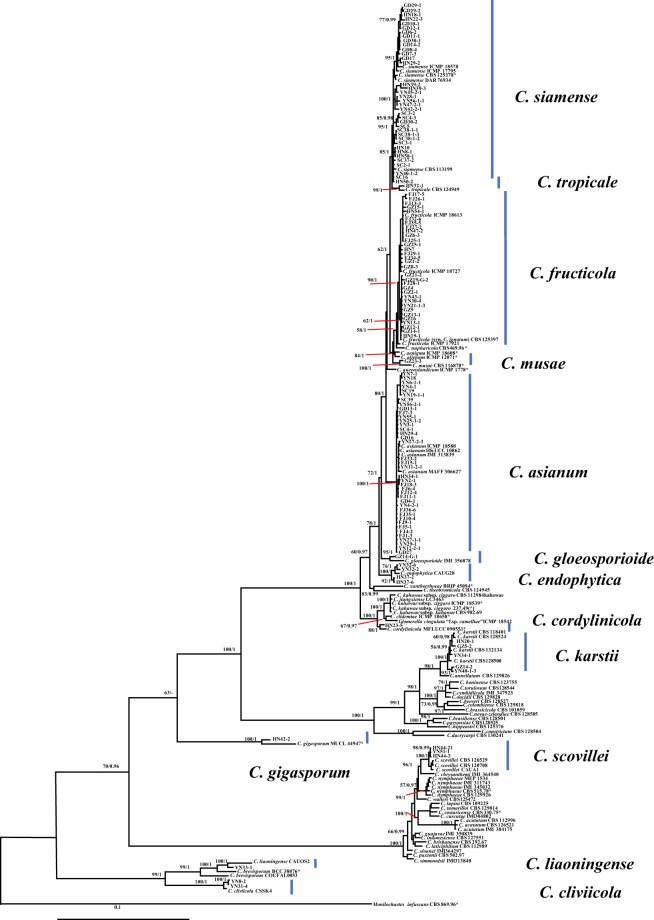
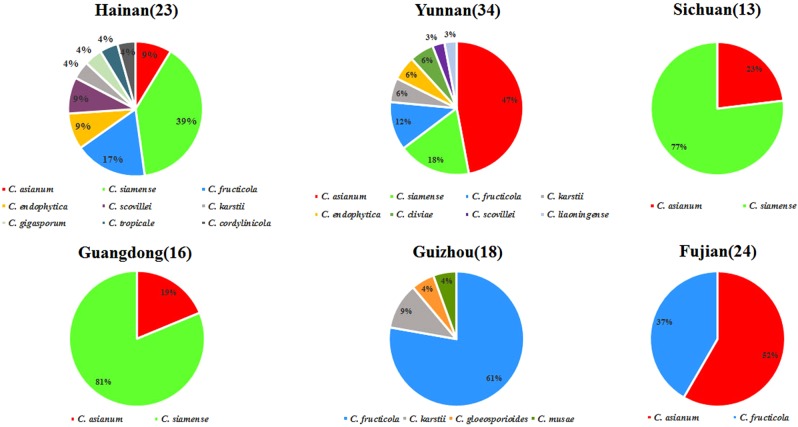
Mango (Mangifera indica L.) is an economically significant fruit crop in provinces of southern China including Hainan, Yunnan, Sichuan, Guizhou, Guangdong and Fujian. The objective of this study was to examine the diversity of Colletotrichum species infecting mango cultivars in major growing areas in China, using morphological and molecular techniques together with pathogenicity tests on detached leaves and fruits. Over 200 Colletotrichum isolates were obtained across all mango orchards investigated, and 128 of them were selected for sequencing and analyses of actin (ACT), chitin synthase (CHS-1), glyceraldehyde-3-phosphate dehydrogenase (GAPDH), the internal transcribed spacer (ITS) region, β-tubulin (TUB2) genomic regions. Our results showed that the most common fungal isolates associated with mango in southern China involved 13 species: Colletotrichum asianum, C. cliviicola, C. cordylinicola, C. endophytica, C. fructicola, C. gigasporum, C. gloeosporioides, C. karstii, C. liaoningense, C. musae, C. scovillei, C. siamense and C. tropicale. The dominant species were C. asianum and C. siamense each accounting for 30%, and C. fructicola for 25%. Only C. asianum, C. fructicola, C. scovillei and C. siamense have previously been reported on mango, while the other nine Colletotrichum species listed above were first reports associated with mango in China. From this study, five Colletotrichum species, namely C. cordylinicola, C. endophytica, C. gigasporum, C. liaoningense and C. musae were the first report on mango worldwide. Pathogenicity tests revealed that all 13 species caused symptoms on artificially wounded mango fruit and leaves (cv. Tainong). There was no obvious relationship between aggressiveness and the geographic origin of the isolates. These findings will help in mango disease management and future disease resistance breeding.
Verified 2026-11-22 · 1 reference not checked yet
Overview
CoChat Summary
## TL;DR
The paper surveyed Colletotrichum from mango anthracnose across six major mango-growing provinces in southern China and used morphology plus five-locus phylogenetics to identify 13 species. It found that three species dominated, several species were first reports on mango in China, and all 13 species were pathogenic on wounded mango leaves and fruits.
## Key findings
- From 2016–2017, the authors obtained 205 Colletotrichum isolates from symptomatic mango tissue and selected 128 representative isolates for detailed study.
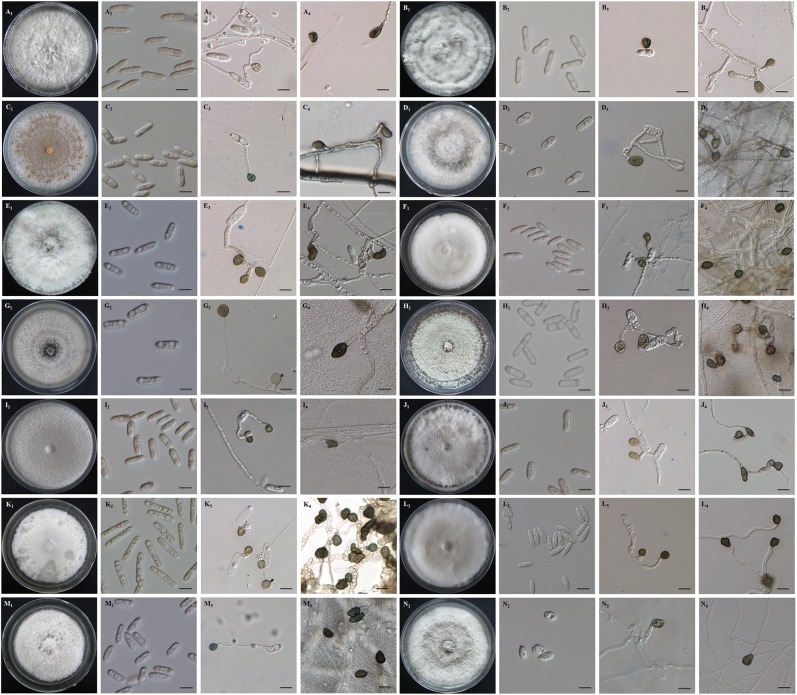
- The 128 isolates were classified into 13 species: *C. asianum, C. cliviicola, C. cordylinicola, C. endophytica, C. fructicola, C. gigasporum, C. gloeosporioides, C. karstii, C. liaoningense, C. musae, C. scovillei, C. siamense,* and *C. tropicale*.
- The dominant species were *C. asianum* and *C. siamense* (38 isolates each, 29.7% each) and *C. fructicola* (32 isolates, 25.0%); together the dominant species accounted for 84.4% of all isolates.
- Nine species were reported as first records on mango in China, and five species (*C. cordylinicola, C. endophytica, C. gigasporum, C. liaoningense,* and *C. musae*) were first reports on mango worldwide.
- All 128 tested isolates were pathogenic on wounded mango leaves and fruits. Fruit lesion diameters ranged from 0.54 cm to 3.64 cm; leaf lesion diameters ranged from 0.60 cm to 4.34 cm.
- On fruits, 52% (66/128) were moderately virulent, 7% (9/128) strongly virulent, and 41% (53/128) weakly virulent; on leaves, 65% (84/128) were moderately virulent, 30% (38/128) strongly virulent, and 5% (6/128) weakly virulent.
## Methods
- Sampling/design: Mango leaves, fruits, and branches with anthracnose symptoms were collected during 2016 and 2017 from six provinces in southern China (Fujian, Guangdong, Guizhou, Hainan, Sichuan, and Yunnan).
- Identification approach: Isolates were cultured and characterized morphologically, then sequenced at five loci (ACT, CHS-1, GAPDH, ITS, TUB2) and analyzed with maximum likelihood and Bayesian phylogenetic methods using concatenated data.
- Pathogenicity tests: Representative isolates were inoculated onto wounded detached mango leaves and fruits (cv. Tainong) under controlled conditions, and lesion diameters were measured; statistical comparisons used ANOVA followed by Fisher’s LSD.
## Limitations
- The authors state that the pathogenicity test used wounded detached leaves and fruits with mycelial plugs, so the results “may not reflect the full aggressiveness potential” of the isolates; they suggest testing conidial inoculation in planta instead.
- They also note that symptoms and aggressiveness can vary with cultivar, fruit physiological state, inoculum concentration, humidity, and temperature, which makes the detached-tissue assay an incomplete proxy for field disease.
- Evident from the text: sampling was confined to six provinces in southern China and to symptomatic anthracnose tissue, so it may not capture the full diversity of Colletotrichum on mango outside those areas or without visible symptoms.
Model-written summary. Check it against the paper before relying on it.
Integrity signals
Registry
Cites
Statistics
Figures
Verification
Claims the paper makes
11 Valid · 3 Not valid · 5 Not checked · 29 Own results and interpretations
At least one cited source doesn’t support this claim or points to a different paper, and none confirmed it — see the verdicts below.
In the paper
“Only C. asianum, C. fructicola, C. scovillei and C. siamense have previously been reported on mango”
- Also stated in: § Discussion · plain
“Mo et al.15, Liu et al.24 and Qin et al. 22,25 identified four Colletotrichum species (C. asianum, C. fructicola, C. scovillei, C. siamense) prevalent on mango in China.”
§ Colletotrichum species associated with mango in southern China > Abstract Mango (Mangifera indica L.) is an economically significant fruit crop in provinces of southern China including Hainan, Yunnan, Sichuan, Guizhou, Guangdong and Fujian. The objective of this study was to examine the diversity of Colletotrichum species infecting mango cultivars in major growing areas in China, using morphological and molecular techniques together with pathogenicity tests on detached leaves and fruits. Over 200 Colletotrichum isolates were obtained across all mango orchards investigated, and 128 of them were selected for sequencing and analyses of actin (ACT), chitin synthase (CHS-1), glyceraldehyde-3-phosphate dehydrogenase (GAPDH), the internal transcribed spacer (ITS) region, β-tubulin (TUB2) genomic regions. Our results showed that the most common fungal isolates associated with mango in southern China involved 13 species: Colletotrichum asianum, C. cliviicola, C. cordylinicola, C. endophytica, C. fructicola, C. gigasporum, C. gloeosporioides, C. karstii, C. liaoningense, C. musae, C. scovillei, C. siamense and C. tropicale. The dominant species were C. asianum and C. siamense each accounting for 30%, and C. fructicola for 25%. Only C. asianum, C. fructicola, C. scovillei and C. siamense have previously been reported on mango, while the other nine Colletotrichum species listed above were first reports associated with mango in China. From this study, five Colletotrichum species, namely C. cordylinicola, C. endophytica, C. gigasporum, C. liaoningense and C. musae were the first report on mango worldwide. Pathogenicity tests revealed that all 13 species caused symptoms on artificially wounded mango fruit and leaves (cv. Tainong). There was no obvious relationship between aggressiveness and the geographic origin of the isolates. These findings will help in mango disease management and future disease resistance breeding.
What the sources say
- Disputedcites Mo et al.15 Mo J Identification and Characterization of Colletotrichum Species Associated with Mango Anthracnose in Guangxi, China Plant Dis. 2018 102 1283 1289 10.1094/PDIS-09-17-1516-RE 30673569 sourceExperimental — accuracy not yet measured
The Discussion reports prior records of C. asianum, C. fructicola, and C. siamense on mango, but it also discusses C. acutatum from mango and says C. gloeosporioides had previously been shown to cause mango fruit rot. Those additional reports contradict “only” the four named species. The passages do not establish a prior mango report for C. scovillei. (LLM, conf=0.86)
Checked by a reasoning model — may be wrong.
- Not checked — no full text of the sourcecites Liu et al.24 Liu LP First report of post-harvest anthracnose on mango (Mangifera indica) caused by Colletotrichum siamense in China Plant Disease 2017 101 5 833 833 10.1094/PDIS-08-16-1130-PDN source
- Not matchedcites Qin et al. 22,25
This doesn’t read as a citation we can look up.
plain- Asserted: passes — The authors put it forward as true.
- Checkable: passes — It can be checked against evidence.
- Load-bearing: passes — The paper’s conclusions depend on it.
- Based: passes — The paper gives a reason why it holds.
- Also stated in: § Discussion · plain
Every source the paper cites for this claim was checked and supports it.
In the paper
“conidial morphology alone could not distinguish all species within species complexes9.”
§ Colletotrichum species associated with mango in southern China > Discussion
What the sources say
- Supportedcites [9] Weir BS Johnston PR Damm U The Colletotrichum gloeosporioides species complex Stud. Mycol. 2012 73 115 180 10.3114/sim0011 23136459 PMC3458417 source
The Results (Morphology and biology) say conidial size ranges often overlap between species in the C. gloeosporioides complex. The Discussion adds that many accepted species have few or no reliable diagnostic morphological features. Together, these support the claim that conidial morphology alone cannot distinguish every species in the complex. (LLM, conf=0.92)
hedged- Asserted: passes — The authors put it forward as true.
- Checkable: passes — It can be checked against evidence.
- Load-bearing: passes — The paper’s conclusions depend on it.
- Based: passes — The paper gives a reason why it holds.
- Supported
Every source the paper cites for this claim was checked and supports it.
In the paper
“Our study showed that a single host species may be attacked by several Colletotrichum species, and this was previously reported by Phoulivong et al.28.”
§ Colletotrichum species associated with mango in southern China > Discussion
What the sources say
- Supportedcites Phoulivong et al.28 Phoulivong S McKenzie EHC Hyde KD Cross infection of Colletotrichum species; a case study with tropical fruits Current Research in Environmental & Applied Mycology. 2012 2 99 111 10.5943/cream/2/2/2 source
The Discussion explicitly states that one host can be infected by many Colletotrichum species. The Introduction likewise describes multiple species occurring on a single host. Page numbers are not available in the supplied copy. (LLM, conf=0.94)
plainstates a possible cause- Asserted: passes — The authors put it forward as true.
- Checkable: passes — It can be checked against evidence.
- Load-bearing: unclear — It is unclear whether the paper’s conclusions depend on it.
- Based: passes — The paper gives a reason why it holds.
- Supported
A result the paper reports from its own data — it cites no other source for it, so there is none to check. The quote shows it is in the paper.
In the paper
“There was no obvious relationship between aggressiveness and the geographic origin of the isolates.”
- Also stated in: § Discussion · plain
“The difference in aggressiveness of Colletotrichum within species was independent of a particular geographical origin for sample collection”
- Also stated in: § Discussion · plain
“no specific correlations were found between aggressiveness and province of origin.”
§ Colletotrichum species associated with mango in southern China > Abstract
plain- Asserted: passes — The authors put it forward as true.
- Checkable: passes — It can be checked against evidence.
- Load-bearing: unclear — It is unclear whether the paper’s conclusions depend on it.
- Based: passes — The paper gives a reason why it holds.
- Also stated in: § Discussion · plain
The paper states this without a source or data behind it here, so there is nothing to check it against. The quote shows it is in the paper.
In the paper
“All 128 tested isolates were pathogenic to wounded mango leaves and fruits.”
§ Colletotrichum species associated with mango in southern China > Results > Pathogenicity and aggressiveness in tissues
states a cause- Asserted: passes — The authors put it forward as true.
- Checkable: passes — It can be checked against evidence.
- Load-bearing: passes — The paper’s conclusions depend on it.
- Based: unclear — It is unclear why the paper says it holds.
18 more claims
Create a free account to see all 48 claims and to verify the 2 references still open.
- Probably not a substantial claim. 14
- It may state two separate claims as one. 19
- Borderline: one of the tests for a substantial claim is unclear. 1
Citations
Cites
Basic local alignment search tool
Altschul, S. F., Gish, W., Miller, W., Myers, E. W., & Lipman, D. J. (1990) · Journal of Molecular Biology · doi:10.1006/jmbi.1990.9999 · Cited by 98,669
MUSCLE: multiple sequence alignment with high accuracy and high throughput
Edgar, R. C. (2004) · Nucleic Acids Research · doi:10.1093/nar/gkh340 · Cited by 44,662
MrBayes 3.2: Efficient Bayesian Phylogenetic Inference and Model Choice Across a Large Model Space
Ronquist, F., Teslenko, M., van der Mark, P., Ayres, D. L., Darling, A., Höhna, S., Larget, B., Liu, L., Suchard, M. A., & Huelsenbeck, J. P. (2012) · Systematic Biology · doi:10.1093/sysbio/sys029 · Cited by 27,843
jModelTest 2: more models, new heuristics and parallel computing
Darriba, D., Taboada, G. L., Doallo, R., & Posada, D. (2012) · Nature Methods · doi:10.1038/nmeth.2109 · Cited by 16,785
BEAST: Bayesian evolutionary analysis by sampling trees
Drummond, A. J., & Rambaut, A. (2007) · BMC Evolutionary Biology · doi:10.1186/1471-2148-7-214 · Cited by 12,919
TESTING SIGNIFICANCE OF INCONGRUENCE
Farris, J. S., Källersjö, M., Kluge, A. G., & Bult, C. (1994) · Cladistics · doi:10.1111/j.1096-0031.1994.tb00181.x · Cited by 3,833
raxmlGUI: a graphical front-end for RAxML
Silvestro, D., & Michalak, I. (2012) · Organisms Diversity & Evolution · doi:10.1007/s13127-011-0056-0 · Cited by 2,864
The Colletotrichum gloeosporioides species complex
Weir, B. S., Johnston, P. R., & Damm, U. (2012) · Studies in Mycology · doi:10.3114/sim0011 · Cited by 1,646
Tang, Q., & Zhang, C. (2013) · Insect Science · doi:10.1111/j.1744-7917.2012.01519.x · Cited by 1,198
Colletotrichum – current status and future directions
Cannon, P. F., Damm, U., Johnston, P. R., & Weir, B. S. (2012) · Studies in Mycology · doi:10.3114/sim0014 · Cited by 1,105
Research works printed but not linked: 5
- Nan N Fu ZJ Xu JC Mango industrialized development in China Journal of Yunnan Agricultural University. 2017 11 80 84
- Hyde KD Colletotrichum: a catalogue of confusion Fungal Divers. 2009 39 1 17
- Cai L A polyphasic approach for studying Colletotrichum. Fungal Divers. 2009 39 183 204
- Sun. S Identification and biological characteristics of Colletotrichum asianum from post-harvest mango (Mangifera indica) Chinese Journal of Tropical Crops 2016 37 2392 2397
- Yang YL Colletotrichum anthracnose of Amaryllidaceae Fungal Divers. 2009 39 2 123 146
Cited by
Items 101–111 of 111
Gutiérrez-Góngora, C., Ferrucho, R. L., & Marín-Ramírez, G. A. (2024) · Revista Cenicafé · doi:10.38141/10778/75205
Cruz, M. A., Cortaga, C. Q., Amas, J. C., Calabon, M. S., Bagacay, J. F. E., Concepcion, R., Bulasag, A. S., Mendoza, J.-V. S., Fronda, M. F., Metrillo, J., et al. (2025) · Physiological and Molecular Plant Pathology · doi:10.1016/j.pmpp.2025.102941 · Cited by 2
First Report of Mango Anthracnose Caused by Colletotrichum plurivorum in China
Zheng, H., Han, Z., Lin, Y., Lv, Y., Yan, J., Miao, W., Lin, C., & Wu, W. (2025) · Plant Disease · doi:10.1094/pdis-03-25-0711-pdn
Pitiwittayakul, N., Niyomvong, N., Wongsorn, D., Kumla, J., & Suwannarach, N. (2025) · PLoS ONE · doi:10.1371/journal.pone.0339399 · Cited by 1
“Some of the isolated Colletotrichum species exhibited strong host preferences, such as C. musae in banana [30], C. asianum in mango [31,32], and C. truncatum in chili [33].”
Prusky, D. B., & Alkan, N. (2026) · Botany, production and uses. · doi:10.1079/9781800622647.0011
Colletotrichum magnum Species Complex: Emerging Pathogens in Tropical and Subtropical Regions
Wang, S., Chen, L., Cao, J., Tang, L.-Q., Clapés, P., Zhu, S.-Q., & Laborda, P. (2026) · Phytopathology · doi:10.1094/phyto-08-25-0278-rvw
Self-citationNiu, Y.-F., Zhu, X., Mao, C.-L., Qian, X., Liu, N., Ai, J., Li, C., Liu, J., & Liu, S. (2026) · Microorganisms · doi:10.3390/microorganisms14040906
“Mango anthracnose is caused by fungi of the genus Colletotrichum , with C. siamense , C. fructicola , and C. asianum identified as the dominant pathogenic species in China [6].”
Tamanna, M. H., Sarmin, S., Irin, U. A., Khatun, M. K., Talukder, M. R., & Hasan, M. M. (2026) · PLoS ONE · doi:10.1371/journal.pone.0347546 · Cited by 2
AMULOTHU, D. V. R. T., & Sriram, S. (2026) · The Indian Journal of Agricultural Sciences · doi:10.56093/ijas.v96i4.168360
“Although many species exhibit broad host ranges, C. siamense has been reported on custard apple (Borges et al. 2021), mango (Giblin et al. 2018, Li et al. 2019, Fuentes-Aragon et al. 2020), banana (Fuentes-Aragón et al. 2021) and pomegranate (Xavier et al. 2019).”
Wang, R., Zhu, T., Huang, R., Sun, W., Tang, L., Huang, S., Chen, X., Zheng, L., Hsiang, T., & Li, Q. (2026) · Molecular Plant Pathology · doi:10.1111/mpp.70339
Self-citationZhu, T., Wang, R., Huang, R., Sun, W., Tang, L., Huang, S., Chen, X., Hsiang, T., Zheng, L., & Li, Q. (2026) · International Journal of Biological Macromolecules · doi:10.1016/j.ijbiomac.2026.154540
Self-citation
Metadata
- Authors
- Li, Q., Bu, J., Shu, J., Yu, Z., Tang, L., Huang, S., Guo, T., Mo, J., Luo, S., Solangi, G. S., & Hsiang, T.
- Affiliations
- Guangxi Academy of Agricultural Science (CN)
- Yangtze University (CN)
- The University of Sydney (AU)
- Sindh Agriculture University (PK)
- University of Guelph (CA)
- Corresponding author
- Yu, Zhihe
- Mo, Jianyou
- ORCID
- Venue
- Scientific Reports
- Published
- 2019-12-11
- Volume
- 9
- Issue
- 1
- Pages
- 18891-18891
- ISSN
- 2045-2322 (ISSN-L)
- PMC
- PMC6906457
- OpenAlex
- W2995564477
- Cited by
- 109
- References
- 43
- Citations by year
- 2026: 8 · 2025: 26 · 2024: 18 · 2023: 15 · 2022: 25 · 2021: 11 · 2020: 6
- FWCI
- 5.69
- Type
- journal article
- Language
- en
- Open access
- gold
- doi.org
- Licence
- cc-by
- creativecommons.org/licenses/by/4.0 (tdm)
- creativecommons.org/licenses/by/4.0 (vor)
- Locations
- Scientific Reports (publishedVersion, cc-by)
- PubMed Central (publishedVersion, cc-by)
- PubMed (publishedVersion)
- DOAJ (DOAJ: Directory of Open Access Journals) (submittedVersion)
- Greater South Information System
- Funders
- National Natural Science Foundation of China (31600029, 31560526)
- Natural Science Foundation of Guangxi Province (2016GXNSFCB380004)
- Foundation for Development of Science and Technology Guangxi Academy of Agricultural Sciences
- Topics
- Life Sciences › Agricultural and Biological Sciences › Plant Science › Plant Pathogens and Fungal Diseases
- Life Sciences › Agricultural and Biological Sciences › Plant Science › Fungal Plant Pathogen Control
- Life Sciences › Immunology and Microbiology › Microbiology › Yeasts and Rust Fungi Studies
- Keywords
- Colletotrichum, mango, plant pathogenic fungi, species diversity, Colletotrichum asianum, Colletotrichum siamense, Colletotrichum fructicola, Colletotrichum scovillei, Colletotrichum musae, Colletotrichum karstii, Colletotrichum gloeosporioides, pathogenicity, new host record, South China
- MeSH terms
- China, DNA, Fungal, Phylogeny, Plant Diseases, Plant Leaves, Colletotrichum, Mangifera
About these checks
Registry, retraction, Cites and statistics results are computed, not judged, with one exception: a printed reference that no index lists is read once by a model before it counts as a citation error. Claims are extracted by a model and kept only when their quote appears verbatim in the text; each cited source is then checked, with a model’s help, for whether it says what the claim relies on. Those verdicts can be wrong — read the claim’s quote and the cited source before relying on one.
The claim verdicts this report counts are experimental: their accuracy is not yet measured.
A language model drew the claims from the paper on 2026-10-10, under version 3 of the claim definition (model deepseek-v4.1-flash, prompt extract-v3).
A second model labelled each claim on 2026-10-10 (model jev-1.13-20260917, definition revision gold-guideline-v0.2).
Cited sources are checked with a language model’s help (gpt-6-sol).
Statistics and arithmetic are recomputed, not judged.
Confidence bands are shown only for fields calibrated on our annotated test set. None is calibrated yet, so no band is shown.
What counts as a claim ›How we measure confidence ›How we check this ›
Are you an author, or do you see a problem with this page? Request a review
Data sources
Bibliographic data: Semantic Scholar, OpenAlex, Crossref.
Contains information from the Semantic Scholar Academic Graph Datasets, made available under the ODC Attribution License (ODC-BY 1.0).
Semantic Scholar’s data is described in: Kinney, R., et al. (2023). The Semantic Scholar Open Data Platform. arXiv:2301.10140.
