

Modeling somatic computation with non-neural bioelectric networks
Open accessThe DOI matches its Crossref record; 141 of the 141 references it cites were found in a registry or an index.
Abstract
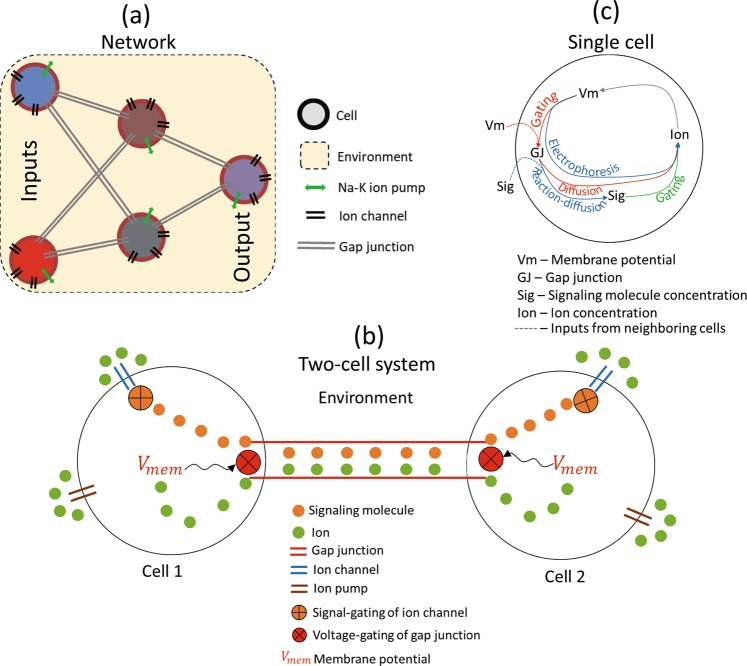
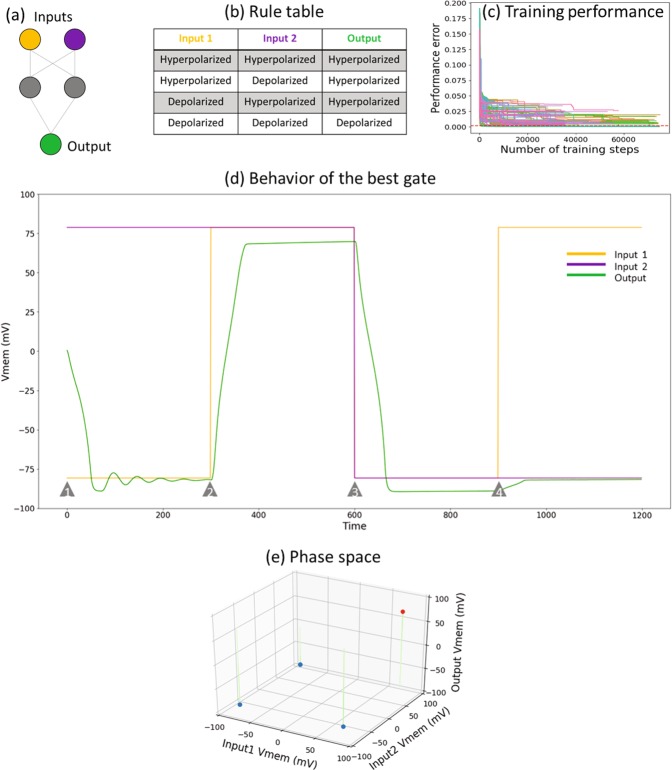
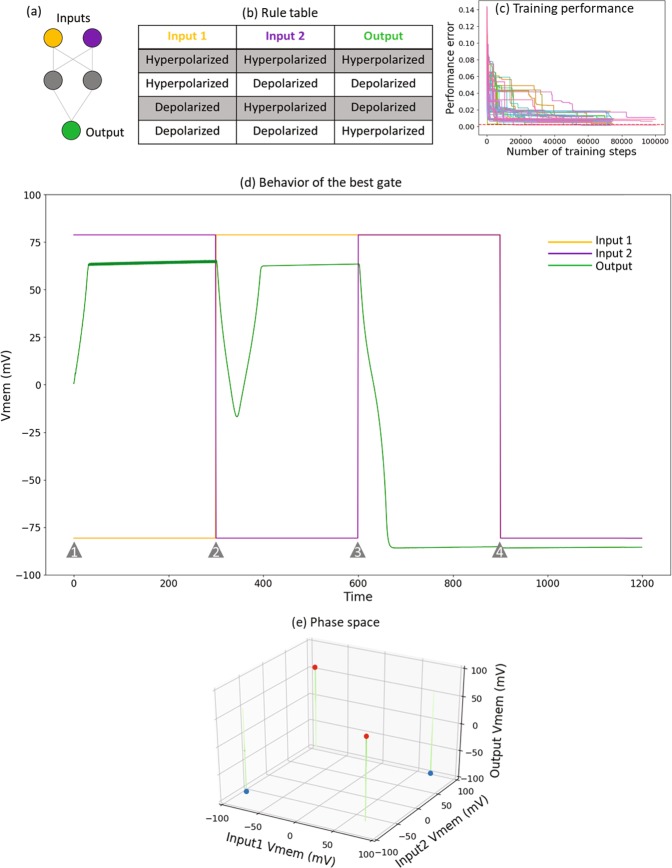
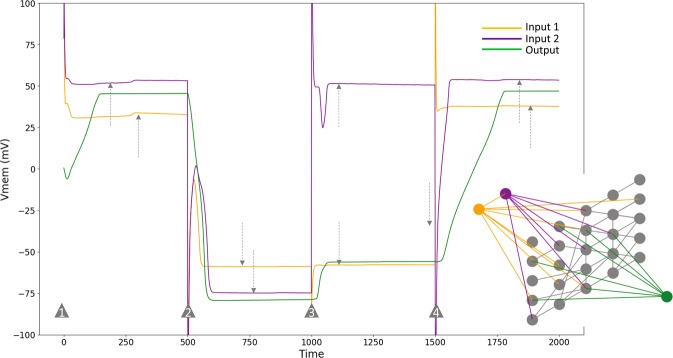
The field of basal cognition seeks to understand how adaptive, context-specific behavior occurs in non-neural biological systems. Embryogenesis and regeneration require plasticity in many tissue types to achieve structural and functional goals in diverse circumstances. Thus, advances in both evolutionary cell biology and regenerative medicine require an understanding of how non-neural tissues could process information. Neurons evolved from ancient cell types that used bioelectric signaling to perform computation. However, it has not been shown whether or how non-neural bioelectric cell networks can support computation. We generalize connectionist methods to non-neural tissue architectures, showing that a minimal non-neural Bio-Electric Network (BEN) model that utilizes the general principles of bioelectricity (electrodiffusion and gating) can compute. We characterize BEN behaviors ranging from elementary logic gates to pattern detectors, using both fixed and transient inputs to recapitulate various biological scenarios. We characterize the mechanisms of such networks using dynamical-systems and information-theory tools, demonstrating that logic can manifest in bidirectional, continuous, and relatively slow bioelectrical systems, complementing conventional neural-centric architectures. Our results reveal a variety of non-neural decision-making processes as manifestations of general cellular biophysical mechanisms and suggest novel bioengineering approaches to construct functional tissues for regenerative medicine and synthetic biology as well as new machine learning architectures.
Overview
The claims and statistics of this paper haven’t been checked yet.
Free: it reads the open-access text and checks the first 5 claims that cite a source we can check. Create a free account to check every claim.
Integrity signals
Registry
Cites
Statistics
Figures
Verification
Claims the paper makes
The claims and statistics of this paper haven’t been checked yet.
Free: it reads the open-access text and checks the first 5 claims that cite a source we can check. Create a free account to check every claim.
Claims other papers make about this one
Each is checked against this paper’s own text: does it say what the citing paper says it does?
The check wasn’t confident either way, so it gives no verdict — never disputed.
In the citing paper
“In other words, an individual member of an ensemble or ecosystem owes its existence to the ensemble of which it is a member—at the level of multicellular organisation or indeed its conspecifics in evolutionary biology [175].”
From The free energy principle made simpler but not too simple (2023) · cites this paper as [175]
Experimental — accuracy not yet measured
Self-check
Percentages, sums and reported differences re-computed from the paper’s own numbers.
The self-check needs the paper’s full text.
Citations
Cites
A logical calculus of the ideas immanent in nervous activity
McCulloch, W. S., & Pitts, W. (1943) · The Bulletin of Mathematical Biophysics · doi:10.1007/bf02478259 · Cited by 18,566
Positional information and the spatial pattern of cellular differentiation
Wolpert, L. (1969) · Journal of Theoretical Biology · doi:10.1016/s0022-5193(69)80016-0 · Cited by 3,050
An Introduction to Systems Biology: Design Principles of Biological Circuits
Alon, U. (2006) · doi:10.1201/9781420011432 · Cited by 2,825
Regulation of pattern recognition receptor signalling in plants
Couto, D., & Zipfel, C. (2016) · Nature Reviews Immunology · doi:10.1038/nri.2016.77 · Cited by 1,393
Modular and hierarchically modular organization of brain networks
Meunier, D., Lambiotte, R., & Bullmore, E. T. (2010) · Frontiers in Neuroscience · doi:10.3389/fnins.2010.00200 · Cited by 1,156
A Logical Calculus of the Ideas Immanent in Nervous Activity (1943)
McCulloch, W., & Pitts, W. (2021) · Ideas That Created the Future · doi:10.7551/mitpress/12274.003.0011 · Cited by 1,111
The blind watchmaker : why the evidence of evolution reveals a universe without design
Dawkins, R. (1996) · International Linear Collider · Cited by 1,057
Neural Networks and Deep Learning
Theodoridis, S. (2015) · Machine Learning · doi:10.1016/b978-0-12-801522-3.00018-5 · Cited by 900
Computational subunits in thin dendrites of pyramidal cells
Polsky, A., Mel, B. W., & Schiller, J. (2004) · Nature Neuroscience · doi:10.1038/nn1253 · Cited by 817
Ion channels enable electrical communication in bacterial communities
Prindle, A., Liu, J., Asally, M., Ly, S., Garcia-Ojalvo, J., & Süel, G. M. (2015) · Nature · doi:10.1038/nature15709 · Cited by 790
Research works printed but not linked: 5
- Albert, R. E. In Complex Networks. Lecture Notes in Physics Vol. 650 (ed Frauenfelder H. Ben-Naim E., Toroczkai Z.) (Springer, 2004).
- Pai VP HCN2 Rescues brain defects by enforcing endogenous voltage pre-patterns Nat Commun 2018 9 998 10.1038/s41467-018-03334-5 29519998 PMC5843655 · DOI · Paper page
- Ferreira, G. B., Matthias, S. & Levin, M. In European Conference on Artificial Life. 170–177 (MIT Press).
- Levin, M. Z. B. A. M. In Artificial Life 351–358 (MIT Press, 2018).
- Levin M Martyniuk CJ The bioelectric code: An ancient computational medium for dynamic control of growth and form Biosystems 2018 164 76 93 10.1016/j.biosystems.2017.08.009 28855098 PMC10464596 · DOI · Paper page
Cited by
Biological underpinnings for lifelong learning machines
Kudithipudi, D., Aguilar-Simon, M., Babb, J., Bazhenov, M., Blackiston, D., Bongard, J., Brna, A. P., Chakravarthi Raja, S., Cheney, N., Clune, J., et al. (2022) · Nature Machine Intelligence · doi:10.1038/s42256-022-00452-0 · Cited by 236
“A simple non-neural bioelectric model 135 that can be trained to perform cognitive tasks like logic and pattern recognition serves as a proof of principle (Fig.”
BackgroundSelf-citationLevin, M. (2022) · Frontiers in Systems Neuroscience · doi:10.3389/fnsys.2022.768201 · Cited by 195
“Taking one step further, individual cells homeostatically maintaining Vmem (cell membrane resting potential voltage) levels readily create bioelectric networks that work as a kind of virtual governor, maintaining patterns of Vmem (which is a coarse-grained parameter, over many different details of ion concentrations a…”
BackgroundSelf-citationA cellular platform for the development of synthetic living machines
Blackiston, D., Lederer, E., Kriegman, S., Garnier, S., Bongard, J., & Levin, M. (2021) · Science Robotics · doi:10.1126/scirobotics.abf1571 · Cited by 178
Self-citationThe free energy principle made simpler but not too simple
Friston, K., Da Costa, L., Sajid, N., Heins, C., Ueltzhöffer, K., Pavliotis, G. A., & Parr, T. (2023) · Physics Reports · doi:10.1016/j.physrep.2023.07.001 · Cited by 163
“In other words, an individual member of an ensemble or ecosystem owes its existence to the ensemble of which it is a member—at the level of multicellular organisation or indeed its conspecifics in evolutionary biology [175].”
Shape Changing Robots: Bioinspiration, Simulation, and Physical Realization
Shah, D., Yang, B., Kriegman, S., Levin, M. G., Bongard, J., & Kramer-Bottiglio, R. K. (2020) · Advanced Materials · doi:10.1002/adma.202002882 · Cited by 175
Self-citationLevin, M. (2023) · Cellular and Molecular Life Sciences · doi:10.1007/s00018-023-04790-z · Cited by 92
Self-citationLevin, M. (2021) · Biochemical and Biophysical Research Communications · doi:10.1016/j.bbrc.2020.10.077 · Cited by 92
Self-citationBiswas, S., Manicka, S., Hoel, E., & Levin, M. (2021) · iScience · doi:10.1016/j.isci.2021.102131 · Cited by 88
Self-citationSynthetic living machines: A new window on life
Ebrahimkhani, M. R., & Levin, M. (2021) · iScience · doi:10.1016/j.isci.2021.102505 · Cited by 68
Self-citationImmunoceptive inference: why are psychiatric disorders and immune responses intertwined?
Bhat, A., Parr, T., Ramstead, M. J. D., & Friston, K. J. (2021) · Biology & Philosophy · doi:10.1007/s10539-021-09801-6 · Cited by 65
“2019; Manicka and Levin 2019) to evolution (Ao 2005; Frank 1 3 Immunoceptive inference: why are psychiatric disorders and… Page 3 of 24 27 2012; Campbell 2016; Ramirez and Marshall 2017)—that put inference, beliefs1 and purpose into biological processes.”
BackgroundThere’s Plenty of Room Right Here: Biological Systems as Evolved, Overloaded, Multi-Scale Machines
Bongard, J., & Levin, M. G. (2023) · Biomimetics · doi:10.3390/biomimetics8010110 · Cited by 110
“Active matter, synthetic biology, and biohybrids [30–36] are blurring the line between evolved and designed systems, and dissolving the distinctions between “life” and “machine” [16,18,37], which were easy to maintain when our capabilities did not permit the construction and analysis of the full…”
Self-citationThe collective intelligence of evolution and development
Watson, R. A. R., & Levin, M. G. (2023) · Collective Intelligence · doi:10.1177/26339137231168355 · Cited by 67
“These capacities of morphogenetic cellular collectives are basally cognitive insomuch as they involve information integration and coordinated action (Fields and Levin, 2020; Grossberg, 1978; Levin, 2019; Manicka and Levin, 2019a; Newman and Bhat, 2008), characteristic of a self (Levin, 2019).”
InfluentialSelf-citationDesign for an Individual: Connectionist Approaches to the Evolutionary Transitions in Individuality
Watson, R. A. R., Levin, M. G., & Buckley, C. L. (2022) · Frontiers in Ecology and Evolution · doi:10.3389/fevo.2022.823588 · Cited by 54
Self-citationA Meta-Analysis of Bioelectric Data in Cancer, Embryogenesis, and Regeneration
Srivastava, P., Kane, A., Harrison, C., & Levin, M. (2021) · Bioelectricity · doi:10.1089/bioe.2019.0034 · Cited by 37
Self-citationA Variational Synthesis of Evolutionary and Developmental Dynamics
Friston, K. J., Friedman, D., Constant, A., Knight, V. B., Fields, C., Parr, T., & Campbell, J. O. (2023) · Entropy · doi:10.3390/e25070964 · Cited by 48
“, the target of niche construction, from a molecular through to a cultural level, depending upon the scale of analysis [77,78].”
BackgroundShreesha, L., & Levin, M. G. (2023) · Entropy · doi:10.3390/e25010131 · Cited by 30
Self-citationNovel hardware and concepts for unconventional computing
Ziegler, M. (2020) · Scientific Reports · doi:10.1038/s41598-020-68834-1 · Cited by 19
Active Inference and Intentional Behavior
Friston, K. J., Salvatori, T., Isomura, T., Tschantz, A., Kiefer, A. B., Verbelen, T., Koudahl, M., Paul, A., Parr, T., Razi, A., et al. (2025) · Neural Computation · doi:10.1162/neco_a_01738 · Cited by 49
“This study has several sources of inspiration that speak to the notion of basal cognition (Fields et al., 2021; Levin, 2019; Manicka & Levin, 2019; and related work, e.g., Masumori et al., 2015).”
Scientific practice as ecological-enactive co-construction
de Oliveira, G. S., van Es, T., & Hipólito, I. (2023) · Synthese · doi:10.1007/s11229-023-04215-1 · Cited by 22
“In weaker claims, neural (or behavioral) patterns are thought to correspond to logic gates, acting as successive logical or mathematical operations (such as in the active inference literature; see, e.g., Manicka & Levin, 2019).”
BackgroundCognition Without Neural Representation: Dynamics of a Complex System
Hipólito, I. (2022) · Frontiers in Psychology · doi:10.3389/fpsyg.2021.643276 · Cited by 27
“…a cortical network, or a brain in an organism, then, thermodynamic energy transfer occurs between the local environment and the system, for example, between other neurons in a cortical network, or between cells, as computationally explained in Bio-Electric Network model of Manicka and Levin (2019).”
BackgroundCervera, J., Ramírez, P., Levin, M. G., & Mafé, S. (2020) · Physical review. E · doi:10.1103/physreve.102.052412 · Cited by 14
Self-citationCervera, J., Manzanares, J. A., Levin, M. G., & Mafé, S. (2024) · Computers in Biology and Medicine · doi:10.1016/j.compbiomed.2024.108964 · Cited by 12
Self-citationAminzare, Z., & Kay, A. R. (2024) · The Journal of General Physiology · doi:10.1085/jgp.202413554 · Cited by 16
Cancer Niches and Their Kikuchi Free Energy
Sajid, N., Convertino, L., & Friston, K. J. (2021) · Entropy · doi:10.3390/e23050609 · Cited by 10
Levin, M. G. (2021) · doi:10.31234/osf.io/t6e8p · Cited by 11
Self-citationBetween pebbles and organisms: weaving autonomy into the Markov blanket
van Es, T., & Kirchhoff, M. D. (2021) · Synthese · doi:10.1007/s11229-021-03084-w · Cited by 13
Computational capabilities of a multicellular reservoir computing system
Nikolić, V., Echlin, M., Aguilar, B. H., & Shmulevich, I. (2023) · PLoS ONE · doi:10.1371/journal.pone.0282122 · Cited by 15
Evolution by natural induction
Watson, R. A. R., Levin, M. G., & Lewens, T. (2025) · Interface Focus · doi:10.1098/rsfs.2025.0025 · Cited by 9
Self-citationEMI model: A scale free biophysical framework for human consciousness, cognition and behaviour
Firaux, T., Tuszyński, J. A., & Cavaglià, M. (2025) · Biosystems · doi:10.1016/j.biosystems.2025.105674 · Cited by 7
Systems of axon-like circuits for self-assembled and self-controlled growth of bioelectric networks
Deaton, R. J., Garzón, M., & Yasmin, R. (2022) · Scientific Reports · doi:10.1038/s41598-022-17103-4 · Cited by 5
“(10) νk = |A (k) n | |An| = A (k) n An ,”
Consciousness and Energy Processing in Neural Systems
Pepperell, R. (2024) · Brain Sciences · doi:10.3390/brainsci14111112 · Cited by 7
Reconfiguring Gene Regulatory Neural Network Computing for Regulating Biofilm Formation
Ratwatte, A., Somathilaka, S. S., Balasubramaniam, S., Taggart, M. G., Nair, K. M., O'Riordan, A. J., & Dooley, J. S. G. (2025) · IEEE Transactions on Network Science and Engineering · doi:10.1109/tnse.2025.3555962 · Cited by 5
Stability and robustness properties of bioelectric networks: A computational approach
Grodstein, J., & Levin, M. G. (2021) · Biophysics Reviews · doi:10.1063/5.0062442 · Cited by 4
Self-citationPlasmonic imaging of living pancreatic beta-cell networks
Abayzeed, S., Galvis, D., Medel, K. R., Jones, C. F., González, O., Setchfield, K., Moreddu, R., Somekh, M. G., Wedgwood, K. C. A., & Smith, P. A. (2026) · Scientific Reports · doi:10.1038/s41598-025-34094-0 · Cited by 6
“Label-free monitoring of bioelectric networks promises long-term tracking of connectivity promising to expose the regeneration 59 and cognitive 60 correlates.”
Dodig-Crnković, G. (2025) · Synthese Library/Synthese library · doi:10.1007/978-3-031-96688-0_4 · Cited by 7
Field-mediated bioelectric basis of morphogenetic prepatterning
Manicka, S., & Levin, M. G. (2025) · Cell Reports Physical Science · doi:10.1016/j.xcrp.2025.102865 · Cited by 8
Self-citationZhou, W., Shen, Y., & Yang, Z. (2025) · Chaos Solitons & Fractals · doi:10.1016/j.chaos.2025.117187 · Cited by 1
Logical computation with self-assembling electric circuits
Yasmin, R., & Deaton, R. J. (2022) · PLoS ONE · doi:10.1371/journal.pone.0278033 · Cited by 1
Multicellular Reservoir ComputingPreprint
Nikolić, V., Echlin, M., Aguilar, B. H., & Ilya Shmulevich, C. (2022) · bioRxiv (Cold Spring Harbor Laboratory) · doi:10.1101/2022.03.26.485905
Aminzare, Z., & Kay, A. R. (2022) · bioRxiv (Cold Spring Harbor Laboratory) · doi:10.1101/2022.12.08.519683
“pNKA ([K ]e/[K ]i) 2 ([Na]i/[Na ]e) 3 [46] (the result is not shown here).”
Stability and Robustness of a Generalized Pump-Leak Model for Epithelial Vesicles
Tarrant, K., Kay, A. R., & Aminzare, Z. (2026) · Bulletin of Mathematical Biology · doi:10.1007/s11538-026-01683-7 · Cited by 1
Metadata
- Authors
- Manicka, S., & Levin, M.
- Affiliations
- Tufts University (US)
- Corresponding author
- Levin, Michael
- Venue
- Scientific Reports
- Published
- 2019-12-09
- Volume
- 9
- Issue
- 1
- Pages
- 18612-18612
- ISSN
- 2045-2322 (ISSN-L)
- PMC
- PMC6901451
- OpenAlex
- W2992017056
- Cited by
- 41
- References
- 140
- Citations by year
- 2026: 2 · 2025: 7 · 2024: 3 · 2023: 8 · 2022: 8 · 2021: 8 · 2020: 5
- FWCI
- 3.05
- Type
- journal article
- Language
- en
- Open access
- gold
- doi.org
- Licence
- cc-by
- creativecommons.org/licenses/by/4.0 (tdm)
- creativecommons.org/licenses/by/4.0 (vor)
- Locations
- Scientific Reports (publishedVersion, cc-by)
- PubMed Central (publishedVersion, cc-by)
- PubMed (publishedVersion)
- arXiv (Cornell University) (submittedVersion)
- DOAJ (DOAJ: Directory of Open Access Journals) (submittedVersion)
- arXiv (Cornell University) (cc-by)
- Funders
- Paul G. Allen Family Foundation (12171)
- Templeton World Charity Foundation (TWCF0089/AB55)
- National Science Foundation (CBET-0939511)
- Topics
- Life Sciences › Neuroscience › Cognitive Neuroscience › Neural dynamics and brain function
- Life Sciences › Agricultural and Biological Sciences › Plant Science › Plant and Biological Electrophysiology Studies
- Physical Sciences › Computer Science › Computational Theory and Mathematics › Cellular Automata and Applications
- Keywords
- bioelectric signaling, electrodiffusion, channel gating, logic gates, pattern detection, regenerative medicine, synthetic biology, connectionist models, dynamical systems, information theory, basal cognition, tissue plasticity
- MeSH terms
- Algorithms, Animals, Biomedical Engineering, Computer Simulation, Models, Biological, Pattern Recognition, Automated, Planarians, Programming Languages, Regeneration, Signal Transduction, Developmental Biology, Computational Biology, Body Patterning, Regenerative Medicine, Electrophysiological Phenomena, Bioengineering, Synthetic Biology
About these checks
Registry, retraction, Cites and statistics results are computed, not judged, with one exception: a printed reference that no index lists is read once by a model before it counts as a citation error. Claims are extracted by a model and kept only when their quote appears verbatim in the text; each cited source is then checked, with a model’s help, for whether it says what the claim relies on. Those verdicts can be wrong — read the claim’s quote and the cited source before relying on one.
Statistics and arithmetic are recomputed, not judged.
Confidence bands are shown only for fields calibrated on our annotated test set. None is calibrated yet, so no band is shown.
What counts as a claim ›How we measure confidence ›How we check this ›
Are you an author, or do you see a problem with this page? Request a review
Data sources
Bibliographic data: Semantic Scholar, OpenAlex, Crossref.
Contains information from the Semantic Scholar Academic Graph Datasets, made available under the ODC Attribution License (ODC-BY 1.0).
Semantic Scholar’s data is described in: Kinney, R., et al. (2023). The Semantic Scholar Open Data Platform. arXiv:2301.10140.
