

Sleep disturbance in Inflammatory Bowel Disease: prevalence and risk factors – A cross-sectional study
Open accessThe DOI matches its Crossref record; 49 of the 52 references it cites were found in a registry or an index.
Abstract
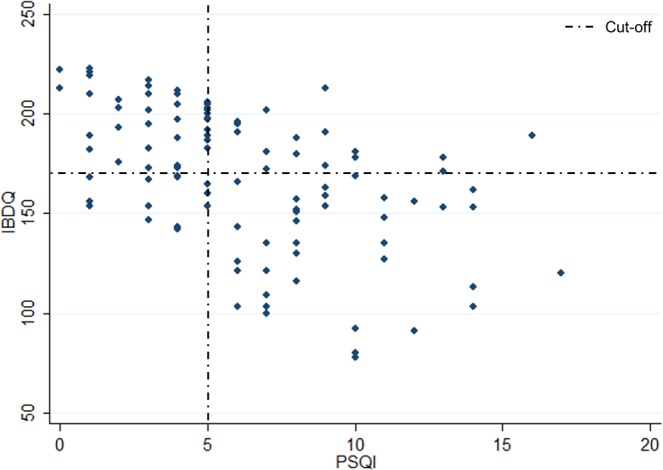
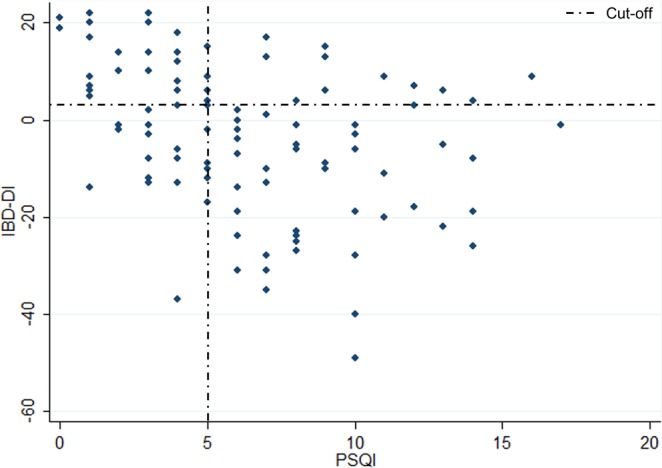
Inflammatory bowel diseases (IBD) are chronic relapsing disorders that have a negative impact on quality of life. They can be highly disabling and have been associated with sleep disturbance. The aim of our study was to evaluate the sleep quality of a large cohort of IBD patients to identify possible associated cofactors. We prospectively recruited consecutive patients attending the IBD Unit of “Azienda Ospedaliera” of Padua from November 2018 to May 2019 and collected demographics and clinical characteristics. The patients completed the Pittsburgh Sleep Quality Index (PSQI), the IBD questionnaire (IBDQ), the IBD-Disability Index (IBD-DI) questionnaire, and the Hospital Anxiety and Depression Scale (9-HADS). A multivariate regression model was applied to assess independent risk factors of sleep disturbance among IBD-related variables, disability, quality of life, anxiety, and depression. We investigated the sleep quality of 166 patients with IBD, finding 67.5% of them suffering from sleep disturbance. In particular, low quality of life, presence of disability and extraintestinal manifestations were identified as independent risk factors of sleep disturbance. We discovered that all depressed patients were also affected by sleep disturbance, while we found no difference in sleep disturbance between patients with or without anxiety state. However, a positive correlation was reported between both anxiety and depression scores and PSQI score (Spearman correlation: r = 0.31 and r = 0.38 respectively). Our study showed that sleep quality is not directly associated with an active or inactive IBD state or with the ongoing treatment, but it is mostly correlated with the patients’ mood state, disability, and quality of life. Gastroenterologists and psychologists should join forces during clinical outpatients’ visits to evaluate emotional states for a better IBD management.
Overview
The claims and statistics of this paper haven’t been checked yet.
Free: it reads the open-access text and checks the first 5 claims that cite a source we can check. Create a free account to check every claim.
Integrity signals
Registry
Cites
Statistics
Figures
Verification
Claims the paper makes
The claims and statistics of this paper haven’t been checked yet.
Free: it reads the open-access text and checks the first 5 claims that cite a source we can check. Create a free account to check every claim.
Claims other papers make about this one
Each is checked against this paper’s own text: does it say what the citing paper says it does?
The cited source doesn’t support the claim as written.
In the citing paper
“Дослідження 2020 р. показало, що у третини обстежуваних пацієнтів із ЗЗК відмічається порушення сну, що, в свою чергу, пов'язано з низькою якістю життя, інвалідністю та позакишковими проявами.”
From PSYCHO-EMOTIONAL STATUS IN PATIENTS WITH INFLAMMATORY BOWEL DISEASE (2024) · cites this paper as [25]
Checked by a reasoning model — may be wrong.
Experimental — accuracy not yet measuredThe source backs part of the claim, not all of it — or backs it for a different population, condition or comparison.
In the citing paper
“Дослідження 2020 р. показало, що у третини обстежуваних пацієнтів із ЗЗК відмічається порушення сну, що, в свою чергу, пов'язано з низькою якістю життя, інвалідністю та позакишковими проявами.”
From PSYCHO-EMOTIONAL STATUS IN PATIENTS WITH INFLAMMATORY BOWEL DISEASE (2024) · cites this paper as [25]
Experimental — accuracy not yet measuredThe cited source says what the claim attributes to it.
In the citing paper
“Крім того, наявність депресії на відміну від тривоги підвищувала частоту змін якості сну [25, 26, 27].”
From PSYCHO-EMOTIONAL STATUS IN PATIENTS WITH INFLAMMATORY BOWEL DISEASE (2024) · cites this paper as [25]
Self-check
Percentages, sums and reported differences re-computed from the paper’s own numbers.
The self-check needs the paper’s full text.
Citations
Cites
The Hospital Anxiety and Depression Scale
Zigmond, A. S., & Snaith, R. P. (1983) · Acta Psychiatrica Scandinavica · doi:10.1111/j.1600-0447.1983.tb09716.x · Cited by 47,139
The Pittsburgh Sleep Quality Index: a new instrument for psychiatric practice and research
Buysse, D. J., Reynolds, C. F., Monk, T. H., Berman, S. R., & Kupfer, D. J. (1989) · Psychiatry Research · doi:10.1016/0165-1781(89)90047-4 · Cited by 35,234
Satsangi, J., Silverberg, M. S., Vermeire, S., & Colombel, J.-F. (2006) · Gut · doi:10.1136/gut.2005.082909 · Cited by 3,176
Coated Oral 5-Aminosalicylic Acid Therapy for Mildly to Moderately Active Ulcerative Colitis
Schroeder, K. W., Tremaine, W. J., & Ilstrup, D. M. (1987) · New England Journal of Medicine · doi:10.1056/nejm198712243172603 · Cited by 3,026
A new measure of health status for clinical trials in inflammatory bowel disease
Guyatt, G., Mitchell, A., Irvine, E. J., Singer, J., Williams, N., Goodacre, R., & Tompkins, C. (1989) · Gastroenterology · doi:10.1016/0016-5085(89)90905-0 · Cited by 1,298
Extraintestinal Manifestations of Inflammatory Bowel Disease
Vavricka, S. R., Schoepfer, A., Scharl, M., Lakatos, P. L., Navarini, A., & Rogler, G. (2015) · Inflammatory Bowel Diseases · doi:10.1097/mib.0000000000000392 · Cited by 909
Dignass, A., Eliakim, R., Magro, F., Maaser, C., Chowers, Y., Geboes, K., Mantzaris, G., Reinisch, W., Colombel, J.-F., Vermeire, S., et al. (2012) · Journal of Crohn's and Colitis · doi:10.1016/j.crohns.2012.09.003 · Cited by 888
Zhai, L., Zhang, H., & Zhang, D. (2015) · Depression and Anxiety · doi:10.1002/da.22386 · Cited by 786
Irvine, E. J., Feagan, B., Rochon, J., Archambault, A., Fedorak, R. N., Groll, A., Kinnear, D., Saibil, F., & McDonald, J. W. D. (1994) · Gastroenterology · doi:10.1016/0016-5085(94)90585-1 · Cited by 712
Validity of the Italian Version of the Pittsburgh Sleep Quality Index (PSQI)
Curcio, G., Tempesta, D., Scarlata, S., Marzano, C., Moroni, F., Rossini, P. M., Ferrara, M., & De Gennaro, L. (2013) · Neurological Sciences · doi:10.1007/s10072-012-1085-y · Cited by 595
Cited by
Ditmer, M., Gabryelska, A., Turkiewicz, S., Białasiewicz, P., Małecka-Wojciesko, E., & Sochal, M. (2021) · Journal of Clinical Medicine · doi:10.3390/jcm11010067 · Cited by 94
“There is limited research on the influence of immunosuppressive immunomodulators, such as 6-mercaptopurine or azathioprine on sleep; however, current studies show that they do not influence sleep quality [57,195].”
BackgroundInfluence of Environmental Factors in the Development and Outcomes of Inflammatory Bowel Disease.
Vedamurthy, A., & Ananthakrishnan, A. N. (2019) · Europe PMC (PubMed Central) · Cited by 102
Hao, G., Zhu, B., li, Y., Wang, P., Li, L., & Hou, L. (2020) · Sleep Medicine · doi:10.1016/j.sleep.2020.08.032 · Cited by 62
Gîlcă-Blanariu, G.-E., Ștefănescu, G., Trifan, A. V., Moscalu, M., Dimofte, M., Ștefănescu, C., Drug, V. L., Afrsnie, V.-A., & Ciocoiu, M. (2020) · Journal of Clinical Medicine · doi:10.3390/jcm9072304 · Cited by 41
“Taking into account the high prevalence of sleep impairment among patients with IBD identified in our study, as well as in other studies [14,15,21], and the significant association between sleep impairment and inflammatory parameters, we noticed a potential clinical benefit in identifying cut-off values for several pa…”
ResultRegueiro, M. D., Hunter, T. M., Lukanova, R., Shan, M., Wild, R., Knight, H., Bannikoppa, P., & Naegeli, A. N. (2022) · Advances in Therapy · doi:10.1007/s12325-022-02364-2 · Cited by 50
“Certain IBD medications have been thought to cause fatigue, and previous studies on sleep and fatigue considered the ongoing therapy to understand this relationship [27].”
Background
Metadata
- Authors
- Marinelli, C., Savarino, E. V., Marsilio, I., Lorenzon, G., Gavaruzzi, T., D’Incà, R., & Zingone, F.
- Affiliations
- Azienda Ospedale - Università Padova (IT)
- Corresponding author
- Savarino, E. V.
- Venue
- Scientific Reports
- Published
- 2020-01-16
- Volume
- 10
- Issue
- 1
- Pages
- 507-507
- ISSN
- 2045-2322 (ISSN-L)
- PMC
- PMC6965196
- OpenAlex
- W2998945645
- Cited by
- 90
- References
- 52
- Citations by year
- 2026: 7 · 2025: 15 · 2024: 23 · 2023: 14 · 2022: 10 · 2021: 9 · 2020: 11
- FWCI
- 6.44
- Type
- journal article
- Language
- en
- Open access
- gold
- doi.org
- Licence
- cc-by
- creativecommons.org/licenses/by/4.0 (tdm)
- creativecommons.org/licenses/by/4.0 (vor)
- Locations
- Scientific Reports (publishedVersion, cc-by)
- Europe PMC (PubMed Central) (publishedVersion, cc-by)
- PubMed Central (publishedVersion, cc-by)
- PubMed (publishedVersion)
- Padua Research Archive (University of Padova) (submittedVersion, cc-by)
- Archivio istituzionale della ricerca (Alma Mater Studiorum Università di Bologna) (submittedVersion, cc-by)
- DOAJ (DOAJ: Directory of Open Access Journals) (submittedVersion)
- Topics
- Health Sciences › Medicine › Gastroenterology › Inflammatory Bowel Disease
- Social Sciences › Psychology › Experimental and Cognitive Psychology › Sleep and related disorders
- Health Sciences › Medicine › Ophthalmology › Ocular Diseases and Behçet’s Syndrome
- Keywords
- inflammatory bowel disease, sleep disorders, sleep quality, risk factors, quality of life, disability, depression, anxiety, extraintestinal manifestations, Pittsburgh Sleep Quality Index, Hospital Anxiety and Depression Scale
- MeSH terms
- Adult, Aged, Aged, 80 and over, Cross-Sectional Studies, Female, Humans, Male, Middle Aged, Prospective Studies, Quality of Life, Sleep Wake Disorders, Inflammatory Bowel Diseases, Prevalence, Logistic Models, Young Adult
About these checks
Registry, retraction, Cites and statistics results are computed, not judged, with one exception: a printed reference that no index lists is read once by a model before it counts as a citation error. Claims are extracted by a model and kept only when their quote appears verbatim in the text; each cited source is then checked, with a model’s help, for whether it says what the claim relies on. Those verdicts can be wrong — read the claim’s quote and the cited source before relying on one.
Statistics and arithmetic are recomputed, not judged.
Confidence bands are shown only for fields calibrated on our annotated test set. None is calibrated yet, so no band is shown.
What counts as a claim ›How we measure confidence ›How we check this ›
Are you an author, or do you see a problem with this page? Request a review
How to cite
Cite CoChat for the checks on this page, and the paper for its own findings.
- This page
- CoChat. (2026). Citation check: Sleep disturbance in Inflammatory Bowel Disease: prevalence and risk factors – A cross-sectional study. https://app.cochat.ai/papers/10.1038/s41598-020-57460-6
- The paper
- Marinelli, C., Savarino, E. V., Marsilio, I., Lorenzon, G., Gavaruzzi, T., D’Incà, R., & Zingone, F. (2020). Sleep disturbance in Inflammatory Bowel Disease: prevalence and risk factors – A cross-sectional study. Scientific Reports. https://doi.org/10.1038/s41598-020-57460-6
Data sources
Bibliographic data: Semantic Scholar, OpenAlex, Crossref.
Contains information from the Semantic Scholar Academic Graph Datasets, made available under the ODC Attribution License (ODC-BY 1.0).
Semantic Scholar’s data is described in: Kinney, R., et al. (2023). The Semantic Scholar Open Data Platform. arXiv:2301.10140.
