

Emergence of life in an inflationary universe
Open accessThe DOI matches its Crossref record; 49 of the 52 references it cites were found in a registry or an index; 9 of the 28 sources its claims cite were checked for support.
Abstract
Abstract Abiotic emergence of ordered information stored in the form of RNA is an important unresolved problem concerning the origin of life. A polymer longer than 40–100 nucleotides is necessary to expect a self-replicating activity, but the formation of such a long polymer having a correct nucleotide sequence by random reactions seems statistically unlikely. However, our universe, created by a single inflation event, likely includes more than 10 100 Sun-like stars. If life can emerge at least once in such a large volume, it is not in contradiction with our observations of life on Earth, even if the expected number of abiogenesis events is negligibly small within the observable universe that contains only 10 22 stars. Here, a quantitative relation is derived between the minimum RNA length l min required to be the first biological polymer, and the universe size necessary to expect the formation of such a long and active RNA by randomly adding monomers. It is then shown that an active RNA can indeed be produced somewhere in an inflationary universe, giving a solution to the abiotic polymerization problem. On the other hand, l min must be shorter than ~20 nucleotides for the abiogenesis probability close to unity on a terrestrial planet, but a self-replicating activity is not expected for such a short RNA. Therefore, if extraterrestrial organisms of a different origin from those on Earth are discovered in the future, it would imply an unknown mechanism at work to polymerize nucleotides much faster than random statistical processes.
Overview
CoChat Summary
## TL;DR
The paper models abiogenesis as random Poissonian RNA polymerization and asks how large an inflationary universe must be for an active RNA molecule to arise somewhere. Using baseline assumptions, it concludes that while abiogenesis is very unlikely in a star, galaxy, or even the observable universe, it can occur in the much larger physical volume produced by sufficient cosmic inflation.
## Key findings
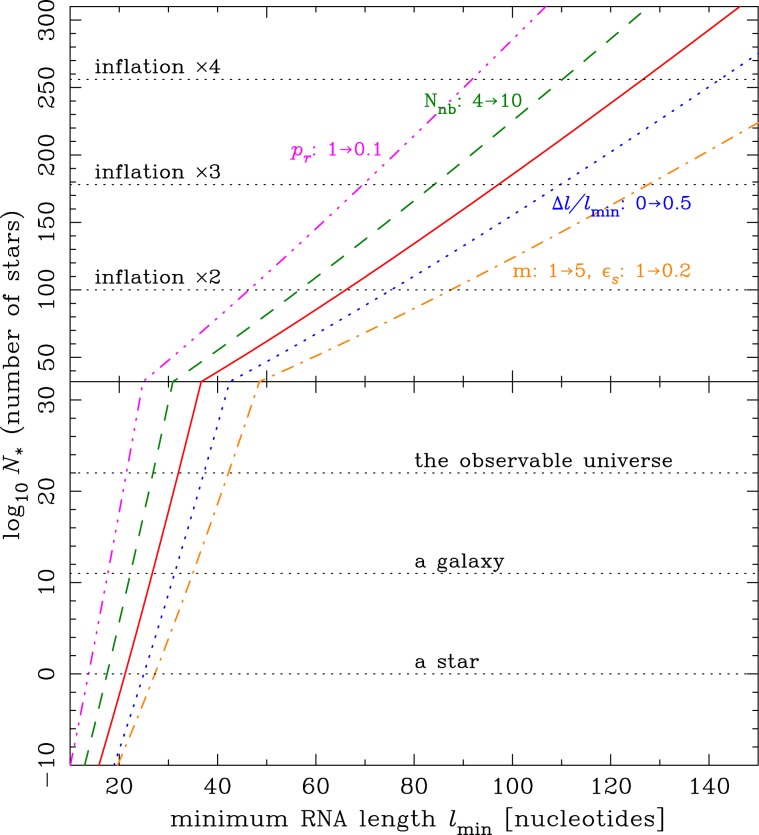
- With baseline parameters, the minimum RNA length needed to expect one abiogenesis event is reported as lmin = 21 for a single star, 27 for a galaxy, and 32 for the observable universe.
- For a more biologically plausible lmin = 40, the paper reports lgN\* = 39; to reduce this to lgN\* = 22 or 0 would require increasing parameter C by 10^17 or 10^39, respectively.
- If inflation lasts 2, 3, or 4 times as long as the minimum needed to solve the horizon/flatness problems, the corresponding physical volumes are said to contain about 10^100, 10^178, or 10^256 stars, with lmin = 66, 97, or 127, respectively, allowing RNA replicase activity.
- The paper states that changing some parameters does not substantially alter the result: increasing Nnb from 4 to 10 or Δl/lmin from 0 to 0.5 does not seriously change the main conclusions, and reducing pr from 1 to 0.1 lowers lmin from 66 to 46 for lgN\* = 100.
## Methods
- The paper uses a toy analytical model of RNA oligomerization as a Poisson process in which activated monomers are added randomly over time; it derives differential equations for oligomer abundances and approximates the process with pr ≡ κt.
- It combines this polymerization model with an estimate of the number of stars in an inflation-created universe and defines the expected number of abiogenesis events in terms of parameters including fpl, td, rp, Nm, tc, Pac, and Pev.
- The main analysis is a parameterized calculation of the relation between minimum functional RNA length (lmin) and the universe size (lgN\*), including sensitivity checks for assumptions such as chirality, multiple polymerization cycles, and reduced reaction probability.
## Limitations
- The paper explicitly states that many parameters are highly uncertain, with “more than 10 orders of magnitude in total” uncertainty, though it argues the key results depend only logarithmically on them.
- It assumes abiogenesis occurs only through a random Poisson process of monomer addition; the paper notes that more efficient non-linear auto- or cross-catalytic processes could exist but are not modeled.
- Evident from the text: the analysis is a highly simplified theoretical toy model and does not provide experimental validation of the assumed polymerization pathway or of the required RNA lengths in realistic prebiotic settings.
Model-written summary. Check it against the paper before relying on it.
Integrity signals
Registry
Cites
Statistics
Figures
Verification
Claims the paper makes
5 Valid · 0 Not valid · 5 Not checked · 40 Own results and interpretations
The cited sources support only part of this claim — read each source’s verdict below.
In the paper
“However, our universe, created by a single inflation event, likely includes more than 10100 Sun-like stars.”
- Also stated in: § Introduction · hedged
“According to the widely accepted view of the inflationary cosmology35–40, the physical size of the universe created by an inflation event should be much larger, likely including more than 10100 stars (see below).”
§ Emergence of life in an inflationary universe > Abstract Abiotic emergence of ordered information stored in the form of RNA is an important unresolved problem concerning the origin of life. A polymer longer than 40–100 nucleotides is necessary to expect a self-replicating activity, but the formation of such a long polymer having a correct nucleotide sequence by random reactions seems statistically unlikely. However, our universe, created by a single inflation event, likely includes more than 10100 Sun-like stars. If life can emerge at least once in such a large volume, it is not in contradiction with our observations of life on Earth, even if the expected number of abiogenesis events is negligibly small within the observable universe that contains only 1022 stars. Here, a quantitative relation is derived between the minimum RNA length lmin required to be the first biological polymer, and the universe size necessary to expect the formation of such a long and active RNA by randomly adding monomers. It is then shown that an active RNA can indeed be produced somewhere in an inflationary universe, giving a solution to the abiotic polymerization problem. On the other hand, lmin must be shorter than ~20 nucleotides for the abiogenesis probability close to unity on a terrestrial planet, but a self-replicating activity is not expected for such a short RNA. Therefore, if extraterrestrial organisms of a different origin from those on Earth are discovered in the future, it would imply an unknown mechanism at work to polymerize nucleotides much faster than random statistical processes.
What the sources say
- Not checked — no full text of the sourcecites [35] Starobinsky A A new type of isotropic cosmological models without singularity Phys. Lett. B 1980 91 99 102 10.1016/0370-2693(80)90670-x source
- Not checked — no full text of the sourcecites [36] Kazanas D Dynamics of the universe and spontaneous symmetry breaking The Astrophys. J. 1980 241 L59 10.1086/183361 source
- Partly supportedcites [37] Guth AH Inflationary universe: A possible solution to the horizon and flatness problems Phys. Rev. D 1981 23 347 356 10.1103/physrevd.23.347 sourceExperimental — accuracy not yet measured
In the discussion immediately before Section IV (page unavailable), Guth says an inflated region could be much bigger than the observed universe. Our copy does not give a count of Sun-like stars, support the threshold of 10^100, or establish that our universe was created by a single inflation event. (LLM, conf=0.84)
- Could not verifycites [38] Sato K First-order phase transition of a vacuum and the expansion of the universe Mon. Notices Royal Astron. Soc. 1981 195 467 479 10.1093/mnras/195.3.467 sourceExperimental — accuracy not yet measured
The results summary (p. 1) discusses exponential expansion under certain phase-transition conditions, and the conclusion (p. 12) discusses a possible origin of galaxies. Neither addresses a universe created by a single inflation event or estimates its number of Sun-like stars; searches for those terms and 10^100 found no supporting passage. (LLM, conf=0.74)
- Not checked — no full text of the sourcecites [39] Linde A A new inflationary universe scenario: A possible solution of the horizon, flatness, homogeneity, isotropy and primordial monopole problems Phys. Lett. B 1982 108 389 393 10.1016/0370-2693(82)91219-9 source
- Not checked — no full text of the sourcecites [40] Albrecht A Steinhardt PJ Cosmology for grand unified theories with radiatively induced symmetry breaking Phys. Rev. Lett. 1982 48 1220 1223 10.1103/physrevlett.48.1220 source
hedged- Asserted: passes — The authors put it forward as true.
- Checkable: passes — It can be checked against evidence.
- Load-bearing: passes — The paper’s conclusions depend on it.
- Based: passes — The paper gives a reason why it holds.
- Rests on an assumption not shown here.
- Also stated in: § Introduction · hedged
The sources with a verdict support this claim; the rest weren’t checked yet, have no full text we could read, or their verdicts aren’t rated yet.
In the paper
“RNA polymerase ribozymes produced by in vitro experiments so far have a length longer than 100 nt10–12.”
§ Emergence of life in an inflationary universe > Introduction
What the sources say
- Not checked — no full text of the sourcecites [10] Johnston WK Unrau PJ Lawrence MS Glasner ME Bartel DP RNA-catalyzed RNA polymerization: accurate and general RNA-templated primer extension Science 2001 292 1319 1325 10.1126/science.1060786 11358999 source
- Not checked — no full text of the sourcecites [11] Horning DP Joyce GF Amplification of RNA by an RNA polymerase ribozyme Proc. Natl. Acad. Sci. USA 2016 113 9786 9791 10.1073/pnas.1610103113 27528667 PMC5024611 source
- Supportedcites [12] Wachowius F Holliger P Non-enzymatic assembly of a minimized RNA polymerase ribozyme ChemSystemsChem 2019 1 12 15 10.1002/syst.201900004 PMC6823052 31673682 source
The paper describes RNA polymerase ribozymes generated by in vitro evolution as large, and reports an evolved 150-nt variant as one of the shortest RNA polymerase ribozymes (Abstract; page unavailable). This supports the citing sentence’s broad length characterization; the 100-nt sequence discussed elsewhere is a catalytic core, not a full polymerase ribozyme. (LLM, conf=0.84)
plain- Asserted: passes — The authors put it forward as true.
- Checkable: passes — It can be checked against evidence.
- Load-bearing: unclear — It is unclear whether the paper’s conclusions depend on it.
- Based: passes — The paper gives a reason why it holds.
The cited sources support only part of this claim — read each source’s verdict below.
In the paper
“A polymer longer than 40–100 nucleotides is necessary to expect a self-replicating activity, but the formation of such a long polymer having a correct nucleotide sequence by random reactions seems statistically unlikely.”
- Also stated in: § Introduction · plain
“RNA polymerase ribozymes produced by in vitro experiments so far have a length longer than 100 nt10–12.”
§ Emergence of life in an inflationary universe > Abstract Abiotic emergence of ordered information stored in the form of RNA is an important unresolved problem concerning the origin of life. A polymer longer than 40–100 nucleotides is necessary to expect a self-replicating activity, but the formation of such a long polymer having a correct nucleotide sequence by random reactions seems statistically unlikely. However, our universe, created by a single inflation event, likely includes more than 10100 Sun-like stars. If life can emerge at least once in such a large volume, it is not in contradiction with our observations of life on Earth, even if the expected number of abiogenesis events is negligibly small within the observable universe that contains only 1022 stars. Here, a quantitative relation is derived between the minimum RNA length lmin required to be the first biological polymer, and the universe size necessary to expect the formation of such a long and active RNA by randomly adding monomers. It is then shown that an active RNA can indeed be produced somewhere in an inflationary universe, giving a solution to the abiotic polymerization problem. On the other hand, lmin must be shorter than ~20 nucleotides for the abiogenesis probability close to unity on a terrestrial planet, but a self-replicating activity is not expected for such a short RNA. Therefore, if extraterrestrial organisms of a different origin from those on Earth are discovered in the future, it would imply an unknown mechanism at work to polymerize nucleotides much faster than random statistical processes.
What the sources say
- Not checked — no full text of the sourcecites [8] Robertson, M. P. & Joyce, G. F. The origins of the RNA world. Cold Spring Harb Perspect Biol4:a003608 (2012). PMC3331698 20739415 source
- Not matchedcites [9] Szostak, J. W. & Ellington, A. D. In vitro selection of functional RNA sequences. In Gesteland, R. F. and Atkins, J. F. (eds.) The RNA world: the nature of modern RNA suggests a prebiotic RNA world, chap. 20, 511–533 (Cold Spring Harbor, NY, USA, 1993).
Its entry has no title and year that we can search by.
- Not checked — no full text of the sourcecites [10] Johnston WK Unrau PJ Lawrence MS Glasner ME Bartel DP RNA-catalyzed RNA polymerization: accurate and general RNA-templated primer extension Science 2001 292 1319 1325 10.1126/science.1060786 11358999 source
- Not checked — no full text of the sourcecites [11] Horning DP Joyce GF Amplification of RNA by an RNA polymerase ribozyme Proc. Natl. Acad. Sci. USA 2016 113 9786 9791 10.1073/pnas.1610103113 27528667 PMC5024611 source
- Partly supportedcites [12] Wachowius F Holliger P Non-enzymatic assembly of a minimized RNA polymerase ribozyme ChemSystemsChem 2019 1 12 15 10.1002/syst.201900004 PMC6823052 31673682 sourceExperimental — accuracy not yet measured
The paper’s Abstract describes replicase ribozymes as complex and reports a functional 150-nucleotide RNA polymerase ribozyme. It does not establish that a polymer longer than 40–100 nucleotides is necessary for self-replication, nor does it quantify the statistical likelihood of forming a correct sequence through random reactions. (LLM, conf=0.82)
plainstates a cause- Asserted: passes — The authors put it forward as true.
- Checkable: passes — It can be checked against evidence.
- Load-bearing: passes — The paper’s conclusions depend on it.
- Based: passes — The paper gives a reason why it holds.
- Also stated in: § Introduction · plain
The cited sources support only part of this claim — read each source’s verdict below.
In the paper
“but an arbitrarily low rate cannot be robustly excluded25–27 because the chance probability tab∕t⊕ ~ 0.1 is not negligible assuming a constant abiogenesis rate, where tab is the time of abiogenesis elapsed from the birth of Earth28, and t⊕ the present age of Earth.”
§ Emergence of life in an inflationary universe > Introduction
What the sources say
- Partly supportedcites [25] Lineweaver CH Davis TM Does the rapid appearance of life on earth suggest that life is common in the universe? Astrobiology 2002 2 293 304 10.1089/153110702762027871 12530239 sourceExperimental — accuracy not yet measured
Our copy supports only the bare conclusion, not the stated reason. The 4.3 Summary (p. 13) says an infinitesimally small biogenesis probability is not ruled out by the mere fact of our existence ('if q were infinitesimally small and there were only one life-harboring planet in the Universe we would, of necessity, find ourselves on that planet'), and Sec. 2 (p. 5) / Fig. 2 (p. 7) note that even a low q = 0.03 leaves a non-negligible ~14% of life-bearing planets with rapid biogenesis. However, the paper never formulates abiogenesis as a constant rate, never quotes a chance probability t_ab/t⊕ ≈ 0.1, and its actual inference runs the other way: it constrains q (q₂ > 0.13 at 95% CL, Abstract p. 1 and Sec. 3.3 p. 11), i.e. it excludes low values rather than showing they cannot be excluded. The constant-rate/0.1-chance argument attributed here is not in this source. (LLM, conf=0.68)
- Partly supportedcites [26] Spiegel DS Turner EL Bayesian analysis of the astrobiological implications of life's early emergence on earth Proc. Natl. Acad. Sci. 2012 109 395 400 10.1073/pnas.1111694108 22198766 PMC3258618 sourceExperimental — accuracy not yet measured
Spiegel & Turner (2012) do support the head of the claim: the abstract states that 'the evidence is inconclusive and indeed is consistent with an arbitrarily low intrinsic probability of abiogenesis for plausible uninformative priors', and 'The Posterior Probability of Abiogenesis' (Fig. 3 discussion) shows a 2σ lower bound on λ becoming arbitrarily low as λ_min decreases, with a 12% chance λ < 1 Gyr⁻¹ under a logarithmic prior; their Poisson formulation also assumes a constant λ (rate) per unit time. However, our copy nowhere gives the stated rationale — a chance probability t_ab/t⊕ ≈ 0.1 relative to Earth's present age; the closest passage ('Limiting Behavior of the Likelihood', A Bayesian Formulation of the Calculation) gives the low-λ limit as the fraction of the interval (t_required − t_min) elapsed by t_emerge, with no ~0.1 value, and the paper's actual ground for not excluding arbitrarily low λ is the dominant influence of the prior, not a non-negligible ratio. The claim also drops the source's conditioning on plausible uninformative priors. (LLM, conf=0.72)
- Partly supportedcites [27] Chen J Kipping D On the rate of abiogenesis from a bayesian informatics perspective Astrobiology 2018 18 1574 1584 10.1089/ast.2018.1836 30383399 sourceExperimental — accuracy not yet measured
Chen & Kipping (2018) do support the framing elements: they adopt a constant (uniform-rate, Poisson) abiogenesis rate following Spiegel & Turner (2012) (§2.1, p. 4), and their λ posteriors conditioned on t_obs are monotonic lower limits rather than measurements (§3.1.2, p. 11; §4, p. 21), with the low end of the prior set by a λ_min that 'it is unclear how one should assign' and that they could not empirically constrain (§3.3.2, p. 18; §4, p. 22). However, the specific rationale the claim attributes — a chance probability t_ab/t_⊕ ≈ 0.1 that is 'not negligible' — appears nowhere in our copy: the paper defines t_obs from the onset of habitability (max plausible ≈1 Gyr, possibly ≈100 Myr; §3.1.1, p. 11), never from Earth's birth, and never evaluates or invokes a ~0.1 probability as grounds for not excluding arbitrarily low rates. That quantitative argument is the part not supported by this source. (LLM, conf=0.70)
- Could not verifycites [28] Pearce BK Tupper AS Pudritz RE Higgs PG Constraining the time interval for the origin of life on earth Astrobiology 2018 18 343 364 10.1089/ast.2017.1674 29570409 sourceExperimental — accuracy not yet measured
Our full copy of Pearce et al. (2018) contains no statistical argument about a constant abiogenesis rate, no ratio t_ab/t⊕ and no ~0.1 chance probability: searches for 'abiogenesis rate / constant rate / Poisson waiting time / exclude', 'chance probability t_ab over Earth's age', and '10% chance' returned only the paper's boundary-construction and discussion material. The closest passages are the Discussion (Sec. 7, p. 28) noting that '~800 million years is 15 % of the time our planet has to be habitable' and that no ubiquity conclusion can be drawn from n = 1 (with Carter 1983's proposal that Earth may be a rare, early-starting planet) — a different quantity and a different inference from the claim's non-excludability of an arbitrarily low rate. Since our copy simply does not address the claim's point (and does not contradict it), the attribution cannot be checked against this paper. (LLM, conf=0.68)
plain- Asserted: passes — The authors put it forward as true.
- Checkable: passes — It can be checked against evidence.
- Load-bearing: passes — The paper’s conclusions depend on it.
- Based: passes — The paper gives a reason why it holds.
- Partly supported
Every source the paper cites for this claim was checked and supports it.
In the paper
“There may also be an anthropic selection effect favoring earlier abiogenesis on Earth, because an intelligent life must emerge before the increasing solar luminosity causes an end to Earth’s habitable state (estimated to be ~1 Gyr in future)31.”
§ Emergence of life in an inflationary universe > Introduction
What the sources say
- Supportedcites [31] Lingam Manasvi Loeb Abraham Role of stellar physics in regulating the critical steps for life International Journal of Astrobiology 2019 18 6 527 546 10.1017/S1473550419000016 source
Sec. 3.1 (p. 4) states that the end of Earth's habitability is driven by 'the increasing solar luminosity and the onset of the greenhouse effect' and that the authors 'assume that the Earth becomes uninhabitable ≈ 1 Gyr in the future' (with the 2 Gyr variant treated in Sec. 3.4), matching the claim's magnitude and mechanism. The anthropic element is carried by the critical-step (Carter 1983 / Watson 2008) framework adopted in the Introduction (p. 1) and Sec. 2 (p. 2), whose constraints (I) and (II) in Sec. 4.2 (p. 17) require all n steps, ending with technological intelligence, to fit inside [0, t_H] after abiogenesis at t_0 — and where P_n is normalized to 1 at t_0 = 0, i.e. earlier abiogenesis raises the probability of the full sequence. Sec. 4.1 (p. 11) likewise ties the habitability duration to the rising stellar luminosity and the continuously habitable zone. (LLM, conf=0.85)
hedgedstates a possible cause- Asserted: passes — The authors put it forward as true.
- Checkable: passes — It can be checked against evidence.
- Load-bearing: unclear — It is unclear whether the paper’s conclusions depend on it.
- Based: passes — The paper gives a reason why it holds.
- Supported
24 more claims
Create a free account to see all 50 claims and to verify the 2 references still open.
- It may state two separate claims as one. 19
- Probably not a substantial claim. 4
- The quote only partly states this claim. 1
Citations
Cites
Inflationary universe: A possible solution to the horizon and flatness problems
Guth, A. H. (1981) · Physical Review D · doi:10.1103/physrevd.23.347 · Cited by 9,983
A new type of isotropic cosmological models without singularity
Starobinsky, A. A. (1980) · Physics Letters B · doi:10.1016/0370-2693(80)90670-x · Cited by 7,677
Linde, A. D. (1982) · Physics Letters B · doi:10.1016/0370-2693(82)91219-9 · Cited by 6,405
Cosmology for Grand Unified Theories with Radiatively Induced Symmetry Breaking
Albrecht, A., & Steinhardt, P. J. (1982) · Physical Review Letters · doi:10.1103/physrevlett.48.1220 · Cited by 4,981
The biomass distribution on Earth
Bar-On, Y. M., Phillips, R., & Milo, R. (2018) · Proceedings of the National Academy of Sciences · doi:10.1073/pnas.1711842115 · Cited by 3,723 · cited 1×
“C. An upper limit may be estimated by the number of nucleotides in the present life on Earth, N m = 7 × 1037 (3.7×10¹⁶ g in mass), which is estimated by the total biomass of 550 Gt-C (3.7×10¹² wet·t) [46] assuming that nucleic acids constitute 1% of the wet biomass. A rough amount of nucleobases delivered from space b…”
BackgroundInfluentialGilbert, W. (1986) · Nature · doi:10.1038/319618a0 · Cited by 2,721 · cited 1×
“y increase N nb. The parameter N ac is highly uncertain. Here we convert this parameter into ∆l (or l eff ≡l min −∆l) defined by the relation N ac ≡N∆l nb , so that P ac = 1 Nlmin−∆l nb = 1 Nleff nb . (6) Consideringanexamplewithl min =40,thereare 440 ∼1024 possiblesequencesof40-mers,andperhapsN ac =104 sequences out o…”
MethodInfluentialCosmological Inflation and Large-Scale Structure
Liddle, A. R., & Lyth, D. H. (2000) · doi:10.1017/cbo9781139175180 · Cited by 2,317
First-order phase transition of a vacuum and the expansion of the Universe
Sato, K. (1981) · Monthly Notices of the Royal Astronomical Society · doi:10.1093/mnras/195.3.467 · Cited by 1,792
Planck 2015 results: XX. Constraints on inflation
Planck Collaboration, Ade, P. A. R., Aghanim, N., Arnaud, M., Arroja, F., Ashdown, M., Aumont, J., Baccigalupi, C., Ballardini, M., Banday, A. J., et al. (2016) · Astronomy & Astrophysics · doi:10.1051/0004-6361/201525898 · Cited by 1,399
Prebiotic chemistry and the origin of the RNA world.
Leslie E., O. (2004) · Critical Reviews in Biochemistry and Molecular Biology · doi:10.1080/10409230490460765 · Cited by 1,124 · cited 1×
“equiringN life =1andtakingalogarithmofeq. 3,wefindthenumberofstarsnecessarytoexpectatleastoneabiogenesis event in their planetary systems, as 2.3lgN∗ = ln(l min!)−l minlnp r + (l min −∆l)lnN nb −lnC , (7) where C ≡ f pl N mt d t −1 c P ev (8) and lg and ln are the common and natural logarithms, respectively. We need to…”
Background
Research works printed but not linked: 2
- Szostak, J. W. & Ellington, A. D. In vitro selection of functional RNA sequences. In Gesteland, R. F. and Atkins, J. F. (eds.) The RNA world: the nature of modern RNA suggests a prebiotic RNA world, chap. 20, 511–533 (Cold Spring Harbor, NY, USA, 1993).
- Carr, B. (ed.) Universe or Multiverse? (Cambridge University Press, 2009).
Cited by
Metacode: One code to rule them all
Paredes, O., Morales, J. A., Mendizabal-Ruiz, A. P., & Romo‐Vázquez, R. (2021) · Biosystems · doi:10.1016/j.biosystems.2021.104486 · Cited by 15
Tsumura, K. (2020) · Scientific Reports · doi:10.1038/s41598-020-69724-2 · Cited by 13
Beyond mediocrity: how common is life?
Balbi, A., & Lingam, M. (2023) · Monthly Notices of the Royal Astronomical Society · doi:10.1093/mnras/stad1155 · Cited by 10
A Bayesian Analysis of the Probability of the Origin of Life Per Site Conducive to Abiogenesis
Lingam, M., Nichols, R., & Balbi, A. (2024) · Astrobiology · doi:10.1089/ast.2024.0037 · Cited by 7
“If we extrapolate from certain publications ( e.g. , Koonin, 2007, 2011; Sandberg et al., 2018; Totani, 2020), extreme estimates of p L .”
Abiogenesis: the Carter argument reconsidered
Whitmire, D. P. (2022) · International Journal of Astrobiology · doi:10.1017/s1473550422000350 · Cited by 6
“…(AB) vary in extremes from it being thermodynamically favoured (England 2013) and therefore presumably nearly automatic given the same chemical and environmental conditions as existed on early Earth, to an occurrence of less than once in the history of the observable universe (Totani 2020).”
BackgroundRNA World Modeling: A Comparison of Two Complementary Approaches
Synak, J., Rybarczyk, A., & Błażewicz, J. (2022) · Entropy · doi:10.3390/e24040536 · Cited by 3
“Therefore, in order to resolve the matter of whether the self-replication of RNA is possible, numerous studies have been dedicated to constructing and improving, through in vitro evolution, RNA polymerase ribozymes (RPR) that are able to conduct both de novo and templated non-enzymatic RNA polymerization [3,17,18].”
BackgroundFlores, J. C. (2022) · Entropy · doi:10.3390/e24010124 · Cited by 2
“Furthermore, a number of studies have been captivatingly curious [62,63], including inorganic trashes “fingerprint” [64], interesting sharpness [65], and revising complexity for amino acids [66].”
BackgroundTsumura, K. (2020) · doi:10.31223/osf.io/pcj7r · Cited by 2
Totani, T. (2023) · International Journal of Astrobiology · doi:10.1017/s147355042300006x · Cited by 4
“Instead, it may be so small that Earth is the only planet that harbours life in the observable universe (13.8 billion light-year radius in light travel distance), though many abiogenesis events may have occurred in the total volume of an in fl ationary universe (Totani 2020).”
InfluentialSelf-citationTheory on the common universes, in relation to the universes inserted in the relational multiverse
Rodas, J. J. M. (2023) · New Astronomy · doi:10.1016/j.newast.2023.102155 · Cited by 1
Cosmology, astrobiology and the RNA world: just add quintessential water
Johnson, K. H. (2021) · International Journal of Astrobiology · doi:10.1017/s1473550420000403 · Cited by 5
“A recent paper (Totani 2020) based on polymer physics and inflationary cosmology proposes that extraterrestrial RNA worlds and thus the emergence of life in an inflationary universe must be statistically rare.”
BackgroundJohnson, K. H. (2021) · Biologically-inspired systems · doi:10.1007/978-3-030-67227-0_3 · Cited by 1
Du, A., & Monteith, B. G. (2024) · ChemRxiv · doi:10.26434/chemrxiv-2024-20kpv
Gaia as Solaris: An Alternative Default Evolutionary Trajectory
Janković, S., Katić, A., & Ćirković, M. M. (2022) · Origins of Life and Evolution of Biospheres · doi:10.1007/s11084-022-09619-6 · Cited by 11
Visscher, A. D. (2020) · International Journal of Astrobiology · doi:10.1017/s1473550420000129 · Cited by 5
Davison, A. (2023) · Cambridge University Press eBooks · doi:10.1017/9781009303187.027
(2023) · Emerald Group Publishing Limited eBooks · doi:10.1108/978-1-80455-117-220231015
Origin of Complex Biomolecules on the Dawn of Lifeforms
Stowe, D. F. (2025) · Springer eBooks · doi:10.1007/978-3-031-76668-8_3
Elements of the Cosmos as Precursors for Lifeforms
Stowe, D. F. (2025) · Springer eBooks · doi:10.1007/978-3-031-76668-8_1 · Cited by 1
Unveiling the terra cognita of sequence spaces using Cartesian projection of asymmetric distances
Ramette, A. (2026) · NAR Genomics and Bioinformatics · doi:10.1093/nargab/lqag085
“In comparison, the estimated total number of stars in an inflationary universe (observed and unobserved) would be in the range of 10 100 [ 7 ].”
Summary of KAVLI-IAU Symposium (IAUS 387): (Toward) Discovery of Life Beyond Earth and its Impact
Kovačević, A., & Mason, N. J. (2024) · Proceedings of the International Astronomical Union · doi:10.1017/s1743921324001819
Иваненков, В. В. (2025) · Библейские схолии · doi:10.31802/bsch.2025.11.2.004
Finite-Trial Constraints on Abiogenesis: Quantitative Bounds on Replicator EmergencePreprint
Reardon, D. C. (2026) · SSRN Electronic Journal · doi:10.2139/ssrn.6843594
Krasnokutski, S. A., Kruczkiewicz, F., Bourseau, C., Blancart‐Remaury, Q., Rodier, C., Ueberschaar, N., Poinot, P., & Chuang, K.-J. (2026) · Communications Chemistry · doi:10.1038/s42004-026-02159-4
Pelegrín, J., & Guerrero‐Caicedo, A. (2023) · Revista Mexicana de Astronomía y Astrofísica Serie de Conferencias · doi:10.22201/ia.14052059p.2023.55.15
Metadata
- Authors
- Totani, T.
- Affiliations
- Research Center for the Early Universe (JP)
- Corresponding author
- Totani, Tomonori
- Venue
- Scientific Reports
- Published
- 2020-02-03
- Volume
- 10
- Issue
- 1
- Pages
- 1671-1671
- ISSN
- 2045-2322 (ISSN-L)
- PMC
- PMC6997386
- OpenAlex
- W2990607988
- Semantic Scholar
- 84393b437194a08ddef918211bf186ec8cfd815e
- Cited by
- 29
- References
- 52
- Citations by year
- 2026: 3 · 2025: 4 · 2024: 3 · 2023: 6 · 2022: 6 · 2021: 4 · 2020: 3
- FWCI
- 2.13
- Type
- journal article
- Language
- en
- Open access
- gold
- doi.org
- Licence
- cc-by
- creativecommons.org/licenses/by/4.0 (tdm)
- creativecommons.org/licenses/by/4.0 (vor)
- Locations
- Scientific Reports (publishedVersion, cc-by)
- arXiv (Cornell University) (publishedVersion)
- PubMed Central (publishedVersion, cc-by)
- PubMed (publishedVersion)
- DOAJ (DOAJ: Directory of Open Access Journals) (submittedVersion)
- arXiv (Cornell University)
- Funders
- Ministry of Education, Culture, Sports, Science and Technology (18K03692, 17H06362)
- Japan Society for the Promotion of Science (17H06362, 18K03692, 17H06357)
- Topics
- Physical Sciences › Physics and Astronomy › Astronomy and Astrophysics › Origins and Evolution of Life
- Physical Sciences › Physics and Astronomy › Astronomy and Astrophysics › Space Science and Extraterrestrial Life
- Life Sciences › Biochemistry, Genetics and Molecular Biology › Molecular Biology › RNA and protein synthesis mechanisms
- Keywords
- origin of life, RNA, inflationary universe, extraterrestrial life, multiverse
- MeSH terms
- Origin of Life, Extraterrestrial Environment, Nucleotides, Polymers, RNA, Planets, Earth, Planet, Exobiology, Polymerization
About these checks
Registry, retraction, Cites and statistics results are computed, not judged, with one exception: a printed reference that no index lists is read once by a model before it counts as a citation error. Claims are extracted by a model and kept only when their quote appears verbatim in the text; each cited source is then checked, with a model’s help, for whether it says what the claim relies on. Those verdicts can be wrong — read the claim’s quote and the cited source before relying on one.
The claim verdicts this report counts are experimental: their accuracy is not yet measured.
A language model drew the claims from the paper on 2026-10-10, under version 3 of the claim definition (model deepseek-v4.1-flash, prompt extract-v3).
A second model labelled each claim on 2026-10-10 (model jev-1.13-20260917, definition revision gold-guideline-v0.2).
Cited sources are checked with a language model’s help (gpt-6-sol and qwen3.8-omni-flash).
Statistics and arithmetic are recomputed, not judged.
Confidence bands are shown only for fields calibrated on our annotated test set. None is calibrated yet, so no band is shown.
What counts as a claim ›How we measure confidence ›How we check this ›
Are you an author, or do you see a problem with this page? Request a review
Data sources
Bibliographic data: Semantic Scholar, OpenAlex, Crossref.
Contains information from the Semantic Scholar Academic Graph Datasets, made available under the ODC Attribution License (ODC-BY 1.0).
Semantic Scholar’s data is described in: Kinney, R., et al. (2023). The Semantic Scholar Open Data Platform. arXiv:2301.10140.
