

Short-term and long-term effects of a social network intervention on friendships among university students
Open accessThe DOI matches its Crossref record; 82 of the 84 references it cites were found in a registry or an index.
Abstract
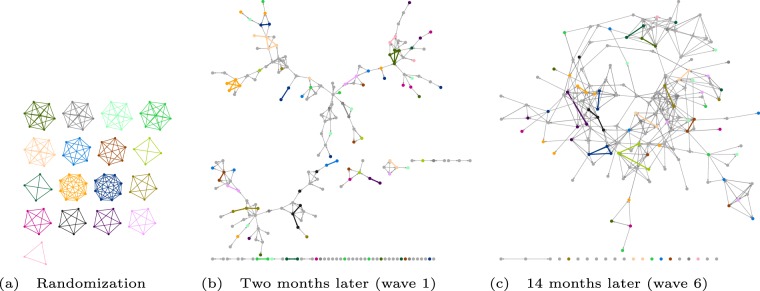
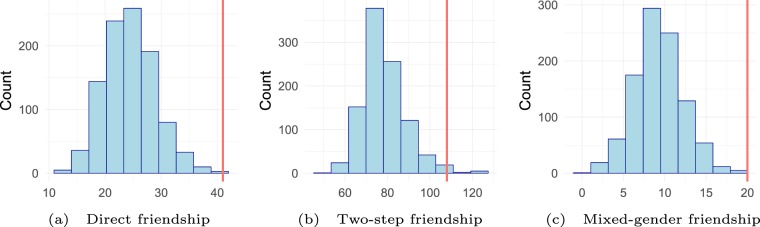
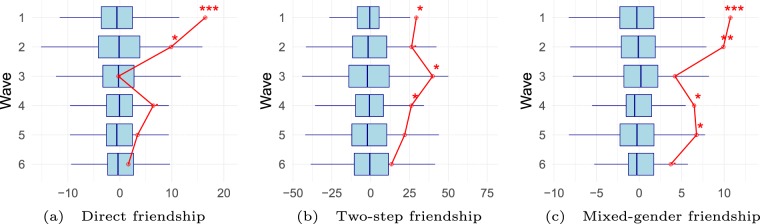
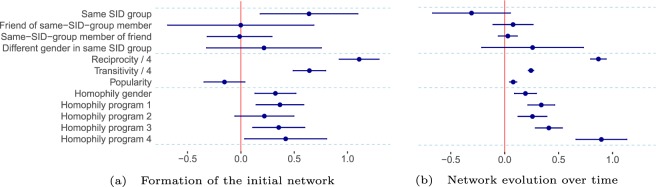
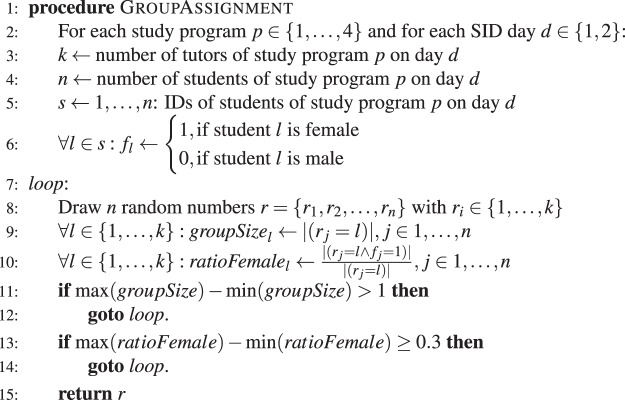
Informal social relations, such as friendships, are crucial for the well-being and success of students at all levels of education. Network interventions can aim at providing contact opportunities in school settings to prevent the social isolation of individuals and facilitate integration between otherwise segregated social groups. We investigate the short-term and long-term effects of one specific network intervention in an undergraduate cohort freshly admitted to an engineering department ( $${\bf{N}}{\boldsymbol{=}}{\bf{226}}$$ N = 226 ). In this intervention, we randomly assigned students into small groups at an introduction event two months prior to their first day at university. The groups were designed to increase mixed-gender contact opportunities. Two months after the intervention, we find a higher rate of friendships, common friends, and mixed-gender friendships in pairs of students who were assigned to the same group than in pairs from different groups (short-term effects). These effects gradually diminish over the first academic year (long-term effects). Using stochastic actor-oriented models, we investigate the long-term trajectory of the intervention effects, while considering alternative network processes, such as reciprocity, transitivity, homophily, and popularity. The results suggest that even though the induced friendship ties are less stable than other friendships, they may serve as early seeds for complex social network processes. Our study shows that simple network interventions can have a pronounced short-term effect and indirect long-term effects on the evolution and structure of student communities.
Overview
The claims and statistics of this paper haven’t been checked yet.
Free: it reads the open-access text and checks the first 5 claims that cite a source we can check. Create a free account to check every claim.
Integrity signals
Registry
Cites
Statistics
Figures
Verification
Claims the paper makes
The claims and statistics of this paper haven’t been checked yet.
Free: it reads the open-access text and checks the first 5 claims that cite a source we can check. Create a free account to check every claim.
Claims other papers make about this one
Each is checked against this paper’s own text: does it say what the citing paper says it does?
The source backs part of the claim, not all of it — or backs it for a different population, condition or comparison.
In the citing paper
“Friendship, interaction, social support, and studying with others have been argued to impact their well-being and academic success, but they often require meeting opportunities and informal settings to develop [5, 13].”
From Students under lockdown: Comparisons of students’ social networks and mental health before and during the COVID-19 crisis in Switzerland (2020) · cites this paper as [13]
Experimental — accuracy not yet measuredThe cited source says what the claim attributes to it.
In the citing paper
“Indeed, social proximity and interpersonal interactions are relevant factors in developing and fostering social ties [90–92] and maintaining mental health [93].”
From Psychological correlates of perceived loneliness in college students before and during the COVID-19 stay-at-home period: a longitudinal study (2023) · cites this paper as [90]
Self-check
Percentages, sums and reported differences re-computed from the paper’s own numbers.
The self-check needs the paper’s full text.
Citations
Cites
Granovetter, M. S. (1973) · American Journal of Sociology · doi:10.1086/225469 · Cited by 40,491
Emergence of Scaling in Random Networks
Barabási, A.-L., & Albert, R. (1999) · Science · doi:10.1126/science.286.5439.509 · Cited by 36,135
Social Capital in the Creation of Human Capital
Coleman, J. S. (1988) · American Journal of Sociology · doi:10.1086/228943 · Cited by 26,975
The need to belong: Desire for interpersonal attachments as a fundamental human motivation.
Baumeister, R. F., & Leary, M. R. (1995) · Psychological Bulletin · doi:10.1037//0033-2909.117.3.497 · Cited by 23,245
Social Capital in the Creation of Human Capital
COLEMAN, J. (2000) · Knowledge and Social Capital · doi:10.1016/b978-0-7506-7222-1.50005-2 · Cited by 21,666
Birds of a Feather: Homophily in Social Networks
McPherson, M., Smith-Lovin, L., & Cook, J. M. (2001) · Annual Review of Sociology · doi:10.1146/annurev.soc.27.1.415 · Cited by 18,567
(1954) · Cited by 15,935
The Proceedings of the National Academy of Sciences
Richards, J. W. (1915) · Science · doi:10.1126/science.42.1074.161 · Cited by 13,983
Journal of personality and social psychology
Armstrong, J. S. (1988) · International Journal of Forecasting · doi:10.1016/0169-2070(88)90126-4 · Cited by 10,485
Structural Holes: The Social Structure of Competition
Lazega, E., & Burt, R. S. (1995) · Revue Française de Sociologie · doi:10.2307/3322456 · Cited by 7,853
Research works printed but not linked: 2
- Best KL Sanwald U Ihsen S Ittel A Gender and STEM in Germany: Policies Enhancing Women’s Participation in Academia International Journal of Gender, Science and Technology 2013 5 171 214
- Ripley, R. M., Snijders, T. A. B., Boda, Z. & Vörös, A. Manual for SIENA 4.0. Nuffield College and Department of Statistics, University of Oxford (2017). Version: March 29, 2019.
Cited by
Elmer, T., Mepham, K., & Stadtfeld, C. (2020) · PLOS ONE · doi:10.1371/journal.pone.0236337 · Cited by 1,658
“Friendship, interaction, social support, and studying with others have been argued to impact their well-being and academic success, but they often require meeting opportunities and informal settings to develop [5, 13].”
BackgroundSelf-citationBrouwer, J., Fernandes, C. A. D. M., Steglich, C., Jansen, E. P. W. A., Hofman, W. H. A., & Flache, A. (2022) · Learning and Instruction · doi:10.1016/j.learninstruc.2022.101603 · Cited by 113
Liu, S., Heinzel, S., Haucke, M. N., & Heinz, A. (2021) · Medicina · doi:10.3390/medicina57010053 · Cited by 81
“Friendship, interaction, social support, and studying with others have been argued to impact their well-being and academic success, but they often require meeting opportunities and informal settings to develop [51].”
BackgroundJohannes, C., Roman, N. V., Onagbiye, S. O., Titus, S., & Leach, L. L. (2024) · International Journal of Environmental Research and Public Health · doi:10.3390/ijerph21020173 · Cited by 77
Student Persistence Through a Different Lens
Tinto, V. (2024) · Journal of College Student Retention Research Theory & Practice · doi:10.1177/15210251241249158 · Cited by 66
Pulgar, J., Ramírez, D., Umanzor, A., Candia, C., & Sánchez, I. (2022) · Physical Review Physics Education Research · doi:10.1103/physrevphyseducres.18.010146 · Cited by 57
Manchanda, T., Stein, A. L., & Fazel, M. S. (2023) · International Journal of Environmental Research and Public Health · doi:10.3390/ijerph20032160 · Cited by 52
Unraveling Student Engagement: Exploring its Relational and Longitudinal Character
Smith, R. A., & Tinto, V. (2022) · Journal of College Student Retention Research Theory & Practice · doi:10.1177/15210251221098172 · Cited by 50
Dokuka, S., Рашитовна, В. Д., & Yudkevich, M. (2020) · PLoS ONE · doi:10.1371/journal.pone.0236737 · Cited by 46
Networks in Education: A Travelogue Through Five Decades
Saqr, M., Poquet, O., & López‐Pernas, S. (2022) · IEEE Access · doi:10.1109/access.2022.3159674 · Cited by 43
Multilevel network interventions: Goals, actions, and outcomes
Robins, G. L., Lusher, D., Broccatelli, C., Bright, D. A., Gallagher, H. C., Karkavandi, M. A., Matouš, P., Coutinho, J. A., Wang, P., Koskinen, J. H., et al. (2022) · Social Networks · doi:10.1016/j.socnet.2022.09.005 · Cited by 41
Heterogeneous peer effects of college roommates on academic performance
Cao, Y., Zhou, T., & Gao, J. G. (2024) · Nature Communications · doi:10.1038/s41467-024-49228-7 · Cited by 29
Ku, B. S., Ren, J., Compton, M. T., Druss, B. G., Guo, S., & Walker, E. F. (2024) · Psychological Medicine · doi:10.1017/s0033291724000278 · Cited by 29
Avcı, M. (2023) · Journal of Happiness and Health · doi:10.47602/johah.v3i2.43 · Cited by 28
Vörös, A., Boda, Z., Elmer, T., Hoffman, M., Mepham, K., Raabe, I. J., & Stadtfeld, C. (2020) · Social Networks · doi:10.1016/j.socnet.2020.11.006 · Cited by 27
Self-citationConti, C., Lanzara, R., Rosa, I., Müller, M. M., & Porcelli, P. (2023) · BMC Psychology · doi:10.1186/s40359-023-01099-1 · Cited by 26
New on the Block: Analyzing Network Selection Trajectories in a Prison Treatment Program
Schaefer, D. R., & Kreager, D. A. (2020) · American Sociological Review · doi:10.1177/0003122420941021 · Cited by 27
Interconnectedness in education systems
Candia, C., Pulgar, J., & Pinheiro, F. L. (2025) · Edward Elgar Publishing eBooks · doi:10.4337/9781802207309.00079 · Cited by 24
Severijns, R., Streukens, S., Brouwer, J., & Lizin, S. (2023) · Journal of Environmental Psychology · doi:10.1016/j.jenvp.2023.102094 · Cited by 23
McFadden, S. L., Guille, S., Daly, J., O'Neill, B. M., Marley, J., Hanratty, C. E., Shepherd, P., Ramsey, L., Breen, C. J., Duffy, O. M., et al. (2022) · PLoS ONE · doi:10.1371/journal.pone.0271873 · Cited by 21
The Role of Social Media in Spreading the Culture of Volunteer Work Among University Students
Khasawneh, Y. J. A., & Khasawneh, M. A. S. (2024) · Studies in Media and Communication · doi:10.11114/smc.v12i4.6941 · Cited by 18
Richardson, L., Long, E., Goodfellow, C., Milicev, J., & Gardani, M. (2024) · PLoS ONE · doi:10.1371/journal.pone.0297953 · Cited by 16
Career intervention program to promote academic adjustment and success in higher education
Sampaio, C., de Carvalho, C. L., Taveira, M. D. C., & Silva, A. D. (2025) · Frontiers in Education · doi:10.3389/feduc.2025.1519877 · Cited by 16
Guerrero, M., Longan, C., Cummings, C., Kassanits, J. E., Reilly, A., Stevens, E., & Jason, L. A. (2022) · The Humanistic Psychologist · doi:10.1037/hum0000295 · Cited by 15
Hassani, S., Schwab, S., & Boda, Z. (2022) · Social Development · doi:10.1111/sode.12581 · Cited by 14
Self-citationGrishina, M., Rooney, R. M., Millar, L., Mann, R., & Mancini, V. O. (2023) · Frontiers in Psychology · doi:10.3389/fpsyg.2023.1078268 · Cited by 12
Stochastic actor‐oriented modelling of the impact of COVID‐19 on financial network evolution
Chu, A. M. Y., Chan, L. S. H., & So, M. K. P. (2021) · Stat · doi:10.1002/sta4.408 · Cited by 12
Social tie formation of COVID-19 students: evidence from a two-cohort longitudinal study
Sigurdardottir, M. S., Torfason, M. Þ., & Jónsdóttir, A. H. (2022) · Higher Education · doi:10.1007/s10734-022-00935-4 · Cited by 12
STEM learning communities promote friendships but risk academic segmentation
Jeffrey, W., Schaefer, D. R., Xu, D., McPartlan, P., & Solanki, S. M. (2022) · Scientific Reports · doi:10.1038/s41598-022-15575-y · Cited by 12
Unlocking social network analysis methods for studying human mobility
Wiedemann, N., Martin, H., & Raubal, M. (2022) · AGILE GIScience Series · doi:10.5194/agile-giss-3-19-2022 · Cited by 11
Effects of Friendship Influence and Normative Pressure on Adolescent Attitudes and Behaviors
Zingora, T., & Flache, A. (2025) · Personality and Social Psychology Bulletin · doi:10.1177/01461672251366388 · Cited by 10
Veenstra, R., Bertogna, A. T., & Laninga‐Wijnen, L. (2023) · Oxford University Press eBooks · doi:10.1093/oso/9780197602317.003.0014 · Cited by 10
Peng, C., Wang, X., Zhang, M. X., Tong, D., Li, J., Xu, T., Qiu, J., & Wei, D. (2025) · Social Science & Medicine · doi:10.1016/j.socscimed.2025.117968 · Cited by 9
Review and Assessment of Digital Twin–Oriented Social Network Simulators
Wen, J., Gabryś, B., & Musiał, K. (2023) · IEEE Access · doi:10.1109/access.2023.3312129 · Cited by 9
Jeffrey, W. (2024) · Sociology of Education · doi:10.1177/00380407241300602 · Cited by 7
Who will participate in online collaborative problem solving? A longitudinal network analysis
Wang, C., & Xiao, J. (2023) · Interactive Learning Environments · doi:10.1080/10494820.2023.2266523 · Cited by 7
The role of a campus herb garden in promoting social and personal wellbeing in naturopathic students
Patel, A., Hill, W., Wesseling, K., Standen, C., & Carruthers, R. (2024) · Advances in Integrative Medicine · doi:10.1016/j.aimed.2024.05.003 · Cited by 7
Praus, P., Bilek, E., Holz, N. E., & Braun, U. (2021) · Der Nervenarzt · doi:10.1007/s00115-021-01161-6 · Cited by 6
Yokotani, K. (2022) · Scientific Reports · doi:10.1038/s41598-022-07714-2 · Cited by 6
Mournet, A. M., Gunin, G. B., Shinall, J. A., Brennan, E., Jadav, N., Istvan, E. M., Kleiman, E. M., & Bal, V. H. (2024) · Autism Research · doi:10.1002/aur.3095 · Cited by 6
Taking Intersectionality Seriously: Teaching Challenges and Practices in the Classroom
Maurel, M. (2025) · Organizational Behavior Teaching Review · doi:10.1177/10525629251346410 · Cited by 5
Free to Choose? : Studies of Opportunity Constraints and the Dynamics of School Segregation
Mutgan, S. (2021) · Institute for Analytical Sociology dissertation series · doi:10.3384/9789179291020 · Cited by 5
Marqués‐Sánchez, P., García-Rodríguez, I., Benítez‐Andrades, J. A., Fulgueiras-Carril, I., Fernández-Sierra, P., & Fernández‐Martínez, E. (2020) · Healthcare · doi:10.3390/healthcare8030220 · Cited by 5
Levinson, M., Ayalon, L., & Benjamini, Y. (2022) · Social Networks · doi:10.1016/j.socnet.2022.06.005 · Cited by 5
Digital communication and tie formation amongst freshmen students during and after the pandemic
Gilsbach, J. M., & Stauder, J. (2025) · Social Networks · doi:10.1016/j.socnet.2024.12.002 · Cited by 4
Blalock, A. E., McCurdy, J., Henry, K., & Wentworth, C. (2024) · Teaching and Learning in Medicine · doi:10.1080/10401334.2024.2416690 · Cited by 4
Mepham, K., Vörös, A., & Stadtfeld, C. (2025) · Network Science · doi:10.1017/nws.2025.2 · Cited by 4
Self-citationRadó, M. K., Kisfalusi, D., Laverty, A. A., van Lenthe, F. J., Been, J. V., & Takács, K. (2023) · Addiction · doi:10.1111/add.16384 · Cited by 4
Левин, С. М. (2021) · Векторы благополучия · doi:10.18799/26584956/2021/1(40)/1086 · Cited by 4
Sense of belonging of bachelor nursing students: a descriptive-comparative study
Fangonil‐Gagalang, E., Kim, Y. S., Schneider, J. T., & Gregg-Chastain, R. (2025) · Teaching and learning in nursing · doi:10.1016/j.teln.2025.09.008 · Cited by 4
Fang, W., Qin, C., Zhou, D., Yin, J. M., Liu, Z., & Guan, X. (2023) · International Journal of Environmental Research and Public Health · doi:10.3390/ijerph20021409 · Cited by 4
Why Do Homogeneous Friendships Persist in a Diverse Population? Making Sense of HomophilyPreprint
Firmansyah, F. M., & Pratama, A. R. (2021) · SocArXiv (OSF Preprints) · doi:10.31235/osf.io/zr7p3 · Cited by 4
Baguant, N. D. (2020) · ResearchSpace (University of KwaZulu-Natal) · Cited by 3
Owens, A., & Cassarino, M. (2022) · PsyArXiv (OSF Preprints) · doi:10.31234/osf.io/bv6u8 · Cited by 3
Severijns, R., Brouwer, J., de la Haye, K., Streukens, S., & Lizin, S. (2025) · Food Quality and Preference · doi:10.1016/j.foodqual.2025.105475 · Cited by 3
Cowen, D. R., Stark, T., Frey, V., & Flache, A. (2025) · Social Networks · doi:10.1016/j.socnet.2025.10.001 · Cited by 3
The Swiss Student Life Study: CodebookPreprint
Elmer, T., Mepham, K., Hoffman, M., Boda, Z., Raabe, I. J., Vörös, A., & Stadtfeld, C. (2022) · PsyArXiv (OSF Preprints) · doi:10.31234/osf.io/9abjk · Cited by 3
Self-citationWen, J., Gabryś, B., & Musiał, K. (2024) · PLoS ONE · doi:10.1371/journal.pone.0303571 · Cited by 3
Abstracts of IV International Scientific and Practical Conference
Майданюк, В. П. (2021) · doi:10.46299/isg.2021.ii.iv · Cited by 3
A study on the impact of COVID-19 on the mental health of undergraduate students
Vaidya, H., Agarwal, N., Kotipalli, S., Anand, A. A., & Vara Lakshmi, S. (2024) · Asian Journal of Management and Commerce · doi:10.22271/27084515.2024.v5.i1d.264 · Cited by 2
Transformation of learning and teaching in rehabilitation sciences: A case study from South Africa
Khuabi, L. J., Bardien, F., de Beer, A., Louw, A., Koegelenberg, A., Baxter, A., Schmutz, A. M. S., Gaskin, A., Gerber, B., Joseph, C., et al. (2022) · Human functioning, technology and health · doi:10.4102/aosis.2022.bk357 · Cited by 2
Seven, M., & Aysel, K. (2025) · ODÜ Sosyal Bilimler Araştırmaları Dergisi (ODÜSOBİAD) · doi:10.48146/odusobiad.1473688 · Cited by 2
Homophily Detection in Opinion Dynamics from Reddit Discussions
Bernardo, C., Ricci, D., & Vasca, F. (2025) · Lecture notes in social networks · doi:10.1007/978-3-031-85240-4_21 · Cited by 2
Shields, S. (2024) · Education and human development · doi:10.5772/intechopen.113775 · Cited by 2
Xiao, J., Wang, C., & Zhang, W. (2026) · International Conference on Learning Analytics and Knowledge (LAK) · doi:10.1145/3785022.3785049 · Cited by 2
Korobchanskyі, V., Sarkis-Ivanova, V. V., Bohachova, O., Oliinyk, Y. O., & Biеleсka, S. V. (2022) · Medicni perspektivi · doi:10.26641/2307-0404.2022.4.271227 · Cited by 2
Pastena, A. (2025) · European Journal of Applied Linguistics · doi:10.1515/eujal-2024-0050 · Cited by 2
Work In Progress: A Scoping Review of Social Network Analysis Methods in Engineering Education
Elliot, J., & Nielson, A. (2024) · ASEE Rocky Mountain Section Conference · doi:10.18260/1-2-1114-49420 · Cited by 1
Brown, M., Smith, R., Tipton, J. A., & Leitner, G. (2026) · Review of Educational Research · doi:10.3102/00346543261438444 · Cited by 1
Xiao, J. (2026) · Interactive Learning Environments · doi:10.1080/10494820.2026.2632766 · Cited by 1
A replication attempt of personality change through randomized peer groups
Krämer, M. D., Kretzschmar, A., Hopwood, C. J., & Bleidorn, W. (2025) · European Journal of Personality · doi:10.1177/08902070251331355 · Cited by 1
Vörös, A., Boda, Z., Elmer, T., Hoffman, M., Mepham, K., Raabe, I. J., & Stadtfeld, C. (2022) · Social Networks · doi:10.1016/j.socnet.2022.01.012 · Cited by 1
Self-citationRădoi, M., Apostol, A.-C., Irimescu, G., & Bostan, C. M. (2024) · Revista Romaneasca pentru Educatie Multidimensionala · doi:10.18662/rrem/16.1/837 · Cited by 1
Elliott, J., Christensen, D. E., Chasmar, J., & Scherf, K. (2025) · ASEE Annual Conference & Exposition · doi:10.18260/1-2--56967 · Cited by 1
Chen, Y., Hai, B., & Chen, G. (2026) · Journal of Innovation & Knowledge · doi:10.1016/j.jik.2026.100976 · Cited by 1
Fernandes, C. A. D. M., Flache, A., & Bakker, D. M. (2025) · Computational and Mathematical Organization Theory · doi:10.1007/s10588-025-09399-0 · Cited by 1
Chinese Visiting Doctoral Student Satisfaction in Visiting a Canadian University: A Case Study
Cheng, M. (2025) · Scholarship@Western (Western University) · Cited by 1
DeYoung, J. K. (2023) · Enlighten: Theses (The University of Glasgow) · doi:10.5525/gla.thesis.83910 · Cited by 1
Chen, L. (2023) · International Journal of Mental Health Promotion · doi:10.32604/ijmhp.2023.027190 · Cited by 1
Diop‐Christensen, A., Diop, L., & Munzula, A. B. (2024) · Journal of Ethnic and Migration Studies · doi:10.1080/1369183x.2024.2404469 · Cited by 1
Ribeiro, B. S., Heidemann, L. A., & Espinosa, T. (2025) · Caderno Brasileiro de Ensino de Física · doi:10.5007/2175-7941.2025.e106810 · Cited by 1
Duan, W., Liu, R., Zhang, Y., Yuan, H., Zheng, C., & Hu, B. (2026) · Applied Research in Quality of Life · doi:10.1007/s11482-025-10530-1
Amin, S., Sansom, R. L., & Poulsen, T. (2026) · Professional Development in Education · doi:10.1080/19415257.2026.2650714
Homophily in friendship choice during an early life transition: A cohort network dynamic approach
Kempnich, M., Wölfer, R., Hewstone, M., & Dunbar, R. (2026) · Evolution and Human Behavior · doi:10.1016/j.evolhumbehav.2026.106888
Azman, A. H. A., Tiong, N., Kamarudin, M. A., & Zamzuri, Z. H. (2026) · BMC Medical Education · doi:10.1186/s12909-026-09397-z
Xiao, C., & Zhou, F. (2025) · Experimental Aging Research · doi:10.1080/0361073x.2025.2599036
Korobchanskyі, V., & Древаль, М. В. (2023) · Актуальні проблеми сучасної медицини Вісник Української медичної стоматологічної академії · doi:10.31718/2077-1096.23.4.305
Friendships and Well-Being in College
Palmeri, A. E., & Robertson, M. E. (2026) · Oxford University Press eBooks · doi:10.1093/9780197759424.003.0016
Studente, S. (2021) · Psychology & Psychological Research International Journal · doi:10.23880/pprij-16000288
Predictive Analytics of Mental Health Problems Among College Students in the Covid-19 Pandemic
Abdullah, M., Omar, M., & Bahardin, T. I. (2022) · Archives of Business Research · doi:10.14738/abr.1011.13510
The associations between social environment, neurobiology, and psychotic disorders
Ku, B. S. (2024) · Research Publications (Maastricht University) · doi:10.26481/dis.20241120bk
GAPS2 - Global Arts and Psychology Seminar "Creativity in music and the arts" : Book of Abstracts
Kempf, A., Parncutt, R., Martinez, I. C., Pérez, J. B., Glasser, S., Osborne, M. S., Daffern, H., Waddington, C., O'Neill, K., & Schiavio, A. (2024) · Oxford University Research Archive (ORA) (University of Oxford) · doi:10.25364/554.2024.1
Social Networks, School Segregation, and Educational Inequality
Lenkewitz, S. (2023) · Kölner Universitäts PublikationsServer (Universität zu Köln)
A Replication Attempt of Personality Change Through Randomized Peer GroupsPreprint
Krämer, M. D., Kretzschmar, A., Hopwood, C. J., & Bleidorn, W. (2025) · PsyArXiv (OSF Preprints) · doi:10.31234/osf.io/rd8ms_v2
Ranking and Sorting: An Examination of Positional and Relational Dynamics in Higher Education
Jeffrey, W. (2024) · eScholarship (California Digital Library)
Фомина, О. Е. (2022) · Bulletin of the South-Russian state technical University (NPI) Series Socio-economic Sciences · doi:10.17213/2075-2067-2022-1-232-246
Kloppers, M., Bester, J., Baxter, A., Denton, E. P., Koegelenberg, A., Burchell, H. J., Simpson, T.-L., van Wyk, M., & Khuabi, L. J. (2022) · Human functioning, technology and health · doi:10.4102/aosis.2022.bk357.06
Lestari, W., Latif, A., & Ridwan, M. (2026) · ACADEMIA Jurnal Inovasi Riset Akademik · doi:10.51878/academia.v6i3.12820
Metadata
- Authors
- Boda, Z., Elmer, T., Vörös, A., & Stadtfeld, C.
- Affiliations
- ETH Zurich (CH)
- University of Manchester (GB)
- Corresponding author
- Boda, Zsófia
- Stadtfeld, Christoph
- Venue
- Scientific Reports
- Published
- 2020-02-19
- Volume
- 10
- Issue
- 1
- Pages
- 2889-2889
- ISSN
- 2045-2322 (ISSN-L)
- PMC
- PMC7031228
- OpenAlex
- W3007313614
- Semantic Scholar
- a4ce5482e0854ebc0be0b26dbf075cb896218049
- Cited by
- 87
- References
- 84
- Citations by year
- 2026: 12 · 2025: 16 · 2024: 13 · 2023: 13 · 2022: 19 · 2021: 8 · 2020: 6
- FWCI
- 4.86
- Type
- journal article
- Language
- en
- Open access
- gold
- doi.org
- Licence
- cc-by
- creativecommons.org/licenses/by/4.0 (tdm)
- creativecommons.org/licenses/by/4.0 (vor)
- Locations
- Scientific Reports (publishedVersion, cc-by)
- Europe PMC (PubMed Central) (publishedVersion, cc-by)
- PubMed Central (publishedVersion, cc-by)
- PubMed (publishedVersion)
- University of Birmingham Research Portal (University of Birmingham) (submittedVersion, cc-by)
- Research Explorer (The University of Manchester) (submittedVersion)
- Repository for Publications and Research Data (ETH Zurich) (submittedVersion, cc-by)
- ETH Zürich Research Collection (cc-by)
- Funders
- Schweizerischer Nationalfonds zur Förderung der Wissenschaftlichen Forschung (10001A 169965)
- Topics
- Physical Sciences › Physics and Astronomy › Statistical and Nonlinear Physics › Complex Network Analysis Techniques
- Social Sciences › Sociology and Political Science › Social Capital and Networks
- Social Sciences › Sociology and Political Science › Social Power and Status Dynamics
- Keywords
- social network intervention, friendship formation, university students, engineering students, social isolation, social integration, common friends, homophily, reciprocity, transitivity, popularity, stochastic actor-oriented models, student community, intervention effects over time
- MeSH terms
- Algorithms, Female, Humans, Male, Students, Time Factors, Universities, Friends, Social Networking
About these checks
Registry, retraction, Cites and statistics results are computed, not judged, with one exception: a printed reference that no index lists is read once by a model before it counts as a citation error. Claims are extracted by a model and kept only when their quote appears verbatim in the text; each cited source is then checked, with a model’s help, for whether it says what the claim relies on. Those verdicts can be wrong — read the claim’s quote and the cited source before relying on one.
Statistics and arithmetic are recomputed, not judged.
Confidence bands are shown only for fields calibrated on our annotated test set. None is calibrated yet, so no band is shown.
What counts as a claim ›How we measure confidence ›How we check this ›
Are you an author, or do you see a problem with this page? Request a review
Data sources
Bibliographic data: Semantic Scholar, OpenAlex, Crossref.
Contains information from the Semantic Scholar Academic Graph Datasets, made available under the ODC Attribution License (ODC-BY 1.0).
Semantic Scholar’s data is described in: Kinney, R., et al. (2023). The Semantic Scholar Open Data Platform. arXiv:2301.10140.
