

Short-term and long-term effects of a social network intervention on friendships among university students
Open accessThe DOI matches its Crossref record; 82 of the 84 references it cites were found in a registry or an index.
Abstract
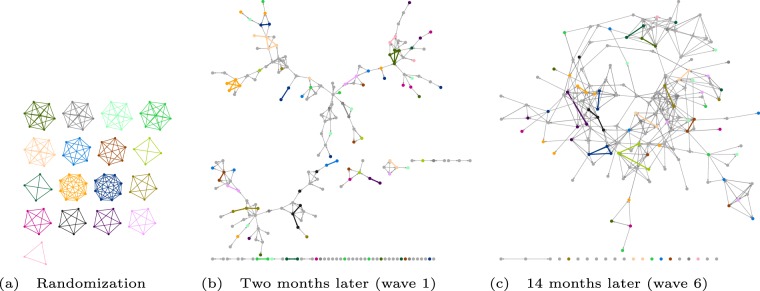
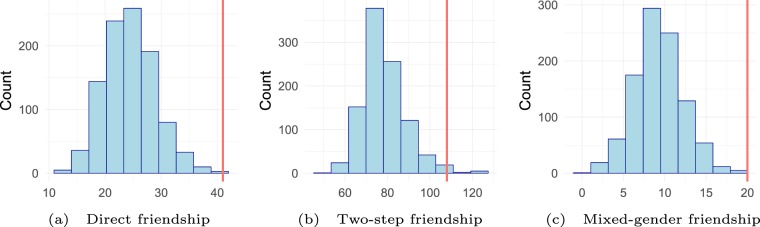
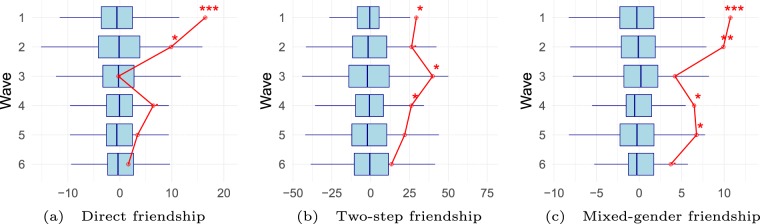
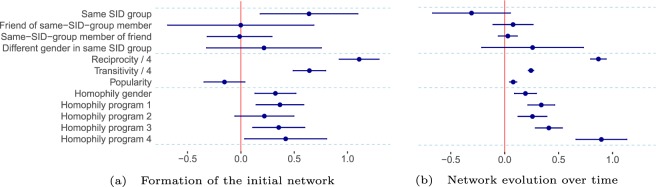
Informal social relations, such as friendships, are crucial for the well-being and success of students at all levels of education. Network interventions can aim at providing contact opportunities in school settings to prevent the social isolation of individuals and facilitate integration between otherwise segregated social groups. We investigate the short-term and long-term effects of one specific network intervention in an undergraduate cohort freshly admitted to an engineering department ( $${\bf{N}}{\boldsymbol{=}}{\bf{226}}$$ N = 226 ). In this intervention, we randomly assigned students into small groups at an introduction event two months prior to their first day at university. The groups were designed to increase mixed-gender contact opportunities. Two months after the intervention, we find a higher rate of friendships, common friends, and mixed-gender friendships in pairs of students who were assigned to the same group than in pairs from different groups (short-term effects). These effects gradually diminish over the first academic year (long-term effects). Using stochastic actor-oriented models, we investigate the long-term trajectory of the intervention effects, while considering alternative network processes, such as reciprocity, transitivity, homophily, and popularity. The results suggest that even though the induced friendship ties are less stable than other friendships, they may serve as early seeds for complex social network processes. Our study shows that simple network interventions can have a pronounced short-term effect and indirect long-term effects on the evolution and structure of student communities.
Overview
The claims and statistics of this paper haven’t been checked yet.
Free: it reads the open-access text and checks the first 5 claims that cite a source we can check. Create a free account to check every claim.
Integrity signals
Registry
Cites
Statistics
Figures
Verification
Claims the paper makes
The claims and statistics of this paper haven’t been checked yet.
Free: it reads the open-access text and checks the first 5 claims that cite a source we can check. Create a free account to check every claim.
Claims other papers make about this one
Each is checked against this paper’s own text: does it say what the citing paper says it does?
The source backs part of the claim, not all of it — or backs it for a different population, condition or comparison.
In the citing paper
“Friendship, interaction, social support, and studying with others have been argued to impact their well-being and academic success, but they often require meeting opportunities and informal settings to develop [5, 13].”
From Students under lockdown: Comparisons of students’ social networks and mental health before and during the COVID-19 crisis in Switzerland (2020) · cites this paper as [13]
Experimental — accuracy not yet measuredThe cited source says what the claim attributes to it.
In the citing paper
“Indeed, social proximity and interpersonal interactions are relevant factors in developing and fostering social ties [90–92] and maintaining mental health [93].”
From Psychological correlates of perceived loneliness in college students before and during the COVID-19 stay-at-home period: a longitudinal study (2023) · cites this paper as [90]
Self-check
Percentages, sums and reported differences re-computed from the paper’s own numbers.
The self-check needs the paper’s full text.
Citations
Cites
Granovetter, M. S. (1973) · American Journal of Sociology · doi:10.1086/225469 · Cited by 40,491
Emergence of Scaling in Random Networks
Barabási, A.-L., & Albert, R. (1999) · Science · doi:10.1126/science.286.5439.509 · Cited by 36,135
Social Capital in the Creation of Human Capital
Coleman, J. S. (1988) · American Journal of Sociology · doi:10.1086/228943 · Cited by 26,975
The need to belong: Desire for interpersonal attachments as a fundamental human motivation.
Baumeister, R. F., & Leary, M. R. (1995) · Psychological Bulletin · doi:10.1037//0033-2909.117.3.497 · Cited by 23,245
Social Capital in the Creation of Human Capital
COLEMAN, J. (2000) · Knowledge and Social Capital · doi:10.1016/b978-0-7506-7222-1.50005-2 · Cited by 21,666
Birds of a Feather: Homophily in Social Networks
McPherson, M., Smith-Lovin, L., & Cook, J. M. (2001) · Annual Review of Sociology · doi:10.1146/annurev.soc.27.1.415 · Cited by 18,567
(1954) · Cited by 15,935
The Proceedings of the National Academy of Sciences
Richards, J. W. (1915) · Science · doi:10.1126/science.42.1074.161 · Cited by 13,983
Journal of personality and social psychology
Armstrong, J. S. (1988) · International Journal of Forecasting · doi:10.1016/0169-2070(88)90126-4 · Cited by 10,485
Structural Holes: The Social Structure of Competition
Lazega, E., & Burt, R. S. (1995) · Revue Française de Sociologie · doi:10.2307/3322456 · Cited by 7,853
The American Psychological Association
Langfeld, H. S. (1919) · Science · doi:10.1126/science.49.1254.51 · Cited by 7,475
Attitudinal Effects of Mere Exposure
Zajonc, R. B. (1968) · Journal of Personality and Social Psychology · doi:10.1037/h0025848 · Cited by 6,745
The Matthew Effect in Science: The reward and communication systems of science are considered.
Merton, R. K. (1968) · Science · doi:10.1126/science.159.3810.56 · Cited by 6,720
From social integration to health: durkheim in the new millennium
Berkman, L. F., Glass, T., Brissette, I., & Seeman, T. E. (2000) · Social Science & Medicine · doi:10.1016/s0277-9536(00)00065-4 · Cited by 4,821
(1968) · PubMed · Cited by 4,803
Attitudes and cognitive organization
Heider, F. (1946) · The Journal of Psychology · doi:10.1080/00223980.1946.9917275 · Cited by 3,672
Cook, K. S. (2020) · The Blackwell Encyclopedia of Sociology · doi:10.1002/9781405165518.wbeoss149.pub2 · Cited by 3,637
Kawachi, I. (2001) · Journal of Urban Health: Bulletin of the New York Academy of Medicine · doi:10.1093/jurban/78.3.458 · Cited by 3,538
Emerson, R. M. (1976) · Annual Review of Sociology · doi:10.1146/annurev.so.02.080176.002003 · Cited by 3,457
Experiments in Intergroup Discrimination
Tajfel, H. (1970) · Scientific American · doi:10.1038/scientificamerican1170-96 · Cited by 2,577
How does intergroup contact reduce prejudice? Meta‐analytic tests of three mediators
Pettigrew, T. F., & Tropp, L. R. (2008) · European Journal of Social Psychology · doi:10.1002/ejsp.504 · Cited by 2,539
The Focused Organization of Social Ties
Feld, S. L. (1981) · American Journal of Sociology · doi:10.1086/227352 · Cited by 2,314
Journal of Experimental Social Psychology
(1965) · Nature · doi:10.1038/2061099b0 · Cited by 1,883
Social Pressures in Informal Groups
Festinger, L., Schachter, S., & Back, K. (1950) · The American Catholic Sociological Review · doi:10.2307/3707362 · Cited by 1,831
European Journal of Social Psychology
(2006) · European Journal of Social Psychology · doi:10.1002/(issn)1099-0992 · Cited by 1,811
Peer Effects with Random Assignment: Results for Dartmouth Roommates
Sacerdote, B. (2001) · The Quarterly Journal of Economics · doi:10.1162/00335530151144131 · Cited by 1,797
Journal of Abnormal and Social Psychology.
(1962) · Anthropology News · doi:10.1111/an.1962.3.1.6.1 · Cited by 1,544
An integrative theory of intergroup contact
Brown, R., & Hewstone, M. (2005) · Advances in Experimental Social Psychology · doi:10.1016/s0065-2601(05)37005-5 · Cited by 1,491
The extended contact effect: Knowledge of cross-group friendships and prejudice.
Wright, S. C., Aron, A., McLaughlin-Volpe, T., & Ropp, S. A. (1997) · Journal of Personality and Social Psychology · doi:10.1037//0022-3514.73.1.73 · Cited by 1,443
Race, School Integration, and Friendship Segregation in America
Moody, J. (2001) · American Journal of Sociology · doi:10.1086/338954 · Cited by 1,342
Valente, T. W. (2012) · Science · doi:10.1126/science.1217330 · Cited by 1,271
The Statistical Evaluation of Social Network Dynamics
Snijders, T. A. B. (2001) · Sociological Methodology · doi:10.1111/0081-1750.00099 · Cited by 1,203
Generalized Intergroup Contact Effects on Prejudice
Pettigrew, T. F. (1997) · Personality and Social Psychology Bulletin · doi:10.1177/0146167297232006 · Cited by 1,179
Social Pressures in Informal Groups, a Study of Human Factors in Housing
Keller, M., Festinger, L., Schachter, S., & Back, K. (1952) · The Milbank Memorial Fund Quarterly · doi:10.2307/3348388 · Cited by 1,104
Predicting with networks: Nonparametric multiple regression analysis of dyadic data
Krackhardt, D. (1988) · Social Networks · doi:10.1016/0378-8733(88)90004-4 · Cited by 1,053
(2015) · Wiley eBooks · doi:10.1002/9781118900772 · Cited by 956
Dynamics of Dyads in Social Networks: Assortative, Relational, and Proximity Mechanisms
Rivera, M. T., Soderstrom, S. B., & Uzzi, B. (2010) · Annual Review of Sociology · doi:10.1146/annurev.soc.34.040507.134743 · Cited by 939
Clustering and Structural Balance in Graphs
Davis, J. A. (1967) · Human Relations · doi:10.1177/001872676702000206 · Cited by 818
Cross-Group Friendships and Intergroup Attitudes: A Meta-Analytic Review
Davies, K., Tropp, L. R., Aron, A., Pettigrew, T. F., & Wright, S. C. (2011) · Personality and Social Psychology Review · doi:10.1177/1088868311411103 · Cited by 809
The Origins of Status Hierarchies: A Formal Theory and Empirical Test
Gould, R. V. (2002) · American Journal of Sociology · doi:10.1086/341744 · Cited by 741
Understanding Social Networks: Theories, Concepts, and Findings
Kadushin, C. (2011) · Cited by 652
Social network analysis: A methodological introduction
Butts, C. T. (2008) · Asian Journal of Social Psychology · doi:10.1111/j.1467-839x.2007.00241.x · Cited by 546
Athena unbound: the advancement of women in science and technology
(2001) · Choice Reviews Online · doi:10.5860/choice.38-5003 · Cited by 468
Doing Social Network Research: Network-based Research Design for Social Scientists
Robins, G. (2015) · SAGE Publications Ltd eBooks · doi:10.4135/9781473916753 · Cited by 419
The Climate for Women in Academic Science: The Good, the Bad, and the Changeable
Settles, I. H., Cortina, L. M., Malley, J., & Stewart, A. J. (2006) · Psychology of Women Quarterly · doi:10.1111/j.1471-6402.2006.00261.x · Cited by 418
Athena Unbound: The Advancement of Women in Science and Technology
Etzkowitz, H., Kemelgor, C., & Uzzi, B. (2000) · Cambridge University Press eBooks · doi:10.1017/cbo9780511541414 · Cited by 358
Status Struggles: Network Centrality and Gender Segregation in Same- and Cross-Gender Aggression
Faris, R., & Felmlee, D. (2011) · American Sociological Review · doi:10.1177/0003122410396196 · Cited by 351
Choosing and leaving science in highly selective institutions
Christopher Strenta, A., Elliott, R., Adair, R., Matier, M., & Scott, J. (1994) · Research in Higher Education · doi:10.1007/bf02497086 · Cited by 308
The Paradox of Critical Mass for Women in Science
Etzkowitz, H., Kemelgor, C., Neuschatz, M., Uzzi, B., & Alonzo, J. (1994) · Science · doi:10.1126/science.7939644 · Cited by 298
Veenstra, R., Dijkstra, J. K., Steglich, C., & Van Zalk, M. H. W. (2013) · Journal of Research on Adolescence · doi:10.1111/jora.12070 · Cited by 296
The Pseudoscience of Single-Sex Schooling
Halpern, D. F., Eliot, L., Bigler, R. S., Fabes, R. A., Hanish, L. D., Hyde, J., Liben, L. S., & Martin, C. L. (2011) · Science · doi:10.1126/science.1205031 · Cited by 294
Obesity-related behaviors in adolescent friendship networks
de la Haye, K., Robins, G., Mohr, P., & Wilson, C. (2010) · Social Networks · doi:10.1016/j.socnet.2009.09.001 · Cited by 251
Stochastic Actor-Oriented Models for Network Dynamics
Snijders, T. A. B. (2017) · Annual Review of Statistics and Its Application · doi:10.1146/annurev-statistics-060116-054035 · Cited by 242
Social networks and spatial configuration—How office layouts drive social interaction
Sailer, K., & McCulloh, I. (2012) · Social Networks · doi:10.1016/j.socnet.2011.05.005 · Cited by 227
Integration in emerging social networks explains academic failure and success
Stadtfeld, C., Vörös, A., Elmer, T., Boda, Z., & Raabe, I. J. (2019) · Proceedings of the National Academy of Sciences · doi:10.1073/pnas.1811388115 · Cited by 212
Self-citationDevelopmental changes in gender composition of friendship networks in adolescent girls and boys.
Poulin, F., & Pedersen, S. (2007) · Developmental Psychology · doi:10.1037/0012-1649.43.6.1484 · Cited by 198
Exposure effects in the classroom: The development of affinity among students
Moreland, R. L., & Beach, S. R. (1992) · Journal of Experimental Social Psychology · doi:10.1016/0022-1031(92)90055-o · Cited by 197
Martin, C. L., Kornienko, O., Schaefer, D. R., Hanish, L. D., Fabes, R. A., & Goble, P. (2013) · Child Development · doi:10.1111/cdev.12032 · Cited by 195
Lomi, A., Snijders, T. A. B., Steglich, C. E. G., & Torló, V. J. (2011) · Social Science Research · doi:10.1016/j.ssresearch.2011.06.010 · Cited by 192
Becoming Mathematicians: Women and Students of Color Choosing and Leaving Doctoral Mathematics
Herzig, A. H. (2004) · Review of Educational Research · doi:10.3102/00346543074002171 · Cited by 191
Bullying in Classrooms: Participant Roles From a Social Network Perspective
Huitsing, G., & Veenstra, R. (2012) · Aggressive Behavior · doi:10.1002/ab.21438 · Cited by 186
Social context, spatial structure and social network structure
Doreian, P., & Conti, N. (2012) · Social Networks · doi:10.1016/j.socnet.2010.09.002 · Cited by 177
The Social Pipeline: How Friend Influence and Peer Exposure Widen the STEM Gender Gap
Raabe, I. J., Boda, Z., & Stadtfeld, C. (2019) · Sociology of Education · doi:10.1177/0038040718824095 · Cited by 177
Self-citationVan Zalk, M. H. W., Kerr, M., Branje, S. J. T., Stattin, H., & Meeus, W. H. J. (2010) · Developmental Psychology · doi:10.1037/a0019661 · Cited by 157
Peer pressure to smoke: the meaning depends on the method
Michell, L., & West, P. (1996) · Health Education Research · doi:10.1093/her/11.1.39 · Cited by 150
Annual Review of Statistics and Its Application
Kamps, U., & Kateri, M. (2017) · Annual Review of Statistics and Its Application · doi:10.1146/statistics · Cited by 146
Forms of Dependence: Comparing SAOMs and ERGMs From Basic Principles
Block, P., Stadtfeld, C., & Snijders, T. A. B. (2016) · Sociological Methods & Research · doi:10.1177/0049124116672680 · Cited by 144
Self-citationde la Haye, K., Green, H. D., Kennedy, D. P., Pollard, M. S., & Tucker, J. S. (2013) · Journal of Research on Adolescence · doi:10.1111/jora.12018 · Cited by 124
Payne, F. (1937) · The Journal of Higher Education · doi:10.2307/1974557 · Cited by 119
Moving beyond prejudice reduction: Pathways to positive intergroup relations.
(2011) · American Psychological Association eBooks · doi:10.1037/12319-000 · Cited by 112
Grund, T., & Densley, J. A. (2014) · Journal of Contemporary Criminal Justice · doi:10.1177/1043986214553377 · Cited by 109
Dijkstra, J. K., Berger, C., & Lindenberg, S. (2011) · Aggressive Behavior · doi:10.1002/ab.20402 · Cited by 85
Children’s Gender-Typed Activity Choices Across Preschool Social Contexts
Goble, P., Martin, C. L., Hanish, L. D., & Fabes, R. A. (2012) · Sex Roles · doi:10.1007/s11199-012-0176-9 · Cited by 83
Statistical Power in Longitudinal Network Studies
Stadtfeld, C., Snijders, T. A. B., Steglich, C., & van Duijn, M. A. J. (2018) · Sociological Methods & Research · doi:10.1177/0049124118769113 · Cited by 72
Self-citationCluster analysis of multiplex networks: Defining composite network measures
Vörös, A., & Snijders, T. A. B. (2017) · Social Networks · doi:10.1016/j.socnet.2017.01.002 · Cited by 71
Self-citationBrockner, J., & Swap, W. C. (1976) · Journal of Personality and Social Psychology · doi:10.1037/0022-3514.33.5.531 · Cited by 61
Status Perceptions Matter: Understanding Disliking Among Adolescents
Pál, J., Stadtfeld, C., Grow, A., & Takács, K. (2015) · Journal of Research on Adolescence · doi:10.1111/jora.12231 · Cited by 56
Self-citationSocial Influence on Observed Race
Boda, Z. (2018) · Sociological Science · doi:10.15195/v5.a3 · Cited by 53
Self-citationA note on the influence of propinquity upon acquaintanceships.
Byrne, D., & Buehler, J. A. (1955) · Journal of Abnormal & Social Psychology · doi:10.1037/h0040985 · Cited by 52
Partnership Ties Shape Friendship Networks: A Dynamic Social Network Study
Stadtfeld, C., & Pentland, A. (2015) · Social Forces · doi:10.1093/sf/sov079 · Cited by 51
Self-citationThe Micro–Macro Link in Social Networks
Stadtfeld, C. (2018) · Wiley eBooks · doi:10.1002/9781118900772.etrds0463 · Cited by 30
Self-citationThe Emergence of Gender Segregation: Towards an Integrative Perspective
Barbu, S., Maner‐Idrissi, G. L., & Jouanjean, A. (2000) · Current psychology letters · doi:10.4000/cpl.128 · Cited by 18
Social influence on observed race
Boda, Z. (2018) · Repository for Publications and Research Data (ETH Zurich) · doi:10.3929/ethz-b-000254294 · Cited by 16
Self-citation
Research works printed but not linked: 2
- Best KL Sanwald U Ihsen S Ittel A Gender and STEM in Germany: Policies Enhancing Women’s Participation in Academia International Journal of Gender, Science and Technology 2013 5 171 214
- Ripley, R. M., Snijders, T. A. B., Boda, Z. & Vörös, A. Manual for SIENA 4.0. Nuffield College and Department of Statistics, University of Oxford (2017). Version: March 29, 2019.
Cited by
Elmer, T., Mepham, K., & Stadtfeld, C. (2020) · PLOS ONE · doi:10.1371/journal.pone.0236337 · Cited by 1,658
“Friendship, interaction, social support, and studying with others have been argued to impact their well-being and academic success, but they often require meeting opportunities and informal settings to develop [5, 13].”
BackgroundSelf-citationBrouwer, J., Fernandes, C. A. D. M., Steglich, C., Jansen, E. P. W. A., Hofman, W. H. A., & Flache, A. (2022) · Learning and Instruction · doi:10.1016/j.learninstruc.2022.101603 · Cited by 113
Liu, S., Heinzel, S., Haucke, M. N., & Heinz, A. (2021) · Medicina · doi:10.3390/medicina57010053 · Cited by 81
“Friendship, interaction, social support, and studying with others have been argued to impact their well-being and academic success, but they often require meeting opportunities and informal settings to develop [51].”
BackgroundJohannes, C., Roman, N. V., Onagbiye, S. O., Titus, S., & Leach, L. L. (2024) · International Journal of Environmental Research and Public Health · doi:10.3390/ijerph21020173 · Cited by 77
Student Persistence Through a Different Lens
Tinto, V. (2024) · Journal of College Student Retention Research Theory & Practice · doi:10.1177/15210251241249158 · Cited by 66
Metadata
- Authors
- Boda, Z., Elmer, T., Vörös, A., & Stadtfeld, C.
- Affiliations
- ETH Zurich (CH)
- University of Manchester (GB)
- Corresponding author
- Boda, Zsófia
- Stadtfeld, Christoph
- Venue
- Scientific Reports
- Published
- 2020-02-19
- Volume
- 10
- Issue
- 1
- Pages
- 2889-2889
- ISSN
- 2045-2322 (ISSN-L)
- PMC
- PMC7031228
- OpenAlex
- W3007313614
- Semantic Scholar
- a4ce5482e0854ebc0be0b26dbf075cb896218049
- Cited by
- 87
- References
- 84
- Citations by year
- 2026: 12 · 2025: 16 · 2024: 13 · 2023: 13 · 2022: 19 · 2021: 8 · 2020: 6
- FWCI
- 4.86
- Type
- journal article
- Language
- en
- Open access
- gold
- doi.org
- Licence
- cc-by
- creativecommons.org/licenses/by/4.0 (tdm)
- creativecommons.org/licenses/by/4.0 (vor)
- Locations
- Scientific Reports (publishedVersion, cc-by)
- Europe PMC (PubMed Central) (publishedVersion, cc-by)
- PubMed Central (publishedVersion, cc-by)
- PubMed (publishedVersion)
- University of Birmingham Research Portal (University of Birmingham) (submittedVersion, cc-by)
- Research Explorer (The University of Manchester) (submittedVersion)
- Repository for Publications and Research Data (ETH Zurich) (submittedVersion, cc-by)
- ETH Zürich Research Collection (cc-by)
- Funders
- Schweizerischer Nationalfonds zur Förderung der Wissenschaftlichen Forschung (10001A 169965)
- Topics
- Physical Sciences › Physics and Astronomy › Statistical and Nonlinear Physics › Complex Network Analysis Techniques
- Social Sciences › Sociology and Political Science › Social Capital and Networks
- Social Sciences › Sociology and Political Science › Social Power and Status Dynamics
- Keywords
- social network intervention, friendship formation, university students, engineering students, social isolation, social integration, common friends, homophily, reciprocity, transitivity, popularity, stochastic actor-oriented models, student community, intervention effects over time
- MeSH terms
- Algorithms, Female, Humans, Male, Students, Time Factors, Universities, Friends, Social Networking
About these checks
Registry, retraction, Cites and statistics results are computed, not judged, with one exception: a printed reference that no index lists is read once by a model before it counts as a citation error. Claims are extracted by a model and kept only when their quote appears verbatim in the text; each cited source is then checked, with a model’s help, for whether it says what the claim relies on. Those verdicts can be wrong — read the claim’s quote and the cited source before relying on one.
Statistics and arithmetic are recomputed, not judged.
Confidence bands are shown only for fields calibrated on our annotated test set. None is calibrated yet, so no band is shown.
What counts as a claim ›How we measure confidence ›How we check this ›
Are you an author, or do you see a problem with this page? Request a review
Data sources
Bibliographic data: Semantic Scholar, OpenAlex, Crossref.
Contains information from the Semantic Scholar Academic Graph Datasets, made available under the ODC Attribution License (ODC-BY 1.0).
Semantic Scholar’s data is described in: Kinney, R., et al. (2023). The Semantic Scholar Open Data Platform. arXiv:2301.10140.
