

The DOI matches its Crossref record; 65 of the 65 references it cites were found in a registry or an index.
Prevalence, comorbidity, and breed differences in canine anxiety in 13,700 Finnish pet dogs
Open accessAbstract
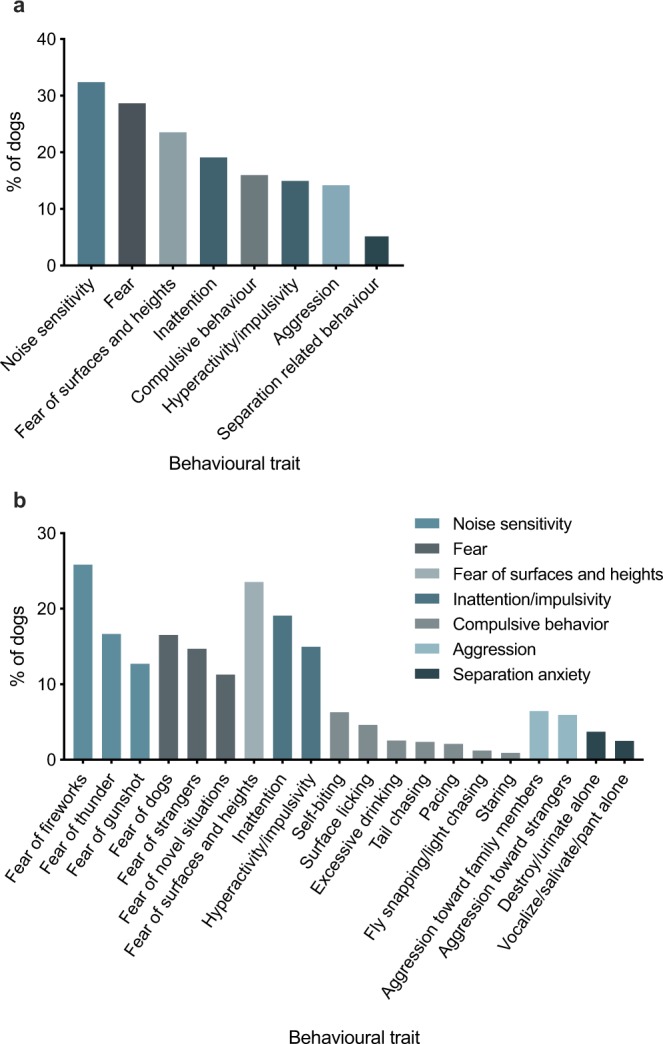
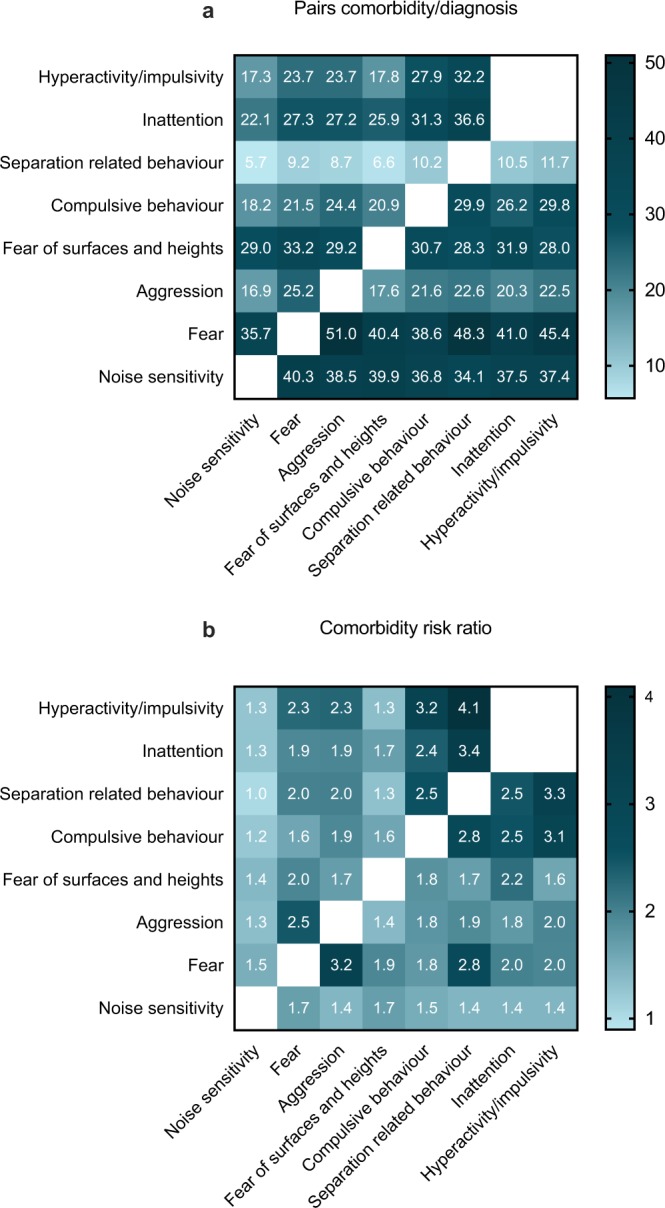
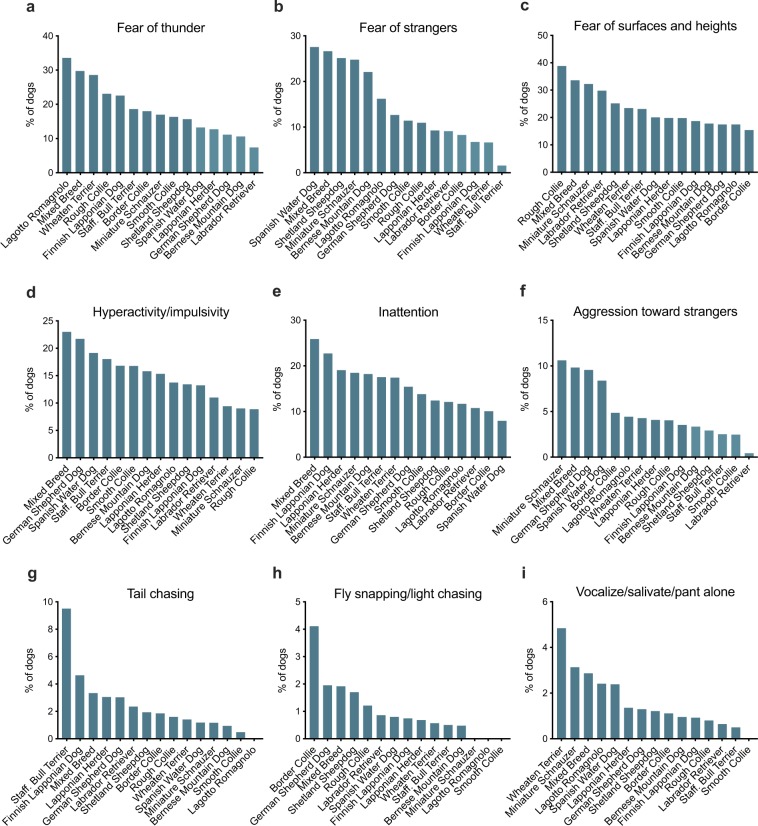
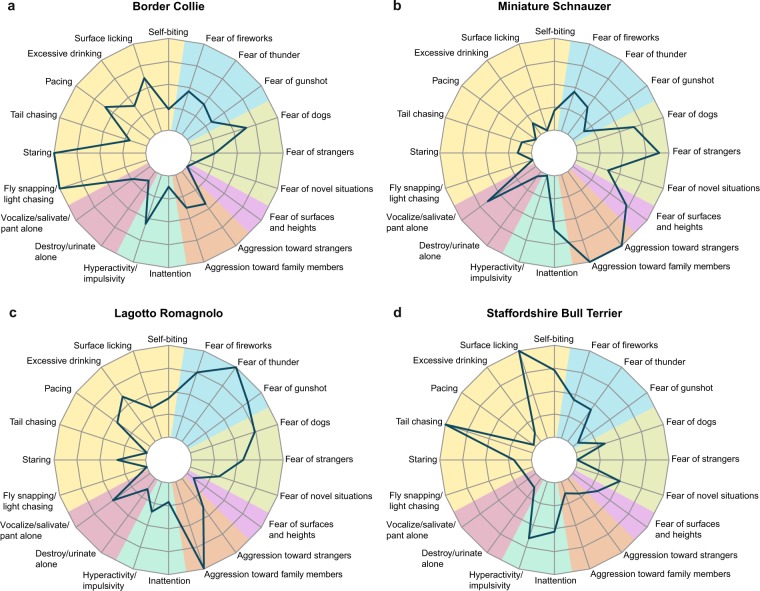
Behaviour problems and anxieties in dogs decrease their quality of life and may lead to relinquishment or euthanasia. Considering the large number of pet dogs and the commonness of these problematic behaviours, a better understanding of the epidemiology and related molecular and environmental factors is needed. We have here studied the prevalence, comorbidity, and breed specificity of seven canine anxiety-like traits: noise sensitivity, fearfulness, fear of surfaces and heights, inattention/impulsivity, compulsion, separation related behaviour and aggression with an online behaviour questionnaire answered by dog owners. Our results show that noise sensitivity is the most common anxiety-related trait with a prevalence of 32% in 13,700 Finnish pet dogs. Due to the high prevalence of noise sensitivity and fear, they were the most common comorbidities. However, when comparing the relative risk, the largest risk ratios were seen between hyperactivity/inattention, separation related behaviour and compulsion, and between fear and aggression. Furthermore, dog breeds showed large differences in prevalence of all anxiety-related traits, suggesting a strong genetic contribution. As a result, selective breeding focusing on behaviour may reduce the prevalence of canine anxieties. Anxious animals may suffer from chronic stress and thus, modified breeding policies could improve the welfare of our companion dogs.
Overview
The claims and statistics of this paper haven’t been checked yet.
Run the check — free, no account needed. It reads the open-access text and checks the sources it cites.
Integrity signals
Registry
Cites
Statistics
Figures
Verification
Claims the paper makes
The claims and statistics of this paper haven’t been checked yet.
Run the check — free, no account needed. It reads the open-access text and checks the sources it cites.
Claims other papers make about this one
Each is checked against this paper’s own text: does it say what the citing paper says it does?
The source backs part of the claim, not all of it — or backs it for a different population, condition or comparison.
In the citing paper
“Smaller dogs have been shown to be more prone to aggression, as well as other undesirable behaviours such as fear [142,155,156,157,158,159,160,161].”
From Ethical Concerns about Fashionable Dog Breeding (2024) · cites this paper as [142]
Experimental — accuracy not yet measuredThe source backs part of the claim, not all of it — or backs it for a different population, condition or comparison.
In the citing paper
“As the breeding of dogs can have an impact on their mental health, certain breeds may be more susceptible to issues such as fear of other dogs, separation anxiety [142], and sensitivity to touch.”
From Ethical Concerns about Fashionable Dog Breeding (2024) · cites this paper as [142]
Experimental — accuracy not yet measuredThe cited source says what the claim attributes to it.
In the citing paper
“The observed behavioural differences suggest that dog breeds have diverged not only morphologically and genetically but also behaviourally [142].”
From Ethical Concerns about Fashionable Dog Breeding (2024) · cites this paper as [142]
Self-check
Percentages, sums and reported differences re-computed from the paper’s own numbers.
The self-check needs the paper’s full text.
Citations
Cites
Impulsivity, compulsivity, and top-down cognitive control
Dalley, J. W., Everitt, B. J., & Robbins, T. W. (2011) · Neuron · doi:10.1016/j.neuron.2011.01.020 · Cited by 1,589
Hsu, Y., & Serpell, J. A. (2003) · Journal of the American Veterinary Medical Association · doi:10.2460/javma.2003.223.1293 · Cited by 709
Risk factors for relinquishment of dogs to an animal shelter
Patronek, G. J., Glickman, L. T., Beck, A. M., McCabe, G. P., & Ecker, C. (1996) · Journal of the American Veterinary Medical Association · doi:10.2460/javma.1996.209.03.572 · Cited by 514
Longevity and mortality of owned dogs in England
O'Neill, D. G., Church, D. B., McGreevy, P. D., Thomson, P. C., & Brodbelt, D. C. (2013) · The Veterinary Journal · doi:10.1016/j.tvjl.2013.09.020 · Cited by 352
Bennett, P. C., & Rohlf, V. (2006) · Applied Animal Behaviour Science · doi:10.1016/j.applanim.2006.03.009 · Cited by 351
Breed differences in canine aggression
Duffy, D. L., Hsu, Y., & Serpell, J. A. (2008) · Applied Animal Behaviour Science · doi:10.1016/j.applanim.2008.04.006 · Cited by 334
New, J. C., Salman, M. D., King, M., Scarlett, J. M., Kass, P. H., & Hutchison, J. M. (2000) · Journal of Applied Animal Welfare Science · doi:10.1207/s15327604jaws0303_1 · Cited by 324
Canine Anxieties and Phobias: An Update on Separation Anxiety and Noise Aversions
Sherman, B. L., & Mills, D. S. (2008) · Veterinary Clinics of North America Small Animal Practice · doi:10.1016/j.cvsm.2008.04.012 · Cited by 279
Gosling, S. D., Kwan, V. S. Y., & John, O. P. (2003) · Journal of Personality and Social Psychology · doi:10.1037/0022-3514.85.6.1161 · Cited by 273
Dog and owner demographic characteristics and dog personality trait associations
Kubinyi, E., Turcsán, B., & Miklósi, Á. (2009) · Behavioural Processes · doi:10.1016/j.beproc.2009.04.004 · Cited by 262
Cited by
Sorted by citations
Items 101–182 of 182
Genomic analysis of firework fear and noise reactivity in standard poodles
Handegård, K. W., Storengen, L. M., Joergensen, D., & Lingaas, F. (2023) · Canine Medicine and Genetics · doi:10.1186/s40575-023-00125-0 · Cited by 3
Paws, Trends, and Family Bonds: The Dog Keeping Cultural Runaway TheoryPreprint
Enikö Kubinyi, B. (2023) · doi:10.31234/osf.io/z8cxf · Cited by 3
Constructing the first comorbidity networks in companion dogs in the Dog Aging ProjectPreprint
Fang, A., Kumar, L., Creevy, K. E., Promislow, D., & Ma, J. (2024) · bioRxiv (Cold Spring Harbor Laboratory) · doi:10.1101/2024.12.18.629088 · Cited by 3
A Systematic Review of the Efficacy of Compression Wraps as an Anxiolytic in Domesticated Dogs
Mathis, S., Schoolfield, S., Gross, M., Gruen, M. E., & Dorman, D. C. (2024) · Animals · doi:10.3390/ani14233445 · Cited by 2
Owner-Perceived Undesirable Behaviours in Young Dogs and Changes with Age
Kinsman, R., Casey, R. A., Tasker, S., Cooper, B., Giragosian, K., Harvey, N. D., Owczarczak‐Garstecka, S. C., Samet, L. E., & Murray, J. (2025) · Animals · doi:10.3390/ani15081163 · Cited by 3
Nicolas, C. S., Espuña, G., Girardin, A., Fatjó, J., Bowen, J., & Monginoux, P. (2022) · Animals · doi:10.3390/ani12010122 · Cited by 2
Urinary neurotransmitter analysis and canine behavior assessment
Schmidt, T., Meller, S., Talbot, S. R., Packer, R. M. A., & Volk, H. A. (2023) · Frontiers in Veterinary Science · doi:10.3389/fvets.2023.1124231 · Cited by 2
Collins, K. A., Miller, K. A., Eagan, B. H., Patterson-Kane, E. G., Rehner‐Fleurant, T., Cussen, V. A., & Reid, P. (2025) · Applied Animal Behaviour Science · doi:10.1016/j.applanim.2025.106743 · Cited by 2
de Souza, M. C., Bastos, G. Q., Gomes, C. M. S., & Tokumaru, R. S. (2025) · Behavioural Processes · doi:10.1016/j.beproc.2025.105241 · Cited by 3
McGuire, B., & Jean-Baptiste, K. (2023) · Journal of Veterinary Behavior · doi:10.1016/j.jveb.2023.06.007 · Cited by 3
Effectiveness of Integrated Medical Treatment for Thunderstorm Aversion: A Case Series of 23 Dogs
McDowell, C., & Shiau, D. (2022) · American Journal of Traditional Chinese Veterinary Medicine · doi:10.59565/001c.83388 · Cited by 2
Can we treat and manage animals in our care and not scare them?
Overall, K. L. (2020) · Journal of Veterinary Behavior · doi:10.1016/j.jveb.2020.09.001 · Cited by 2
Normando, S., Filugelli, L., Contiero, B., Schrank, M., Mutinelli, F., Zanetti, R., & Contalbrigo, L. (2023) · Journal of Veterinary Behavior · doi:10.1016/j.jveb.2023.09.002 · Cited by 1
All body systems affect behavior
Gerken, A. (2024) · Elsevier eBooks · doi:10.1016/b978-0-7020-8214-6.00015-2 · Cited by 2
Firework aversion in cats and dogs as reported by Dutch animal owners
van Herwijnen, I. R., Vinke, C. M., Arndt, S. S., & Roulaux, P. E. M. (2024) · Veterinary and Animal Science · doi:10.1016/j.vas.2024.100402 · Cited by 1
The Puppies’ Age at Adoption Time Influences the Behavioral Responses of Adult Dog
Cocco, R., Arfuso, F., Sechi, S., Piccione, G. G., Giannetto, C., Arrigo, F., & Rizzo, M. (2025) · Veterinary Sciences · doi:10.3390/vetsci12020176 · Cited by 2
Xu, K., Yan, J., Wang, M., Zhang, S., & Lin, S. (2025) · Applied Animal Behaviour Science · doi:10.1016/j.applanim.2025.106602 · Cited by 2
Dale, F. C., Casey, R. A., & Burn, C. C. (2025) · Journal of Veterinary Behavior · doi:10.1016/j.jveb.2025.11.002 · Cited by 1
Excessive energy in dogs: The impact of caregiver-related variables and fear/anxiety
Batista, M. T., Lavrador, C., & Pereira, G. G. (2025) · Applied Animal Behaviour Science · doi:10.1016/j.applanim.2025.106900 · Cited by 1
Hernández‐Álvarez, E., Canino-Quijada, C., Roiz, S., Luzardo, O. P., & Henríquez‐Hernández, L. A. (2026) · Veterinary Sciences · doi:10.3390/vetsci13010096 · Cited by 1
Almquist, E., Meyer, I., Sandøe, P., Thomassen, K. M., Newberry, R. C., & Rehn, T. (2026) · Scientific Reports · doi:10.1038/s41598-026-36791-w · Cited by 1
Predictors of fear and anxiety in companion dogs: The role of caregiver-related variables
Batista, M. T., Lavrador, C., & da Graça‐Pereira, G. (2026) · Journal of Veterinary Behavior · doi:10.1016/j.jveb.2026.02.003 · Cited by 1
Dogs’ Behavioural Responses to Dog-Assisted Interventions: A Field Study
Haven-Pross, S. C., Jens, A. L., Maarleveld, K. N., van Honk, P., de Kort, M., & Visser, E. K. (2026) · Animals · doi:10.3390/ani16071063 · Cited by 1
Yan, H., Zhang, M., Gui, C., Huang, H., Wu, W., Chen, Z., Wu, Y., Chen, S., Huang, H., Lin, H., et al. (2026) · Microorganisms · doi:10.3390/microorganisms14040940 · Cited by 1
Tananaeva, A., & Udell, M. A. R. (2026) · Biological reviews/Biological reviews of the Cambridge Philosophical Society · doi:10.1002/brv.70179 · Cited by 1
Anxiety reactions in companion dogs exposed to noise associated with warfare in Ukraine
Zaborski, D., Kavetska, K. M., Grzesiak, W., Tokareva, V., & Wypych, A. (2026) · Journal of Veterinary Behavior · doi:10.1016/j.jveb.2026.08.001 · Cited by 1
Fatjó, J., Bowen, J., & Calvo, P. (2021) · Springer eBooks · doi:10.1007/978-3-030-69587-3_5 · Cited by 2
Wong, C. F., & Govendir, M. (2021) · Veterinary Evidence · doi:10.18849/ve.v6i4.421 · Cited by 1
Puppies in the problem-solving paradigm: quick males and social females
Pinelli, C., Scandurra, A., Lucrezia, A. D., Aria, M., Semin, G. R., & D’Aniello, B. (2022) · Animal Cognition · doi:10.1007/s10071-022-01714-5 · Cited by 1
Noise reactivity and firework fear in dogs
Handegård, K. W. (2023) · Companion animal · doi:10.12968/coan.2023.0041 · Cited by 1
Factors influencing the development of canine fear of thunder
Okamoto, K., Inoue, K., Kawai, J., Yamauchi, H., Hisamoto, S., Nishisue, K., Koyama, S., Satoh, T., Tsushima, M., & Irimajiri, M. (2024) · Applied Animal Behaviour Science · doi:10.1016/j.applanim.2023.106139 · Cited by 1
Perros y Humanos: una conjunta construcción emocional de la cotidianeidad
Martín, P. T. (2021) · Nuevo mundo mundos nuevos · doi:10.4000/nuevomundo.85298 · Cited by 1
McGuire, B., & Jean-Baptiste, K. (2022) · Journal of Veterinary Behavior · doi:10.1016/j.jveb.2022.11.005 · Cited by 2
RetractedDog-directed parenting styles : The role of parenting styles in the owner-dog relationship
van Herwijnen, I. R. (2020) · doi:10.18174/521648 · Cited by 1
Behavioral genetics of dog breeds
Alvarez, C. E., van Rooy, D., & Wade, C. M. (2025) · Elsevier eBooks · doi:10.1016/b978-0-443-29068-8.00145-8 · Cited by 1
Data-driven approaches to clinical veterinary behavioral medicine
Overall, K. L. (2020) · Journal of Veterinary Behavior · doi:10.1016/j.jveb.2020.05.015
Only when you measure suffering can you fix it
Overall, K. L. (2021) · Journal of Veterinary Behavior · doi:10.1016/j.jveb.2021.09.005
Chapouthier, G. (2020) · Cerveau & Psycho · doi:10.3917/cerpsy.122.0026
Prevalence and circumstances of dog bites in Poland – a longitudinal studyPreprint
Wierzbowska, I. A., Hędrzak, M., Tallian, A. G., & Basak, S. M. (2022) · Research Square · doi:10.21203/rs.3.rs-1897249/v1 · Cited by 1
АКТУАЛЬНЫЕ ВОПРОСЫ РАЗВИТИЯ СОВРЕМЕННОЙ НАУКИ И ТЕХНОЛОГИЙ
Химки), Ф. Н. «. Ф. Р. (., Гладких, В. Д., Ешиев, А. М., больница, О. М. О. К., Терновых, Т. В., ФГБОУ ВО «Орловский государственный университет им. И.С. Тургенева, М. И., Бочкарёв, А. Б., ФГБОУ ВО «Орловский государственный университет им. И.С. Тургенева, М. И., Мошкин, А. С., ФГБОУ ВО «Орловский государственный университет им. И.С. Тургенева, М. И., et al. (2023) · ICSP «NEW SCIENCE» eBooks · doi:10.46916/28042023-1-978-5-00174-955-4
АГРЕССИВНОСТЬ ДОМАШНИХ СОБАК: МНЕНИЕ ВЛАДЕЛЬЦА
Скрябина, К. К. П. М. Г. А. В. М. И. Б. И. К. И., Гриценко, В. В., Карапетьянц, К. Г., & Научно-исследовательский центр по проблемам кинологии, Р. «. Х. В. (2023) · ICSP «NEW SCIENCE» eBooks · doi:10.46916/28042023-3-978-5-00174-955-4
Compulsive behavioral disorders in dogs and their correction
Emelyanenko, A., Yemelyanenko, O., Kozіy, V., Poroshynska, O. A., Стовбецька, Л. С., Shmayun, S., & Sadovnik, J. (2023) · Bulletin Veterinary biotechnology · doi:10.31073/vet_biotech42-03
Aggression and Breed Differences
Ha, J. C., Brad, T. L., & Ha, J. C. (2024) · CABI eBooks · doi:10.1079/9781800624566.0009
Owner-Dog Interaction is Essential to Prevent Canine Separation-Related Behaviors in ThailandPreprint
Sungkatavat, P., Boonhoh, W., Waran, N. K., & Wongtawan, T. (2024) · SSRN Electronic Journal · doi:10.2139/ssrn.4886694
Canine Genetics and Epidemiology of Behavior in Dogs
Amfim, A., Bercea, L. C., & Cucu, N. (2024) · Veterinary medicine and science · doi:10.5772/intechopen.1006724
Diederich, C. (2024) · Veterinární Medicína · doi:10.17221/62/2024-vetmed
Dale, F. C., Casey, R. A., & Burn, C. C. (2025) · SSRN Electronic Journal · doi:10.2139/ssrn.5222143
Development of a questionnaire for early detection of behavioural disorders in dogs
Richard, O., Gaultier, E., & Lesueur, J. (2025) · Journal of Veterinary Behavior · doi:10.1016/j.jveb.2025.05.001
Psychological Resilience in Animals – Focus on Dogs
Tiira, K. (2025) · CABI eBooks · doi:10.1079/9781800624313.0013
Self-citationCovid-19 pandemic: Effect of changes in the owner’s life on dog behavior
Takahashi, S., Imai, Y., Okamoto, K., Nishisue, K., Koyama, S., Satoh, T., Tsushima, M., & Irimajiri, M. (2025) · Journal of Veterinary Behavior · doi:10.1016/j.jveb.2025.07.005
Dawson, J. K., Howell, T. J., Ruby, M. B., & Bennett, P. C. (2025) · Anthrozoös · doi:10.1080/08927936.2025.2544419
The impact of anxiety on canine heart function: a study using echocardiographic techniques
Soghyani, D., Arfaee, F., Molazem, M., Soflaei, R., & Abdous, A. (2025) · BMC Veterinary Research · doi:10.1186/s12917-025-05074-3
Fomina, A. S., Vasiliev, P. V., Krikunova, A. A., & Ermakov, A. M. (2025) · Agrarian science · doi:10.32634/0869-8155-2025-399-10-58-70
Additional file 2 of Genomic analysis of firework fear and noise reactivity in standard poodles
Handegård, K. W., Storengen, L. M., Joergensen, D., & Lingaas, F. (2023) · Figshare · doi:10.6084/m9.figshare.22624619
Weir, L. (2025) · SSRN Electronic Journal · doi:10.2139/ssrn.5101901
Additional file 1 of Genomic analysis of firework fear and noise reactivity in standard poodles
Handegård, K. W., Storengen, L. M., Joergensen, D., & Lingaas, F. (2023) · Figshare · doi:10.6084/m9.figshare.22624616
Alvarenga, I. C., Hess, H., Fagen, A., Feldman, A., Wilson, K., Wernimont, S. M., & McGrath, S. (2026) · Journal of Veterinary Behavior · doi:10.1016/j.jveb.2025.12.012
Troubles compulsifs chez le chien
Bowen, J., & Fatjó, J. (2026) · EMC - Vétérinaire · doi:10.1016/s1283-0828(25)51250-4
Phenome-wide study connects behavioral genetics of odor detection dogs with temperament traits
Eyre, A. W., Zapata, I., Fraire, J., Coty, K. D., Huson, H. J., Evans, K. M., Otto, C. M., Serpell, J. A., van Rooy, D., Wade, C. M., et al. (2026) · Scientific Reports · doi:10.1038/s41598-026-42708-4
FEATURES OF EARLY SOCIALIZATION IN DOGS
Sakhatskyi, M. I., & VOYNICH, V. (2026) · The Scientific and Technical Bulletin of the Institute of Animal Science NAAS of Ukraine · doi:10.32900/2312-8402-2026-136-156-172
Kaeoket, K., Waran, N. K., & Boonhoh, W. (2026) · SSRN Electronic Journal · doi:10.2139/ssrn.6578000
Owner-reported prevalence and severity of fear and anxiety in dogs
Beaver, B. V. (2026) · Veterinary Research Communications · doi:10.1007/s11259-026-11227-y
Bremhorst, A., & Loftus, L. (2026) · Animal Behaviour and Welfare Cases · doi:10.1079/abwcases.2026.0004
Beyond impulsivity: Exploring mechanisms that may influence inhibitory control measures
Montgomery, L. I., Collins-Pisano, C., Smith, J. G., Busby, K., Katz, J. S., & Krichbaum, S. (2026) · Applied Animal Behaviour Science · doi:10.1016/j.applanim.2026.107098
Eckhardt, E. R. M., Andreu‐Sánchez, S., Cereghetti, D. M., Tamási, B., Boucard, A.-S., Landsberg, G., Kelly, S., Milanese, A., Klein, B. A., Pagani, E., et al. (2026) · Research Square · doi:10.21203/rs.3.rs-10040780/v1
Bellini, V., Stagi, G., Gazzano, V., Cordon, R., Gazzano, A., Cecchi, F., Curadi, M. C., & Ogi, A. (2026) · Animals · doi:10.3390/ani16131976
Taurine in canine physiology and metabolic regulation
Wang, P., Yang, M., Yang, Y., Xiu, F., Liu, C., & Zhou, S. (2026) · Frontiers in Veterinary Science · doi:10.3389/fvets.2026.1812065
How questions on dog behavioural problems may shape caretaker answers
Normando, S., Canori, C., Borlini, M., Zanetti, R., Walsh, E. A., Meers, L. L., & Contalbrigo, L. (2026) · Applied Animal Behaviour Science · doi:10.1016/j.applanim.2026.107134
Seymour, R., Caddiell, R. M. P., Cunningham, R., Pachel, C., Love, K. R., Lascelles, B. D. X., & Gruen, M. E. (2026) · Australian Veterinary Journal · doi:10.1111/avj.70127
Wongtawan, T., Waran, N. K., & Boonhoh, W. (2026) · Applied Animal Behaviour Science · doi:10.1016/j.applanim.2026.107150
Olsen, C., Johnson, A., Binder, A. J., & Winkle, M. (2026) · Human-Animal Interactions · doi:10.1079/hai.2026.0040
Investigating targeted and untargeted approaches to biomarker discovery in fearful, adult dogs
Burron, S., Croney, C., Seymour, D. J., Strassburger, R., Cottee, S., Harlander-Matauschek, A., & Shoveller, A. K. K. (2026) · Journal of Animal Science · doi:10.1093/jas/skag260
Targeted lipidomics showed altered serum phosphatidylcholine levels in fearful dogs
Sacchettino, L., Costanzo, M., Bianco, S., Veneruso, I., D’Argenio, V., Giuliano, V. O., Lombardi, P., Napolitano, F., & d’Angelo, D. (2026) · PLoS ONE · doi:10.1371/journal.pone.0356063
Behavioral Signs of Inflammatory Disease in Dogs and Cats
Shih, H., & Siracusa, C. (2026) · Advances in Small Animal Care · doi:10.1016/j.yasa.2026.08.001
Kotianová, L., Janíková, B., Koláčková, J., Hesová, R., Alvarez, O. E. H., Večerek, V., & Voslářová, E. (2026) · Applied Animal Behaviour Science · doi:10.1016/j.applanim.2026.107177
Wang, H., Wang, W., Chen, Q., Ma, M., Zhang, Y., Zhu, S., Wang, R., Zhu, Y., & Xiong, W. (2026) · Animals · doi:10.3390/ani16182961
Comorbidities Among Canine Behavioral Disorders and Their Relationship With Caregiver Mental Health
Batista, M. T., Lavrador, C., & da Graça‐Pereira, G. (2026) · Anthrozoös · doi:10.1080/08927936.2026.2724666
Kotianová, L., Janíková, B., Koláčková, J., Hesová, R., Kryštofová, L., Večerek, V., & Voslářová, E. (2026) · Acta Veterinaria Brno · doi:10.2754/avb202695030273
Kristensen, S. S.-R., Almquist, E., Eskeland, G. E., Meyer, I., Newberry, R. C., Rehn, T., Thomassen, K. M., Lund, T. B., & Sandøe, P. (2026) · Journal of Veterinary Behavior · doi:10.1016/j.jveb.2026.10.004
Storz, S., & Schöning, B. (2026) · Journal of Veterinary Behavior · doi:10.1016/j.jveb.2026.10.002
Metadata
- Authors
- Salonen, M., Sulkama, S., Mikkola, S., Puurunen, J., Hakanen, E., Tiira, K., Araujo, C., & Lohi, H.
- Affiliations
- University of Helsinki (FI)
- Corresponding author
- Lohi, Hannes
- ORCID
- Venue
- Scientific Reports
- Published
- 2020-03-05
- Volume
- 10
- Issue
- 1
- Pages
- 2962-2962
- ISSN
- 2045-2322 (ISSN-L)
- PMC
- PMC7058607
- OpenAlex
- W3009145783
- Cited by
- 182
- References
- 65
- Citations by year
- 2026: 33 · 2025: 34 · 2024: 27 · 2023: 26 · 2022: 25 · 2021: 27 · 2020: 10
- FWCI
- 12.90
- Type
- journal article
- Language
- en
- Open access
- gold
- doi.org
- Locations
- Scientific Reports (publishedVersion, cc-by)
- PubMed Central (publishedVersion, cc-by)
- PubMed (publishedVersion)
- Työväentutkimus Vuosikirja (submittedVersion)
- Funders
- Academy of Finland (308887)
- Jane ja Aatos Erkon Säätiö
- Topics
- Life Sciences › Agricultural and Biological Sciences › Animal Science and Zoology › Human-Animal Interaction Studies
- Life Sciences › Agricultural and Biological Sciences › Animal Science and Zoology › Animal Behavior and Welfare Studies
- Health Sciences › Veterinary › Small Animals › Veterinary Orthopedics and Neurology
- Keywords
- canine anxiety, noise sensitivity, fearfulness, compulsive behavior, canine aggression, breed differences, comorbidities, prevalence, selective breeding, dog welfare
- MeSH terms
- Aggression, Animals, Anxiety Disorders, Behavior, Animal, Human-Animal Bond, Compulsive Behavior, Dog Diseases, Dogs, Fear, Female, Finland, Humans, Impulsive Behavior, Male, Quality of Life, Surveys and Questionnaires, Species Specificity, Comorbidity, Prevalence, Pets
About these checks
Registry, retraction, Cites and statistics results are computed, not judged, with one exception: a printed reference that no index lists is read once by a model before it counts as a citation error. Claims are extracted by a model and kept only when their quote appears verbatim in the text; each cited source is then checked, with a model’s help, for whether it says what the claim relies on. Those verdicts can be wrong — read the claim’s quote and the cited source before relying on one.
Statistics and arithmetic are recomputed, not judged.
Confidence bands are shown only for fields calibrated on our annotated test set. None is calibrated yet, so no band is shown.
What counts as a claim ›How we measure confidence ›How we check this ›
Are you an author, or do you see a problem with this page? Request a review
