

Large-scale assessment of human navigation ability across the lifespan
Open accessThe DOI matches its Crossref record; 45 of the 45 references it cites were found in a registry or an index.
Abstract
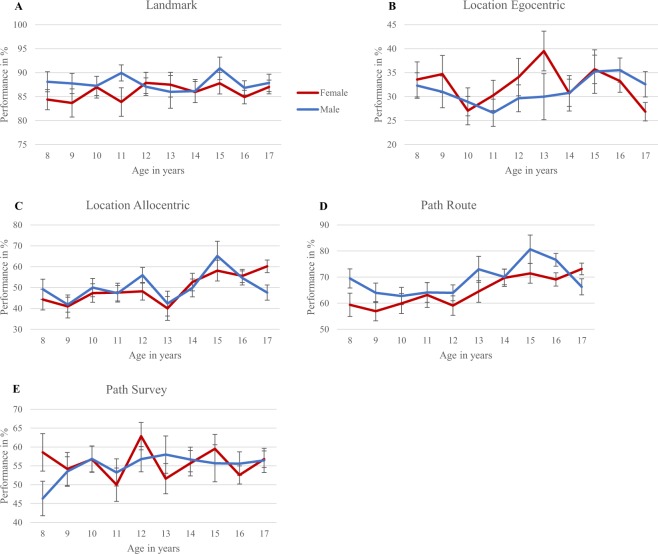
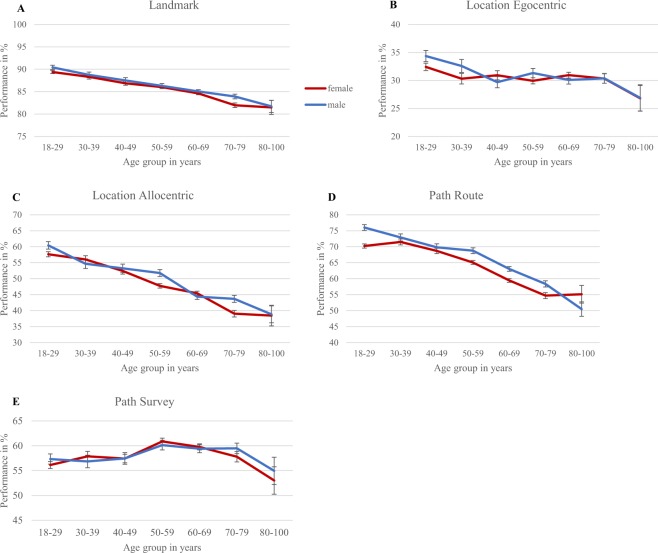
Navigation ability is particularly sensitive to aging. Evidence of aging patterns is largely restricted to comparing young adults and elderly and limited in the variety of navigation tasks used. Therefore, we designed a novel task battery to assess navigation ability in a very large, representative sample (N = 11,887, 8–100 years). The main aim was to measure navigation ability across the lifespan in a brief, yet comprehensive manner. Tasks included landmark knowledge, egocentric and allocentric location knowledge, and path knowledge for a route and survey perspective. Additionally, factors that potentially contribute to navigation ability were considered; gender, spatial experience and spatial anxiety. Increase in performance with age in children was found for allocentric location knowledge and for route-based path knowledge. Age related decline was found for all five tasks, each with clearly discernible aging patterns, substantiated the claim that each task distinctively contributes to the assessment of navigation ability. This study provides an in depth examination of navigation ability across dissociable functional domains and describes cognitive changes across the lifespan. The outcome supports the use of this task battery for brief assessment of navigation for experimental and clinical purposes.
Overview
The claims and statistics of this paper haven’t been checked yet.
Free: it reads the open-access text and checks the first 5 claims that cite a source we can check. Create a free account to check every claim.
Integrity signals
Registry
Cites
Statistics
Figures
Verification
Claims the paper makes
The claims and statistics of this paper haven’t been checked yet.
Free: it reads the open-access text and checks the first 5 claims that cite a source we can check. Create a free account to check every claim.
Claims other papers make about this one
Each is checked against this paper’s own text: does it say what the citing paper says it does?
The source backs part of the claim, not all of it — or backs it for a different population, condition or comparison.
In the citing paper
“People who can readily associate map information with egocentric views might derive more benefit from combining map viewing with navigation (Ishikawa & Montello, 2006; Van der Ham et al., 2020).”
From Does viewing a top-down map facilitate spatial learning from navigation in a virtual environment? (2026) · cites this paper as Van der Ham et al., 2020
Experimental — accuracy not yet measured
Self-check
Percentages, sums and reported differences re-computed from the paper’s own numbers.
The self-check needs the paper’s full text.
Citations
Cites
Navigation-related structural change in the hippocampi of taxi drivers
Maguire, E. A., Gadian, D. G., Johnsrude, I. S., Good, C. D., Ashburner, J., Frackowiak, R. S. J., & Frith, C. D. (2000) · Proceedings of the National Academy of Sciences · doi:10.1073/pnas.070039597 · Cited by 3,225
The human hippocampus and spatial and episodic memory
Burgess, N., Maguire, E. A., & O'Keefe, J. (2002) · Neuron · doi:10.1016/s0896-6273(02)00830-9 · Cited by 2,401
Memory deficits associated with senescence: A neurophysiological and behavioral study in the rat.
Barnes, C. A. (1979) · Journal of Comparative and Physiological Psychology · doi:10.1037/h0077579 · Cited by 2,088
The Development of Spatial Representations of Large-Scale Environments
Siegel, A. W., & White, S. H. (1975) · Advances in Child Development and Behavior · doi:10.1016/s0065-2407(08)60007-5 · Cited by 1,830
Parahippocampal and retrosplenial contributions to human spatial navigation
Epstein, R. A. (2008) · Trends in Cognitive Sciences · doi:10.1016/j.tics.2008.07.004 · Cited by 928
London taxi drivers and bus drivers: A structural MRI and neuropsychological analysis
Maguire, E. A., Woollett, K., & Spiers, H. J. (2006) · Hippocampus · doi:10.1002/hipo.20233 · Cited by 918
Hegarty, M., Montello, D. R., Richardson, A. E., Ishikawa, T., & Lovelace, K. (2006) · Intelligence · doi:10.1016/j.intell.2005.09.005 · Cited by 820
What determines our navigational abilities?
Wolbers, T., & Hegarty, M. (2010) · Trends in Cognitive Sciences · doi:10.1016/j.tics.2010.01.001 · Cited by 810
Topographical disorientation: a synthesis and taxonomy
Aguirre, G. K. (1999) · Brain · doi:10.1093/brain/122.9.1613 · Cited by 772
Grön, G., Wunderlich, A. P., Spitzer, M., Tomczak, R., & Riepe, M. W. (2000) · Nature Neuroscience · doi:10.1038/73980 · Cited by 685
Cited by
Vector-based pedestrian navigation in cities
Bongiorno, C., Zhou, Y., Kryven, M., Theurel, D., Rizzo, A., Santi, P., Tenenbaum, J., & Ratti, C. (2021) · Nature Computational Science · doi:10.1038/s43588-021-00130-y · Cited by 90
Robot navigation as hierarchical active inference
Çatal, O., Verbelen, T., de Maele, T. V., Dhoedt, B., & Safron, A. (2021) · Neural Networks · doi:10.1016/j.neunet.2021.05.010 · Cited by 99
How Can We Best Assess Spatial Skills? Practical and Conceptual Challenges
Uttal, D. H., McKee, K., Simms, N. K., Hegarty, M., & Newcombe, N. S. (2024) · Journal of Intelligence · doi:10.3390/jintelligence12010008 · Cited by 81
“An additional test is available, but access to collected data requires contacting the authors of the system (van der Ham et al. 2020).”
BackgroundQuality of self-reported cognition: effects of age and gender on spatial navigation self-reports
van der Ham, I. J. M., van der Kuil, M. N. A., & Claessen, M. H. G. (2020) · Aging & Mental Health · doi:10.1080/13607863.2020.1742658 · Cited by 52
“As reported in a related study, a clear age related decline was found for navigation ability overall (Van der Ham et al., 2020), which is in line with other large scale reports on the impact of age on spatial cognition (Coutrot et al., 2018; Head & Isom, 2010; Moffat, 2009).”
BackgroundResultSelf-citationLandmark-based spatial navigation across the human lifespan
Bécu, M., Sheynikhovich, D., Ramanoël, S., Tatur, G., Ozier‐Lafontaine, A., Authié, C., Sahel, J., & Arleo, A. (2023) · eLife · doi:10.7554/elife.81318 · Cited by 45
“…( Colombo et al., 2017 ; Wiener et al., 2013 ; Davis and Weisbeck, 2015 ; Driscoll et al., 2005 ; Rodgers et al., 2012 ; Bohbot et al., 2012 ; van der Ham et al., 2020 ; Newcombe, 2019 ; Nardini et al., 2006 ; Bullens et al., 2010 ), can rather be ascribed to an difficulty in using a…”
Muffato, V., Simonetto, A., Pellegrini, M., Tortora, C., & Meneghetti, C. (2022) · Journal of Environmental Psychology · doi:10.1016/j.jenvp.2022.101820 · Cited by 26
Zhou, R., Bernard, T. B., & Wolbers, T. (2022) · Topics in Cognitive Science · doi:10.1111/tops.12608 · Cited by 29
Colombo, G., Minta, K., Grübel, J., Tai, W. L. E., Hölscher, C., & Schinazi, V. R. (2024) · Computers in Human Behavior · doi:10.1016/j.chb.2024.108349 · Cited by 26
Lancia, G. L., Eluchans, M., D’Alessandro, M., Spiers, H. J., & Pezzulo, G. (2023) · PLoS Computational Biology · doi:10.1371/journal.pcbi.1010829 · Cited by 33
Redesigning navigational aids using virtual global landmarks to improve spatial knowledge retrieval
Liu, J., Singh, A. K., Wunderlich, A., Gramann, K., & Lin, C. (2022) · npj Science of Learning · doi:10.1038/s41539-022-00132-z · Cited by 29
“A recent study on aging highlights decreased navigation abilities in elderly populations 4 and in individuals with both early-stage symptomatic Alzheimer ’ s disease and with preclinical Alzheimer ’ s disease displaying navigational de fi cits 12 – 14 .”
BackgroundGlöckner, F., Schuck, N. W., & Li, S. (2021) · Scientific Reports · doi:10.1038/s41598-021-94530-9 · Cited by 15
Rekers, S., & Finke, C. (2023) · Behavior Research Methods · doi:10.3758/s13428-023-02134-0 · Cited by 24
“While there were no systematic age differences between men and women in this study, the effect could be masked by a decrease of gender difference in spatial abilities with age (Jansen & Heil, 2009) and stronger aging effects of route navigation in men than in women (van der Ham et al., 2020).”
BackgroundResearch status of visuospatial dysfunction and spatial navigation
Bao, R., Chang, S., Liu, R., Wang, Y., & Guan, Y. (2025) · Frontiers in Aging Neuroscience · doi:10.3389/fnagi.2025.1609620 · Cited by 16
“Van Der Ham et al. (2020) adopted a distinct methodological approach by designing a passive observational spatial task.”
Nossa, R., Gagliardi, C., Panzeri, D., Diella, E., Maghini, C., Genova, C., Turconi, A. C., & Biffi, E. (2022) · Journal of Clinical Medicine · doi:10.3390/jcm11206146 · Cited by 18
“Several factors influence navigation skills, among which the maturation of sensory and motor systems combined with the environmental feedback, experience-expectant ways, action in the world, and success–failure feedback [15,22,23].”
BackgroundMuffato, V., Miola, L., Pellegrini, M., Pazzaglia, F., & Meneghetti, C. (2023) · Cognitive Research Principles and Implications · doi:10.1186/s41235-023-00506-w · Cited by 18
“Findings have shown that all types of environmental knowledge decline with age after passively learn from navigation (van der Ham et al., 2020), and particularly when tested in location-allocentric and path-survey modes in real environment learning (i.e. active learning, Muffato et al., 2022).”
BackgroundEffects of older age on visual and self-motion sensory cue integration in navigation
Shayman, C. S., McCracken, M. K., Finney, H. C., Katsanevas, A. M., Fino, P. C., Stefanucci, J. K., & Creem-Regehr, S. H. (2024) · Experimental Brain Research · doi:10.1007/s00221-024-06818-7 · Cited by 16
“Deficits in navigation result in an increased chance of getting lost, an inability to travel independently, and feelings of isolation, making them a significant and pervasive issue for aging adults (van der Ham et al. 2020).”
Learning My Way: A Pilot Study of Navigation Skills in Cerebral Palsy in Immersive Virtual Reality
Biffi, E., Gagliardi, C., Maghini, C., Genova, C., Panzeri, D., Redaelli, D. F., & Turconi, A. C. (2020) · Frontiers in Psychology · doi:10.3389/fpsyg.2020.591296 · Cited by 13
“It includes abilities such as orienting in complex environments, perceiving distance and planning routes to distant locations as well as mentally representing the reciprocal relations of landmarks in space (Lawton, 2010; Wolbers and Hegarty, 2010; van der Ham et al., 2020).”
BackgroundGentle, J., Shakur, A., Ivanova, M., & Gilligan-Lee, K. A. (2024) · Research in Developmental Disabilities · doi:10.1016/j.ridd.2024.104672 · Cited by 16
Muffato, V., Miola, L., Pazzaglia, F., & Meneghetti, C. (2023) · Frontiers in Psychology · doi:10.3389/fpsyg.2023.1240873 · Cited by 11
Navigation ability in patients with acquired brain injury: A population-wide online study
van der Kuil, M. N. A., Visser‐Meily, J. M. A., Evers, A. W. M., & van der Ham, I. J. M. (2021) · Neuropsychological Rehabilitation · doi:10.1080/09602011.2021.1893192 · Cited by 12
Self-citationSpatial navigation performance in people with multiple sclerosis-a large-scale online study
van der Ham, I. J. M., Koutzmpi, V., Milan, N. A. V. D. K., & van der Hiele, K. (2021) · Multiple Sclerosis and Related Disorders · doi:10.1016/j.msard.2021.103423 · Cited by 9
Miola, L., Muffato, V., Pazzaglia, F., & Meneghetti, C. (2023) · Frontiers in Psychology · doi:10.3389/fpsyg.2023.1130549 · Cited by 15
Miola, L., Meneghetti, C., Pazzaglia, F., & van der Ham, I. J. M. (2023) · Learning and Individual Differences · doi:10.1016/j.lindif.2023.102342 · Cited by 9
Colombo, G., & Grübel, J. (2023) · CHI Conference Extended Abstracts on Human Factors in Computing Systems (CHI EA) · doi:10.1145/3544549.3583828 · Cited by 10
A Comparison of the Effects of Older Age on Homing Performance in Real and Virtual Environments
McCracken, M. K., Shayman, C. S., Fino, P. C., Stefanucci, J. K., & Creem-Regehr, S. H. (2025) · IEEE Transactions on Visualization and Computer Graphics · doi:10.1109/tvcg.2025.3549901 · Cited by 9
“Such age-related navigational decline leads to significant impacts on aging adults’ mobility and independence, and consequently the quality of life in older age [34, 61].”
van der Ham, I. J. M., & Claessen, M. H. G. (2022) · Journal of Clinical and Experimental Neuropsychology · doi:10.1080/13803395.2022.2123895 · Cited by 10
“However, Van der Ham et al. (2020) have established that the performance online on the LNT was highly similar to performance in a formal lab setting.”
BackgroundMethodResultSelf-citationStudying the Development of Navigation Using Virtual Environments
Nguyen, K. V., Tansan, M., & Newcombe, N. S. (2022) · Journal of Cognition and Development · doi:10.1080/15248372.2022.2133123 · Cited by 10
“The van der Ham et al. (2020) task can be accessed online; however, contact with the authors is required to access the data.”
BackgroundA longitudinal study on pre-service teachers’ spatial thinking skills and spatial anxiety
ARIKAN, A. (2025) · Thinking Skills and Creativity · doi:10.1016/j.tsc.2025.102101 · Cited by 10
Electrooculography Dataset for Objective Spatial Navigation Assessment in Healthy Participants
Zibandehpoor, M., Alizadehziri, F., Larki, A. A., Teymouri, S., & Delrobaei, M. (2025) · Scientific Data · doi:10.1038/s41597-025-04879-z · Cited by 8
“We hope researchers investigating spatial navigation abilities through EOG signal analysis find this dataset valuable.”
Aly, L. M., Masi, M., Montanaro, M., & Ricciardelli, P. (2024) · Frontiers in Psychology · doi:10.3389/fpsyg.2023.1301981 · Cited by 7
Thayaseelan, K., Zhai, Y., Li, S., & Liu, X. (2024) · Disciplinary and Interdisciplinary Science Education Research · doi:10.1186/s43031-024-00095-8 · Cited by 22
“For example, Nazareth et al. (2019) and van der Ham et al. (2020) assessed spatial thinking in the environmental context.”
BackgroundDeterminants of individual navigation ability
Yavuz, E., & Spiers, H. J. (2026) · Nature Reviews Psychology · doi:10.1038/s44159-026-00544-3 · Cited by 9
Components of navigation ability and their predictors in a community-dwelling sample of older adults
Prevratil, M. J., Kossowska‐Kuhn, D., Gray, N., & Charness, N. H. (2023) · Frontiers in Aging · doi:10.3389/fragi.2023.1239094 · Cited by 10
Learning the layout of different environments: common or dissociated abilities?
Topete, A., He, C., & Hegarty, M. (2025) · Cognitive Research · doi:10.1186/s41235-025-00618-5 · Cited by 6
“…et al., 2017) and Star maze (Rondi-Reig et al., 2006), and faceted navigation tasks (e.g., Iaria et al., 2003, 2007; Malanchini et al., 2020; van der Ham et al., 2020), which examine more outcome measures, including landmark and route knowledge in addition to the outcome measures studied…”
van der Ham, I. J. M., & Claessen, M. H. G. (2025) · Neuropsychology Review · doi:10.1007/s11065-025-09664-8 · Cited by 5
“Analogous to previous work on navigation impairment (Claessen & van der Ham, 2017; van der Ham & Claessen, 2020; van der Ham et al., 2020), five categories were used: landmark knowledge (identifying landmarks or scenes of an environment), egocentric location knowledge (directional coding of…”
Self-citationScene-Intuitive Agent for Remote Embodied Visual GroundingPreprint
Lin, X., Li, G., & Yu, Y. (2021) · arXiv (Cornell University) · doi:10.48550/arxiv.2103.12944 · Cited by 4
“The behavioural research of navigation of human beings has a long history and is still under active research [14, 6, 16, 15, 1, 2, 4].”
BackgroundA strength-based approach to exploring pre-school children’s spatial language and patterning skills
Harris, D., Resnick, I., & Lowrie, T. J. (2025) · Learning and Instruction · doi:10.1016/j.learninstruc.2025.102180 · Cited by 3
Muffato, V., Miola, L., Soltantouyeh, A., Pazzaglia, F., & Meneghetti, C. (2025) · Journal of Environmental Psychology · doi:10.1016/j.jenvp.2025.102734 · Cited by 4
Mobility impairment and fall concern predict wayfinding ability in persons with multiple sclerosis
Chargo, A. N., Takla, T. N., Fritz, N. E., & Daugherty, A. M. (2025) · Multiple Sclerosis and Related Disorders · doi:10.1016/j.msard.2025.106722 · Cited by 4
Using visual scene memory accuracy as a predictor of spatial navigation performance
Lovegrove, R. A., & Baumann, O. (2021) · Applied Cognitive Psychology · doi:10.1002/acp.3876 · Cited by 3
Colombo, G., Minta, K., Thrash, T., Grübel, J., Wiener, J. M., Avraamides, M. N., Taylor, W. R., Hölscher, C., & Schinazi, V. R. (2024) · medRxiv · doi:10.1101/2024.10.12.24315402 · Cited by 3
“Here, researchers have used several spatial tasks to predict MCI and AD with varying degrees of success [47,53–59] but have not systematically investigated the manner in which these spatial tasks can contribute to common cognitive assessments.”
BackgroundAge and Self-Expansion Behaviors Correlate with Spatial Navigation in Healthy Adults
Ansara, M., Duggan, M., Schafer, A., Villalobos, K., Chargo, A. N., Daugherty, A. M., Takla, T. N., & Fritz, N. E. (2025) · Brain Sciences · doi:10.3390/brainsci15091002 · Cited by 2
“SN abilities, including knowledge about landmarks, travel routes, and integration of sensory and spatial information are necessary for efficient navigation and vulnerable to aging [2–5].”
Preserving the ability to discriminate between left and right; A case study
Ruis, C., Robe, P. A. J. T., & Dijkerman, H. C. (2023) · Journal of Neuropsychology · doi:10.1111/jnp.12348 · Cited by 2
van der Ham, I. J. M., & Claessen, M. H. G. (2025) · Neurocase · doi:10.1080/13554794.2024.2442552 · Cited by 2
“As described by van der Kuil et al. (2020) for the Virtual Tübingen task, cut off scores for each of the subtasks have been determined to distinguish between intact and impaired performance.”
InfluentialSelf-citationLiu, J., Zhong, K., & Zhu, L. (2025) · Journal of Environmental Psychology · doi:10.1016/j.jenvp.2025.102661 · Cited by 2
Batts, K., Whitney, S. L., Heiderscheit, B. C., & Grove, C. R. (2025) · Neuropsychologia · doi:10.1016/j.neuropsychologia.2025.109212 · Cited by 3
Rusconi, M. L., Fusi, G., & Crepaldi, M. (2020) · Elsevier eBooks · doi:10.1016/b978-0-12-819641-0.00048-7 · Cited by 2
Bonavita, A., Pepe, S., Nori, R., Palmiero, M., Guariglia, C., & Piccardi, L. (2025) · Brain Sciences · doi:10.3390/brainsci15030318 · Cited by 1
Real-Time Biometric Analysis of Eye Movement Patterns in Human Spatial Navigation
Mirzapour, F., Mirzapour, R., Zibandehpoor, M., & Delrobaei, M. (2025) · International Computer Conference, Computer Society of Iran (CSICC) · doi:10.1109/csicc65765.2025.10967468 · Cited by 1
Individual differences in navigation skill: towards reliable and valid measures
Lader, J., Nguyen, K. V., & Newcombe, N. S. (2025) · Cognitive Research Principles and Implications · doi:10.1186/s41235-025-00642-5 · Cited by 7
“After identifying the best-fitting model, we added age, KBIT-IQ, and gender to create a sixth model since gender is an individual difference often related to navigation performance (e.g., Coutrot et al., 2019; van der Ham et al., 2020).”
A thematic synthesis of the experiences and perceptions of everyday wayfinding
Goldenberg, V., Wiener, J. M., Cox, C., & Hardman, D. I. (2026) · Journal of Environmental Psychology · doi:10.1016/j.jenvp.2026.102928 · Cited by 4
García-Navarra, S., Solares, L., & Mendez, M. (2026) · Behavioural Brain Research · doi:10.1016/j.bbr.2026.116227 · Cited by 2
Colombo, G., Minta, K., Thrash, T., Grübel, J., Wiener, J. M., Avraamides, M. N., Taylor, W. R., Hölscher, C., & Schinazi, V. R. (2026) · Behavior Research Methods · doi:10.3758/s13428-026-02998-y · Cited by 6
“…degrees of success (Berron et al., 2024a; Chan et al., 2016; Coughlan et al., 2019; Hort et al., 2007; Rekers & Finke, 2024; Tu et al., 2015; van der Ham et al., 2020; Wiener et al., 2020) but have not systematically investigated the manner in which these spatial tasks can contribute to…”
Rekers, S., Meyer, T. C., & Finke, C. (2025) · Computers in Human Behavior Reports · doi:10.1016/j.chbr.2025.100730 · Cited by 2
Benefícios da musicalização para pessoas idosas: potencialidades do canto coral
Fagundes, R., Ferreira-Costa, J., da Silva-Ferreira, T., Bartholomeu, D., Zanca, G. G., & Montiel, J. M. (2022) · Percepta - Revista de Cognição Musical · doi:10.34018/2318-891x.9(2)43-57 · Cited by 4
Rossi, C., & Frisiello, A. (2024) · doi:10.1002/9781119741374.ch12 · Cited by 1
Does viewing a top-down map facilitate spatial learning from navigation in a virtual environment?
Ding, J., Chan, H. M., & Saunders, J. A. (2026) · Cognitive Research: Principles and Implications · doi:10.1186/s41235-026-00732-y
“People who can readily associate map information with egocentric views might derive more benefit from combining map viewing with navigation (Ishikawa & Montello, 2006; Van der Ham et al., 2020).”
Cognitive Performance in Immersive Environments After Acquired Brain Injury
van der Ham, I. J. M. (2021) · Advances in medical technologies and clinical practice book series · doi:10.4018/978-1-7998-7430-0.ch012
Autonomous Human Navigation Using Wearable Multiple Laser Projection Suit
Nayak, S. K., Ohno, K., Neto, R. P. B., Konyo, M., & Tadokoro, S. (2022) · IEEE International Symposium on Safety, Security, and Rescue Robotics (SSRR) · doi:10.1109/ssrr56537.2022.10018708
Avcı, N. B., & Aksoy, S. (2024) · Hacettepe Üniversitesi Sağlık Bilimleri Fakültesi Dergisi · doi:10.21020/husbfd.1368575
Navigational difficulties after stroke: A systematic review and meta-analysis
Bosmans, J., Moyaert, J., Eetvelde, J. V., & Gillebert, C. R. (2025) · The Clinical Neuropsychologist · doi:10.1080/13854046.2025.2498044
Charting the Unknown: Sex Differences in Spatial Exploration Across the Lifespan
Zheng, L., Genç, Z. N., Baumann, V., van der Ham, I. J. M., & Schomaker, J. (2025) · Human Nature · doi:10.1007/s12110-025-09492-y · Cited by 1
“…priming a male stereotype can enhance womens’ performance on spatial tasks, diminishing sex differences (Ortner & Sieverding, 2008 ), and a large-scale study ( n = 7150) suggested that males overestimate, while females underestimate their spatial naviga - tion ability (van der Ham et al., 2020 ).”
InfluentialSosyal Bilgiler Öğretmen Adaylarının Mekânsal Düşünme Becerilerine Dair Algıları
ARIKAN, A. (2025) · Ege coğrafya dergisi :/Ege coğrafya dergisi · doi:10.51800/ecd.1616895
Mousavi, S., Ashrafi, S., & Delrobaei, M. (2025) · doi:10.1109/icee67339.2025.11213885
Muffato, V., Miola, L., Pellegrini, M., Pazzaglia, F., & Meneghetti, C. (2024) · Figshare · doi:10.6084/m9.figshare.26608084
Blokland, D. P. H., van Loef, M. J. E., der Stoep, N. V., Postma, A., & Overvliet, K. E. (2025) · Brain Sciences · doi:10.3390/brainsci16010006 · Cited by 3
“Van der Ham et al. [35], in a large-scale study encompassing sighted participants across the lifespan, found minimal gender differences in actual navigation performance but did find differences in participant’s own performance judgments.”
Towards Modeling Users' Spatial Abilities in Pedestrian Navigation Systems
León-Gómez, A. N., & Benítez–Guerrero, E. (2025) · International Conference in Software Engineering Research and Innovation (CONISOFT) · doi:10.1109/conisoft66928.2025.00016
“In the field of psychology, several studies suggest that spatial navigation ability is composed of spatial orientation, mental rotation, and other components [4], [5].”
Age-related deficits in reference frame switching of navigation ability
Bai, T., Yang, T., Tang, S., Qin, T., Ying, Q., Li, X., Wan, X., & Dong, W. (2026) · Cartography and Geographic Information Science · doi:10.1080/15230406.2026.2625330
Harris, D., Resnick, I., Larkin, K., & Lowrie, T. J. (2026) · Mathematics Education Research Journal · doi:10.1007/s13394-026-00566-3
Being Where? Putting Memory, Technology, and Wayfinding Together Again
Mingon, M., Gillett, A. J., & Sutton, J. (2026) · Review of Philosophy and Psychology · doi:10.1007/s13164-026-00816-0 · Cited by 2
Schinazi, V. R., Colombo, G., & Minta, K. (2026) · Springer eBooks · doi:10.1007/978-3-032-20563-6_15 · Cited by 1
Ying, Q., Hilton, C. W., & Fabrikant, S. I. (2026) · Journal of Environmental Psychology · doi:10.1016/j.jenvp.2026.103031
Malangone, D., Dolce, E., Menniti, P., Caruso, A., Canino, S., Ruffo, I., Raimo, S., & Palermo, L. (2026) · Journal of Experimental Child Psychology · doi:10.1016/j.jecp.2026.106631 · Cited by 1
Liu, Y., Liu, H., & Kang, P. (2026) · Journal of Intelligence · doi:10.3390/jintelligence14080187
“…here as the encoding, maintenance, updating, and retrieval of spatial relations and visual-spatial layouts, provides an important cognitive foundation for orientation and environmental information use (Ishikawa & Montello, 2006; Lubinski, 2010; van der Ham et al., 2020; Weisberg et al., 2019).”
Stöfsel, M. M., van Zandvoort, M. J. E., & van der Ham, I. J. M. (2026) · Lecture notes in computer science · doi:10.1007/978-3-032-36716-7_4
Piza, S. B., Schneegass, C., Dingler, T., Melles, M., & van der Ham, I. J. M. (2026) · International ACM SIGACCESS Conference on Computers and Accessibility (ASSETS) · doi:10.1145/3797867.3841197
Metadata
- Authors
- van der Ham, I. J. M., Claessen, M. H. G., Evers, A. W. M., & van der Kuil, M. N. A.
- Affiliations
- Leiden University (NL)
- Venue
- Scientific Reports
- Published
- 2020-02-24
- Volume
- 10
- Issue
- 1
- Pages
- 3299-3299
- ISSN
- 2045-2322 (ISSN-L)
- PMC
- PMC7039892
- OpenAlex
- W3008947166
- Cited by
- 76
- References
- 44
- Citations by year
- 2026: 14 · 2025: 23 · 2024: 10 · 2023: 10 · 2022: 8 · 2021: 8 · 2020: 3
- FWCI
- 2.68
- Type
- journal article
- Language
- en
- Open access
- gold
- doi.org
- Licence
- cc-by
- creativecommons.org/licenses/by/4.0 (tdm)
- creativecommons.org/licenses/by/4.0 (vor)
- Locations
- Scientific Reports (publishedVersion, cc-by)
- PubMed Central (publishedVersion, cc-by)
- PubMed (publishedVersion)
- Leiden Repository (Leiden University) (submittedVersion, cc-by)
- DOAJ (DOAJ: Directory of Open Access Journals) (submittedVersion, cc-by-sa)
- Data Archiving and Networked Services (DANS) (submittedVersion, cc-by)
- Topics
- Social Sciences › Psychology › Experimental and Cognitive Psychology › Spatial Cognition and Navigation
- Social Sciences › Psychology › Experimental and Cognitive Psychology › Cognitive Abilities and Testing
- Social Sciences › Geography, Planning and Development › Geography Education and Pedagogy
- Keywords
- spatial navigation, aging, lifespan development, landmark knowledge, route knowledge, spatial anxiety, spatial experience, gender differences, cognitive decline
- MeSH terms
- Adolescent, Adult, Age Factors, Aged, Aged, 80 and over, Anxiety, Child, Female, Humans, Longevity, Male, Middle Aged, Task Performance and Analysis, Young Adult, Spatial Navigation
About these checks
Registry, retraction, Cites and statistics results are computed, not judged, with one exception: a printed reference that no index lists is read once by a model before it counts as a citation error. Claims are extracted by a model and kept only when their quote appears verbatim in the text; each cited source is then checked, with a model’s help, for whether it says what the claim relies on. Those verdicts can be wrong — read the claim’s quote and the cited source before relying on one.
Statistics and arithmetic are recomputed, not judged.
Confidence bands are shown only for fields calibrated on our annotated test set. None is calibrated yet, so no band is shown.
What counts as a claim ›How we measure confidence ›How we check this ›
Are you an author, or do you see a problem with this page? Request a review
Data sources
Bibliographic data: Semantic Scholar, OpenAlex, Crossref.
Contains information from the Semantic Scholar Academic Graph Datasets, made available under the ODC Attribution License (ODC-BY 1.0).
Semantic Scholar’s data is described in: Kinney, R., et al. (2023). The Semantic Scholar Open Data Platform. arXiv:2301.10140.
