

Emergence of Visual Center-Periphery Spatial Organization in Deep Convolutional Neural Networks
Open accessPublished version of a preprint
The DOI matches its Crossref record; 67 of the 67 references it cites were found in a registry or an index.
Abstract
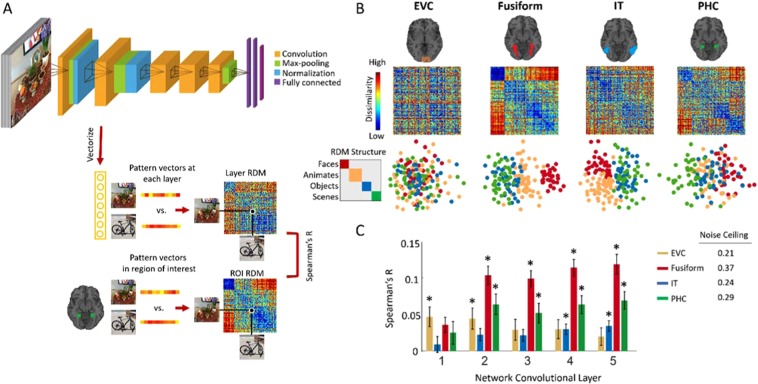
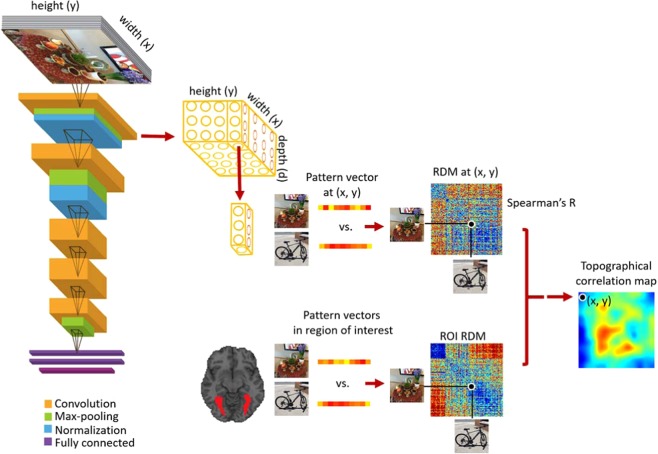
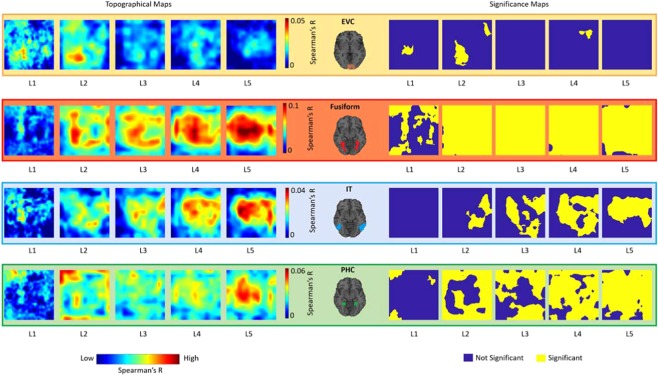
Research at the intersection of computer vision and neuroscience has revealed hierarchical correspondence between layers of deep convolutional neural networks (DCNNs) and cascade of regions along human ventral visual cortex. Recently, studies have uncovered emergence of human interpretable concepts within DCNNs layers trained to identify visual objects and scenes. Here, we asked whether an artificial neural network (with convolutional structure) trained for visual categorization would demonstrate spatial correspondences with human brain regions showing central/peripheral biases. Using representational similarity analysis, we compared activations of convolutional layers of a DCNN trained for object and scene categorization with neural representations in human brain visual regions. Results reveal a brain-like topographical organization in the layers of the DCNN, such that activations of layer-units with central-bias were associated with brain regions with foveal tendencies (e.g. fusiform gyrus), and activations of layer-units with selectivity for image backgrounds were associated with cortical regions showing peripheral preference (e.g. parahippocampal cortex). The emergence of a categorical topographical correspondence between DCNNs and brain regions suggests these models are a good approximation of the perceptual representation generated by biological neural networks.
Overview
The claims and statistics of this paper haven’t been checked yet.
Free: it reads the open-access text and checks the first 5 claims that cite a source we can check. Create a free account to check every claim.
Integrity signals
Registry
Cites
Statistics
Figures
Verification
Claims the paper makes
The claims and statistics of this paper haven’t been checked yet.
Free: it reads the open-access text and checks the first 5 claims that cite a source we can check. Create a free account to check every claim.
Claims other papers make about this one
Each is checked against this paper’s own text: does it say what the citing paper says it does?
The cited source says what the claim attributes to it.
In the citing paper
“Models trained to process images, for example, spontaneously learned how to count (30, 31) and differentially process central and peripheral image areas (32), as well as experience human-like optical illusions (33).”
From Evaluating large language models in theory of mind tasks (2024) · cites this paper as [32]
Self-check
Percentages, sums and reported differences re-computed from the paper’s own numbers.
The self-check needs the paper’s full text.
Citations
Cites
ImageNet classification with deep convolutional neural networks
Krizhevsky, A., Sutskever, I., & Hinton, G. E. (2017) · Communications of the ACM · doi:10.1145/3065386 · Cited by 112,155 · cited 2×
“The network architecture consists of five convolutional and three fully connected layers similar to Krizhevsky et al. (2012)35.”
BackgroundMethodImageNet: A large-scale hierarchical image database
Deng, J., Dong, W., Socher, R., Li, L.-J., Li, K., & Fei-Fei, L. (2009) · 2009 IEEE Conference on Computer Vision and Pattern Recognition · doi:10.1109/cvpr.2009.5206848 · Cited by 65,333
Tzourio-Mazoyer, N., Landeau, B., Papathanassiou, D., Crivello, F., Etard, O., Delcroix, N., Mazoyer, B., & Joliot, M. (2002) · NeuroImage · doi:10.1006/nimg.2001.0978 · Cited by 16,319
Nonparametric statistical testing of EEG- and MEG-data
Maris, E., & Oostenveld, R. (2007) · Journal of Neuroscience Methods · doi:10.1016/j.jneumeth.2007.03.024 · Cited by 8,496 · cited 1×
“For statistical tests we used nonparametric methods with no assumption on the data distributions 59,60 .”
MethodThe fusiform face area: a module in human extrastriate cortex specialized for face perception
Kanwisher, N., McDermott, J., & Chun, M. M. (1997) · The Journal of Neuroscience · doi:10.1523/jneurosci.17-11-04302.1997 · Cited by 7,738
Representational similarity analysis-connecting the branches of systems neuroscience
Kriegeskorte, N. (2008) · Frontiers in Systems Neuroscience · doi:10.3389/neuro.06.004.2008 · Cited by 3,355
IARBUS, A. L. (1967) · Medical Entomology and Zoology · Cited by 3,319
Yarbus, A. L. (1967) · doi:10.1007/978-1-4899-5379-7 · Cited by 3,304
A cortical representation of the local visual environment
Epstein, R., & Kanwisher, N. (1998) · Nature · doi:10.1038/33402 · Cited by 2,984 · cited 1×
“For instance, while the fusiform gyrus shows specialization for faces 2 , the parahippocampal cortex (PHC) is more selective to spatial layout, places 3,4 and large-size objects 5,6 .”
Background(2014) · DSpace@MIT (Massachusetts Institute of Technology) · Cited by 2,534
Self-citation
Cited by
Evaluating large language models in theory of mind tasks
Kosinski, M. (2024) · Proceedings of the National Academy of Sciences · doi:10.1073/pnas.2405460121 · Cited by 339
“Models trained to process images, for example, spontaneously learned how to count ( 30 , 31 ) and differentially process central and peripheral image areas ( 32 ), as well as experience human - like optical illusions ( 33 ).”
BackgroundUsing artificial neural networks to ask ‘why’ questions of minds and brains
Kanwisher, N., Khosla, M., & Dobs, K. (2023) · Trends in Neurosciences · doi:10.1016/j.tins.2022.12.008 · Cited by 182
“One such study [42] trained a CNN on object and scene categorization and found that the network organized itself into units with a central image bias and units more selective for the background of images.”
BackgroundBrain-like functional specialization emerges spontaneously in deep neural networks
Dobs, K., Martinez, J., Kell, A. J. E., & Kanwisher, N. (2022) · Science Advances · doi:10.1126/sciadv.abl8913 · Cited by 129
Evaluating Large Language Models in Theory of Mind Tasks
Kosinski, M. (2023) · arXiv · doi:10.48550/arxiv.2302.02083 · Cited by 339
“Models trained to process images, for example, spontaneously learned how to count ( 30 , 31 ) and differentially process central and peripheral image areas ( 32 ), as well as experience human - like optical illusions ( 33 ).”
BackgroundVisuospatial coding as ubiquitous scaffolding for human cognition
Groen, I. I. A., Dekker, T. M., Knapen, T. H. J., & Silson, E. H. (2021) · Trends in Cognitive Sciences · doi:10.1016/j.tics.2021.10.011 · Cited by 102
“For example, object position can be decoded not just from low-but also high-level CNN layers [49,50], and face-and scene-specialized CNNs exhibit center-periphery biases similar to face-and scene-selective brain regions [129].”
BackgroundWill We Ever Have Conscious Machines?
Krauß, P., & Maier, A. (2020) · Frontiers in Computational Neuroscience · doi:10.3389/fncom.2020.556544 · Cited by 63
“, 2020), or center-periphery spatial organization (Mohsenzadeh et al., 2020) was observed.”
BackgroundBrain-inspired models for visual object recognition: an overview
Yang, X. N., Yan, J., Wang, W., Li, S., Hu, B., & Lin, J. L. (2022) · Artificial Intelligence Review · doi:10.1007/s10462-021-10130-z · Cited by 54
“…2016; Eick-Table (Gavornik and Bear 2014; Konen and Kastner 2008) MATLAB Psycho-physics Toolbox b (Kar and DiCarlo 2021; Kar et al. 2019; Cadieu et al. 2014) POV-Ray c enberg et al. 2017; Wen et al. 2018b; Zeman et al. 2020; Rajalingham et al. 2018; Mohsenzadeh et al. 2020; Kuzovkin et al. 2018).”
BackgroundInfluentialAttention-Based Knowledge Distillation in Scene Recognition: The Impact of a DCT-Driven Loss
López-Cifuentes, A., Escudero-Viñolo, M., Bescós, J., & SanMiguel, J. C. (2023) · IEEE Transactions on Circuits and Systems for Video Technology · doi:10.1109/tcsvt.2023.3250031 · Cited by 26
Al-Tahan, H., & Mohsenzadeh, Y. (2021) · PLoS Computational Biology · doi:10.1371/journal.pcbi.1008775 · Cited by 27
“…object recognition DNNs develop internal representations that are hierarchically similar to brain representations in early visual cortex [40], area V4 (a mid-level region), and IT cortex (a high level categorical region) along ventral visual pathway in primates [21, 26] and humans [27, 29, 32].”
BackgroundSelf-citationMemristive neuromorphic interfaces: integrating sensory modalities with artificial neural networks
Kim, J. E., Soh, K., Hwang, S. I., Yang, D. Y., & Yoon, J. H. (2025) · Materials Horizons · doi:10.1039/d5mh00038f · Cited by 21
Hancock, P. A. (2023) · Ergonomics · doi:10.1080/00140139.2023.2236822 · Cited by 18
“The evidence we have seems to be most prominent in certain areas of neuroscientific specialisation (e.g. Mohsenzadeh et al. 2020; Nasr, Viswanathan, and Nieder 2019; Stoianov and Zorzi 2012).”
BackgroundAnti-Occlusion Infrared Aerial Target Recognition With Multisemantic Graph Skeleton Model
Yang, X. N., Li, S., Sun, S., & Yan, J. (2022) · IEEE Transactions on Geoscience and Remote Sensing · doi:10.1109/tgrs.2022.3204062 · Cited by 16
Machine Learning of Spatial Data
Nikparvar, B., & Thill, J. (2021) · ISPRS International Journal of Geo-Information · doi:10.3390/ijgi10090600 · Cited by 179
“Spatial heterogeneity is not limited to the geo-spatial domains and has been studied in other domains, such as molecular biology of the cells [59] and neuroscience [60].”
BackgroundBrain-like functional specialization emerges spontaneously in deep neural networksPreprint
Dobs, K., Martinez, J., Kell, A. J. E., & Kanwisher, N. (2021) · bioRxiv (Cold Spring Harbor Laboratory) · doi:10.1101/2021.07.05.451192 · Cited by 15
False memories for scenes using the DRM paradigm
Děchtěrenko, F., Lukavský, J., & Štipl, J. (2020) · Vision Research · doi:10.1016/j.visres.2020.09.009 · Cited by 13
Shared representations of human actions across vision and language
Dima, D. C., Janarthanan, S., Culham, J. C., & Mohsenzadeh, Y. (2024) · Neuropsychologia · doi:10.1016/j.neuropsychologia.2024.108962 · Cited by 10
Self-citationZhang, C., Gao, Q., Shi, R., & Yue, M. (2024) · International Journal of Intelligent Systems · doi:10.1155/2024/7259029 · Cited by 8
Tool Representations in Human Visual Cortex
Cortinovis, D., Peelen, M. V., & Bracci, S. (2025) · Journal of Cognitive Neuroscience · doi:10.1162/jocn_a_02281 · Cited by 14
Shkreli, L., Thoroddsen, T., Kobelt, M., Martens, M., Browning, M. D., Harmer, C. J., Cowen, P. J., & Reinecke, A. (2023) · Biological Psychiatry Global Open Science · doi:10.1016/j.bpsgos.2023.100286 · Cited by 8
“The PHC is involved in processing associations between spatial, scene, and context information during memory formation (53,54) and is considered a higher-order visual processing area at the end of the ventral visual stream that particularly responds to naturalistic scenes (55 – 57).”
BackgroundAntiocclusion Infrared Aerial Target Recognition With Vision-Inspired Dual-Stream Graph Network
Yang, X. N., Li, S., Zhang, L., Yan, B., & Meng, Z. (2024) · IEEE Transactions on Geoscience and Remote Sensing · doi:10.1109/tgrs.2024.3416112 · Cited by 6
“The ventral pathway plays a key role in processing the shape information of targets [3], [4], [5].”
BackgroundPredicting proprioceptive cortical anatomy and neural coding with topographic autoencoders
Grogan, M., Blum, K. P., Wu, Y., Harston, J. A., Miller, L. E., & Faisal, A. A. (2024) · PLoS Computational Biology · doi:10.1371/journal.pcbi.1012614 · Cited by 4
“This combination of experiment and theory has been useful for explaining population-level coding in other sensory modalities, such as vision [17] and touch [18,19], but has only recently begun to be applied to proprioception [20,21].”
Spontaneous Emergence of Robustness to Light Variation in CNNs With a Precortically Inspired Module
Petkovic, J., & Fioresi, R. (2024) · Neural Computation · doi:10.1162/neco_a_01691 · Cited by 4
“…studied, in particular, in relation to the deeper components of the visual pathway, starting from the hypercolumnar structure of the primary visual cortex and continuing with the superior processing centers, like V4 and the inferior temporal cortex (De & Horwitz, 2021; Mohsenzadeh et al., 2020).”
BackgroundSoftware solutions for managing radiomics and radiogenomics in neuro-oncology clinical settings
Das, G., & Panda, S. (2024) · Elsevier eBooks · doi:10.1016/b978-0-443-18509-0.00004-9 · Cited by 1
Ramírez-Carrillo, E., Isaac, G.-S., Oliver, L.-C., Rojas-Ramos, O. A., Falcón, L. I., Gaona, O., Cerqueda‐García, D., Sánchez-Quinto, A., Rodríguez, R. M. D. L. F., Hernández-Castillo, A., et al. (2020) · bioRxiv (Cold Spring Harbor Laboratory) · doi:10.1101/2020.07.25.221408 · Cited by 1
Zhu, M., Pan, Y., & Huai, K. (2022) · Optik · doi:10.1016/j.ijleo.2022.170480
RetractedDong, Z. H., Lin, B., & Xie, F. (2023) · IEEE Access · doi:10.1109/access.2023.3264502 · Cited by 1
“Recent studies have highlighted the categorical topological correspondence between deep CNNs and the brain [16].”
BackgroundKrauß, P. (2023) · Springer eBooks · doi:10.1007/978-3-662-67179-5_21
Krauß, P. (2024) · Springer eBooks · doi:10.1007/978-3-662-68980-6_21
Perceptual Expertise and Attention: An Exploration using Deep Neural NetworksPreprint
Das, S., Mangun, G. R., & Ding, M. (2024) · bioRxiv (Cold Spring Harbor Laboratory) · doi:10.1101/2024.10.15.617743
“We analyzed the effect separately for scenes and faces in the two models while attention was applied at different layers, showing representative results from layers 3, 5, 9, and 11 in the figure.”
BackgroundMethodResultVision-Inspired Transformer-Based Thermal Infrared Target Tracking Framework for Internet of Things
Ma, S., Zhang, K., Yang, Y., Liu, Q., & Chen, G. (2025) · IEEE Internet of Things Journal · doi:10.1109/jiot.2025.3603220
“Research shows that the human brain achieves stable tracking in complex TIR scenes through dual visual pathways [19], [20].”
Cai, Y., Wang, J., Qiu, Y., & Huang, R. (2026) · Journal of Cognitive Neuroscience · doi:10.1162/jocn.a.101
Neurodatascience: Past, Present, and Future
Cooper, K. W., Shahbaba, B., & Fortin, N. J. (2026) · Data Science in Science · doi:10.1080/26941899.2026.2619222
Metadata
- Authors
- Mohsenzadeh, Y., Mullin, C., Lahner, B., & Oliva, A.
- Affiliations
- Western University (CA)
- York University (CA)
- MIT Computer Science and Artificial Intelligence Laboratory (US)
- Corresponding author
- Mohsenzadeh, Yalda
- Venue
- Scientific Reports
- Published
- 2020-03-13
- Volume
- 10
- Issue
- 1
- Pages
- 4638-4638
- ISSN
- 2045-2322 (ISSN-L)
- PMC
- PMC7070097
- OpenAlex
- W3010846116
- Semantic Scholar
- 217820cd2e57d946b152b5cd018c18cd8ba93b57
- Cited by
- 31
- References
- 66
- Citations by year
- 2026: 1 · 2025: 3 · 2024: 10 · 2023: 6 · 2022: 4 · 2021: 4 · 2020: 3
- FWCI
- 2.28
- Type
- journal article
- Language
- en
- Open access
- gold
- doi.org
- Licence
- cc-by
- creativecommons.org/licenses/by/4.0 (tdm)
- creativecommons.org/licenses/by/4.0 (vor)
- Locations
- Scientific Reports (publishedVersion, cc-by)
- bioRxiv (Cold Spring Harbor Laboratory) (acceptedVersion, cc-by-nd)
- Europe PMC (PubMed Central) (publishedVersion, cc-by)
- PubMed Central (publishedVersion, cc-by)
- PubMed (publishedVersion)
- Scholarship@Western (Western University) (submittedVersion)
- Funders
- United States Department of Defense | United States Navy | Office of Naval Research (N00014-16-1-3116)
- National Science Foundation (1532591)
- United States Department of Defense | United States Navy | ONR | Office of Naval Research Global (N00014-16-1-3116)
- Topics
- Life Sciences › Neuroscience › Cognitive Neuroscience › Visual perception and processing mechanisms
- Life Sciences › Neuroscience › Cognitive Neuroscience › Face Recognition and Perception
- Physical Sciences › Computer Science › Computer Vision and Pattern Recognition › Advanced Neural Network Applications
- Keywords
- deep convolutional neural networks, ventral visual cortex, representational similarity analysis, object classification, scene classification, fusiform gyrus, parahippocampal cortex, hierarchical visual processing
- MeSH terms
- Adult, Female, Humans, Magnetic Resonance Imaging, Male, Models, Neurological, Pattern Recognition, Visual, Photic Stimulation, Visual Cortex, Neural Networks, Computer, Young Adult
About these checks
Registry, retraction, Cites and statistics results are computed, not judged, with one exception: a printed reference that no index lists is read once by a model before it counts as a citation error. Claims are extracted by a model and kept only when their quote appears verbatim in the text; each cited source is then checked, with a model’s help, for whether it says what the claim relies on. Those verdicts can be wrong — read the claim’s quote and the cited source before relying on one.
Statistics and arithmetic are recomputed, not judged.
Confidence bands are shown only for fields calibrated on our annotated test set. None is calibrated yet, so no band is shown.
What counts as a claim ›How we measure confidence ›How we check this ›
Are you an author, or do you see a problem with this page? Request a review
Data sources
Bibliographic data: Semantic Scholar, OpenAlex, Crossref.
Contains information from the Semantic Scholar Academic Graph Datasets, made available under the ODC Attribution License (ODC-BY 1.0).
Semantic Scholar’s data is described in: Kinney, R., et al. (2023). The Semantic Scholar Open Data Platform. arXiv:2301.10140.
