

Prognostic implications of EGFR protein expression in sporadic colorectal tumors: Correlation with copy number status, mRNA levels and miRNA regulation
Open accessThe DOI matches its Crossref record; 75 of the 75 references it cites were found in a registry or an index.
Abstract
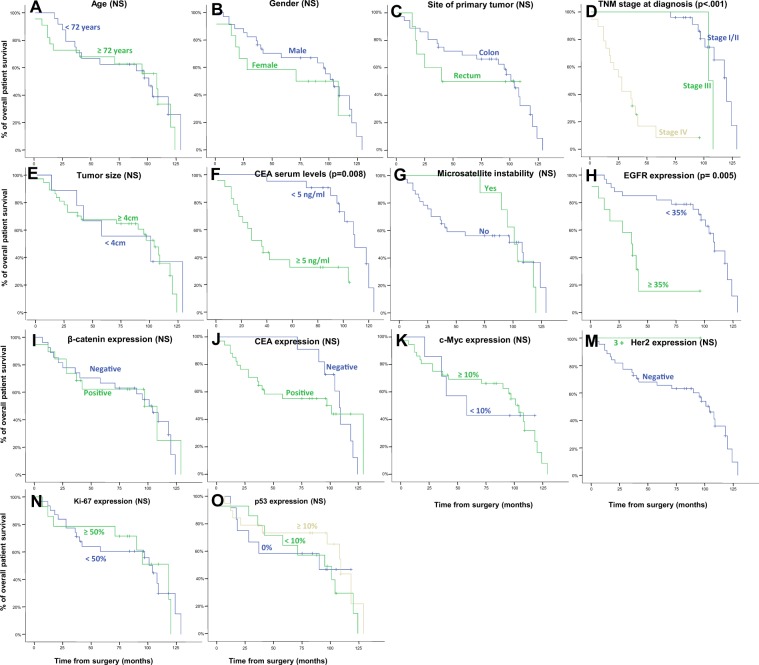
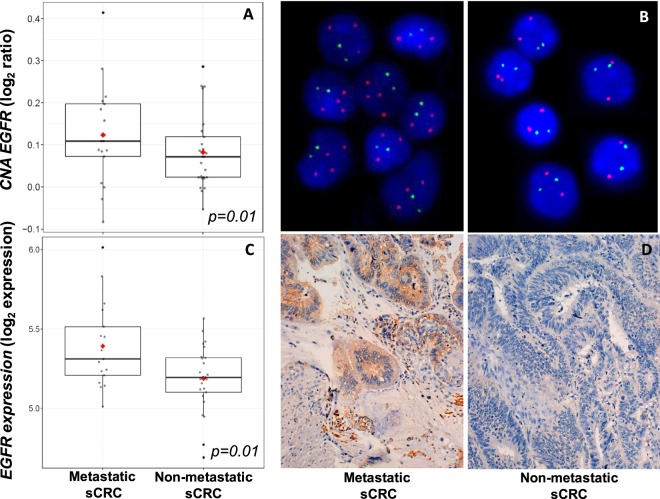
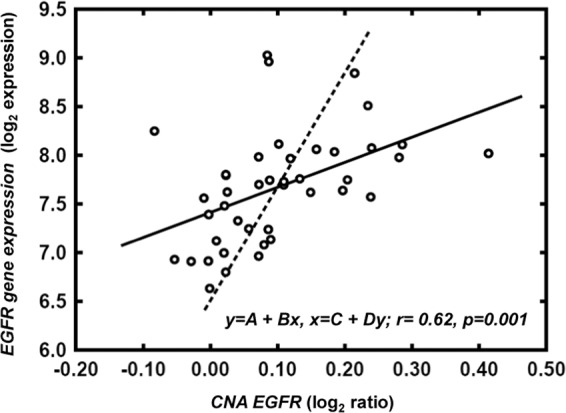
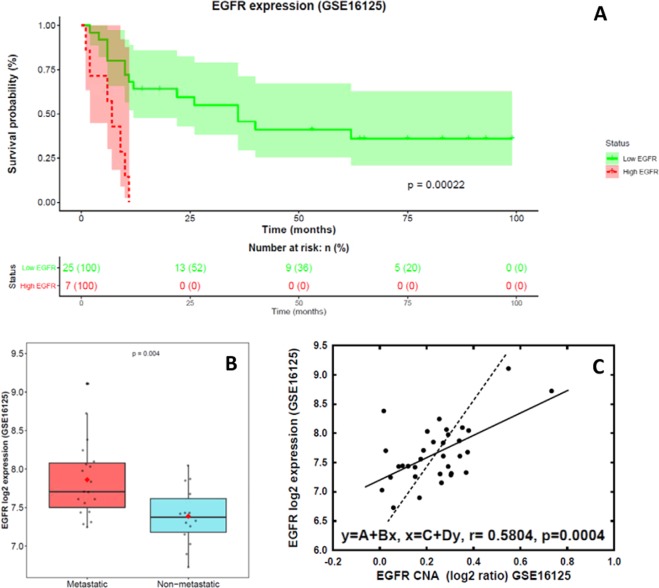
Sporadic colorectal cancer (sCRC) is the third most frequent cancer worldwide and the second most common cause of cancer-related deaths (mainly due metastatic dissemination). We investigated the immunohistochemical expression of frequently altered proteins in primary tumors from 51 patients (25 liver metastatic and 26 non-metastatic cases) with a median 103 months follow-up (103 months). We evaluated EGFR copy number (using SNP arrays and FISH) and its expression and regulation (by mRNA and miRNA arrays). We found differences between metastatic and non-metastatic sCRCs for MLH1 (p = 0.05), PMS2 (p = 0.02), CEA (p < 0.001) and EGFR (p < 0.001) expression. EGFR expression was associated with lymph node metastases (p = 0.001), liver metastases at diagnosis (p < 0.001), and advanced stage (p < 0.001). There were associations between EGFR expression-, EGFR gene copy number- and EGFR mRNA levels. We found potential interactions of two miRNAs targeting EGFR expression, (miR-134 and miR-4328, in non-metastatic and metastatic tumors, respectively). EGFR expression was associated with a worse outcome (p = 0.005). Multivariate analysis of prognostic factors for overall survival identified that, the expression of EGFR expression (p = 0.047) and pTNM stage (p < 0.001) predicted an adverse outcome. EGFR expression could be regulated by amplification or polysomies (in metastatic tumors), or miRNAs (miRNA-134, in non-metastatic tumors). EGFR expression in sCRC appears to be related to metastases and poor outcome.
Overview
The claims and statistics of this paper haven’t been checked yet.
Free: it reads the open-access text and checks the first 5 claims that cite a source we can check. Create a free account to check every claim.
Integrity signals
Registry
Cites
Statistics
Figures
Verification
Claims the paper makes
The claims and statistics of this paper haven’t been checked yet.
Free: it reads the open-access text and checks the first 5 claims that cite a source we can check. Create a free account to check every claim.
Claims other papers make about this one
Each is checked against this paper’s own text: does it say what the citing paper says it does?
In the citing paper
“Epidermal growth factor (EGF) receptor (EGFR/ErbB1/HER1) is widely expressed in CRC, and its elevated expression is associated with metastases and poor outcomes [25].”
From Recent Advances in Therapeutic Strategies to Improve Colorectal Cancer Treatment (2024) · cites this paper as [25]
Self-check
Percentages, sums and reported differences re-computed from the paper’s own numbers.
The self-check needs the paper’s full text.
Citations
Cites
In silico prediction of protein-protein interactions in human macrophages
Souiai, O., Guerfali, F., Ben Miled, S., Brun, C., & Benkahla, A. (2014) · BMC Research Notes · doi:10.1186/1756-0500-7-157 · Cited by 10,803
Significance analysis of microarrays applied to the ionizing radiation response
Tusher, V. G., Tibshirani, R., & Chu, G. (2001) · Proceedings of the National Academy of Sciences · doi:10.1073/pnas.091062498 · Cited by 10,568
Egner, J. R. (2010) · JAMA · doi:10.1001/jama.2010.1525 · Cited by 5,997
TM4: a free, open-source system for microarray data management and analysis
Saeed, A. I., Sharov, V., White, J., Li, J., Liang, W., Bhagabati, N., Braisted, J., Klapa, M., Currier, T., Thiagarajan, M., et al. (2003) · BioTechniques · doi:10.2144/03342mt01 · Cited by 4,837
Microsatellite Instability in Colorectal Cancer
Boland, C. R., & Goel, A. (2010) · Gastroenterology · doi:10.1053/j.gastro.2009.12.064 · Cited by 2,456
Global cancer statistics in the year 2000
Parkin, D. M. (2001) · The Lancet Oncology · doi:10.1016/s1470-2045(01)00486-7 · Cited by 2,445
Dweep, H., Sticht, C., Pandey, P., & Gretz, N. (2011) · Journal of Biomedical Informatics · doi:10.1016/j.jbi.2011.05.002 · Cited by 1,696
miRecords: an integrated resource for microRNA-target interactions
Xiao, F., Zuo, Z., Cai, G., Kang, S., Gao, X., & Li, T. (2009) · Nucleic Acids Research · doi:10.1093/nar/gkn851 · Cited by 1,438
Prognostic Factors in Prostate Cancer: College of American Pathologists Consensus Statement 1999
Bostwick, D. G., Grignon, D. J., Hammond, M. E. H., Amin, M. B., Cohen, M., Crawford, D., Gospadarowicz, M., Kaplan, R. S., Miller, D. S., Montironi, R., et al. (2000) · Archives of Pathology & Laboratory Medicine · doi:10.5858/2000-124-0995-pfipc · Cited by 1,239
Prognostic Factors in Colorectal Cancer: College of American Pathologists Consensus Statement 1999
Compton, C. C., Fielding, L. P., Burgart, L. J., Conley, B., Cooper, H. S., Hamilton, S. R., Hammond, M. E. H., Henson, D. E., Hutter, R. V. P., Nagle, R. B., et al. (2000) · Archives of Pathology & Laboratory Medicine · doi:10.5858/2000-124-0979-pficc · Cited by 1,230
Cited by
Recent Advances in Therapeutic Strategies to Improve Colorectal Cancer Treatment
Gmeiner, W. H. (2024) · Cancers · doi:10.3390/cancers16051029 · Cited by 78
The Current Landscape of Antibody-based Therapies in Solid Malignancies
Shah, A., Rauth, S., Aithal, A., Kaur, S., Ganguly, K., Orzechowski, C., Varshney, G. C., Jain, M., & Batra, S. K. (2021) · Theranostics · doi:10.7150/thno.52614 · Cited by 49
“A clinically relevant example for this is seen by a better response of cetuximab or panitumumab in metastatic colorectal cancer patients having higher EGFR gene copy numbers [45, 47].”
BackgroundPersonalized Immunotherapy in Colorectal Cancers: Where Do We Stand?
Hu, L., Lan, H., Huang, D., Li, X., & Jin, K. (2021) · Frontiers in Oncology · doi:10.3389/fonc.2021.769305 · Cited by 38
Hao, M., Wang, K., Ding, Y., Li, H., Liu, Y., & Ding, L. (2022) · European journal of medical research · doi:10.1186/s40001-022-00759-z · Cited by 35
An amino acid transporter subunit as an antibody–drug conjugate target in colorectal cancer
Montero, J. C., del Carmen, S., Abad, M., Sayagués, J. M., Barbáchano, A., Fernández‐Barral, A., Múñoz, A., & Pandiella, A. (2023) · Journal of Experimental & Clinical Cancer Research · doi:10.1186/s13046-023-02784-0 · Cited by 15
“The tissue microarray (TMA) used to analyze levels of CD98hc in 26 primary tumors, 34 liver metastases and 16 lymph node metastases by Immunohistochemical was created as described [44].”
MethodSelf-citationTseng, Y., Chen, H.-C., Shu, C., Lee, C., Chou, Y.-T., Li, Y., Liou, H., Cheng, J., Chen, C., Ger, L., et al. (2021) · International Journal of Molecular Sciences · doi:10.3390/ijms222212226 · Cited by 13
Melo, V. A., Nelemans, L. C., Vlaming, M. R., Lourens, H. J., Wiersma, V. R., Bilemjian, V., Huls, G. A., de Bruyn, M., & Bremer, E. (2023) · Frontiers in Immunology · doi:10.3389/fimmu.2023.1191866 · Cited by 13
Zheng, S.-J., Zheng, C.-P., Zhai, T., Xu, X., Zheng, Y.-Q., Li, Z., Li, E., Liu, W., & Xu, L. (2022) · Annals of Surgical Oncology · doi:10.1245/s10434-022-13026-6 · Cited by 10
“In studies on updating and supplementing biomarkers for pTNM staging systems, different molecular biomarkers, such as gene mutation, miRNA, mRNA or protein, have been explored.(16,54,55) Some molecular biomarkers have been used clinically in glioma, breast cancer, and colon cancer, driving the advanced treatment of th…”
BackgroundTumor Suppressor microRNAs in Gastrointestinal Cancers: A Mini-Review
Jothimani, G., Bhatiya, M., Pathak, S., Paul, S., & Banerjee, A. (2022) · Recent Advances in Inflammation & Allergy Drug Discovery · doi:10.2174/2772270816666220606112727 · Cited by 10
Liu, W., Luo, Z., Zhang, L., Wang, Y., Yang, J., You, D., Cao, X., & Yang, W. (2023) · Acta Diabetologica · doi:10.1007/s00592-023-02077-0 · Cited by 9
Lee, T. H., Jang, B., Chang, J. H., Kim, E., Park, J. H., & Chie, E. K. (2023) · Cancer Medicine · doi:10.1002/cam4.6169 · Cited by 8
Ye, P., Li, F., Wei, Y., Zhang, Y., Cui, J., Dai, R., Chen, H., Xie, J., & Cai, P. (2022) · Scientific Reports · doi:10.1038/s41598-022-17210-2 · Cited by 7
Järemo, H., Semenas, J., Bergström, S. H., Lundholm, M., Thysell, E., Widmark, A., Crnalic, S., Ylitalo, E. B., Bergh, A. R. J., Brattsand, M., et al. (2023) · Cancers · doi:10.3390/cancers15092437 · Cited by 5
Marinović, S., Vuković, K., Škrtić, A., Poljak, M., Petek, S., Petek, L., & Kapitanović, S. (2020) · Oncology Letters · doi:10.3892/ol.2020.12392 · Cited by 5
“This could be explained by posttranscriptional regulation via miRNAs (42,43) and possibly other regulatory mechanisms on protein levels like EGFR dimerization, internalization, degradation or recycling (44‐46).”
BackgroundСлужев, М. И., Зарайский, М. И., Семиглазов, В. В., Semiglazova, Т. Y., Ткаченко, Е. В., Кондратьев, С. В., Бриш, Н. А., Alekseeva, Y. V., Петрик, Ю. В., & Сидорова, А. Н. (2022) · Siberian Journal of Oncology · doi:10.21294/1814-4861-2022-21-2-55-64 · Cited by 1
microRNA-939 Promotes the Vitality of Human Breast Cancer Cells via Inhibition of E2F1/P73 Signaling
Wang, S., Qi, X., & Liu, H. (2021) · Journal of Biomaterials and Tissue Engineering · doi:10.1166/jbt.2021.2642
Li, W., Pan, Y., Qi, J., Zhao, Q., Sun, Z., & Wang, C. (2022) · Research Square · doi:10.21203/rs.3.rs-1981311/v1
Служев, М. И., Зарайский, М. И., Семиглазов, В. В., Semiglazova, Т. Y., Ткаченко, Е. В., Кондратьев, С. В., Бриш, Н. А., Alekseeva, Y. V., Абасова, С. В., Козюкалов, А. С., et al. (2024) · Voprosy Onkologii · doi:10.37469/0507-3758-2024-70-4-696-706
“EGFR — это трансмембранный гликопротеин с внутриклеточ-ной тирозинкиназой, служащий рецептором для внеклеточных белковых лигандов [10].”
Bublitz, N.-A. (2024) · edoc Publication server (Humboldt University of Berlin) · doi:10.18452/29059 · Cited by 1
Montero, J. C., del Carmen, S., Abad, M., Sayagués, J. M., Barbáchano, A., Fernández‐Barral, A., Muñoz, A., & Pandiella, A. (2023) · DIGITAL.CSIC (Spanish National Research Council (CSIC)) · doi:10.6084/m9.figshare.23916982
Self-citationMontero, J. C., del Carmen, S., Abad, M., Sayagués, J. M., Barbáchano, A., Fernández‐Barral, A., Muñoz, A., & Pandiella, A. (2023) · DIGITAL.CSIC (Spanish National Research Council (CSIC)) · doi:10.6084/m9.figshare.23916985
Self-citationMontero, J. C., del Carmen, S., Abad, M., Sayagués, J. M., Barbáchano, A., Fernández‐Barral, A., Muñoz, A., & Pandiella, A. (2023) · DIGITAL.CSIC (Spanish National Research Council (CSIC)) · doi:10.6084/m9.figshare.23916991
Self-citationMontero, J. C., del Carmen, S., Abad, M., Sayagués, J. M., Barbáchano, A., Fernández‐Barral, A., Muñoz, A., & Pandiella, A. (2023) · DIGITAL.CSIC (Spanish National Research Council (CSIC)) · doi:10.6084/m9.figshare.23916988
Self-citationFang, Y., & Imoukhuede, P. I. (2025) · Current Opinion in Biomedical Engineering · doi:10.1016/j.cobme.2025.100646
Metadata
- Authors
- del Carmen, S., Corchete, L. A., Gervas, R., Rodriguez, A., Garcia, M., Álcazar, J. A., García, J., Bengoechea, O., Muñoz-Bellvis, L., Sayagués, J. M., & Abad, M.
- Affiliations
- Universidad de Salamanca (ES)
- Corresponding author
- Sayagués, José María
- Abad, Mar
- Venue
- Scientific Reports
- Published
- 2020-03-13
- Volume
- 10
- Issue
- 1
- Pages
- 4662-4662
- ISSN
- 2045-2322 (ISSN-L)
- PMC
- PMC7070091
- OpenAlex
- W3011667214
- Semantic Scholar
- ddd44066bad7c1848d771397e143138460db6bca
- Cited by
- 18
- References
- 73
- Citations by year
- 2025: 1 · 2024: 1 · 2023: 5 · 2022: 6 · 2021: 3 · 2020: 2
- FWCI
- 1.81
- Type
- journal article
- Language
- en
- Open access
- gold
- doi.org
- Licence
- cc-by
- creativecommons.org/licenses/by/4.0 (tdm)
- creativecommons.org/licenses/by/4.0 (vor)
- Locations
- Scientific Reports (publishedVersion, cc-by)
- Europe PMC (PubMed Central) (publishedVersion, cc-by)
- PubMed Central (publishedVersion, cc-by)
- PubMed (publishedVersion)
- Hispana (publishedVersion, cc-by-nc-nd)
- Gredos (University of Salamanca) (submittedVersion, cc-by-nc-nd)
- Funders
- Centro de Investigación Biomédica en Red de Cáncer (CB16/12/00400)
- Instituto de Salud Carlos III (CB16/12/00400)
- Topics
- Health Sciences › Medicine › Oncology › Colorectal Cancer Treatments and Studies
- Health Sciences › Medicine › Pathology and Forensic Medicine › Genetic factors in colorectal cancer
- Health Sciences › Medicine › Oncology › HER2/EGFR in Cancer Research
- Keywords
- sporadic colorectal cancer, EGFR expression, EGFR gene copy number, microRNA regulation, miR-134, liver metastasis, lymph node metastasis, prognostic factors, overall survival, MLH1, PMS2, CEA, gene amplification, polysomy, TNM stage
- MeSH terms
- Adult, Aged, Aged, 80 and over, Female, Humans, Male, Middle Aged, Neoplasm Metastasis, Neoplasm Staging, Prognosis, Colorectal Neoplasms, Gene Expression Regulation, Neoplastic, Survival Analysis, Gene Expression Profiling, MicroRNAs, DNA Copy Number Variations, ErbB Receptors
About these checks
Registry, retraction, Cites and statistics results are computed, not judged, with one exception: a printed reference that no index lists is read once by a model before it counts as a citation error. Claims are extracted by a model and kept only when their quote appears verbatim in the text; each cited source is then checked, with a model’s help, for whether it says what the claim relies on. Those verdicts can be wrong — read the claim’s quote and the cited source before relying on one.
Statistics and arithmetic are recomputed, not judged.
Confidence bands are shown only for fields calibrated on our annotated test set. None is calibrated yet, so no band is shown.
What counts as a claim ›How we measure confidence ›How we check this ›
Are you an author, or do you see a problem with this page? Request a review
Data sources
Bibliographic data: Semantic Scholar, OpenAlex, Crossref.
Contains information from the Semantic Scholar Academic Graph Datasets, made available under the ODC Attribution License (ODC-BY 1.0).
Semantic Scholar’s data is described in: Kinney, R., et al. (2023). The Semantic Scholar Open Data Platform. arXiv:2301.10140.
