

Dynamic and synchronous changes in metazoan body size during the Cambrian Explosion
Open accessThe DOI matches its Crossref record; 41 of the 41 references it cites were found in a registry or an index.
Abstract
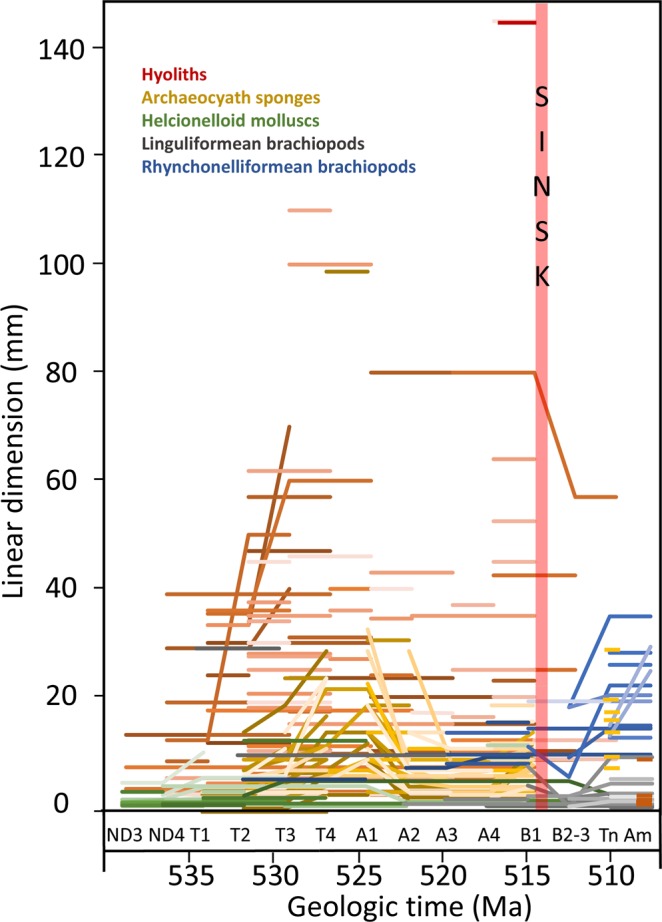
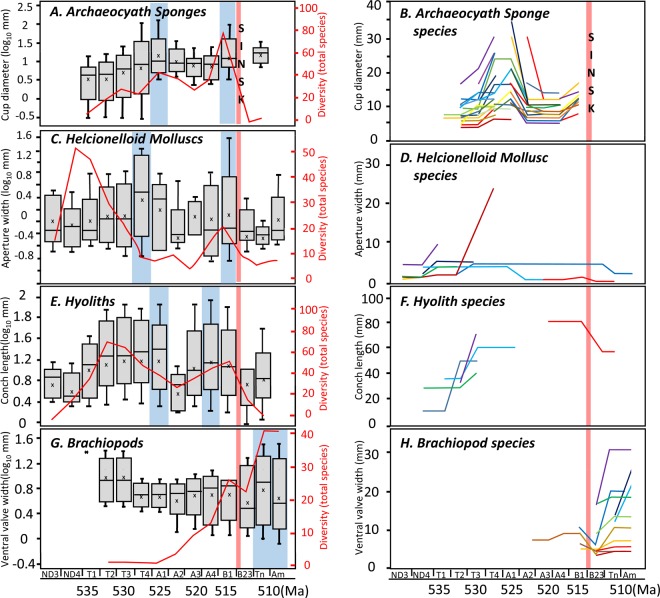
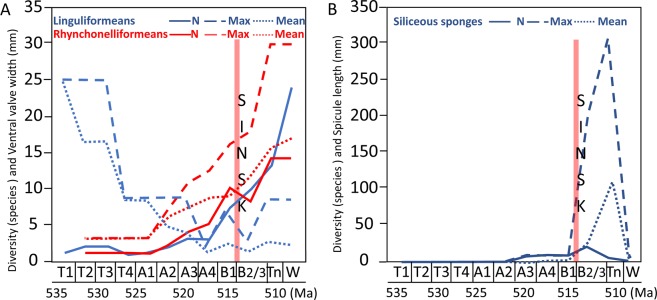
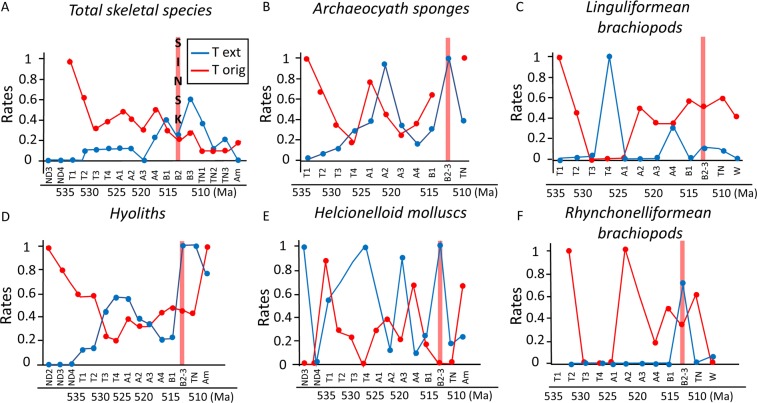
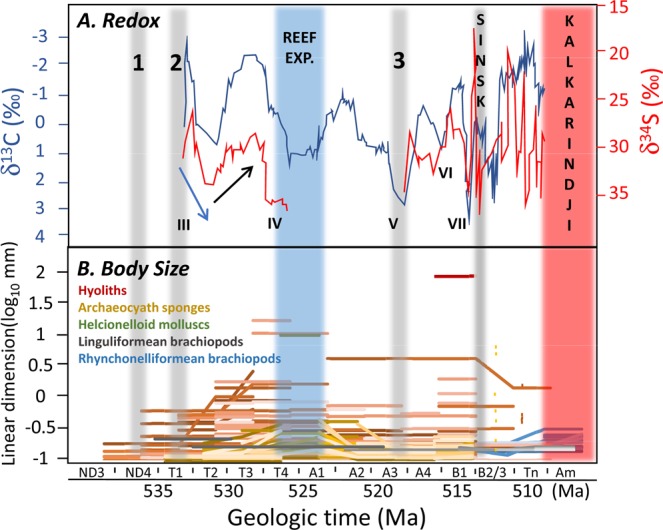
Many aspects of the drivers for, and evolutionary dynamics of, the Cambrian Explosion are poorly understood. Here we quantify high-resolution changes in species body size in major metazoan groups on the Siberian Platform during the early Cambrian (ca. 540–510 Million years ago (Ma)). Archaeocyath sponges, hyolith lophophorates, and helcionelloid mollusc species show dynamic and synchronous trends over million-year timescales, with peaks in body size during the latest Tommotian/early Atbadanian and late Atdabanian/early Botoman, and notably small body sizes in the middle Atdabanian and after the Sinsk anoxic extinction event, starting ca. 513 Ma. These intervals of body size changes are also mirrored in individual species and correlate positively with increased rates of origination and broadly with total species diversity. Calcitic brachiopods (rhynchonelliformeans), however, show a general increase in body size following the increase in species diversity through this interval: phosphatic brachiopods (linguliformeans) show a body size decrease that negatively correlates with diversity. Both brachiopod groups show a rapid recovery at the Sinsk Event. The synchronous changes in these metrics in archaeocyath, hyoliths and helcionelloids suggest the operation of external drivers through the early Cambrian, such as episodic changes in oxygenation or productivity. But the trends shown by brachiopods suggests a differing physiological response. Together, these dynamics created both the distinct evolutionary record of metazoan groups during the Cambrian Explosion and determined the nature of its termination.
Overview
The claims and statistics of this paper haven’t been checked yet.
Free: it reads the open-access text and checks the first 5 claims that cite a source we can check. Create a free account to check every claim.
Integrity signals
Registry
Cites
Statistics
Figures
Verification
Claims the paper makes
The claims and statistics of this paper haven’t been checked yet.
Free: it reads the open-access text and checks the first 5 claims that cite a source we can check. Create a free account to check every claim.
Claims other papers make about this one
Each is checked against this paper’s own text: does it say what the citing paper says it does?
The source backs part of the claim, not all of it — or backs it for a different population, condition or comparison.
In the citing paper
“Notwithstanding these concerns, the later early Cambrian short-lived δ13Ccarb excursions have also been tied to paired extinction/origination events (78).”
From Sea level controls on Ediacaran-Cambrian animal radiations (2024) · cites this paper as [78]
Experimental — accuracy not yet measuredThe cited source says what the claim attributes to it.
In the citing paper
“The response of brachiopods is quite different, calcitic shells showing a general increase in body size while phosphatic shells decreasing in size through time (Zhuravlev and Wood 2020).”
From Current understanding on the Cambrian Explosion: questions and answers (2021) · cites this paper as Zhuravlev and Wood 2020
The cited source says what the claim attributes to it.
In the citing paper
“A quantitative study of skeletal species from Siberia demonstrated marked changes in maximum linear body size dimensions but no unidirectional trend throughout the early Cambrian (Zhuravlev and Wood 2020).”
From Current understanding on the Cambrian Explosion: questions and answers (2021) · cites this paper as Zhuravlev and Wood 2020
The cited source says what the claim attributes to it.
In the citing paper
“However, the variation of the linear body size was in interesting paces: the size of archaeocyath, hyolith, and helcionelloid mollusc species varied in a synchronous rhythm over million-year timescales, with peaks positively correlated with origination rate and total species diversity, which appear to be a consequence of external drivers.”
From Current understanding on the Cambrian Explosion: questions and answers (2021) · cites this paper as Zhuravlev and Wood 2020
Self-check
Percentages, sums and reported differences re-computed from the paper’s own numbers.
The self-check needs the paper’s full text.
Citations
Cites
(2026) · Acta Palaeontologica Polonica · doi:10.4202/app · Cited by 2,792
Climate change affects marine fishes through the oxygen limitation of thermal tolerance
Pörtner, H. O., & Knust, R. (2007) · Science · doi:10.1126/science.1135471 · Cited by 2,030
GATTUSO, J.-P., ALLEMAND, D., & FRANKIGNOULLE, M. (1999) · American Zoologist · doi:10.1093/icb/39.1.160 · Cited by 709
Paleophysiology and end-Permian mass extinction
Knoll, A. H., Bambach, R. K., Payne, J. L., Pruss, S., & Fischer, W. W. (2007) · Earth and Planetary Science Letters · doi:10.1016/j.epsl.2007.02.018 · Cited by 665
Gattuso, J., Allemand, D., & Frankignoulle, M. (1999) · HAL (Le Centre pour la Communication Scientifique Directe) · Cited by 624
EVOLUTIONARY AND ECOLOGIC SIGNIFICANCE OF OXYGEN‐DEFICIENT MARINE BASINS
Rhoads, D. C., & Morse, J. W. (1971) · Lethaia · doi:10.1111/j.1502-3931.1971.tb01864.x · Cited by 578
Calibrating Rates of Early Cambrian Evolution
Bowring, S. A., Grotzinger, J. P., Isachsen, C. E., Knoll, A. H., Pelechaty, S. M., & Kolosov, P. (1993) · Science · doi:10.1126/science.11539488 · Cited by 526
Life at Stable low Oxygen Levels: Adaptations of Animals to Oceanic Oxygen Minimum Layers
Childress, J. J., & Seibel, B. A. (1998) · Journal of Experimental Biology · doi:10.1242/jeb.201.8.1223 · Cited by 408
MECHANISMS OF LARGE-SCALE EVOLUTIONARY TRENDS
McShea, D. W. (1994) · Evolution · doi:10.1111/j.1558-5646.1994.tb02211.x · Cited by 383
Payne, J. L., Boyer, A. G., Brown, J. H., Finnegan, S., Kowalewski, M., Krause, R. A., Lyons, S. K., McClain, C. R., McShea, D. W., Novack-Gottshall, P. M., et al. (2009) · Proceedings of the National Academy of Sciences · doi:10.1073/pnas.0806314106 · Cited by 325
The Lilliput effect in the aftermath of the end-Permian extinction event
Twitchett, R. J. (2007) · Palaeogeography, Palaeoclimatology, Palaeoecology · doi:10.1016/j.palaeo.2006.11.038 · Cited by 307
Macrobenthic community structure within and beneath the oxygen minimum zone, NW Arabian Sea
Levin, L. A., Gage, J. D., Martin, C., & Lamont, P. A. (2000) · Deep Sea Research Part II: Topical Studies in Oceanography · doi:10.1016/s0967-0645(99)00103-4 · Cited by 236
Linnemann, U., Ovtcharova, M., Schaltegger, U., Gärtner, A., Hautmann, M., Geyer, G., Vickers‐Rich, P., Rich, T., Plessen, B., Hofmann, M., et al. (2019) · Terra Nova · doi:10.1111/ter.12368 · Cited by 208
Cope’s rule in the evolution of marine animals
Heim, N. A., Knope, M. L., Schaal, E. K., Wang, S. C., & Payne, J. L. (2015) · Science · doi:10.1126/science.1260065 · Cited by 199
Anoxia as the cause of the mid-Early Cambrian (Botomian) extinction event
Zhuravlev, A. Y., & Wood, R. A. (1996) · Geology · doi:10.1130/0091-7613(1996)024<0311:aatcot>2.3.co;2 · Cited by 195
Self-citationPossible links between extreme oxygen perturbations and the Cambrian radiation of animals
He, T., Zhu, M., Mills, B. J. W., Wynn, P. M., Zhuravlev, A. Y., Tostevin, R., Pogge von Strandmann, P. A. E., Yang, A., Poulton, S. W., & Shields, G. A. (2019) · Nature Geoscience · doi:10.1038/s41561-019-0357-z · Cited by 193
Self-citationOxygen-Collagen Priority and the Early Metazoan Fossil Record
Towe, K. M. (1970) · Proceedings of the National Academy of Sciences · doi:10.1073/pnas.65.4.781 · Cited by 180
The Ecological Physiology of Earth's Second Oxygen Revolution
Sperling, E. A., Knoll, A. H., & Girguis, P. R. (2015) · Annual Review of Ecology, Evolution, and Systematics · doi:10.1146/annurev-ecolsys-110512-135808 · Cited by 165
Marine redox fluctuation as a potential trigger for the Cambrian explosion
Wei, G.-Y., Planavsky, N. J., Tarhan, L. G., Chen, X., Wei, W., Li, D., & Ling, H.-F. (2018) · Geology · doi:10.1130/g40150.1 · Cited by 155
Coupled oceanic oxygenation and metazoan diversification during the early–middle Cambrian?
Li, C., Jin, C., Planavsky, N. J., Algeo, T. J., Cheng, M., Yang, X., Zhao, Y., & Xie, S. (2017) · Geology · doi:10.1130/g39208.1 · Cited by 127
Atmosphere-ocean oxygen and productivity dynamics during early animal radiations
Dahl, T. W., Connelly, J. N., Li, D., Kouchinsky, A., Gill, B. C., Porter, S., Maloof, A. C., & Bizzarro, M. (2019) · Proceedings of the National Academy of Sciences · doi:10.1073/pnas.1901178116 · Cited by 113
Maas, A. E., Wishner, K. F., & Seibel, B. A. (2012) · Biogeosciences · doi:10.5194/bg-9-747-2012 · Cited by 105
Terreneuvian stratigraphy and faunas from the Anabar Uplift, Siberia.
Kouchinsky, A., Bengtson, S., Landing, E., Steiner, M., Vendrasco, M., & Ziegler, K. (2017) · Acta Palaeontologica Polonica · doi:10.4202/app.00289.2016 · Cited by 101
Palaeoecology of the Early Cambrian Sinsk biota from the Siberian Platform
Ivantsov, A. Y., Zhuravlev, A. Y., Leguta, A. V., Krassilov, V. A., Melnikova, L. M., & Ushatinskaya, G. T. (2005) · Palaeogeography, Palaeoclimatology, Palaeoecology · doi:10.1016/j.palaeo.2004.01.022 · Cited by 97
Self-citationThe two phases of the Cambrian Explosion
Zhuravlev, A. Y., & Wood, R. A. (2018) · Scientific Reports · doi:10.1038/s41598-018-34962-y · Cited by 92
Self-citationIncreased productivity as a primary driver of marine anoxia in the Lower Cambrian
Liu, K., Feng, Q., Shen, J., Khan, M. Z., & Planavsky, N. J. (2017) · Palaeogeography Palaeoclimatology Palaeoecology · doi:10.1016/j.palaeo.2017.11.007 · Cited by 73
A tectonically driven Ediacaran oxygenation event
Williams, J., Mills, B. J. W., & Lenton, T. M. (2019) · Nature Communications · doi:10.1038/s41467-019-10286-x · Cited by 71
Distribution and Ecology of Clonal and Aclonal Benthic Invertebrates
Jackson, J. B. C. (2018) · Yale University Press eBooks · doi:10.2307/j.ctt2250w9n.12 · Cited by 65
Tunnicliffe, V, & Wilson, K. (1988) · Marine Ecology Progress Series · doi:10.3354/meps047117 · Cited by 62
Duration of the first biozone in the Siberian hypostratotype of the Vendian
Rogov, V. I., Karlova, G. A., Marusin, V. V., Kochnev, B. B., Nagovitsin, K. E., & Grazhdankin, D. V. (2015) · Russian Geology and Geophysics · doi:10.1016/j.rgg.2015.03.016 · Cited by 62
Grazhdankin, D. V., Marusin, V. V., Izokh, O. P., Karlova, G. A., Kochnev, B. B., Markov, G., Nagovitsin, K. E., Sarsembaev, Z. A., Peek, S., Cui, H., et al. (2019) · Geological Magazine · doi:10.1017/s0016756819001286 · Cited by 45
Isotopic evidence for temperate oceans during the Cambrian Explosion
Wotte, T., Skovsted, C. B., Whitehouse, M. J., & Kouchinsky, A. (2019) · Scientific Reports · doi:10.1038/s41598-019-42719-4 · Cited by 44
Skovsted, C. B., Clausen, S., Álvaro, J. J., & Ponlevé, D. (2014) · Palaeontology · doi:10.1111/pala.12060 · Cited by 42
Parkhaev, P. Y., & Karlova, G. A. (2011) · Paleontological Journal · doi:10.1134/s0031030111100030 · Cited by 36
Zhuravlev, A. Y., Наймарк, Е. Б., & Wood, R. A. (2015) · Earth-Science Reviews · doi:10.1016/j.earscirev.2015.04.008 · Cited by 35
Self-citationSize of the earliest mollusks: Did small helcionellids grow to become large adults?
Mus, M. M., Palacios, T., & Jensen, S. (2008) · Geology · doi:10.1130/g24218a.1 · Cited by 35
Alpha, beta, or gamma: Numerical view on the Early Cambrian world
Zhuravlev, A. Y., & Naimark, E. B. (2005) · Palaeogeography, Palaeoclimatology, Palaeoecology · doi:10.1016/j.palaeo.2004.08.009 · Cited by 34
Self-citationAtkinson, J. W., Wignall, P. B., Morton, J. D., & Aze, T. L. (2019) · Palaeontology · doi:10.1111/pala.12415 · Cited by 27
Ballanti, L. A., Tullis, A., & Ward, P. D. (2012) · Paleobiology · doi:10.1666/11020.1 · Cited by 16
Exploring the Ecological Dynamics of Extinction
Webb, A. E., & Leighton, L. R. (2011) · Topics in geobiology · doi:10.1007/978-94-007-0680-4_8 · Cited by 14
Marshall, P. E., Halton, A. M., Kelley, S. P., Widdowson, M., & Sherlock, S. C. (2018) · Journal of the Geological Society · doi:10.1144/jgs2018-035 · Cited by 11
Research works printed but not linked: 1
- Dzik, J. Is fossil evidence consistent with traditional views of the early metazoan phylogeny? In Simonetta, A. M. & Conway Morris, S. (eds), The Early Evolution of Metazoa and the Significance of Problematic Taxa. Cambridge University Press, Cambridge, 47–56 (1991).
Cited by
Wei, G.-Y., Planavsky, N. J., He, T., Zhang, F., Stockey, R. G., Cole, D. B., Lin, Y.-B., & Ling, H.-F. (2021) · Earth-Science Reviews · doi:10.1016/j.earscirev.2021.103506 · Cited by 122
Current understanding on the Cambrian Explosion: questions and answers
Zhang, X., & Shu, D. (2021) · PalZ · doi:10.1007/s12542-021-00568-5 · Cited by 96
Sea level controls on Ediacaran-Cambrian animal radiations
Bowyer, F. T., Wood, R. A., & Yilales, M. (2024) · Science Advances · doi:10.1126/sciadv.ado6462 · Cited by 54
Self-citationDevelopmental capacity and the early evolution of animals
Erwin, D. H. (2021) · Journal of the Geological Society · doi:10.1144/jgs2020-245 · Cited by 30
Zhuravlev, A. Y., Wood, R. A., & Bowyer, F. T. (2023) · Science Advances · doi:10.1126/sciadv.adh2558 · Cited by 29
“(E) Rates of archaeocyath sponge species origination and extinction (24).”
BackgroundInfluentialSelf-citation
Metadata
- Authors
- Zhuravlev, A. Y., & Wood, R.
- Affiliations
- Lomonosov Moscow State University (RU)
- University of Edinburgh (GB)
- Corresponding author
- Wood, Rachel
- Venue
- Scientific Reports
- Published
- 2020-04-22
- Volume
- 10
- Issue
- 1
- Pages
- 6784-6784
- ISSN
- 2045-2322 (ISSN-L)
- PMC
- PMC7176670
- OpenAlex
- W3019145430
- Cited by
- 38
- References
- 41
- Citations by year
- 2026: 1 · 2025: 5 · 2024: 11 · 2023: 10 · 2022: 4 · 2021: 6 · 2020: 1
- FWCI
- 3.01
- Type
- journal article
- Language
- en
- Open access
- gold
- doi.org
- Licence
- cc-by
- creativecommons.org/licenses/by/4.0 (tdm)
- creativecommons.org/licenses/by/4.0 (vor)
- Locations
- Scientific Reports (publishedVersion, cc-by)
- PubMed Central (publishedVersion, cc-by)
- PubMed (publishedVersion)
- Edinburgh Research Explorer (University of Edinburgh) (submittedVersion, cc-by)
- Funders
- Natural Environment Research Council (NE/T008458/1, NE/I005935/1, NE/P013651, NE/P013651/1)
- Topics
- Physical Sciences › Earth and Planetary Sciences › Paleontology › Paleontology and Stratigraphy of Fossils
- Physical Sciences › Earth and Planetary Sciences › Paleontology › Evolution and Paleontology Studies
- Physical Sciences › Earth and Planetary Sciences › Paleontology › Paleontology and Evolutionary Biology
- Keywords
- Cambrian explosion, Lower Cambrian, Siberian Platform, hyoliths, species diversity, oxygenation, productivity, Cambrian stratigraphy
- MeSH terms
- Animals, Biological Evolution, Fossils, Invertebrates, Paleontology, Siberia, Biodiversity, Body Size, Spatio-Temporal Analysis
About these checks
Registry, retraction, Cites and statistics results are computed, not judged, with one exception: a printed reference that no index lists is read once by a model before it counts as a citation error. Claims are extracted by a model and kept only when their quote appears verbatim in the text; each cited source is then checked, with a model’s help, for whether it says what the claim relies on. Those verdicts can be wrong — read the claim’s quote and the cited source before relying on one.
Statistics and arithmetic are recomputed, not judged.
Confidence bands are shown only for fields calibrated on our annotated test set. None is calibrated yet, so no band is shown.
What counts as a claim ›How we measure confidence ›How we check this ›
Are you an author, or do you see a problem with this page? Request a review
Data sources
Bibliographic data: Semantic Scholar, OpenAlex, Crossref.
Contains information from the Semantic Scholar Academic Graph Datasets, made available under the ODC Attribution License (ODC-BY 1.0).
Semantic Scholar’s data is described in: Kinney, R., et al. (2023). The Semantic Scholar Open Data Platform. arXiv:2301.10140.
