

Dynamic and synchronous changes in metazoan body size during the Cambrian Explosion
Open accessThe DOI matches its Crossref record; 41 of the 41 references it cites were found in a registry or an index.
Abstract
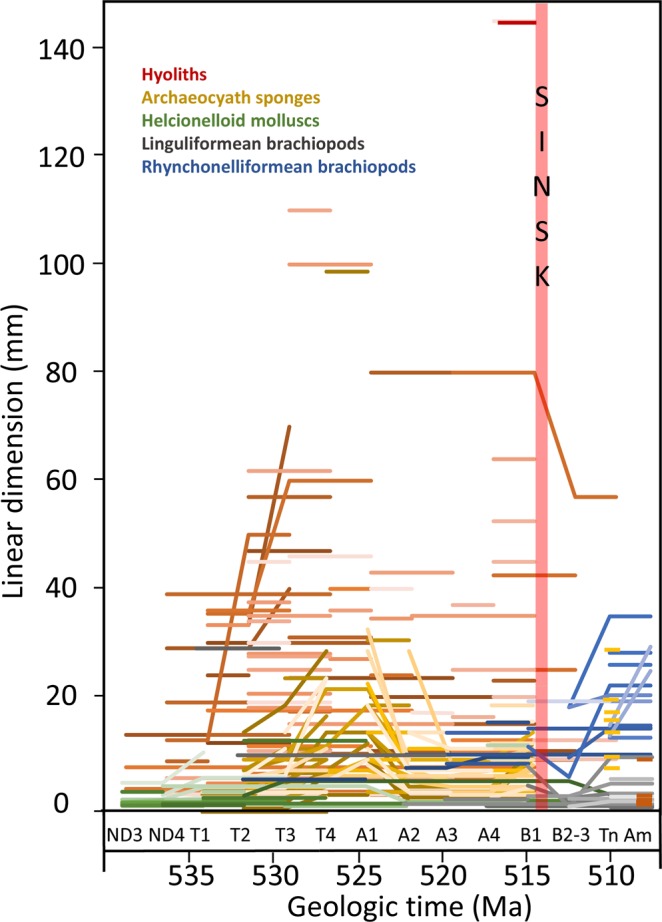
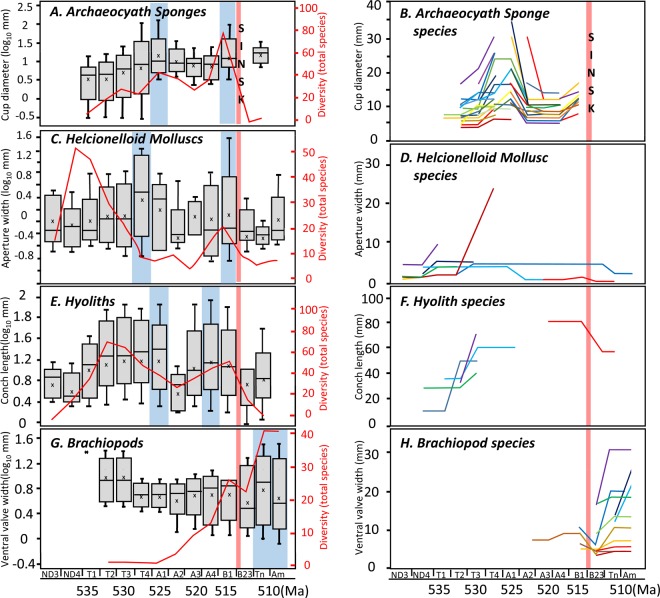
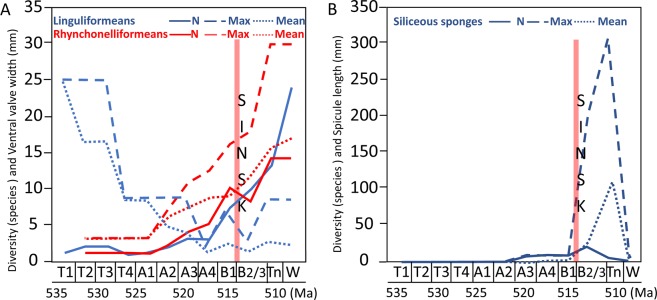
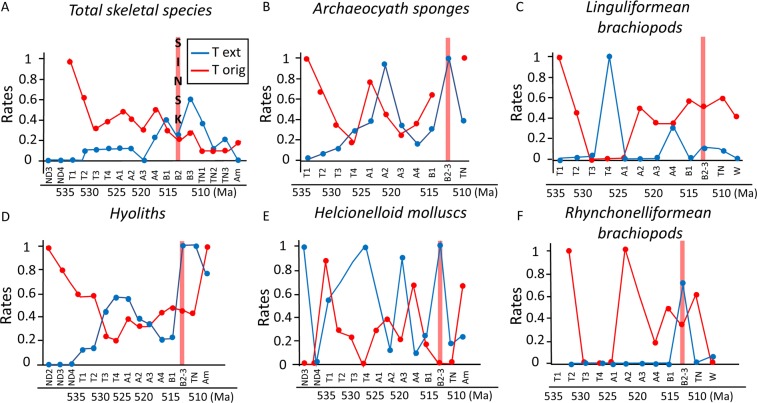
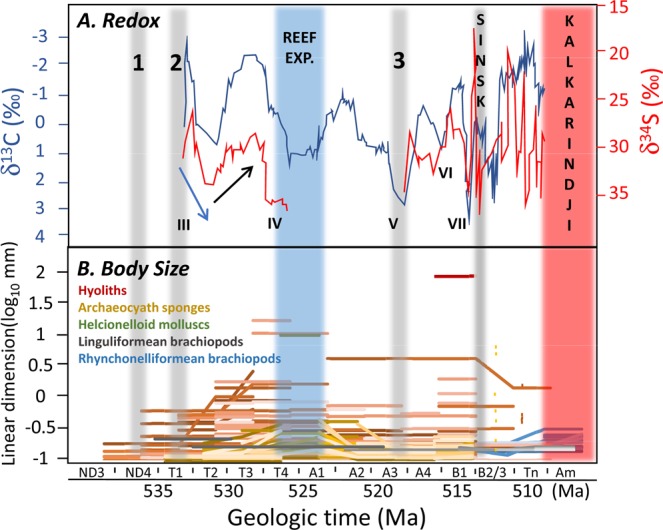
Many aspects of the drivers for, and evolutionary dynamics of, the Cambrian Explosion are poorly understood. Here we quantify high-resolution changes in species body size in major metazoan groups on the Siberian Platform during the early Cambrian (ca. 540–510 Million years ago (Ma)). Archaeocyath sponges, hyolith lophophorates, and helcionelloid mollusc species show dynamic and synchronous trends over million-year timescales, with peaks in body size during the latest Tommotian/early Atbadanian and late Atdabanian/early Botoman, and notably small body sizes in the middle Atdabanian and after the Sinsk anoxic extinction event, starting ca. 513 Ma. These intervals of body size changes are also mirrored in individual species and correlate positively with increased rates of origination and broadly with total species diversity. Calcitic brachiopods (rhynchonelliformeans), however, show a general increase in body size following the increase in species diversity through this interval: phosphatic brachiopods (linguliformeans) show a body size decrease that negatively correlates with diversity. Both brachiopod groups show a rapid recovery at the Sinsk Event. The synchronous changes in these metrics in archaeocyath, hyoliths and helcionelloids suggest the operation of external drivers through the early Cambrian, such as episodic changes in oxygenation or productivity. But the trends shown by brachiopods suggests a differing physiological response. Together, these dynamics created both the distinct evolutionary record of metazoan groups during the Cambrian Explosion and determined the nature of its termination.
Overview
The claims and statistics of this paper haven’t been checked yet.
Free: it reads the open-access text and checks the first 5 claims that cite a source we can check. Create a free account to check every claim.
Integrity signals
Registry
Cites
Statistics
Figures
Verification
Claims the paper makes
The claims and statistics of this paper haven’t been checked yet.
Free: it reads the open-access text and checks the first 5 claims that cite a source we can check. Create a free account to check every claim.
Claims other papers make about this one
Each is checked against this paper’s own text: does it say what the citing paper says it does?
The source backs part of the claim, not all of it — or backs it for a different population, condition or comparison.
In the citing paper
“Notwithstanding these concerns, the later early Cambrian short-lived δ13Ccarb excursions have also been tied to paired extinction/origination events (78).”
From Sea level controls on Ediacaran-Cambrian animal radiations (2024) · cites this paper as [78]
Experimental — accuracy not yet measuredThe cited source says what the claim attributes to it.
In the citing paper
“The response of brachiopods is quite different, calcitic shells showing a general increase in body size while phosphatic shells decreasing in size through time (Zhuravlev and Wood 2020).”
From Current understanding on the Cambrian Explosion: questions and answers (2021) · cites this paper as Zhuravlev and Wood 2020
The cited source says what the claim attributes to it.
In the citing paper
“A quantitative study of skeletal species from Siberia demonstrated marked changes in maximum linear body size dimensions but no unidirectional trend throughout the early Cambrian (Zhuravlev and Wood 2020).”
From Current understanding on the Cambrian Explosion: questions and answers (2021) · cites this paper as Zhuravlev and Wood 2020
The cited source says what the claim attributes to it.
In the citing paper
“However, the variation of the linear body size was in interesting paces: the size of archaeocyath, hyolith, and helcionelloid mollusc species varied in a synchronous rhythm over million-year timescales, with peaks positively correlated with origination rate and total species diversity, which appear to be a consequence of external drivers.”
From Current understanding on the Cambrian Explosion: questions and answers (2021) · cites this paper as Zhuravlev and Wood 2020
Self-check
Percentages, sums and reported differences re-computed from the paper’s own numbers.
The self-check needs the paper’s full text.
Citations
Cites
(2026) · Acta Palaeontologica Polonica · doi:10.4202/app · Cited by 2,792
Climate change affects marine fishes through the oxygen limitation of thermal tolerance
Pörtner, H. O., & Knust, R. (2007) · Science · doi:10.1126/science.1135471 · Cited by 2,030
GATTUSO, J.-P., ALLEMAND, D., & FRANKIGNOULLE, M. (1999) · American Zoologist · doi:10.1093/icb/39.1.160 · Cited by 709
Paleophysiology and end-Permian mass extinction
Knoll, A. H., Bambach, R. K., Payne, J. L., Pruss, S., & Fischer, W. W. (2007) · Earth and Planetary Science Letters · doi:10.1016/j.epsl.2007.02.018 · Cited by 665
Gattuso, J., Allemand, D., & Frankignoulle, M. (1999) · HAL (Le Centre pour la Communication Scientifique Directe) · Cited by 624
EVOLUTIONARY AND ECOLOGIC SIGNIFICANCE OF OXYGEN‐DEFICIENT MARINE BASINS
Rhoads, D. C., & Morse, J. W. (1971) · Lethaia · doi:10.1111/j.1502-3931.1971.tb01864.x · Cited by 578
Calibrating Rates of Early Cambrian Evolution
Bowring, S. A., Grotzinger, J. P., Isachsen, C. E., Knoll, A. H., Pelechaty, S. M., & Kolosov, P. (1993) · Science · doi:10.1126/science.11539488 · Cited by 526
Life at Stable low Oxygen Levels: Adaptations of Animals to Oceanic Oxygen Minimum Layers
Childress, J. J., & Seibel, B. A. (1998) · Journal of Experimental Biology · doi:10.1242/jeb.201.8.1223 · Cited by 408
MECHANISMS OF LARGE-SCALE EVOLUTIONARY TRENDS
McShea, D. W. (1994) · Evolution · doi:10.1111/j.1558-5646.1994.tb02211.x · Cited by 383
Payne, J. L., Boyer, A. G., Brown, J. H., Finnegan, S., Kowalewski, M., Krause, R. A., Lyons, S. K., McClain, C. R., McShea, D. W., Novack-Gottshall, P. M., et al. (2009) · Proceedings of the National Academy of Sciences · doi:10.1073/pnas.0806314106 · Cited by 325
Research works printed but not linked: 1
- Dzik, J. Is fossil evidence consistent with traditional views of the early metazoan phylogeny? In Simonetta, A. M. & Conway Morris, S. (eds), The Early Evolution of Metazoa and the Significance of Problematic Taxa. Cambridge University Press, Cambridge, 47–56 (1991).
Cited by
Wei, G.-Y., Planavsky, N. J., He, T., Zhang, F., Stockey, R. G., Cole, D. B., Lin, Y.-B., & Ling, H.-F. (2021) · Earth-Science Reviews · doi:10.1016/j.earscirev.2021.103506 · Cited by 122
Current understanding on the Cambrian Explosion: questions and answers
Zhang, X., & Shu, D. (2021) · PalZ · doi:10.1007/s12542-021-00568-5 · Cited by 96
Sea level controls on Ediacaran-Cambrian animal radiations
Bowyer, F. T., Wood, R. A., & Yilales, M. (2024) · Science Advances · doi:10.1126/sciadv.ado6462 · Cited by 54
Self-citationDevelopmental capacity and the early evolution of animals
Erwin, D. H. (2021) · Journal of the Geological Society · doi:10.1144/jgs2020-245 · Cited by 30
Zhuravlev, A. Y., Wood, R. A., & Bowyer, F. T. (2023) · Science Advances · doi:10.1126/sciadv.adh2558 · Cited by 29
“(E) Rates of archaeocyath sponge species origination and extinction (24).”
BackgroundInfluentialSelf-citationImpact of global climate cooling on Ordovician marine biodiversity
Ontiveros, D. E., Beaugrand, G., Lefèbvre, B., Marcilly, C. M., Servais, T., & Pohl, A. (2023) · Nature Communications · doi:10.1038/s41467-023-41685-w · Cited by 31
Zhuravlev, A. Y., Mitchell, E. G., Bowyer, F., Wood, R., & Penny, A. (2022) · Nature Communications · doi:10.1038/s41467-022-35283-5 · Cited by 24
Self-citationTectonic trigger to the first major extinction of the Phanerozoic: the early Cambrian Sinsk event
Myrow, P. M., Goodge, J. W., Brock, G. A., Betts, M. J., Park, T.-Y. S., Hughes, N. C., & Gaines, R. R. (2024) · Science Advances · doi:10.1126/sciadv.adl3452 · Cited by 22
Enduring evolutionary embellishment of cloudinids in the Cambrian
Park, T. S., Jung, J., Lee, M., Lee, S., Zhen, Y. Y., Hua, H., Warren, L. V., & Hughes, N. C. (2021) · Royal Society Open Science · doi:10.1098/rsos.210829 · Cited by 18
Low oxygen but dynamic marine redox conditions permitted the Cambrian Radiation
Alexander, R. D., Zhuravlev, A. Y., Bowyer, F. T., Pichevin, L., Poulton, S. W., Kouchinsky, A., & Wood, R. A. (2025) · Science Advances · doi:10.1126/sciadv.ads2846 · Cited by 24
Self-citationTransgression–regression cycles drive correlations in Ediacaran–Cambrian rock and fossil records
Segessenman, D. C., & Peters, S. E. (2024) · Paleobiology · doi:10.1017/pab.2023.31 · Cited by 13
“…and taxa with larger maximum body sizes, and there are increased traces of more metabolically demanding behaviors such as complex feeding/burrowing patterns, increased motility, and increased predator – prey interactions (Schiffbauer et al. 2016; Zhuravlev and Wood 2020; Zhang and Shu 2021).”
BackgroundPhylogenetic response of naraoiid arthropods to early–middle Cambrian environmental change
Bond, A. D., & Edgecombe, G. D. (2020) · Palaeontology · doi:10.1111/pala.12516 · Cited by 12
Coupling of geographic range and provincialism in Cambrian marine invertebrates
Na, L., Kocsis, Á. T., Li, Q., & Kiessling, W. (2022) · Paleobiology · doi:10.1017/pab.2022.36 · Cited by 10
Vauxiids as descendants of archaeocyaths: a hypothesis
Luo, C., Yang, A., Zhuravlev, A. Y., & Reitner, J. (2021) · Lethaia · doi:10.1111/let.12433 · Cited by 10
Self-citationThe record of sea water chemistry evolution during the Ediacaran–Cambrian from early marine cements
Xiong, Y., Wood, R. A., & Pichevin, L. (2022) · The Depositional Record · doi:10.1002/dep2.211 · Cited by 11
Self-citationGibson, B., Chipman, M., Attanasio, P., Qureshi, Z. A., Darroch, S., Rahman, I. A., & Laflamme, M. (2023) · Royal Society Open Science · doi:10.1098/rsos.230766 · Cited by 7
Wang, Z., Mángano, M. G., Buatois, L. A., & Hang, N. (2025) · Proceedings of the Royal Society B Biological Sciences · doi:10.1098/rspb.2025.0889 · Cited by 11
Zheng, Y., Tang, Q., Liu, P., Sun, J., Yao, X., Hao, W., Yang, X., Guo, J., Uesugi, K., Komiya, T., et al. (2021) · Journal of Geophysical Research Biogeosciences · doi:10.1029/2020jg006102 · Cited by 10
Murphy, A., Penny, A., Zhuravlev, A. Y., & Wood, R. A. (2025) · Proceedings of the Royal Society B Biological Sciences · doi:10.1098/rspb.2025.0968 · Cited by 10
Self-citationSalsi, V., Chiara, M., Pini, S., Kuś, P., Ruggiero, L., Bonanno, S., Rodolico, C., Previtali, S. C., D’Angelo, M. G., Maggi, L., et al. (2023) · medRxiv · doi:10.1101/2023.06.13.23291337 · Cited by 7
Ecological novelty at the start of the Cambrian and Ordovician radiations of echinoderms
Novack‐Gottshall, P. M., Purcell, J. N., Sultan, A., Ranjha, I., Deline, B., & Sumrall, C. D. (2024) · Palaeontology · doi:10.1111/pala.12688 · Cited by 4
Drozdov, A., Zhuravlev, A., Karpenko, A., Kolesnikov, K. A., & Ivantsov, A. (2022) · Russian Journal of Marine Biology · doi:10.1134/s1063074022010059
Self-citationRanking and serial thinking: A geometric solutionPreprint
Antonio, G. D., Raglio, S., & Mattia, M. (2023) · bioRxiv (Cold Spring Harbor Laboratory) · doi:10.1101/2023.08.03.551859 · Cited by 4
Morphological disparity and evolutionary patterns of Cambrian hyoliths
Liu, F., Topper, T. P., Strotz, L. C., Liang, Y., Hu, Y., Skovsted, C. B., & Zhang, Z. (2024) · Papers in Palaeontology · doi:10.1002/spp2.1554 · Cited by 3
Zhang, Y., Wang, X., Han, J., Xiao, J., Yong, Y., Yu, C., Yue, N., Sun, J., He, K., Hao, W., et al. (2025) · eLife · doi:10.1101/2023.07.28.550931 · Cited by 2
Ocean redox evolution past and present
Hardisty, D. S., & Lau, K. (2024) · Elsevier eBooks · doi:10.1016/b978-0-323-99762-1.00033-4 · Cited by 6
The Problem of Axial Organization and Body Plan of Brachiopods in Phylogeny
Мадисон, А. А., Кузьмина, Т. В., Temereva, E. H., & Malakhov, V. V. (2025) · Paleontological Journal · doi:10.1134/s0031030125600829 · Cited by 1
Maas, A. E., Lawson, G. L., Bergan, A. J., Wang, Z. A., & Tarrant, A. M. (2023) · bioRxiv (Cold Spring Harbor Laboratory) · doi:10.1101/2023.07.31.551235 · Cited by 1
Yalcin, H. A., Ramirez-Gonzalez, R. H., Jacott, C. N., Steuernagel, B., Sidhu, G. S., Kirby, R., Verbeek, E., Schoonbeek, H., Ridout, C. J., & Wells, R. (2023) · bioRxiv (Cold Spring Harbor Laboratory) · doi:10.1101/2023.08.01.551450
Zhang, Y., Wang, X., Han, J., Xiao, J., Yong, Y., Yu, C., Yue, N., Sun, J., He, K., Hao, W., et al. (2023) · eLife · doi:10.7554/elife.90211 · Cited by 1
Zhang, Y., Wang, X., Han, J., Xiao, J., Yong, Y., Yu, C., Yue, N., Sun, J., He, K., Hao, W., et al. (2023) · eLife · doi:10.7554/elife.90211.1
Zhang, Y., Wang, X., Han, J., Xiao, J., Yong, Y., Yu, C., Yue, N., Sun, J., He, K., Hao, W., et al. (2024) · eLife · doi:10.7554/elife.90211.2
Zhang, Y., Wang, X., Han, J., et al. (2024) · eLife · doi:10.7554/elife.90211.3.sa2
Zhang, Y., Wang, X., Han, J., Xiao, J., Yong, Y., Yu, C., Yue, N., Sun, J., He, K., Hao, W., et al. (2024) · eLife · doi:10.7554/elife.90211.3.sa0
Zhang, Y., Wang, X., Han, J., et al. (2024) · eLife · doi:10.7554/elife.90211.3.sa1
Zhang, Y., Wang, X., Han, J., Xiao, J., Yong, Y., Yu, C., Yue, N., Sun, J., He, K., Hao, W., et al. (2024) · eLife · doi:10.7554/elife.90211.3
On the origin of metazoan reefs
Zhuravlev, A. Y., & Wood, R. A. (2026) · Proceedings of the Royal Society B Biological Sciences · doi:10.1098/rspb.2025.2760
Self-citation
Metadata
- Authors
- Zhuravlev, A. Y., & Wood, R.
- Affiliations
- Lomonosov Moscow State University (RU)
- University of Edinburgh (GB)
- Corresponding author
- Wood, Rachel
- Venue
- Scientific Reports
- Published
- 2020-04-22
- Volume
- 10
- Issue
- 1
- Pages
- 6784-6784
- ISSN
- 2045-2322 (ISSN-L)
- PMC
- PMC7176670
- OpenAlex
- W3019145430
- Cited by
- 38
- References
- 41
- Citations by year
- 2026: 1 · 2025: 5 · 2024: 11 · 2023: 10 · 2022: 4 · 2021: 6 · 2020: 1
- FWCI
- 3.01
- Type
- journal article
- Language
- en
- Open access
- gold
- doi.org
- Licence
- cc-by
- creativecommons.org/licenses/by/4.0 (tdm)
- creativecommons.org/licenses/by/4.0 (vor)
- Locations
- Scientific Reports (publishedVersion, cc-by)
- PubMed Central (publishedVersion, cc-by)
- PubMed (publishedVersion)
- Edinburgh Research Explorer (University of Edinburgh) (submittedVersion, cc-by)
- Funders
- Natural Environment Research Council (NE/T008458/1, NE/I005935/1, NE/P013651, NE/P013651/1)
- Topics
- Physical Sciences › Earth and Planetary Sciences › Paleontology › Paleontology and Stratigraphy of Fossils
- Physical Sciences › Earth and Planetary Sciences › Paleontology › Evolution and Paleontology Studies
- Physical Sciences › Earth and Planetary Sciences › Paleontology › Paleontology and Evolutionary Biology
- Keywords
- Cambrian explosion, Lower Cambrian, Siberian Platform, hyoliths, species diversity, oxygenation, productivity, Cambrian stratigraphy
- MeSH terms
- Animals, Biological Evolution, Fossils, Invertebrates, Paleontology, Siberia, Biodiversity, Body Size, Spatio-Temporal Analysis
About these checks
Registry, retraction, Cites and statistics results are computed, not judged, with one exception: a printed reference that no index lists is read once by a model before it counts as a citation error. Claims are extracted by a model and kept only when their quote appears verbatim in the text; each cited source is then checked, with a model’s help, for whether it says what the claim relies on. Those verdicts can be wrong — read the claim’s quote and the cited source before relying on one.
Statistics and arithmetic are recomputed, not judged.
Confidence bands are shown only for fields calibrated on our annotated test set. None is calibrated yet, so no band is shown.
What counts as a claim ›How we measure confidence ›How we check this ›
Are you an author, or do you see a problem with this page? Request a review
Data sources
Bibliographic data: Semantic Scholar, OpenAlex, Crossref.
Contains information from the Semantic Scholar Academic Graph Datasets, made available under the ODC Attribution License (ODC-BY 1.0).
Semantic Scholar’s data is described in: Kinney, R., et al. (2023). The Semantic Scholar Open Data Platform. arXiv:2301.10140.
