

The DOI matches its Crossref record; 37 of the 38 references it cites were found in a registry or an index.
Optimization of cultivation techniques improves the agronomic behavior of Agaricus subrufescens
Open accessAbstract
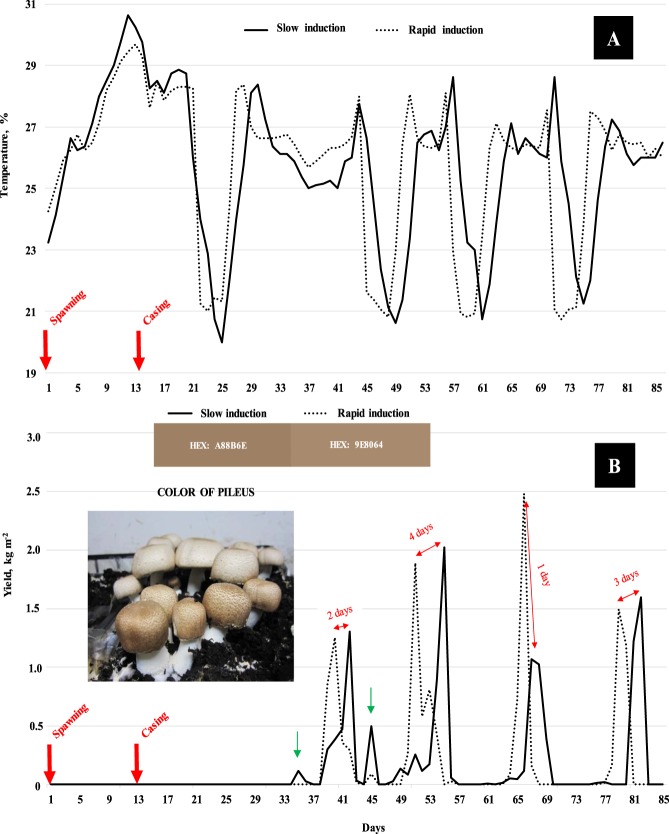
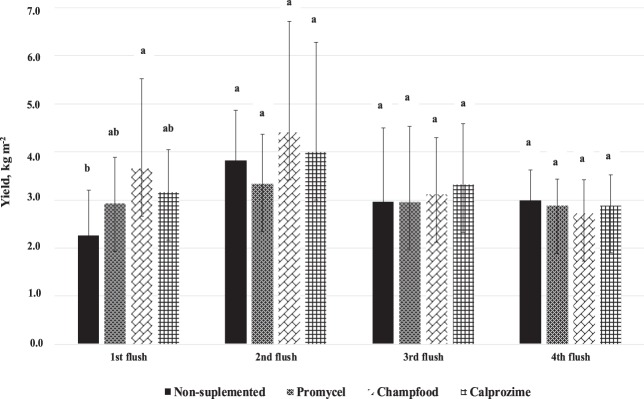
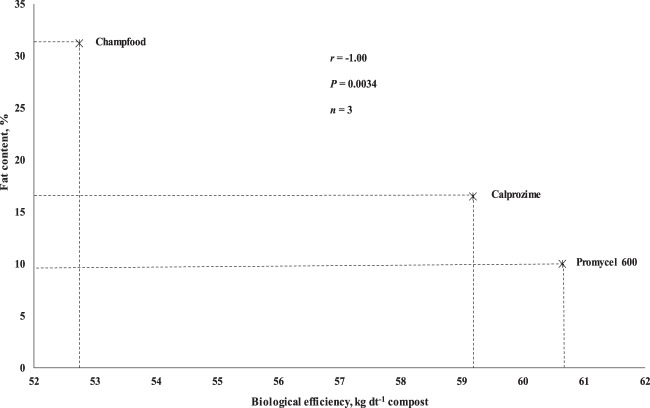
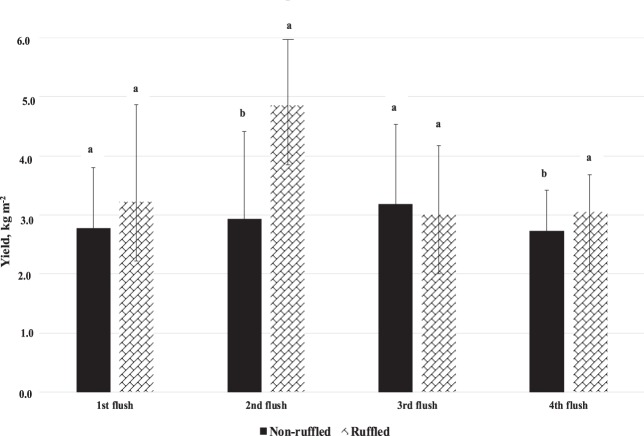
New species of medicinal mushrooms have emerged over the past several decades, such as the Sun mushroom, Agaricus subrufescens. Horticultural improvements are required to shift its cultivation from small-scale local production to large-scale international production. The research reported here evaluated the agronomic behavior and the chemical characteristics of the Sun mushroom as a function of i) nutritional supplementation ii) ruffling of the casing layer and iii) the temperature management on the primordia induction and reduction of the crop cycle. Supplementation was beneficial for yield, unit mushroom weigh and decrease in time to first harvest. Supplementation improved biological efficiency with Champfood providing a yield increase of 15% over the non-supplemented compost. Among the supplements only Promycel increased the individual mushroom weight. Ruffling overall improved the yield in the 2 nd and 4 th flush. Already biological efficiency was greater by 21%. The highest yield harvested in any single day in the crop occurred in 3 rd flush with the amount of 2.484 kg of mushrooms per m 2 for the rapid induction method. Still the biological efficiency was not significantly affected by the mushroom induction temperature method. Only the fat content of the mushrooms was positively affected by the rapid induction of primordia. Champfood supplement promotes a reduction in the value of earliness and an increase of 1 st flush yield. The ruffling technique provided an increase in biological efficiency due to the great number of mushrooms harvested. Rapid primordia induction allowed the crop cycle to end 3 days earlier than the slow primordia induction, providing a higher production rate.
Overview
The claims and statistics of this paper haven’t been checked yet.
Run the check — free, no account needed. It reads the open-access text and checks the sources it cites.
Integrity signals
Registry
Cites
Statistics
Figures
Verification
Claims the paper makes
The claims and statistics of this paper haven’t been checked yet.
Run the check — free, no account needed. It reads the open-access text and checks the sources it cites.
Claims other papers make about this one
Each is checked against this paper’s own text: does it say what the citing paper says it does?
The source backs part of the claim, not all of it — or backs it for a different population, condition or comparison.
In the citing paper
“Pardo-Giménez et al. (2020) noted that crude protein reached 15% and more dry weight in mushrooms grown using Acacia sawdust and beech sawdust as fertilizer.”
From Recycling municipal, agricultural and industrial waste into energy, fertilizers, food and construction materials, and economic feasibility: a review (2023) · cites this paper as Pardo-Giménez et al. 2020
Experimental — accuracy not yet measured
Self-check
Percentages, sums and reported differences re-computed from the paper’s own numbers.
The self-check needs the paper’s full text.
Citations
Cites
Current Overview of Mushroom Production in the World
Royse, D. J., Baars, J., & Tan, Q. (2017) · Edible and Medicinal Mushrooms · doi:10.1002/9781119149446.ch2 · Cited by 575
Acta Scientiarum Polonorum Hortorum Cultus
(2019) · Acta Scientiarum Polonorum Hortorum Cultus · doi:10.24326/asphc · Cited by 412
Firenzuoli, F., Gori, L., & Lombardo, G. (2008) · Evidence-Based Complementary and Alternative Medicine · doi:10.1093/ecam/nem007 · Cited by 241
Miles, P. G., & Chang, S. (1997) · WORLD SCIENTIFIC eBooks · doi:10.1142/3296 · Cited by 218
Agaricus subrufescens, a cultivated edible and medicinal mushroom, and its synonyms
Kerrigan, R. W. (2005) · Mycologia · doi:10.1080/15572536.2006.11832834 · Cited by 165
Carneiro, A. A. J., Ferreira, I. C. F. R., Dueñas, M., Barros, L., da Silva, R., Gomes, E., & Santos‐Buelga, C. (2012) · Food Chemistry · doi:10.1016/j.foodchem.2012.12.036 · Cited by 134
Agaricus subrufescens: A review
Wisitrassameewong, K., Karunarathna, S. C., Thongklang, N., Zhao, R., Callac, P., Moukha, S., Férandon, C., Chukeatirote, E., & Hyde, K. D. (2012) · Saudi Journal of Biological Sciences · doi:10.1016/j.sjbs.2012.01.003 · Cited by 116
Largeteau, M. L., Llarena‐Hernández, R. C., Régnault-Roger, C., & Savoie, J. (2011) · Applied Microbiology and Biotechnology · doi:10.1007/s00253-011-3630-7 · Cited by 65
Pardo‐Giménez, A., Catalán, L., Carrasco, J., Álvarez‐Ortí, M., Zied, D. C., & González, J. E. P. (2015) · Journal of the Science of Food and Agriculture · doi:10.1002/jsfa.7579 · Cited by 58
Self-citationAlternative to peat for Agaricus brasiliensis yield
Colauto, N. B., da Silveira, A. R., da Eira, A. F., & Linde, G. A. (2009) · Bioresource Technology · doi:10.1016/j.biortech.2009.08.052 · Cited by 54
Research works printed but not linked: 9
- Sánchez, E. J., Zied, D. C. & Alberto, E. Edible mushroom production in the Americas, in 9th International Conference on Mushroom Biology and Mushroom Products. WSMBMP, Shanghai, China, pp. 2–11, (2018).
- Fritsche, G. & Sonnenberg, A. S. M. Mushroom strains. In The Cultivation of Mushrooms, ed. by van Griensven, L. J. L. D., Interlingua, Sussex, England, pp. 101–123 (1988).
- Couvy, J. Les facteurs de la fructification de l’Agaricus bisporus (champignon de couche). Bull FNSACC 14, 585–604 (1972).
- Kopytowski Filho, J. & Minhoni, M. T. A. Produtividade e eficiência biológica da linhagem ABL 99/30 de Agaricus blazei em três tipos de compostos e em dois ambientes de cultivo. Energia na Agricultura 22, 65–78 (2007).
- Lau, O. Methods of chemical analysis of mushrooms. In Tropical Mushrooms. Biological Nature and Cultivation Methods, ed. by Chang, S. T. & Quimio, T. H. The Chinese University Press, Hong Kong, China, pp. 87–116 (1982).
- Randle, P. E. & Smith, J. F. Economic aspects of compost supplementation. Mushroom Journal 165, 297–305 (1986).
- Van Gils, J. J. Cultivation. In The Cultivation of Mushrooms, ed. by van Griensven, L. J. L. D., Interlingua, Sussex, England, pp. 263-308, (1988).
- Vedder, P. J. C. Practical experience with the cac’ing technique. Mushroom Science 12, 381–385 (1989).
- Eira, A. F., Nascimento, J. S., Colauto, N. B. & Celso, P. G. Tecnologia de cultivo do cogumelo medicinal Agaricus blazei (Agaricus brasiliensis). Agropecuária Catarinense 18, 45–49 (2005).
Cited by
Kumla, J., Suwannarach, N., Sujarit, K., Penkhrue, W., Kakumyan, P., Jatuwong, K., Vadthanarat, S., & Lumyong, S. (2020) · Molecules · doi:10.3390/molecules25122811 · Cited by 324
Peng, X., Jiang, Y., Chen, Z., Osman, A. I., Farghali, M., Rooney, D. W., & Yap, P.-S. (2023) · Environmental Chemistry Letters · doi:10.1007/s10311-022-01551-5 · Cited by 333
Impact of Cultivation Substrate and Microbial Community on Improving Mushroom Productivity: A Review
Suwannarach, N., Kumla, J., Zhao, Y., & Kakumyan, P. (2022) · Biology · doi:10.3390/biology11040569 · Cited by 181
El-Ramady, H. R., Abdalla, N. A., Fawzy, Z. F., Badgar, K., Llanaj, X., Törős, G., Hajdú, P., Eid, Y. Z., & Prokisch, J. (2022) · Sustainability · doi:10.3390/su14063667 · Cited by 133
Jayaraman, S., Yadav, B., Dalal, R. C., Naorem, A., Sinha, N. K., Rao, C. S., Dang, Y. P., Patra, A. K., Datta, S. P., & Rao, A. S. (2024) · Farming System · doi:10.1016/j.farsys.2024.100098 · Cited by 79
Metadata
- Authors
- Pardo-Giménez, A., Pardo, J. E., Dias, E. S., Rinker, D. L., Caitano, C. E. C., & Zied, D. C.
- Affiliations
- Universidade Federal de Lavras (BR)
- University of Guelph (CA)
- Universidade Estadual Paulista (Unesp) (BR)
- Corresponding author
- Zied, Diego Cunha
- Venue
- Scientific Reports
- Published
- 2020-05-18
- Volume
- 10
- Issue
- 1
- Pages
- 8154-8154
- ISSN
- 2045-2322 (ISSN-L)
- PMC
- PMC7235075
- OpenAlex
- W3025511850
- Cited by
- 35
- References
- 38
- Citations by year
- 2026: 4 · 2025: 2 · 2024: 3 · 2023: 7 · 2022: 9 · 2021: 9 · 2020: 1
- FWCI
- 3.90
- Type
- journal article
- Language
- en
- Open access
- gold
- doi.org
- Licence
- cc-by
- creativecommons.org/licenses/by/4.0 (tdm)
- creativecommons.org/licenses/by/4.0 (vor)
- Locations
- Scientific Reports (publishedVersion, cc-by)
- PubMed Central (publishedVersion, cc-by)
- PubMed (publishedVersion)
- LA Referencia (Red Federada de Repositorios Institucionales de Publicaciones Científicas) (submittedVersion, other-oa)
- Funders
- Universidade Estadual Paulista (FAPESP 2018/21492-2)
- Topics
- Health Sciences › Medicine › Pharmacology (medical) › Fungal Biology and Applications
- Life Sciences › Agricultural and Biological Sciences › Plant Science › Mycorrhizal Fungi and Plant Interactions
- Life Sciences › Biochemistry, Genetics and Molecular Biology › Molecular Biology › Fungal and yeast genetics research
- Keywords
- Agaricus subrufescens, medicinal mushroom cultivation, dietary supplementation, temperature control, biological efficiency, mushroom yield, crop duration
- MeSH terms
- Agaricus, Agriculture, Culture Media, Soil, Temperature
About these checks
Registry, retraction, Cites and statistics results are computed, not judged, with one exception: a printed reference that no index lists is read once by a model before it counts as a citation error. Claims are extracted by a model and kept only when their quote appears verbatim in the text; each cited source is then checked, with a model’s help, for whether it says what the claim relies on. Those verdicts can be wrong — read the claim’s quote and the cited source before relying on one.
Statistics and arithmetic are recomputed, not judged.
Confidence bands are shown only for fields calibrated on our annotated test set. None is calibrated yet, so no band is shown.
What counts as a claim ›How we measure confidence ›How we check this ›
Are you an author, or do you see a problem with this page? Request a review
Data sources
Bibliographic data: Semantic Scholar, OpenAlex, Crossref.
Contains information from the Semantic Scholar Academic Graph Datasets, made available under the ODC Attribution License (ODC-BY 1.0).
Semantic Scholar’s data is described in: Kinney, R., et al. (2023). The Semantic Scholar Open Data Platform. arXiv:2301.10140.
