

Machine learning based identification of relevant parameters for functional voice disorders derived from endoscopic high-speed recordings
Open accessThe DOI matches its Crossref record; 63 of the 63 references it cites were found in a registry or an index.
Abstract
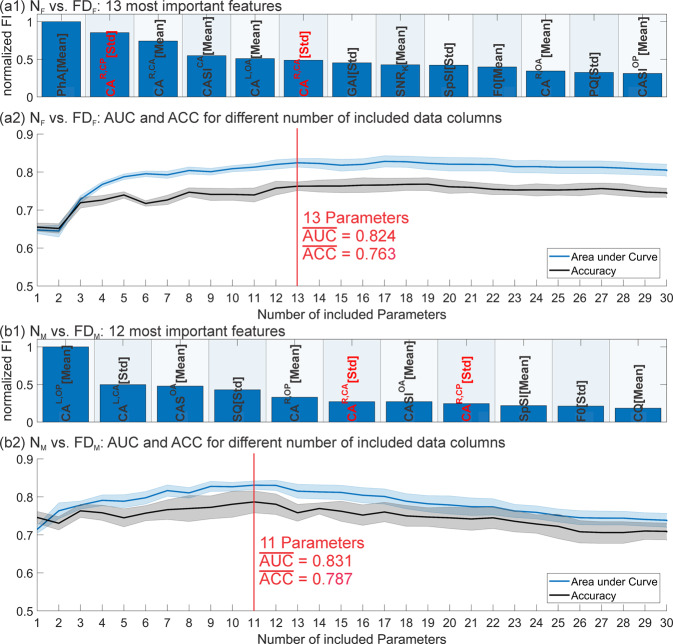
In voice research and clinical assessment, many objective parameters are in use. However, there is no commonly used set of parameters that reflect certain voice disorders, such as functional dysphonia (FD); i.e. disorders with no visible anatomical changes. Hence, 358 high-speed videoendoscopy (HSV) recordings (159 normal females (N F), 101 FD females (FD F), 66 normal males (N M), 32 FD males (FD M)) were analyzed. We investigated 91 quantitative HSV parameters towards their significance. First, 25 highly correlated parameters were discarded. Second, further 54 parameters were discarded by using a LogitBoost decision stumps approach. This yielded a subset of 12 parameters sufficient to reflect functional dysphonia. These parameters separated groups N F vs. FD F and N M vs. FD M with fair accuracy of 0.745 or 0.768, respectively. Parameters solely computed from the changing glottal area waveform (1D-function called GAW) between the vocal folds were less important than parameters describing the oscillation characteristics along the vocal folds (2D-function called Phonovibrogram). Regularity of GAW phases and peak shape, harmonic structure and Phonovibrogram-based vocal fold open and closing angles were mainly important. This study showed the high degree of redundancy of HSV-voice-parameters but also affirms the need of multidimensional based assessment of clinical data.
Overview
The claims and statistics of this paper haven’t been checked yet.
Free: it reads the open-access text and checks the first 5 claims that cite a source we can check. Create a free account to check every claim.
Integrity signals
Registry
Cites
Statistics
Figures
Verification
Claims the paper makes
The claims and statistics of this paper haven’t been checked yet.
Free: it reads the open-access text and checks the first 5 claims that cite a source we can check. Create a free account to check every claim.
Claims other papers make about this one
Each is checked against this paper’s own text: does it say what the citing paper says it does?
The source backs part of the claim, not all of it — or backs it for a different population, condition or comparison.
In the citing paper
“Laryngeal imaging—including videolaryngoscopy, stroboscopy, and high-speed videoendoscopy—represents the reference standard for laryngeal evaluation [9,16,17,18]; however, access depends on practitioner expertise, equipment availability, and cost, while neuromuscular disorders may present without visible structural lesions, complicating diagnosis [19].”
From Diagnostic Accuracy of Artificial Intelligence in Laryngeal Disorders: An Integrative Review (2026) · cites this paper as [17]
Experimental — accuracy not yet measured
Self-check
Percentages, sums and reported differences re-computed from the paper’s own numbers.
The self-check needs the paper’s full text.
Citations
Cites
Statistics corner: A guide to appropriate use of correlation coefficient in medical research.
(2012) · Europe PMC (PubMed Central) · Cited by 4,239
An empirical comparison of supervised learning algorithms
Caruana, R., & Niculescu-Mizil, A. (2006) · Proceedings of the 23rd international conference on Machine learning - ICML '06 · doi:10.1145/1143844.1143865 · Cited by 2,780
Géron, A. (2017) · Cited by 1,443
Acoustic Correlates of Breathy Vocal Quality
Hillenbrand, J., Cleveland, R. A., & Erickson, R. L. (1994) · Journal of Speech, Language, and Hearing Research · doi:10.1044/jshr.3704.769 · Cited by 747
Holmberg, E. B., Hillman, R. E., & Perkell, J. S. (1988) · The Journal of the Acoustical Society of America · doi:10.1121/1.396829 · Cited by 642
Harmonics-to-noise ratio as an index of the degree of hoarseness
Yumoto, E., Gould, W. J., & Baer, T. (1982) · The Journal of the Acoustical Society of America · doi:10.1121/1.387808 · Cited by 559
Stevens, K. N. (1999) · The MIT Press eBooks · doi:10.7551/mitpress/1072.001.0001 · Cited by 515
Induction of One-Level Decision Trees
Iba, W., & Langley, P. (1992) · Machine Learning Proceedings 1992 · doi:10.1016/b978-1-55860-247-2.50035-8 · Cited by 349
Laryngoscopic and Voice Characteristics of Aged Persons
Honjo, I., & Isshiki, N. (1980) · Archives of Otolaryngology - Head and Neck Surgery · doi:10.1001/archotol.1980.00790270013003 · Cited by 288
Normalized noise energy as an acoustic measure to evaluate pathologic voice
Kasuya, H., Ogawa, S., Mashima, K., & Ebihara, S. (1986) · The Journal of the Acoustical Society of America · doi:10.1121/1.394384 · Cited by 256
Research works printed but not linked: 6
- Titze, I. R. Principles of voice production (2nd ed.) (National Center for Voice and Speech, 2000).
- Wendler, J., Seidner, W. & Eysholdt, U. Lehrbuch der Phoniatrie und Pädaudiologie (4th ed.) 139-189 (Georg Thieme, 2005). · DOI
- Stemple, J. C. & Fry, L. B. Laryngeal Evaluation. 110–119 (Georg Thieme, 2010).
- Deliyski, D. Laryngeal evaluation., 245–270 (Georg Thieme, 2010).
- Géron, A. Hands-on machine learning with Scikit-Learn & TensorFlow (vol. 1) 183-205 (Media, Inc., 2017).
- Géron, A. Hands-on machine learning with Scikit-Learn & TensorFlow (vol. 1) 81-106 (Media, Inc., 2017).
Cited by
A Novel Approach for Classification of Speech Emotions Based on Deep and Acoustic Features
Er, M. B. (2020) · IEEE Access · doi:10.1109/access.2020.3043201 · Cited by 177
“During the speech, air flows through the trachea from the lungs to the larynx, and this air flow creates speech signals by vibrating the vocal cords [1].”
BackgroundUr Rehman, M., Shafique, A., Azhar, Q.-U.-A., Jamal, S. S., Gheraibia, Y., & Usman, A. B. (2024) · Engineering Applications of Artificial Intelligence · doi:10.1016/j.engappai.2024.108047 · Cited by 73
Nobel, S. M. N., Swapno, S. M. M. R., Islam, M. R., Safran, M., Alfarhood, S., & Mridha, M. F. (2024) · Scientific Reports · doi:10.1038/s41598-024-64987-5 · Cited by 79
OpenHSV: an open platform for laryngeal high-speed videoendoscopy
Kist, A. M., Dürr, S., Schützenberger, A., & Döllinger, M. (2021) · Scientific Reports · doi:10.1038/s41598-021-93149-0 · Cited by 48
Self-citationArtificial intelligence in clinical endoscopy: Insights in the field of videomics
Paderno, A., Gennarini, F., Sordi, A., Montenegro, C., Lancini, D., Villani, F. P., Moccia, S., & Piazza, C. (2022) · Frontiers in Surgery · doi:10.3389/fsurg.2022.933297 · Cited by 35
“These results were obtained through an organized and stepwise approach headed by the Erlangen research group that achieved high-fidelity automatic segmentation of the glottis (23) and glottal midline (26) as well as extraction of relevant functional parameters (27).”
MethodLiu, G. S., Jovanovic, N., Sung, C. K., & Doyle, P. C. (2024) · Otolaryngology–Head and Neck Surgery · doi:10.1002/ohn.809 · Cited by 23
Predicting 3D soft tissue dynamics from 2D imaging using physics informed neural networks
Movahhedi, M., Liu, X., Geng, B., Elemans, C. P. H., Xue, Q., Wang, J., & Zheng, X. (2023) · Communications Biology · doi:10.1038/s42003-023-04914-y · Cited by 38
“Previous data-driven methods were developed for automatic reconstruction of vibratory parameters from endoscopy images; 37 however, the methods cannot predict other physical quantities.”
Are source-filter interactions detectable in classical singing during vowel glides?
Echternach, M., Herbst, C. T., Köberlein, M. C., Story, B. H., Döllinger, M., & Gellrich, D. (2021) · The Journal of the Acoustical Society of America · doi:10.1121/10.0005432 · Cited by 19
Self-citationLocalization and quantification of glottal gaps on deep learning segmentation of vocal folds
Pedersen, M., Larsen, C. F., Madsen, B., & Eeg, M. (2023) · Scientific Reports · doi:10.1038/s41598-023-27980-y · Cited by 20
“Some measures of the vocal folds in GAT are shown, however, to be better than others 17 .”
BackgroundTur, B., Gühring, L., Wendler, O., Schlicht, S., Drummer, D., & Kniesburges, S. (2023) · Bioengineering · doi:10.3390/bioengineering10101130 · Cited by 19
“The symmetry of vocal fold vibration is a critical aspect of voice production, and asymmetric characteristics of the vocal fold motion can be indicative of vocal pathologies [91,92].”
BackgroundSelf-citationKim, Y., Oh, J., Choi, S., Jung, A., Lee, J., Lee, Y. S., & Kim, J. K. (2021) · JMIR mhealth and uhealth · doi:10.2196/25816 · Cited by 14
Interdependencies between acoustic and high-speed videoendoscopy parameters
Schlegel, P., Kist, A. M., Kunduk, M., Dürr, S., Döllinger, M., & Schützenberger, A. (2021) · PLoS ONE · doi:10.1371/journal.pone.0246136 · Cited by 14
Self-citationMalinowski, J., Pietruszewska, W., Kowalczyk, M., & Niebudek-Bogusz, E. (2024) · Journal of Cancer Research and Clinical Oncology · doi:10.1007/s00432-023-05543-y · Cited by 12
“The temporal aspect can be evaluated either on its own (by analysis of glottal area and width waveform) or along with mediolateral dimen-sion—using digital kymography (Schlegel et al. 2020; Kist et al. 2021a; Yousef et al. 2023).”
MethodIndian Sign Language Recognition Using Ensemble Based Classifier Combination
Sahoo, A. K., Sarangi, P. K., & Yadav, C. S. (2022) · Macromolecular Symposia · doi:10.1002/masy.202100286 · Cited by 10
Kałuża, J., Niebudek-Bogusz, E., Malinowski, J., Strumiłło, P., & Pietruszewska, W. (2022) · Cancers · doi:10.3390/cancers14194697 · Cited by 9
Laryngeal High-Speed Videoendoscopy with Laser Illumination: A Preliminary Report
Malinowski, J., Niebudek-Bogusz, E., Just, M., Morawska, J., Racino, A., Hoffman, J., Barańska, M., Kowalczyk, M., & Pietruszewska, W. (2021) · Otolaryngologia Polska · doi:10.5604/01.3001.0015.2575 · Cited by 8
Machine learning based estimation of hoarseness severity using sustained vowels
Schraut, T., Schützenberger, A., Arias‐Vergara, T., Kunduk, M., Echternach, M., & Döllinger, M. (2024) · The Journal of the Acoustical Society of America · doi:10.1121/10.0024341 · Cited by 9
Self-citationMaximum and Minimum Phonatory Glottal Area before and after Treatment for Vocal Nodules
Hsu, C., Yang, M., Fang, T., Wu, C., Tsai, Y., Chang, G., & Tsai, M. (2020) · Healthcare · doi:10.3390/healthcare8030326 · Cited by 7
Analysis of vibratory mode changes in symmetric and asymmetric activation of the canine larynx
Schlegel, P., Berry, D. A., & Chhetri, D. K. (2022) · PLoS ONE · doi:10.1371/journal.pone.0266910 · Cited by 6
“To ensure replicability, we added all code we used for data evaluation in the supporting information and only used already established procedures that are described in more detail in the cited sources [19, 24].”
MethodSelf-citationSchraut, T., Doellinger, M., Kunduk, M., Echternach, M., Dürr, S., Werz, J., & Schützenberger, A. (2025) · Journal of Voice · doi:10.1016/j.jvoice.2024.12.008 · Cited by 6
Self-citationSchraut, T., Schützenberger, A., Arias‐Vergara, T., Kunduk, M., Echternach, M., Dürr, S., Werz, J., & Doellinger, M. (2025) · Frontiers in Artificial Intelligence · doi:10.3389/frai.2025.1601716 · Cited by 7
Self-citationNyquist Plot Parametrization for Quantitative Analysis of Vibration of the Vocal Folds
Arias‐Vergara, T., Döllinger, M., Schraut, T., Khairuddin, K. A. M., & Schützenberger, A. (2023) · Journal of Voice · doi:10.1016/j.jvoice.2023.01.014 · Cited by 5
Self-citationMalinowski, J., Pietruszewska, W., Stawiski, K., Pietrzak, M., Barańska, M., Rycerz, A., & Niebudek-Bogusz, E. (2023) · Cancers · doi:10.3390/cancers15143716 · Cited by 5
“In our study, all temporal parameters differed significantly between healthy subjects and patients with organic pathologies, similar to the literature [40].”
Multi-modal speech emotion detection using optimised deep neural network classifier
Padman, S. N., & Magare, D. B. (2023) · Computer Methods in Biomechanics and Biomedical Engineering Imaging & Visualization · doi:10.1080/21681163.2023.2212082 · Cited by 5
“For the duration of the speech, the flow of air tends to create speech signals in the way of the trachea and the vocal cords are vibrated from the alveolus to the glottis (Schlegel et al. 2020; Er 2020).”
BackgroundAndrade-Miranda, G. X., Chatzipapas, K., Arias-Londoño, J. D., & Godino-Llorente, J. I. (2025) · Data in Brief · doi:10.1016/j.dib.2025.111376 · Cited by 4
“Laryngeal HSV sequences have also been used to investigate functional voice disorders, accurately distinguishing normal and abnormal vibration patterns of the vocal folds based on features derived from different FP [ 37 , 38 ].”
Gühring, L., Tur, B., Semmler, M., Schützenberger, A., & Kniesburges, S. (2024) · Frontiers in Physiology · doi:10.3389/fphys.2024.1455360 · Cited by 5
Self-citationSchlegel, P., Berry, D. A., Moffatt, C., Zhang, Z., & Chhetri, D. K. (2024) · The Journal of the Acoustical Society of America · doi:10.1121/10.0025135 · Cited by 3
Self-citationDeep Learning-Based Detection of Glottis Segmentation Failures
Dadras, A. A., & Aichinger, P. (2024) · Bioengineering · doi:10.3390/bioengineering11050443 · Cited by 5
“In [28], the most important features for classification are outlined.”
BackgroundPedersen, M. (2021) · Scholarly Journal of Otolaryngology · doi:10.32474/sjo.2021.06.000237 · Cited by 3
“Various deep learning software are discussed [21-23].”
Suleman, A., & Rutt, A. L. (2025) · Eye & ENT Research · doi:10.1002/eer3.70006 · Cited by 2
Semmler, M., Lasar, S., Kremer, F., Reinwald, L., Wittig, F., Peters, G., Schraut, T., Wendler, O., Seyferth, S., Schützenberger, A., et al. (2023) · Journal of Voice · doi:10.1016/j.jvoice.2023.07.019 · Cited by 2
Self-citationPadman, S. N., & Magare, D. B. (2024) · International Conference on Intelligent Cyber Physical Systems and Internet of Things (ICoICI) · doi:10.1109/icoici62503.2024.10696312 · Cited by 2
“The vocal cords vibrate when the air flows through trachea [1].”
BackgroundMethodDiagnostic Accuracy of Artificial Intelligence in Laryngeal Disorders: An Integrative Review
Mairesse, S., Maniaci, A., Briganti, G., & Lechien, J. R. (2026) · Journal of Personalized Medicine · doi:10.3390/jpm16060301 · Cited by 1
Patel, R. R., Zhang, Z., Doellinger, M., Adeola, A., & Kniesburges, S. (2026) · Journal of Speech Language and Hearing Research · doi:10.1044/2026_jslhr-25-00611 · Cited by 1
“…glottal area wave-form in human participants remain limited, especially across high frequency and soft vocal intensity, as most studies have been on modal/typical phonation (Ahmad et al., 2012; Arias-Vergara et al., 2023; Bohr et al., 2013; R. R. Patel et al., 2014a; Schlegel et al., 2020).”
Self-citationRegional language Speech Emotion Detection using Deep Neural Network
Padman, S. N., & Magare, D. B. (2022) · ITM Web of Conferences · doi:10.1051/itmconf/20224403071 · Cited by 1
Accelerating Endoscopic Diagnosis by Videomics
Piazza, C., Paderno, A., Montenegro, C., Sordi, A., & Gennarini, F. (2023) · Journal of Head & Neck Physicians and Surgeons · doi:10.4103/jhnps.jhnps_28_23 · Cited by 1
Comparative Analysis of YOLO-based Models for Vocal Cord Segmentation in Laryngoscopic Images
Steinbach, J., Vrba, J., Jirsa, T., Cejnek, M., & Urbaniova, Z. (2024) · Procedia Computer Science · doi:10.1016/j.procs.2024.09.457 · Cited by 1
Lei, J. (2022) · International Conference on Sustainable Computing and Data Communication Systems (ICSCDS) · doi:10.1109/icscds53736.2022.9760979
Künstliche Intelligenz bei akustischen Signalen zur Bestimmung der Stimmqualität
Schlegel, P. (2023) · Sprache · Stimme · Gehör · doi:10.1055/a-2089-5758
“[17] Schlegel P, Kniesburges S, Dürr S et al.”
BackgroundSelf-citationVocal Folds Image Segmentation Based on YOLO Network
Steinbach, J., Urbaniova, Z., & Vrba, J. (2024) · Lecture notes in networks and systems · doi:10.1007/978-3-031-53549-9_15 · Cited by 1
Jeleniewska, J., Malinowski, J., Niebudek-Bogusz, E., & Pietruszewska, W. (2025) · Journal of Clinical Medicine · doi:10.3390/jcm14196861
Echternach, M., Döllinger, M., Richter, B., & Köberlein, M. C. (2026) · Journal of Otolaryngology - Head and Neck Surgery · doi:10.1177/19160216251409743
“34 From the GAW and PVG, as well as the electroglotto-graphical and audio signals, the parameters introduced below were calculated using the Multi Signal Analyzer (Division of Phoniatrics, University Hospital Erlangen, Erlangen, Germany).”
Self-citationHybrid acoustic-deep features with auto encoders for speech emotion recognition
Raghu, K., Sadanandam, M., & Hanumanthu, B. (2026) · Multimedia Tools and Applications · doi:10.1007/s11042-026-21244-3 · Cited by 2
Metadata
- Authors
- Schlegel, P., Kniesburges, S., Dürr, S., Schützenberger, A., & Döllinger, M.
- Affiliations
- Friedrich-Alexander-Universität Erlangen-Nürnberg (DE)
- Corresponding author
- Schlegel, Patrick
- Venue
- Scientific Reports
- Published
- 2020-06-29
- Volume
- 10
- Issue
- 1
- Pages
- 10517-10517
- ISSN
- 2045-2322 (ISSN-L)
- PMC
- PMC7324600
- OpenAlex
- W3040522169
- Semantic Scholar
- a3fd467f131d952b003305293261f3800579245b
- Cited by
- 43
- References
- 63
- Citations by year
- 2026: 4 · 2025: 5 · 2024: 11 · 2023: 9 · 2022: 6 · 2021: 6 · 2020: 2
- FWCI
- 3.46
- Type
- journal article
- Language
- en
- Open access
- gold
- doi.org
- Licence
- cc-by
- creativecommons.org/licenses/by/4.0 (tdm)
- creativecommons.org/licenses/by/4.0 (vor)
- Locations
- Scientific Reports (publishedVersion, cc-by)
- PubMed Central (publishedVersion, cc-by)
- PubMed (publishedVersion)
- OPUS FAU (Kooperativer Bibliotheksverbund Berlin-Brandenburg (KOBV), on behalf of the Universitätsbibliothek Erlangen-Nürnberg) (submittedVersion, cc-by)
- Funders
- Deutsche Forschungsgemeinschaft (BO4399/2‐1, DO1247/8-1, 323308998)
- Topics
- Health Sciences › Health Professions › Speech and Hearing › Voice and Speech Disorders
- Social Sciences › Psychology › Experimental and Cognitive Psychology › Phonetics and Phonology Research
- Health Sciences › Medicine › Pulmonary and Respiratory Medicine › Respiratory and Cough-Related Research
- Keywords
- functional dysphonia, high-speed videoendoscopy, voice disorders, parameter selection, LogitBoost, glottal area waveform, vocal fold vibration, parameter redundancy
- MeSH terms
- Machine Learning, Age Factors, Endoscopy, Female, Humans, Laryngoscopy, Male, Voice Disorders, Voice Quality
About these checks
Registry, retraction, Cites and statistics results are computed, not judged, with one exception: a printed reference that no index lists is read once by a model before it counts as a citation error. Claims are extracted by a model and kept only when their quote appears verbatim in the text; each cited source is then checked, with a model’s help, for whether it says what the claim relies on. Those verdicts can be wrong — read the claim’s quote and the cited source before relying on one.
Statistics and arithmetic are recomputed, not judged.
Confidence bands are shown only for fields calibrated on our annotated test set. None is calibrated yet, so no band is shown.
What counts as a claim ›How we measure confidence ›How we check this ›
Are you an author, or do you see a problem with this page? Request a review
Data sources
Bibliographic data: Semantic Scholar, OpenAlex, Crossref.
Contains information from the Semantic Scholar Academic Graph Datasets, made available under the ODC Attribution License (ODC-BY 1.0).
Semantic Scholar’s data is described in: Kinney, R., et al. (2023). The Semantic Scholar Open Data Platform. arXiv:2301.10140.
