

An Incremental Voltage Difference Based Technique for Online State of Health Estimation of Li-ion Batteries
Open accessThe DOI matches its Crossref record; 38 of the 38 references it cites were found in a registry or an index.
Abstract
Accurate state of health (SOH) estimation of rechargeable batteries is important for the safe and reliable operation of electric vehicles (EVs), smart phones, and other battery operated systems. We propose a novel method for accurate SOH estimation which does not necessarily need full charging data. Using only partial charging data during normal usage, 10 derived voltage values ([Formula: see text]) are collected. The initial [Formula: see text] point is fixed and then for every 1.5% increase in the Coulomb counting, other points are selected. The difference between the [Formula: see text] values ([Formula: see text]) and the average temperature during the charging form the feature vector at different SOH levels. The training data set is prepared by extrapolating the charging voltage curves for the complete SOH range using initial 400 cycles of data. The trained artificial neural network (ANN) based on the feature vector and SOH values can be used in any battery management system (BMS) with a time complexity of only [Formula: see text]. Less than 1% mean absolute error (MAE) for the test cases has been achieved. The proposed method has a moderate training data requirement and does not need any knowledge of previous SOH, state of charge (SOC) vs. OCV relationship, and absolute SOC value.
Overview
The claims and statistics of this paper haven’t been checked yet.
Free: it reads the open-access text and checks the first 5 claims that cite a source we can check. Create a free account to check every claim.
Integrity signals
Registry
Cites
Statistics
Figures
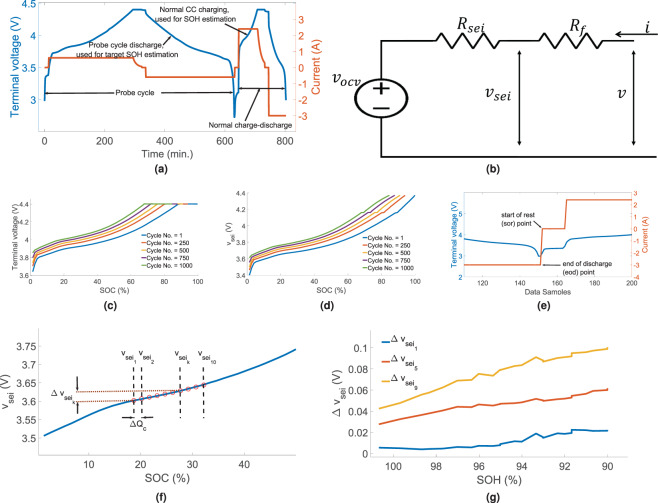
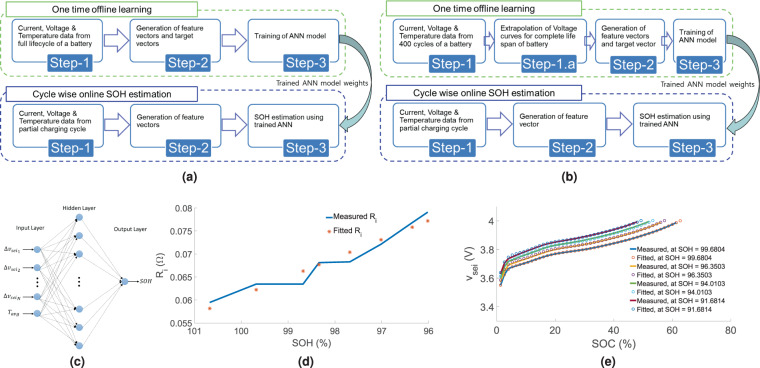
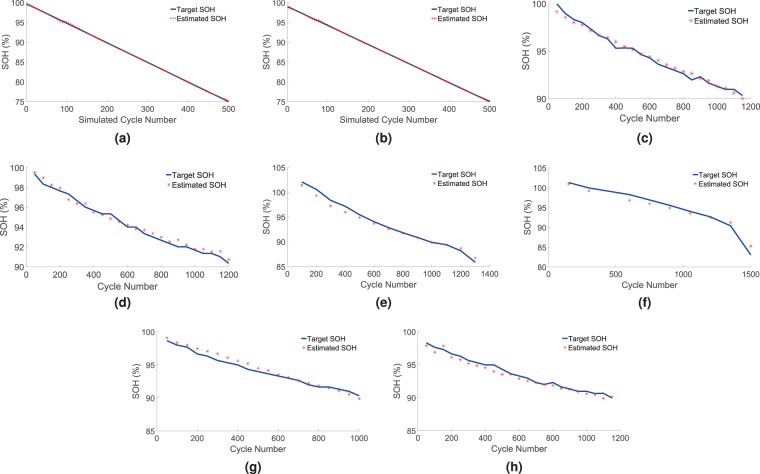
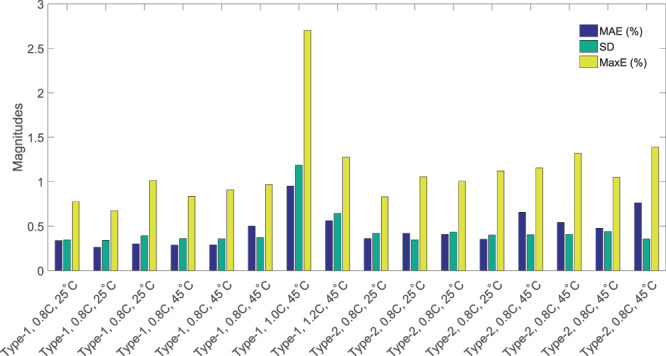
Verification
Claims the paper makes
The claims and statistics of this paper haven’t been checked yet.
Free: it reads the open-access text and checks the first 5 claims that cite a source we can check. Create a free account to check every claim.
Claims other papers make about this one
Each is checked against this paper’s own text: does it say what the citing paper says it does?
The source backs part of the claim, not all of it — or backs it for a different population, condition or comparison.
In the citing paper
“The experimental results showed that the error between the extrapolated prediction curve and that measured is less than 1%.”
From A Review of Lithium-Ion Battery State of Health Estimation and Prediction Methods (2021) · cites this paper as [97]
Experimental — accuracy not yet measuredIn the citing paper
“The proposed algorithm in this paper greatly improved accuracy and did not need the past SOH, SOC, OCV curves, and other information, which indicates that it has strong applicability.”
From A Review of Lithium-Ion Battery State of Health Estimation and Prediction Methods (2021) · cites this paper as [97]
Self-check
Percentages, sums and reported differences re-computed from the paper’s own numbers.
The self-check needs the paper’s full text.
Citations
Cites
IEEE Transactions on Vehicular Technology
(2023) · IEEE Transactions on Vehicular Technology · doi:10.1109/tvt.25 · Cited by 1,174
Modeling of Lithium-Ion Battery Degradation for Cell Life Assessment
Xu, B., Oudalov, A., Ulbig, A., Andersson, G., & Kirschen, D. S. (2018) · IEEE Transactions on Smart Grid · doi:10.1109/tsg.2016.2578950 · Cited by 1,162
Lipu, M. S. H., Hannan, M. A., Hussain, A., Hoque, M. M., Ker, P. J., Saad, M. H. M., & Ayob, A. (2018) · Journal of Cleaner Production · doi:10.1016/j.jclepro.2018.09.065 · Cited by 755
State of Charge and State of Health Estimation for Lithium Batteries Using Recurrent Neural Networks
Chaoui, H., & Ibe-Ekeocha, C. C. (2017) · IEEE Transactions on Vehicular Technology · doi:10.1109/tvt.2017.2715333 · Cited by 555 · cited 1×
“Simplified analytical expressions are provided in35 for capacity loss (QLoss (10)) and the resistance of the SEI layer (Rsei (11)).”
BackgroundShen, P., Ouyang, M., Lu, L., Li, J., & Feng, X. (2018) · IEEE Transactions on Vehicular Technology · doi:10.1109/tvt.2017.2751613 · Cited by 534 · cited 1×
“∆ = ∆ ∆ ∆ Q Q Q Q [ (50,0) (100,0) (400,0)] (20) Loss Loss Loss T Loss”
Hu, X., Yuan, H., Zou, C., Li, Z., & Zhang, L. (2018) · IEEE Transactions on Vehicular Technology · doi:10.1109/tvt.2018.2865664 · Cited by 532 · cited 1×
“∆ = ∆ ∆ ∆ R R R R [ (50,0) (100,0) (400,0)] (21) sei sei sei T sei”
Li, Y., Abdel-Monem, M., Gopalakrishnan, R., Berecibar, M., Nanini-Maury, E., Omar, N., van den Bossche, P., & Van Mierlo, J. (2018) · Journal of Power Sources · doi:10.1016/j.jpowsour.2017.10.092 · Cited by 531 · cited 3×
“The summation in (4) is taken for the complete discharge period.”
BackgroundMethodLi, X., Yuan, C., Li, X., & Wang, Z. (2020) · Energy · doi:10.1016/j.energy.2019.116467 · Cited by 482
Xiong, R., Zhang, Y., Wang, J., He, H., Peng, S., & Pecht, M. (2019) · IEEE Transactions on Vehicular Technology · doi:10.1109/tvt.2018.2864688 · Cited by 449 · cited 3×
“The descriptions of the symbols used in (10)-(12) are provided in Table 4.”
BackgroundMethodWeng, C., Sun, J., & Peng, H. (2014) · Journal of Power Sources · doi:10.1016/j.jpowsour.2014.02.026 · Cited by 375 · cited 2×
“= × SOH n capacity n C ( ) ( ) 100% (5) max”
Method
Cited by
Review on state-of-health of lithium-ion batteries: Characterizations, estimations and applications
Yang, S., Zhang, C., Jiang, J., Zhang, W., Zhang, L., & Wang, Y. (2021) · Journal of Cleaner Production · doi:10.1016/j.jclepro.2021.128015 · Cited by 435
Sui, X., He, S., Vilsen, S. B., Meng, J., Teodorescu, R., & Stroe, D.-I. (2021) · Applied Energy · doi:10.1016/j.apenergy.2021.117346 · Cited by 409
Lu, J., Xiong, R., Tian, J., Wang, C., & Sun, F. (2023) · Nature Communications · doi:10.1038/s41467-023-38458-w · Cited by 403
“Speci fi cally, charging capacity sequences within a voltage sampling window (so-called partial charging curves) are taken as the input of each DNN, as demonstrated by previous studies 25,34 – 37 .”
Applications of artificial neural network based battery management systems: A literature review
Kurucan, M., Özbaltan, M., Yetgin, Z., & Alkaya, A. (2024) · Renewable and Sustainable Energy Reviews · doi:10.1016/j.rser.2023.114262 · Cited by 256
Multi-modal framework for battery state of health evaluation using open-source electric vehicle data
Liu, H., Li, C., Hu, X., Li, J., Zhang, K., Xie, Y., Wu, R., & Song, Z. (2025) · Nature Communications · doi:10.1038/s41467-025-56485-7 · Cited by 209
“Although effective features 45 , such as IC curves 46 and incremental voltage difference 47 , can be extracted during the charging process, as displayed in Fig.”
A Review of Lithium-Ion Battery State of Health Estimation and Prediction Methods
Yao, L., Xu, S., Tang, A., Zhou, F., Hou, J., Xiao, Y., & Fu, Z. (2021) · World Electric Vehicle Journal · doi:10.3390/wevj12030113 · Cited by 237
“Current, voltage and battery temperatures were collected [97] from constant current constant voltage (CC-CV) charging experiment under 400 cycles.”
MethodBattery management strategies: An essential review for battery state of health monitoring techniques
Pradhan, S. K., & Chakraborty, B. (2022) · Journal of Energy Storage · doi:10.1016/j.est.2022.104427 · Cited by 194
Recovering large-scale battery aging dataset with machine learning
Tang, X., Liu, K., Li, K., Widanage, W. D., Kendrick, E., & Gao, F. (2021) · Patterns · doi:10.1016/j.patter.2021.100302 · Cited by 120
“34,35 This difficulty is by and large caused by the inherent nature of the general supervised training algo-rithms—a training target (battery capacity) is required to map input features.”
BackgroundMethodOnline Estimations of Li-Ion Battery SOC and SOH Applicable to Partial Charge/Discharge
Bavand, A., Khajehoddin, S. A., Ardakani, M., & Tabesh, A. (2022) · IEEE Transactions on Transportation Electrification · doi:10.1109/tte.2022.3162164 · Cited by 124
Panwar, N. G., Singh, S., Garg, A., Gupta, A. K., & Gao, L. (2021) · Energy Technology · doi:10.1002/ente.202000984 · Cited by 110
Jiang, Z., Shi, Q., Wei, Y., Hanlin, W., Bingzhao, G., & He, L. (2021) · Energy · doi:10.1016/j.energy.2021.120805 · Cited by 125
Vanem, E., Salucci, C. B., Bakdi, A., & Alnes, Ø. Å. S. (2021) · Journal of Energy Storage · doi:10.1016/j.est.2021.103158 · Cited by 92
Liu, G., Zhang, X., & Liu, Z. (2022) · Energy · doi:10.1016/j.energy.2022.124851 · Cited by 100
State of Charge Estimation in Lithium-Ion Batteries: A Neural Network Optimization Approach
Hossain Lipu, M. S., Hannan, M. A., Hussain, A., Ayob, A., Saad, M. H. M., & Muttaqi, K. M. (2020) · Electronics · doi:10.3390/electronics9091546 · Cited by 84
“It is reported in the literature that a lithium-ion battery with a cycle life below 80% is declared unsafe and unserviceable [37].”
BackgroundChen, H., Zhang, T., Gao, Q., Han, Z., Jin, Y., Li, L., Yang, K., Xu, Y., Liu, X., Xu, X., et al. (2022) · Journal of Cleaner Production · doi:10.1016/j.jclepro.2022.134583 · Cited by 84
A Practical Data-Driven Battery State-of-Health Estimation for Electric Vehicles
Rahimian, S. K., & Tang, Y. (2022) · IEEE Transactions on Industrial Electronics · doi:10.1109/tie.2022.3165295 · Cited by 79
“their health features under constant current-constant voltage (CC-CV) protocols [13], [14], [17], [18], [22], [25]–[28], [33].”
BackgroundQin, P., Zhao, L., & Liu, Z. (2021) · Journal of Energy Storage · doi:10.1016/j.est.2021.103644 · Cited by 76
Qiao, J., Wang, S., Yu, C., Yang, X. G., & Fernández, C. (2022) · Energy · doi:10.1016/j.energy.2022.126164 · Cited by 63
Wang, Y., Li, K., Peng, P., & Chen, Z. (2022) · IEEE Transactions on Industrial Electronics · doi:10.1109/tie.2022.3224201 · Cited by 54
“For the nonlinear and non-Gaussian characteristics of capacity degradation, many scholars have proposed SOH prediction methods based on the exponential decay empirical model [16] and the black-box model with excellent performance through the continuous training iterations of machine learning, including migration learn…”
MethodTransfer learning based generalized framework for state of health estimation of Li-ion cells
Sahoo, S., Hariharan, K. S., Agarwal, S., Swernath, S. B., Bharti, R., Han, S., & Lee, S. (2022) · Scientific Reports · doi:10.1038/s41598-022-16692-4 · Cited by 48
“However, any variation in charging current profile would change the elapsed time features thereby deviating the output of SVM. Incremental voltage difference has been used as a feature in 18 to train a shallow ANN.”
BackgroundMethodSelf-citationChan, H. S., Dickinson, E. J. F., Heins, T. P., Park, J., Gaberšček, M., Lee, Y. Y., Heinrich, M., Ruiz, V., Napolitano, E., Kauranen, P., et al. (2022) · Journal of Power Sources · doi:10.1016/j.jpowsour.2022.231814 · Cited by 52
A comparative study of data-driven battery capacity estimation based on partial charging curves
Lin, C., Xu, J., Jiang, D., Hou, J., Liang, Y., Zhang, X., Li, E., & Mei, X. (2023) · Journal of Energy Chemistry · doi:10.1016/j.jechem.2023.09.025 · Cited by 50
Predictive Modeling for Electric Vehicle Battery State of Health: A Comprehensive Literature Review
Gong, J., Xu, B. S., Chen, F., & Zhou, G. (2025) · Energies · doi:10.3390/en18020337 · Cited by 48
Koster, D., Marongiu, A., Chahardahcherik, D., Braun, C. F., Schulte, D., & Figgemeier, E. (2023) · Journal of Energy Storage · doi:10.1016/j.est.2023.106839 · Cited by 47
Nazim, M. S., Chakma, A., Joha, M. I., Alam, S. S., Rahman, M. M., Umam, M. K. S., & Jang, Y. M. (2025) · ICT Express · doi:10.1016/j.icte.2025.05.013 · Cited by 49
Xiong, R., Wang, S., Takyi‐Aninakwa, P., Jin, S., Fernández, C., Huang, Q., Hu, W., & Zhan, W. (2024) · Protection and Control of Modern Power Systems · doi:10.23919/pcmp.2023.000234 · Cited by 42
Zhang, Y., Wang, Y., Xia, Y. F., & Chen, W. (2022) · Journal of Energy Storage · doi:10.1016/j.est.2022.106323 · Cited by 34
Moulik, B., Dubey, A. K., & Ali, A. M. (2022) · IEEE Transactions on Intelligent Transportation Systems · doi:10.1109/tits.2022.3224561 · Cited by 35
“The electrical, electro-thermal, and electro-chemical models proposed by [19], [20], [21], [22], [23], [24], and [25] are analysed in details in Table I.”
JIBHKATE, U. N., & Mujumdar, U. B. (2022) · Electrochimica Acta · doi:10.1016/j.electacta.2022.140944 · Cited by 35
Sun, Z., He, W., Wang, J., & He, X. (2024) · Energies · doi:10.3390/en17112487 · Cited by 29
Pandey, S. V., Parikh, N., Prochowicz, D., Akın, S., Satapathi, S., Tavakoli, M. M., Kalam, A., & Yadav, P. (2023) · Sustainable Energy & Fuels · doi:10.1039/d2se01209j · Cited by 27
Small-Sample-Learning-Based Lithium-Ion Batteries Health Assessment: An Optimized Ensemble Framework
Sui, X., He, S., & Teodorescu, R. (2024) · IEEE Transactions on Industry Applications · doi:10.1109/tia.2024.3351619 · Cited by 24
“Additionally, given that obtaining the full battery charging and discharging curves may not always be feasible in practical scenarios, utilizing measurements from partial curves becomes crucial [28].”
BackgroundXiong, R., Wang, S., Yu, C., Fernández, C., Xiao, W., & Jia, J. (2022) · Journal of Energy Storage · doi:10.1016/j.est.2022.106484 · Cited by 23
Certifying battery usage for V2G and second life with a blockchain-based framework
Augello, A., Gallo, P., Sanseverino, E. R., Sciabica, G., & Sciumè, G. (2023) · Computer Networks · doi:10.1016/j.comnet.2023.109558 · Cited by 27
Nazim, M. S., & Elavarasan, R. M. (2026) · Renewable and Sustainable Energy Reviews · doi:10.1016/j.rser.2026.116848 · Cited by 25
Yadu, A., Swernath, S., Agarwal, S., Sreevatsa, D., Lee, S., & Kim, Y.-J. (2023) · IEEE Transactions on Automation Science and Engineering · doi:10.1109/tase.2023.3307168 · Cited by 22
“An ECM based model is employed from [4] as the environment for RL simulation.”
BackgroundMethodInfluentialSelf-citationMa, B., Yu, H., Yang, L., Liu, Q., Xie, H., Chen, S., Zhang, Z., Zhang, C., Zhang, L., Wang, W., et al. (2022) · Rare Metals · doi:10.1007/s12598-022-02138-3 · Cited by 22
“[87] proposed a novel artificial neutral network for SOH estimation and achieved high accuracy, with a mean absolute error of 1%.”
BackgroundPark, S. W., Lee, H., & Won, Y. S. (2022) · Journal of Energy Storage · doi:10.1016/j.est.2022.103987 · Cited by 21
Efficient estimating and clustering lithium-ion batteries with a deep-learning approach
Wu, J., Sun, Z., Li, D., He, W., Yang, D., Wu, Z., Geng, X., Yang, H. M., Wang, H., Hu, L., et al. (2025) · Communications Engineering · doi:10.1038/s44172-025-00488-1 · Cited by 17
“Extracting correlation features, such as peak area, peak position, and peak width from incremental capacity curves for estimating battery SOH is considered as a well-established technique 29 – 31 .”
Analysis of Lithium-ion Batteries through Electrochemical Impedance Spectroscopy Modeling
Krishna, T. V., Kasi, J., Saiprakash, C., Priyadarshini, S., Joga, S. R. K., Maharana, M. K., & Panigrahi, C. K. (2024) · Journal of The Electrochemical Society · doi:10.1149/1945-7111/ad561f · Cited by 18
Yang, S., Ling, L., Li, X., Han, J., & Tong, S. (2024) · Journal of Dynamics Monitoring and Diagnostics · doi:10.37965/jdmd.2024.562 · Cited by 45
“All these factors Significant studies have been devoted to predicting battery SOH in recent years [14-18].”
BackgroundSbarra, R. G., Pasquali, M., Coppotelli, G., Gaudenzi, P., di Ienno, D., Ciancarelli, C., & Picci, N. (2025) · Energies · doi:10.3390/en18215858 · Cited by 15
“A notable study used data from a constant current constant voltage (CC-CV) charging experiment to train battery models, achieving accurate SOH predictions [186].”
An Overview of Data-Driven Methods for the State of Health Estimation
Eleftheriadis, P., Giazitzis, S., Ozmalatyalilar, C., Leva, S., & Zich, R. (2023) · IEEE International Conference on Environment and Electrical Engineering and IEEE Industrial and Commercial Power Systems Europe (EEEIC / I&CPS Europe) · doi:10.1109/eeeic/icpseurope57605.2023.10194864 · Cited by 16
“In [16], it was observed that ANNs, which are composed of interconnected layers of artificial neurons, are capable of processing and analyzing data.”
BackgroundSmart Health Evaluation for Lithium‐Ion Battery With Super‐Short‐Segment Charging
Li, Q., Wei, Z., He, H., Shen, J., Li, Y., Yang, X., & Vilathgamuwa, D. M. (2025) · Advanced Science · doi:10.1002/advs.202503583 · Cited by 9
Tracing battery usage for second life market with a blockchain-based framework
Augello, A., Gallo, P., Sanseverino, E. R., Sciabica, G., & Sciumè, G. (2021) · IEEE International Conference on Environment and Electrical Engineering and IEEE Industrial and Commercial Power Systems Europe (EEEIC / I&CPS Europe) · doi:10.1109/eeeic/icpseurope51590.2021.9584472 · Cited by 9
Lithium Battery Model and Its Application to Parallel Charging
Shieh, Y.-T., Wu, C.-C., Liu, C.-Y., Chieng, W.-H., Su, Y., Jeng, S.-L., & Chang, E. Y. (2022) · Energies · doi:10.3390/en15134767 · Cited by 8
Research on battery SOH estimation method based on electrochemical impedance spectroscopy
Wang, R., Wang, S., Yuhao, W., Guo, Y., Siwen, C., & Jinlei, S. (2024) · IEEE Vehicle Power and Propulsion Conference (VPPC) · doi:10.1109/vppc63154.2024.10755197 · Cited by 6
Liu, X., Chen, L., Zhu, L., Wang, J., Chen, L., Zeng, X., Song, Z., & Wang, L. (2023) · Journal of Electrochemical Energy Conversion and Storage · doi:10.1115/1.4063431 · Cited by 6
Zhao, C., Yao, L. Y., Xiao, Y., Cui, G., Qu, C., Dai, H., Chen, Z. B., Wang, T., & Fei, Z. (2025) · Engineering Applications of Artificial Intelligence · doi:10.1016/j.engappai.2025.111924 · Cited by 5
Feature selection of battery capacity estimation method based on deep learning
Xu, J., Qu, J., & Xu, H. (2025) · Journal of Power Sources · doi:10.1016/j.jpowsour.2025.236809 · Cited by 5
Feature-enhanced encoder-decoder model for accurate lithium-ion battery state of health estimation
Ju, W., Wei, Z., Wu, M.-W., Shen, Z., He, Q., & Zhao, Y. (2025) · Journal of Energy Storage · doi:10.1016/j.est.2025.116430 · Cited by 5
Lithium-Ion Battery State of Health Prediction Using a Hybrid BiLSTM–Random Forest Framework
Mohamud, N. M., Ayob, S. M., Saimon, S. M., Nahhas, A. M., Arfeen, Z. A., Masud, M. I., & Aman, M. (2026) · Batteries · doi:10.3390/batteries12060210 · Cited by 4
“However, the methods based on partial charging data and voltage-derived features reached less than 1% MAE without resorting to full charging cycles and prior knowledge of SOC–OCV relationships, limiting both computational and operational efforts for real-world deployment [13].”
Vignesh, S., Seng, H., Selvaraj, J. A.-L., & Tey, K. S. (2024) · Journal of Energy Storage · doi:10.1016/j.est.2024.113453 · Cited by 7
Wang, S., Liu, C.-L., Chen, G., Liu, Y., Chen, J., & Kao, Y.-C. (2025) · International Journal of Electrochemical Science · doi:10.1016/j.ijoes.2025.100946 · Cited by 4
Battery Safety Enhancement in Electric Vehicles—A Review Paper
Saraswathi, R. J. V., & Prabhu, V. V. (2021) · Springer proceedings in energy · doi:10.1007/978-981-16-0719-6_14 · Cited by 3
Vanem, E., Alnes, Ø. Å., & Lam, J. (2021) · Annual Conference of the PHM Society · doi:10.36001/phmconf.2021.v13i1.2972 · Cited by 4
Kalman-Filter-Based Learning of Characteristic Profiles of Lithium-Ion Batteries
Arima, M., Lin, L., & Fukui, M. (2022) · Sensors · doi:10.3390/s22145156 · Cited by 3
“The charge–discharge voltage difference indicates the RUL [11,12].”
BackgroundInfluentialHealth evaluation for in-service electric vehicle battery pack with recursive Gaussian process
Liu, H., Zheng, Y., Che, Y., Li, J., Pan, Y., & Hu, X. (2025) · Energy · doi:10.1016/j.energy.2025.139380 · Cited by 2
Errakkas, K., Kissaoui, M., Lajouad, R., Magri, A. E., Khayat, A., & Atifi, Y. (2026) · Scientific African · doi:10.1016/j.sciaf.2026.e03244 · Cited by 2
Lithium battery state of health (SOH): analysis based on capacity increments and data-driven methods
He, L., Chen, L., & Wei, W. (2025) · Electrical Engineering · doi:10.1007/s00202-025-03227-z · Cited by 2
“A more refined selection of features or an increased dataset size may mitigate these spikes and enhance model precision [19, 20].”
Rabah, M., Immonen, E., Shahsavari, S., Haghbayan, M.-H., Murashko, K., & Immonen, P. (2021) · Anwendungen und Konzepte der Wirtschaftsinformatik · doi:10.26034/lu.akwi.2021.3317 · Cited by 2
Jarosz-Kozyro, A., Bauer, W., & Baranowski, J. (2026) · Energies · doi:10.3390/en19143346 · Cited by 1
Raza, K., Ouledboutaarjia, O., Rifat, R. A., Berecibar, M., & Hosen, M. S. (2026) · Renewable and Sustainable Energy Reviews · doi:10.1016/j.rser.2026.117559 · Cited by 1
Electric Battery Life State of Health Models for Electric Vehicles
Choudhary, R. (2021) · Cited by 1
Intelligent and Conventional Methods for SoC and SoH Estimation
Gandhi, R. V., Jha, A., & Bhavsar, K. (2023) · Lecture notes in networks and systems · doi:10.1007/978-981-99-3761-5_36 · Cited by 1
Chan, H. S., Dickinson, E. J. F., Heins, T. P., Park, J., Gaberšček, M., Lee, Y. Y., Heinrich, M., Ruiz, V., Napolitano, E., Kauranen, P., et al. (2022) · SSRN Electronic Journal · doi:10.2139/ssrn.4109008 · Cited by 2
“…charging/discharging energy and efficiency [23,34], rate of change of CV charging current [32], nominal voltage [23,32,34], peak heights/ratio from incremental capacity analysis (ICA) [40], incremental voltage difference [22], characteristic features from the voltage relaxation curve [41], etc.”
MethodBattery state-of-health estimation methods
Wang, S., Fan, Y., Stroe, D., Fernández, C., Yu, C., Cao, W., & Chen, Z. (2021) · Elsevier eBooks · doi:10.1016/b978-0-323-90472-8.00007-x
Maiya, V., Channegowda, J., & Lingaraj, C. (2022) · International Journal of Energy Research · doi:10.1002/er.8481
“Some of the methods available in literature include the use of Neural Networks,(6) SVM (Support Vector Machines),(7) LSTM (Long Short-Term Memory),(8,9) Learning Machines(10,11) and also potential difference approach.(12) All these procedures evaluate the battery state by the “black box” approach, which means estimati…”
MethodSrilekha, N., Rana, K., Kumar, P., Ravanikar, S. K., & Chandrashekar, P. (2023) · Power Research · doi:10.33686/pwj.v18i2.1103
Huang, Q., Wang, S., Chen, Z., Xiong, R., Fernández, C., & Stroe, D. (2023) · Springer eBooks · doi:10.1007/978-981-99-5344-8_1
Batarya Yönetim Sistemlerinde İleri Beslemeli Sinir Ağları Uygulamaları
ÖZBALTAN, M., & KURUCAN, M. (2023) · doi:10.59287/myc.628
Vignesh, S., Selvaraj, J. A.-L., Seng, H., & Tey, K. S. (2023) · International Conference on Advances in Electrical, Electronics and Computational Intelligence (ICAEECI) · doi:10.1109/icaeeci58247.2023.10370779 · Cited by 2
Lithium-ion Battery Health State Prediction based on Adaptive Fine-tuning Learning Approach
Yao, L. Y., Zhao, C., Cui, G., Dai, H., & Shen, Y. (2024) · CAA International Conference on Vehicular Control and Intelligence (CVCI) · doi:10.1109/cvci63518.2024.10830275
Age Estimation of Li-ion Batteries Based on Internal Resistance for Electric Vehicle Applications
Tashakor, N., Asadi, E., Hashemi-Zadeh, A., Mohamed, M., Amirrezai, M., Schotten, H. D., & Goetz, S. M. (2025) · Annual Conference of the IEEE Industrial Electronics Society (IECON) · doi:10.1109/iecon58223.2025.11221075
“Naha [33] estimated SOH from partial charging data, training an artificial neural network on voltage and temperature.”
Battery real-time power monitoring and control in automotive embedded systems
Aryanfar, Y., Keçebaş, A., fardinnia, H., Aghazadeh, R., Castellanos, H. G., Wagini, H. A., Ghasemlou, S. M., & García-Alcaráz, J. L. (2026) · Elsevier eBooks · doi:10.1016/b978-0-443-33861-8.00015-x
Battery Management Systems: integration and optimization in automotive applications
Aryanfar, Y., Keçebaş, A., Baghlou, A. A., Aghazadeh, R., Sadabad, A. N., Radmehr, P., Ghasemlou, S. M., & Bouabidi, A. (2026) · Elsevier eBooks · doi:10.1016/b978-0-443-33861-8.00011-2
HPPC Derived Feature Augmented DNN for SOC Estimation in Electric Vehicles
Mühendis, A., & Akkaya, R. (2026) · Electrical Engineering and Energy (ELENE) · doi:10.64470/elene.2026.28
LSTM-Based MetaFormer for Data-Limited SOH Prediction of Lithium-Ion Batteries
Zhang, S., Yuan, J., Yang, W., Pan, Z., Zhu, H., & Zhang, L. (2026) · Asia Conference on Algorithms, Computing and Machine Learning (CACML) · doi:10.1109/cacml68972.2026.11507124
Online SOH Estimation of Lithium-Ion Batteries with a Sequential Gaussian Process
Li, J., Xie, Y., & Xu, B. (2026) · Energies · doi:10.3390/en19143244
Metode optimizacije i primene veštačke inteligencije u efikasnoj integraciji vehicle-to-grid sistema
Zoroje, L., Zarev, D., Ćeranić, B., Stefanov, P., Terzić, J. S., Ristić, L., & Bonfiglio, A. (2026) · Energija Ekonomija Ekologija · doi:10.46793/eee26-1.08z
AI‐Driven Detection of Lithium Plating on Graphite Anode
Sheng, C., Wang, X., & Zhao, Y. (2026) · ChemistrySelect · doi:10.1002/slct.74321
Unseen-Cell SOH Prediction via Energy-Aware Warm-Up and Degradation-Consistency Constraints
Zhao, J. Q., Qian, X., Zhang, Y., Mu, Y., Wang, B., & Xiao, H. (2026) · Energies · doi:10.3390/en19184326
An Enhanced BiLSTM Approach for Improved State-of-Health Estimation of Lithium-Ion Batteries
Mohamud, N. M., Ayob, S. M., Saimon, S. M., Daud, M. Z., Nordin, N. M., & Alik, R. (2026) · IEEE International Conference on Advanced Power Engineering and Energy (APEE) · doi:10.1109/apee69982.2026.11722098
Metadata
- Authors
- Naha, A., Han, S., Agarwal, S., Guha, A., Khandelwal, A., Tagade, P., Hariharan, K. S., Kolake, S. M., Yoon, J., & Oh, B.
- Affiliations
- Samsung (India) (IN)
- Samsung (South Korea) (KR)
- Corresponding author
- Agarwal, Samarth
- Venue
- Scientific Reports
- Published
- 2020-06-12
- Volume
- 10
- Issue
- 1
- Pages
- 9526-9526
- ISSN
- 2045-2322 (ISSN-L)
- PMC
- PMC7293255
- OpenAlex
- W3035578270
- Semantic Scholar
- 9f3ed771fcfa70e48100a7527702d0c43acb02ad
- Cited by
- 81
- References
- 38
- Citations by year
- 2026: 12 · 2025: 13 · 2024: 9 · 2023: 13 · 2022: 19 · 2021: 14 · 2020: 1
- FWCI
- 4.35
- Type
- journal article
- Language
- en
- Open access
- gold
- doi.org
- Licence
- cc-by
- creativecommons.org/licenses/by/4.0 (tdm)
- creativecommons.org/licenses/by/4.0 (vor)
- Locations
- Scientific Reports (publishedVersion, cc-by)
- PubMed Central (publishedVersion, cc-by)
- PubMed (publishedVersion)
- Topics
- Physical Sciences › Engineering › Automotive Engineering › Battery Modeling and Management
- Physical Sciences › Engineering › Electrical and Electronic Engineering › Advancements in Battery Materials
- Physical Sciences › Engineering › Automotive Engineering › Electric and Hybrid Vehicle Technologies
- Keywords
- state of health estimation, lithium-ion batteries, Coulomb counting, artificial neural networks, battery management systems, electric vehicles
About these checks
Registry, retraction, Cites and statistics results are computed, not judged, with one exception: a printed reference that no index lists is read once by a model before it counts as a citation error. Claims are extracted by a model and kept only when their quote appears verbatim in the text; each cited source is then checked, with a model’s help, for whether it says what the claim relies on. Those verdicts can be wrong — read the claim’s quote and the cited source before relying on one.
Statistics and arithmetic are recomputed, not judged.
Confidence bands are shown only for fields calibrated on our annotated test set. None is calibrated yet, so no band is shown.
What counts as a claim ›How we measure confidence ›How we check this ›
Are you an author, or do you see a problem with this page? Request a review
Data sources
Bibliographic data: Semantic Scholar, OpenAlex, Crossref.
Contains information from the Semantic Scholar Academic Graph Datasets, made available under the ODC Attribution License (ODC-BY 1.0).
Semantic Scholar’s data is described in: Kinney, R., et al. (2023). The Semantic Scholar Open Data Platform. arXiv:2301.10140.
