

The power of children's sleep - Improved declarative memory consolidation in children compared with adults
Open accessThe DOI matches its Crossref record; 71 of the 71 references it cites were found in a registry or an index.
Abstract
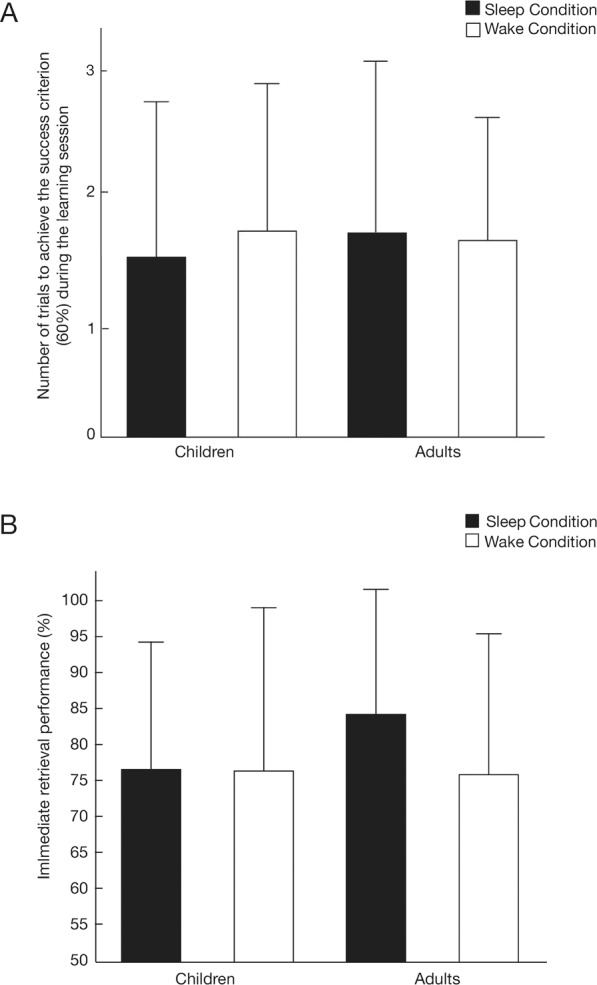
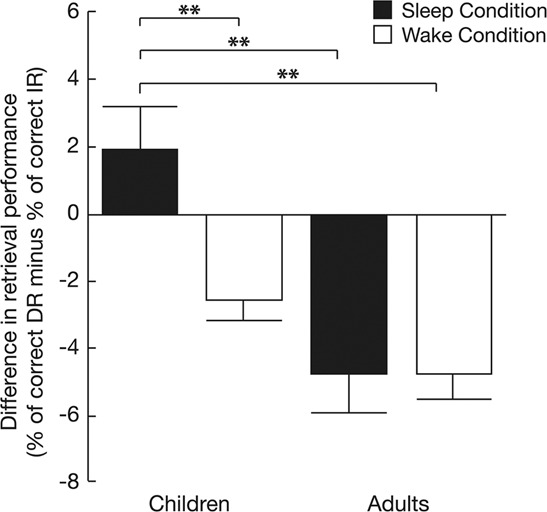
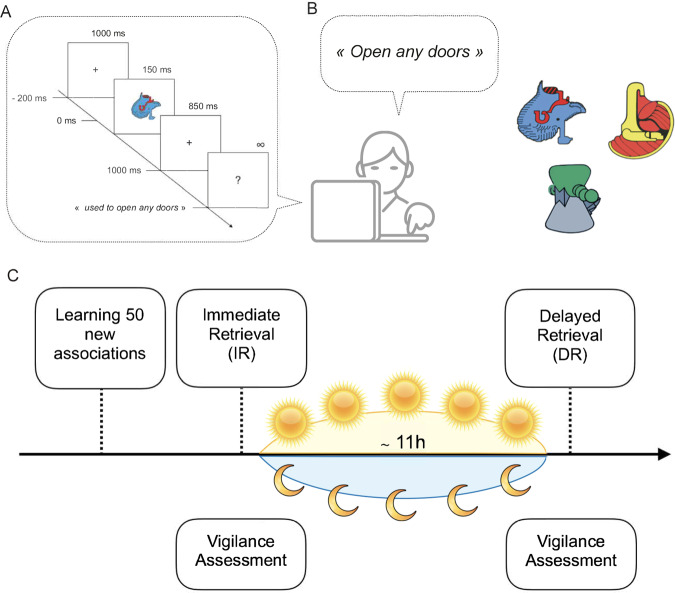
Post-learning slow wave sleep (SWS) is known to support declarative memory consolidation. As SWS is more abundant in young population, we suggested that sleep-dependent memory consolidation processes could occur at a faster pace in school-aged children. After learning new associations between non-objects and their functions, retrieval performance was tested in 30 children (7–12 years) and 34 adults (20–30 years) during an immediate (IR) and a delayed retrieval (DR) session separated by either a Sleep or a Wake condition. Sleep led to stabilized memory retrieval performance only in children, not in adults, whereas no age-related difference was observed after a similar period of wakefulness. Hence, our results suggest more efficient sleep-dependent declarative memory consolidation processes in children compared with adults, an effect potentially ascribed to more abundant and deeper SWS during childhood.
Overview
The claims and statistics of this paper haven’t been checked yet.
Free: it reads the open-access text and checks the first 5 claims that cite a source we can check. Create a free account to check every claim.
Integrity signals
Registry
Cites
Statistics
Figures
Verification
Claims the paper makes
The claims and statistics of this paper haven’t been checked yet.
Free: it reads the open-access text and checks the first 5 claims that cite a source we can check. Create a free account to check every claim.
Claims other papers make about this one
Each is checked against this paper’s own text: does it say what the citing paper says it does?
The cited source says what the claim attributes to it.
In the citing paper
“Children of similar age (7-12 years) showed likewise a greater sleep-dependent gain than adult controls for associative memories between artificial objects and their functions.264”
From Sleep—A brain-state serving systems memory consolidation (2023) · cites this paper as [264]
Self-check
Percentages, sums and reported differences re-computed from the paper’s own numbers.
The self-check needs the paper’s full text.
Citations
Cites
The Pittsburgh Sleep Quality Index: a new instrument for psychiatric practice and research
Buysse, D. J., Reynolds, C. F., Monk, T. H., Berman, S. R., & Kupfer, D. J. (1989) · Psychiatry Research · doi:10.1016/0165-1781(89)90047-4 · Cited by 35,234
A self-assessment questionnaire to determine morningness- eveningness in human circadian rhythms
Home, J. K. (1976) · Medical Entomology and Zoology · Cited by 4,783
(1976) · PubMed · Cited by 3,979
Bayesian t tests for accepting and rejecting the null hypothesis
Rouder, J. N., Speckman, P. L., Sun, D., Morey, R. D., & Iverson, G. (2009) · Psychonomic Bulletin & Review · doi:10.3758/pbr.16.2.225 · Cited by 3,688
Ohayon, M. M., Carskadon, M. A., Guilleminault, C., & Vitiello, M. V. (2004) · Sleep · doi:10.1093/sleep/27.7.1255 · Cited by 3,349
Tononi, G., & Cirelli, C. (2014) · Neuron · doi:10.1016/j.neuron.2013.12.025 · Cited by 2,356
Dinges, D. F., & Powell, J. W. (1985) · Behavior Research Methods, Instruments, & Computers · doi:10.3758/bf03200977 · Cited by 1,744
Dewald, J. F., Meijer, A. M., Oort, F. J., Kerkhof, G. A., & Bögels, S. M. (2010) · Sleep Medicine Reviews · doi:10.1016/j.smrv.2009.10.004 · Cited by 1,526
BRUNI, O., OTTAVIANO, S., GUIDETTI, V., ROMOLI, M., INNOCENZI, M., CORTESI, F., & GIANNOTTI, F. (1996) · Journal of Sleep Research · doi:10.1111/j.1365-2869.1996.00251.x · Cited by 1,380
Cited by
Sleep—A brain-state serving systems memory consolidation
Brodt, S., Inostroza, M., Niethard, N., & Born, J. (2023) · Neuron · doi:10.1016/j.neuron.2023.03.005 · Cited by 343
Sleep and human cognitive development
Mason, G. M., Lokhandwala, S., Riggins, T., & Spencer, R. M. C. (2021) · Sleep Medicine Reviews · doi:10.1016/j.smrv.2021.101472 · Cited by 274
Which Are the Central Aspects of Infant Sleep? The Dynamics of Sleep Composites across Infancy
Schoch, S. F., Huber, R., Kohler, M., & Kurth, S. (2020) · Sensors · doi:10.3390/s20247188 · Cited by 42
“The neurophysiology of sleep is linked to brain maturation, neural reorganization [2–4], as well as processes of learning and memory [5,6] (for an overview see [7]).”
BackgroundSleep’s contribution to memory formation
Lutz, N. D., Harkotte, M., & Born, J. (2025) · Physiological Reviews · doi:10.1152/physrev.00054.2024 · Cited by 60
Sleep and Memory in Infancy and Childhood
Mason, G. M., & Spencer, R. M. C. (2022) · Annual Review of Developmental Psychology · doi:10.1146/annurev-devpsych-121020-033411 · Cited by 34
Recent advances in memory consolidation and information processing during sleep
Hoedlmoser, K., Peigneux, P., & Rauchs, G. (2022) · Journal of Sleep Research · doi:10.1111/jsr.13607 · Cited by 32
“with regard to declarative (explicit) memory (Ashworth et al., 2014; Hahn et al., 2019; Hahn et al., 2020; Peiffer et al., 2020; Wang et al., 2018; Wilhelm et al., 2008).”
Self-citationSchommartz, I., Lembcke, P. F., Pupillo, F., Schuetz, H., de Chamorro, N. W., Bauer, M., Kaindl, A. M., Buß, C., & Shing, Y. L. (2022) · Developmental Cognitive Neuroscience · doi:10.1016/j.dcn.2022.101192 · Cited by 15
Hacking the functions of sleep: noninvasive approaches to stimulate sleep neurophysiology
Krugliakova, E., Breuer, F., Adelhöfer, N., Alonso, A., Besedovsky, L., Murphy, K. R., Peters, E., Raczek, K., Rasch, B., Salvesen, L., et al. (2025) · Physiological Reviews · doi:10.1152/physrev.00007.2025 · Cited by 23
Ben-Zion, D., Gabitov, E., Prior, A., & Bitan, T. (2022) · Neurobiology of Language · doi:10.1162/nol_a_00060 · Cited by 13
“…we predicted that sleep will result in the stabilization of item-specific knowledge (evident by performance on high frequency items), as was previously evident in vocabulary learning and episodic memory tasks (Gais et al., 2006; Payne et al., 2012; Peiffer et al., 2020; Tamminen et al., 2010).”
BackgroundSchommartz, I., Kaindl, A. M., Buß, C., & Shing, Y. L. (2024) · Developmental Psychology · doi:10.1037/dev0001691 · Cited by 12
A sleep schedule incorporating naps benefits the transformation of hierarchical knowledge
Golkashani, H. A., Leong, R. L. F., Ghorbani, S., Ong, J. L., Fernández, G., & Chee, M. W. L. (2022) · SLEEP · doi:10.1093/sleep/zsac025 · Cited by 9
“While a recent study found comparable benefits of prior knowledge on sleep-dependent memory consolidation in children [59], our findings in adolescents should not be generalized, until Table 4.”
ResultDo naps benefit novel word learning? Developmental differences and white matter correlates
van Rijn, E., Gouws, A. D., Walker, S. A., Knowland, V. C. P., Cairney, S. A., Gaskell, M. G., & Henderson, L. M. (2022) · Cortex · doi:10.1016/j.cortex.2022.09.016 · Cited by 10
The Role of Sleep in Memory Consolidation and Reading in Dyslexia
Solbi, A., & Earle, F. S. (2025) · Journal of Cognitive Neuroscience · doi:10.1162/jocn_a_02282 · Cited by 8
Reich, N., Imparato, A., Cataldi, J., Thillainathan, N., Delavari, F., Schneider, M., Eliez, S., Siclari, F., & Sandini, C. (2025) · Psychiatry Research · doi:10.1016/j.psychres.2025.116423 · Cited by 4
Gander, S., Rouge, C., Peiffer, A., Wens, V., Tiège, X. D., & Urbain, C. M. (2025) · Imaging Neuroscience · doi:10.1162/imag_a_00555 · Cited by 5
“Complete details regarding the learning material features and task procedure can be found in Urbain et al. (2013), Urbain, De Tiège, et al. (2016), and Peiffer et al. (2020).”
Self-citationIranmanesh, H., Kakhki, A. S., Taheri, H., & Shea, C. H. (2022) · Biomedical Human Kinetics · doi:10.2478/bhk-2022-0011 · Cited by 3
“[31] also confirmed that sleep was the main factor of the declarative memory consolidation.”
BackgroundInfluentialRibeiro‐Lages, M. B., Jural, L. A., Magno, M. B., Marañón‐Vásquez, G. A., Tavares-Silva, C. M., Coqueiro, R. D. S., Pithon, M. M., Fonseca‐Gonçalves, A., Serra‐Negra, J. M., & Maia, L. C. (2022) · Sleep Medicine · doi:10.1016/j.sleep.2021.12.017 · Cited by 1
Advantage conferred by overnight sleep on schema-related memory may last only a day
Golkashani, H. A., Ghorbani, S., Leong, R. L. F., Ong, J. L., & Chee, M. W. L. (2023) · SLEEP Advances · doi:10.1093/sleepadvances/zpad019 · Cited by 2
“First, despite reported sleep-dependent benefits to schema-based learning in children [61], and young adults [22, 42]; caution must be taken before generalizing our findings in adolescents to adults.”
ResultJames, E., Gaskell, M. G., Murphy, G., Tulip, J., & Henderson, L. M. (2022) · doi:10.31234/osf.io/qe5gc · Cited by 1
Schommartz, I., Lembcke, P. F., Ortiz-Tudela, J., Bauer, M., Kaindl, A. M., Buß, C., & Shing, Y. L. (2024) · doi:10.7554/elife.89908.2 · Cited by 1
Neural correlates and reinstatement of recent and remote memory in children and young adults
Schommartz, I., Lembcke, P. F., Ortiz-Tudela, J., Bauer, M., Kaindl, A. M., Buß, C., & Shing, Y. L. (2025) · eLife · doi:10.7554/elife.89908.4 · Cited by 4
Schommartz, I., Lembcke, P. F., Ortiz-Tudela, J., Bauer, M., Kaindl, A. M., Buß, C., & Shing, Y. L. (2023) · eLife · doi:10.7554/elife.89908.1
Iranmanesh, H., Kakhki, A. S., Taheri, H., Shea, C. H., & Iranmanesh, H. (2023) · Scientific Journal of Rehabilitation Medicine · doi:10.32598/sjrm.12.3.11
„Sleep tight, wake up bright“: Bedeutung des Schlafs für das Gedächtnis im Kindesalter
Hoedlmoser, K., & Bothe, K. (2023) · Monatsschrift Kinderheilkunde · doi:10.1007/s00112-023-01858-9
Schommartz, I., Lembcke, P. F., Ortiz-Tudela, J., Bauer, M., Kaindl, A. M., Buß, C., & Shing, Y. L. (2024) · doi:10.7554/elife.89908.2.sa0
Does sleep help children to generalise features like adults?
Kurz, E., Schreiber, C. M., Kölle, K., Tunçel, Z., Meyer, P. T., Ngo, H.-V. V., Conzelmann, A., & Prehn‐Kristensen, A. (2024) · Journal of Sleep Research · doi:10.1111/jsr.14432 · Cited by 1
“…we chose this age range to be comparable to previous studies finding better sleep-dependent memory consolidation in children than adults (e.g. Peiffer et al., 2020; Prehn-Kristensen et al., 2013; Wilhelm et al., 2013), we cannot exclude that the chosen age range was too heterogenous to be…”
Schommartz, I., Lembcke, P. F., Ortiz-Tudela, J., Bauer, M., Kaindl, A. M., Buß, C., & Shing, Y. L. (2025) · eLife · doi:10.7554/elife.89908.3
Rouge, C., Juvené, E., Dyck, D. V., Gander, S., Feys, O., Gyseghem, P. V., Bourguignon, M., Wens, V., Tiège, X. D., Aeby, A., et al. (2025) · Brain Topography · doi:10.1007/s10548-025-01153-8 · Cited by 1
“This sleep stage is critical for memory consolidation and the plastic reorganisation of learning-related brain networks in both children (Peiffer et al. 2020; Urbain et al. 2016; Wilhelm et al. 2013) and adults (Gais et al. 2007; Klinzing et al. 2019; Takashima et al. 2006).”
Self-citationGander, S., Rouge, C., Peiffer, A., Peigneux, P., Simor, P., Bourguignon, M., Wens, V., Tiège, X. D., Deliens, G., & Urbain, C. M. (2026) · bioRxiv (Cold Spring Harbor Laboratory) · doi:10.64898/2026.04.30.721844
Self-citation
Metadata
- Authors
- Peiffer, A., Brichet, M., De Tiège, X., Peigneux, P., & Urbain, C.
- Affiliations
- Université Libre de Bruxelles (BE)
- Corresponding author
- Peiffer, Anna
- Urbain, Charline
- Venue
- Scientific Reports
- Published
- 2020-06-19
- Volume
- 10
- Issue
- 1
- Pages
- 9979-9979
- ISSN
- 2045-2322 (ISSN-L)
- PMC
- PMC7305149
- OpenAlex
- W3035965330
- Semantic Scholar
- c982bc66a40282b9cd007ff72ce5dccab21296b0
- Cited by
- 34
- References
- 71
- Citations by year
- 2026: 2 · 2025: 6 · 2024: 9 · 2023: 6 · 2022: 8 · 2021: 2 · 2020: 1
- FWCI
- 2.28
- Type
- journal article
- Language
- en
- Update notices
- correction (2020-07-24)
- Open access
- gold
- doi.org
- Licence
- cc-by
- creativecommons.org/licenses/by/4.0 (tdm)
- creativecommons.org/licenses/by/4.0 (vor)
- Locations
- Scientific Reports (publishedVersion, cc-by)
- PubMed Central (publishedVersion, cc-by)
- PubMed (publishedVersion)
- Dépôt institutionnel de l'Université libre de Bruxelles (Université Libre de Bruxelles) (submittedVersion, other-oa)
- Funders
- Fonds De La Recherche Scientifique - FNRS (29149840)
- Topics
- Life Sciences › Neuroscience › Cognitive Neuroscience › Sleep and Wakefulness Research
- Life Sciences › Neuroscience › Cognitive Neuroscience › Memory and Neural Mechanisms
- Life Sciences › Neuroscience › Cognitive Neuroscience › Memory Processes and Influences
- Keywords
- sleep-dependent memory consolidation, slow-wave sleep, declarative memory, children, age differences, memory retrieval, wakefulness
About these checks
Registry, retraction, Cites and statistics results are computed, not judged, with one exception: a printed reference that no index lists is read once by a model before it counts as a citation error. Claims are extracted by a model and kept only when their quote appears verbatim in the text; each cited source is then checked, with a model’s help, for whether it says what the claim relies on. Those verdicts can be wrong — read the claim’s quote and the cited source before relying on one.
Statistics and arithmetic are recomputed, not judged.
Confidence bands are shown only for fields calibrated on our annotated test set. None is calibrated yet, so no band is shown.
What counts as a claim ›How we measure confidence ›How we check this ›
Are you an author, or do you see a problem with this page? Request a review
Data sources
Bibliographic data: Semantic Scholar, OpenAlex, Crossref.
Contains information from the Semantic Scholar Academic Graph Datasets, made available under the ODC Attribution License (ODC-BY 1.0).
Semantic Scholar’s data is described in: Kinney, R., et al. (2023). The Semantic Scholar Open Data Platform. arXiv:2301.10140.
