

Molecular tests support the viability of rare earth elements as proxies for fossil biomolecule preservation
Open accessThe DOI matches its Crossref record; 72 of the 72 references it cites were found in a registry or an index; 1 of the 161 sources its claims cite were checked for support.
Abstract
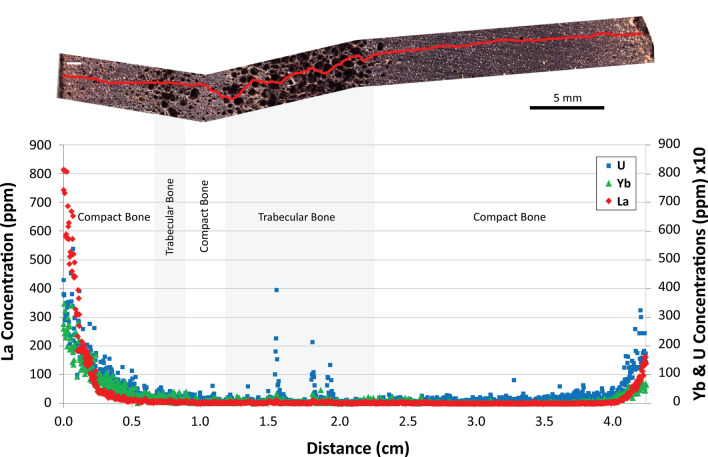
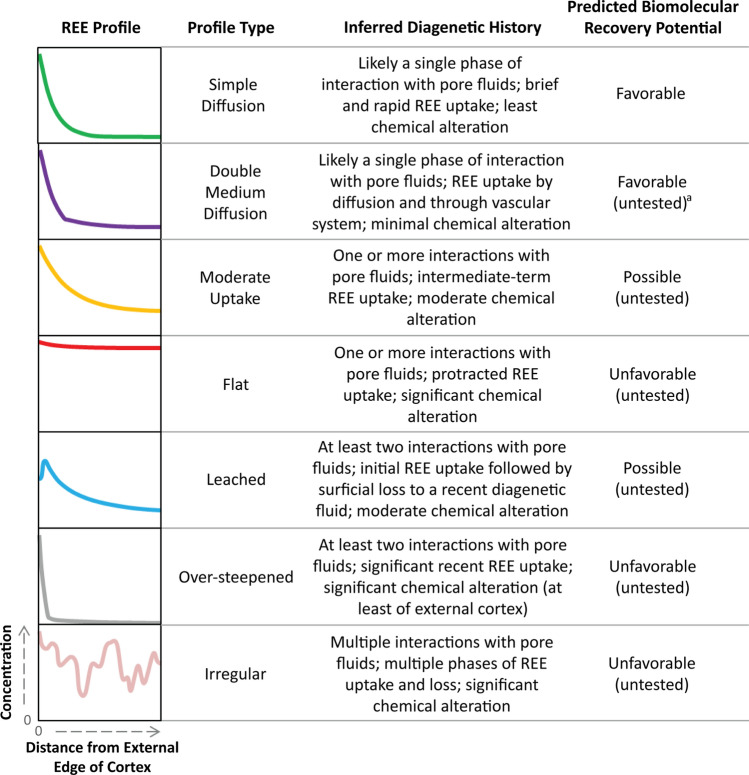
The rare earth element (REE) composition of a fossil bone reflects its chemical alteration during diagenesis. Consequently, fossils presenting low REE concentrations and/or REE profiles indicative of simple diffusion, signifying minimal alteration, have been proposed as ideal candidates for paleomolecular investigation. We directly tested this prediction by conducting multiple biomolecular assays on a well-preserved fibula of the dinosaur Edmontosaurus from the Cretaceous Hell Creek Formation previously found to exhibit low REE concentrations and steeply-declining REE profiles. Gel electrophoresis identified the presence of organic material in this specimen, and subsequent immunofluorescence and enzyme-linked immunosorbant assays identified preservation of epitopes of the structural protein collagen I. Our results thereby support the utility of REE profiles as proxies for soft tissue and biomolecular preservation in fossil bones. Based on considerations of trace element taphonomy, we also draw predictions as to the biomolecular recovery potential of additional REE profile types exhibited by fossil bones.
Overview
CoChat Summary
TL;DR
The study directly tests whether low rare earth element (REE) concentrations and steep REE depth profiles in fossil bone predict biomolecular preservation. In an *Edmontosaurus* fibula with such REE profiles, PAGE, ELISA, and immunofluorescence detected organic material and collagen I epitopes, supporting REE profiles as screening proxies for biomolecular recovery potential.
Key findings
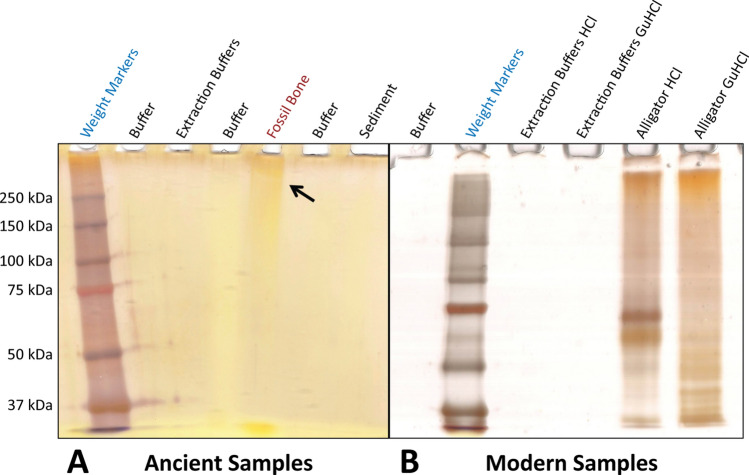
- PAGE with silver staining of GuHCl extracts from *Edmontosaurus* fibula SRHS-DU-231 showed a high-molecular-weight orange smear darkening upward from ~150 kDa; no staining occurred in co-extracted sediment or buffer control lanes.
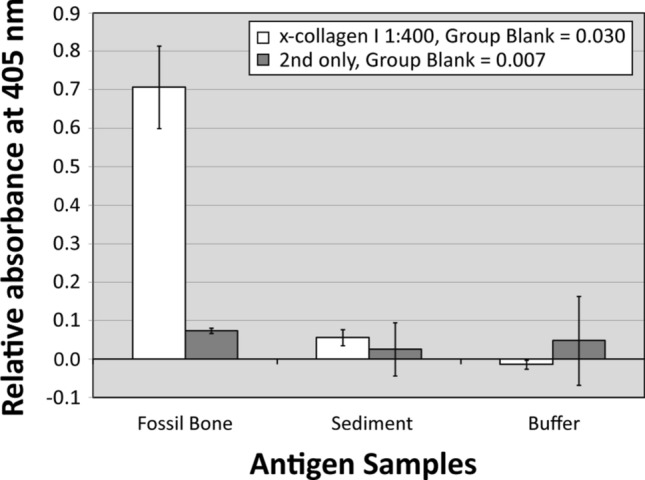
- ELISA with anti-chicken collagen I antibodies gave fossil extract absorbance of 0.37 at 240 min, over 500% of associated sediment and negative controls; sediment was 0.03 and negative controls −0.01, while modern *Alligator* controls reached saturation (~3.0) by ~120 min.
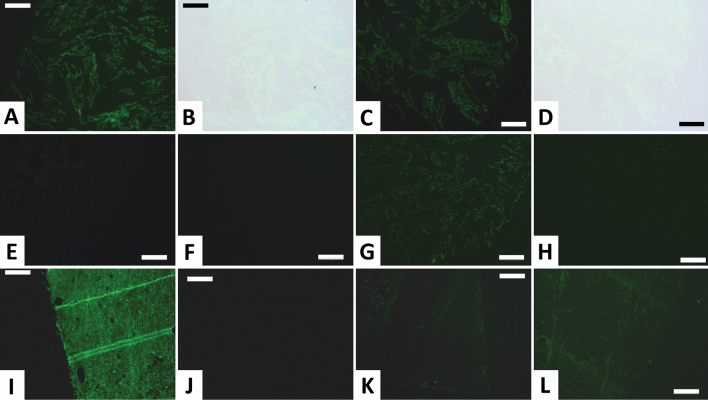
- In situ immunofluorescence localized collagen I to demineralized cortical tissue; signal was diminished relative to modern *Alligator*, and secondary-only, inhibition, and 6-h collagenase controls showed extremely reduced or no fluorescence.
- The authors conclude REE profiles may be useful proxies for biomolecular recovery, predicting “simple” and “moderate” diffusion profiles as best candidates, while leached, secondary-uptake, or complex diagenetic histories would have lower likelihood.
Methods
- One *Edmontosaurus annectens* fibula, SRHS-DU-231, from the Standing Rock Hadrosaur Site in the Maastrichtian Hell Creek Formation; its trace element composition had previously been determined by LA-ICPMS on transverse thick sections and showed low REE concentrations and steeply declining REE profiles.
- Three independent biomolecular assays were performed on demineralized tissues and chemical extracts: polyacrylamide gel electrophoresis (PAGE) with silver staining, enzyme-linked immunosorbant assay (ELISA), and in situ immunofluorescence; ABC and GuHCl extracts were used, with modern *Alligator* controls and a fossil-dedicated laboratory.
- The specimen was contextualized with 16 SRHS bones previously shown to yield microstructures upon demineralization, nine of which had reported trace element compositions, and eight additional SRHS bones previously subjected to demineralization assays.
Limitations
- The paper states that the current dataset supporting the “simple diffusion” prediction is only one bone, or nine bones from one mudstone facies at one locality if soft tissue recovery is used as the criterion; two fossil bones with double medium diffusion REE profiles also yielded cellular and soft tissue microstructures, indicating other profile types may be productive.
- The paper states that the relationship between REE profiles and biomolecular recovery potential remains far from clear, and that bone tissue type, structure, and biomolecule location are key variables; the analyzed SRHS specimens do not shed light on expectations for leaching or secondary uptake phases.
- Evident from the text: PAGE alone cannot determine the precise identity of the organic materials, and the immunoassays detect collagen I epitopes but do not provide sequence-level confirmation; biomolecular assays were performed on only one specimen.
Model-written summary. Check it against the paper before relying on it.
Integrity signals
Registry
Cites
Statistics
Figures
Verification
Claims the paper makes
1 Valid · 0 Not valid · 69 Not checked · 52 Own results and interpretations
The cited sources support only part of this claim — read each source’s verdict below.
In the paper
“Conversely, decay of the fibrous protein matrix exposes otherwise passivated (“shielded”) bone crystallite surfaces to geochemical gradients in permeating pore fluids31,33.”
§ Molecular tests support the viability of rare earth elements as proxies for fossil biomolecule preservation > Introduction
What the sources say
- Not checked yetcites [31] Trueman CN Martill DM The long-term survival of bone: the role of bioerosion Archaeometry 2002 44 371 382 10.1111/1475-4754.t01-1-00070 source
- Partly supportedcites [33] Collins MJ The survival of organic matter in bone: a review Archaeometry 2002 44 383 394 10.1111/1475-4754.t01-1-00071 sourceExperimental — accuracy not yet measured
Our copy supports the passivation half of the claim: 'MECHANISMS OF DETERIORATION' (p. n/a) states that 'the presence of organic molecules will passivate the mineral surface (Putnis and Putnis 1995), slowing the rate of mineral solution reaction (Kleter et al. 1994)', and 'Mechanism 1' describes collagen loss leaving a porous 'mineral ghost' (< 30 nm interconnected pores), with 'Mechanism 2' noting bone mineral's profound disequilibrium with percolating rain water/soil solution. However, the direction the source actually draws from the converse is the opposite of the claim's: it says dissolution of the mineral phase exposes collagen to biodegradation, and it confines chemical collagen loss (path 1) to environments 'geochemically stable for bone mineral' (Abstract). The paper nowhere states that decay of the protein matrix exposes crystallite surfaces to geochemical gradients in permeating pore fluids, so that causal consequence is the citing authors' extension rather than the source's assertion. (LLM, conf=0.70)
plainstates a cause- Asserted: passes — The authors put it forward as true.
- Checkable: passes — It can be checked against evidence.
- Load-bearing: passes — The paper’s conclusions depend on it.
- Based: passes — The paper gives a reason why it holds.
A result the paper reports from its own data — it cites no other source for it, so there is none to check. The quote shows it is in the paper.
In the paper
“No staining occurred in co-extracted sediment or buffer control lanes.”
§ Molecular tests support the viability of rare earth elements as proxies for fossil biomolecule preservation > Results > Polyacrylamide gel electrophoresis (PAGE)
plainSingle case- Asserted: passes — The authors put it forward as true.
- Checkable: passes — It can be checked against evidence.
- Load-bearing: passes — The paper’s conclusions depend on it.
- Based: passes — The paper gives a reason why it holds.
A result the paper reports from its own data — it cites no other source for it, so there is none to check. The quote shows it is in the paper.
In the paper
“In both in situ immunofluorescence and ELISA, reactivity was only observed when fossil tissues or extracts were incubated with primary antibodies; sediment and secondary-only controls were negative (Fig. 3 and Fig. 4E, J).”
§ Molecular tests support the viability of rare earth elements as proxies for fossil biomolecule preservation > Discussion
plainSingle case- Asserted: passes — The authors put it forward as true.
- Checkable: passes — It can be checked against evidence.
- Load-bearing: passes — The paper’s conclusions depend on it.
- Based: passes — The paper gives a reason why it holds.
A result the paper reports from its own data — it cites no other source for it, so there is none to check. The quote shows it is in the paper.
In the paper
“Secondary-only and inhibition specificity controls exhibited extremely reduced or no fluorescence (Fig. 4E,F,J,K).”
§ Molecular tests support the viability of rare earth elements as proxies for fossil biomolecule preservation > Results > Immunofluorescence
plainSingle case- Asserted: passes — The authors put it forward as true.
- Checkable: passes — It can be checked against evidence.
- Load-bearing: passes — The paper’s conclusions depend on it.
- Based: passes — The paper gives a reason why it holds.
A result the paper reports from its own data — it cites no other source for it, so there is none to check. The quote shows it is in the paper.
In the paper
“Fossil bone and sediment ABC extracts contained dark brown substances, which we interpret to likely be humic substances, as these are commonly co-extracted with proteins from fossil bones39.”
§ Molecular tests support the viability of rare earth elements as proxies for fossil biomolecule preservation > Results > Polyacrylamide gel electrophoresis (PAGE)
hedged- Asserted: passes — The authors put it forward as true.
- Checkable: passes — It can be checked against evidence.
- Load-bearing: unclear — It is unclear whether the paper’s conclusions depend on it.
- Based: passes — The paper gives a reason why it holds.
69 more claims
Create a free account to see all 122 claims and to verify the 156 references still open.
- It may state two separate claims as one. 34
- Probably not a substantial claim. 21
Claims other papers make about this one
Each is checked against this paper’s own text: does it say what the citing paper says it does?
In the citing paper
“Thus, the hypothesis advanced by Trueman et al. [101] and Ullmann et al. [123] that regions of bones exhibiting low uptake of REE are likely the best targets for paleomolecular analyses is supported, even though MPM-PV 1156-49 exhibits ‘average’ alteration at the whole-bone level.”
From Soft-Tissue, Rare Earth Element, and Molecular Analyses of Dreadnoughtus schrani, an Exceptionally Complete Titanosaur from Argentina (2022) · cites this paper as [123]
In the citing paper
“These findings support the hypotheses advanced by Trueman et al. [101], Ullmann et al. [123], and Gatti et al. [129] that bones exhibiting low trace element uptake are favorable targets for paleomolecular analyses.”
From Soft-Tissue, Rare Earth Element, and Molecular Analyses of Dreadnoughtus schrani, an Exceptionally Complete Titanosaur from Argentina (2022) · cites this paper as [123]
Self-check
Percentages, sums and reported differences re-computed from the paper’s own numbers.
Each contradiction between two passages listed here was confirmed by an independent check.
Rated minor: it would not touch a result — a value no result rests on, a p-value that stays on the same side of the significance level, or a conflict that is clerical, resolved elsewhere in the paper, or outside its own findings.
In the paper
§ Molecular tests support the viability of rare earth elements as proxies for fossil biomolecule preservation > Discussion
“Moreover, both inhibition and (3 h and 6 h) digestion controls demonstrate the specificity of antibody binding to collagen I (Fig. 4F–H, K, L).”
§ Molecular tests support the viability of rare earth elements as proxies for fossil biomolecule preservation > Results > Immunofluorescence
“(G) Section digested with collagenase for 1 h prior to exposure to anti-collagen I antibodies. (H) Section digested with collagenase for 6 h prior to exposure to anti-collagen I antibodies.”
Citations
Cites
Taphonomic and ecologic information from bone weathering
Behrensmeyer, A. K. (1978) · Paleobiology · doi:10.1017/s0094837300005820 · Cited by 2,235
The human keratins: biology and pathology
Moll, R., Divo, M., & Langbein, L. (2008) · Histochemistry and Cell Biology · doi:10.1007/s00418-008-0435-6 · Cited by 1,465
The Role of Decay and Mineralization in the Preservation of Soft-Bodied Fossils
Briggs, D. E. G. (2003) · Annual Review of Earth and Planetary Sciences · doi:10.1146/annurev.earth.31.100901.144746 · Cited by 624
The survival of organic matter in bone: a review
Collins, M. J., Nielsen–Marsh, C. M., Hiller, J., Smith, C. I., Roberts, J. P., Prigodich, R. V., Wess, T. J., Csapò, J., Millard, A. R., & Turner–Walker, G. (2002) · Archaeometry · doi:10.1111/1475-4754.t01-1-00071 · Cited by 615
Trueman, C. N. G., Behrensmeyer, A. K., Tuross, N., & Weiner, S. (2004) · Journal of Archaeological Science · doi:10.1016/j.jas.2003.11.003 · Cited by 427
The role of anoxia in the decay and mineralization of proteinaceous macro-fossils
Allison, P. A. (1988) · Paleobiology · doi:10.1017/s009483730001188x · Cited by 350
Organic preservation of non-mineralizing organisms and the taphonomy of the Burgess Shale
Butterfield, N. J. (1990) · Paleobiology · doi:10.1017/s0094837300009994 · Cited by 265
Eglinton, G., & Logan, G. A. (1991) · Philosophical Transactions of the Royal Society of London. Series B: Biological Sciences · doi:10.1098/rstb.1991.0081 · Cited by 249
Biomolecular Characterization and Protein Sequences of the Campanian Hadrosaur B. canadensis
Schweitzer, M. H., Zheng, W., Organ, C. L., Avci, R., Suo, Z., Freimark, L. M., Lebleu, V. S., Duncan, M. B., Vander Heiden, M. G., Neveu, J. M., et al. (2009) · Science · doi:10.1126/science.1165069 · Cited by 238
Self-citationThe long–term survival of bone: the role of bioerosion
Trueman, C. N., & Martill, D. M. (2002) · Archaeometry · doi:10.1111/1475-4754.t01-1-00070 · Cited by 227
Cited by
Early diagenetic REE migration from Fe-Mn nodules to fish teeth in deep sea sediments
Huang, F., Fu, Y., Li, D., Peng, J., He, W., Li, S., Sun, X., & He, G. (2023) · Ore Geology Reviews · doi:10.1016/j.oregeorev.2023.105581 · Cited by 23
Titus, A. L., Knoll, K., Sertich, J. J. W., Yamamura, D., Suarez, C. A., Glasspool, I. J., Ginouves, J. E., Lukacic, A. K., & Roberts, E. M. (2021) · PeerJ · doi:10.7717/peerj.11013 · Cited by 17
Deep Time Paleoproteomics: Looking Forward
Schroeter, E. R., Cleland, T. P., & Schweitzer, M. H. (2022) · Journal of Proteome Research · doi:10.1021/acs.jproteome.1c00755 · Cited by 15
Self-citationUllmann, P. V., Macauley, K., Ash, R. D., Shoup, B., & Scannella, J. B. (2021) · Biology · doi:10.3390/biology10111193 · Cited by 15
Self-citationVoegele, K. K., Boles, Z. M., Ullmann, P. V., Schroeter, E. R., Zheng, W., & Lacovara, K. J. (2022) · Biology · doi:10.3390/biology11081161 · Cited by 16
Self-citationGatti, L., Lugli, F., Sciutto, G., Zangheri, M., Prati, S., Mirasoli, M., Silvestrini, S., Benazzi, S., Tütken, T., Douka, K., et al. (2022) · Scientific Reports · doi:10.1038/s41598-022-08979-3 · Cited by 13
Müller, W., Lugli, F., McCormack, J., Evans, D., Anczkiewicz, R., Bondioli, L., & Nava, A. (2024) · Elsevier eBooks · doi:10.1016/b978-0-323-99762-1.00105-4 · Cited by 13
Schroeter, E. R., Ullmann, P. V., Macauley, K., Ash, R. D., Zheng, W., Schweitzer, M. H., & Lacovara, K. J. (2022) · Biology · doi:10.3390/biology11081158 · Cited by 13
Self-citationDauphin, Y. (2022) · Minerals · doi:10.3390/min12020180 · Cited by 11
Botfalvai, G., Kocsis, L., Szabó, M., Király, E., & Sebe, K. (2023) · Historical Biology · doi:10.1080/08912963.2022.2049771 · Cited by 10
Ullmann, P. V., Ash, R. D., & Scannella, J. B. (2022) · Biology · doi:10.3390/biology11081177 · Cited by 10
Self-citationMCLAIN, M. A., Ullmann, P. V., Ash, R. D., BOHNSTEDT, K., Nelsen, D. R., CLARK, R. O., Brand, L. R., & CHADWICK, A. V. (2021) · Palaios · doi:10.2110/palo.2020.064 · Cited by 9
Self-citationСилаев, В. И., Anoykin, A., Павленок, Г. Д., Федорович, Х. А., Filippov, V., Kiseleva, D. V., Шанина, С. Н., Makeev, B. A., & Urazova, K. K. (2022) · Vestnik of Geosciences · doi:10.19110/geov.2022.4.1 · Cited by 8
Ullmann, P. V., Caputo, C., Snyder, K., Chadwick, A. V., & Ash, R. D. (2024) · Chemical Geology · doi:10.1016/j.chemgeo.2024.122501 · Cited by 5
Self-citationNew Application of Histological Staining for Visualization of Endogenous Proteins in Fossil Material
Inaba, H., Chiba, K., Saneyoshi, M., Miyaji, T., Kawakami, A., Nagaoka, N., TAKECHI, Y., Takabatake, K., Brink, K. S., Tanaka, M., et al. (2025) · Journal of Proteome Research · doi:10.1021/acs.jproteome.5c00078 · Cited by 2
Actualistic Testing of the Influence of Groundwater Chemistry on Degradation of Collagen I in Bone
Ullmann, P. V., Voegele, K. K., & Lacovara, K. J. (2023) · Minerals · doi:10.3390/min13050596 · Cited by 2
Self-citationBooth, S., Snyder, K., Chadwick, A. V., Ash, R. D., Voegele, K. K., & Ullmann, P. V. (2025) · Minerals · doi:10.3390/min15090919 · Cited by 2
Self-citationMuniz, F. P., Hsiou, A. S., de Andrade, F. D., Osés, G. L., Rizzutto, M. A., & Pacheco, M. L. A. F. (2025) · Cretaceous Research · doi:10.1016/j.cretres.2025.106248 · Cited by 1
Early evidence for a stable and flexible foraging niche in the evolution of Homo
Forrest, F. L., Gonzalez-Alvarez, E., Palcu, D. V., Kuo, S., Skinner, M. M., Reeves, J. S., DiMaggio, E., Hlubik, S., Melaku, S., Ribordy, M., et al. (2026) · Proceedings of the National Academy of Sciences · doi:10.1073/pnas.2537631123 · Cited by 1
Metadata
- Authors
- Ullmann, P. V., Voegele, K. K., Grandstaff, D. E., Ash, R. D., Zheng, W., Schroeter, E. R., Schweitzer, M. H., & Lacovara, K. J.
- Affiliations
- Rowan University (US)
- Temple University (US)
- University of Maryland, College Park (US)
- North Carolina State University (US)
- North Carolina Museum of Natural Sciences (US)
- Corresponding author
- Ullmann, Paul V.
- ORCID
- Venue
- Scientific Reports
- Published
- 2020-09-23
- Volume
- 10
- Issue
- 1
- Pages
- 15566-15566
- ISSN
- 2045-2322 (ISSN-L)
- PMC
- PMC7511940
- OpenAlex
- W3176962166
- Semantic Scholar
- 2d5d99250fc3d93468bbdde1c34aad8132c4557d
- Cited by
- 19
- References
- 72
- Citations by year
- 2026: 1 · 2025: 3 · 2024: 2 · 2023: 2 · 2022: 7 · 2021: 4
- FWCI
- 1.60
- Type
- journal article
- Language
- en
- Open access
- gold
- doi.org
- Licence
- cc-by
- creativecommons.org/licenses/by/4.0 (tdm)
- creativecommons.org/licenses/by/4.0 (vor)
- Locations
- Scientific Reports (publishedVersion, cc-by)
- PubMed Central (publishedVersion, cc-by)
- PubMed (publishedVersion)
- Rowan Digitals Works (Rowan University) (submittedVersion, cc-by)
- Lund University Publications (Lund University) (submittedVersion)
- TUScholarShare (Temple University) (submittedVersion, cc-by)
- Funders
- National Science Foundation (DGE Award 1002809)
- Rowan University
- Jurassic Foundation
- Topics
- Physical Sciences › Earth and Planetary Sciences › Paleontology › Paleontology and Evolutionary Biology
- Physical Sciences › Earth and Planetary Sciences › Paleontology › Paleontology and Stratigraphy of Fossils
- Social Sciences › Arts and Humanities › Archeology (arts and humanities) › Cultural Heritage Materials Analysis
- Keywords
- rare earth elements, soft tissue preservation, type I collagen, Edmontosaurus, Hell Creek Formation, diagenesis, dinosaur bones, immunofluorescence, enzyme-linked immunosorbent assay
- MeSH terms
- Animals, Bone and Bones, Fossils, Metals, Rare Earth, Trace Elements, Dinosaurs
About these checks
Registry, retraction, Cites and statistics results are computed, not judged, with one exception: a printed reference that no index lists is read once by a model before it counts as a citation error. Claims are extracted by a model and kept only when their quote appears verbatim in the text; each cited source is then checked, with a model’s help, for whether it says what the claim relies on. Those verdicts can be wrong — read the claim’s quote and the cited source before relying on one.
The claim verdicts this report counts are experimental: their accuracy is not yet measured.
A language model drew the claims from the paper on 2026-11-23, under version 3 of the claim definition (model deepseek-v4.1-flash, prompt extract-v3).
A second model labelled each claim on 2026-11-23 (model jev-1.13-20260917, definition revision gold-guideline-v0.2).
Cited sources are checked with a language model’s help (qwen3.8-omni-flash).
Statistics and arithmetic are recomputed, not judged.
Confidence bands are shown only for fields calibrated on our annotated test set. None is calibrated yet, so no band is shown.
What counts as a claim ›How we measure confidence ›How we check this ›
Are you an author, or do you see a problem with this page? Request a review
Data sources
Bibliographic data: Semantic Scholar, OpenAlex, Crossref.
Contains information from the Semantic Scholar Academic Graph Datasets, made available under the ODC Attribution License (ODC-BY 1.0).
Semantic Scholar’s data is described in: Kinney, R., et al. (2023). The Semantic Scholar Open Data Platform. arXiv:2301.10140.
