

Mitigation of cascading failures in complex networks
Open accessThe DOI matches its Crossref record; 41 of the 44 references it cites were found in a registry or an index; 6 of the 14 sources its claims cite were checked for support.
Abstract
AbstractCascading failures in many systems such as infrastructures or financial networks can lead to catastrophic system collapse. We develop here an intuitive, powerful and simple-to-implement approach for mitigation of cascading failures on complex networks based on local network structure. We offer an algorithm to select critical nodes, the protection of which ensures better survival of the network. We demonstrate the strength of our approach compared to various standard mitigation techniques. We show the efficacy of our method on various network structures and failure mechanisms, and finally demonstrate its merit on an example of a real network of financial holdings.
Overview
CoChat Summary
TL;DR
The paper proposes a local-structure mitigation algorithm that protects fragile nodes with fragile neighbors to stop cascading failures in complex networks. It reports improved survival over random, degree-based, and centrality-based strategies across model networks and a European bank–sovereign debt network.
Key findings
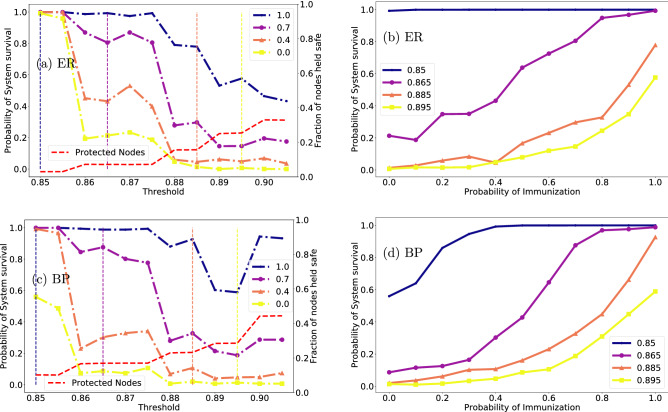
- Protecting nodes selected by the algorithm raises survival above the unprotected critical threshold; for the ER network the unprotected critical threshold is just below 0.86, and partial protection at 70% or 40% still noticeably increases survival probability.
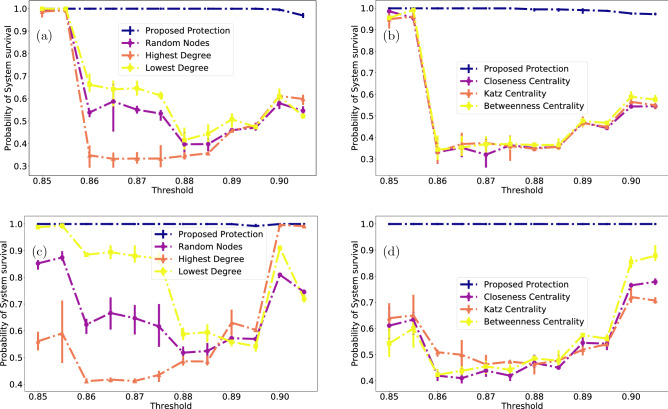
- The method outperforms random, highest-degree, lowest-degree, and centrality-based protection; for ER networks, surprisingly, low-degree protection outperforms high-degree protection, which under-performs even random selection.
- Near the critical threshold the protected set is small, of the order of several percent of the network, and the system tends to either collapse completely or survive almost entirely.
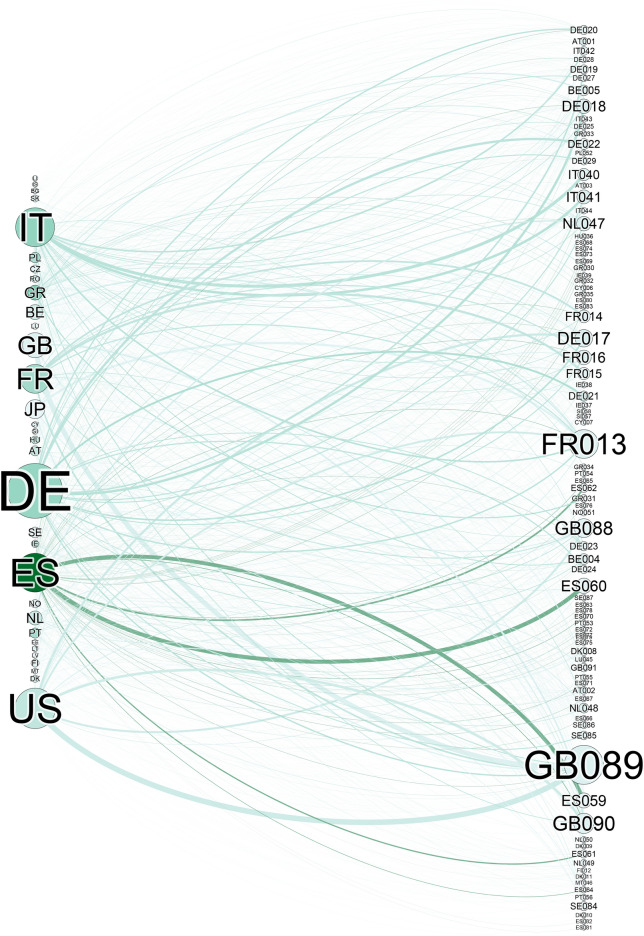
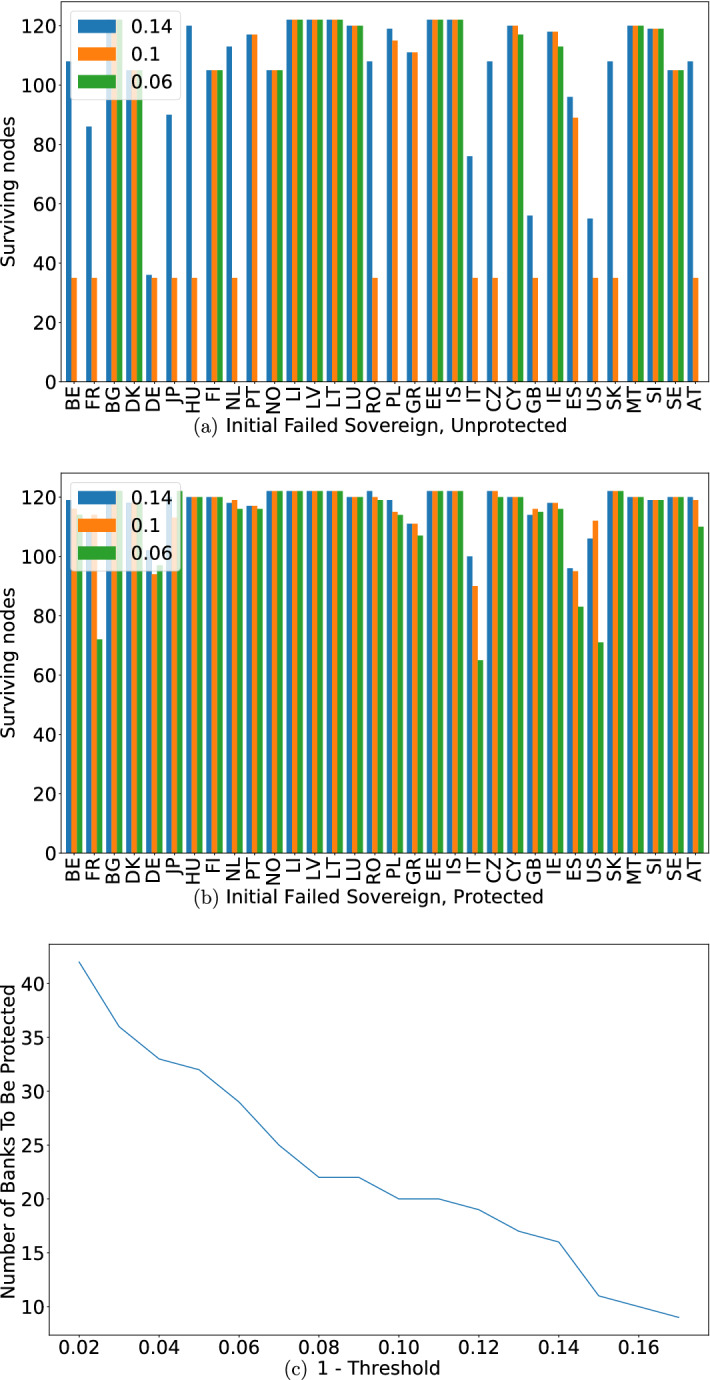
- In the European banks’ sovereign debt exposure network (close to 90 European banks, 2011), protecting around fifteen financial institutions is enough for a 14% impact threshold; for severe failures such as Italy or Spain, holding less than twenty institutions safe spares more than half the network, while at a 6% failure threshold roughly a third of all financial institutions must be protected.
Methods
- Simulations use undirected, unweighted networks—mainly ER and a bipartite bank–asset structure, with scale-free and interdependent networks in the Supplementary—typically of order 10k nodes, repeated at least 150 times and up to 1,000; the main failure mechanism is fractional threshold, with k-core and interdependent failure also considered.
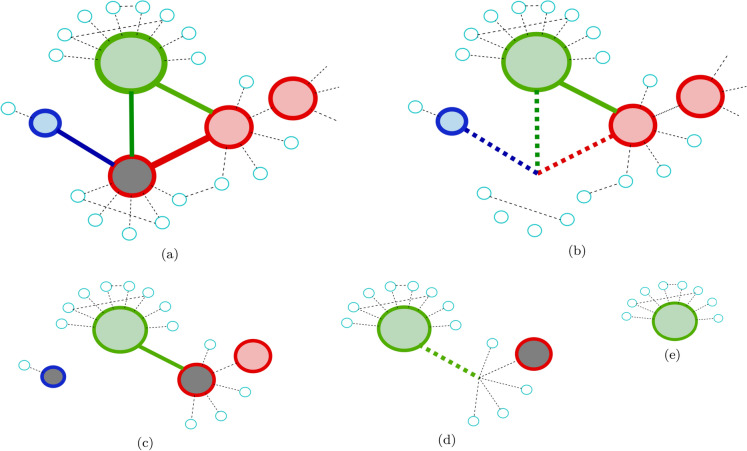
- The mitigation algorithm defines a node as fragile under failure mechanism M when removal of a minimal relevant quantity K of its links causes failure; it selects fragile nodes that also have at least some fragile neighbors, then applies a heuristic refinement based on the induced subgraph’s minimal degree.
- Cascades are initiated by removing a single node while selected nodes are held safe; for the real financial network, a sovereign debt is set to zero and banks fail if remaining holdings fall below a specified threshold relative to initial holdings, with only banks protected.
Limitations
- Stated: the approach lacks theoretical foundation, and a top-down theory could refine the heuristics and parameter choices; several network configurations and failure mechanisms were tested, but real and theoretical networks have more intricacies, including correlated networks, communities, multiplex or time- and space-dependent financial relations, uniform failure thresholds, short-cycle feedback, and healing or new failures.
- Stated: the real financial application is a very simplistic view of an intricate ecosystem and requires further analysis.
- Evident: the real network is much smaller than the simulated networks, limiting discussion of distributions; simulations are unweighted and undirected for tractability even though the real network is weighted; the full spectrum of model parameters is left for further investigation.
Model-written summary. Check it against the paper before relying on it.
Integrity signals
Registry
Cites
Statistics
Figures
Verification
Claims the paper makes
2 Valid · 2 Not valid · 4 Not checked · 76 Own results and interpretations
The cited sources that could be checked couldn’t confirm or dispute this claim.
In the paper
“under the fractional threshold failure mechanism scale-free networks are more vulnerable compared to their ER counterparts with the same average degree39.”
§ Mitigation of cascading failures in complex networks > Methods > Network structure
What the sources say
- Could not verifycites [39] Shao S Huang X Stanley HE Havlin S Percolation of localized attack on complex networks N. J. Phys. 2015 17 2 023049 10.1088/1367-2630/17/2/023049 sourceExperimental — accuracy not yet measured
The paper's discussion of SF and ER networks (indexed section labeled Abstract; page unavailable) concerns localized versus random attacks, not a fractional-threshold failure mechanism. Searches for that mechanism and for an SF–ER comparison at the same average degree found no passage addressing the claimed result. (LLM, conf=0.77)
plainstates an association- Asserted: passes — The authors put it forward as true.
- Checkable: passes — It can be checked against evidence.
- Load-bearing: unclear — It is unclear whether the paper’s conclusions depend on it.
- Based: passes — The paper gives a reason why it holds.
- Could not verify
A result the paper reports from its own data — it cites no other source for it, so there is none to check. The quote shows it is in the paper.
In the paper
“This shows that even partially randomized protection allows us to noticeably increase the survival probability of our system.”
§ Mitigation of cascading failures in complex networks > Results > Mitigation of cascading failure
boostedstates a cause- Asserted: passes — The authors put it forward as true.
- Checkable: passes — It can be checked against evidence.
- Load-bearing: passes — The paper’s conclusions depend on it.
- Based: passes — The paper gives a reason why it holds.
- Rests on an assumption not shown here.
A result the paper reports from its own data — it cites no other source for it, so there is none to check. The quote shows it is in the paper.
In the paper
“We show the efficacy of our method on various network structures and failure mechanisms”
§ Mitigation of cascading failures in complex networks > Abstract
plainstates a cause- Asserted: passes — The authors put it forward as true.
- Checkable: passes — It can be checked against evidence.
- Load-bearing: passes — The paper’s conclusions depend on it.
- Based: passes — The paper gives a reason why it holds.
A result the paper reports from its own data — it cites no other source for it, so there is none to check. The quote shows it is in the paper.
In the paper
“and even when it begins to fail—it does so much more rarely than in the unprotected case.”
§ Mitigation of cascading failures in complex networks > Results > Mitigation of cascading failure
plainstates an association- Asserted: passes — The authors put it forward as true.
- Checkable: passes — It can be checked against evidence.
- Load-bearing: passes — The paper’s conclusions depend on it.
- Based: passes — The paper gives a reason why it holds.
- Rests on an assumption not shown here.
A result the paper reports from its own data — it cites no other source for it, so there is none to check. The quote shows it is in the paper.
In the paper
“We find that our protection, even with partial information, is highly efficient in mitigating the cascading failure process.”
§ Mitigation of cascading failures in complex networks > Results > Mitigation of cascading failure
plainstates a cause- Asserted: passes — The authors put it forward as true.
- Checkable: passes — It can be checked against evidence.
- Load-bearing: passes — The paper’s conclusions depend on it.
- Based: passes — The paper gives a reason why it holds.
- Rests on an assumption not shown here.
48 more claims
Create a free account to see all 84 claims and every source verdict.
- Probably not a substantial claim. 15
- It may state two separate claims as one. 19
Self-check
Percentages, sums and reported differences re-computed from the paper’s own numbers.
Each contradiction between two passages listed here was confirmed by an independent check.
Rated minor: it would not touch a result — a value no result rests on, a p-value that stays on the same side of the significance level, or a conflict that is clerical, resolved elsewhere in the paper, or outside its own findings.
In the paper
§ Mitigation of cascading failures in complex networks > Methods > Simulation setup
“Our method is applicable without any modification.”
§ Mitigation of cascading failures in complex networks > Application to European Banks’ sovereign debt exposures > Failure and mitigation in a real financial network
“As mentioned above, the only adjustment to the original, unweighted strategy, is to set a node’s fragility in accordance with its sensitivity to the failure of any of its neighbors.”
Citations
Cites
Collective dynamics of ‘small-world’ networks
Watts, D. J., & Strogatz, S. H. (1998) · Nature · doi:10.1038/30918 · Cited by 43,060
Statistical mechanics of complex networks
Albert, R., & Barabási, A.-L. (2002) · Reviews of Modern Physics · doi:10.1103/revmodphys.74.47 · Cited by 20,471
The Structure and Function of Complex Networks
Newman, M. E. J. (2003) · SIAM Review · doi:10.1137/s003614450342480 · Cited by 18,719
The spread of true and false news online
Vosoughi, S., Roy, D., & Aral, S. (2018) · Science · doi:10.1126/science.aap9559 · Cited by 8,847
Catastrophic cascade of failures in interdependent networks
Buldyrev, S. V., Parshani, R., Paul, G., Stanley, H. E., & Havlin, S. (2010) · Nature · doi:10.1038/nature08932 · Cited by 4,513
Self-citationIdentification of influential spreaders in complex networks
Kitsak, M., Gallos, L. K., Havlin, S., Liljeros, F., Muchnik, L., Stanley, H. E., & Makse, H. A. (2010) · Nature Physics · doi:10.1038/nphys1746 · Cited by 3,212
Self-citationA simple model of global cascades on random networks
Watts, D. J. (2002) · Proceedings of the National Academy of Sciences · doi:10.1073/pnas.082090499 · Cited by 2,673
Newman, M. (2018) · doi:10.1093/oso/9780198805090.001.0001 · Cited by 2,297
Cascade-based attacks on complex networks
Motter, A. E., & Lai, Y.-C. (2002) · Physical Review E · doi:10.1103/physreve.66.065102 · Cited by 1,929
Complex Contagions and the Weakness of Long Ties
Centola, D., & Macy, M. (2007) · American Journal of Sociology · doi:10.1086/521848 · Cited by 1,878
Cited by
The physics of financial networks
Bardoscia, M., Barucca, P., Battiston, S., Caccioli, F., Cimini, G., Garlaschelli, D., Saracco, F., Squartini, T., & Caldarelli, G. (2021) · Nature Reviews Physics · doi:10.1038/s42254-021-00322-5 · Cited by 281
Xu, X., Zhu, Y., Xu, M., Deng, W., & Zuo, Y. (2022) · Ocean & Coastal Management · doi:10.1016/j.ocecoaman.2022.106325 · Cited by 93
Multiplex networks in resilience modeling of critical infrastructure systems: A systematic review
Wang, Y., Zhao, O., & Zhang, L. (2024) · Reliability Engineering & System Safety · doi:10.1016/j.ress.2024.110300 · Cited by 66
Understanding and governing global systemic crises in the 21st century: A complexity perspective
Wernli, D., Böttcher, L., Vanackere, F., Kaspiarovich, Y., Masood, M., & Levrat, N. (2023) · Global Policy · doi:10.1111/1758-5899.13192 · Cited by 83
Assessing the cascading impacts of natural disasters in a multi-layer behavioral network framework
Naqvi, A., & Monasterolo, I. (2021) · Scientific Reports · doi:10.1038/s41598-021-99343-4 · Cited by 47
A critical review of emerging cybersecurity threats in financial technologies
Umoga, U. J., Sodiya, E. O., Amoo, O. O., & Atadoga, A. (2024) · International Journal of Science and Research Archive · doi:10.30574/ijsra.2024.11.1.0284 · Cited by 76
Fu, X., Zheng, D., Liu, X., Xing, L., & Peng, R. (2024) · Reliability Engineering & System Safety · doi:10.1016/j.ress.2024.110582 · Cited by 43
Data-Integrity Aware Stochastic Model for Cascading Failures in Power Grids
Shuvro, R. A., Das, P., Jyoti, J. S., Abreu, J. M., & Hayat, M. M. (2022) · IEEE Transactions on Power Systems · doi:10.1109/tpwrs.2022.3164671 · Cited by 26
Li, F., Li, Y., Rubinato, M., Zheng, Y., & Zhou, T. (2024) · International Journal of Disaster Risk Reduction · doi:10.1016/j.ijdrr.2024.104943 · Cited by 25
From stress testing to systemic stress testing: The importance of macroprudential regulation
Vodenska, I., Aoyama, H., Becker, A. P., Fujiwara, Y., Iyetomi, H., & Lungu, E.-O. (2020) · Journal of Financial Stability · doi:10.1016/j.jfs.2020.100803 · Cited by 28
Self-citationRoss, L. N. (2025) · Cambridge University Press eBooks · doi:10.1017/9781009300940 · Cited by 42
Effects of mobility restrictions during COVID19 in Italy
Smolyak, A., Bonaccorsi, G., Flori, A., Pammolli, F., & Havlin, S. (2021) · Scientific Reports · doi:10.1038/s41598-021-01076-x · Cited by 21
Self-citationEpidemic spreading on multilayer community networks
Ma, J., & Wang, P. (2024) · Physics Letters A · doi:10.1016/j.physleta.2024.130199 · Cited by 17
Percolation of attack with tunable limited knowledge
Shang, Y. (2021) · Physical review. E · doi:10.1103/physreve.103.042316 · Cited by 12
Graph coloring framework to mitigate cascading failure in complex networks
Singh, K., Chandrasekar, V. K., Zou, W., Kurths, J., & Senthilkumar, D. V. (2025) · Communications Physics · doi:10.1038/s42005-025-02089-y · Cited by 18
Mitigation strategy of cascading failures in urban traffic congestion based on complex networks
Yin, R., & Song, X. (2022) · International Journal of Modern Physics C · doi:10.1142/s0129183123500225 · Cited by 12
Complex systems engineering for grid resilience: Insights from the 2025 Iberian blackout
Hou, Y., Zhao, P., Tao, Q., Li, J., Hernando‐Gil, I., Li, X., & Xie, D. G. (2026) · Renewable and Sustainable Energy Reviews · doi:10.1016/j.rser.2026.116976 · Cited by 17
Identifying vital edges based on the cycle structure in complex networks
Jiang, W., Li, P., Li, T., Fan, T., & Zhang, C. (2024) · Physics Letters A · doi:10.1016/j.physleta.2024.130137 · Cited by 14
Systemic stress test model for shared portfolio networks
Vodenska, I., Dehmamy, N., Becker, A. P., Buldyrev, S. V., & Havlin, S. (2021) · Scientific Reports · doi:10.1038/s41598-021-82904-y · Cited by 10
Self-citationPROGRESS: the sectoral approach to cyber resilience
Tabansky, L., & Lichterman, E. (2024) · International Journal of Information Security · doi:10.1007/s10207-024-00910-3 · Cited by 17
Abnormal cascading dynamics in transportation networks based on Gaussian distribution of load
Wang, J., Li, Y., He, H., & He, R. (2024) · Physica A Statistical Mechanics and its Applications · doi:10.1016/j.physa.2024.130119 · Cited by 9
Wang, K., Chen, Z., Dang, X., Fan, X., Han, X., Chen, C., Ding, W., Yiu, S., & Weng, J. (2023) · Pattern Recognition · doi:10.1016/j.patcog.2023.109745 · Cited by 10
Cascading failure prediction and recovery in large-scale critical infrastructure networks: A survey
Li, B., Hu, W., Yuan, C., Wang, X., Li, Y., & Wu, Y. (2025) · Information and Software Technology · doi:10.1016/j.infsof.2025.107705 · Cited by 9
Cascading Negative Transfer in Networks of Machine Learning Systems
Cody, T., & Beling, P. A. (2023) · IEEE International Conference on Assured Autonomy (ICAA) · doi:10.1109/icaa58325.2023.00028 · Cited by 6
Robustness of Double-Layer Group-Dependent Combat Network with Cascading Failure
Yu, J., Xiao, B., & Cui, Y. (2023) · Electronics · doi:10.3390/electronics12143061 · Cited by 7
Optimizing the robustness of higher-low order coupled networks
Zheng, C., Hu, Y., Zhang, C., Yu, W., Yao, H., Li, Y., Fan, C., & Cen, X. (2024) · PLoS ONE · doi:10.1371/journal.pone.0298439 · Cited by 8
Three Decades in Econophysics—From Microscopic Modelling to Macroscopic Complexity and Back
Smolyak, A., & Havlin, S. (2022) · Entropy · doi:10.3390/e24020271 · Cited by 12
Self-citationFragility Induced by Interdependency of Complex Networks and Their Higher-Order Networks
Zhang, C., Lei, Y., Shen, X., Li, Q., Yao, H., Cheng, D., Xie, Y., & Yu, W. (2022) · Entropy · doi:10.3390/e25010022 · Cited by 5
Li, P., Cheng, Y., Zhang, Y., Cheng, C., & Tao, F. (2025) · The International Journal of Advanced Manufacturing Technology · doi:10.1007/s00170-025-15056-2 · Cited by 5
Node and edge centrality based failures in multi-layer complex networks
Das, D., Bapat, J. L., & Das, D. (2024) · Journal of Computational Science · doi:10.1016/j.jocs.2024.102396 · Cited by 6
Zhang, C., Mendes, J. F. F., Zhou, G.-J., & Gao, L. (2024) · Chaos Solitons & Fractals · doi:10.1016/j.chaos.2024.115151 · Cited by 4
Heterogeneous update processes shape information cascades in social networks
Pinheiro, F. L., & de Vasconcelos, V. V. L. (2025) · Scientific Reports · doi:10.1038/s41598-025-97809-3 · Cited by 10
Zhang, C., Xie, Y., Chen, Y., Yu, W., Xiang, G., Zhao, P., & Lei, Y. (2023) · Entropy · doi:10.3390/e26010008 · Cited by 3
Robustness of complex networks under cost-constrained cascaded attack strategies
Ding, L., Xie, L., Wen, J., & Tan, M. (2023) · Modern Physics Letters B · doi:10.1142/s0217984924501483 · Cited by 2
Predicting multi period flood cascades and community failure in EV charging networks
Wan, Y., Zhang, K., Xia, R., Li, Z., Zhang, Y., & Genovese, P. V. (2026) · npj natural hazards. · doi:10.1038/s44304-025-00164-6 · Cited by 11
Optimization method for protecting the robustness of first-order nodes in complex networks
Chen, M., Wang, N., & Wei, D. (2024) · AIP Advances · doi:10.1063/5.0225538 · Cited by 2
Data-Driven Distributionally Robust Mitigation of Risk of Cascading Failures
Liu, G., Amini, A., Pandey, V. K., & Motee, N. (2024) · Proceedings of the ... American Control Conference/Proceedings of the American Control Conference · doi:10.23919/acc60939.2024.10644661 · Cited by 3
Topological Attributes of Cascading Failures in Power Grids
Jyoti, J. S., & Hayat, M. M. (2023) · IEEE Power Engineering Society General Meeting · doi:10.1109/pesgm52003.2023.10252476 · Cited by 3
A symbiotic generative adversarial network framework for supply chain stress-testing
Khakifirooz, M., & Fathi, M. (2026) · International Journal of Production Research · doi:10.1080/00207543.2026.2658137 · Cited by 1
Mitigating cascades in coevolving networks with targeted rewiring
Singh, K., Thirumurugan, K., Chandrasekar, V. K., & Senthilkumar, D. V. (2025) · Physical review. E · doi:10.1103/h58r-7wdh · Cited by 2
Dynamics of node cascading model with source-sink edges
Li, W., Wang, D., Liu, X., Gao, Q., & Wang, J. (2022) · International Journal of Modern Physics C · doi:10.1142/s0129183122501558 · Cited by 1
Climate-informed stress tests expose hidden high-risk ports in the global shipping networkPreprint
Zhang, Z., Guo, J., & Zhang, Y. (2026) · Research Square · doi:10.21203/rs.3.rs-10468653/v1
Paradoxical cascading dynamics induced by demand elasticity in transportation networks
Wang, J., Hao, J., & Liu, W. (2026) · Chaos Solitons & Fractals · doi:10.1016/j.chaos.2026.118932
Fractal Calculus Facilitates Rethinking ‘Hard Problems’: A New Research Paradigm
West, B. J. (2024) · Fractal and Fractional · doi:10.3390/fractalfract8110620 · Cited by 3
Fusing Large Language Model Reasoning with Modularity Optimization for Community DetectionPreprint
He, Y., Liu, C., Zhang, J., Li, R., & Zhan, X. (2026) · SSRN Electronic Journal · doi:10.2139/ssrn.6905318
Improving Efficiency of Catastrophic Cascade Attacks by Combining Multi-attribute Node Influence
Yang, Z., Bai, L., Che, K., & Wen, P. (2023) · ACIS International Winter Conference on Software Engineering, Artificial Intelligence, Networking and Parallel/Distributed Computing (SNPD-Winter) · doi:10.1109/snpd-winter57765.2023.10223970
Tucker, C. S., & Prakash, S. K. A. (2012) · Springer eBooks · doi:10.1007/978-3-031-88574-7_5
A Primer on Graph-Theoretic Models and Metrics: Using Graphs for Modeling and Assessing Robustness
Snyder, D., Johnson, C., Hastings, K. C., Bennett, B. E., Menthe, L., & Steier, J. (2024) · RAND Corporation eBooks · doi:10.7249/rra1506-1 · Cited by 2
Collective dynamics of multiplex networks with distinct adaptation rules
Yadav, A., Rahaman, Q. S., Chandrasekar, V. K., & Senthilkumar, D. V. (2025) · Physical review. E · doi:10.1103/vndm-lcqs · Cited by 1
Yang, S., & Liu, X. (2026) · Journal of King Saud University Computer and Information Sciences · doi:10.1007/s44443-026-00904-2
Predicting the cascading dynamics in complex networks via the bimodal failure size distribution
Zhong, C., Xing, Y., Fan, Y., & Zeng, A. (2023) · Chaos An Interdisciplinary Journal of Nonlinear Science · doi:10.1063/5.0119902
Metadata
- Authors
- Smolyak, A., Levy, O., Vodenska, I., Buldyrev, S., & Havlin, S.
- Affiliations
- Bar-Ilan University (IL)
- Boston University (US)
- Yeshiva University (US)
- Corresponding author
- Smolyak, Alex
- Venue
- Scientific Reports
- Published
- 2020-09-30
- Volume
- 10
- Issue
- 1
- Pages
- 16124-16124
- ISSN
- 2045-2322 (ISSN-L)
- PMC
- PMC7528121
- OpenAlex
- W3091426098
- Cited by
- 67
- References
- 44
- Citations by year
- 2026: 10 · 2025: 11 · 2024: 18 · 2023: 12 · 2022: 8 · 2021: 6 · 2020: 1
- FWCI
- 2.85
- Type
- journal article
- Language
- en
- Open access
- gold
- doi.org
- Licence
- cc-by
- creativecommons.org/licenses/by/4.0 (tdm)
- creativecommons.org/licenses/by/4.0 (vor)
- Locations
- Scientific Reports (publishedVersion, cc-by)
- PubMed (publishedVersion)
- OpenBU (Boston University) (publishedVersion, cc-by)
- Funders
- Israel Science Foundation
- Defense Threat Reduction Agency (HDTRA-1-19-10016)
- Center for Research in Applied Cryptography and Cyber Security, Bar-Ilan University
- Topics
- Physical Sciences › Physics and Astronomy › Statistical and Nonlinear Physics › Complex Network Analysis Techniques
- Physical Sciences › Engineering › Civil and Structural Engineering › Infrastructure Resilience and Vulnerability Analysis
- Social Sciences › Economics, Econometrics and Finance › Economics and Econometrics › Complex Systems and Time Series Analysis
- Keywords
- cascading failures, complex networks, failure mitigation, network robustness, local network structure, financial networks, infrastructure networks
About these checks
Registry, retraction, Cites and statistics results are computed, not judged, with one exception: a printed reference that no index lists is read once by a model before it counts as a citation error. Claims are extracted by a model and kept only when their quote appears verbatim in the text; each cited source is then checked, with a model’s help, for whether it says what the claim relies on. Those verdicts can be wrong — read the claim’s quote and the cited source before relying on one.
The claim verdicts this report counts are experimental: their accuracy is not yet measured.
A language model drew the claims from the paper on 2026-10-11, under version 3 of the claim definition (model deepseek-v4.1-flash, prompt extract-v3).
A second model labelled each claim on 2026-10-11 (model jev-1.13-20260917, definition revision gold-guideline-v0.2).
Cited sources are checked with a language model’s help (gpt-6-sol).
Statistics and arithmetic are recomputed, not judged.
Confidence bands are shown only for fields calibrated on our annotated test set. None is calibrated yet, so no band is shown.
What counts as a claim ›How we measure confidence ›How we check this ›
Are you an author, or do you see a problem with this page? Request a review
Data sources
Bibliographic data: Semantic Scholar, OpenAlex, Crossref.
Contains information from the Semantic Scholar Academic Graph Datasets, made available under the ODC Attribution License (ODC-BY 1.0).
Semantic Scholar’s data is described in: Kinney, R., et al. (2023). The Semantic Scholar Open Data Platform. arXiv:2301.10140.
