

Waist-to-height ratio is a better discriminator of cardiovascular disease than other anthropometric indicators in Kurdish adults
Open accessThe DOI matches its Crossref record; 51 of the 51 references it cites were found in a registry or an index.
Abstract
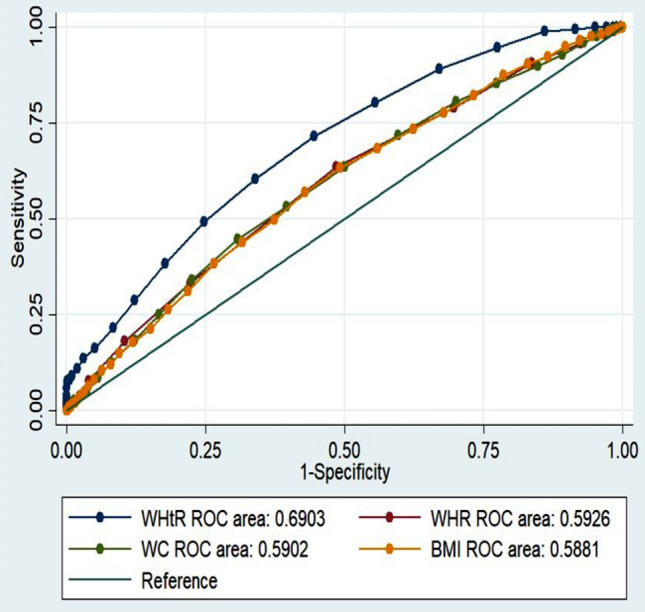
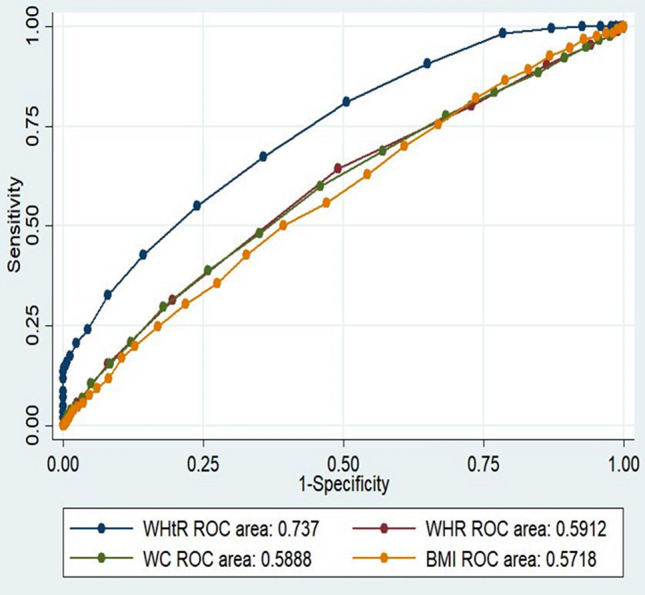
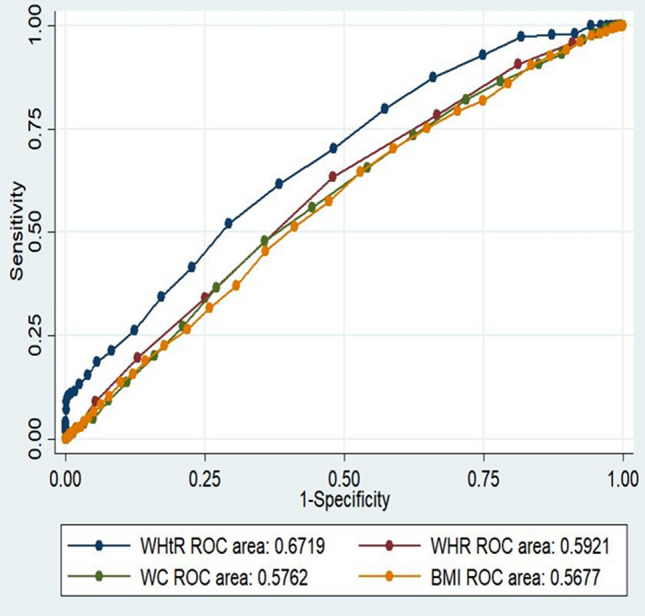
It has been suggested that abdominal obesity might be a better cardiovascular diseases (CVDs) discriminator than overall obesity. The most appropriate obesity measures for estimating CVD events in Kurdish populations have not been well-recognized. The objective of the present study was, therefore, to determine the cutoff points of BMI, waist circumference (WC), waist-to-hip ratio (WHR), and waist to height ratio (WHtR) as the diagnostic cut-offs to discriminate the prevalent cardiovascular diseases. The data collected from Ravansar Non-Communicable Disease (RaNCD) cohort, the first Kurdish population-based study, was analyzed. The information related to BMI, WC, WHR and WHtR of 10,065 adult participants in the age range of 35–65 was analyzed in this study. Receiver operating characteristic (ROC) analyses were conducted to evaluate the optimum cut-off values and to predict the incidence of cardiac events. The results showed that WHtR had the largest areas under the ROC curve for cardiac events in both male and female participants, and this was followed by WHR, WC, and BMI. The optimal cut-off values for determining the cardiac events in the Kurdish population were BMI = 27.02 kg/m 2 for men and BMI = 27.60 kg/m 2 for women, WC = 96.05 cm in men and 99.5 cm for women, WHRs = 0.96 in both sexes, and WHtR = 0.56 for men and 0.65 for women. The current study, therefore, showed that WHtR might serve as a better index of prevalent cardiac event than BMI, WHR and WC.
Overview
The claims and statistics of this paper haven’t been checked yet.
Free: it reads the open-access text and checks the first 5 claims that cite a source we can check. Create a free account to check every claim.
Integrity signals
Registry
Cites
Statistics
Figures
Verification
Claims the paper makes
The claims and statistics of this paper haven’t been checked yet.
Free: it reads the open-access text and checks the first 5 claims that cite a source we can check. Create a free account to check every claim.
Claims other papers make about this one
Each is checked against this paper’s own text: does it say what the citing paper says it does?
The cited source says what the claim attributes to it.
In the citing paper
“Another WHtR analysis suggested that it could be a better index of prevalent cardiac events than BMI, waist-to-hip ratio (WHR), and WC (20, 21).”
From The waist-to-height ratio is a good predictor for insulin resistance in women with polycystic ovary syndrome (2024) · cites this paper as [20]
Self-check
Percentages, sums and reported differences re-computed from the paper’s own numbers.
The self-check needs the paper’s full text.
Citations
Cites
Alberti, K. G. M. M., Eckel, R. H., Grundy, S. M., Zimmet, P. Z., Cleeman, J. I., Donato, K. A., Fruchart, J.-C., James, W. P. T., Loria, C. M., & Smith, S. C. (2009) · Circulation · doi:10.1161/circulationaha.109.192644 · Cited by 14,860
(2004) · The Lancet · doi:10.1016/s0140-6736(03)15268-3 · Cited by 12,717
Alberti, K. G. M. M., Zimmet, P., & Shaw, J. (2006) · Diabetic Medicine · doi:10.1111/j.1464-5491.2006.01858.x · Cited by 6,597
Kuczmarski, R. J. (1994) · JAMA · doi:10.1001/jama.272.3.205 · Cited by 2,362
Obesity and Cardiovascular Disease
Lavie, C. J., Milani, R. V., & Ventura, H. O. (2009) · Journal of the American College of Cardiology · doi:10.1016/j.jacc.2008.12.068 · Cited by 2,326
Ashwell, M., Gunn, P., & Gibson, S. (2012) · Obesity Reviews · doi:10.1111/j.1467-789x.2011.00952.x · Cited by 2,130
Pouliot, M.-C., Després, J.-P., Lemieux, S., Moorjani, S., Bouchard, C., Tremblay, A., Nadeau, A., & Lupien, P. J. (1994) · The American Journal of Cardiology · doi:10.1016/0002-9149(94)90676-9 · Cited by 2,085
Pearson, T. A., Blair, S. N., Daniels, S. R., Eckel, R. H., Fair, J. M., Fortmann, S. P., Franklin, B. A., Goldstein, L. B., Greenland, P., Grundy, S. M., et al. (2002) · Circulation · doi:10.1161/01.cir.0000020190.45892.75 · Cited by 1,854
Ford, E. S. (2005) · Diabetes Care · doi:10.2337/diacare.28.7.1769 · Cited by 1,710
Abdominal obesity and the metabolic syndrome: contribution to global cardiometabolic risk
Després, J.-P., Lemieux, I., Bergeron, J., Pibarot, P., Mathieu, P., Larose, E., Rodés-Cabau, J., Bertrand, O. F., & Poirier, P. (2008) · Arteriosclerosis Thrombosis and Vascular Biology · doi:10.1161/atvbaha.107.159228 · Cited by 1,589
Cited by
Lee, M.-R., Ke, H., Huang, J., Huang, S., & Geng, J. (2021) · Urolithiasis · doi:10.1007/s00240-021-01288-w · Cited by 98
Li, Y., He, Y., Yang, L., Liu, Q., Li, C., Wang, Y., Yang, P., Wang, J., Chen, Z., & Huang, X. (2022) · Frontiers in Nutrition · doi:10.3389/fnut.2022.801582 · Cited by 84
“In recent years, several alternative anthropometric adiposity measurements, such as waist circumference (WC), hip circumstance (HC), waist– height ratio (WHtR), and waist–hip ratio (WHR), which focus on abdominal adiposity, have been identified as useful weightrelated anthropometric measures to predict the risk of typ…”
BackgroundFang, H., Xie, F., Li, K., Li, M., & Wu, Y. (2023) · BMC Cardiovascular Disorders · doi:10.1186/s12872-023-03452-z · Cited by 84
“Although the waist-to-height ratio (WHtR) appears to be superior in assessing obesity, it remains controversial in predicting obesity-related CVD risk and mortality [13, 14].”
BackgroundKe, J.-F., Wang, J., Lu, J., Zhang, Z., Liu, Y., & Li, L. (2021) · Diabetes Research and Clinical Practice · doi:10.1016/j.diabres.2021.109151 · Cited by 95
The History and Faults of the Body Mass Index and Where to Look Next: A Literature Review
Pray, R., & Riskin, S. (2023) · Cureus · doi:10.7759/cureus.48230 · Cited by 74
“WHtR may be an excellent replacement for BMI when showing information about obesity status, as it also considers height, sex, and race differences [8].”
BackgroundInfluentialZhou, B., Bennett, J. E., Wickham, A. P., Singleton, R. K., Mishra, A., Carrillo-Larco, R. M., Ikeda, N., Jain, L., Barradas‐Pires, A., Heap, R. A., et al. (2024) · The Lancet · doi:10.1016/s0140-6736(24)01405-3 · Cited by 103
Qin, Z., Du, D., Li, Y., Chang, K., Yang, Q., Zhang, Z., Liao, R., & Su, B. (2022) · Scientific Reports · doi:10.1038/s41598-022-24756-8 · Cited by 66
Lv, L., Zhang, P., Chen, X., & Gao, Y. (2025) · Cardiovascular Diabetology · doi:10.1186/s12933-025-02919-x · Cited by 50
“However, WC cannot distinguish VAT from subcutaneous fat, while WHR measurements exhibit high variability due to inconsistent hip circumference assessment protocols [22].”
Tuglo, L. S. (2022) · Scientific Reports · doi:10.1038/s41598-022-22848-z · Cited by 24
Nuñez-Leyva, R. E., López, T. E. L., Calizaya-Milla, Y. E., Calizaya-Milla, S. E., & Saintila, J. (2022) · Scientifica · doi:10.1155/2022/1310030 · Cited by 27
“Being a WC a marker of morbidity [50], therefore, it is suggested that it should be routinely measured in clinical practice and nutritional counseling to provide additional information to guide the proper management and approach of patients [3].”
BackgroundMethodBody impedance analyzer and anthropometric indicators; predictors of metabolic syndrome
Pouragha, H., Amiri, M., Saraei, M., Pouryaghoub, G., & Mehrdad, R. (2021) · Journal of Diabetes & Metabolic Disorders · doi:10.1007/s40200-021-00836-w · Cited by 25
Association of obesity with cardiovascular disease in the absence of traditional risk factors
Luo, H., Liu, Y., Tian, X., Zhao, Y., Liu, L., Zhao, Z., Luo, L., Zhang, Y., Jiang, X., Liu, Y., et al. (2023) · International Journal of Obesity · doi:10.1038/s41366-023-01408-z · Cited by 24
“In addition, a large number of studies have found that waist height ratio (WHtR), an comprehensive indicator for abdominal obesity, is a better predictor of CVD than waist circumference, and waist-hip ratio [11 – 14].”
Ichikawa, T., Okada, H., Nakajima, H., Yoneda, M., Ushigome, E., Hamaguchi, M., Kurogi, K., Murata, H., Tsuda, E., Yoshida, N., et al. (2025) · American Journal of Clinical Nutrition · doi:10.1016/j.ajcnut.2025.08.010 · Cited by 17
Zhu, M., Wang, K., Feng, J., Liu, Y., Guan, M., Wang, Y., & Wu, X. (2024) · Frontiers in Endocrinology · doi:10.3389/fendo.2024.1502321 · Cited by 14
Christofoletti, M., Sandreschi, P. F., Quadros, E. N., d’Orsi, E., Rech, C. R., Manta, S. W., & Benedetti, T. R. B. (2021) · Sao Paulo Medical Journal · doi:10.1590/1516-3180.2020.0504.r1.1802021 · Cited by 16
Jian, L.-Y., Guo, S., Ma, R., He, J., Rui, D., Ding, Y., Li, Y., Sun, X.-Y., Mao, Y., He, X., et al. (2022) · BMC Public Health · doi:10.1186/s12889-022-14122-8 · Cited by 16
“As a simple anthropometric indicator, WHtR is better than BMI and WC in predicting cardiometabolic risk [9, 10, 30].”
BackgroundHamzeh, B., Pasdar, Y., Moradi, S., Darbandi, M., Rahmani, N., Shakiba, E., & Najafi, F. (2022) · BMC Cardiovascular Disorders · doi:10.1186/s12872-022-02553-5 · Cited by 19
“Waist circumference (WC) was measured using a non-stretched and flexible tape at the level of the iliac crest in standing position [18].”
MethodSelf-citationWang, Z., Shi, Q., Yan, X.-J., Tang, J., & Zhang, J. (2023) · Frontiers in Nutrition · doi:10.3389/fnut.2023.1304521 · Cited by 14
Undiagnosed Hypertension in a Workplace: The Case of a Logistics Company in Gauteng, South Africa
Bokaba, M., Modjadji, P., & Mokwena, K. E. (2021) · Healthcare · doi:10.3390/healthcare9080964 · Cited by 16
“WHtR is a better discriminator of CVDs than other anthropometric indicators, and it also indicates abdominal obesity [48,54].”
BackgroundChen, F., Niu, Y., Wu, R., Jiang, H., Zhu, J., Wang, C., Xia, X., & Jin, Y. (2025) · Frontiers in Cardiovascular Medicine · doi:10.3389/fcvm.2025.1516591 · Cited by 14
Metabolic and Bariatric Operation and the Path to Kidney Transplantation
Attia, A. S., Toraih, E. A., Ardis, C., Omar, M., Abdelmaksoud, A., Tatum, D. M., Killackey, M. T., Levy, S. M., & Paramesh, A. S. (2025) · Journal of the American College of Surgeons · doi:10.1097/xcs.0000000000001301 · Cited by 11
Hu, J., Tang, S., Zhu, Q., & Liao, H. (2025) · Scientific Reports · doi:10.1038/s41598-025-99490-y · Cited by 12
“To address this issue, the body shape index (ABSI) and waist-to-height ratio (WHtR) have been developed to capture the added value of WC; these indices correspond to visceral fat and can predict mortality 12,13 .”
Wang, M. (2025) · Archives of cardiovascular diseases · doi:10.1016/j.acvd.2025.09.005 · Cited by 10
Huang, M., Yang, Y., Chen, C., Luo, R.-X., Wen, C.-Q., Li, Y., Zeng, L.-P., Li, X.-Y., & Yin, Z. (2022) · Asian Journal of Andrology · doi:10.4103/aja202249 · Cited by 12
Zadarko-Domaradzka, M., Sobolewski, M., Nizioł-Babiarz, E., Barabasz, Z., Warchoł, K., Niewczas-Czarna, K., & Zadarko, E. (2023) · International Journal of Environmental Research and Public Health · doi:10.3390/ijerph20010851 · Cited by 12
“WHtR is also indicated as a much better predictor of cardiovascular diseases than BMI and WC [43,44].”
BackgroundTian, Y., Tang, X., Liu, Y., & Liu, S. Y. (2024) · Frontiers in Endocrinology · doi:10.3389/fendo.2024.1379516 · Cited by 11
Han, L., Li, X., Wang, X., Zhou, J., Wang, Q., Rong, X., Wang, G., & Shao, X. (2022) · Journal of Diabetes Research · doi:10.1155/2022/7311950 · Cited by 8
“Body mass index (BMI) has been widely used for the screening of overweight/obese; however, BMI is criticized for its lack of body fat distribution assessment [16, 17].”
BackgroundPhysical activity, cardiovascular disease, and mortality across obesity levels
Tian, Q., Chen, S., Liu, S., Li, Y., Wu, S., & Wang, Y. (2025) · The EPMA Journal · doi:10.1007/s13167-025-00397-5 · Cited by 8
Association of Body Composition with Pulmonary Function in Ningxia: The China Northwest Cohort
Hou, P., Pi, Y.-Y., Jiao, Z.-M., Tian, X., Hu, W., Zhang, Y., Zhao, Y., & Wang, F. (2022) · Diabetes Metabolic Syndrome and Obesity · doi:10.2147/dmso.s383098 · Cited by 7
“Although body mass index (BMI) has been widely used to screen overweight and obese individuals, it does not accurately predict central obesity (ie, abdominal obesity).(8) Abdominal obesity, a special type of obesity, is more associated with the disease than non-abdominal obesity.”
BackgroundPasdar, Y., Sharifi, M., Saber, A., Soleimani, D., Moradi, S., Cheshmeh, S., Rezaeian, S., & Najafi, F. (2024) · Eating and Weight Disorders - Studies on Anorexia Bulimia and Obesity · doi:10.1007/s40519-024-01686-0 · Cited by 6
“According to previous studies, the high prevalence of overweight and obesity was seen in the Kurdish population [12, 13].”
ResultSelf-citationSaad, A. H., Hassan, A. A., Al‐Nafeesah, A., AlE'ed, A. A., & Adam, I. (2024) · Vascular Health and Risk Management · doi:10.2147/vhrm.s491857 · Cited by 6
“17,18 Different populations have different cutoff points for anthropometric measures, and it is recommended that these measurements be assessed in each population rather than using international cutoff points when detecting cardiometabolic diseases in adolescents.”
Li, X., Zhou, X., Du, H., Wang, H., Tan, Z., Zeng, Y., Song, Z., & Zhang, G. (2025) · Frontiers in Public Health · doi:10.3389/fpubh.2025.1505364 · Cited by 5
Busaidi, S. A., Al-Maqbali, J. S., Noumani, J. H. A., Harthi, T. A., Alawi, A. M. A., & Kharusi, A. A. (2025) · International Journal of Obesity · doi:10.1038/s41366-025-01922-2 · Cited by 3
Golzarand, M., Mahdavi, M., Abiri, B., Mirmiran, P., & Azizi, F. (2026) · Journal of Translational Medicine · doi:10.1186/s12967-025-07467-2 · Cited by 4
Qiu, Y., Fan, S., Liu, J., He, X., Zhu, T., Li, Y., & Ren, M. (2024) · Clinical Cardiology · doi:10.1002/clc.70020 · Cited by 4
“Nevertheless, the WC index lacks consideration for height measurements, potentially limiting its predictive capability for cardiovascular risk factors in both tall and short populations [28, 29].”
BackgroundMarks, K., Kopeć, D., Lenik, J., Lenik, P., & Dziadek, B. (2024) · Scientific Reports · doi:10.1038/s41598-024-75821-3 · Cited by 9
“There are increasing reports that WHtR is a much better predictor of CVD than BMI and WC 58,59 .”
BackgroundYang, Z., Cao, W., Qin, H., Lu, X., Wang, Y., & Liu, D. (2025) · Medicine · doi:10.1097/md.0000000000042348 · Cited by 4
Aggarwal, M., Singh, S. R., Bansal, A., Desiraju, B. K., & Agrawal, A. (2020) · Wellcome Open Research · doi:10.12688/wellcomeopenres.16385.1 · Cited by 6
“Some studies have documented similar results in other ethnic groups where waist measurements were the better correlates of cardiometabolic risks 22,23 .”
Zadarko, E., Zadarko-Domaradzka, M., Barabasz, Z., & Sobolewski, M. (2022) · International Journal of Environmental Research and Public Health · doi:10.3390/ijerph19052643 · Cited by 2
Low Fitness and High Fatness: The "Double Whammy" on Vascular Health
Craig, J. C., & Bunsawat, K. (2021) · The Korean Journal of Sports Medicine · doi:10.5763/kjsm.2021.39.3.91 · Cited by 1
Heydarian, A., Moradi, S., Asbaghi, O., Tahvilian, N., Cheshmeh, S., Nadery, M., & Aryaeian, N. (2024) · Diabetes & Metabolic Syndrome Clinical Research & Reviews · doi:10.1016/j.dsx.2024.103173 · Cited by 1
Self-citationCurvas del índice cintura-talla de adultos colombianos
Rincón, M. V. B., Escobar, C. D. S., & Estrada, A. (2025) · Biomédica · doi:10.7705/biomedica.7647 · Cited by 4
Asiri, F., Dixit, S., Alsubaie, S. F., Gular, K., Alshahrani, A., Reddy, R. S., Gautam, A. P., & Tedla, J. S. (2022) · International Journal of Environmental Research and Public Health · doi:10.3390/ijerph192114283 · Cited by 1
“On the contrary, handgrip asymmetry is often associated with a future risk of cardiac and neurodegenerative disorders [27,28].”
BackgroundKIRATLI, B., & Türker, P. F. (2022) · Turkiye Klinikleri Journal of Health Sciences · doi:10.5336/healthsci.2021-86872
Xie, F., Li, M., Li, K., & Wu, Y. (2022) · Research Square · doi:10.21203/rs.3.rs-2021929/v1
Wang, L., Wang, Y., Han, T., Li, Y., Zhang, T., Ma, W., Zhang, Y., Zhang, C., & Wang, C. (2023) · PubMed Central
Kawamoto, R., Kikuchi, A., Ninomiya, D., & Kumagi, T. (2023) · PLoS ONE · doi:10.1371/journal.pone.0292287 · Cited by 1
Ayoobi, F., Abbaszadeh, F., Khalili, P., Jamali, Z., Esmaeili-Nadimi, A., Sadeghi, T., Lotfi, M. A., & Vakilian, A. (2024) · Research Square · doi:10.21203/rs.3.rs-4273444/v1
Nakhostin-Ansari, A., Razavi, S. E., Seifi, S., Ahmadi, M., Hoveidaei, A. H., Nalini, M., Gandomkar, A., Malekzadeh, F., Poustchi, H., Fattahi, M. R., et al. (2024) · Scientific Reports · doi:10.1038/s41598-024-54148-z
Li, X., Zhou, X., Du, H., Wang, H., Tan, Z., Zeng, Y., Song, Z., & Zhang, G. (2024) · Research Square · doi:10.21203/rs.3.rs-4776158/v1
Rincón, M. V. B. (2024) · Revista de Nutrición Clínica y Metabolismo · doi:10.35454/rncm.v7n4.682
Physical Activity and Its Relationship With National‐Based Examination Results Among Adolescents
Venugopal, V., Ismail, M. A., Mohamed, M. N. A., Chinna, K., Jalaludin, M. Y., Su, T. T., & Majid, H. A. (2025) · Journal of Adolescence · doi:10.1002/jad.12479 · Cited by 1
Tang, C., Nahar, A. M., Teo, E. W., & Khoo, S. (2025) · International Journal of Women s Health · doi:10.2147/ijwh.s497927 · Cited by 1
“37,38 The accumulation of fat tissue in the abdominal area increases the risk of CHD. 39 In addition, earlier research also recommended WHtR as a better indicator for determining CHD risk in women.”
Haddaoui, S. E., Taiek, N., & Hangouche, A. J. E. (2025) · Revista Facultad Nacional de Salud Pública · doi:10.17533/udea.rfnsp.e359023 · Cited by 1
Pan, Y., Sun, Y., & Pan, X. (2025) · Discover Public Health · doi:10.1186/s12982-025-00882-2
“Studies have confirmed that WHtR may be a better indicator of heart disease incidence compared to BMI and waist circumference among Kurdish adults [30].”
Fang, H., Xie, F., Li, K., Li, M., & Wu, Y. (2023) · Figshare · doi:10.6084/m9.figshare.24076941
Imannezhad, M., Saberi‐Karimian, M., Darroudi, S., Ebrahimi, M., Esmaily, H., Allahyari, M., Zamani, E., Ferns, G. A., Ghayour‐Mobarhan, M., & Alinezhad‐Namaghi, M. (2026) · Health Science Reports · doi:10.1002/hsr2.71617
Comprehensive Analysis of the Relationship Between Cardiometabolic Index and Coronary Heart Disease
Guo, R., Sun, M., Lin, W., Yang, H., Dou, J., Gao, J., Wang, J., Liu, L., Wei, T., Liu, T., et al. (2026) · International Journal of General Medicine · doi:10.2147/ijgm.s563397 · Cited by 1
“19 TG and HDL-C are widely recognized as closely associated with CHD, with TG acting as a prominent risk factor and HDL-C providing a protective effect.”
Tang, R., Luo, S., Zhang, Z., Wang, H., Hou, H., Liu, M., Yang, N., Liu, J., & Wang, J. (2026) · Research Square · doi:10.21203/rs.3.rs-8955218/v1
Correlation between waist-to-height ratio and other anthropometric indices in the Bosnian elderly
Začiragić, A., Dervišević, A., Lepara, O., Huremović, A., & Valjevac, A. (2026) · Central European Journal of Public Health · doi:10.21101/cejph.a8533
Waist-to-height ratio for OSA risk: a comparative analysis of NHANES and a clinical data
Li, Y., Zhang, J., Zhao, X., & Li, Y. (2026) · Frontiers in Medicine · doi:10.3389/fmed.2026.1842979
“Pasdar and colleagues also reached similar conclusions, suggesting that WHtR can better predict cardiovascular events in the obese population compared to waist circumference and BMI (14).”
Chen, Y., Xiao, N., Kong, X., Zhou, Q., Xie, K., & Zhao, X. (2026) · Psychiatry Research · doi:10.1016/j.psychres.2026.117307
이재호, Jeong, K., Lee, Y., & Baek, Y. (2026) · PLoS ONE · doi:10.1371/journal.pone.0360853
Metadata
- Authors
- Pasdar, Y., Moradi, S., Moludi, J., Saiedi, S., Moradinazar, M., Hamzeh, B., Jafarabadi, M. A., & Najafi, F.
- Affiliations
- Kermanshah University of Medical Sciences (IR)
- Tabriz University of Medical Sciences (IR)
- Corresponding author
- Moludi, Jalal
- ORCID
- Venue
- Scientific Reports
- Published
- 2020-10-01
- Volume
- 10
- Issue
- 1
- Pages
- 16228-16228
- ISSN
- 2045-2322 (ISSN-L)
- PMC
- PMC7530727
- OpenAlex
- W3091175884
- Semantic Scholar
- 30b56f2f64cf3e57fc7f58d06c35e307ec092052
- Cited by
- 64
- References
- 51
- Citations by year
- 2026: 8 · 2025: 15 · 2024: 12 · 2023: 8 · 2022: 13 · 2021: 7 · 2020: 1
- FWCI
- 5.47
- Type
- journal article
- Language
- en
- Open access
- gold
- doi.org
- Licence
- cc-by
- creativecommons.org/licenses/by/4.0 (tdm)
- creativecommons.org/licenses/by/4.0 (vor)
- Locations
- Scientific Reports (publishedVersion, cc-by)
- PubMed (publishedVersion)
- DOAJ (DOAJ: Directory of Open Access Journals) (submittedVersion, cc-by-sa)
- Topics
- Health Sciences › Medicine › Endocrinology, Diabetes and Metabolism › Diabetes, Cardiovascular Risks, and Lipoproteins
- Health Sciences › Medicine › Physiology (medical) › Body Composition Measurement Techniques
- Health Sciences › Medicine › Public Health, Environmental and Occupational Health › Obesity, Physical Activity, Diet
- Keywords
- waist-to-height ratio, waist-to-hip ratio, waist circumference, body mass index, cardiovascular disease, abdominal obesity, diagnostic thresholds, cardiovascular risk prediction, anthropometric indicators
- MeSH terms
- Adult, Aged, Anthropometry, Cardiovascular Diseases, Cross-Sectional Studies, Ethnicity, Female, Humans, Iran, Male, Middle Aged, Reference Values, ROC Curve, Sex Factors, Body Mass Index, Metabolic Syndrome, Waist-Hip Ratio, Waist Circumference, Waist-Height Ratio
About these checks
Registry, retraction, Cites and statistics results are computed, not judged, with one exception: a printed reference that no index lists is read once by a model before it counts as a citation error. Claims are extracted by a model and kept only when their quote appears verbatim in the text; each cited source is then checked, with a model’s help, for whether it says what the claim relies on. Those verdicts can be wrong — read the claim’s quote and the cited source before relying on one.
Statistics and arithmetic are recomputed, not judged.
Confidence bands are shown only for fields calibrated on our annotated test set. None is calibrated yet, so no band is shown.
What counts as a claim ›How we measure confidence ›How we check this ›
Are you an author, or do you see a problem with this page? Request a review
Data sources
Bibliographic data: Semantic Scholar, OpenAlex, Crossref.
Contains information from the Semantic Scholar Academic Graph Datasets, made available under the ODC Attribution License (ODC-BY 1.0).
Semantic Scholar’s data is described in: Kinney, R., et al. (2023). The Semantic Scholar Open Data Platform. arXiv:2301.10140.
