

Phenotyping chronic tinnitus patients using self-report questionnaire data: cluster analysis and visual comparison
Open accessThe DOI matches its Crossref record; 44 of the 44 references it cites were found in a registry or an index.
Abstract
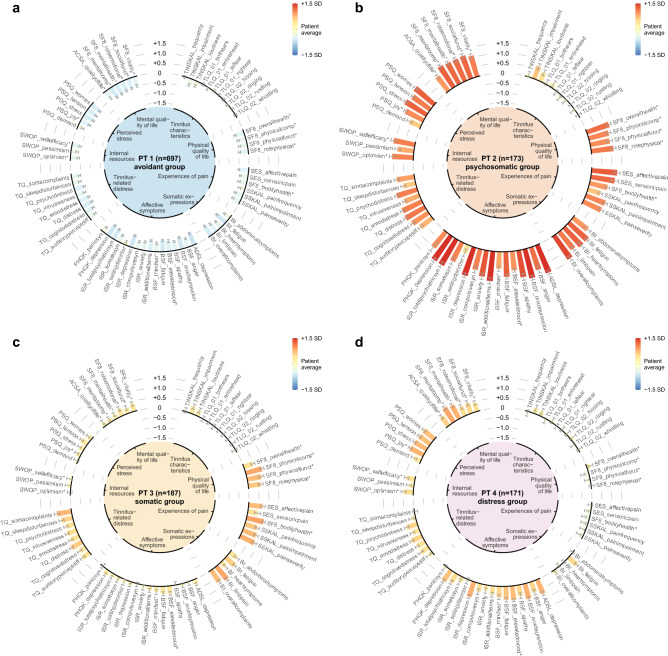
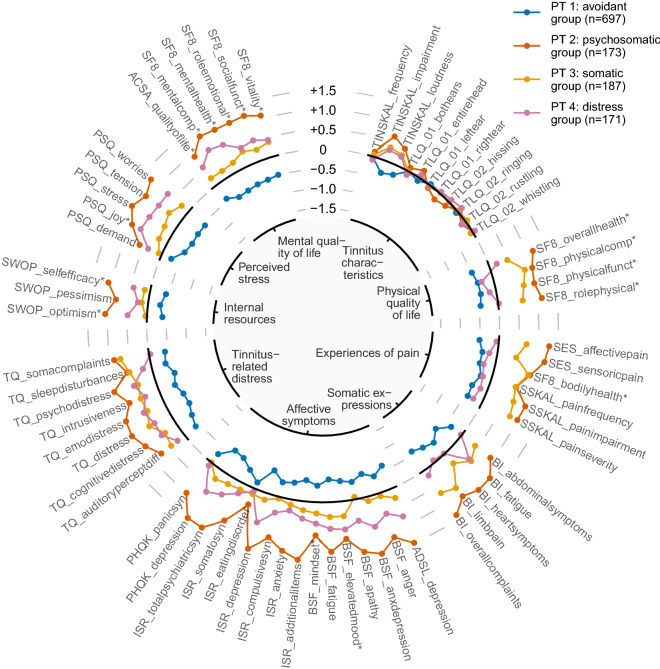
Chronic tinnitus is a complex, multi-factorial symptom that requires careful assessment and management. Evidence-based therapeutic approaches involve audiological and psychological treatment components. However, not everyone benefits from treatment. The identification and characterisation of patient subgroups (or “phenotypes”) may provide clinically relevant information. Due to the large number of assessment tools, data-driven methods appear to be promising. The acceptance of these empirical results can be further strengthened by a comprehensive visualisation. In this study, we used cluster analysis to identify distinct tinnitus phenotypes based on self-report questionnaire data and implemented a visualisation tool to explore phenotype idiosyncrasies. 1228 patients with chronic tinnitus from the Charité Tinnitus Center in Berlin were included. At baseline, each participant completed 14 questionnaires measuring tinnitus distress, -loudness, frequency and location, depressivity, perceived stress, quality of life, physical and mental health, pain perception, somatic symptom expression and coping attitudes. Four distinct patient phenotypes emerged from clustering: avoidant group (56.8%), psychosomatic group (14.1%) , somatic group (15.2%), and distress group (13.9%). Radial bar- and line charts allowed for visual inspection and juxtaposition of major phenotype characteristics. The phenotypes differed in terms of clinical information including psychological symptoms, quality of life, coping attitudes, stress, tinnitus-related distress and pain, as well as socio-demographics. Our findings suggest that identifiable patient subgroups and their visualisation may allow for stratified treatment strategies and research designs.
Overview
The claims and statistics of this paper haven’t been checked yet.
Free: it reads the open-access text and checks the first 5 claims that cite a source we can check. Create a free account to check every claim.
Integrity signals
Registry
Cites
Statistics
Figures
Verification
Claims the paper makes
The claims and statistics of this paper haven’t been checked yet.
Free: it reads the open-access text and checks the first 5 claims that cite a source we can check. Create a free account to check every claim.
Claims other papers make about this one
Each is checked against this paper’s own text: does it say what the citing paper says it does?
The cited source says what the claim attributes to it.
In the citing paper
“Nonetheless, reports on psychological phenotyping involving the use of machine learning and psychometric data show promise14,36,37.”
From Cluster-based psychological phenotyping and differences in anxiety treatment outcomes (2023) · cites this paper as [37]
Self-check
Percentages, sums and reported differences re-computed from the paper’s own numbers.
The self-check needs the paper’s full text.
Citations
Cites
The CES-D Scale: A Self-Report Depression Scale for Research in the General Population
Radloff, L. S. (1977) · Applied Psychological Measurement · doi:10.1177/014662167700100306 · Cited by 53,267
Estimating the Dimension of a Model
Schwarz, G. (1978) · The Annals of Statistics · doi:10.1214/aos/1176344136 · Cited by 47,033
(2008) · Journal of Machine Learning Research · Cited by 33,051
Spitzer, R. L. (1999) · JAMA · doi:10.1001/jama.282.18.1737 · Cited by 9,802
Analysis of a complex of statistical variables into principal components.
Hotelling, H. (1933) · Journal of Educational Psychology · doi:10.1037/h0071325 · Cited by 9,633
Bootstrap Methods and their Application
Davison, A. C., & Hinkley, D. V. (1997) · doi:10.1017/cbo9780511802843 · Cited by 7,350
Bootstrap Methods and Their Application
Loughin, T. M., Davison, A. C., & Hinkley, D. V. (1999) · Journal of the American Statistical Association · doi:10.2307/2669707 · Cited by 5,418
X-means: Extending K-means with Efficient Estimation of the Number of Clusters
Pelleg, D., & Moore, A. (2000) · Cited by 2,245
Violin Plots: A Box Plot-Density Trace Synergism
Hintze, J. L., & Nelson, R. D. (1998) · The American Statistician · doi:10.1080/00031305.1998.10480559 · Cited by 1,802
Baguley, D., McFerran, D., & Hall, D. (2013) · The Lancet · doi:10.1016/s0140-6736(13)60142-7 · Cited by 1,245
Research works printed but not linked: 2
- Hörhold M Klapp B Schimmack U Testungen der Invarianz und der Hierarchie eines mehrdimensionalen Stimmungsmodells auf der Basis von Zweipunkterhebungen an Patienten-und Studentenstichproben Z. Med. Psychol. 1993 2 27 35
- Ishioka T An expansion of x-means for automatically determining the optimal number of clusters Proc. Int. Conf. Comput. Intell. 2005 2 91 95
Cited by
Secondary metabolites as biostimulant and bioprotectant agents: A review
Ben Mrid, R., Benmrid, B., Hafsa, J., Boukcim, H., Sobeh, M., & Yasri, A. (2021) · Science of The Total Environment · doi:10.1016/j.scitotenv.2021.146204 · Cited by 202
A Review and a Framework of Variables for Defining and Characterizing Tinnitus Subphenotypes
Genitsaridi, E., Hoare, D. J., Kypraios, T., & Hall, D. A. (2020) · Brain Sciences · doi:10.3390/brainsci10120938 · Cited by 41
Dimensions of Tinnitus-Related Distress
Brüeggemann, P., Mebus, W., Boecking, B., Amarjargal, N., Niemann, U., Spiliopoulou, M., Dobel, C., Rose, M., & Mazurek, B. (2022) · Brain Sciences · doi:10.3390/brainsci12020275 · Cited by 31
Self-citationTinnitus und beeinflussende Komorbiditäten
Mazurek, B., Boecking, B., Dobel, C., Rose, M., & Brüeggemann, P. (2023) · Laryngo-Rhino-Otologie · doi:10.1055/a-1950-6149 · Cited by 54
Self-citationKmezik, C., Krska, D., Mazurkewich, S., & Larsbrink, J. (2021) · Scientific Reports · doi:10.1038/s41598-021-96659-z · Cited by 30
Metadata
- Authors
- Niemann, U., Brueggemann, P., Boecking, B., Mebus, W., Rose, M., Spiliopoulou, M., & Mazurek, B.
- Affiliations
- Otto-von-Guericke-Universität Magdeburg (DE)
- Charité – Universitätsmedizin Berlin (DE)
- Corresponding author
- Niemann, Uli
- Venue
- Scientific Reports
- Published
- 2020-10-02
- Volume
- 10
- Issue
- 1
- Pages
- 16411-16411
- ISSN
- 2045-2322 (ISSN-L)
- PMC
- PMC7532444
- OpenAlex
- W3090143170
- Cited by
- 41
- References
- 44
- Citations by year
- 2026: 6 · 2025: 2 · 2024: 5 · 2023: 9 · 2022: 5 · 2021: 11 · 2020: 3
- FWCI
- 2.46
- Type
- journal article
- Language
- en
- Open access
- gold
- doi.org
- Licence
- cc-by
- creativecommons.org/licenses/by/4.0 (tdm)
- creativecommons.org/licenses/by/4.0 (vor)
- Locations
- Scientific Reports (publishedVersion, cc-by)
- PubMed Central (publishedVersion, cc-by)
- PubMed (publishedVersion)
- Digitalen Hochschulbibliothek Sachsen-Anhalt (Universitäts- und Landesbibliothek Sachsen-Anhalt)
- Funders
- Projekt DEAL
- Topics
- Life Sciences › Neuroscience › Sensory Systems › Hearing, Cochlea, Tinnitus, Genetics
- Health Sciences › Health Professions › Speech and Hearing › Hearing Loss and Rehabilitation
- Physical Sciences › Physics and Astronomy › Acoustics and Ultrasonics › Noise Effects and Management
- Keywords
- chronic tinnitus, patient subgroups, self-report questionnaire, clustering, data visualization, tinnitus distress, tinnitus loudness, psychosomatic symptoms, coping attitudes, perceived stress, quality of life, pain perception, treatment stratification
- MeSH terms
- Adaptation, Psychological, Adolescent, Berlin, Chronic Disease, Female, Humans, Male, Patients, Quality of Life, Surveys and Questionnaires, Tinnitus, Cluster Analysis, Self Report
About these checks
Registry, retraction, Cites and statistics results are computed, not judged, with one exception: a printed reference that no index lists is read once by a model before it counts as a citation error. Claims are extracted by a model and kept only when their quote appears verbatim in the text; each cited source is then checked, with a model’s help, for whether it says what the claim relies on. Those verdicts can be wrong — read the claim’s quote and the cited source before relying on one.
Statistics and arithmetic are recomputed, not judged.
Confidence bands are shown only for fields calibrated on our annotated test set. None is calibrated yet, so no band is shown.
What counts as a claim ›How we measure confidence ›How we check this ›
Are you an author, or do you see a problem with this page? Request a review
How to cite
Cite CoChat for the checks on this page, and the paper for its own findings.
- This page
- CoChat. (2026). Citation check: Phenotyping chronic tinnitus patients using self-report questionnaire data: cluster analysis and visual comparison. https://app.cochat.ai/papers/10.1038/s41598-020-73402-8
- The paper
- Niemann, U., Brueggemann, P., Boecking, B., Mebus, W., Rose, M., Spiliopoulou, M., & Mazurek, B. (2020). Phenotyping chronic tinnitus patients using self-report questionnaire data: cluster analysis and visual comparison. Scientific Reports. https://doi.org/10.1038/s41598-020-73402-8
Data sources
Bibliographic data: Semantic Scholar, OpenAlex, Crossref.
Contains information from the Semantic Scholar Academic Graph Datasets, made available under the ODC Attribution License (ODC-BY 1.0).
Semantic Scholar’s data is described in: Kinney, R., et al. (2023). The Semantic Scholar Open Data Platform. arXiv:2301.10140.
